
Transportation Transshipment and Assignment Problems Chapter 6 Copyright
Transportation, Transshipment, and Assignment Problems Chapter 6 Copyright © 2010 Pearson Education, Inc. Publishing as Prentice Hall 6 -1
Chapter Topics ■ The Transportation Model ■ Computer Solution of a Transportation Problem ■ The Transshipment Model ■ Computer Solution of a Transshipment Problem ■ The Assignment Model ■ Computer Solution of an Assignment Problem Copyright © 2010 Pearson Education, Inc. Publishing as Prentice Hall 6 -2
Overview ■ Transportation, Transshipment, and Assignment models are part of a larger class of LP problems known as network flow models. ■ These models have special mathematical features that permit management scientists to develop very efficient, unique solution methods (variations of traditional simplex procedure). ■ Detailed description of methods is contained on the companion website. ■ Text focuses on model formulation and solution with Excel and QM for windows. Copyright © 2010 Pearson Education, Inc. Publishing as Prentice Hall 6 -3
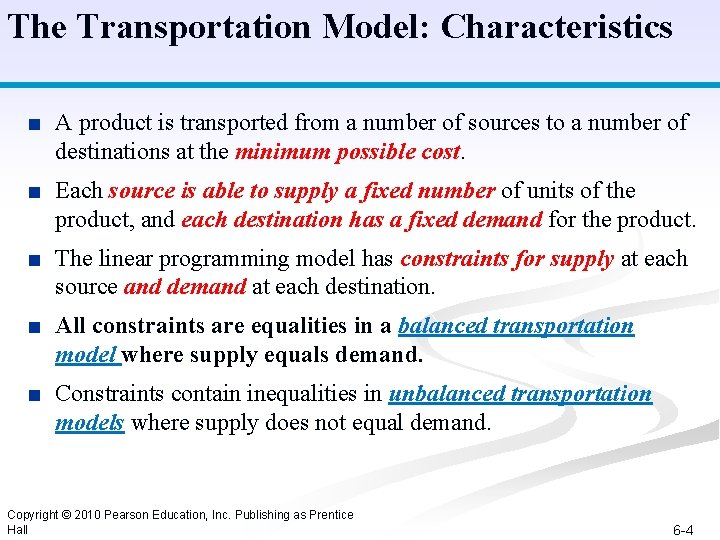
The Transportation Model: Characteristics ■ A product is transported from a number of sources to a number of destinations at the minimum possible cost. ■ Each source is able to supply a fixed number of units of the product, and each destination has a fixed demand for the product. ■ The linear programming model has constraints for supply at each source and demand at each destination. ■ All constraints are equalities in a balanced transportation model where supply equals demand. ■ Constraints contain inequalities in unbalanced transportation models where supply does not equal demand. Copyright © 2010 Pearson Education, Inc. Publishing as Prentice Hall 6 -4
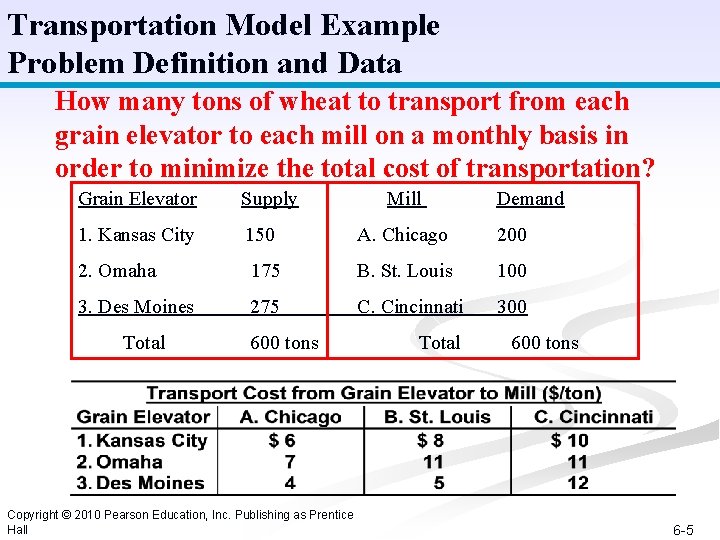
Transportation Model Example Problem Definition and Data How many tons of wheat to transport from each grain elevator to each mill on a monthly basis in order to minimize the total cost of transportation? Grain Elevator Supply 1. Kansas City 150 A. Chicago 200 2. Omaha 175 B. St. Louis 100 3. Des Moines 275 C. Cincinnati 300 Total 600 tons Copyright © 2010 Pearson Education, Inc. Publishing as Prentice Hall Mill Total Demand 600 tons 6 -5
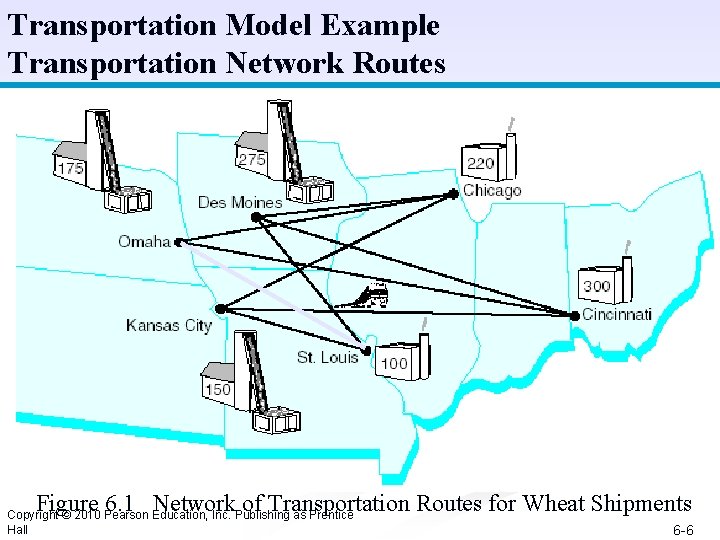
Transportation Model Example Transportation Network Routes Figure 6. 1 Network of Transportation Routes for Wheat Shipments Copyright © 2010 Pearson Education, Inc. Publishing as Prentice Hall 6 -6
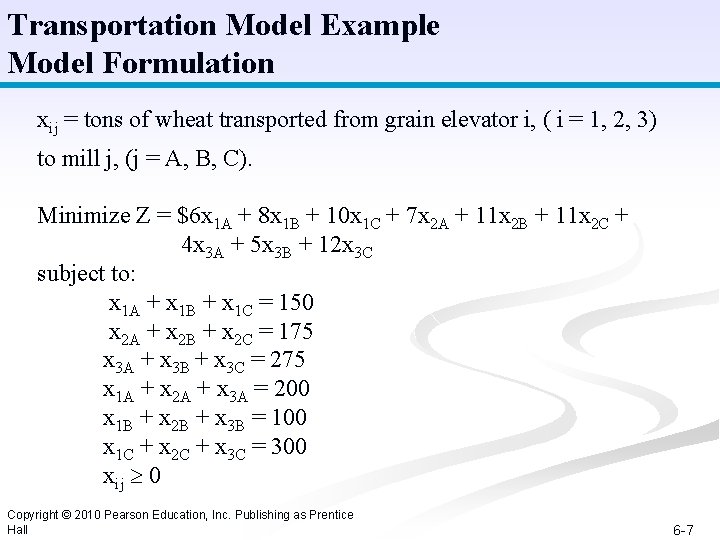
Transportation Model Example Model Formulation xij = tons of wheat transported from grain elevator i, ( i = 1, 2, 3) to mill j, (j = A, B, C). Minimize Z = $6 x 1 A + 8 x 1 B + 10 x 1 C + 7 x 2 A + 11 x 2 B + 11 x 2 C + 4 x 3 A + 5 x 3 B + 12 x 3 C subject to: x 1 A + x 1 B + x 1 C = 150 x 2 A + x 2 B + x 2 C = 175 x 3 A + x 3 B + x 3 C = 275 x 1 A + x 2 A + x 3 A = 200 x 1 B + x 2 B + x 3 B = 100 x 1 C + x 2 C + x 3 C = 300 xij 0 Copyright © 2010 Pearson Education, Inc. Publishing as Prentice Hall 6 -7
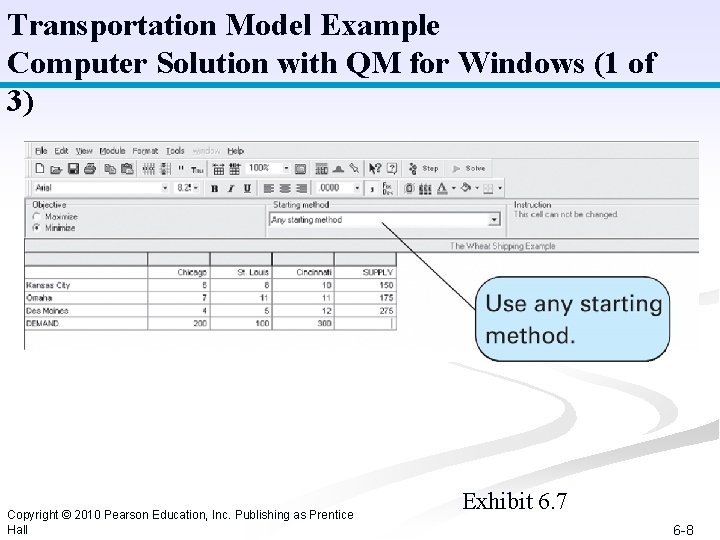
Transportation Model Example Computer Solution with QM for Windows (1 of 3) Copyright © 2010 Pearson Education, Inc. Publishing as Prentice Hall Exhibit 6. 7 6 -8
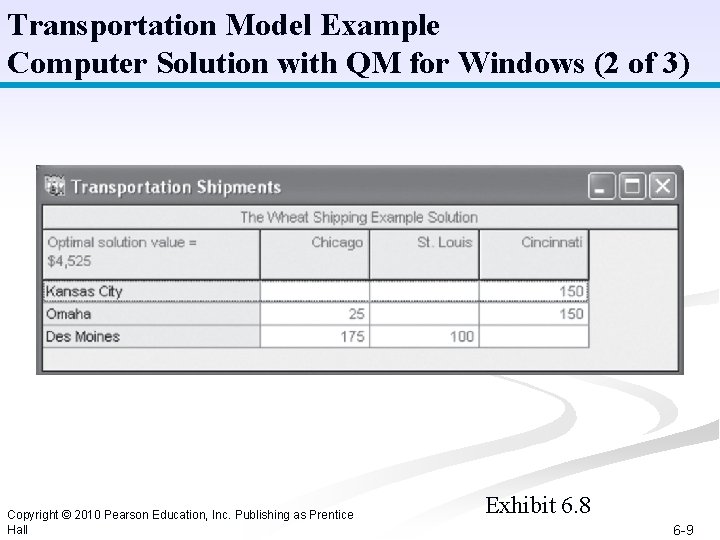
Transportation Model Example Computer Solution with QM for Windows (2 of 3) Copyright © 2010 Pearson Education, Inc. Publishing as Prentice Hall Exhibit 6. 8 6 -9
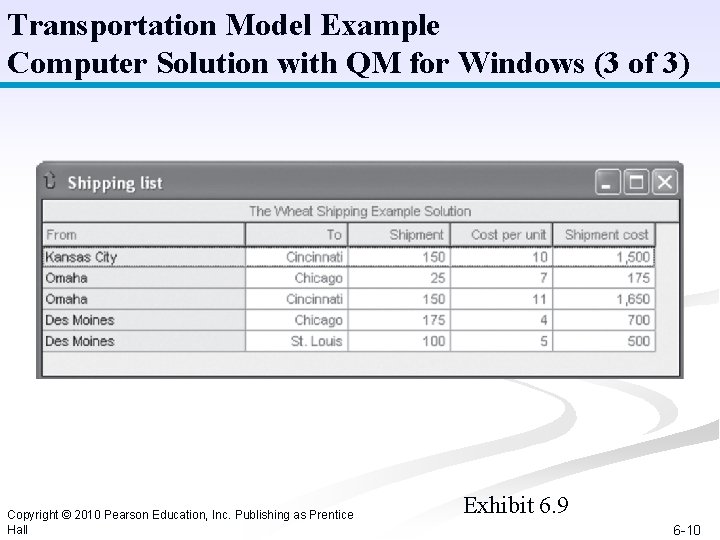
Transportation Model Example Computer Solution with QM for Windows (3 of 3) Copyright © 2010 Pearson Education, Inc. Publishing as Prentice Hall Exhibit 6. 9 6 -10
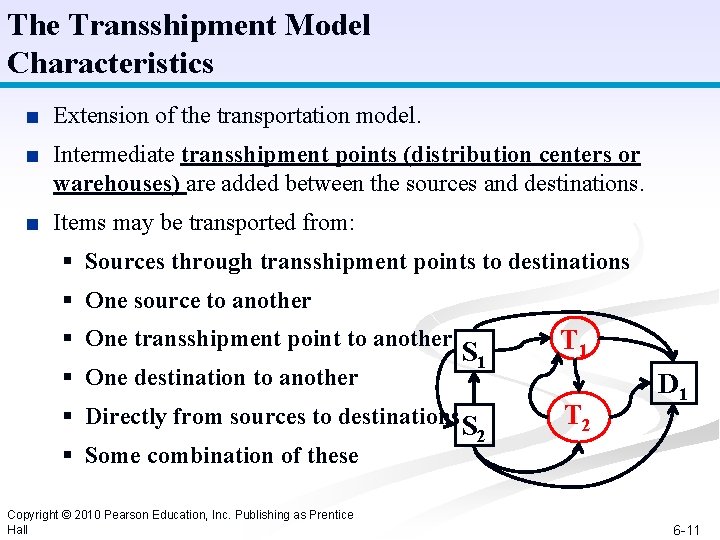
The Transshipment Model Characteristics ■ Extension of the transportation model. ■ Intermediate transshipment points (distribution centers or warehouses) are added between the sources and destinations. ■ Items may be transported from: § Sources through transshipment points to destinations § One source to another § One transshipment point to another § One destination to another S 1 § Directly from sources to destinations S § Some combination of these Copyright © 2010 Pearson Education, Inc. Publishing as Prentice Hall 2 T 1 T 2 D 1 6 -11
Transshipment Model Example Problem Definition and Data Suppose wheat is harvested at two farms in: ü Nebraska (300 tons) ü Colorado (300 tons) Before being shipped to three mills (200, 100, 300 tons), the wheat is shipped to three grain elavators in: ü Kansas City ü Omaha ü Des Moines Copyright © 2010 Pearson Education, Inc. Publishing as Prentice Hall 6 -12

Transshipment Model Example Problem Definition and Data Extension of the transportation model in which intermediate transshipment points are added between sources and destinations. Shipping Costs 1. Nebraska 2. Colorado Copyright © 2010 Pearson Education, Inc. Publishing as Prentice Hall 6 -13
Formulating the LP Model Now, objective function will also include the shipping costs from farms to grain elavators. n There will be 3 groups of constranits: 1. Supply constraints for the farms. 2. Demand constraints for the mills. 3. Conservation of flow constraints: at each transshipment point, the amount of grain shipped IN must also be shipped OUT. n Copyright © 2010 Pearson Education, Inc. Publishing as Prentice Hall 6 -14
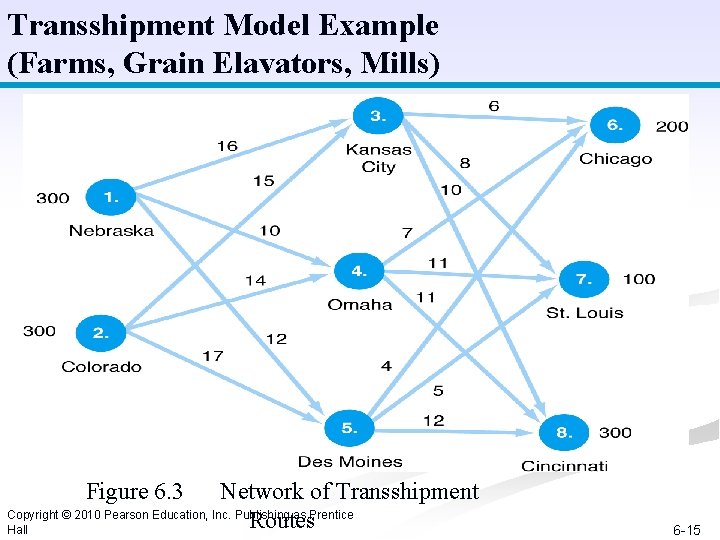
Transshipment Model Example (Farms, Grain Elavators, Mills) Figure 6. 3 Network of Transshipment Copyright © 2010 Pearson Education, Inc. Publishing as Prentice Routes Hall 6 -15
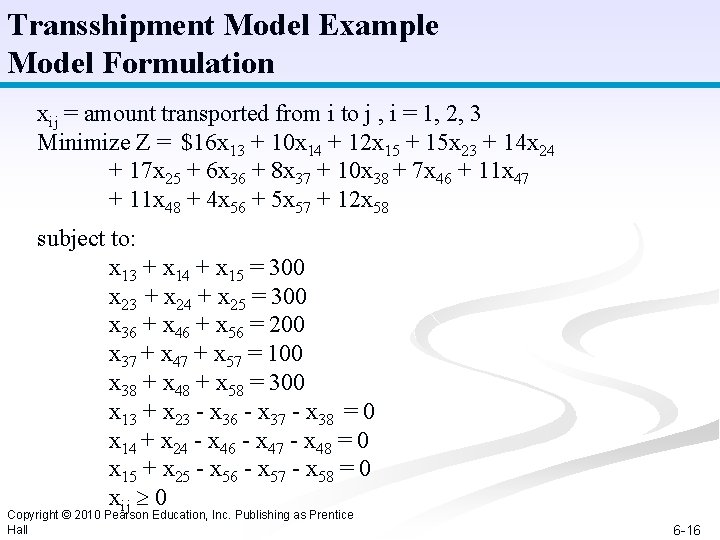
Transshipment Model Example Model Formulation xij = amount transported from i to j , i = 1, 2, 3 Minimize Z = $16 x 13 + 10 x 14 + 12 x 15 + 15 x 23 + 14 x 24 + 17 x 25 + 6 x 36 + 8 x 37 + 10 x 38 + 7 x 46 + 11 x 47 + 11 x 48 + 4 x 56 + 5 x 57 + 12 x 58 subject to: x 13 + x 14 + x 15 = 300 x 23 + x 24 + x 25 = 300 x 36 + x 46 + x 56 = 200 x 37 + x 47 + x 57 = 100 x 38 + x 48 + x 58 = 300 x 13 + x 23 - x 36 - x 37 - x 38 = 0 x 14 + x 24 - x 46 - x 47 - x 48 = 0 x 15 + x 25 - x 56 - x 57 - x 58 = 0 xij 0 Copyright © 2010 Pearson Education, Inc. Publishing as Prentice Hall 6 -16
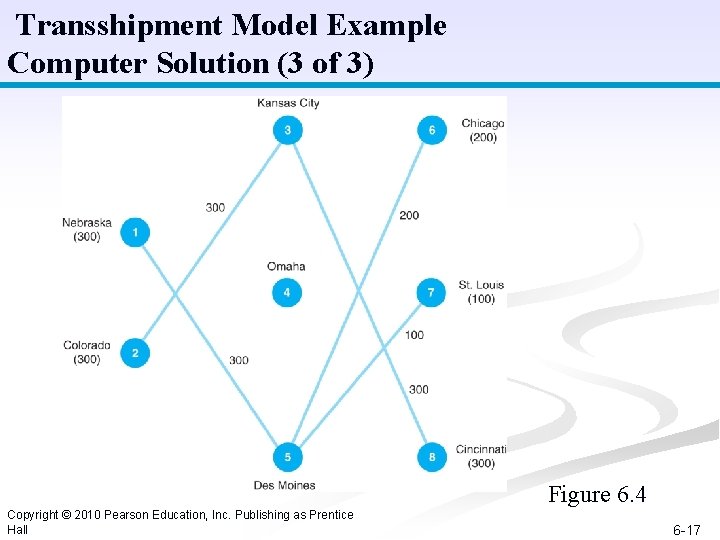
Transshipment Model Example Computer Solution (3 of 3) Figure 6. 4 Copyright © 2010 Pearson Education, Inc. Publishing as Prentice Hall 6 -17
The Assignment Model Characteristics ■ Special form of linear programming model similar to the transportation model. ■ Supply at each source and demand at each destination is limited to one unit. ■ In a balanced model supply equals demand. ■ In an unbalanced model supply does not equal demand. Copyright © 2010 Pearson Education, Inc. Publishing as Prentice Hall 6 -18
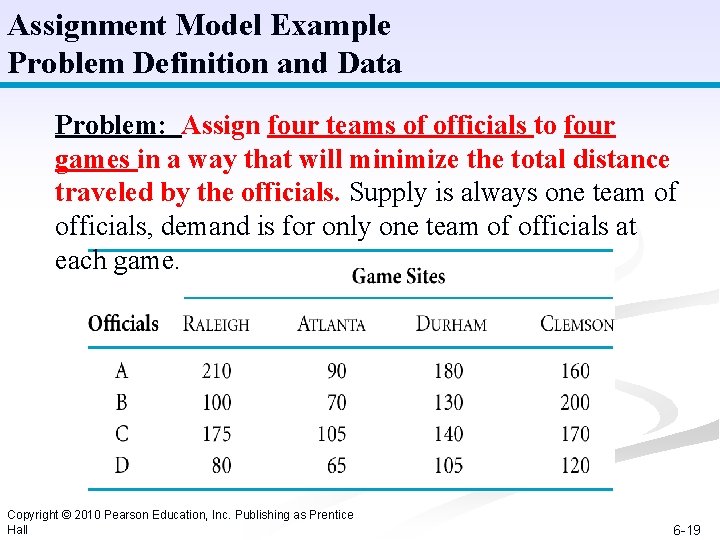
Assignment Model Example Problem Definition and Data Problem: Assign four teams of officials to four games in a way that will minimize the total distance traveled by the officials. Supply is always one team of officials, demand is for only one team of officials at each game. Copyright © 2010 Pearson Education, Inc. Publishing as Prentice Hall 6 -19
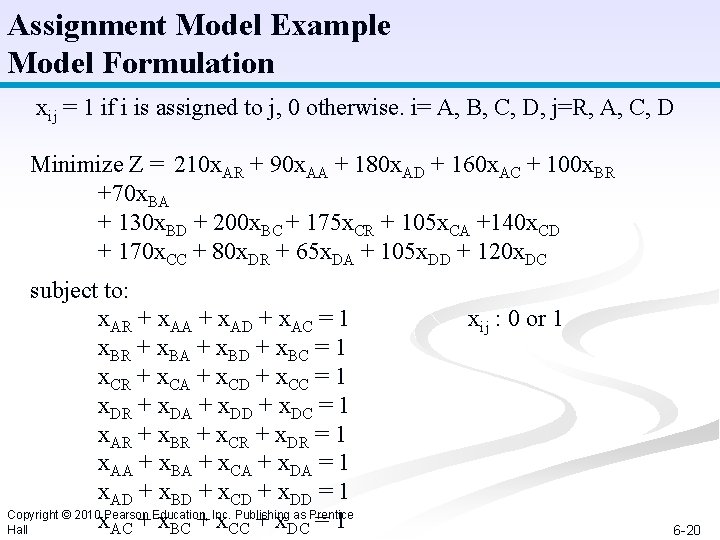
Assignment Model Example Model Formulation xij = 1 if i is assigned to j, 0 otherwise. i= A, B, C, D, j=R, A, C, D Minimize Z = 210 x. AR + 90 x. AA + 180 x. AD + 160 x. AC + 100 x. BR +70 x. BA + 130 x. BD + 200 x. BC + 175 x. CR + 105 x. CA +140 x. CD + 170 x. CC + 80 x. DR + 65 x. DA + 105 x. DD + 120 x. DC subject to: x. AR + x. AA + x. AD + x. AC = 1 x. BR + x. BA + x. BD + x. BC = 1 x. CR + x. CA + x. CD + x. CC = 1 x. DR + x. DA + x. DD + x. DC = 1 x. AR + x. BR + x. CR + x. DR = 1 x. AA + x. BA + x. CA + x. DA = 1 x. AD + x. BD + x. CD + x. DD = 1 Copyright © 2010 Pearson Education, Inc. Publishing as Prentice x. AC + x. BC + x. CC + x. DC = 1 Hall xij : 0 or 1 6 -20
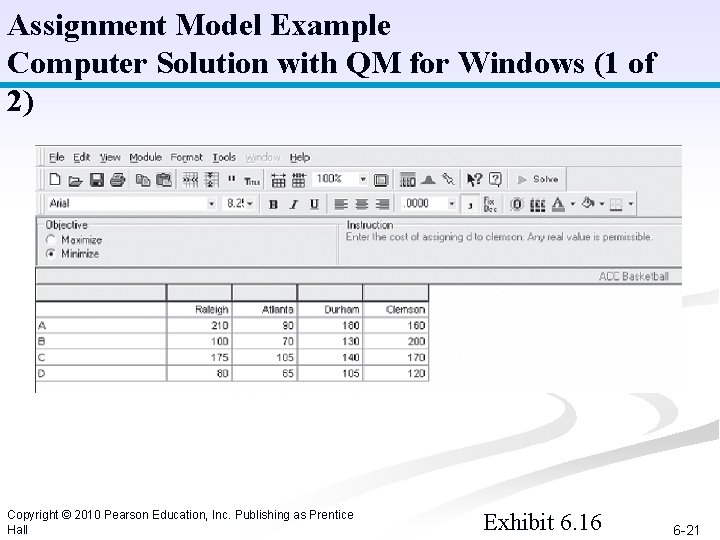
Assignment Model Example Computer Solution with QM for Windows (1 of 2) Copyright © 2010 Pearson Education, Inc. Publishing as Prentice Hall Exhibit 6. 16 6 -21
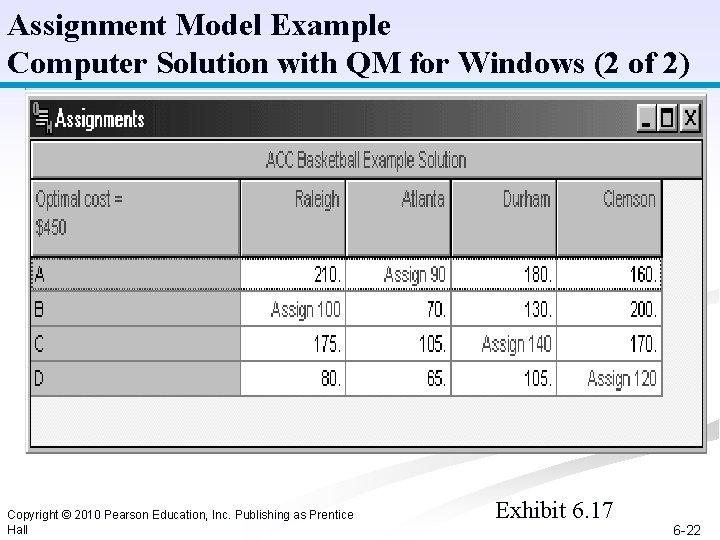
Assignment Model Example Computer Solution with QM for Windows (2 of 2) Copyright © 2010 Pearson Education, Inc. Publishing as Prentice Hall Exhibit 6. 17 6 -22
Example Problem Solution Transportation Problem Statement A concrete company transports concrete from three plants to three construction sites. Determine the linear programming model formulation and solve using QM: Copyright © 2010 Pearson Education, Inc. Publishing as Prentice Hall 6 -23
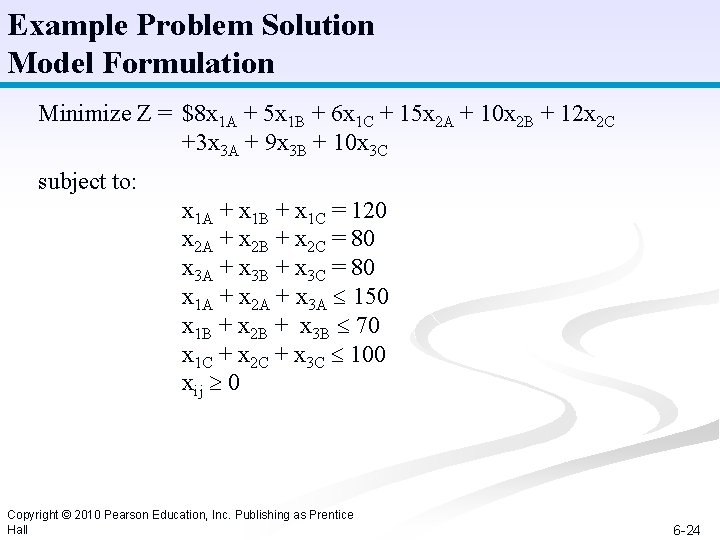
Example Problem Solution Model Formulation Minimize Z = $8 x 1 A + 5 x 1 B + 6 x 1 C + 15 x 2 A + 10 x 2 B + 12 x 2 C +3 x 3 A + 9 x 3 B + 10 x 3 C subject to: x 1 A + x 1 B + x 1 C = 120 x 2 A + x 2 B + x 2 C = 80 x 3 A + x 3 B + x 3 C = 80 x 1 A + x 2 A + x 3 A 150 x 1 B + x 2 B + x 3 B 70 x 1 C + x 2 C + x 3 C 100 xij 0 Copyright © 2010 Pearson Education, Inc. Publishing as Prentice Hall 6 -24
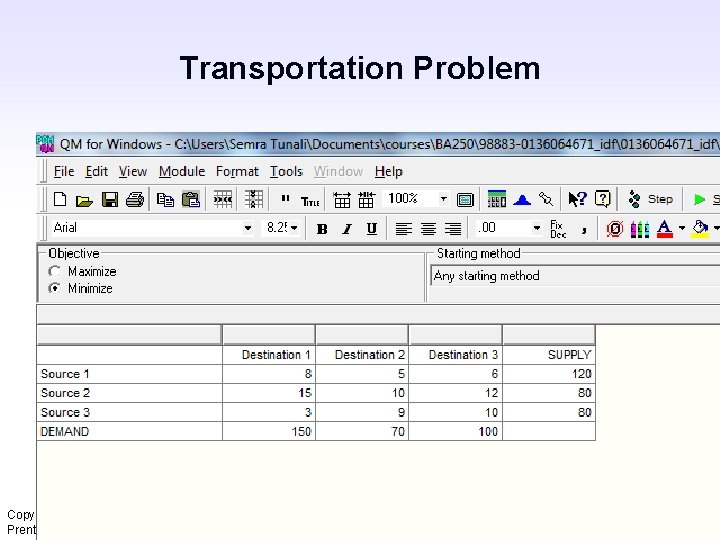
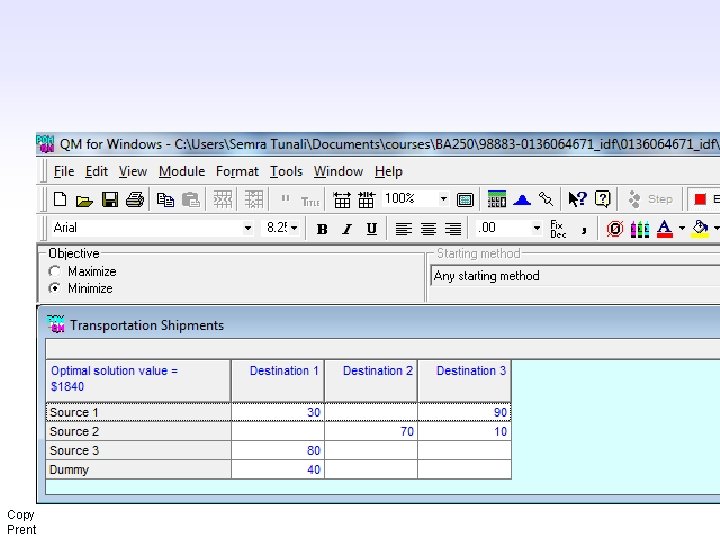
Transportation Problem Copyright © 2010 Pearson Education, Inc. Publishing as Prentice Hall 6 -25
Copyright © 2010 Pearson Education, Inc. Publishing as Prentice Hall 6 -26
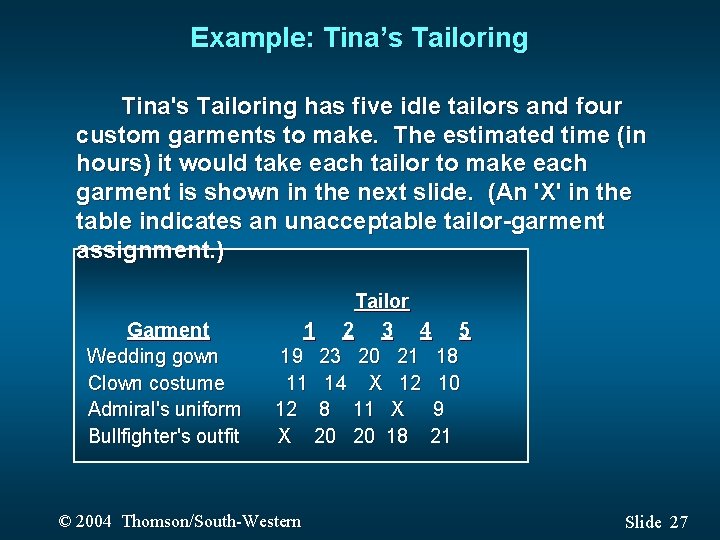
Example: Tina’s Tailoring Tina's Tailoring has five idle tailors and four custom garments to make. The estimated time (in hours) it would take each tailor to make each garment is shown in the next slide. (An 'X' in the table indicates an unacceptable tailor-garment assignment. ) Garment Wedding gown Clown costume Admiral's uniform Bullfighter's outfit Tailor 1 2 3 4 5 19 23 20 21 18 11 14 X 12 10 12 8 11 X 9 X 20 20 18 21 © 2004 Thomson/South-Western Slide 27
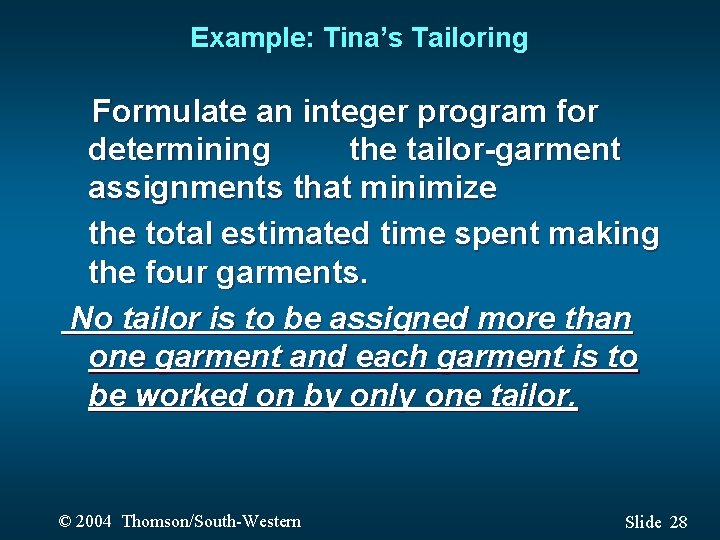
Example: Tina’s Tailoring Formulate an integer program for determining the tailor-garment assignments that minimize the total estimated time spent making the four garments. No tailor is to be assigned more than one garment and each garment is to be worked on by only one tailor. © 2004 Thomson/South-Western Slide 28
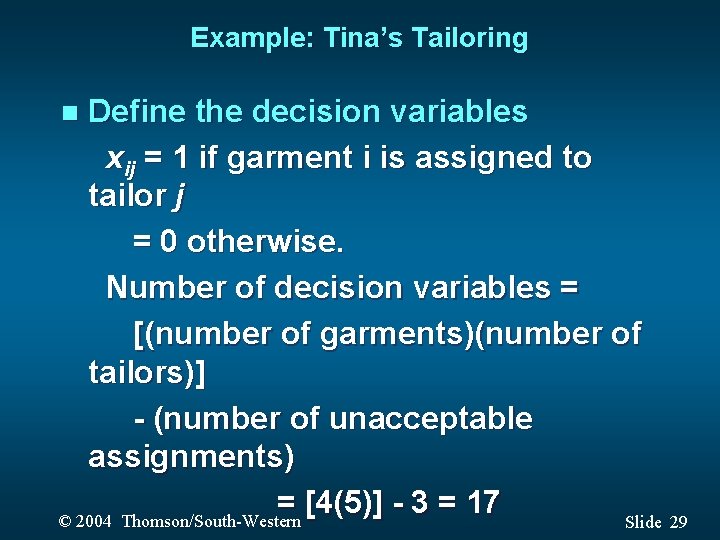
Example: Tina’s Tailoring Define the decision variables xij = 1 if garment i is assigned to tailor j = 0 otherwise. Number of decision variables = [(number of garments)(number of tailors)] - (number of unacceptable assignments) = [4(5)] - 3 = 17 © 2004 Thomson/South-Western Slide 29 n
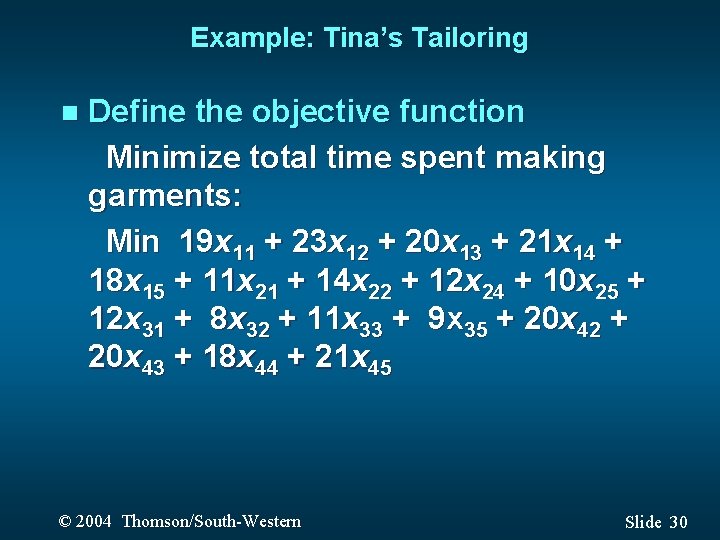
Example: Tina’s Tailoring n Define the objective function Minimize total time spent making garments: Min 19 x 11 + 23 x 12 + 20 x 13 + 21 x 14 + 18 x 15 + 11 x 21 + 14 x 22 + 12 x 24 + 10 x 25 + 12 x 31 + 8 x 32 + 11 x 33 + 9 x 35 + 20 x 42 + 20 x 43 + 18 x 44 + 21 x 45 © 2004 Thomson/South-Western Slide 30
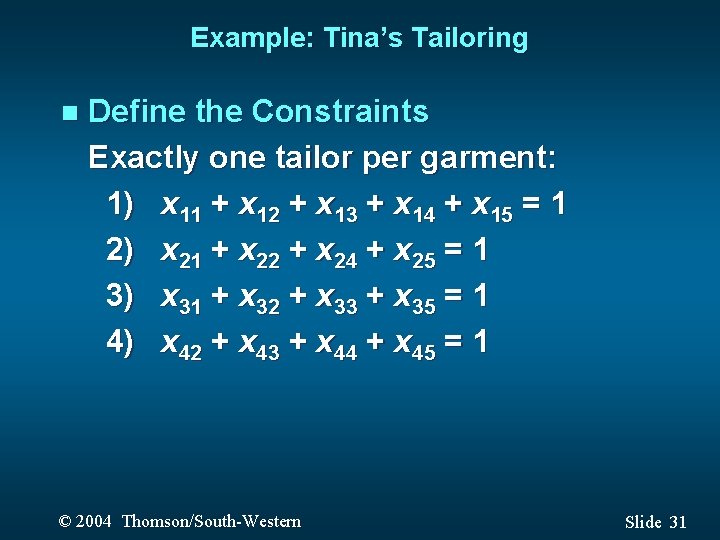
Example: Tina’s Tailoring n Define the Constraints Exactly one tailor per garment: 1) x 11 + x 12 + x 13 + x 14 + x 15 = 1 2) x 21 + x 22 + x 24 + x 25 = 1 3) x 31 + x 32 + x 33 + x 35 = 1 4) x 42 + x 43 + x 44 + x 45 = 1 © 2004 Thomson/South-Western Slide 31
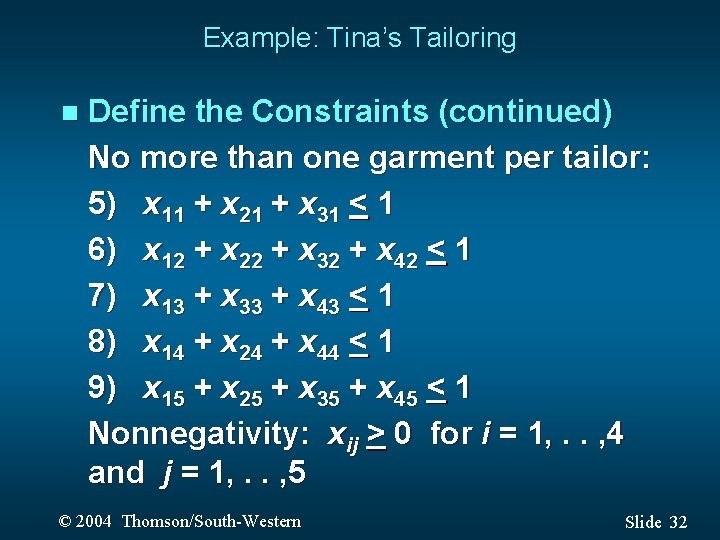
Example: Tina’s Tailoring n Define the Constraints (continued) No more than one garment per tailor: 5) x 11 + x 21 + x 31 < 1 6) x 12 + x 22 + x 32 + x 42 < 1 7) x 13 + x 33 + x 43 < 1 8) x 14 + x 24 + x 44 < 1 9) x 15 + x 25 + x 35 + x 45 < 1 Nonnegativity: xij > 0 for i = 1, . . , 4 and j = 1, . . , 5 © 2004 Thomson/South-Western Slide 32
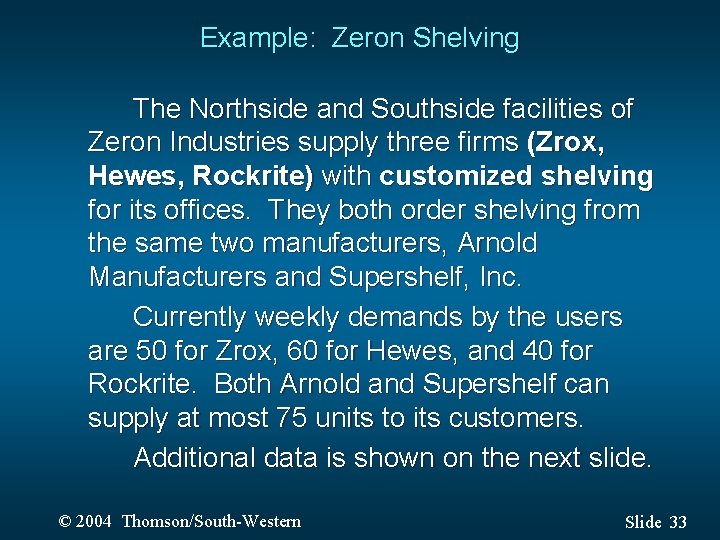
Example: Zeron Shelving The Northside and Southside facilities of Zeron Industries supply three firms (Zrox, Hewes, Rockrite) with customized shelving for its offices. They both order shelving from the same two manufacturers, Arnold Manufacturers and Supershelf, Inc. Currently weekly demands by the users are 50 for Zrox, 60 for Hewes, and 40 for Rockrite. Both Arnold and Supershelf can supply at most 75 units to its customers. Additional data is shown on the next slide. © 2004 Thomson/South-Western Slide 33
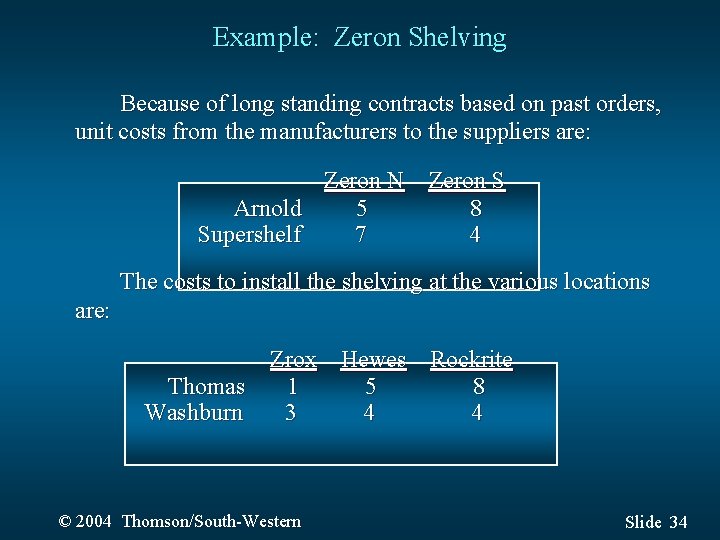
Example: Zeron Shelving Because of long standing contracts based on past orders, unit costs from the manufacturers to the suppliers are: Zeron N Zeron S Arnold 5 8 Supershelf 7 4 The costs to install the shelving at the various locations are: Zrox Hewes Rockrite Thomas 1 5 8 Washburn 3 4 4 © 2004 Thomson/South-Western Slide 34
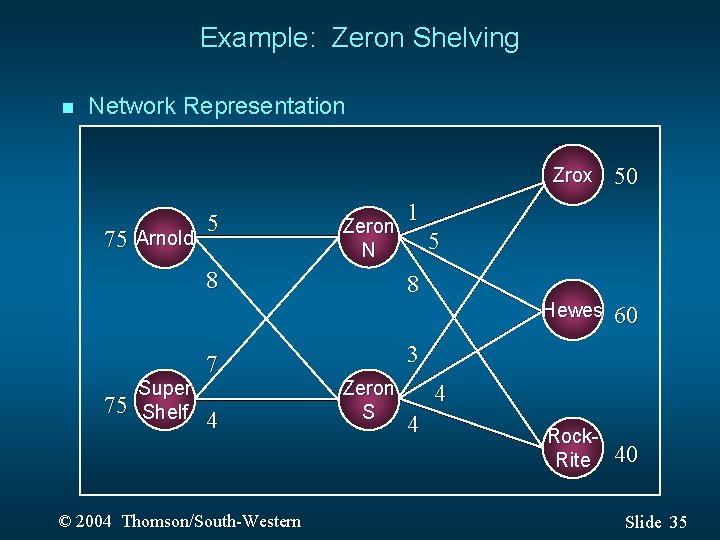
Example: Zeron Shelving n Network Representation ZROX ARNOLD 75 Arnold 5 Zeron N 8 75 Super Shelf 7 4 © 2004 Thomson/South-Western Zrox 50 Hewes HEWES 60 Rock. Rite 40 1 5 8 3 Zeron WASH BURN S 4 4 Slide 35
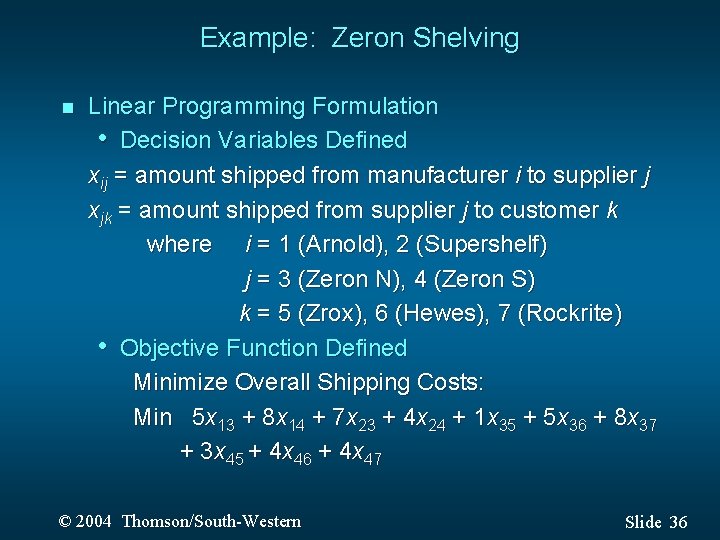
Example: Zeron Shelving n Linear Programming Formulation • Decision Variables Defined xij = amount shipped from manufacturer i to supplier j xjk = amount shipped from supplier j to customer k where i = 1 (Arnold), 2 (Supershelf) j = 3 (Zeron N), 4 (Zeron S) k = 5 (Zrox), 6 (Hewes), 7 (Rockrite) • Objective Function Defined Minimize Overall Shipping Costs: Min 5 x 13 + 8 x 14 + 7 x 23 + 4 x 24 + 1 x 35 + 5 x 36 + 8 x 37 + 3 x 45 + 4 x 46 + 4 x 47 © 2004 Thomson/South-Western Slide 36
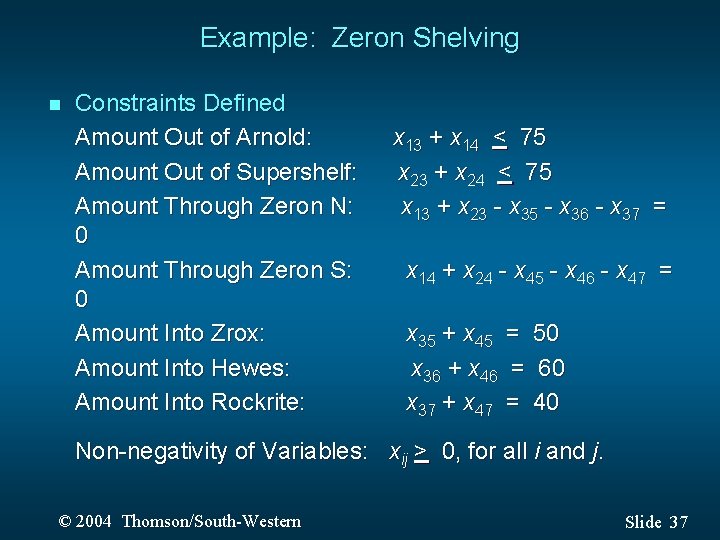
Example: Zeron Shelving n Constraints Defined Amount Out of Arnold: Amount Out of Supershelf: Amount Through Zeron N: 0 Amount Through Zeron S: 0 Amount Into Zrox: Amount Into Hewes: Amount Into Rockrite: x 13 + x 14 < 75 x 23 + x 24 < 75 x 13 + x 23 - x 35 - x 36 - x 37 = x 14 + x 24 - x 45 - x 46 - x 47 = x 35 + x 45 x 36 + x 46 x 37 + x 47 = 50 = 60 = 40 Non-negativity of Variables: xij > 0, for all i and j. © 2004 Thomson/South-Western Slide 37
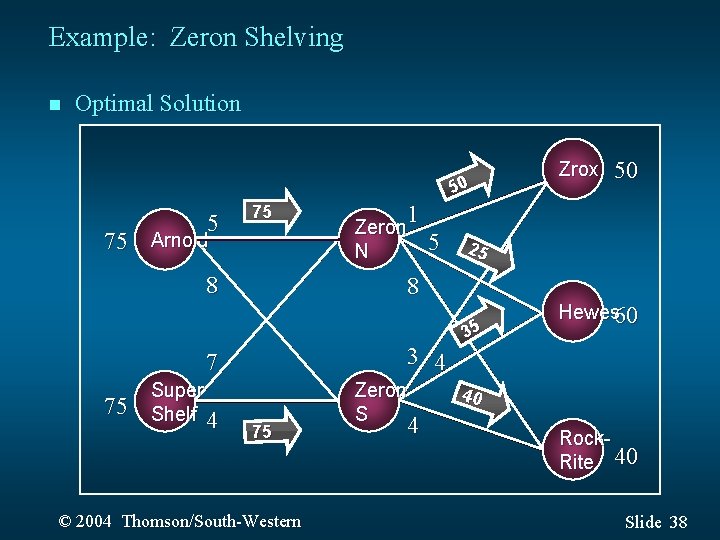
Example: Zeron Shelving n Optimal Solution ZROX 50 5 75 Arnold 75 ARNOLD 5 25 8 3 4 7 75 50 1 Zeron N 8 Super Shelf 4 Zrox Zeron S WASH BURN 75 © 2004 Thomson/South-Western 4 35 Hewes 60 HEWES 40 Rock. Rite 40 Slide 38
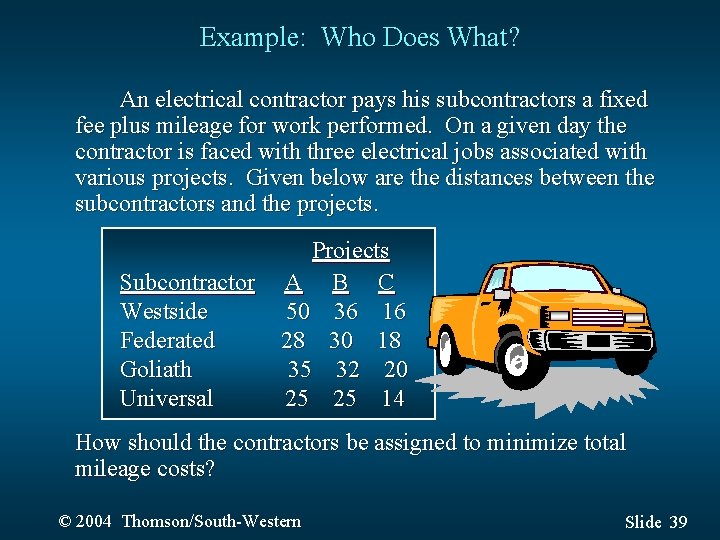
Example: Who Does What? An electrical contractor pays his subcontractors a fixed fee plus mileage for work performed. On a given day the contractor is faced with three electrical jobs associated with various projects. Given below are the distances between the subcontractors and the projects. Subcontractor Westside Federated Goliath Universal Projects A B C 50 36 16 28 30 18 35 32 20 25 25 14 How should the contractors be assigned to minimize total mileage costs? © 2004 Thomson/South-Western Slide 39
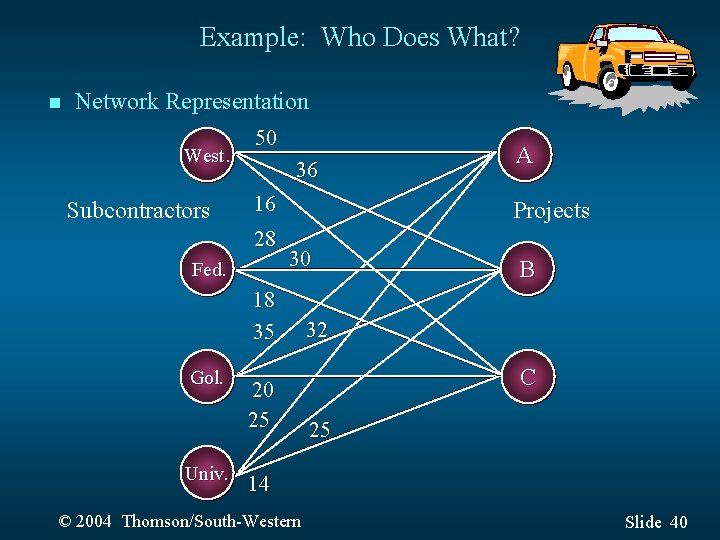
Example: Who Does What? n Network Representation West. Subcontractors 50 36 16 28 Fed. Projects 30 18 35 Gol. Univ. A 20 25 B 32 C 25 14 © 2004 Thomson/South-Western Slide 40
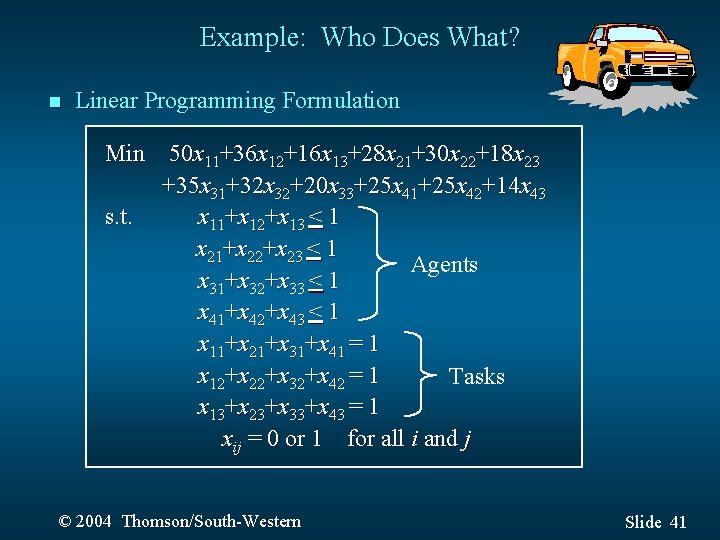
Example: Who Does What? n Linear Programming Formulation Min 50 x 11+36 x 12+16 x 13+28 x 21+30 x 22+18 x 23 +35 x 31+32 x 32+20 x 33+25 x 41+25 x 42+14 x 43 s. t. x 11+x 12+x 13 < 1 x 21+x 22+x 23 < 1 Agents x 31+x 32+x 33 < 1 x 41+x 42+x 43 < 1 x 11+x 21+x 31+x 41 = 1 x 12+x 22+x 32+x 42 = 1 Tasks x 13+x 23+x 33+x 43 = 1 xij = 0 or 1 for all i and j © 2004 Thomson/South-Western Slide 41
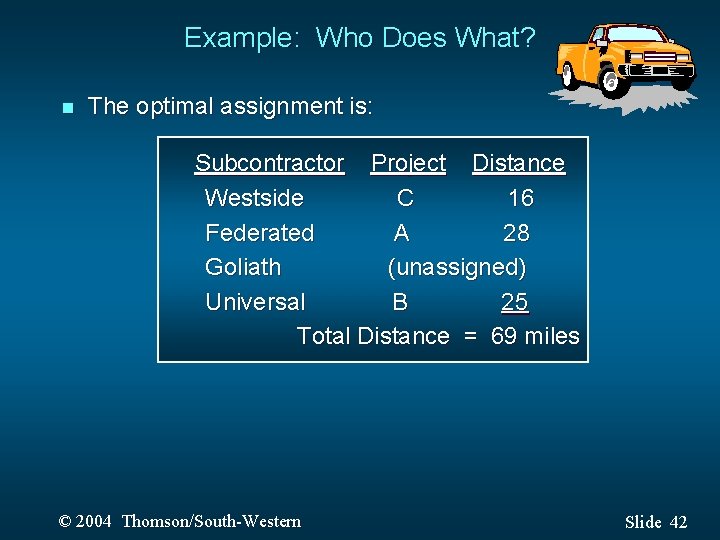
Example: Who Does What? n The optimal assignment is: Subcontractor Project Distance Westside C 16 Federated A 28 Goliath (unassigned) Universal B 25 Total Distance = 69 miles © 2004 Thomson/South-Western Slide 42
- Slides: 42