
Transportation Problems 1 Meaning of Transportation Problems 2
Transportation Problems 1 Meaning of Transportation Problems 2 Important Definitions in Transportation Problems 3 Mathematical Formulation of Transportation Problem 4 Solution of the Transportation Problem
Introduction v A transportation problem fundamentally deals with the difficulty which aspires to find the best possible way to accomplish the demand of 'n' demand points using the capabilities of 'm' supply points. v While attempting to find the best probable way, usually a variable cost of transporting the product from 1 supply point to a demand point or a related constraint ought to be taken into concern. v This kind of problem is known as allocation or transportation problem in which the main idea is to reduce the charge or the time of transport. v If the overall capacity is equivalent to the total requirement, the problem is referred to as balanced transportation problem or else it is referred as unbalanced transportation problem.
6. 1 Meaning of Transportation Problems A)Meaning: § The transportation problem is a special type of linear programming problem where the objective is to minimise the cost of distributing a product from a number of sources or origins to a number of destinations. § Because of its special structure the usual simplex method is not suitable for solving transportation problems. § These problems require a special method of solution. The origin of a transportation problem is the location from which shipments are dispatched. § The destination of a transportation problem is the location to which shipments are transported. The unit transportation cost is the cost of transporting one unit of the consignment from an origin to a destination. § In the most general form, a transportation problem has a number of origins and a number of destinations.

6. 2 Definitions in Transportation Problems A) Some important definitions in Transportation Problems: 1) Basic Feasible Solution: A feasible solution to a m-origin, n-destination problem is said to be basic if the number of positive allocations are equal to (m+n-1). 2) Feasible Solution : A set of positive individual allocations which simultaneously removes deficiencies is called a feasible solution. 3) Optimal Solution : A feasible solution (not basically basic) is said to be optimal if it minimises the total transportation cost.
6. 3 Mathematical Formulation of Transportation Problem Let there be three units, producing scooter, say, A 1, A 2 and A 3 from where the scooters are to be supplied to four depots say B 1, B 2, B 3 and B 4. Let the number of scooters produced at A 1, A 2 and A 3 be a 1, a 2 and a 3 respectively and the demands at the depots be b 1, b 2, b 3 and b 4 respectively. We assume the condition a 1+a 2+a 3 = b 1+b 2 + b 3 + b 4 i. e. , all scooters produced are supplied to the different depots. Let the cost of transportation of one scooter from A 1 to B 1 be c 11. Similarly, the cost of transportations in other casus are also shown in the figure and Table.
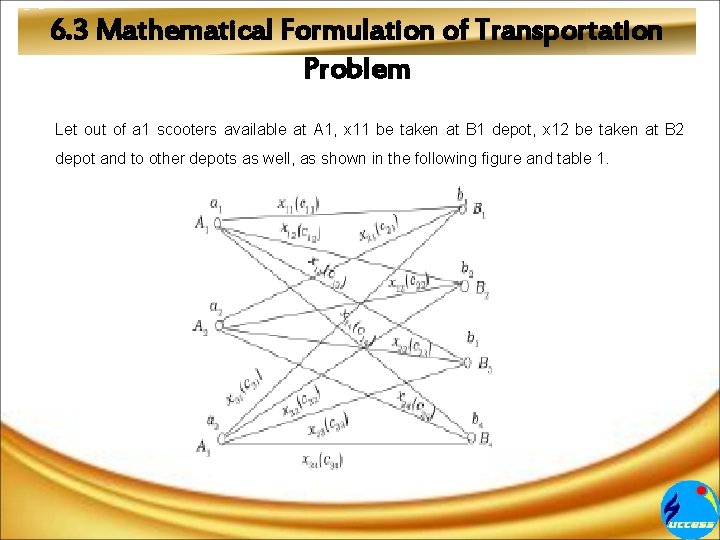
6. 3 Mathematical Formulation of Transportation Problem Let out of a 1 scooters available at A 1, x 11 be taken at B 1 depot, x 12 be taken at B 2 depot and to other depots as well, as shown in the following figure and table 1.
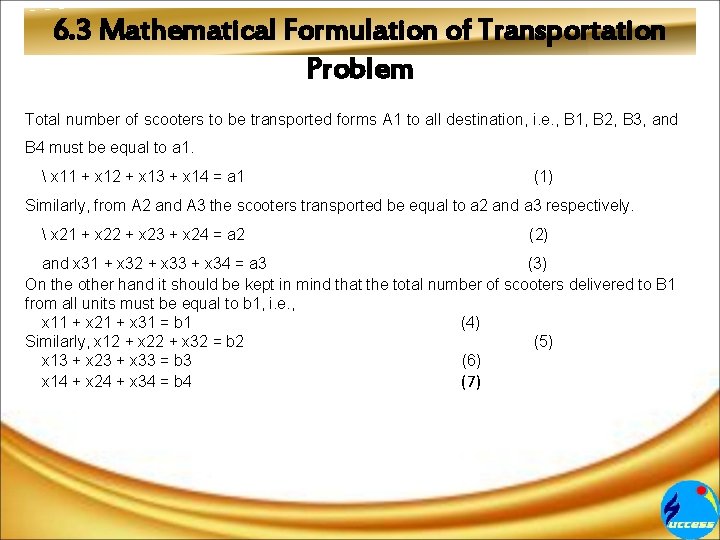
6. 3 Mathematical Formulation of Transportation Problem Total number of scooters to be transported forms A 1 to all destination, i. e. , B 1, B 2, B 3, and B 4 must be equal to a 1. x 11 + x 12 + x 13 + x 14 = a 1 (1) Similarly, from A 2 and A 3 the scooters transported be equal to a 2 and a 3 respectively. x 21 + x 22 + x 23 + x 24 = a 2 (2) and x 31 + x 32 + x 33 + x 34 = a 3 (3) On the other hand it should be kept in mind that the total number of scooters delivered to B 1 from all units must be equal to b 1, i. e. , x 11 + x 21 + x 31 = b 1 (4) Similarly, x 12 + x 22 + x 32 = b 2 (5) x 13 + x 23 + x 33 = b 3 (6) x 14 + x 24 + x 34 = b 4 (7)

6. 3 Mathematical Formulation of Transportation Problem With the help of the above information we can construct the following table: Deposit To B 1 To B 2 To B 3 To B 4 Stock From A 1 x 11(c 11) x 12(c 12) x 13(c 13) x 14(c 14) a 1 From A 2 x 21(c 21) x 22(c 22) x 23(c 23) x 24(c 24) a 2 From A 3 x 31(c 31) x 32(c 32) x 33(c 33) x 34(c 34) a 3 b 2 b 3 b 4 Time Requirement b 1

6. 3 Mathematical Formulation of Transportation Problem The cost of transportation from Ai (i=1, 2, 3) to Bj (j=1, 2, 3, 4) will be equal to …………… (8) where the symbol put before cij xij signifies that the quantities cij xij must be summed over all i = 1, 2, 3 and all j = 1, 2, 3, 4. Thus we come across a linear programming problem given by equations (1) to (7) and a linear function (8). We have to find the non-negative solutions of the system such that it minimizes the function (8).

6. 3 Mathematical Formulation of Transportation Problem Note: We can think about a transportation problem in a general way if there are m sources (say A 1, A 2. . . Am) and n destinations (say B 1, B 2, . . , Bn). We can use ai to denote the quantity of goods concentrated at points Ai(i=1, 2, . . , m) and Bj denote the quantity of goods expected at points Bj(j =1, 2, . . . , n). We assume the condition a 1 + a 2 +. . + am = b 1 + b 2 +. . + bn implying that the total stock of goods is equal to the summed demand for it.

6. 3 Mathematical Formulation of Transportation Problem Some Definitions: A) Feasible Solution (F. S. ): A set of non-negative allocations xij > 0 which satisfies the row and column restrictions is known as feasible solution. B) Basic Feasible Solution (B. F. S. ): A feasible solution to a m-origin and n-destination problem is said to be basic feasible solution if the number of positive allocations are (m + n – 1). If the number of allocations in a basic feasible solutions are less than (m+n– 1), it is called degenerate basic feasible solution (DBFS) (otherwise non-degenerate). C) Optimal Solution: A feasible solution (not necessarily basic) is said to be optimal if it minimizes the total transportation cost.
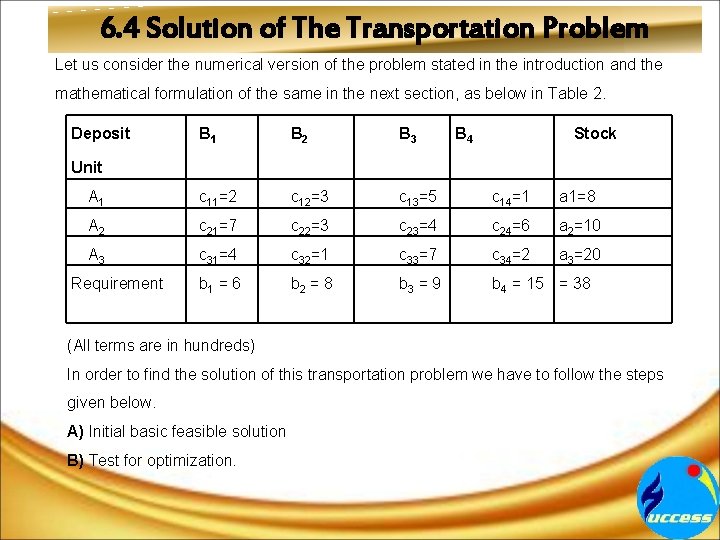
6. 4 Solution of The Transportation Problem Let us consider the numerical version of the problem stated in the introduction and the mathematical formulation of the same in the next section, as below in Table 2. Deposit B 1 B 2 B 3 B 4 Stock A 1 c 11=2 c 12=3 c 13=5 c 14=1 a 1=8 A 2 c 21=7 c 22=3 c 23=4 c 24=6 a 2=10 A 3 c 31=4 c 32=1 c 33=7 c 34=2 a 3=20 b 1 = 6 b 2 = 8 b 3 = 9 b 4 = 15 = 38 Unit Requirement (All terms are in hundreds) In order to find the solution of this transportation problem we have to follow the steps given below. A) Initial basic feasible solution B) Test for optimization.

6. 4 Solution of The Transportation Problem A) Initial Basic Feasible Solution: There are three different methods to obtain the initial basic feasible solution viz. I) North-West Corner Rule: In this method we distribute the available units in rows and column in such a way that the sum will remain the same. We have to follow the steps given below. a) Start allocations from north-west corner, i. e. , from (1, 1) position. Here min (a 1, b 1), i. e. , min (8, 6)=6 units. Therefore, the maximum possible units that can be allocated to this position is 6, and write it as 6(2) in the (1, 1) position of the table. This completes the allocation in the first column and cross the other positions, i. e. , (2, 1) and (3, 1) in the column. (see Table 3) Deposit Unit B 1 B 2 B 3 B 4 Stock A 1 6(2) 8– 6=2 A 2 × 10 A 3 × 20 Requirement 6 – 6 = 0 8 9 15 32
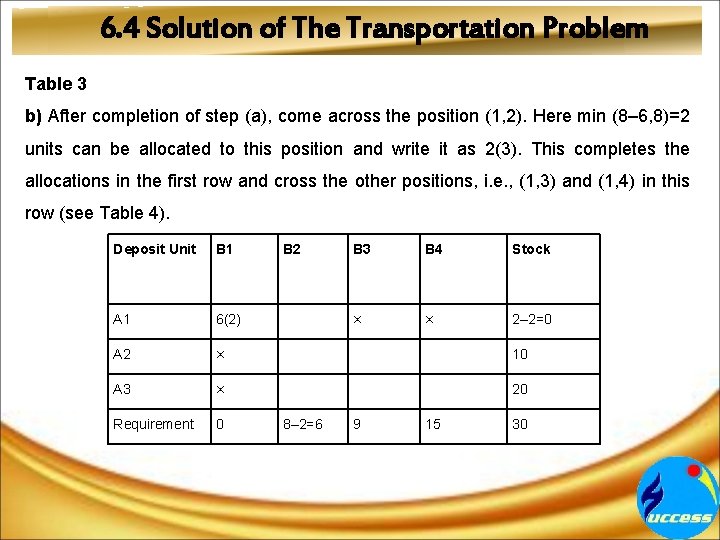
6. 4 Solution of The Transportation Problem Table 3 b) After completion of step (a), come across the position (1, 2). Here min (8– 6, 8)=2 units can be allocated to this position and write it as 2(3). This completes the allocations in the first row and cross the other positions, i. e. , (1, 3) and (1, 4) in this row (see Table 4). Deposit Unit B 1 B 2 A 1 6(2) A 2 × 10 A 3 × 20 Requirement 0 8– 2=6 B 3 B 4 Stock × × 2– 2=0 9 15 30
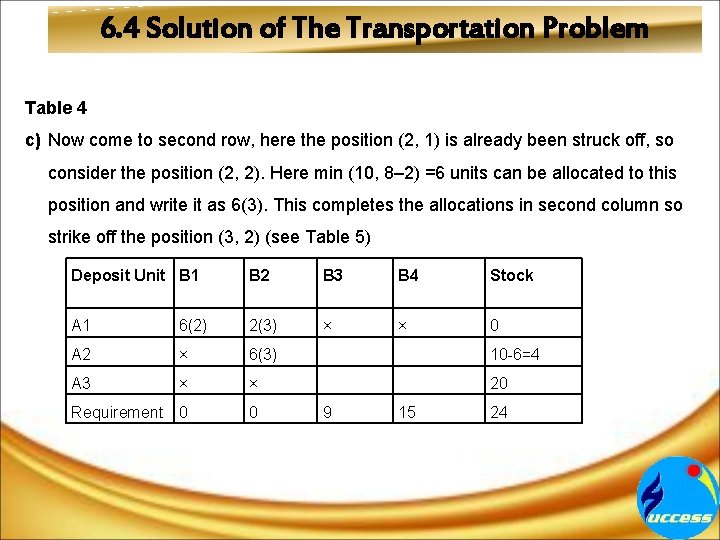
6. 4 Solution of The Transportation Problem Table 4 c) Now come to second row, here the position (2, 1) is already been struck off, so consider the position (2, 2). Here min (10, 8– 2) =6 units can be allocated to this position and write it as 6(3). This completes the allocations in second column so strike off the position (3, 2) (see Table 5) Deposit Unit B 1 B 2 B 3 B 4 Stock A 1 6(2) 2(3) × × 0 A 2 × 6(3) 10 -6=4 A 3 × × 20 Requirement 0 0 9 15 24
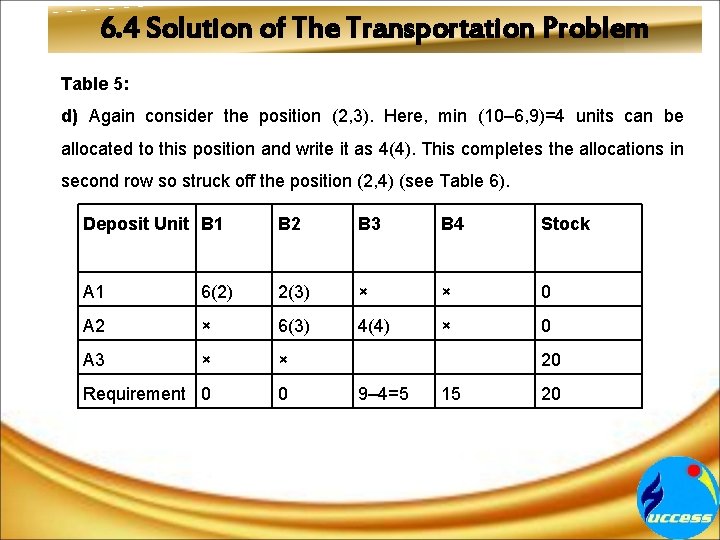
6. 4 Solution of The Transportation Problem Table 5: d) Again consider the position (2, 3). Here, min (10– 6, 9)=4 units can be allocated to this position and write it as 4(4). This completes the allocations in second row so struck off the position (2, 4) (see Table 6). Deposit Unit B 1 B 2 B 3 B 4 Stock A 1 6(2) 2(3) × × 0 A 2 × 6(3) 4(4) × 0 A 3 × × Requirement 0 0 20 9– 4=5 15 20
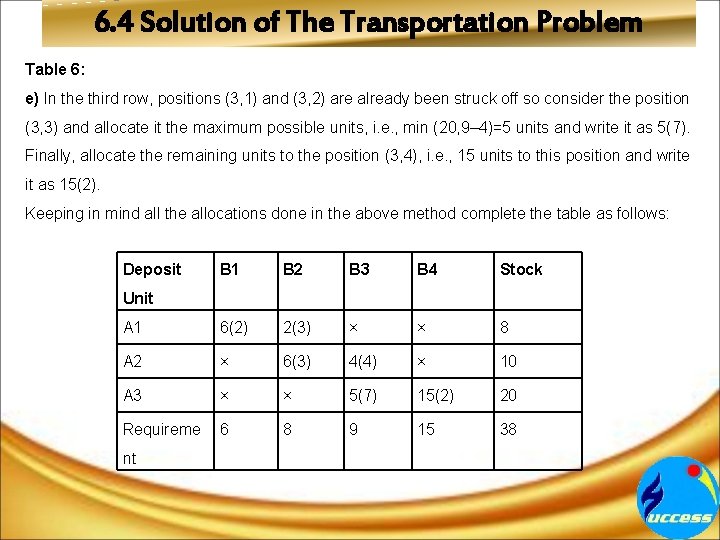
6. 4 Solution of The Transportation Problem Table 6: e) In the third row, positions (3, 1) and (3, 2) are already been struck off so consider the position (3, 3) and allocate it the maximum possible units, i. e. , min (20, 9– 4)=5 units and write it as 5(7). Finally, allocate the remaining units to the position (3, 4), i. e. , 15 units to this position and write it as 15(2). Keeping in mind all the allocations done in the above method complete the table as follows: Deposit B 1 B 2 B 3 B 4 Stock A 1 6(2) 2(3) × × 8 A 2 × 6(3) 4(4) × 10 A 3 × × 5(7) 15(2) 20 Requireme 6 8 9 15 38 Unit nt
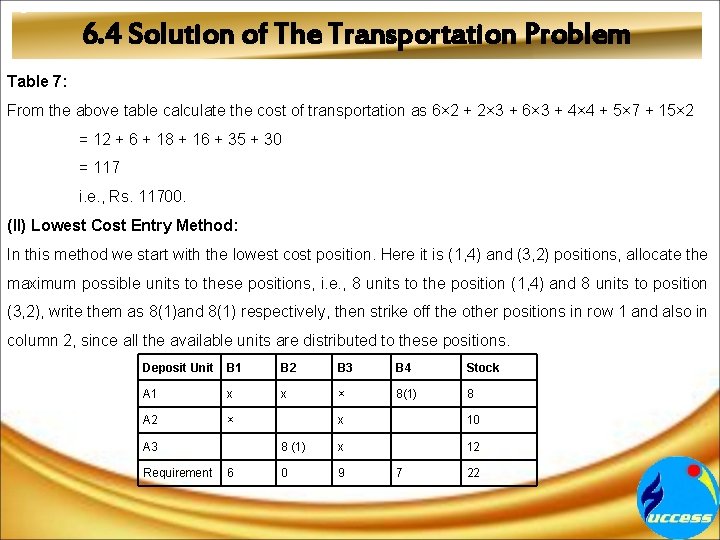
6. 4 Solution of The Transportation Problem Table 7: From the above table calculate the cost of transportation as 6× 2 + 2× 3 + 6× 3 + 4× 4 + 5× 7 + 15× 2 = 12 + 6 + 18 + 16 + 35 + 30 = 117 i. e. , Rs. 11700. (II) Lowest Cost Entry Method: In this method we start with the lowest cost position. Here it is (1, 4) and (3, 2) positions, allocate the maximum possible units to these positions, i. e. , 8 units to the position (1, 4) and 8 units to position (3, 2), write them as 8(1)and 8(1) respectively, then strike off the other positions in row 1 and also in column 2, since all the available units are distributed to these positions. Deposit Unit B 1 B 2 B 3 B 4 Stock A 1 x x × 8(1) 8 A 2 × A 3 Requirement 6 x 10 8 (1) x 12 0 9 7 22
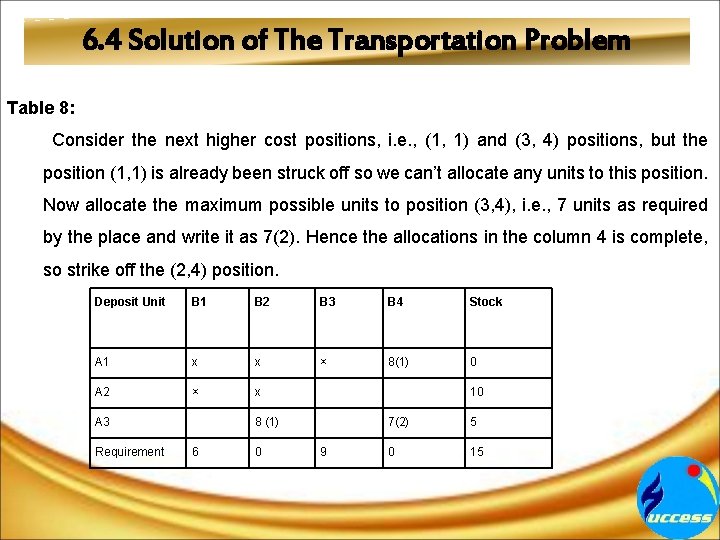
6. 4 Solution of The Transportation Problem Table 8: Consider the next higher cost positions, i. e. , (1, 1) and (3, 4) positions, but the position (1, 1) is already been struck off so we can’t allocate any units to this position. Now allocate the maximum possible units to position (3, 4), i. e. , 7 units as required by the place and write it as 7(2). Hence the allocations in the column 4 is complete, so strike off the (2, 4) position. Deposit Unit B 1 B 2 B 3 B 4 Stock A 1 x x × 8(1) 0 A 2 × x A 3 Requirement 10 8 (1) 6 0 9 7(2) 5 0 15
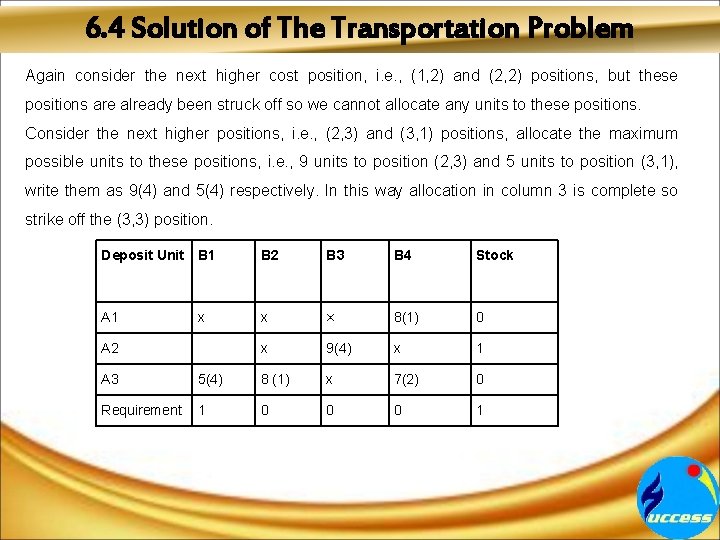
6. 4 Solution of The Transportation Problem Again consider the next higher cost position, i. e. , (1, 2) and (2, 2) positions, but these positions are already been struck off so we cannot allocate any units to these positions. Consider the next higher positions, i. e. , (2, 3) and (3, 1) positions, allocate the maximum possible units to these positions, i. e. , 9 units to position (2, 3) and 5 units to position (3, 1), write them as 9(4) and 5(4) respectively. In this way allocation in column 3 is complete so strike off the (3, 3) position. Deposit Unit B 1 B 2 B 3 B 4 Stock A 1 x x × 8(1) 0 x 9(4) x 1 A 2 A 3 5(4) 8 (1) x 7(2) 0 Requirement 1 0 0 0 1
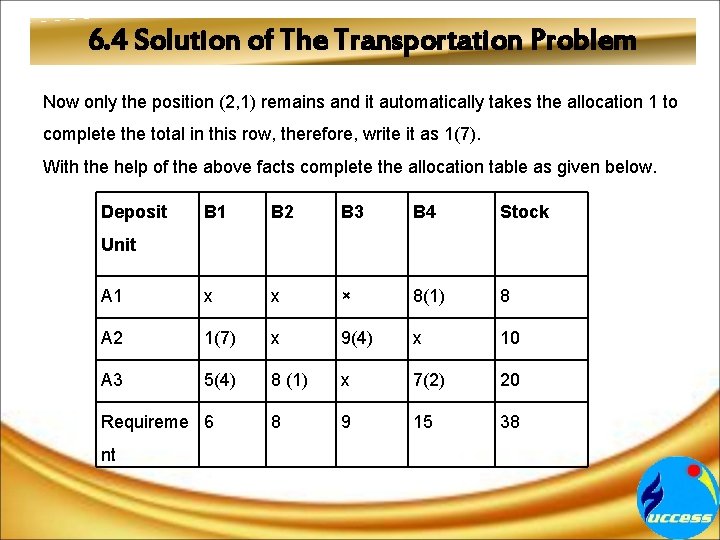
6. 4 Solution of The Transportation Problem Now only the position (2, 1) remains and it automatically takes the allocation 1 to complete the total in this row, therefore, write it as 1(7). With the help of the above facts complete the allocation table as given below. Deposit B 1 B 2 B 3 B 4 Stock A 1 x x × 8(1) 8 A 2 1(7) x 9(4) x 10 A 3 5(4) 8 (1) x 7(2) 20 8 9 15 38 Unit Requireme 6 nt
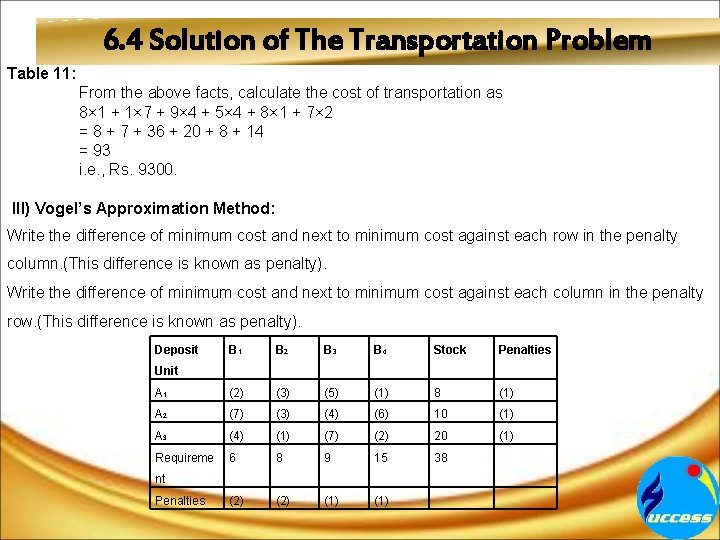
6. 4 Solution of The Transportation Problem Table 11: From the above facts, calculate the cost of transportation as 8× 1 + 1× 7 + 9× 4 + 5× 4 + 8× 1 + 7× 2 = 8 + 7 + 36 + 20 + 8 + 14 = 93 i. e. , Rs. 9300. III) Vogel’s Approximation Method: Write the difference of minimum cost and next to minimum cost against each row in the penalty column. (This difference is known as penalty). Write the difference of minimum cost and next to minimum cost against each column in the penalty row. (This difference is known as penalty). Deposit B 1 B 2 B 3 B 4 Stock Penalties A 1 (2) (3) (5) (1) 8 (1) A 2 (7) (3) (4) (6) 10 (1) A 3 (4) (1) (7) (2) 20 (1) Requireme 6 8 9 15 38 (2) (1) Unit nt Penalties
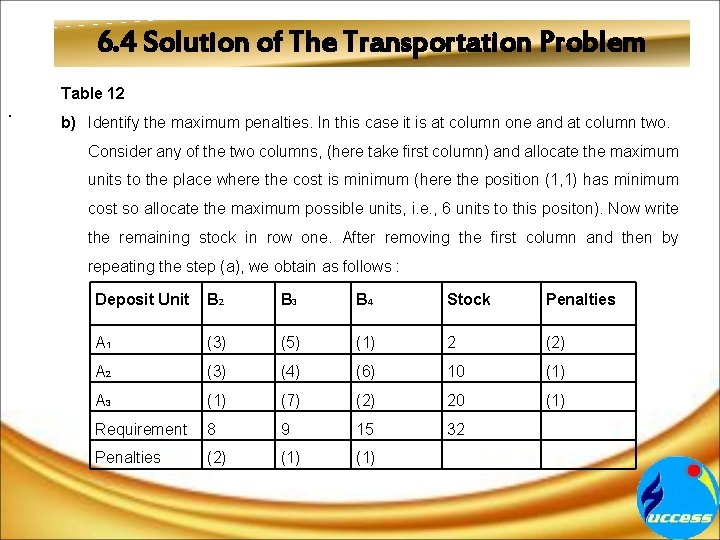
6. 4 Solution of The Transportation Problem. Table 12 b) Identify the maximum penalties. In this case it is at column one and at column two. Consider any of the two columns, (here take first column) and allocate the maximum units to the place where the cost is minimum (here the position (1, 1) has minimum cost so allocate the maximum possible units, i. e. , 6 units to this positon). Now write the remaining stock in row one. After removing the first column and then by repeating the step (a), we obtain as follows : Deposit Unit B 2 B 3 B 4 Stock Penalties A 1 (3) (5) (1) 2 (2) A 2 (3) (4) (6) 10 (1) A 3 (1) (7) (2) 20 (1) Requirement 8 9 15 32 Penalties (2) (1)
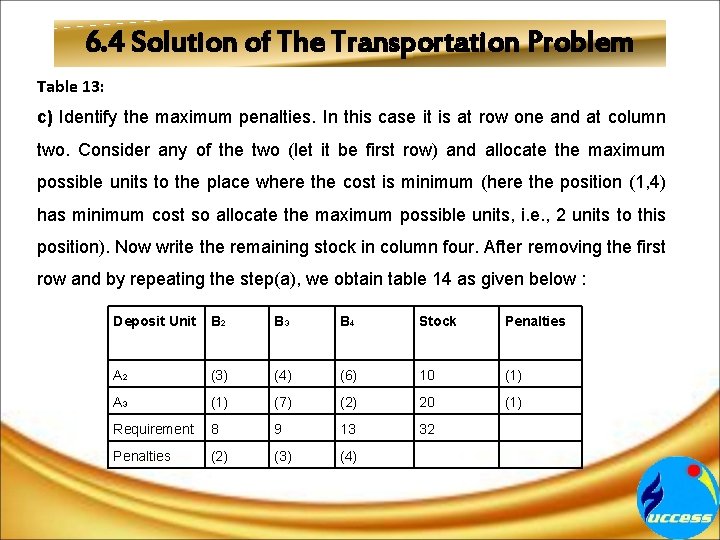
6. 4 Solution of The Transportation Problem Table 13: c) Identify the maximum penalties. In this case it is at row one and at column two. Consider any of the two (let it be first row) and allocate the maximum possible units to the place where the cost is minimum (here the position (1, 4) has minimum cost so allocate the maximum possible units, i. e. , 2 units to this position). Now write the remaining stock in column four. After removing the first row and by repeating the step(a), we obtain table 14 as given below : Deposit Unit B 2 B 3 B 4 Stock Penalties A 2 (3) (4) (6) 10 (1) A 3 (1) (7) (2) 20 (1) Requirement 8 9 13 32 Penalties (2) (3) (4)
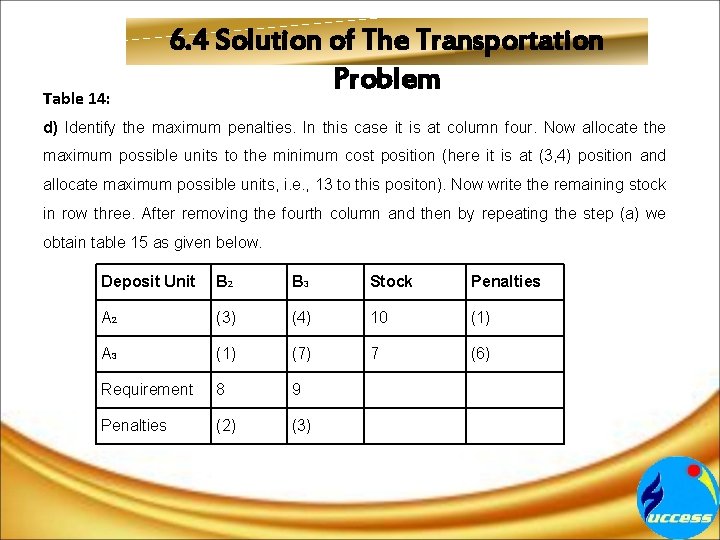
Table 14: 6. 4 Solution of The Transportation Problem d) Identify the maximum penalties. In this case it is at column four. Now allocate the maximum possible units to the minimum cost position (here it is at (3, 4) position and allocate maximum possible units, i. e. , 13 to this positon). Now write the remaining stock in row three. After removing the fourth column and then by repeating the step (a) we obtain table 15 as given below. Deposit Unit B 2 B 3 Stock Penalties A 2 (3) (4) 10 (1) A 3 (1) (7) 7 (6) Requirement 8 9 Penalties (2) (3)
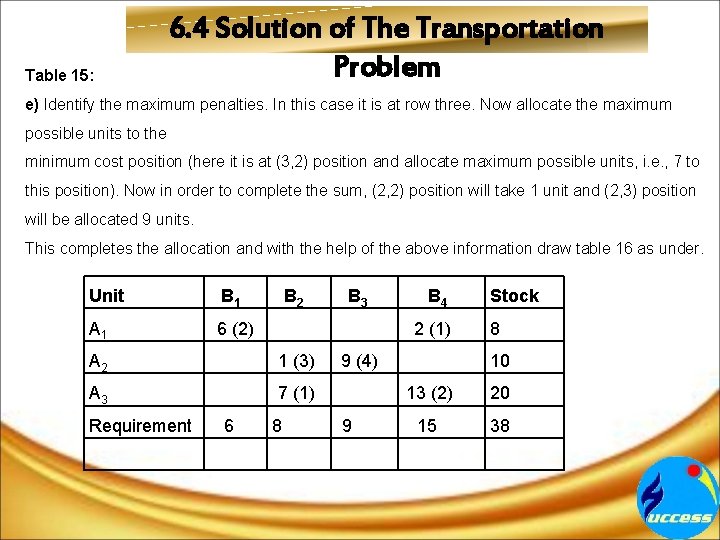
Table 15: 6. 4 Solution of The Transportation Problem e) Identify the maximum penalties. In this case it is at row three. Now allocate the maximum possible units to the minimum cost position (here it is at (3, 2) position and allocate maximum possible units, i. e. , 7 to this position). Now in order to complete the sum, (2, 2) position will take 1 unit and (2, 3) position will be allocated 9 units. This completes the allocation and with the help of the above information draw table 16 as under. Unit B 1 A 1 6 (2) B 2 1 (3) A 3 7 (1) 6 B 4 2 (1) A 2 Requirement B 3 8 9 (4) 9 Stock 8 10 13 (2) 20 15 38
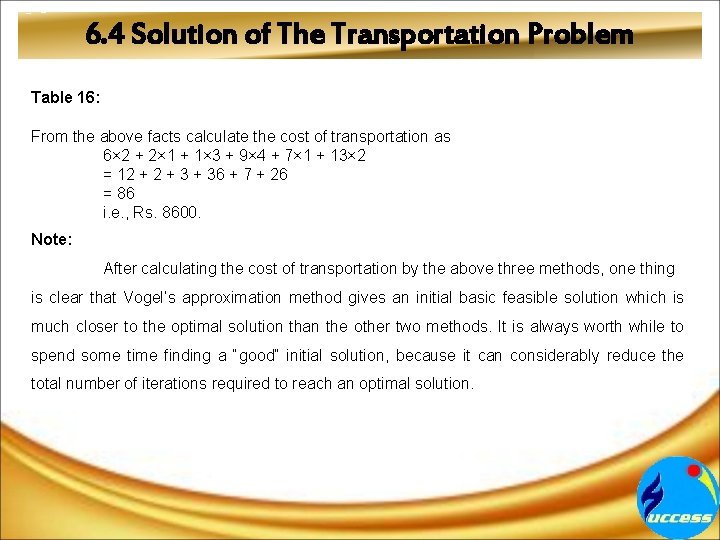
6. 4 Solution of The Transportation Problem Table 16: From the above facts calculate the cost of transportation as 6× 2 + 2× 1 + 1× 3 + 9× 4 + 7× 1 + 13× 2 = 12 + 3 + 36 + 7 + 26 = 86 i. e. , Rs. 8600. Note: After calculating the cost of transportation by the above three methods, one thing is clear that Vogel’s approximation method gives an initial basic feasible solution which is much closer to the optimal solution than the other two methods. It is always worth while to spend some time finding a “good” initial solution, because it can considerably reduce the total number of iterations required to reach an optimal solution.
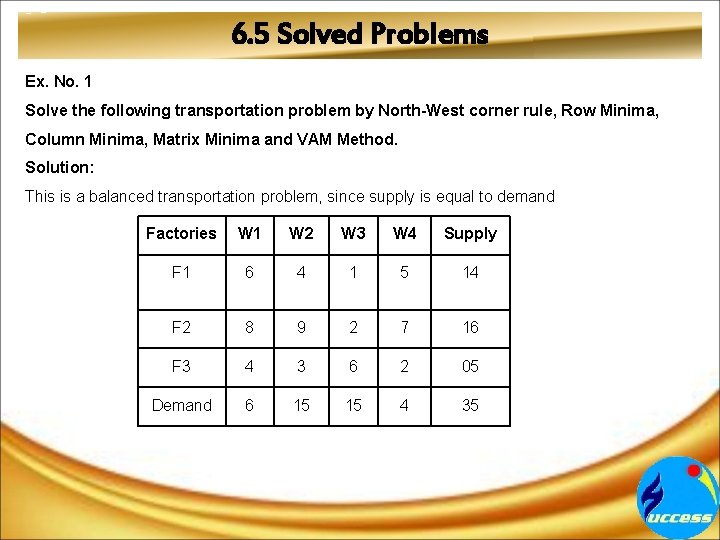
6. 5 Solved Problems Ex. No. 1 Solve the following transportation problem by North-West corner rule, Row Minima, Column Minima, Matrix Minima and VAM Method. Solution: This is a balanced transportation problem, since supply is equal to demand Factories W 1 W 2 W 3 W 4 Supply F 1 6 4 1 5 14 F 2 8 9 2 7 16 F 3 4 3 6 2 05 Demand 6 15 15 4 35
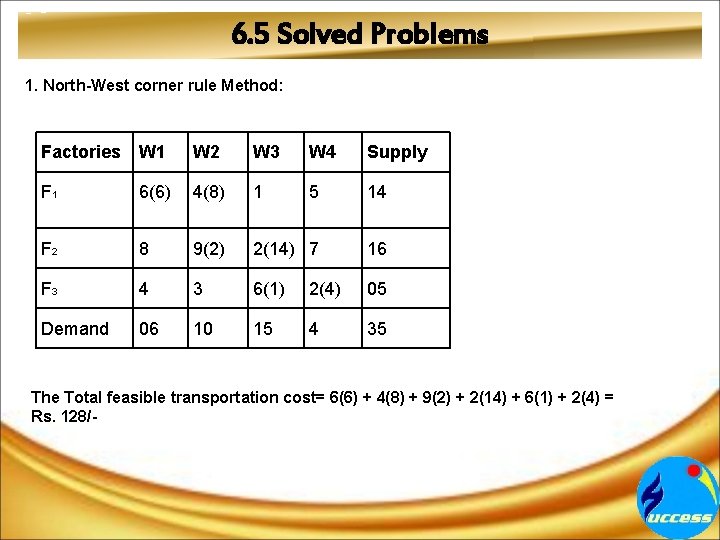
6. 5 Solved Problems 1. North-West corner rule Method: Factories W 1 W 2 W 3 W 4 Supply F 1 6(6) 4(8) 1 5 14 F 2 8 9(2) 2(14) 7 16 F 3 4 3 6(1) 2(4) 05 Demand 06 10 15 4 35 The Total feasible transportation cost= 6(6) + 4(8) + 9(2) + 2(14) + 6(1) + 2(4) = Rs. 128/-
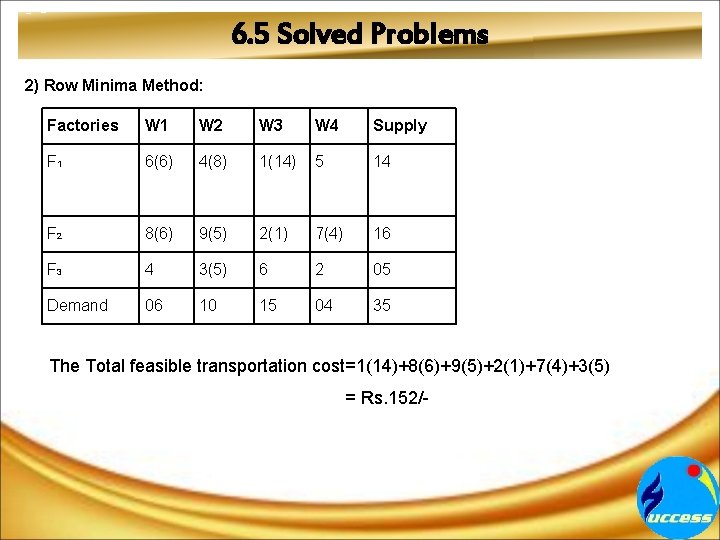
6. 5 Solved Problems 2) Row Minima Method: Factories W 1 W 2 W 3 W 4 Supply F 1 6(6) 4(8) 1(14) 5 14 F 2 8(6) 9(5) 2(1) 7(4) 16 F 3 4 3(5) 6 2 05 Demand 06 10 15 04 35 The Total feasible transportation cost=1(14)+8(6)+9(5)+2(1)+7(4)+3(5) = Rs. 152/-
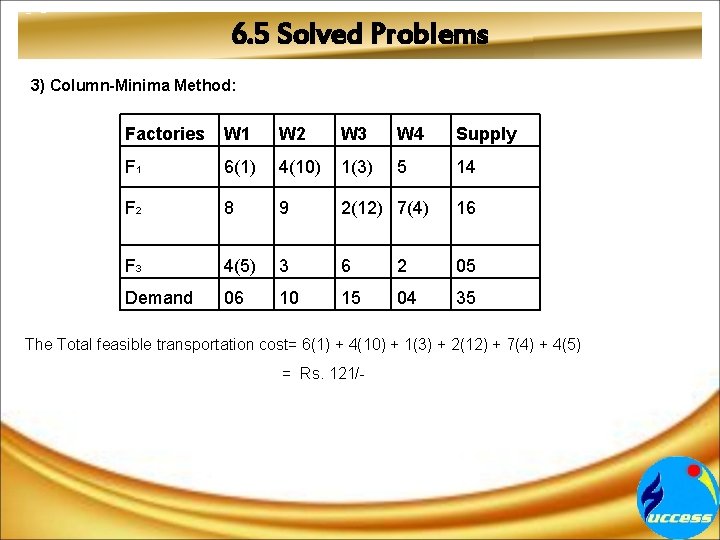
6. 5 Solved Problems 3) Column-Minima Method: Factories W 1 W 2 W 3 W 4 Supply F 1 6(1) 4(10) 1(3) 5 14 F 2 8 9 2(12) 7(4) 16 F 3 4(5) 3 6 2 05 Demand 06 10 15 04 35 The Total feasible transportation cost= 6(1) + 4(10) + 1(3) + 2(12) + 7(4) + 4(5) = Rs. 121/-
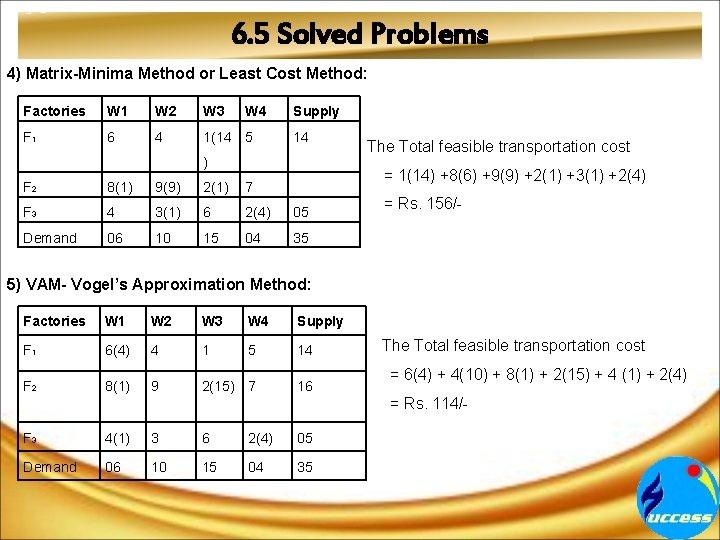
6. 5 Solved Problems 4) Matrix-Minima Method or Least Cost Method: Factories W 1 W 2 W 3 W 4 F 1 6 4 1(14 5 Supply 14 ) The Total feasible transportation cost = 1(14) +8(6) +9(9) +2(1) +3(1) +2(4) F 2 8(1) 9(9) 2(1) 7 F 3 4 3(1) 6 2(4) 05 Demand 06 10 15 04 35 = Rs. 156/- 5) VAM- Vogel’s Approximation Method: Factories W 1 W 2 W 3 W 4 Supply F 1 6(4) 4 1 5 14 F 2 8(1) 9 2(15) 7 16 F 3 4(1) 3 6 2(4) 05 Demand 06 10 15 04 35 The Total feasible transportation cost = 6(4) + 4(10) + 8(1) + 2(15) + 4 (1) + 2(4) = Rs. 114/-
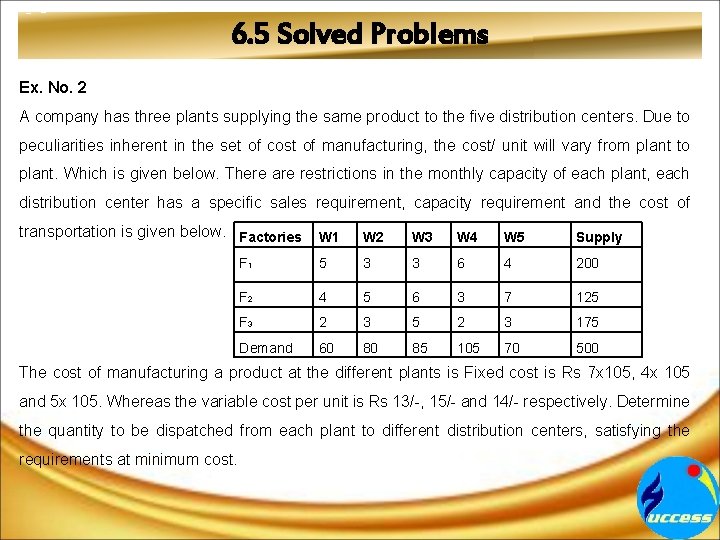
6. 5 Solved Problems Ex. No. 2 A company has three plants supplying the same product to the five distribution centers. Due to peculiarities inherent in the set of cost of manufacturing, the cost/ unit will vary from plant to plant. Which is given below. There are restrictions in the monthly capacity of each plant, each distribution center has a specific sales requirement, capacity requirement and the cost of transportation is given below. Factories W 1 W 2 W 3 W 4 W 5 Supply F 1 5 3 3 6 4 200 F 2 4 5 6 3 7 125 F 3 2 3 5 2 3 175 Demand 60 80 85 105 70 500 The cost of manufacturing a product at the different plants is Fixed cost is Rs 7 x 10⁵, 4 x 10⁵ and 5 x 10⁵. Whereas the variable cost per unit is Rs 13/-, 15/- and 14/- respectively. Determine the quantity to be dispatched from each plant to different distribution centers, satisfying the requirements at minimum cost.
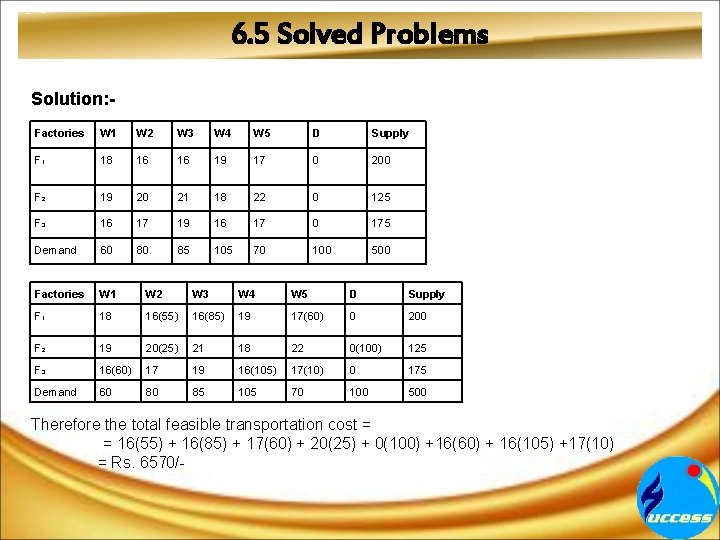
6. 5 Solved Problems Solution: Factories W 1 W 2 W 3 W 4 W 5 D Supply F 1 18 16 16 19 17 0 200 F 2 19 20 21 18 22 0 125 F 3 16 17 19 16 17 0 175 Demand 60 80 85 105 70 100 500 Factories W 1 W 2 W 3 W 4 W 5 D Supply F 1 18 16(55) 16(85) 19 17(60) 0 200 F 2 19 20(25) 21 18 22 0(100) 125 F 3 16(60) 17 19 16(105) 17(10) 0 175 Demand 60 80 85 105 70 100 500 Therefore the total feasible transportation cost = = 16(55) + 16(85) + 17(60) + 20(25) + 0(100) +16(60) + 16(105) +17(10) = Rs. 6570/-
- Slides: 34