
Transportation Engineering Prof Rajesh Bhagat Asst Professor CED

Transportation Engineering Prof. Rajesh Bhagat Asst. Professor, CED, YCCE, Nagpur B. E. (Civil Engg. ) GCOE, Amravati M. Tech. (Enviro. Engg. ) VNIT, Nagpur Experience & Achievement: v Selected Scientist, NEERI-CSIR, Govt. of India. v GATE Qualified Three Times. v UGC - NET Qualified in First Attempt. v Selected Junior Engineer, ZP Washim. v Three Times Selected as UGC Approved Assistant Professor. v Assistant Professor, PCE, Nagpur. v Assistant Professor, Cummins College of Engg. For Women, Nagpur v Topper of Pre-Ph. D Course Work at UGC-HRDC, RTMNU Nagpur Mobile No. : - 8483002277 / 8483003474 Email ID : - rajeysh 7 bhagat@gmail. com Website: - www. rajeysh 7 bhagat. wordpress. com
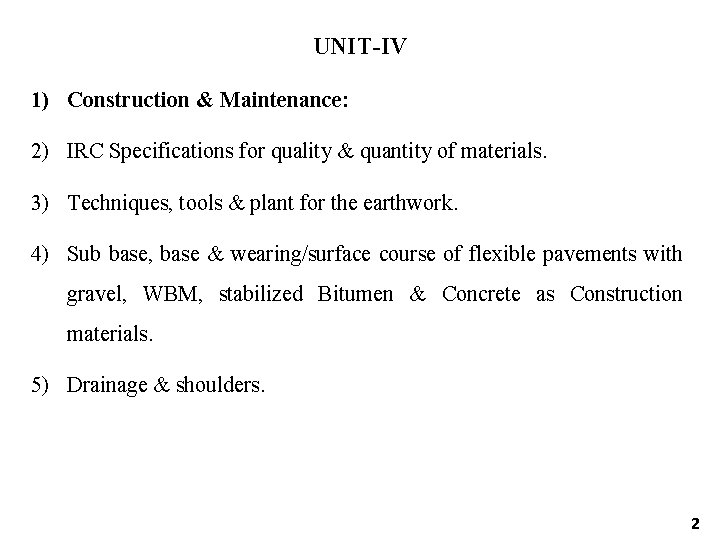
UNIT-IV 1) Construction & Maintenance: 2) IRC Specifications for quality & quantity of materials. 3) Techniques, tools & plant for the earthwork. 4) Sub base, base & wearing/surface course of flexible pavements with gravel, WBM, stabilized Bitumen & Concrete as Construction materials. 5) Drainage & shoulders. 2
References: 1) Highway engineering by Khanna & Justo, Nem Chand & Bros. Pub. 1) Bridge Engineering by S. P. Bindra, Dhanpat Rai Publication. 2) A Text Book of Railway Engineering by S. C. Saxena & S. P. Arora, Dhanpat Rai Sons, New Delhi. 3) Indian Road Congress, IRC handbooks , International Code Council. 4) Traffic and Highway Engineering by J. Garber and L. A. Hoel, Thomson Learning, Inc.
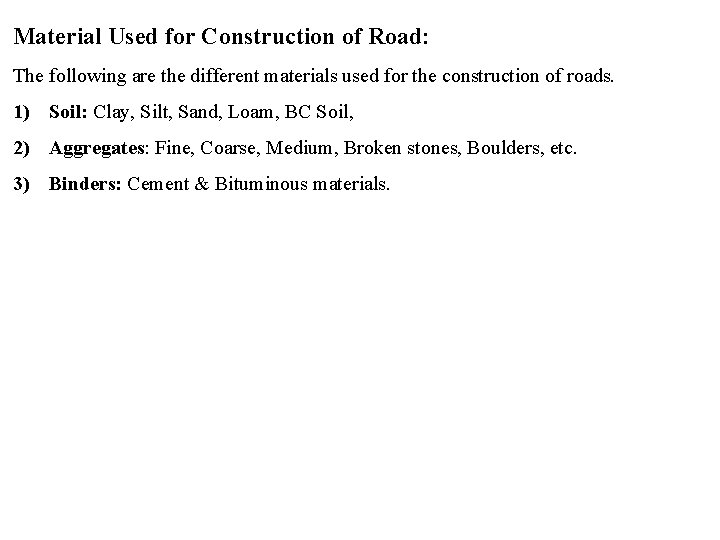
Material Used for Construction of Road: The following are the different materials used for the construction of roads. 1) Soil: Clay, Silt, Sand, Loam, BC Soil, 2) Aggregates: Fine, Coarse, Medium, Broken stones, Boulders, etc. 3) Binders: Cement & Bituminous materials.
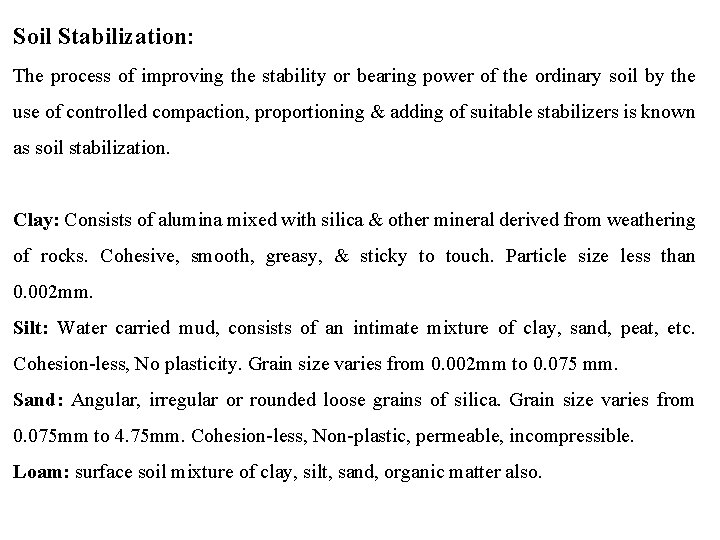
Soil Stabilization: The process of improving the stability or bearing power of the ordinary soil by the use of controlled compaction, proportioning & adding of suitable stabilizers is known as soil stabilization. Clay: Consists of alumina mixed with silica & other mineral derived from weathering of rocks. Cohesive, smooth, greasy, & sticky to touch. Particle size less than 0. 002 mm. Silt: Water carried mud, consists of an intimate mixture of clay, sand, peat, etc. Cohesion-less, No plasticity. Grain size varies from 0. 002 mm to 0. 075 mm. Sand: Angular, irregular or rounded loose grains of silica. Grain size varies from 0. 075 mm to 4. 75 mm. Cohesion-less, Non-plastic, permeable, incompressible. Loam: surface soil mixture of clay, silt, sand, organic matter also.
Subgrade: The finished & compacted surface of earthwork on which a road pavement rest is called subgrade or formation. Sub-base: A layer of granular material provided in between the subgrade & the base course in a road pavement is called sub-base. Base Course: Soiling & foundation course. Wearing Course: The top most layer of the road pavement directly exposed to traffic is called wearing course or surfacing.
Seal Coat: A final coat of bituminous material provided on the top of surface course for sealing the voids against entry of moisture as known as seal coat. Prime Coat: A single coat of low viscosity bituminous binder applied to an existing untreated base of previous nature like WBM in order to promote adhesion between the base & the bituminous surface is called prime coat. Base Coat: The layer of hard stones provided in between the base course & the wearing course in a road pavement is called base coat or bearing course.
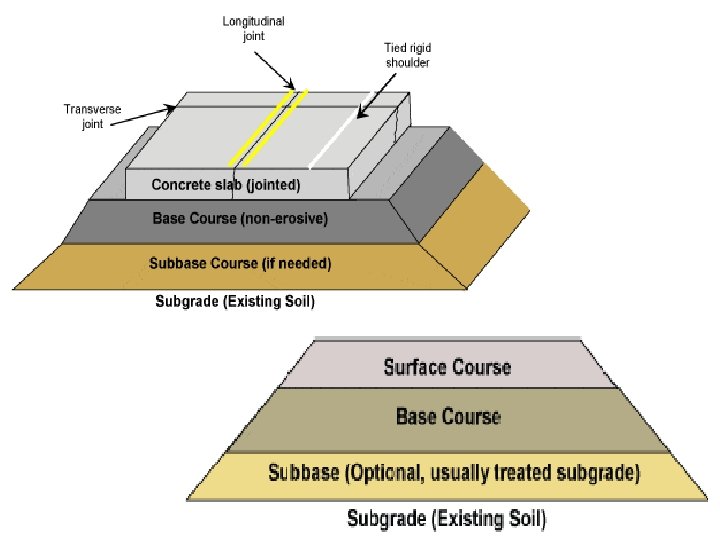
Road Pavement: A layered structure supported by the subgrade soil to form the carriage way of a road is called a road pavement. Flexible Pavement: The road pavements which can change their shape to some extent without rupture are known as rigid pavement. Rigid Pavement: The road pavements which can not change their shape without rupture are known as rigid pavement. Cement Concrete Road: The roads having their wearing surface consisting of cement concrete slab are called cement concrete roads. Optimum Moisture Content: The moisture content at which the soil will compact to its greatest density is called OMC.
Earth Road: The road having its foundation & wearing surface consisting of one or two compacted layers of an ordinary or stabilized soil is known as earth road or kutcha road. Gravel Road: The road having its wearing surface consisting of one or two compacted layers of gravel mixed with sand clay is known as gravel road. Water Bound Macadam Road: The road having its wearing surface consists of clean, crushed aggregates, mechanically interlocked by rolling & bound together with filler material & water laid on a prepared base course is called WBM road. Bituminous Road: The roads having their surface consists of bituminous materials are known as bituminous roads or black top roads.
Types of Excavating Equipment: Excavation is the process of cutting or loosening & removing earth including rock from its original position, transporting & dumping it as a fill or spoil bank. The excavation equipment are needed to highway project. 1) Bull Dozer 2) Scraper 3) Power Shovel 4) Dragline 5) Hoe 6) Clamshell 12
Bull Dozer: Bull dozer is considered to be a versatile earth moving equipment for many construction projects as it may be used for cleaning site, opening up pilot roads moving earth for short haul distance of about 100 m & also in several other jobs. Scraper: It is considered one of the useful earth moving equipment as it is self operating & can dig earth up to a shallow depth, haul & discharge the material in layers of uniform thickness, where required. Power Shovel : It is sued primarily to excavate earth of all classes except rock & to load it into wagons. It may be mounted on crawler tracks & so they are stable & can move at low speeds. 13
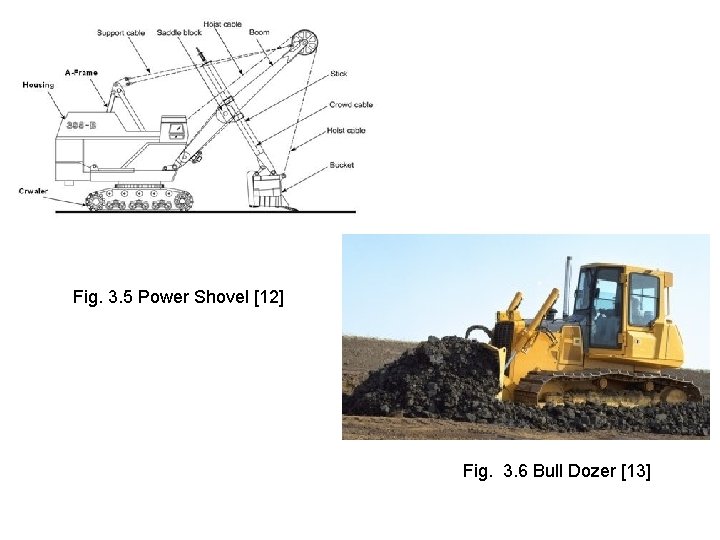
Fig. 3. 5 Power Shovel [12] Fig. 3. 6 Bull Dozer [13]
Hoe: It is an excavating equipment of the power shovel family. It is sue to excavate below the natural surface where the machine is stationed & is capable of having precise control of depth of excavation at close range work. Dragline: It is used to excavate soft soil or earth & to deposit in near by banks or to load into wagons. It may be mounted on crawler track. Clam Shell : It consist of heavy bucket of two halves in the form of a shell, hinged together at top. The shell may be attached to the shovel crane unit or at the bottom of a drag line. It is useful for excavation of loose material at or below existing ground surface. 15
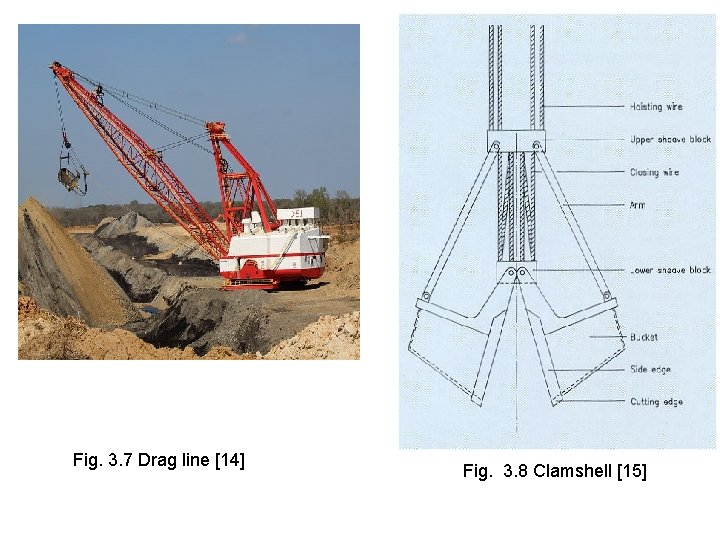
Fig. 3. 7 Drag line [14] Fig. 3. 8 Clamshell [15]
Types of Compacting Equipment : Soil compaction is achieved in the field either by rolling, ramming or by vibration. 1) Rammers 2) Vibrators 3) Rollers 1) Smooth Wheeled Rollers 2) Pneumatic Tyred Rollers 3) Sheeps-foot Roller 17
Pneumatic Tyred Rollers : A number of pneumatic wheels are mounted on two or more axles, under a loaded platform. The gross load of the pneumatic tyred rollers can be substantially increased by adding sand bags or any other load on the platfor. These rollers may be self propelled type or pulled by tractors. Sheeps-foot Rollers : This type of roller consists of hollow steel cylinder with projecting feet. The weight of the roller can be increased by filling the drum with wet soil. The efficiency of the sheeps-foot rollers depends on the weight of the roller & the number of feet in contact with the ground at a time. Sheep-foot rollers are more suited to compact clayey soils. 18
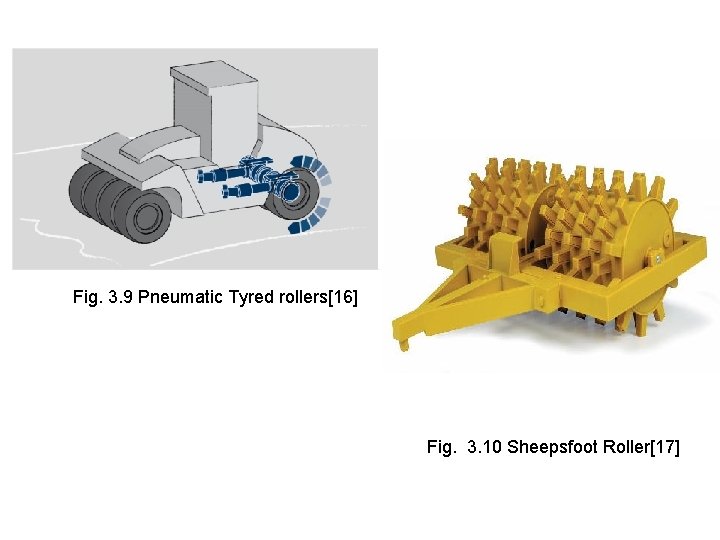
Fig. 3. 9 Pneumatic Tyred rollers[16] Fig. 3. 10 Sheepsfoot Roller[17]
Earth Road : 1) It is cheapest type of road pavement. 2) Camber is very steep and ranges between 1: 20 to 1: 33. 3) The maximum cross slope of 1: 20 is recommended to avoid erosion. 4) Specification of materials: BASE COURSE WEARING COURSE CLAY CONTENT <5% 10 TO 18 % SILT CONTENT 9 TO 32 % 5 TO 15 % SAND CONTENT 60 TO 80 % 65 TO 80 % LIQUID LIMIT < 35 % PLASITICITY INDEX <6% 4 TO 10 % 20
Earth Road : The construction steps of earth roads are as : - 1) Survey is carried out and suitable borrow pits are located within economical haulage distance. 2) Centre line and road edges are marked on the ground along the alignment by driving wooden pegs. 3) Preparation of subgrade: - Clearing site, Excavating and construction of fills, Shaping of subgrade. 4) Pavement construction: - Filled moisture content is checked and additional water is added if necessary to bring it upto OMC. The compaction is carried out. 5) Opening to traffic: - The compacted earth road is allowed to dry out for a few days before opening to traffic. 21
Gravel Road : Constructed using soil-aggregates. These roads falls under category of un-surfaced roads. The construction steps are as : - 1) Soil subgrade of total thickness 300 mm is constructed by compacting the soil in suitable layers at its OMC. 2) After sub-garde gets sufficiently dry, the gravel base course of specified thickness (100 -200 mm) is constructed using the selected gravel in suitable layers. 3) The surface course layers is laid using the selected gravel & the material is compacted. 4) Each above layer is compacted at its OMC to obtain 100% dry density by proctor compaction & light compaction. 5) The cross slope of 4 to 5 % is provided. 22
Water Bound Macadam Roads: The term macadam means, the pavement base course made of crushed or broken aggregate mechanically interlocked by rolling and the void filled with screening and binding material with the assistance of water. The thickness ranges from 10 cm to 7. 5 cm depending on the size and gradation of the aggregate used. The construction steps of water bound macadam road are as follows: 1) Preparation of foundation for receiving the WBM course: - it consist of subgrade or subbase or base course. The foundation layer is prepared to the required grade and camber and also dust and loose material are clean. 2) Provision of lateral confinement: - This is done by constructing the shoulder to the advance , to a thickness equal to that of compacted WBM layer. 3) Spreading of coarse aggregates: - It is spread uniformly to proper profile. The WBM course is normally constructed to compacted thickness of 7. 5 cm. 23 4) Rolling: - it is done by Three Wheeled Power roller of capacity 6 to 10 tonnes.
Water Bound Macadam Roads: 5) Application of Screenings: - Dry screenings are applied gradually over the surface to fill the interstices in the three or more applications. 6) Sprinkling and grouting: - After screening, the surface the sprinkled with water, swept and rolled. 7) Application of binding material: it is applied at a uniform and slow rate in two or more successive thin layers. Murrum or gravel are used for binding. 8) Setting and drying: -After final compaction the WBM course is allow to set over night. 24
Water Bound Macadam Method: WBM Method 1) WBM road construction method is improved method based on Macadam method. 2) Crushed stones mechanically interlocked by rolling & voids filled by screening & binding material with water. 3) Thickness of each compacted layer 7. 5 to 10 cm. 4) Coarse aggregate of size 40 to 90 mm used for sub-base. 5) Subgrade ie lowest portion of pavement is prepared with compacted layer of smaller size broken stones carry the load transmitted. 6) Compacted layer of smaller size stones at bottom replaced the heavy foundation stones used before this. 7) Stresses due to the wheel load of traffic gets decreased at the lower layer of pavement & larger size stones are not necessary at the lowest layer. 8) Compacted stones of smaller size are better for load dispersion. 9) Economical, locally available material is used & not required skilled labor. 10) Maintenance is high & life is less.
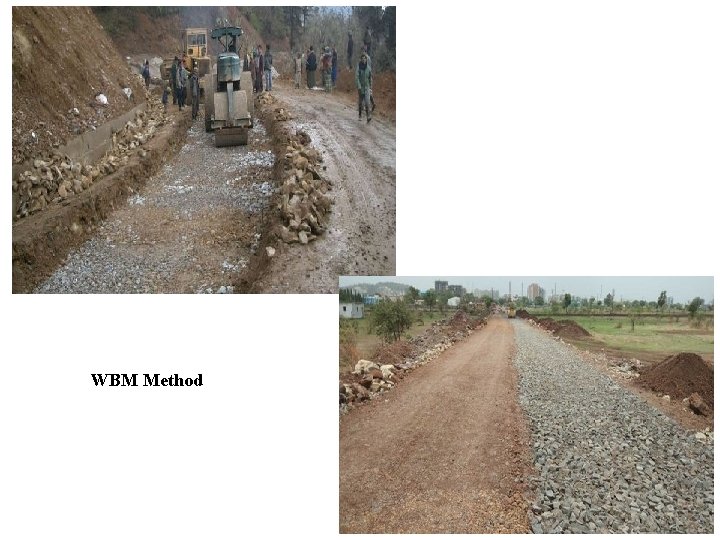
WBM Method
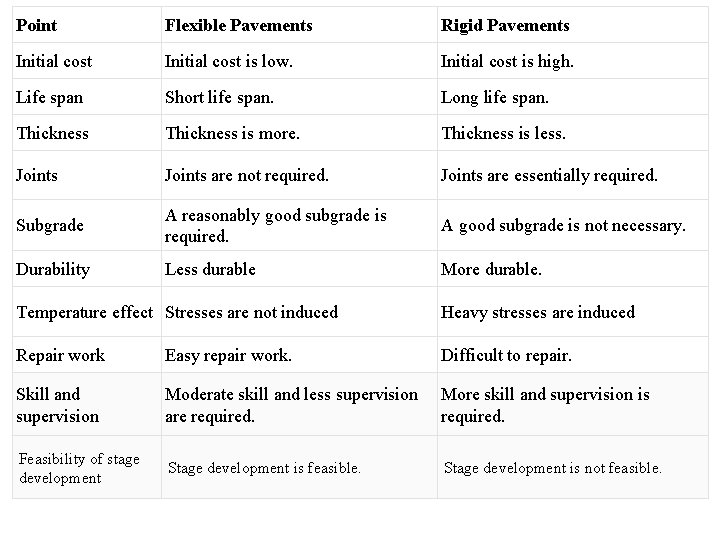
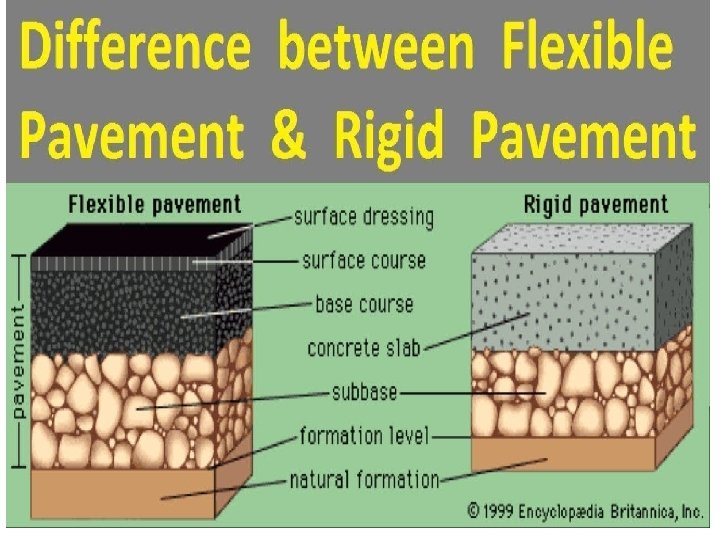
Point Flexible Pavements Rigid Pavements Initial cost is low. Initial cost is high. Life span Short life span. Long life span. Thickness is more. Thickness is less. Joints are not required. Joints are essentially required. Subgrade A reasonably good subgrade is required. A good subgrade is not necessary. Durability Less durable More durable. Temperature effect Stresses are not induced Heavy stresses are induced Repair work Easy repair work. Difficult to repair. Skill and supervision Moderate skill and less supervision are required. More skill and supervision is required. Feasibility of stage development Stage development is feasible. Stage development is not feasible.
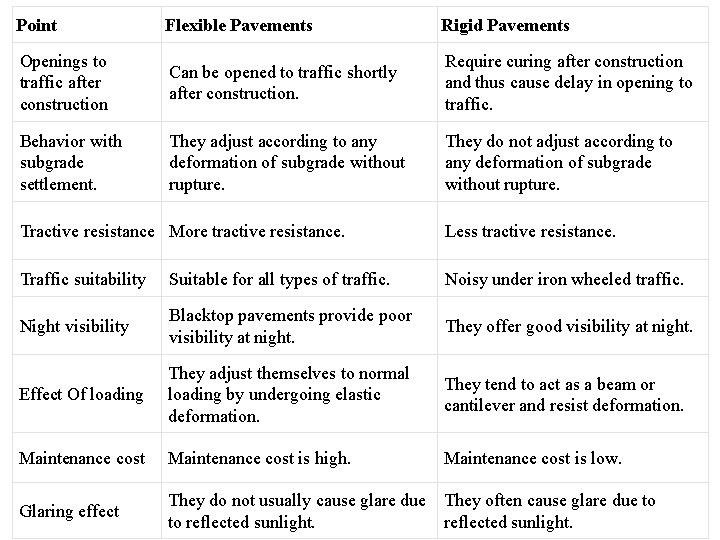
Point Flexible Pavements Rigid Pavements Openings to traffic after construction Can be opened to traffic shortly after construction. Require curing after construction and thus cause delay in opening to traffic. Behavior with subgrade settlement. They adjust according to any deformation of subgrade without rupture. They do not adjust according to any deformation of subgrade without rupture. Tractive resistance More tractive resistance. Less tractive resistance. Traffic suitability Suitable for all types of traffic. Noisy under iron wheeled traffic. Night visibility Blacktop pavements provide poor visibility at night. They offer good visibility at night. Effect Of loading They adjust themselves to normal loading by undergoing elastic deformation. They tend to act as a beam or cantilever and resist deformation. Maintenance cost is high. Maintenance cost is low. Glaring effect They do not usually cause glare due They often cause glare due to to reflected sunlight.
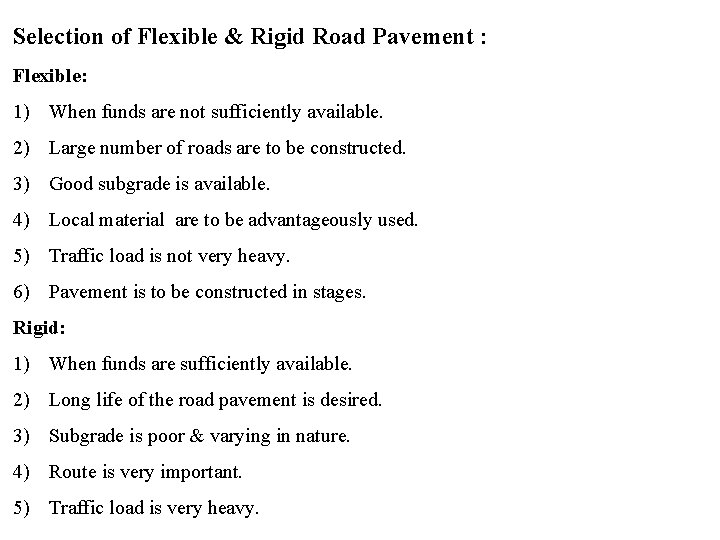
Selection of Flexible & Rigid Road Pavement : Flexible: 1) When funds are not sufficiently available. 2) Large number of roads are to be constructed. 3) Good subgrade is available. 4) Local material are to be advantageously used. 5) Traffic load is not very heavy. 6) Pavement is to be constructed in stages. Rigid: 1) When funds are sufficiently available. 2) Long life of the road pavement is desired. 3) Subgrade is poor & varying in nature. 4) Route is very important. 5) Traffic load is very heavy.
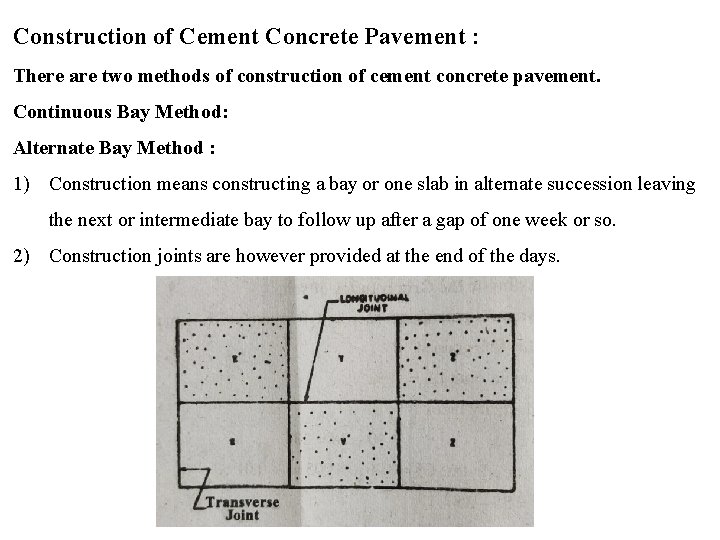
Construction of Cement Concrete Pavement : There are two methods of construction of cement concrete pavement. Continuous Bay Method: Alternate Bay Method : 1) Construction means constructing a bay or one slab in alternate succession leaving the next or intermediate bay to follow up after a gap of one week or so. 2) Construction joints are however provided at the end of the days.
Procedure for Rigid Pavement Construction by Alternate Bay Method : 1) The subgrade is prepared & checked at least two days in advance of correcting. 2) The sub—grade or sub-base is kept in moist condition at the time when the cement concrete is placed. 3) The steel or wooden forms are placed. These have minimum base width of 10 cm for slab thickness of 20 cm & minimum base width of 10 cm for slab thickness of 20 cm & minimum base width of 15 cm for slab over 20 cm & minimum base width of 15 cm for slabs over 20 cm thickness. 4) Material is batched & mixed as per design, then it is transported to the site & placing of concrete is carried out. 5) Spreading is done uniformly. Needle vibrator is employed in lieu of rodding & splicing of the concrete. 6) The surface of pavement is compacted either by means of power driven finishing machine or by a vibrating hand screed. At small width or corner hand consolidation & finishing may be adopted.
Procedure for Rigid Pavement Construction by Alternate Bay Method : 1) The surface of pavement is compacted either by means of power driven finishing machine or by a vibrating hand screed. At small width or corner hand consolidation & finishing may be adopted. 2) The concrete is further compacted by means of longitudinal float. Just before the concrete becomes hard, the surface is belted with two ply canvas belt. After belting pavement is given broom finish with fibre broom brush. 3) Finally curing of newly laid pavement surface is done. For initial curing burlap or cotton mats saturated with water are placed in connect with the surface. In initial curing edges of the slab are banked with soil berm. The soil is thoroughly kept saturated with water for 14 days.

Explain Continuous Bay Method for Rigid Pavement Construction:
Pavement Unevenness: 1) Higher operating speeds are possible on even pavement surfaces with less undulations than on uneven & poor surfaces. 2) Pavement surface should hence be maintained with minimum possible unevenness so that the desired speed can be maintained in conformity with other geometrics standards. 3) Fuel consumption & wear & tear of tyres increases with increase in pavement unevenness. 4) Uneven surfaces also increase fatigue & accident. 5) The pavement surface condition is commonly measured by using an equipment called Bump Integrator, in terms of unevenness index, which is the cumulative measure of vertical undulation of the pavement surface recorded per unit horizontal length of the road.
Unevenness or Undulation on Pavement Caused by: 1) Inadequate or improper compaction of the fill, sub-grade & pavement layers. 2) Un-scientific construction practices including the use of boulder stones & bricks as soiling course over loos sub-grade soil. 3) Use of inferior pavement materials. 4) Improper surface & subsurface drainage. 5) Use of improper construction machinery. 6) Poor maintenances practice. 7) Localized failure due to combination of causes.
- Slides: 35