
TRANSPORTATION ENGINEERING II Activities to consider in pavement
- Slides: 25
TRANSPORTATION ENGINEERING II Activities to consider in pavement design standards
INTRODUCTION • For pavement construction standards must be followed for the activities listed below; – General Considerations. – Pavement Width. – Pavement Design. – Material Testing. – Flexible Pavement Design. – Rigid Pavement Design. – Driveways, Driveway Aprons and Loading. Unloading Berths, Storage Areas and Parking Lots.
INTRODUCTION – Allowable Pavement Construction Materials. – Sub-grade Preparation. – Grades. – Sight Distances. – Curbs and Gutters. – Side Walks.
General Considerations • Codes and Specification approved by related Government department. • Classification and specification for the pavements. • Pavement Design and right of way.
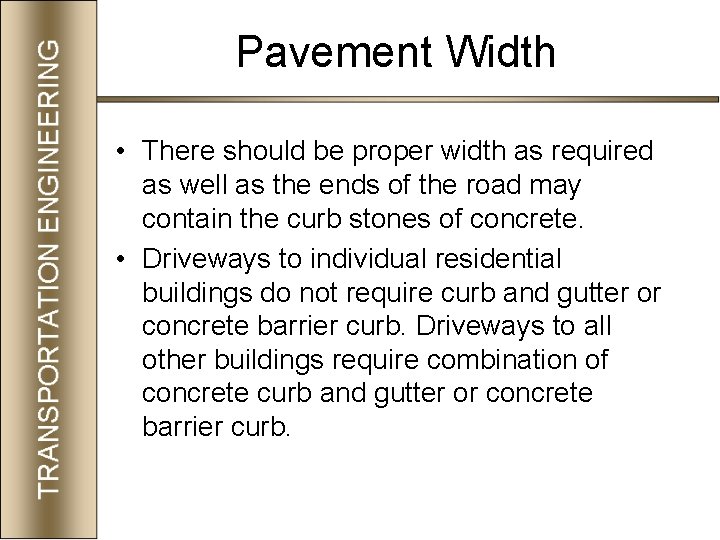
Pavement Width • There should be proper width as required as well as the ends of the road may contain the curb stones of concrete. • Driveways to individual residential buildings do not require curb and gutter or concrete barrier curb. Driveways to all other buildings require combination of concrete curb and gutter or concrete barrier curb.
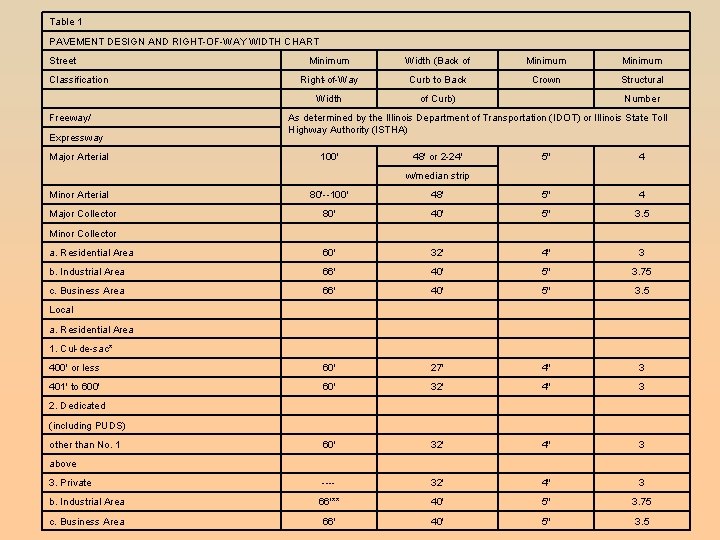
Table 1 PAVEMENT DESIGN AND RIGHT-OF-WAY WIDTH CHART Street Classification Freeway/ Expressway Major Arterial Minimum Width (Back of Minimum Right-of-Way Curb to Back Crown Structural Width of Curb) Number As determined by the Illinois Department of Transportation (IDOT) or Illinois State Toll Highway Authority (ISTHA) 100' 48' or 2 -24' 5" 4 w/median strip Minor Arterial 80'--100' 48' 5" 4 80' 40' 5" 3. 5 a. Residential Area 60' 32' 4" 3 b. Industrial Area 66' 40' 5" 3. 75 c. Business Area 66' 40' 5" 3. 5 400' or less 60' 27' 4" 3 401' to 600' 60' 32' 4" 3 ---- 32' 4" 3 b. Industrial Area 66'** 40' 5" 3. 75 c. Business Area 66' 40' 5" 3. 5 Major Collector Minor Collector Local a. Residential Area 1. Cul-de-sac* 2. Dedicated (including PUDS) other than No. 1 above 3. Private
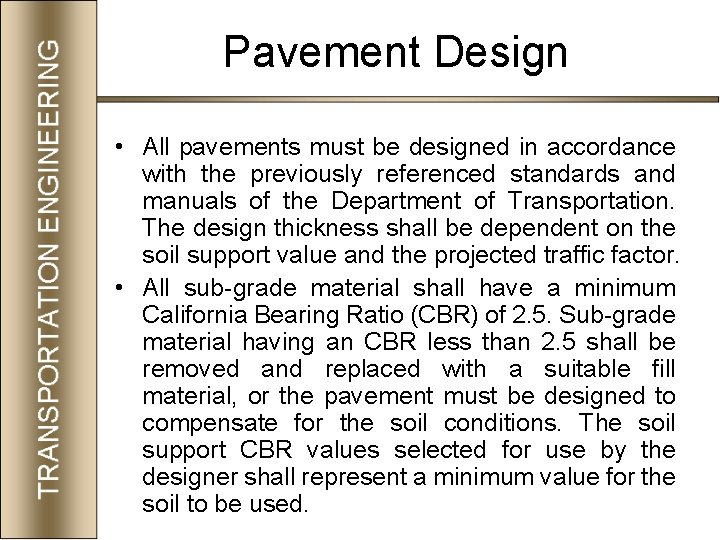
Pavement Design • All pavements must be designed in accordance with the previously referenced standards and manuals of the Department of Transportation. The design thickness shall be dependent on the soil support value and the projected traffic factor. • All sub-grade material shall have a minimum California Bearing Ratio (CBR) of 2. 5. Sub-grade material having an CBR less than 2. 5 shall be removed and replaced with a suitable fill material, or the pavement must be designed to compensate for the soil conditions. The soil support CBR values selected for use by the designer shall represent a minimum value for the soil to be used.
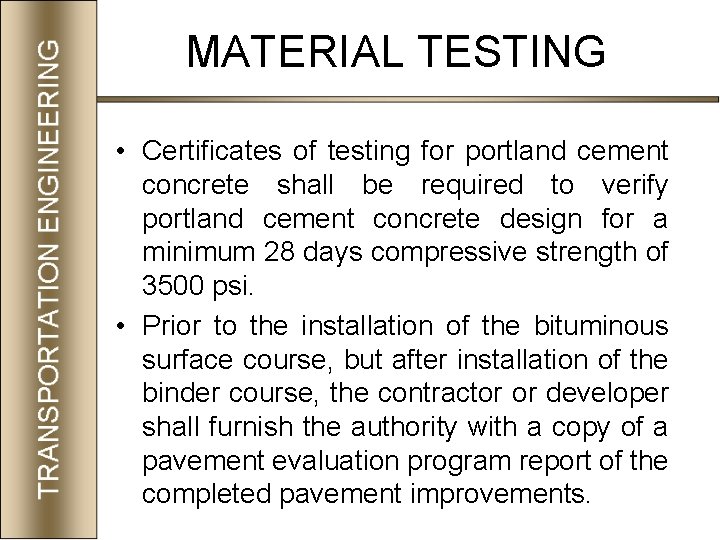
MATERIAL TESTING • Certificates of testing for portland cement concrete shall be required to verify portland cement concrete design for a minimum 28 days compressive strength of 3500 psi. • Prior to the installation of the bituminous surface course, but after installation of the binder course, the contractor or developer shall furnish the authority with a copy of a pavement evaluation program report of the completed pavement improvements.
Flexible Pavements • The design of all flexible pavements shall be based on the minimum structural design number for the type of road in question. • A minimum of two and one-half inches of compacted asphalt is required on all pavements with a structural number of 3. 00 -3. 99. This surface shall consist of one inch wearing surface, and onehalf inches of binder course.
• Pavements with a structural number of 4. 00 -4. 99 will require three inches of asphalt. This surface shall consist of one inch wearing surface and two inches of binder. • After receipt of the pavement evaluation program report, the authority reviews the reports and performs an inspection of the existing base and binder courses. All base and binder course failures will then be repaired to the authority’s satisfaction. This may include, but not be limited to, crack grouting, crack filling and crack sealing.
Rigid Pavements • The design of all concrete pavements shall be based on the minimum thickness as determined by multiplying the structural coefficient for concrete pavements (0. 5). (Table 2). • The thickness shall be rounded up to the nearest one-half inch. Concrete pavement shall be reinforced with rigid wire mesh (six inch by six inch #6 rigid fabric), if required.
Driveways, Driveway Aprons etc. • Driveways. – Driveways for single-family residential buildings be a minimum of nine feet in width. – Driveways for residential buildings must be constructed of a minimum of two inches bituminous concrete surface over six inches aggregate base course (crushed) or four inches concrete pavement. The grade or pitch of driveways shall not be toward or in the direction of the residence.
– Driveways for commercial or industrial buildings shall be constructed of one inch of bituminous surface and one-half inches of bituminous concrete binder over either ten inches of crushed stone or five inches of bitumen aggregate mixture (BAM) at 1900 Marshall Stability. – Residential historic landmarks may retain any currently existing gravel driveways.
• Aprons. – Aprons for residential building shall be constructed of either a minimum of five inches of non-reinforced concrete pavement or two inches of bituminous concrete surface over eight inches of crushed stone. – Aprons for commercial or industrial buildings shall be constructed of a minimum of eight inch reinforced concrete (six inch by six inch #6 rigid fabric) on a two-inch base of grade 9 gravel.
• Loading-unloading berths. – Berths provided in non-residential areas for loading and unloading of materials or merchandise from vehicles must be constructed of a minimum eight inch reinforced concrete pavement. • Pavement requirements for storage areas. – All outside areas used for the storage of materials, products or vehicles in nonresidential areas shall be a minimum six inch reinforced concrete pavement (six inch by six inch rigid fabric).
• Resurfacing and widening. – A minimum of one inch of bituminous concrete surface overlay will be permitted over existing driveways, aprons, loading and unloading berths, and storage areas. • Parking lots. – Base course construction and surfacing. This design shall pertain to all open offstreet parking areas and aisles, except parking spaces.
– Surface course shall be a minimum of one inch bituminous concrete surface course, compacted. – Binder course shall be a minimum of 1 and 11/2 inch bituminous concrete binder course, compacted. The binder course and surface course shall be laid in two lifts. – Base course shall be a minimum of ten inches of crushed stone, or five inches of bituminous aggregate mixture (BAM) at a minimum Marshall Stability of 1900, compacted.
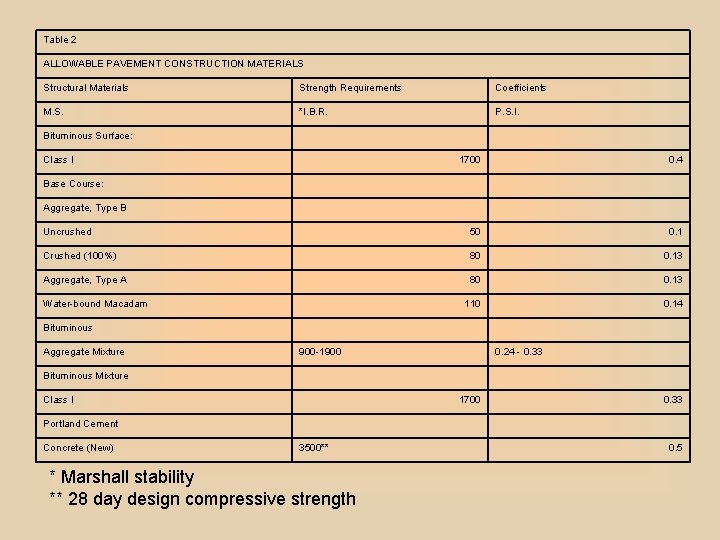
Allowable Pavement Construction Materials • Table 2 indicates the approved materials which can be used for roadway construction. Listed with these materials are the coefficients to be used for approved pavement structural number. The coefficients, when multiplied by the thickness of the materials, will yield the structural number. • Portland cement concrete shall be proportioned according to the applicable sections of the State Standard Specifications and shall be designed for a minimum 28 days compressive strength of 3500 P. S. I. Air entrainment shall be 4 --7% and slump between two inches and four inches.
Table 2 ALLOWABLE PAVEMENT CONSTRUCTION MATERIALS Structural Materials Strength Requirements Coefficients M. S. *I. B. R. P. S. I. Bituminous Surface: Class I 1700 0. 4 Uncrushed 50 0. 1 Crushed (100%) 80 0. 13 Aggregate, Type A 80 0. 13 110 0. 14 Base Course: Aggregate, Type B Water-bound Macadam Bituminous Aggregate Mixture 900 -1900 0. 24 - 0. 33 Bituminous Mixture Class I 1700 0. 33 Portland Cement Concrete (New) 3500** * Marshall stability ** 28 day design compressive strength 0. 5
SUBGRADE PREPARATION • The sub-grade of all roads shall be graded and rolled in accordance with Section 212 of the Standard Specifications for Road and Bridge Construction, current edition, by the Department of Transportation, hereinafter referred to as "State Standard Specifications. • At least one standard density test (performed in accordance with AASHTO-T 99) shall be taken in each fill section, with the maximum distance between tests of 300 feet. One standard proctor test shall be taken from each different source of borrowed material.
Grades • The longitudinal gradient shall not be in excess of 4% on all dedicated streets. • Where the gradient of the street warrants installation of vertical-type curb and other special design of improvements due to right-of-way conditions. • The minimum length of vertical curves shall be 100 feet for 1. 5% difference of grade. For each additional 1% difference in grade over 1. 5%, a 50 -feet increment shall be added to the length of vertical curve. If the grade difference is less than 1. 5%, a vertical curve is not required.
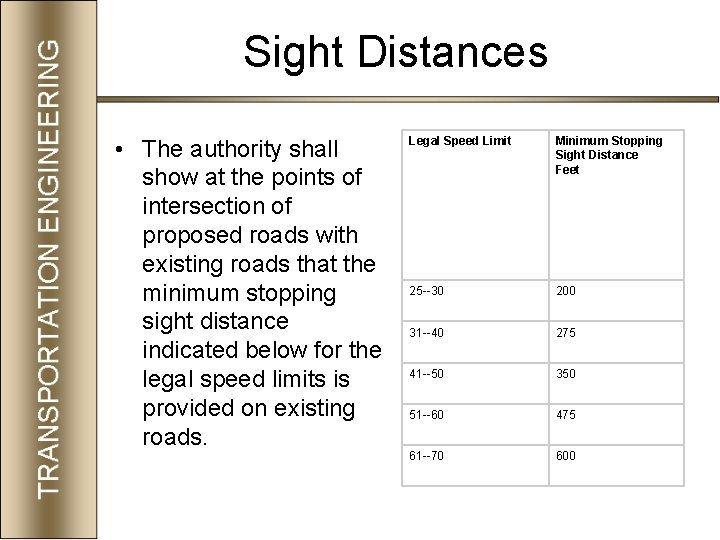
Sight Distances • The authority shall show at the points of intersection of proposed roads with existing roads that the minimum stopping sight distance indicated below for the legal speed limits is provided on existing roads. Legal Speed Limit Minimum Stopping Sight Distance Feet 25 --30 200 31 --40 275 41 --50 350 51 --60 475 61 --70 600
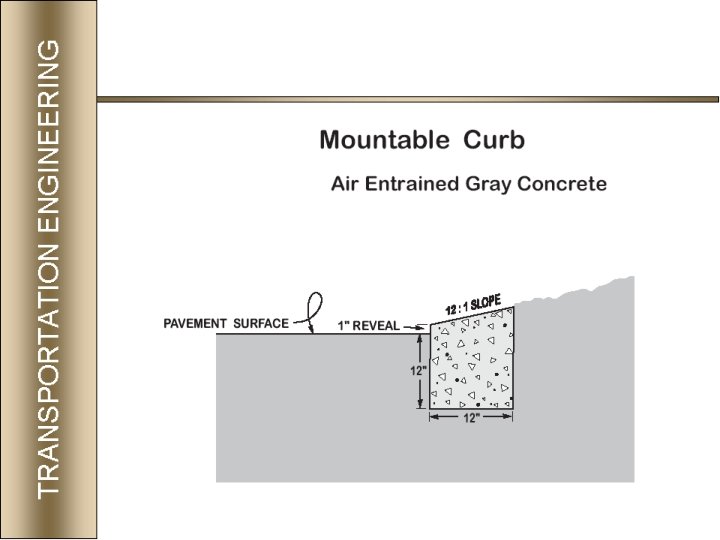
Curb and Gutter • Barrier curb shall be utilized in all commercial and industrial developments, all collector streets, and on the radius of street returns in residential areas. • Mountable curbs can be utilized on newly constructed, local residential streets.
Sidewalks • Sidewalks shall be constructed of Portland cement concrete in accordance with Section 624 of the State Standard Specifications. Said sidewalks shall be five feet in width on all streets with a pavement (back-to-back) greater than 32 feet and four feet in width in all other locations. The sidewalks shall be a minimum of five inches thick. • Sidewalks are required along both sides of all streets