
Transportation and the Role of the Planner Civil
- Slides: 31
Transportation and the Role of the Planner Civil Engineering 451/551 Fall Semester 2008 Presented by: Phil Mescher, AICP Office of Systems Planning, Iowa Department of Transportation Des Moines, Iowa
Purpose of Today’s Presentation • Overview of the Role the DOT plays • Discuss Jurisdiction over Transportation Infrastructure • Discuss System Performance Measures • Tour the DOT Organizational Structure • Define the Steps in the Statewide Planning Process • Cover the Planners Role in Transportation • Discuss Areas of Planning Expertise • Job Requirements and Opportunities
Role of the State DOT • The State Department of Transportation is responsible for the overall connectivity of all modes of transportation in the state, even if the DOT does not have direct jurisdiction
Highways-- Jurisdiction • • State Highway System County Road System City Road System Federal Aid System – State – City – County
DOT Covers All Modes • • • Highway Rail Aviation Transit Water
Iowa Facts Iowa has: • 114, 194 miles of roads 9, 393 maintained by the DOT 79% of the roads are county roads Roughly 30, 000 miles are paved (35%) 13 th highest in the nation • 24, 598 bridges 5 th highest in nation
DOT Organization • Governor • Transportation Commission – (7 Members appointed by Governor) • DOT Director – General Counsel • 5 Divisions – – – Highway Division Information Technology Planning, Programming, Modal Motor Vehicle Operations and Finance • 6 Transportation Districts
Statewide Planning • The purpose of statewide transportation planning is to outline strategic investments in facilities and services that are necessary to meet expected future deficiencies and to identify the operational and technological changes in the existing network that will improve transportation service.
Definition of Statewide Planning • Statewide Multimodal Transportation Planning is the process of identifying the most cost-effective and appropriate set of transportation strategies that will provide a DESIRED LEVEL OF PERFORMANCE for the state’s transportation system in relation to a set of desired goals and outcomes, thus helping the state meet the needs of its citizens and of those dependent upon the state’s products for their livelihood
Iowa Goal • The transportation goal of Iowa is to provide and preserve adequate safe, and efficient, transportation services based on the use by and benefits to the public.
Performance Measures • Highways – V/C ratio, minutes of delay, crashes/hmm • Transit – passengers/vehicle hour, operating ratio (revenue/cost) • Airports – Airside, landside, terminal System performance is the ultimate test --quality of life, environmental quality
Iowa Policies 1. Address user needs and maximize the economic and social benefits for Iowa 2. Provide a participatory planning process 3. Encourage and support programs to provide commodity movement and mobility for all citizens 4. Develop, promote, administer, and enforce just and equitable procedures for the registration, regulation, and operation of motor vehicles, aircraft, and common carriers of passengers and freight 5. Promote financing the system through user and non-user sources 6. Administer the land resources under the State’s jurisdiction in a manner that protects the rights of individuals and considers the effects on the environment 7. Promote a transportation research and technology transfer program to develop and improve services, methods, and materials.
Statewide Transportation Plan • Focus on needs that concern the state • Include all modes • Financial Resources • Coordinated and Integrated • Shared and consistent data collection strategy • Common set of assumptions • Common performance measures • Each plan should serve as input to others • Formal public participation process • Relate all plans to realistic financial strategies
Statewide Transportation Improvement Plan • Capital projects (highways, bridges, buses) and operating projects (transit operating) that require federal funding • “Regionally significant projects” must be in • Must be financially constrained • Must maintain performance levels
Information in a STIP • • • Project description Estimated cost Federal funds by year and category Non-federal match for year 1 Responsible agency Air Quality conformity -- for nonattainment areas
Steps in Statewide Planning • • Vision, Goals, and Objectives Performance, Linkages, and Deficiencies Identify Issues Identify and Analyze Alternatives Financial Planning and Programming System Monitoring Traffic Forecasting/Modeling
The Transportation Planner • Can fill a multitude of roles to aid in reaching goals • Entry Level Planner • Senior Level Planner • Office/Division Head
The Transportation Planner • Education Requirements – Bachelor’s Degree • • • Planning Engineering Accounting Geography Economics
The Transportation Planner • Job Responsibilities – General Planning • • Write Plans Economic Analysis Policy Analysis Grant Writing/Administration Financial Environmental/ NEPA Modal Public Involvement – Technical • • • Travel Demand Modeling Traffic Forecasting Pavement Analysis GIS Air Quality Safety
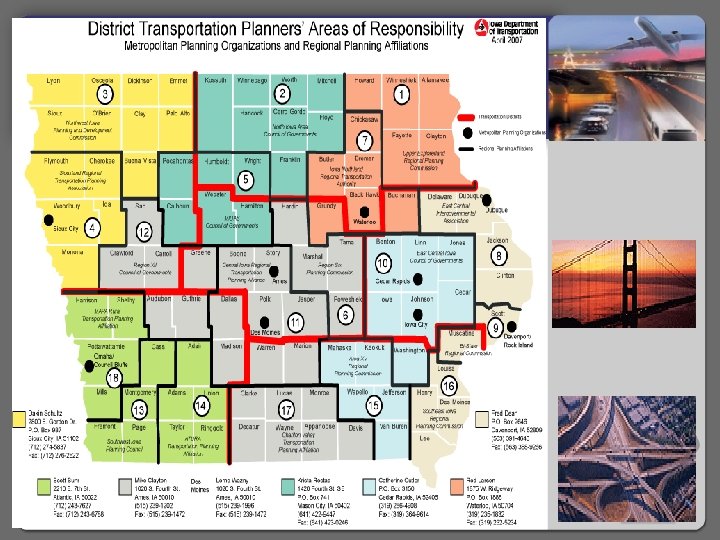
The Transportation Planner • • • District Transportation Planner Liaison with Locals Public Meetings Project Coordination Public Speaking! Meetings
The Transportation Planner (outside the DOT) • • Consulting FHWA/US DOT Metropolitan Planning Organization Regional Planning Affiliation University Research/Education City/County Other Governmental Entities – Census Bureau
Transportation Areas of Knowledge • This is a list of areas of interest where a transportation planner should be knowledgeable.
Planning Process • Metropolitan, Regional and Statewide Planning Process – LRTP, TIP, UPWP, PTDP • Legislation (SAFETEA-LU) • Funding Mechanisms – Gas Tax, registration, bonding, tolls – (Time 21) • Federal Funding Flowcharts/STP/TE Distribution
Planning Process • Programming – TIP/STIP/5 -year program • Grant Administration • NEPA – CE, EA(FONSI), EIS(ROD) • Systems – – – FFC F 2 M NHS Interstate CIN
Planning Process • Modal – – – Bike/Ped Rail Transit Highway Water • Planning Boundaries – Urbanized Area (Census) – Urban Area (FHWA) – Planning Area (Local)
Planning Process • Data – Census • CTPP – Survey • NHTS • NPTS – Reebie/Transearch – REMI
Planning Process • Traffic Forecasting/Modeling • System Monitoring – Traffic Count Program • Geographic Information Systems – Cartography/Map Making • Engineering Basics/Terminology • Traffic Impact Studies • Interchange Justification
Planning Process • Safety Analysis – Crash Data • Asset Management – Pavements/Infrastructure • Access Management • Land Use and Development • Real Estate Basics
Planning Process • • • Civil Rights Title VI – Discrimination Impact on the Human Environmental Justice DBE/On Job Training JARC
Questions? Contact Information: Phil Mescher, AICP Office of Systems Planning Iowa Department of Transportation 515 -239 -1629 Phil. mescher@dot. iowa. gov