
Transport of power Simplest schema of power system
![Parameters of power line Resistance R [Ω] (longitudinal element, serial) Leakage (conductivity of line](https://slidetodoc.com/presentation_image_h/0e222e1bc666907ee59319bc1cf7e195/image-2.jpg "Parameters of power line Resistance R [Ω] (longitudinal element, serial) Leakage (conductivity of line")
- Slides: 61
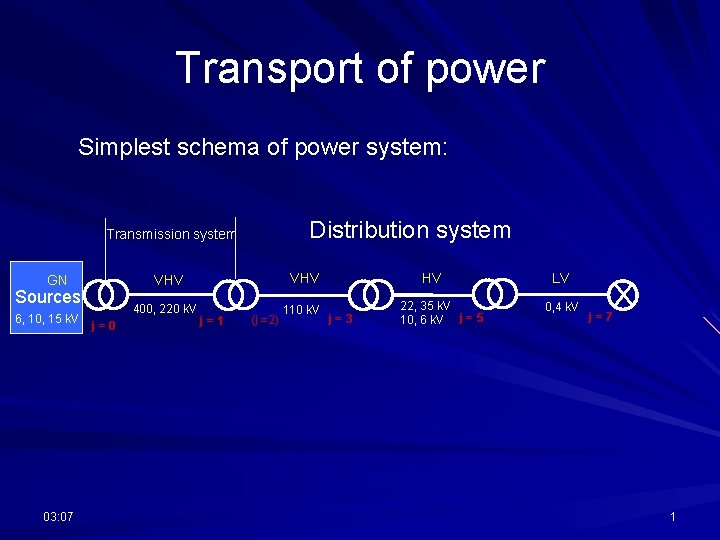
Transport of power Simplest schema of power system: Distribution system Transmission system Sources 6, 10, 15 k. V 03: 07 VHV GN 400, 220 k. V j=0 j=1 (j =2) 110 k. V HV j=3 22, 35 k. V 10, 6 k. V j = 5 LV 0, 4 k. V j=7 1
Parameters of power line Resistance R [Ω] (longitudinal element, serial) Leakage (conductivity of line insulation) G [S] (transverse element, parallel) Inductive reactance XL [Ω] (longitudinal, serial) Capacity admitance (sukceptance) BC [S] (transverse, parallel) ^I 2 ^I 1 R G 03: 07 XL BC 2
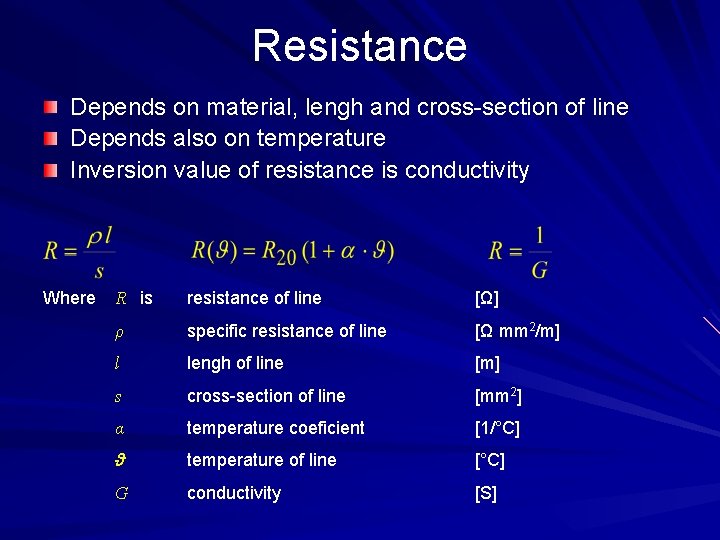
Resistance Depends on material, lengh and cross-section of line Depends also on temperature Inversion value of resistance is conductivity Where R is resistance of line [Ω] ρ specific resistance of line [Ω mm 2/m] l lengh of line [m] s cross-section of line [mm 2] α temperature coeficient [1/°C] ϑ temperature of line [°C] G conductivity [S]
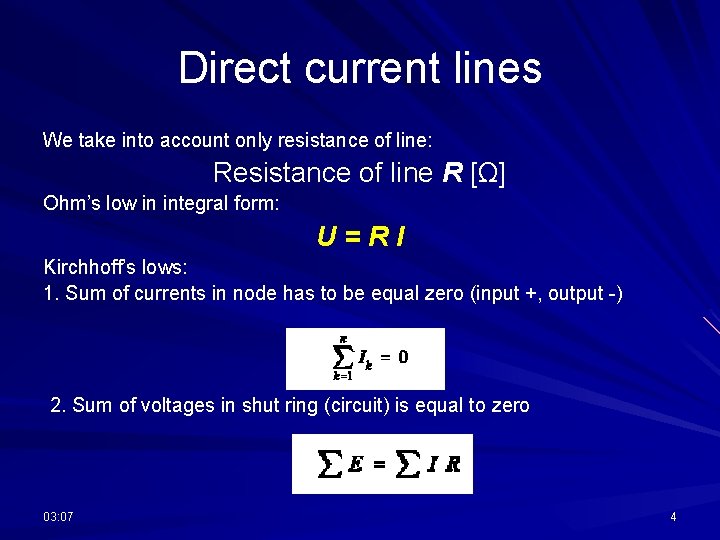
Direct current lines We take into account only resistance of line: Resistance of line R [Ω] Ohm’s low in integral form: U=RI Kirchhoff’s lows: 1. Sum of currents in node has to be equal zero (input +, output -) 2. Sum of voltages in shut ring (circuit) is equal to zero 03: 07 4
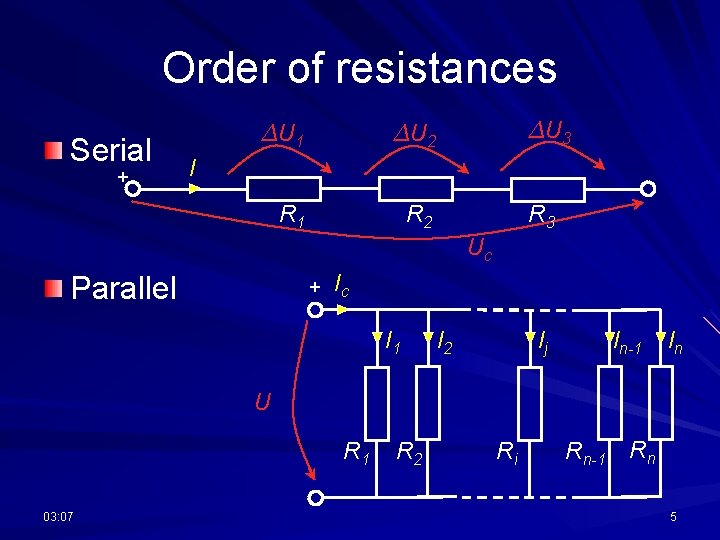
Order of resistances Serial + ΔU 1 ΔU 2 R 1 R 2 ΔU 3 I R 3 Uc Parallel + Ic I 1 I 2 Ij In-1 In U R 1 03: 07 R 2 Ri Rn-1 Rn 5
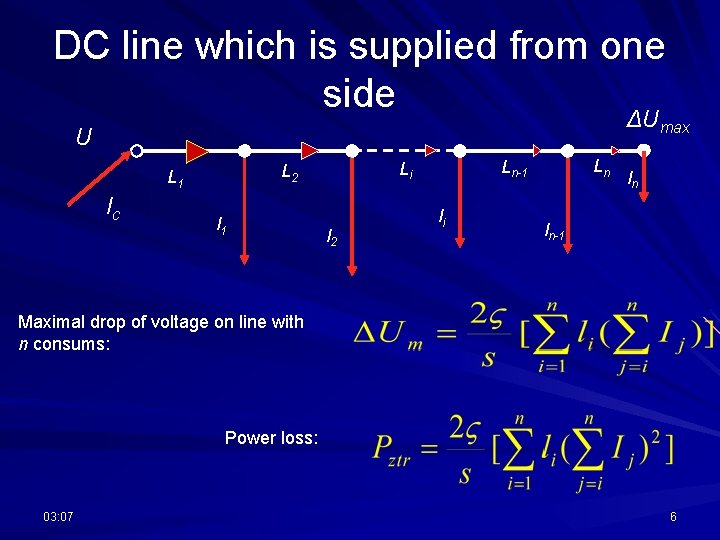
DC line which is supplied from one side ΔU max U lc l 1 l 2 Ln Ln-1 Li L 2 L 1 li ln ln-1 Maximal drop of voltage on line with n consums: Power loss: 03: 07 6
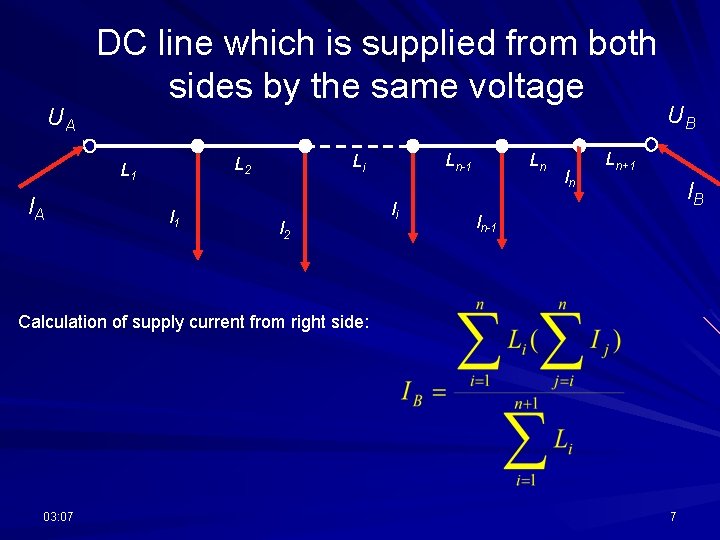
UA DC line which is supplied from both sides by the same voltage l. A l 1 Ln-1 Li L 2 L 1 l 2 li Ln ln UB Ln+1 l. B ln-1 Calculation of supply current from right side: 03: 07 7
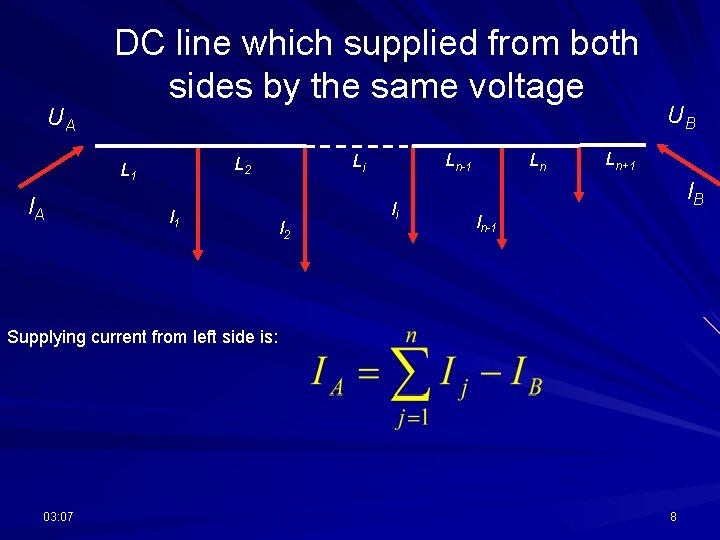
UA DC line which supplied from both sides by the same voltage l. A l 1 Ln-1 Li L 2 L 1 l 2 li Ln UB Ln+1 l. B ln-1 Supplying current from left side is: 03: 07 8
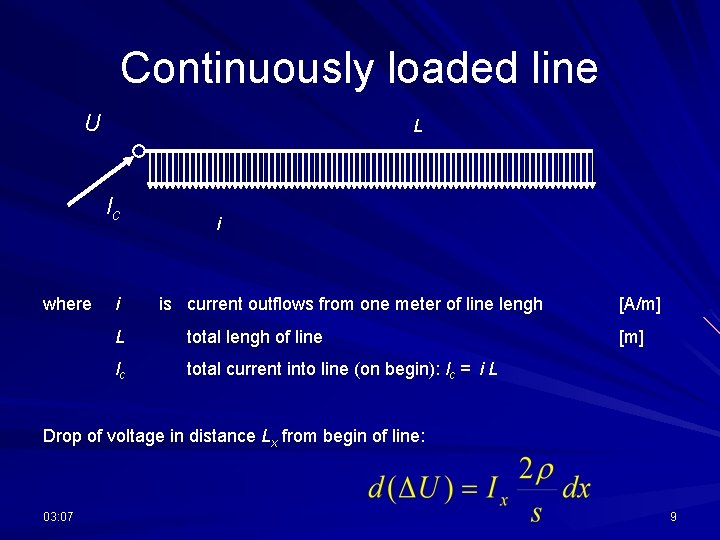
Continuously loaded line U L lc where i i is current outflows from one meter of line lengh L total lengh of line lc total current into line (on begin): lc = i L [A/m] [m] Drop of voltage in distance Lx from begin of line: 03: 07 9
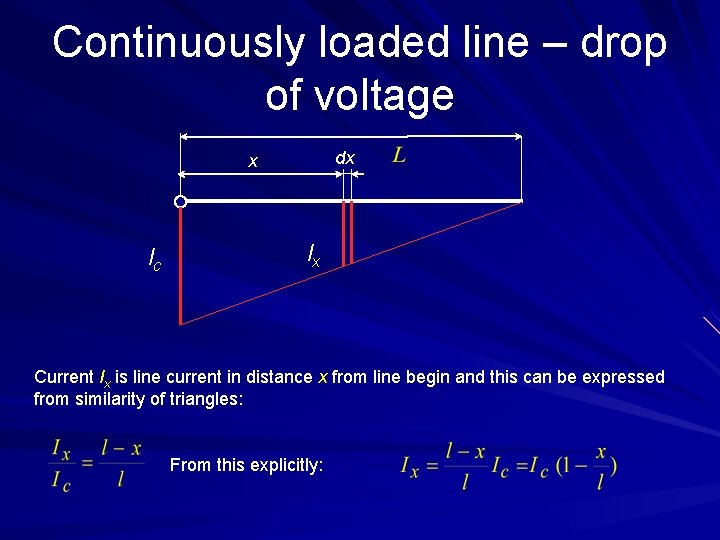
Continuously loaded line – drop of voltage dx x lc lx Current Ix is line current in distance x from line begin and this can be expressed from similarity of triangles: From this explicitly:
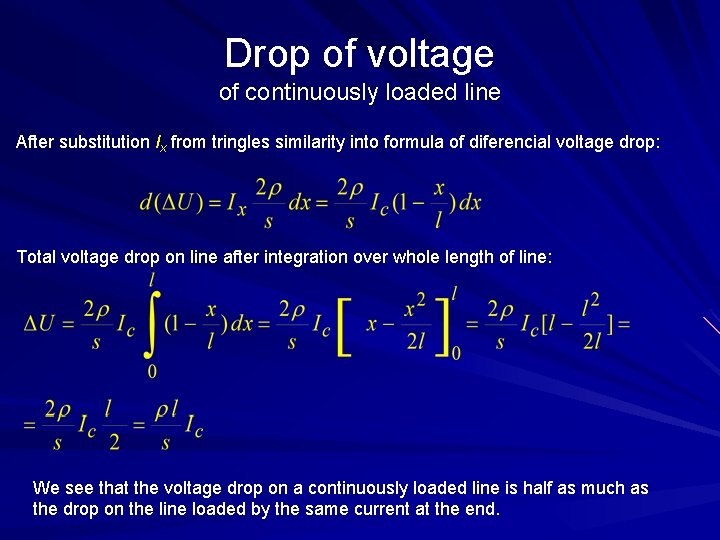
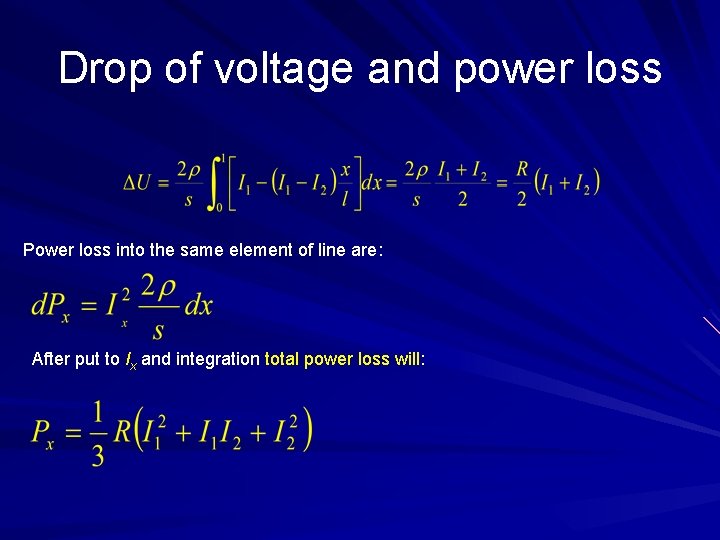
Drop of voltage of continuously loaded line After substitution Ix from tringles similarity into formula of diferencial voltage drop: Total voltage drop on line after integration over whole length of line: We see that the voltage drop on a continuously loaded line is half as much as the drop on the line loaded by the same current at the end.
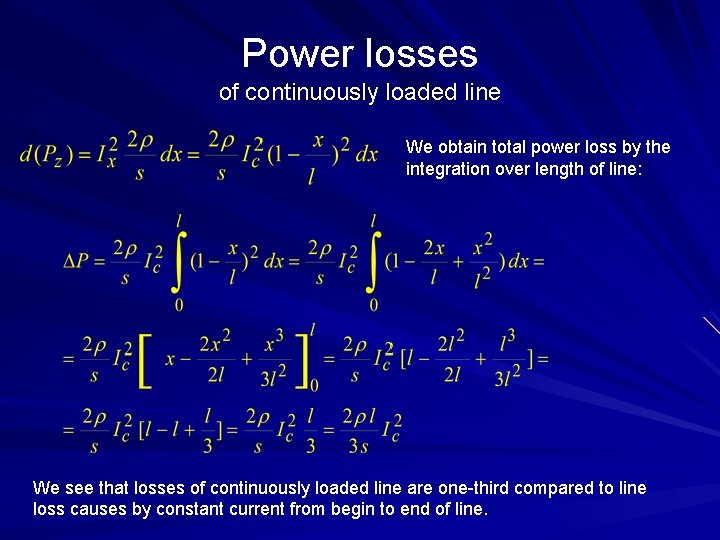
Power losses of continuously loaded line We obtain total power loss by the integration over length of line: We see that losses of continuously loaded line are one-third compared to line loss causes by constant current from begin to end of line.
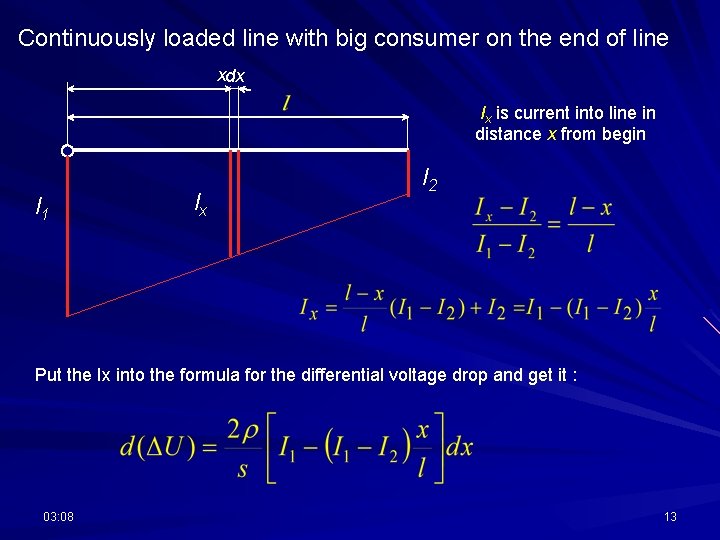
Continuously loaded line with big consumer on the end of line xdx Ix is current into line in distance x from begin l 1 lx l 2 Put the Ix into the formula for the differential voltage drop and get it : 03: 08 13
Drop of voltage and power loss Power loss into the same element of line are: After put to Ix and integration total power loss will:
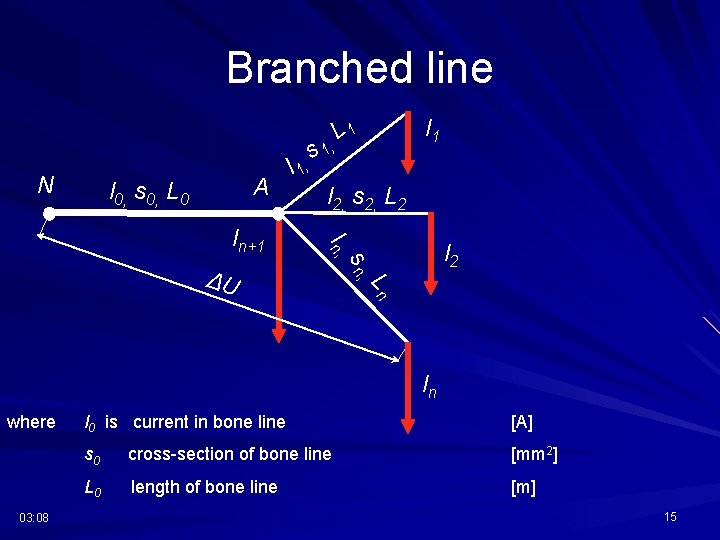
Branched line N A l 0, s 0, L 0 s l 1 L 1 l 2, s 2, L 2 l n, In+1 l 1, s n, Ln ΔU ln where 03: 08 l 0 is current in bone line [A] s 0 cross-section of bone line [mm 2] L 0 length of bone line [m] 15
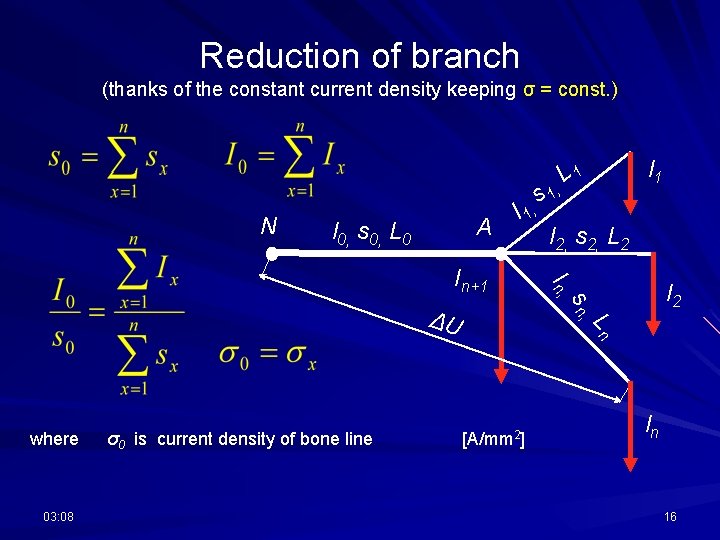
Reduction of branch (thanks of the constant current density keeping σ = const. ) N A l 0, s 0, L 0 l 1, l 2 Ln 03: 08 σ0 is current density of bone line l 2, s 2, L 2 s n, ΔU where s 1 l n, In+1 l 1 1 L , [A/mm 2] ln 16
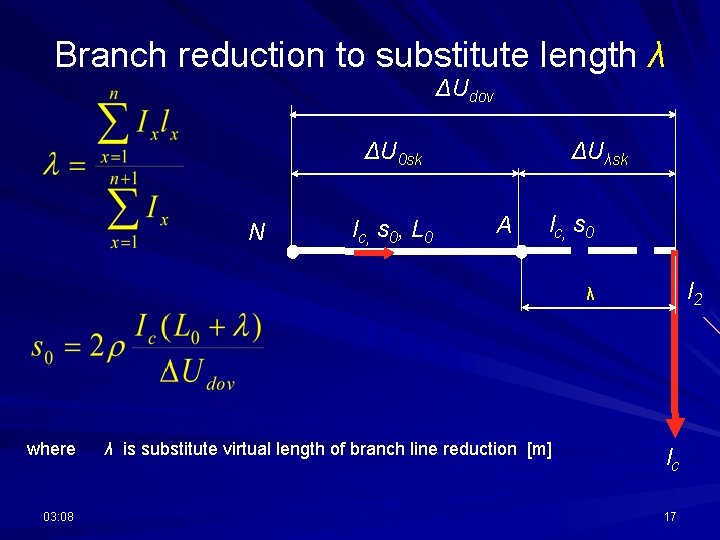
Branch reduction to substitute length λ ΔUdov ΔU 0 sk N lc, s 0, L 0 ΔUλsk A lc, s 0 l 2 λ where 03: 08 λ is substitute virtual length of branch line reduction [m] lc 17
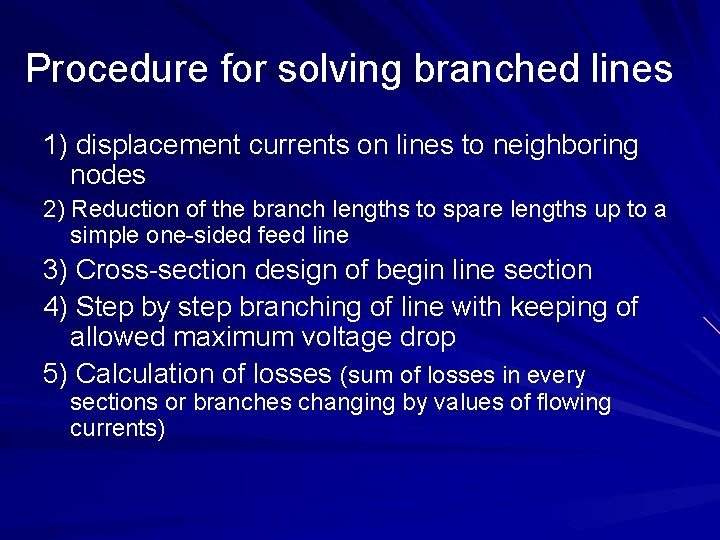
Procedure for solving branched lines 1) displacement currents on lines to neighboring nodes 2) Reduction of the branch lengths to spare lengths up to a simple one-sided feed line 3) Cross-section design of begin line section 4) Step by step branching of line with keeping of allowed maximum voltage drop 5) Calculation of losses (sum of losses in every sections or branches changing by values of flowing currents)
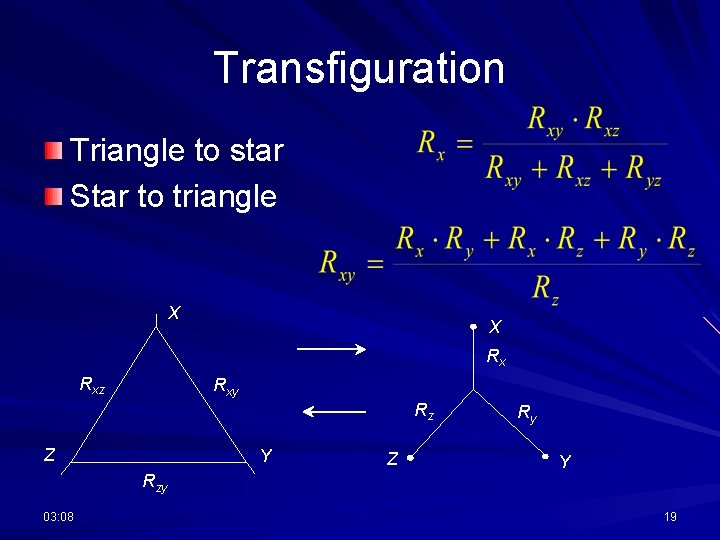
Transfiguration Triangle to star Star to triangle X X Rx Rxz Rxy Rz Z Y Rzy 03: 08 Z Ry Y 19
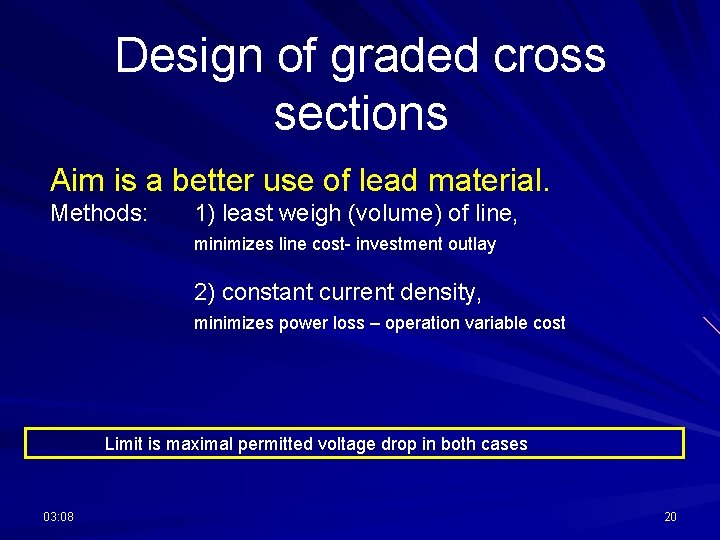
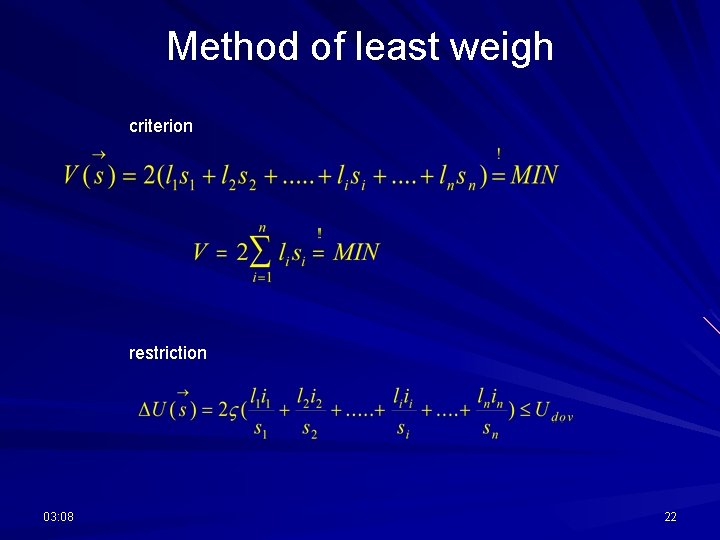
Design of graded cross sections Aim is a better use of lead material. Methods: 1) least weigh (volume) of line, minimizes line cost- investment outlay 2) constant current density, minimizes power loss – operation variable cost Limit is maximal permitted voltage drop in both cases 03: 08 20
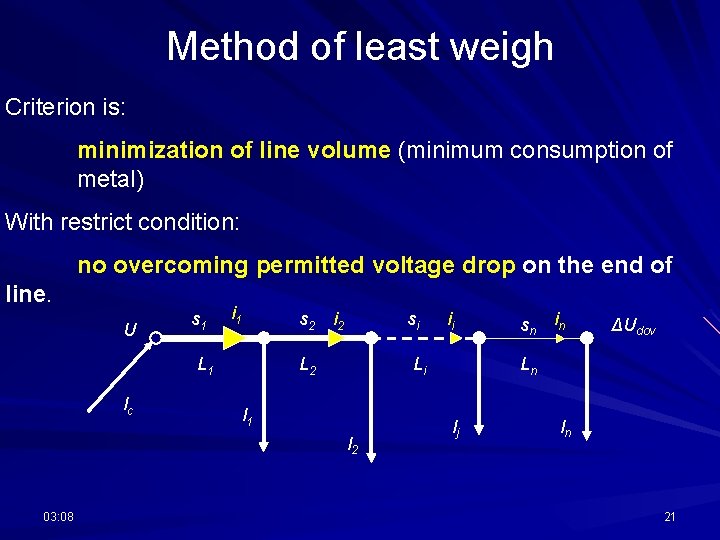
Method of least weigh Criterion is: minimization of line volume (minimum consumption of metal) With restrict condition: no overcoming permitted voltage drop on the end of line. U s 1 i 1 s 2 L 1 lc i 2 si L 2 Li l 1 l 2 03: 08 ii sn in ΔUdov Ln lj ln 21
Method of least weigh criterion restriction 03: 08 22
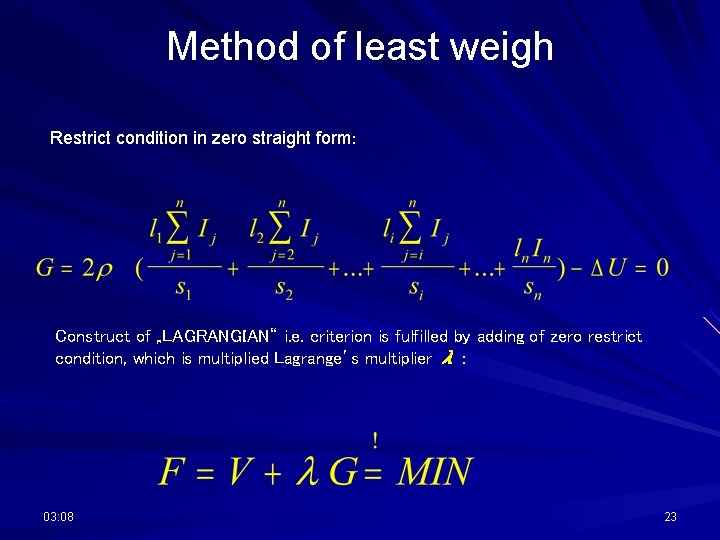
Method of least weigh Restrict condition in zero straight form: Construct of „LAGRANGIAN“ i. e. criterion is fulfilled by adding of zero restrict condition, which is multiplied Lagrange’s multiplier λ : 03: 08 23
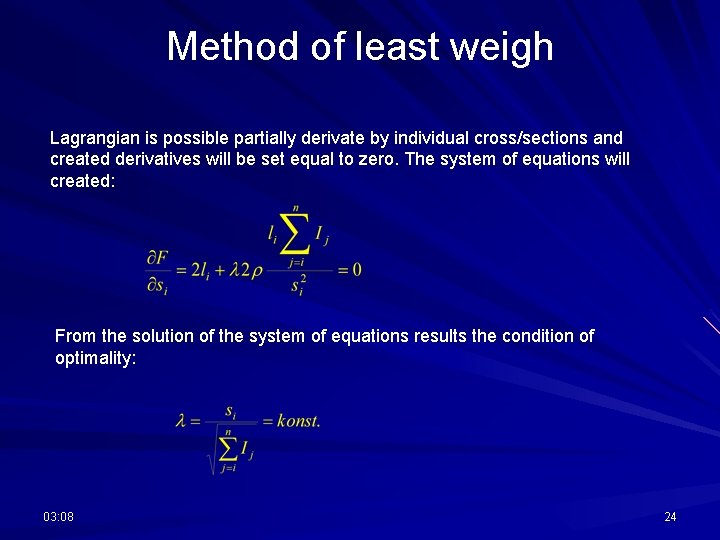
Method of least weigh Lagrangian is possible partially derivate by individual cross/sections and created derivatives will be set equal to zero. The system of equations will created: From the solution of the system of equations results the condition of optimality: 03: 08 24
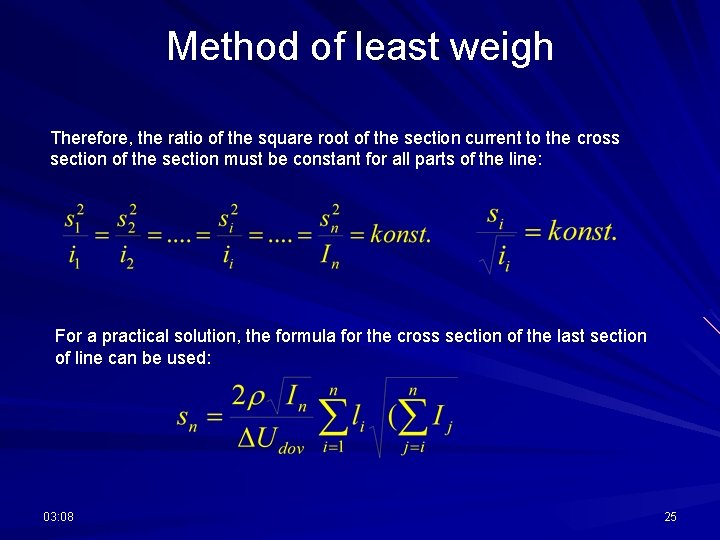
Method of least weigh Therefore, the ratio of the square root of the section current to the cross section of the section must be constant for all parts of the line: For a practical solution, the formula for the cross section of the last section of line can be used: 03: 08 25
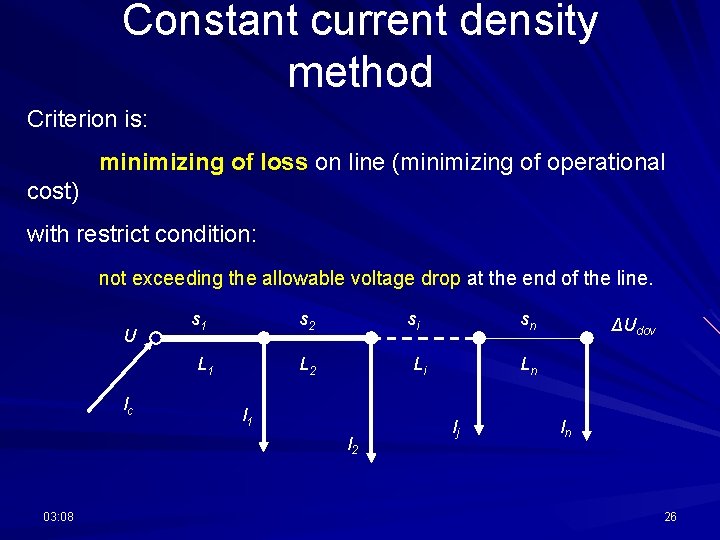
Constant current density method Criterion is: minimizing of loss on line (minimizing of operational cost) with restrict condition: not exceeding the allowable voltage drop at the end of the line. U s 1 s 2 L 1 lc si L 2 Li l 1 l 2 03: 08 sn ΔUdov Ln lj ln 26
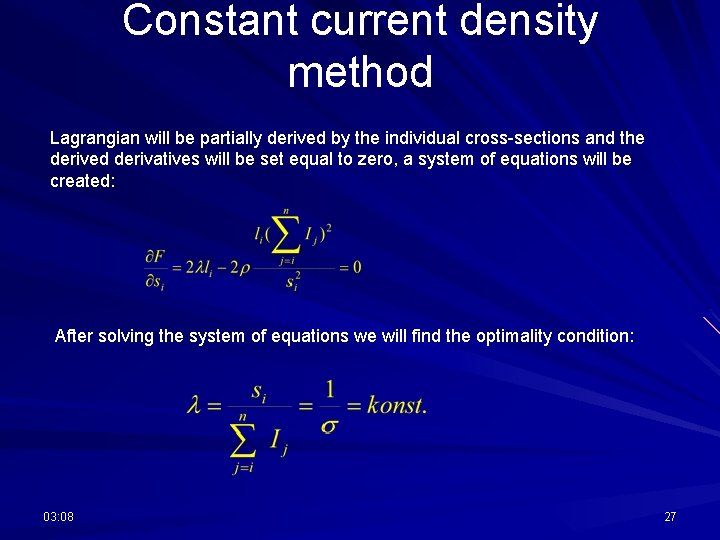
Constant current density method Lagrangian will be partially derived by the individual cross-sections and the derived derivatives will be set equal to zero, a system of equations will be created: After solving the system of equations we will find the optimality condition: 03: 08 27
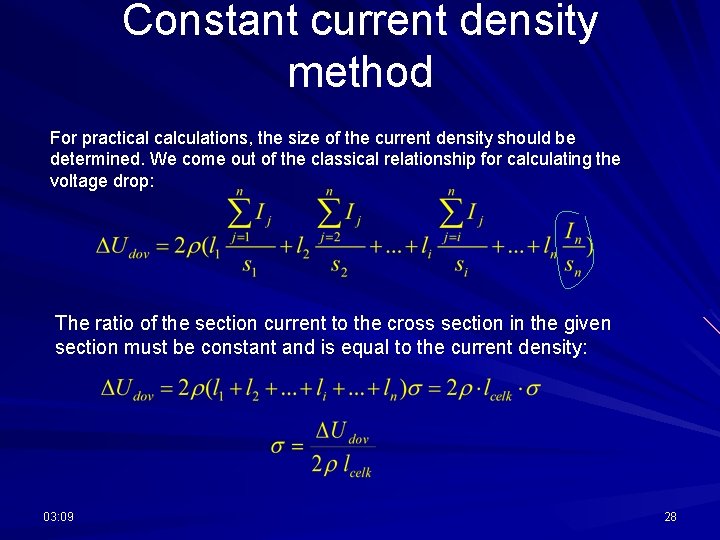
Constant current density method For practical calculations, the size of the current density should be determined. We come out of the classical relationship for calculating the voltage drop: The ratio of the section current to the cross section in the given section must be constant and is equal to the current density: 03: 09 28
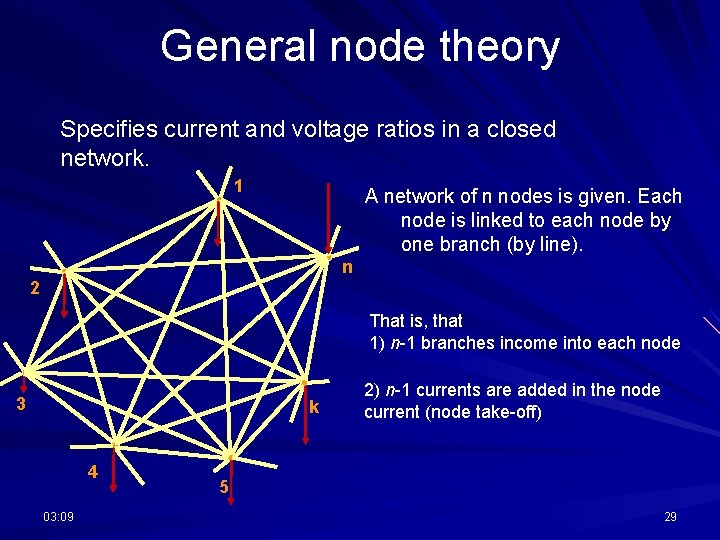
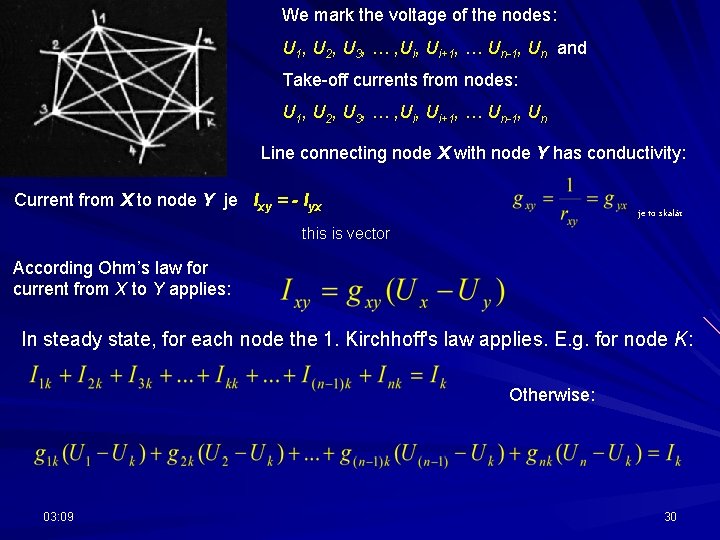
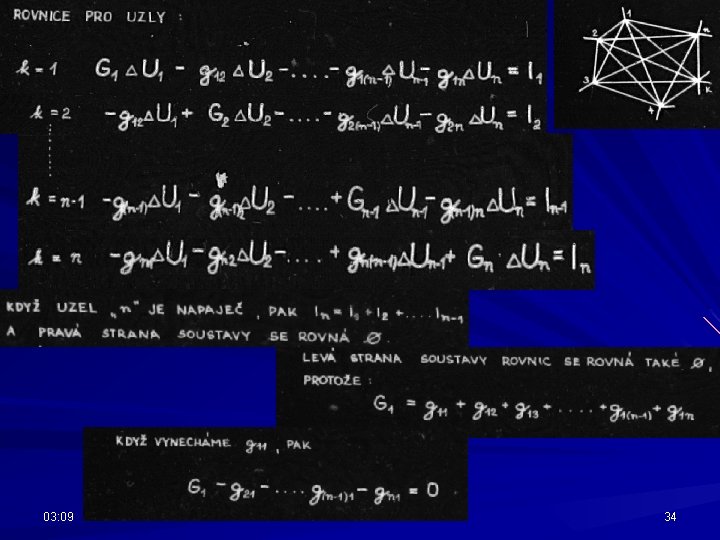
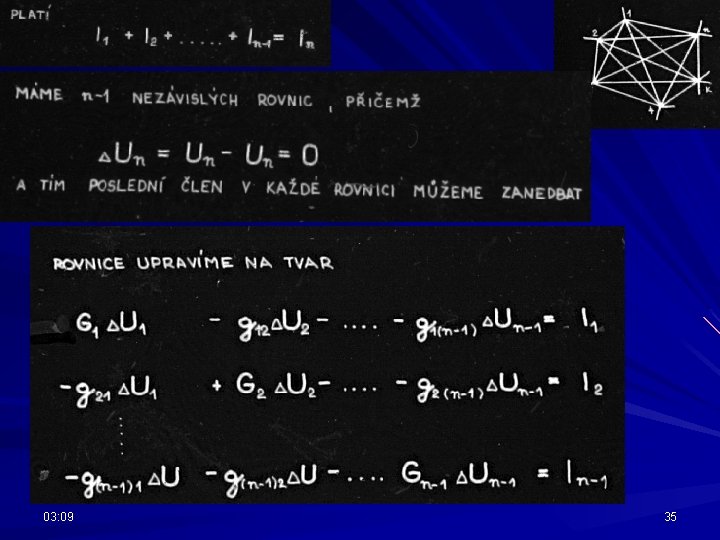
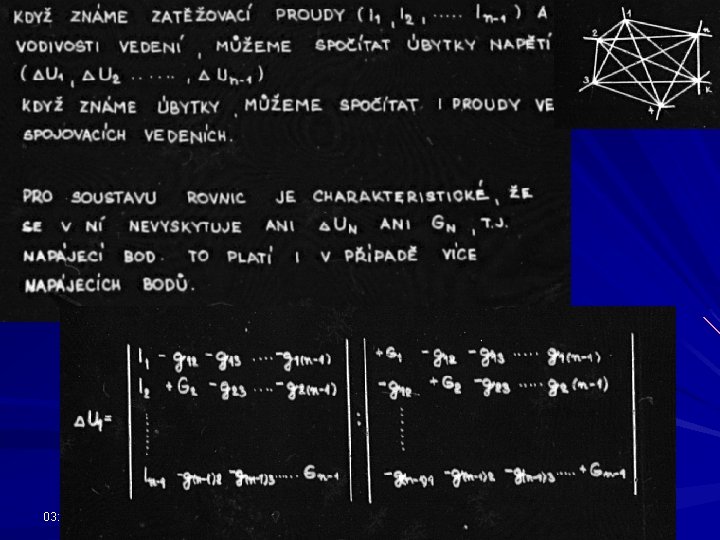
General node theory Specifies current and voltage ratios in a closed network. 1 A network of n nodes is given. Each node is linked to each node by one branch (by line). n 2 That is, that 1) n-1 branches income into each node 3 k 4 03: 09 2) n-1 currents are added in the node current (node take-off) 5 29
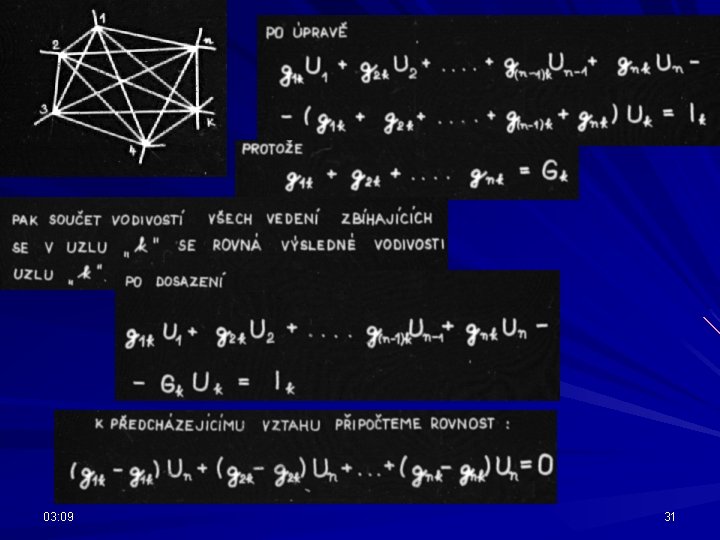
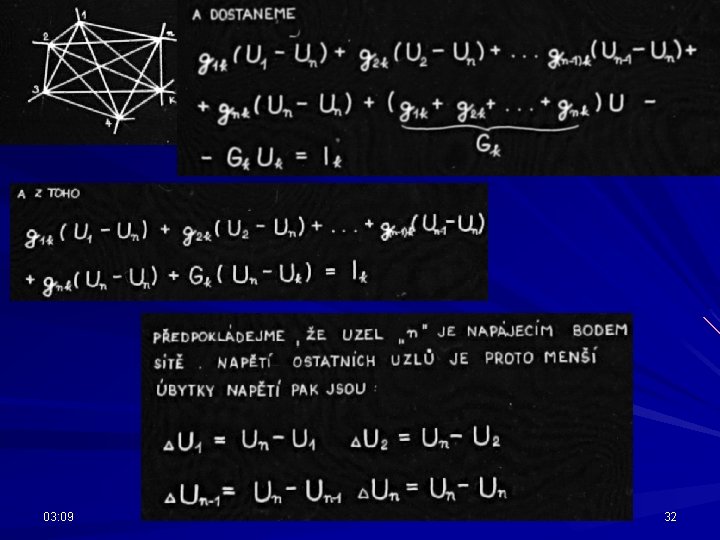
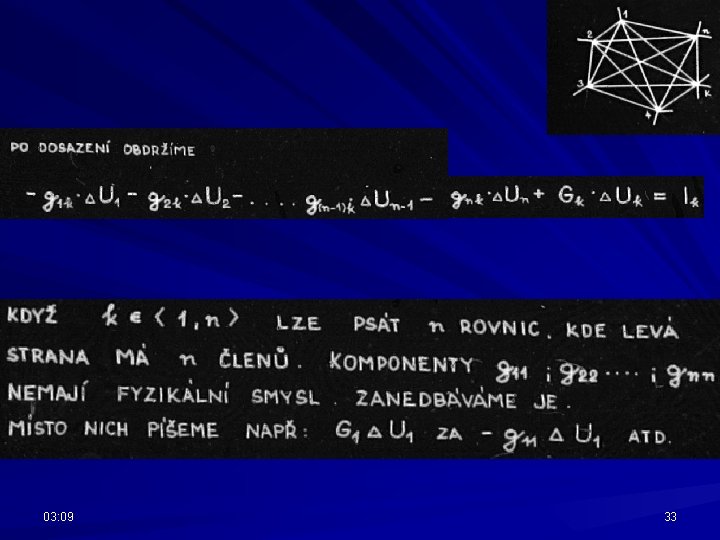
We mark the voltage of the nodes: U 1, U 2, U 3, … , Ui+1, … Un-1, Un and Take-off currents from nodes: U 1, U 2, U 3, … , Ui+1, … Un-1, Un Line connecting node X with node Y has conductivity: Current from X to node Y je Ixy = - Iyx je to skalár this is vector According Ohm’s law for current from X to Y applies: In steady state, for each node the 1. Kirchhoff's law applies. E. g. for node K: Otherwise: 03: 09 30
03: 09 31
03: 09 32
03: 09 33
03: 09 34
03: 09 35
03: 09 36
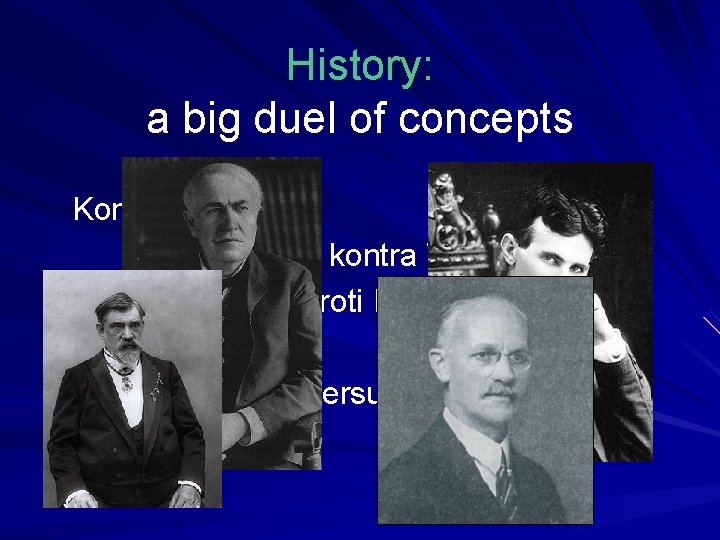
History: a big duel of concepts Konec 19. století: EDISON kontra TESLA Křižík proti Kolbenovi Dynamo versus Alternátor
The benefits of AC power: 1 rotating field for an asynchronous motor 2 easier switch-off 3 easy transformability 4 less corrosion in ground streams
Disadvantages of AC: 1 more complex description, reactivity, juniper 2 transmission stability problems with long lines 3 the need for synchronous operation of the generators 4 non-storage
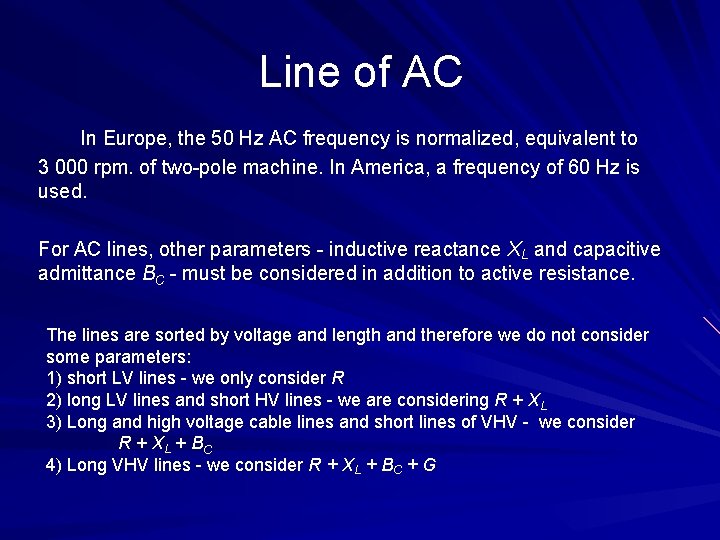
Line of AC In Europe, the 50 Hz AC frequency is normalized, equivalent to 3 000 rpm. of two-pole machine. In America, a frequency of 60 Hz is used. For AC lines, other parameters - inductive reactance XL and capacitive admittance BC - must be considered in addition to active resistance. The lines are sorted by voltage and length and therefore we do not consider some parameters: 1) short LV lines - we only consider R 2) long LV lines and short HV lines - we are considering R + XL 3) Long and high voltage cable lines and short lines of VHV - we consider R + XL + BC 4) Long VHV lines - we consider R + XL + BC + G
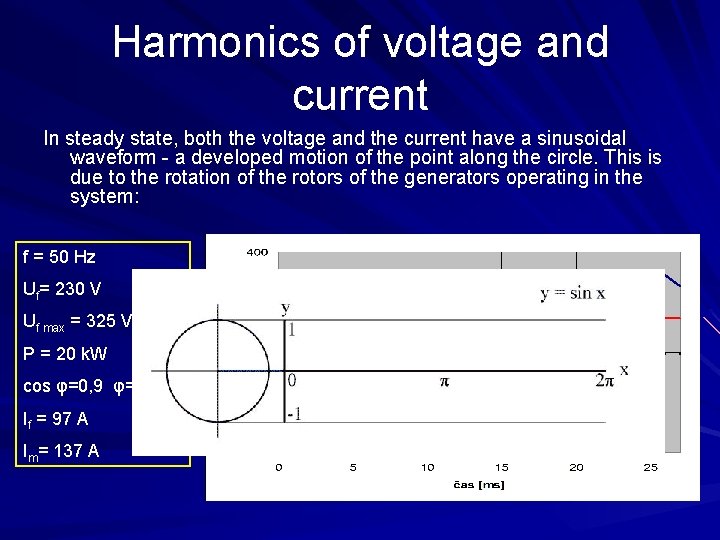
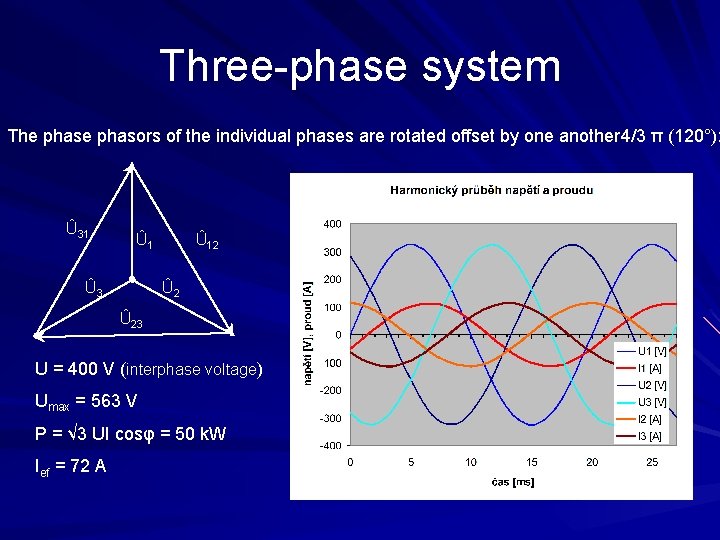
Harmonics of voltage and current In steady state, both the voltage and the current have a sinusoidal waveform - a developed motion of the point along the circle. This is due to the rotation of the rotors of the generators operating in the system: f = 50 Hz Uf= 230 V Uf max = 325 V P = 20 k. W cos φ=0, 9 φ=0, 45 If = 97 A Im= 137 A
Three-phase system The phasors of the individual phases are rotated offset by one another 4/3 π (120°): Û 31 Û 12 Û 3 Û 23 U = 400 V (interphase voltage) Umax = 563 V P = √ 3 UI cosφ = 50 k. W Ief = 72 A
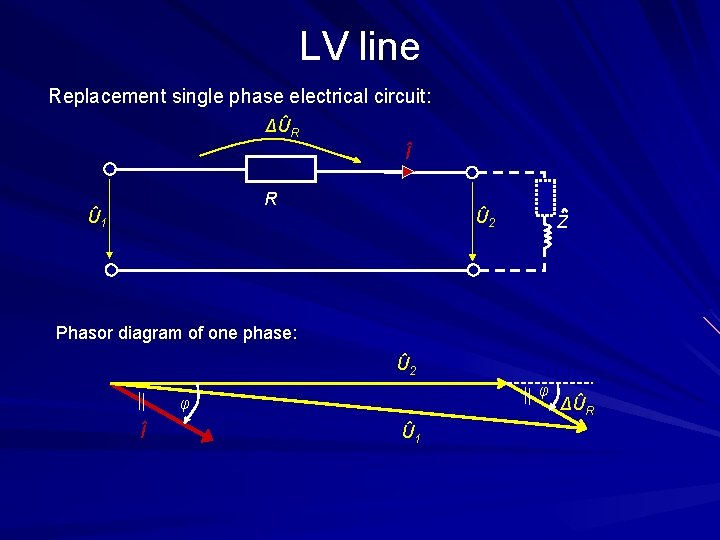
LV line Replacement single phase electrical circuit: ΔÛR Î R Û 1 Û 2 Z Phasor diagram of one phase: Û 2 φ φ Î Û 1 ΔÛR
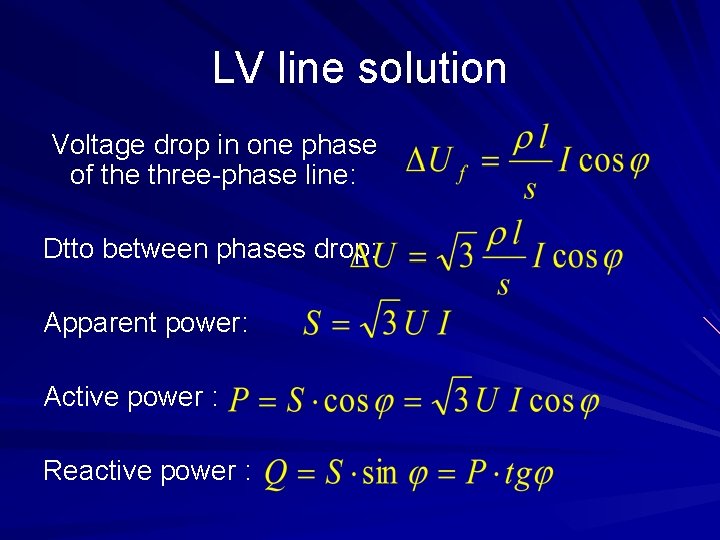
LV line solution Voltage drop in one phase of the three-phase line: Dtto between phases drop: Apparent power: Active power : Reactive power :
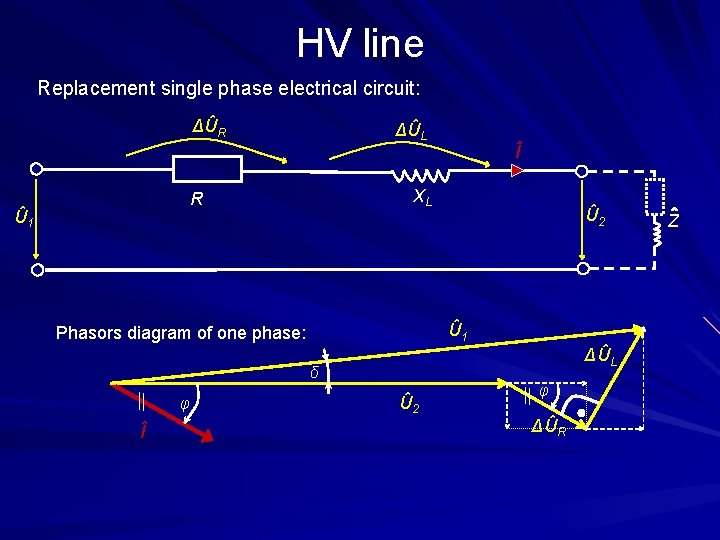
HV line Replacement single phase electrical circuit: ΔÛR ΔÛL XL R Û 1 Î Û 2 Û 1 Phasors diagram of one phase: ΔÛL δ φ Î Û 2 φ ΔÛR Z
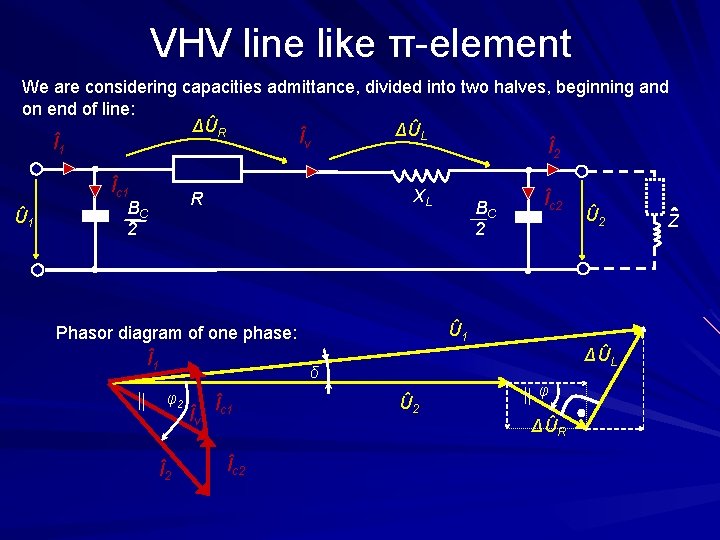
VHV line like π-element We are considering capacities admittance, divided into two halves, beginning and on end of line: ΔÛR ΔÛL Î v Î1 Î2 Û 1 Îc 1 BC 2 XL R Phasor diagram of one phase: Î1 φ2 Î2 Îv Îc 1 Îc 2 BC 2 Îc 2 Û 1 ΔÛL δ Û 2 φ ΔÛR Z
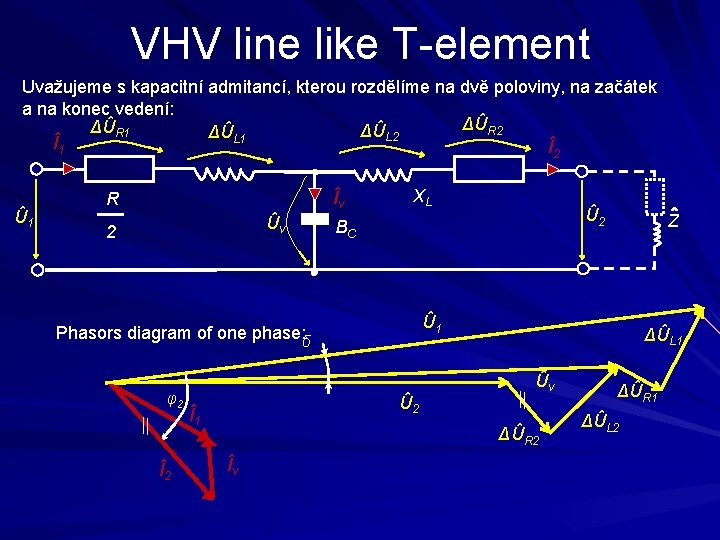
VHV line like T-element Uvažujeme s kapacitní admitancí, kterou rozdělíme na dvě poloviny, na začátek a na konec vedení: ΔÛR 2 ΔÛR 1 ΔÛL 2 ΔÛL 1 Î1 Î2 Û 1 Îv R Ûv 2 XL Î2 Û 2 Î1 ΔÛL 1 Ûv ΔÛR 2 Îv Z Û 1 Phasors diagram of one phase: δ φ2 Û 2 BC ΔÛR 1 ΔÛL 2
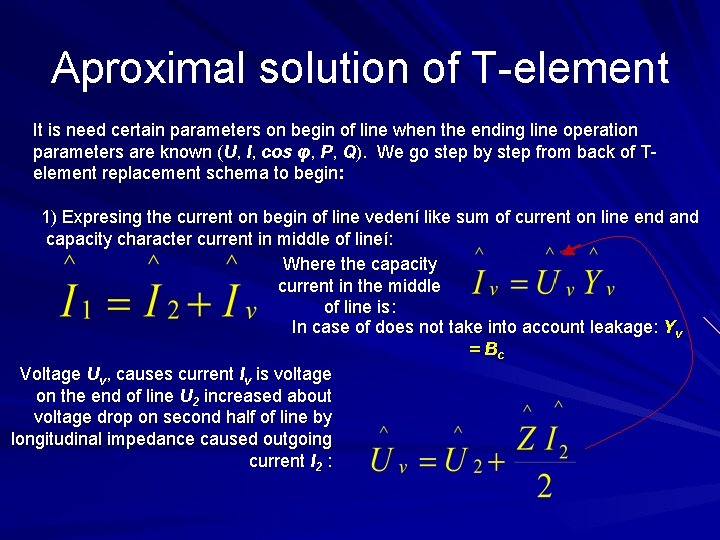
Aproximal solution of T-element It is need certain parameters on begin of line when the ending line operation parameters are known (U, I, cos φ, P, Q). We go step by step from back of Telement replacement schema to begin: 1) Expresing the current on begin of line vedení like sum of current on line end and capacity character current in middle of lineí: Where the capacity current in the middle of line is: In case of does not take into account leakage: Yv = Bc Voltage Uv, causes current Iv is voltage on the end of line U 2 increased about voltage drop on second half of line by longitudinal impedance caused outgoing current I 2 :
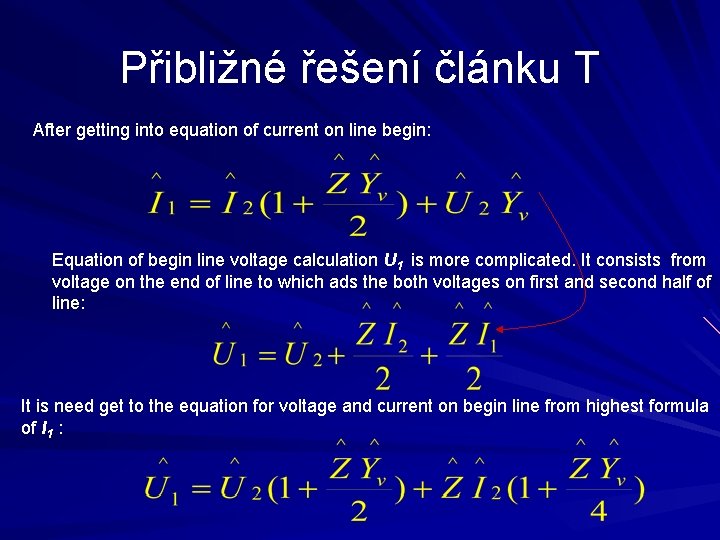
Přibližné řešení článku T After getting into equation of current on line begin: Equation of begin line voltage calculation U 1 is more complicated. It consists from voltage on the end of line to which ads the both voltages on first and second half of line: It is need get to the equation for voltage and current on begin line from highest formula of I 1 :
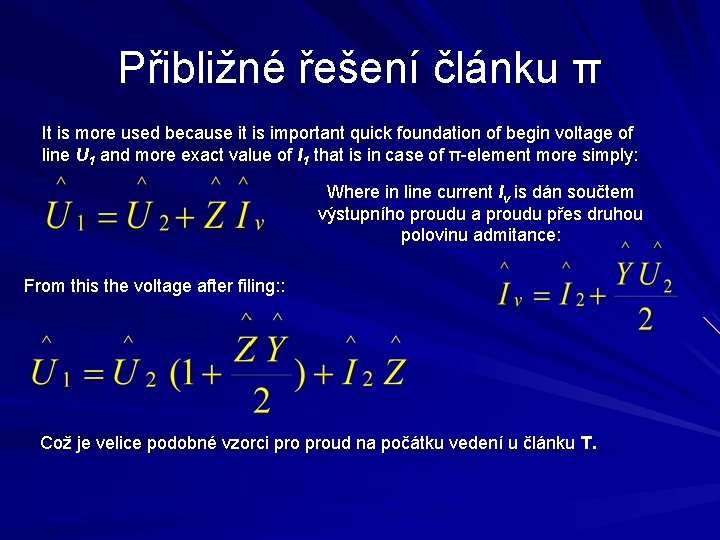
Přibližné řešení článku π It is more used because it is important quick foundation of begin voltage of line U 1 and more exact value of I 1 that is in case of π-element more simply: Where in line current Iv is dán součtem výstupního proudu a proudu přes druhou polovinu admitance: From this the voltage after filing: : Což je velice podobné vzorci proud na počátku vedení u článku T.
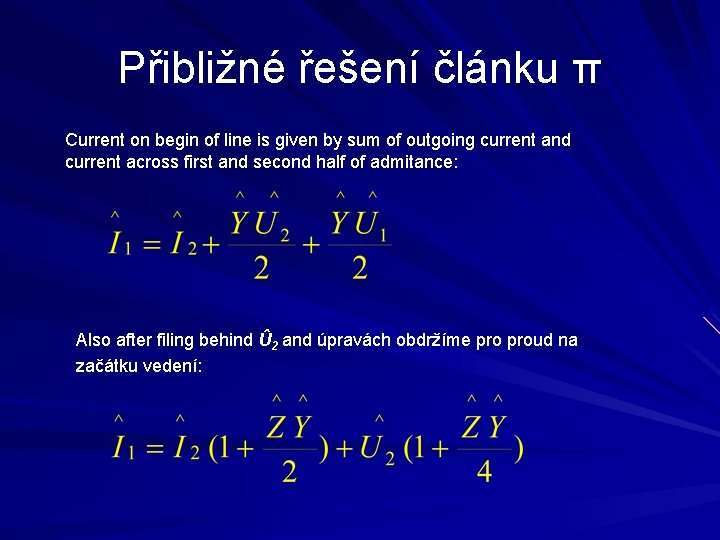
Přibližné řešení článku π Current on begin of line is given by sum of outgoing current and current across first and second half of admitance: Also after filing behind Û 2 and úpravách obdržíme proud na začátku vedení:
Breitfeldova metoda Vychází z π-článku Nepotřebuje pracovat s komplexními čísly Poskytuje zároveň přehled o přenášených výkonech v jednotlivých místech vedení Využívá goniometrických funkcí cosinus a tangens
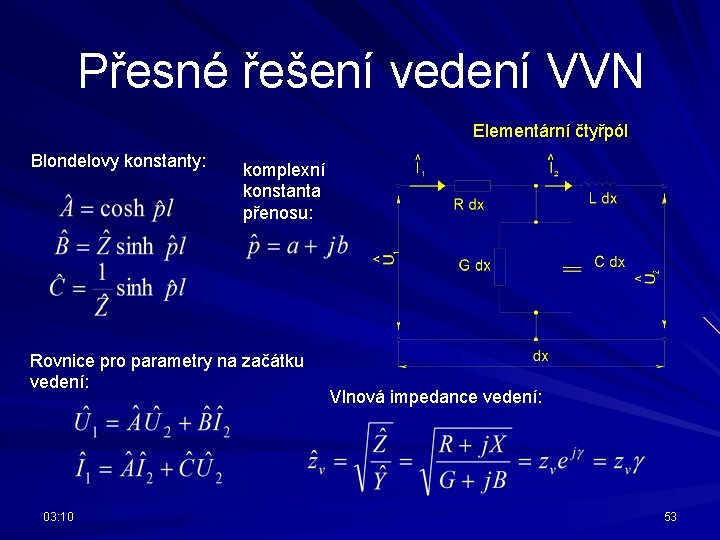
Přesné řešení vedení VVN Elementární čtyřpól Blondelovy konstanty: komplexní konstanta přenosu: Rovnice pro parametry na začátku vedení: 03: 10 Vlnová impedance vedení: 53
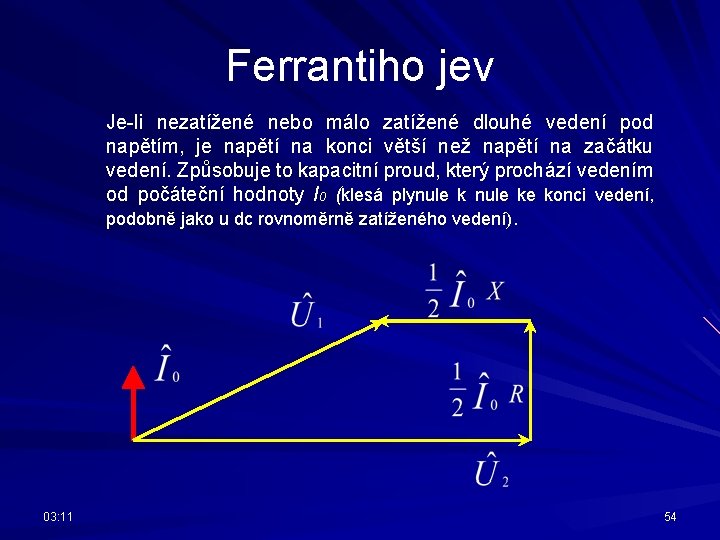
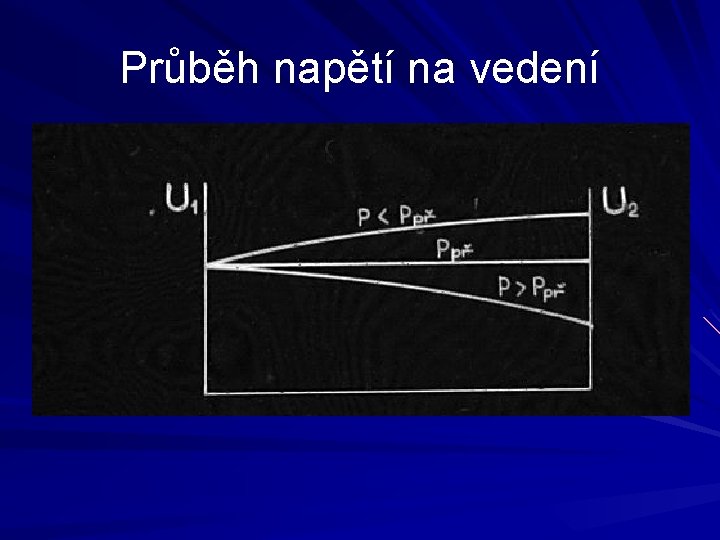
Ferrantiho jev Je-li nezatížené nebo málo zatížené dlouhé vedení pod napětím, je napětí na konci větší než napětí na začátku vedení. Způsobuje to kapacitní proud, který prochází vedením od počáteční hodnoty I 0 (klesá plynule ke konci vedení, podobně jako u dc rovnoměrně zatíženého vedení). 03: 11 54
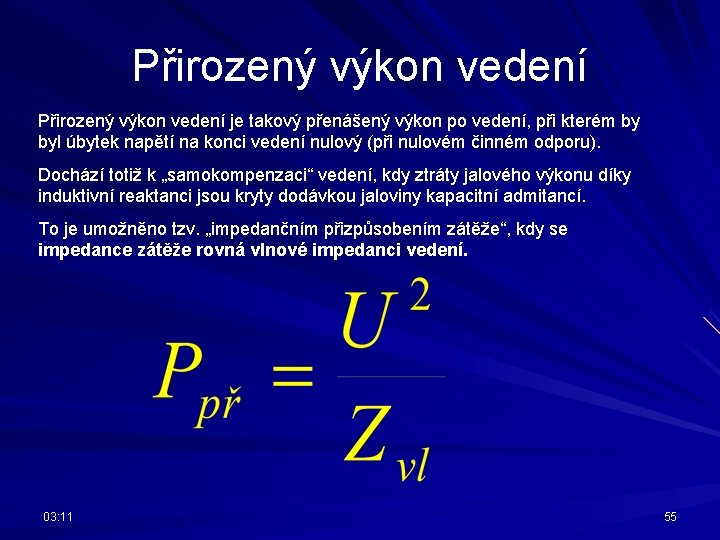
Přirozený výkon vedení je takový přenášený výkon po vedení, při kterém by byl úbytek napětí na konci vedení nulový (při nulovém činném odporu). Dochází totiž k „samokompenzaci“ vedení, kdy ztráty jalového výkonu díky induktivní reaktanci jsou kryty dodávkou jaloviny kapacitní admitancí. To je umožněno tzv. „impedančním přizpůsobením zátěže“, kdy se impedance zátěže rovná vlnové impedanci vedení. 03: 11 55
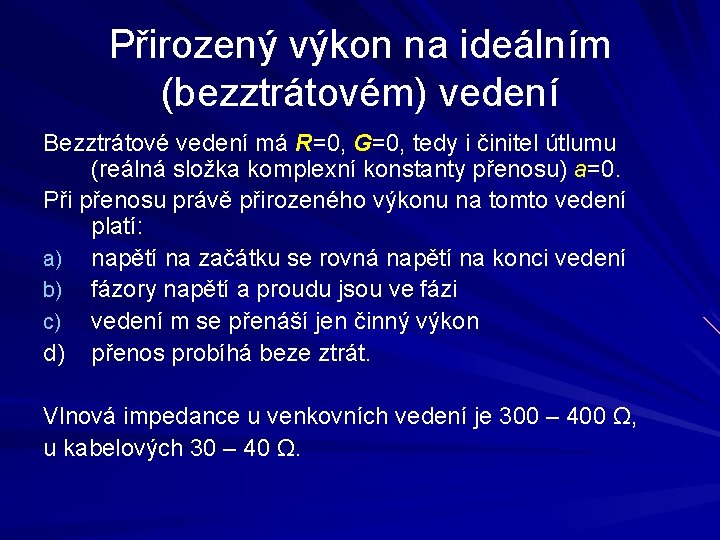
Přirozený výkon na ideálním (bezztrátovém) vedení Bezztrátové vedení má R=0, G=0, tedy i činitel útlumu (reálná složka komplexní konstanty přenosu) a=0. Při přenosu právě přirozeného výkonu na tomto vedení platí: a) napětí na začátku se rovná napětí na konci vedení b) fázory napětí a proudu jsou ve fázi c) vedení m se přenáší jen činný výkon d) přenos probíhá beze ztrát. Vlnová impedance u venkovních vedení je 300 – 400 Ω, u kabelových 30 – 40 Ω.
Průběh napětí na vedení
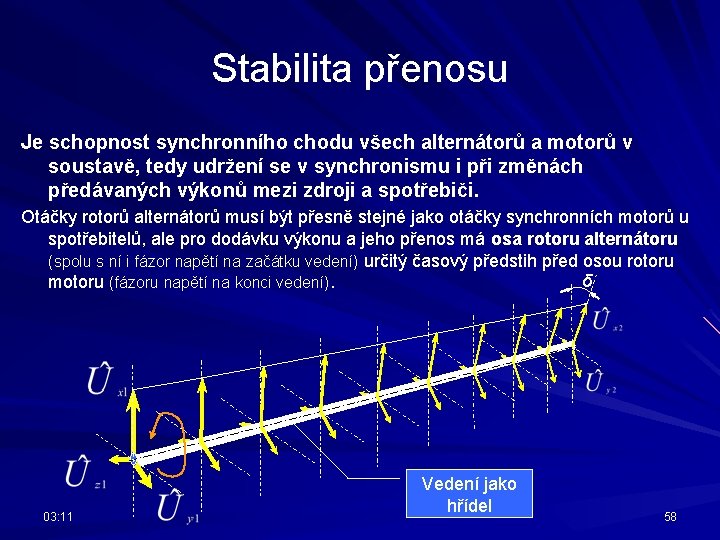
Stabilita přenosu Je schopnost synchronního chodu všech alternátorů a motorů v soustavě, tedy udržení se v synchronismu i při změnách předávaných výkonů mezi zdroji a spotřebiči. Otáčky rotorů alternátorů musí být přesně stejné jako otáčky synchronních motorů u spotřebitelů, ale pro dodávku výkonu a jeho přenos má osa rotoru alternátoru (spolu s ní i fázor napětí na začátku vedení) určitý časový předstih před osou rotoru δ motoru (fázoru napětí na konci vedení). 03: 11 Vedení jako hřídel 58
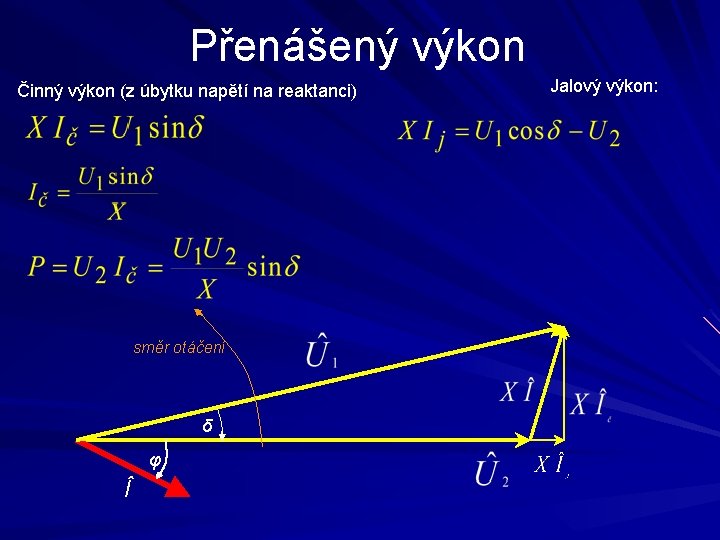
Přenášený výkon Činný výkon (z úbytku napětí na reaktanci) směr otáčení δ φ Î Jalový výkon:
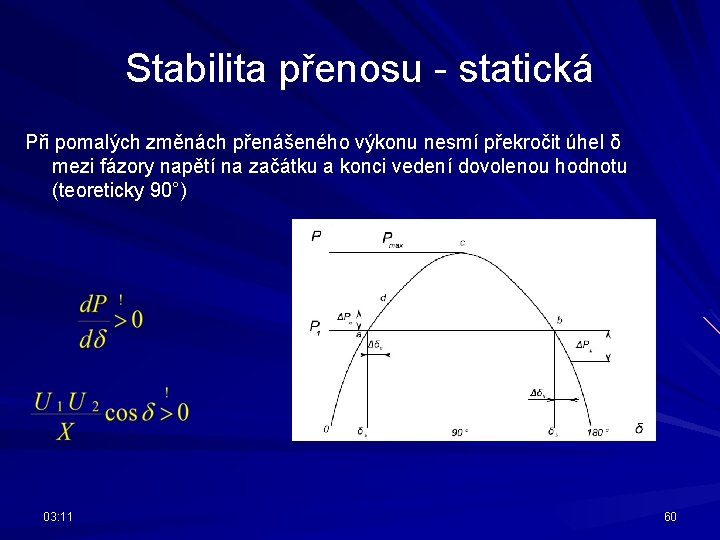
Stabilita přenosu - statická Při pomalých změnách přenášeného výkonu nesmí překročit úhel δ mezi fázory napětí na začátku a konci vedení dovolenou hodnotu (teoreticky 90°) 03: 11 60
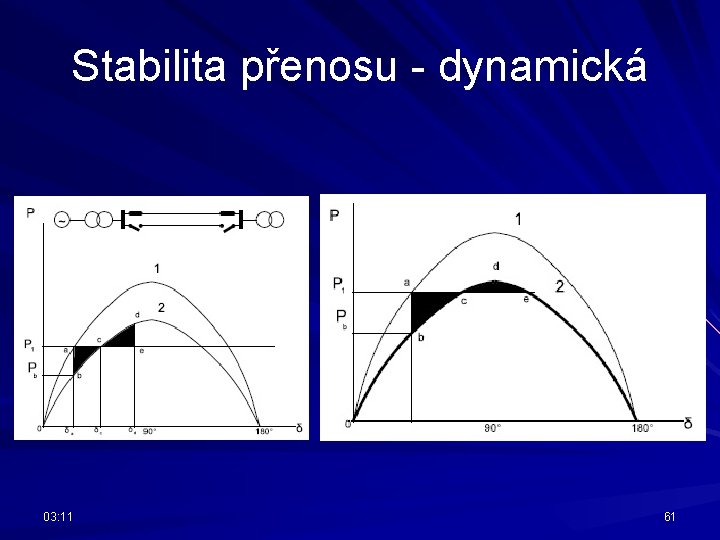
Stabilita přenosu - dynamická 03: 11 61