
Transport of Bacterial Endospores in Silica Sand Sibylle
Transport of Bacterial Endospores in Silica Sand Sibylle Tesar, Fulbright Scholar Dr. Barbara Williams, Faculty Dr. Robin Nimmer, Res. Supp. Sci. Angelina Cernick, Undergraduate Kristina Beaulieau, NSF REU Department of Biological and Agricultural Engineering University of Idaho
Outline l Research Goals – transport mechanisms / endospores l l l Background – transport mechanisms / endospores Research Questions – preliminary Methods – sporulation / saturated column tests / breakthrough curves / depth distribution data l l l Preliminary Results Preliminary Conclusions Future Work – B. cereus, other microbes
Research Goals – Spore Transport in Porous Media l l l Mechanistic Goal: Contribute to the lively debate of attachment versus straining Microbe-specific goal: Bacterial endospore Practical Applications l Drinking water protection - groundwater l l l Shallow recharge Septic drainfield setbacks Surface water filtration l Riverbank or riverbed filtration
Outline l Research Goals – transport mechanisms / endospores l Background – transport mechanisms / endospores l l Research Questions – preliminary Methods – sporulation / saturated column tests / breakthrough curves / depth distribution data l l l Preliminary Results Preliminary Conclusions Future Work – B. cereus, other microbes
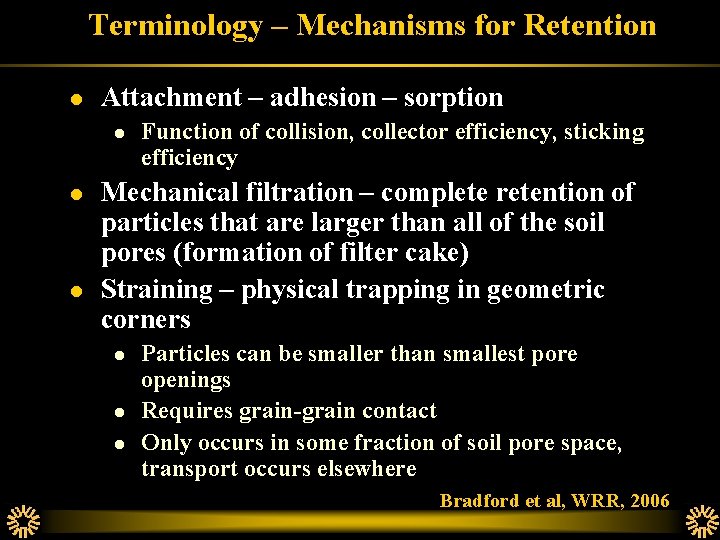
Terminology – Mechanisms for Retention l Attachment – adhesion – sorption l l l Function of collision, collector efficiency, sticking efficiency Mechanical filtration – complete retention of particles that are larger than all of the soil pores (formation of filter cake) Straining – physical trapping in geometric corners l l l Particles can be smaller than smallest pore openings Requires grain-grain contact Only occurs in some fraction of soil pore space, transport occurs elsewhere Bradford et al, WRR, 2006
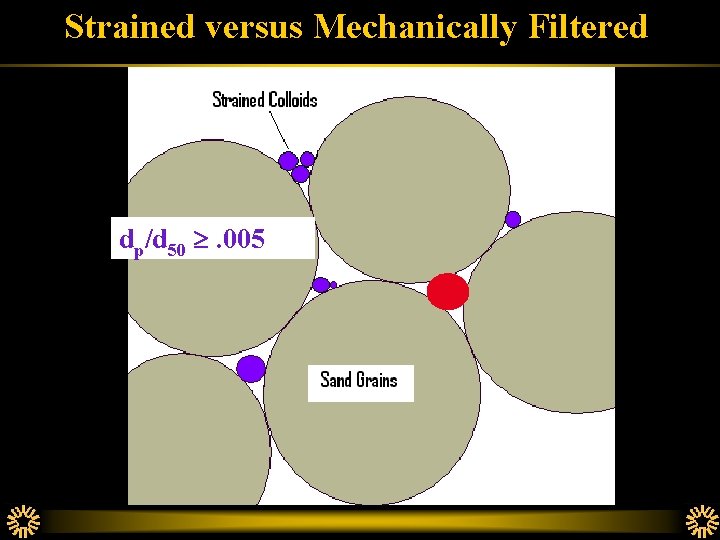
Strained versus Mechanically Filtered dp/d 50 . 005
Background l Clean-bed Filtration Theory l l Depends on mechanism of attachment / detachment Deviation from Clean Bed Filtration Theory l l Unfavorable attachment condition; neg-neg Fine sand large colloids (dp/d 50 . 005)
Explanations for Deviation from CFT l l l Attachment w/ porous media charge variability – Johnson and Elimelech, 1995 Attachment w/ heterogeneity in surface charge characteristics of colloids – Li et al, 2004 Attachment w/ deposition of colloids in a secondary energy minimum – Tufenkji et al. 2003, Redman et al. , 2004 l l All of the above – Tufenkji and Elimelech, 2005 Attachment w/ straining – Foppen et al, 2005, Bradford et al, 2006 a, b
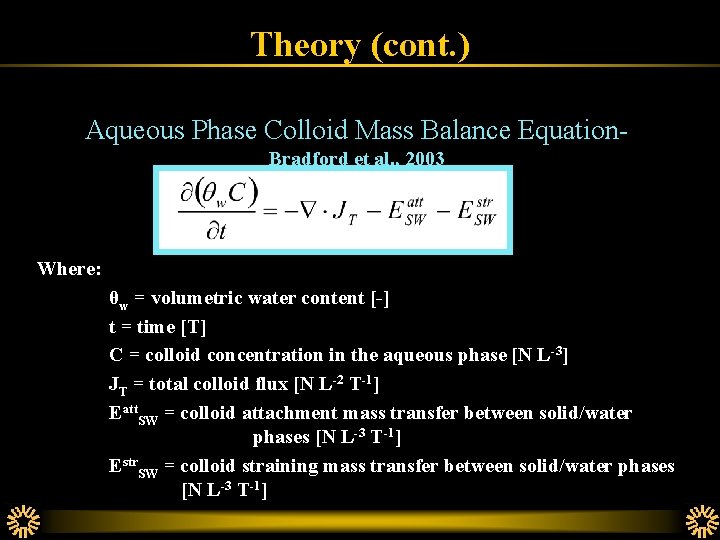
Theory (cont. ) Aqueous Phase Colloid Mass Balance Equation. Bradford et al. , 2003 Where: θw = volumetric water content [-] t = time [T] C = colloid concentration in the aqueous phase [N L-3] JT = total colloid flux [N L-2 T-1] Eatt. SW = colloid attachment mass transfer between solid/water phases [N L-3 T-1] Estr. SW = colloid straining mass transfer between solid/water phases [N L-3 T-1]
Research Goals – Endospore Transport l Endospore-forming bacteria have two viable modes l l l Vegetative cell (growing) Endospore (dormant) – formed as survival mechanism Endospores have the potential to be more mobile than their vegetative cell counterparts l l smaller size potentially less adhesion
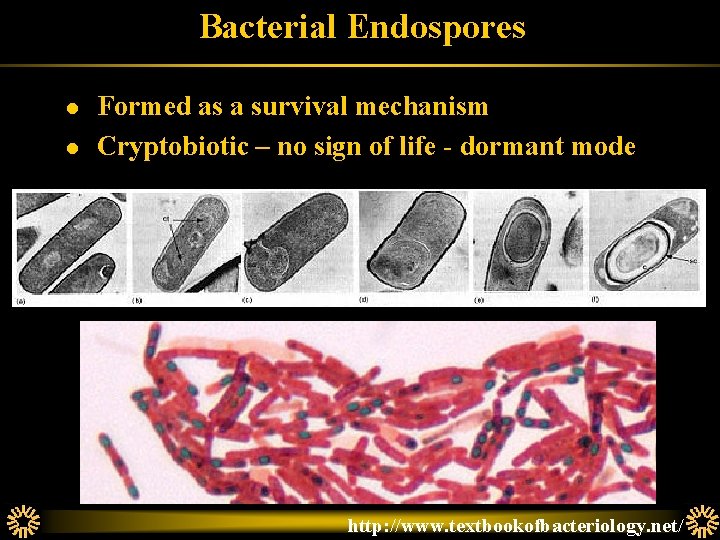
Bacterial Endospores l l Formed as a survival mechanism Cryptobiotic – no sign of life - dormant mode http: //www. textbookofbacteriology. net/
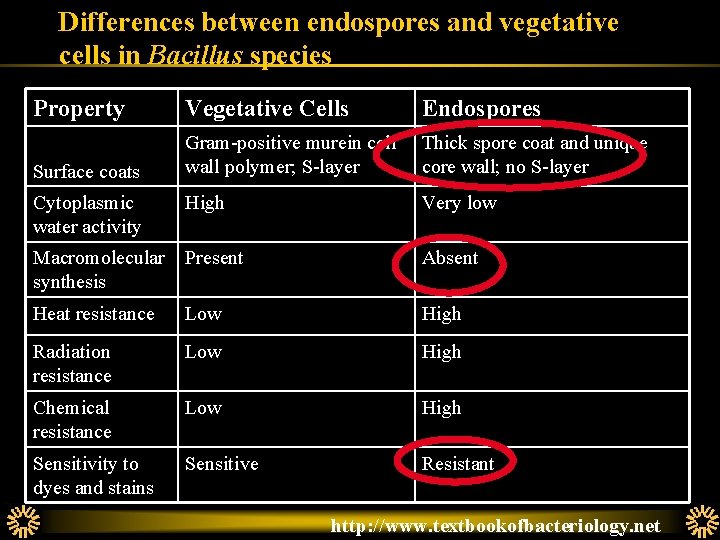
Differences between endospores and vegetative cells in Bacillus species Property Vegetative Cells Endospores Surface coats Gram-positive murein cell wall polymer; S-layer Thick spore coat and unique core wall; no S-layer Cytoplasmic water activity High Very low Macromolecular synthesis Present Absent Heat resistance Low High Radiation resistance Low High Chemical resistance Low High Sensitivity to dyes and stains Sensitive Resistant http: //www. textbookofbacteriology. net
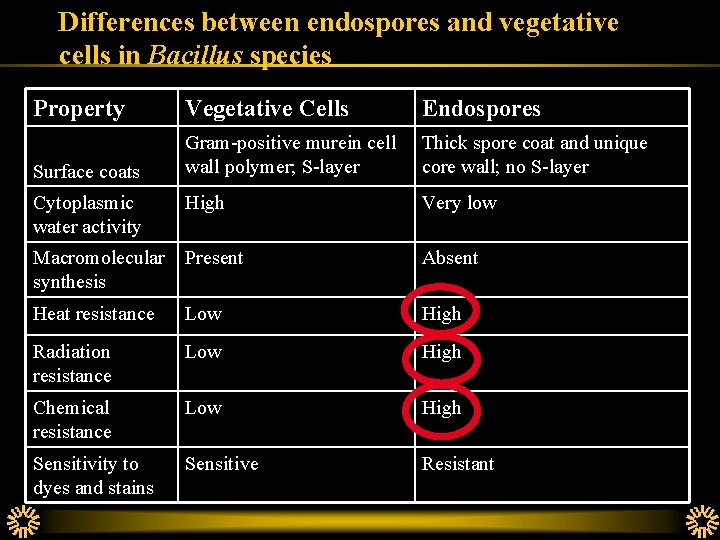
Differences between endospores and vegetative cells in Bacillus species Property Vegetative Cells Endospores Surface coats Gram-positive murein cell wall polymer; S-layer Thick spore coat and unique core wall; no S-layer Cytoplasmic water activity High Very low Macromolecular synthesis Present Absent Heat resistance Low High Radiation resistance Low High Chemical resistance Low High Sensitivity to dyes and stains Sensitive Resistant
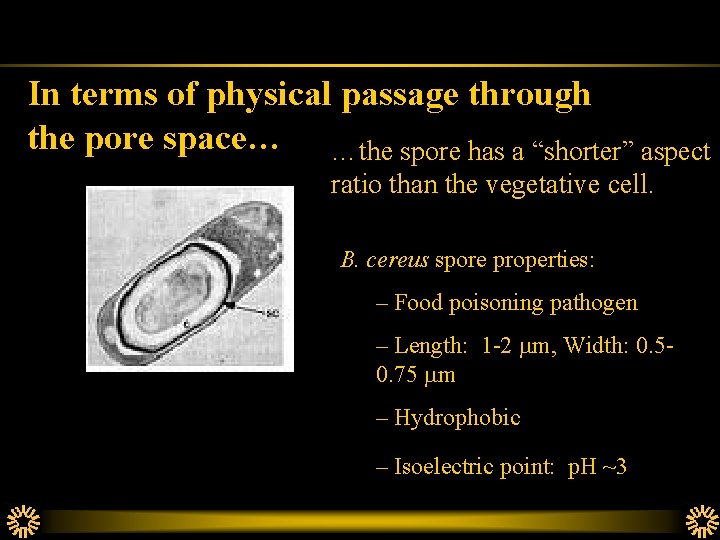
In terms of physical passage through the pore space… …the spore has a “shorter” aspect ratio than the vegetative cell. B. cereus spore properties: – Food poisoning pathogen – Length: 1 -2 mm, Width: 0. 50. 75 mm – Hydrophobic – Isoelectric point: p. H ~3
Outline l Research Goals – transport mechanisms / endospores Background – transport mechanisms / endospores l Research Questions – preliminary l Methods – sporulation / saturated column tests / l breakthrough curves / depth distribution data l l l Preliminary Results Preliminary Conclusions Future Work – B. cereus, other microbes
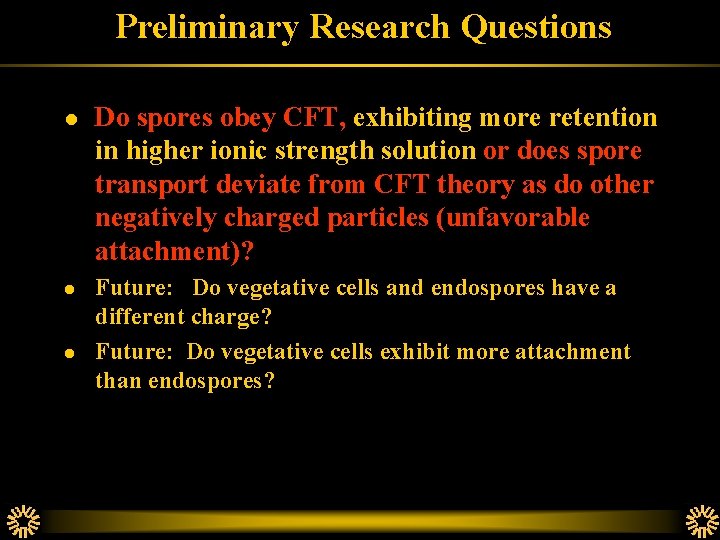
Preliminary Research Questions l l l Do spores obey CFT, exhibiting more retention in higher ionic strength solution or does spore transport deviate from CFT theory as do other negatively charged particles (unfavorable attachment)? Future: Do vegetative cells and endospores have a different charge? Future: Do vegetative cells exhibit more attachment than endospores?
Outline l Research Goals – transport mechanisms / endospores Background – transport mechanisms / endospores Research Questions – preliminary l Methods – sporulation / saturated column tests / l l breakthrough curves / depth distribution data l l l Preliminary Results Preliminary Conclusions Future Work – B. cereus, other microbes
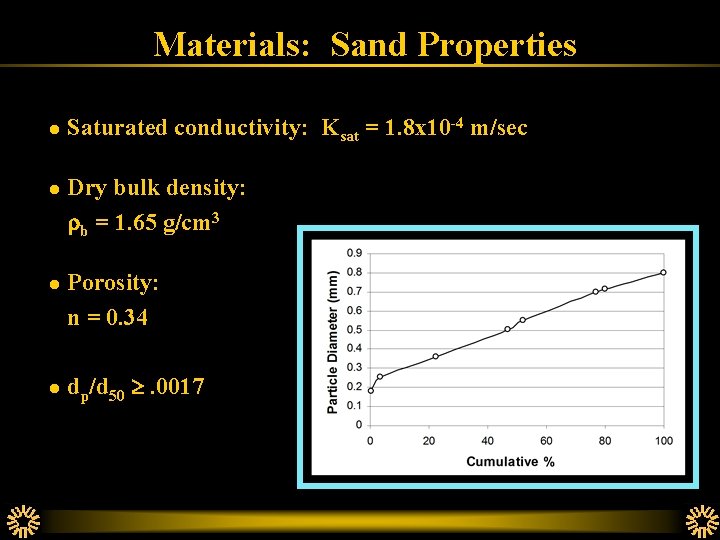
Materials: Sand Properties l Saturated conductivity: Ksat = 1. 8 x 10 -4 m/sec l Dry bulk density: rb = 1. 65 g/cm 3 l Porosity: n = 0. 34 l dp/d 50 . 0017
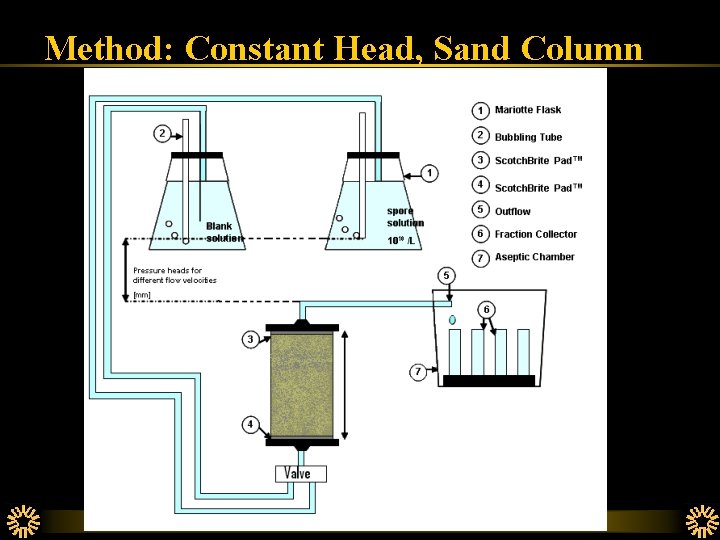
Method: Constant Head, Sand Column
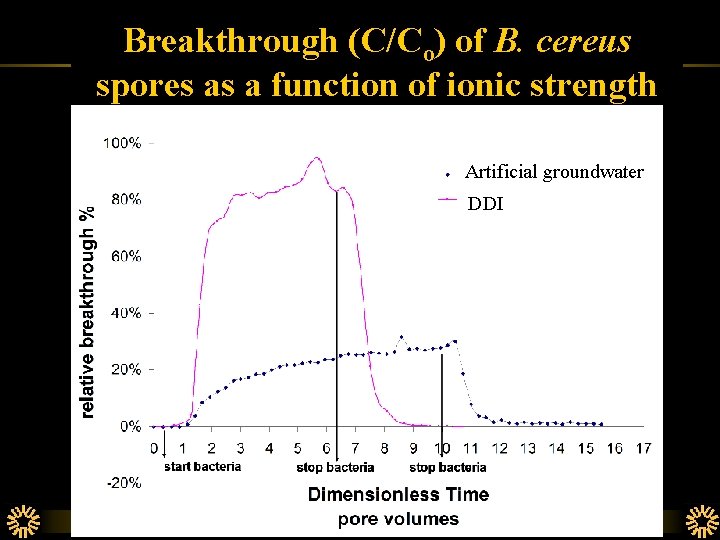
Breakthrough (C/Co) of B. cereus spores as a function of ionic strength Artificial groundwater DDI
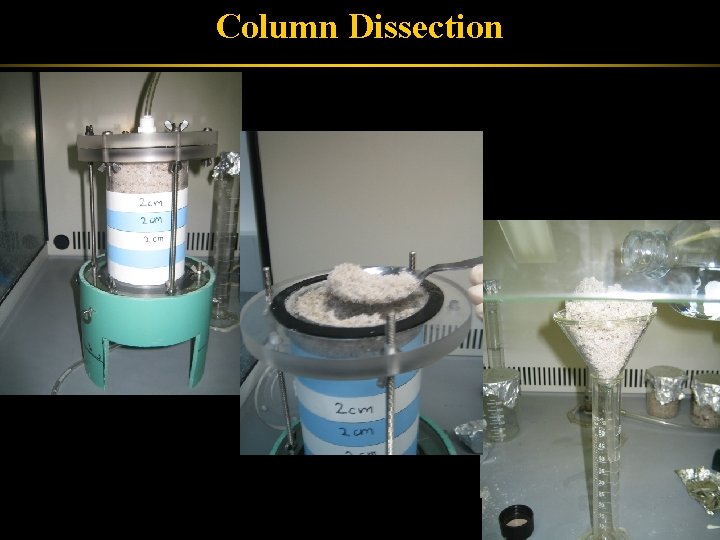
Column Dissection
Column Dissection l l l Drain column to field capacity, in the flow direction. Dissect into seven 2 cm increments STR 1: Gently place sand, allowing bridging and loose packing, in a funnel that has been plugged with Scotchbritetm pad STR 2: Wash off the strained bacteria by pouring the solution (the solution used in that particular experiment) over the sand into a graduated cylinder ATT: To remove the attached bacteria, place a known amount of 2% Tweentm 80 solution into a beaker containing the sand. Stir then sonicate. Used optical density (OD) measurements in addition to plate counting to enumerate. (Tween and sonication proven not to affect germination efficiency)
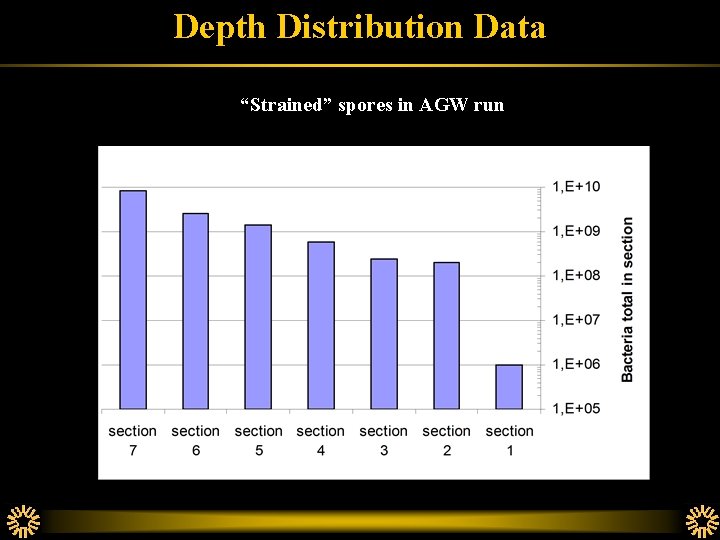
Depth Distribution Data “Strained” spores in AGW run
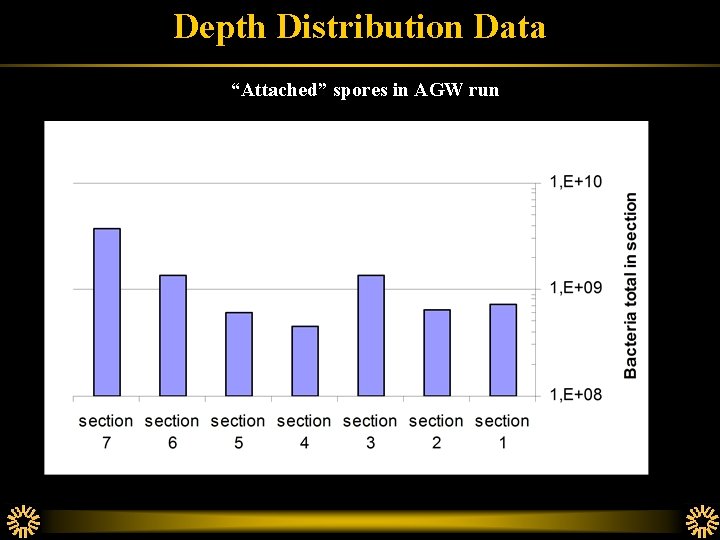
Depth Distribution Data “Attached” spores in AGW run
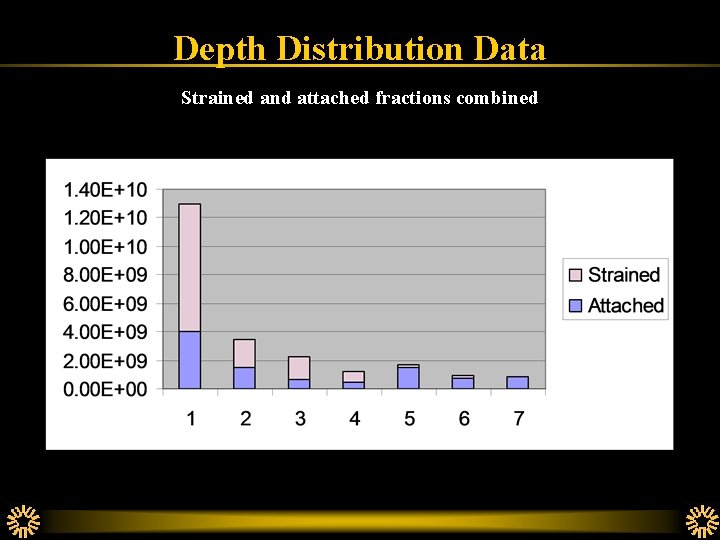
Depth Distribution Data Strained and attached fractions combined
Outline l l Research Goals – transport mechanisms / endospores Background – transport mechanisms / endospores Research Questions – preliminary Methods – sporulation / saturated column tests / breakthrough curves / depth distribution data l Preliminary Results l Preliminary Conclusions l Future Work – B. cereus, other microbes
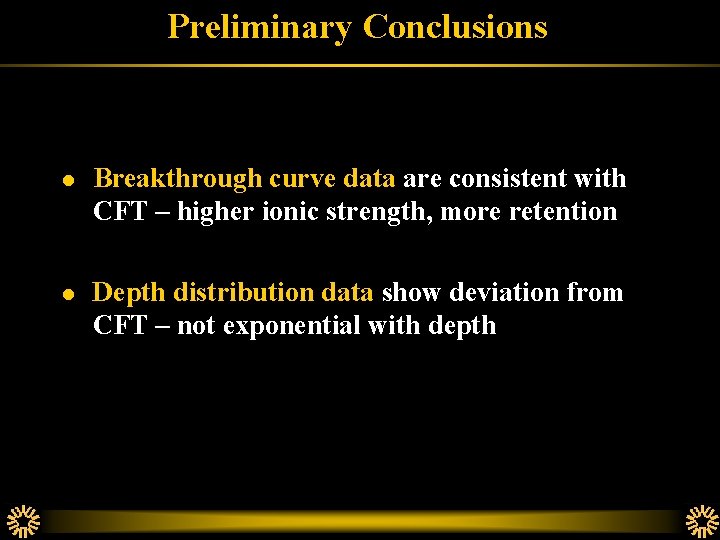
Preliminary Conclusions l Breakthrough curve data are consistent with CFT – higher ionic strength, more retention l Depth distribution data show deviation from CFT – not exponential with depth
Outline l l Research Goals – transport mechanisms / endospores Background – transport mechanisms / endospores Research Questions – preliminary Methods – sporulation / saturated column tests / breakthrough curves / depth distribution data l Preliminary Results Preliminary Conclusions l Future Work – B. cereus, other microbes l
Future Work l Compare attachment/straining of spores versus vegetative cells l l l Column experiments Micromodels and photographs Wet AFM Compare zeta potential p. H and more ionic strength effects Different endospore bacteria, such as S. pasteurii, for biomineralization
Acknowledgements l l l Dr. Ron Crawford, Director, Environmental Biotechnology Institute, UI Nick Benardini, Ph. D Candidate, MMBB Elizabeth Scherling, MS, BAE Dr. Markus Tuller, PSES David Christian, Research Support Sci.
Funding Acknowledgements l l Fulbright Scholars Program USDA Hatch UI URO Seed Grant Program NSF REU program
References l l l l Bradford, S. A. , J. Šimůnek, M. Bettahar, M. van. Genuchten, and S. R. Yates. 2003. Modeling colloid attachment, straining, and exclusion in saturated porous media. Environmental Science and Technology 37: 2242 -2250. Bradford, S. A. , J. Šimůnek, M. Bettahar, M. Th. van. Genuchten, and S. R. Yates. 2006 a. Significance of straining in colloid deposition: evidence and implications. Water Resources Research, 42: doi: 10. 1029/2005 WR 004791. Bradford, S. A. , J. Šimůnek, and S. L. Walker. 2006 b. Transport and straining of E. coli 0157: H 7 in saturated porous media. Water Resources Research (in review). Li, X. , TD. Scheibe, and W. P. Johnson. 2004. Apparent decreases in colloid deposition rate coefficient with distance of transport under unfavorable deposition conditions: a general phenomenon. Environ. Sci. Technol. , 38: 5616 -5625. Redman, J. A. , S. L. Walker, and M. Elimelech. 2004. Bacterial adhesion and transport in porous media: Role of the secondary energy minimum, Environ. Sci. Technol. , 38: 1777 -1785. Tufenkji, N. , J. A. Redman, and M. Elimelech. 2003. Interpreting deposition patterns of microbial particles in laboratory-scale column experiments, Environ. Sci. Technol. , 37: 616 -623. Tufenkji, N. , Elimelech, M. 2005. Breakdown of colloid filtration theory: Role of the secondary energy minimum and surface charge heterogeneities. Langmuir 21: 841 -852.
- Slides: 32