
Transport Network Design Robert Schafer October 1 2015
Transport Network Design Robert Schafer October 1, 2015
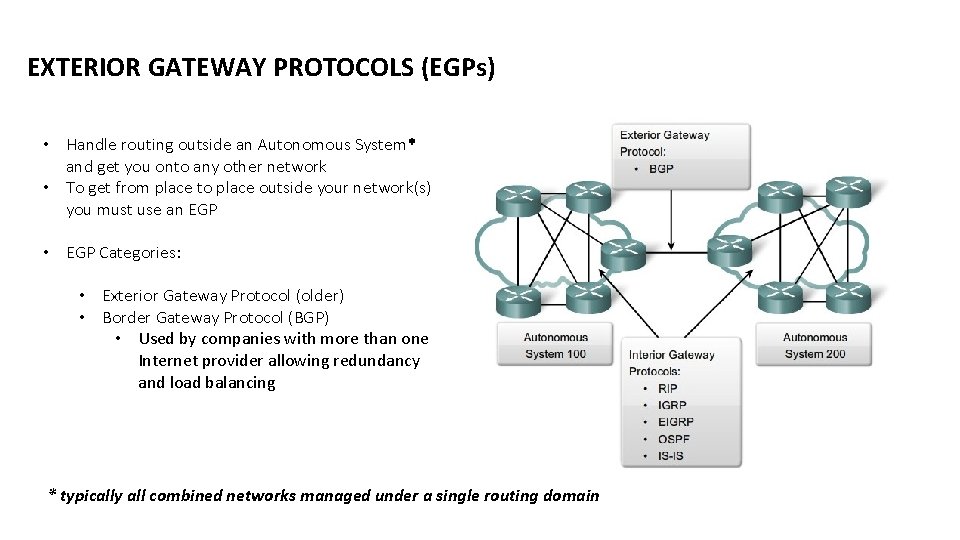
EXTERIOR GATEWAY PROTOCOLS (EGPs) • Handle routing outside an Autonomous System* and get you onto any other network • To get from place to place outside your network(s) you must use an EGP • EGP Categories: • Exterior Gateway Protocol (older) • Border Gateway Protocol (BGP) • Used by companies with more than one Internet provider allowing redundancy and load balancing * typically all combined networks managed under a single routing domain
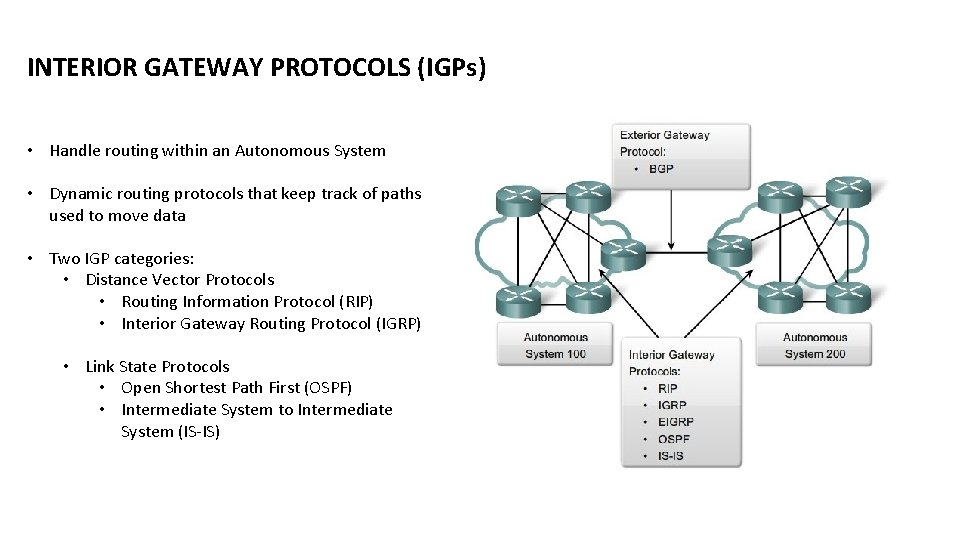
INTERIOR GATEWAY PROTOCOLS (IGPs) • Handle routing within an Autonomous System • Dynamic routing protocols that keep track of paths used to move data • Two IGP categories: • Distance Vector Protocols • Routing Information Protocol (RIP) • Interior Gateway Routing Protocol (IGRP) • Link State Protocols • Open Shortest Path First (OSPF) • Intermediate System to Intermediate System (IS-IS)
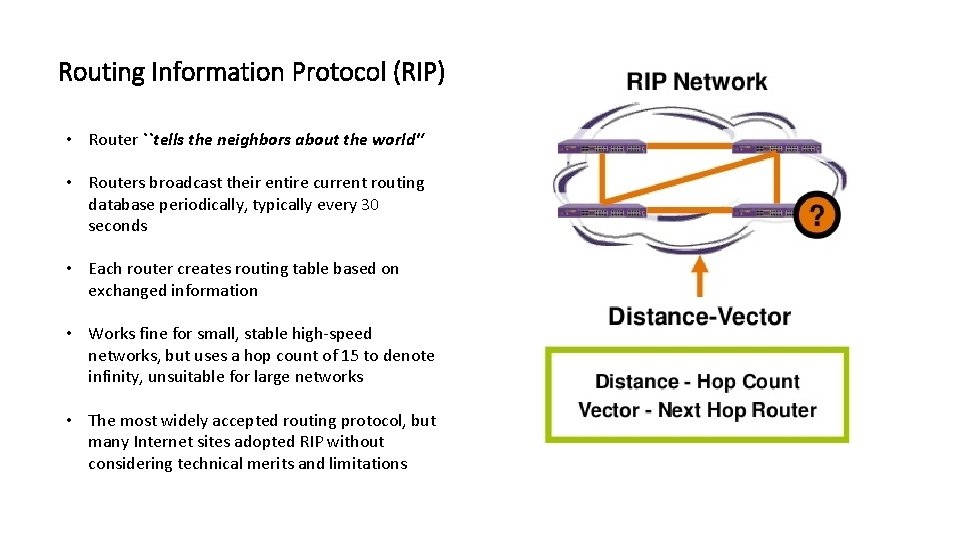
Routing Information Protocol (RIP) • Router ``tells the neighbors about the world'‘ • Routers broadcast their entire current routing database periodically, typically every 30 seconds • Each router creates routing table based on exchanged information • Works fine for small, stable high-speed networks, but uses a hop count of 15 to denote infinity, unsuitable for large networks • The most widely accepted routing protocol, but many Internet sites adopted RIP without considering technical merits and limitations
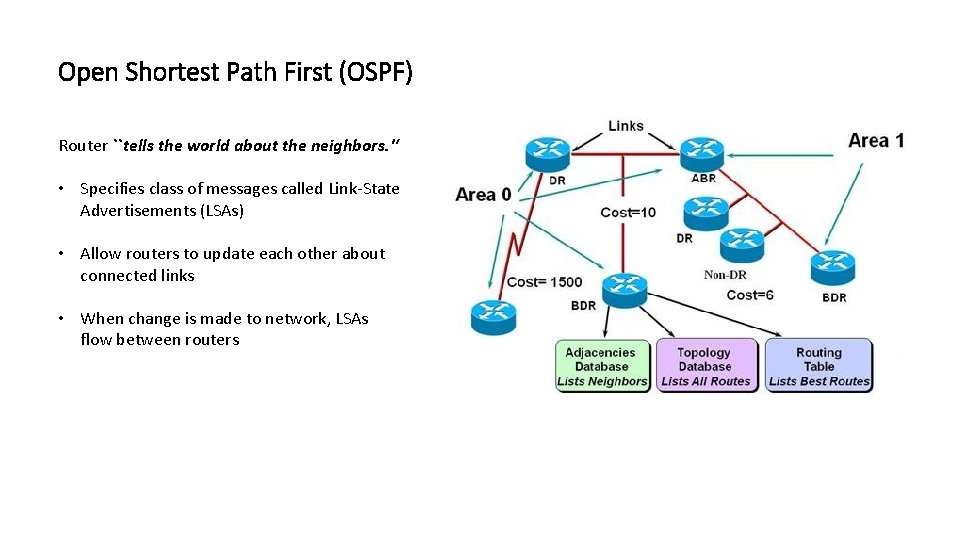
Open Shortest Path First (OSPF) Router ``tells the world about the neighbors. '‘ • Specifies class of messages called Link-State Advertisements (LSAs) • Allow routers to update each other about connected links • When change is made to network, LSAs flow between routers
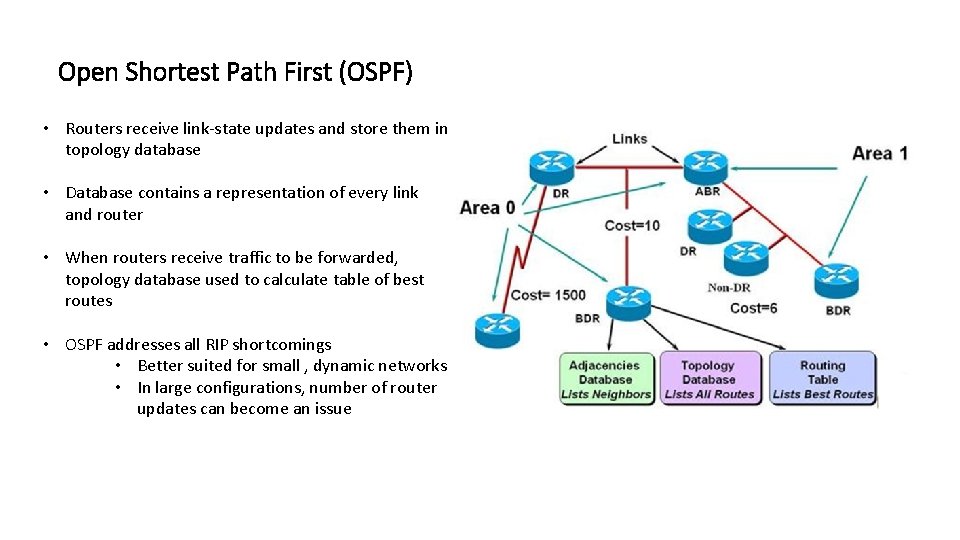
Open Shortest Path First (OSPF) • Routers receive link-state updates and store them in topology database • Database contains a representation of every link and router • When routers receive traffic to be forwarded, topology database used to calculate table of best routes • OSPF addresses all RIP shortcomings • Better suited for small , dynamic networks • In large configurations, number of router updates can become an issue

Intermediate System to Intermediate System (IS-IS) • A native Layer 3 (network layer) protocol capable of passing routing information for any routable protocol • Can implement comparable link-state routing but not restricted to IP like OSPF and other protocols • Network-protocol neutral, can support IPv 6 • Better suited for larger networks than other protocols, not as susceptible to scaling issues
Summary • Reliability protocols and vendor implementations have and continue to evolve • For different sized networks and scenarios, these protocol solutions should be considered for implementation to improve routing reliability • Resources available to learn more about these protocols: • • RIP OSPF V 2 OSPF for IPv 6 IS-IS

- Slides: 9