
TRANSPORT MODES COMPARISON from the presentation series Basics
TRANSPORT MODES - COMPARISON from the presentation series „Basics of Inland Navigation“
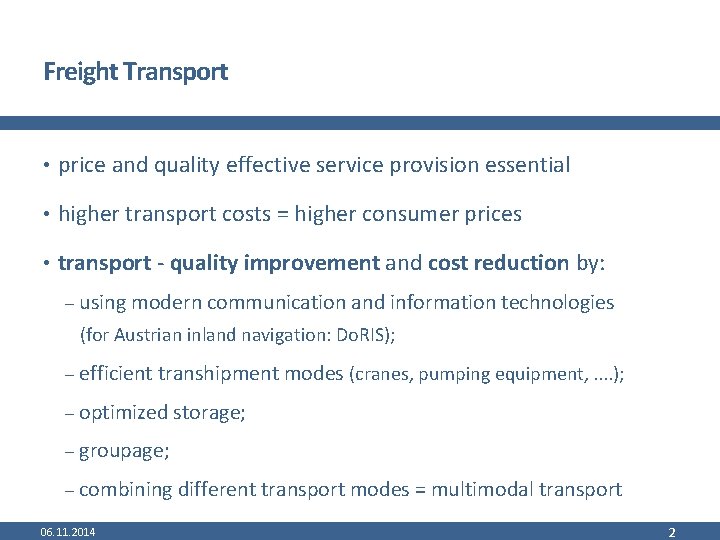
Freight Transport • price and quality effective service provision essential • higher transport costs = higher consumer prices • transport - quality improvement and cost reduction by: - using modern communication and information technologies (for Austrian inland navigation: Do. RIS); - efficient transhipment modes (cranes, pumping equipment, . . ); - optimized storage; - groupage; - combining different transport modes = multimodal transport 06. 11. 2014 2
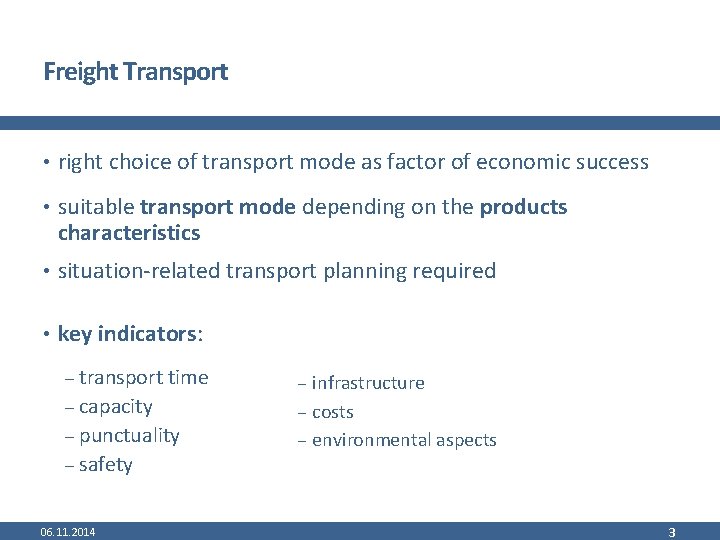
Freight Transport • right choice of transport mode as factor of economic success • suitable transport mode depending on the products characteristics • situation-related transport planning required • key indicators: - transport time - capacity - punctuality - safety 06. 11. 2014 - infrastructure - costs - environmental aspects 3
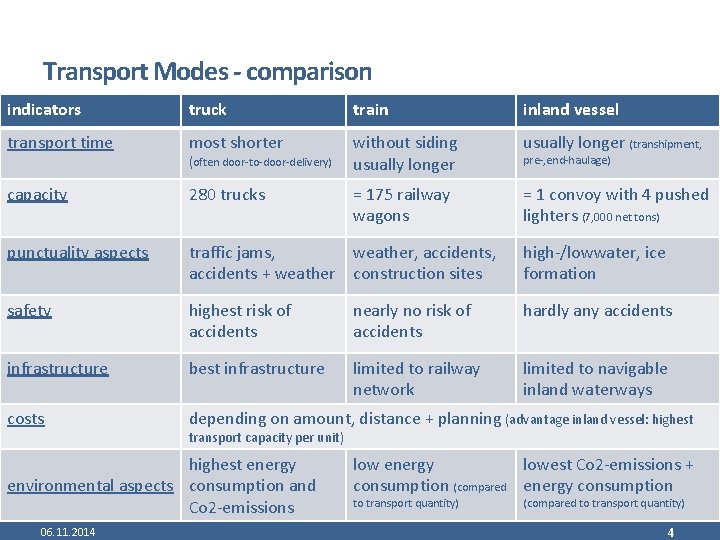
Transport Modes - comparison indicators truck train inland vessel transport time most shorter without siding usually longer (transhipment, capacity 280 trucks = 175 railway wagons = 1 convoy with 4 pushed lighters (7, 000 net tons) punctuality aspects traffic jams, weather, accidents + weather construction sites high-/lowwater, ice formation safety highest risk of accidents nearly no risk of accidents hardly any accidents infrastructure best infrastructure limited to railway network limited to navigable inland waterways costs depending on amount, distance + planning (advantage inland vessel: highest (often door-to-door-delivery) transport capacity per unit) highest energy environmental aspects consumption and Co 2 -emissions 06. 11. 2014 pre-, end-haulage) low energy lowest Co 2 -emissions + consumption (compared energy consumption to transport quantity) (compared to transport quantity) 4
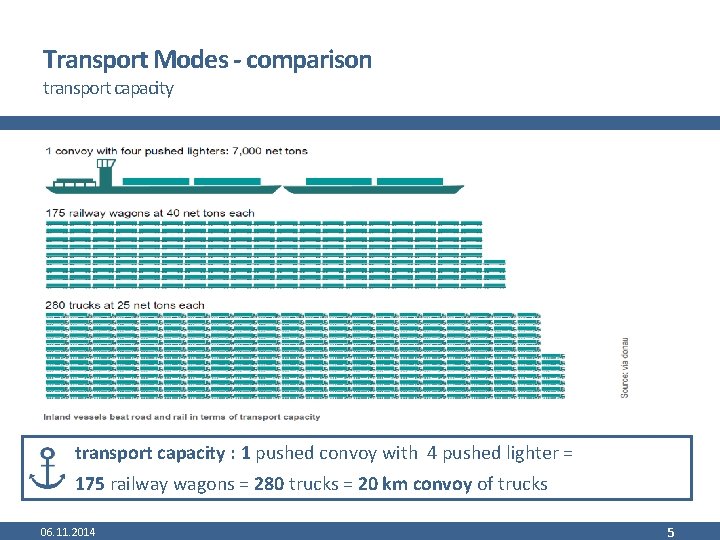
Transport Modes - comparison transport capacity : 1 pushed convoy with 4 pushed lighter = 175 railway wagons = 280 trucks = 20 km convoy of trucks 06. 11. 2014 5
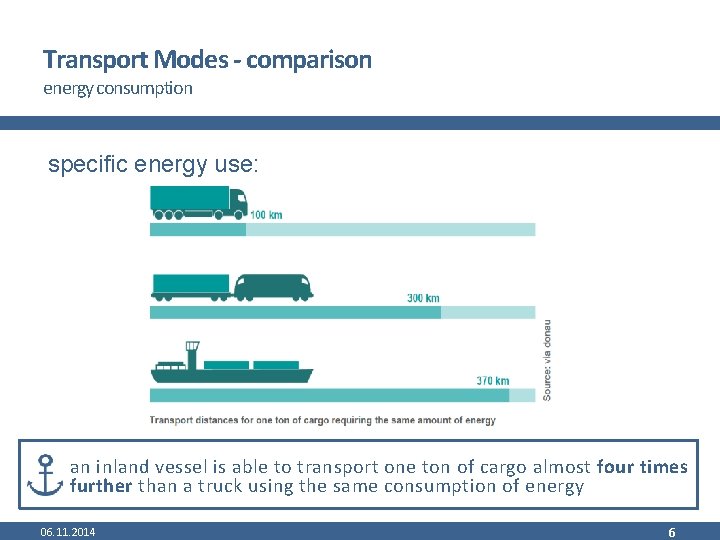
Transport Modes - comparison energy consumption specific energy use: an inland vessel is able to transport one ton of cargo almost four times further than a truck using the same consumption of energy 06. 11. 2014 6
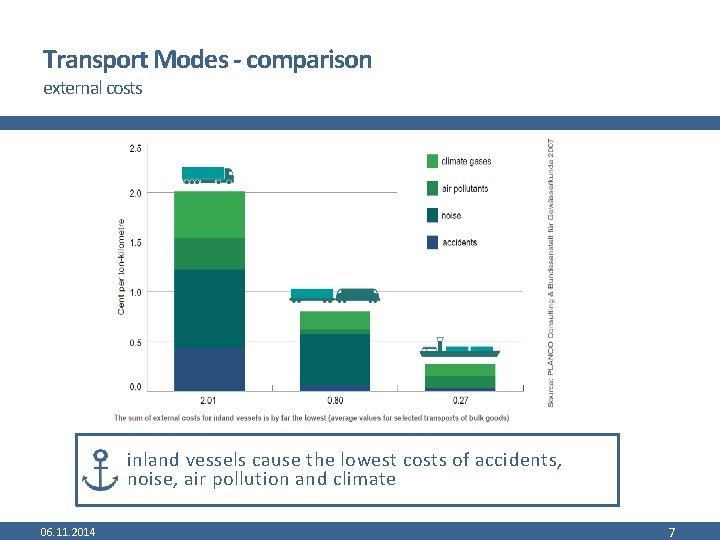
Transport Modes - comparison external costs inland vessels cause the lowest costs of accidents, noise, air pollution and climate 06. 11. 2014 7
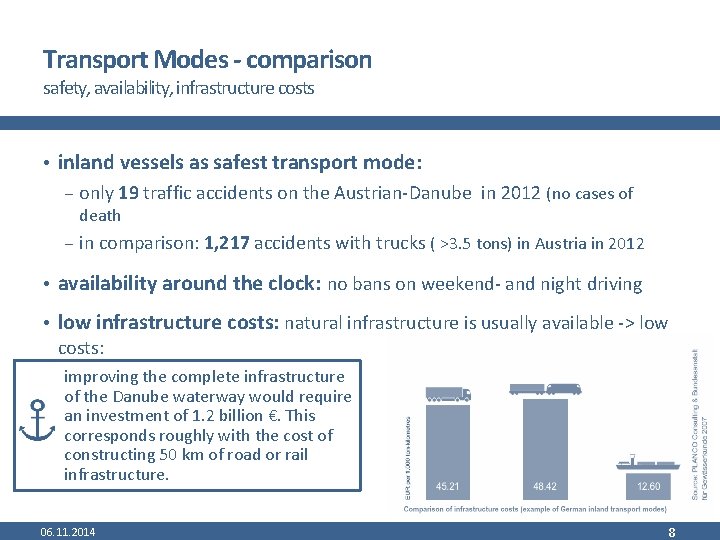
Transport Modes - comparison safety, availability, infrastructure costs • inland vessels as safest transport mode: - only 19 traffic accidents on the Austrian-Danube in 2012 (no cases of death - in comparison: 1, 217 accidents with trucks ( >3. 5 tons) in Austria in 2012 • availability around the clock: no bans on weekend- and night driving • low infrastructure costs: natural infrastructure is usually available -> low costs: improving the complete infrastructure of the Danube waterway would require an investment of 1. 2 billion €. This corresponds roughly with the cost of constructing 50 km of road or rail infrastructure. 06. 11. 2014 8
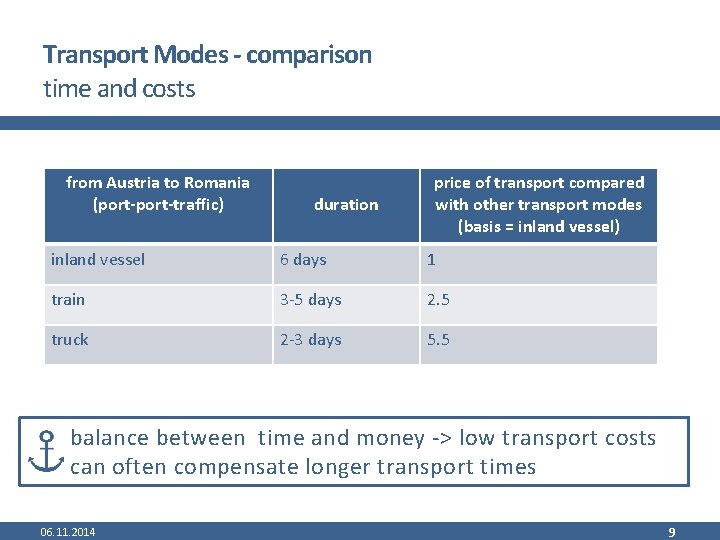
Transport Modes - comparison time and costs from Austria to Romania (port-traffic) duration price of transport compared with other transport modes (basis = inland vessel) inland vessel 6 days 1 train 3 -5 days 2. 5 truck 2 -3 days 5. 5 balance between time and money -> low transport costs can often compensate longer transport times 06. 11. 2014 9
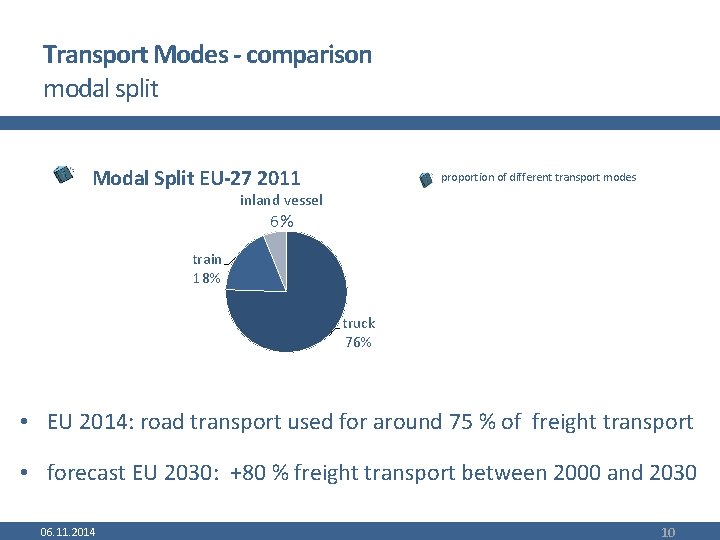
Transport Modes - comparison modal split Modal Split EU-27 2011 proportion of different transport modes inland vessel 6% train 18% truck 76% • EU 2014: road transport used for around 75 % of freight transport • forecast EU 2030: +80 % freight transport between 2000 and 2030 06. 11. 2014 10
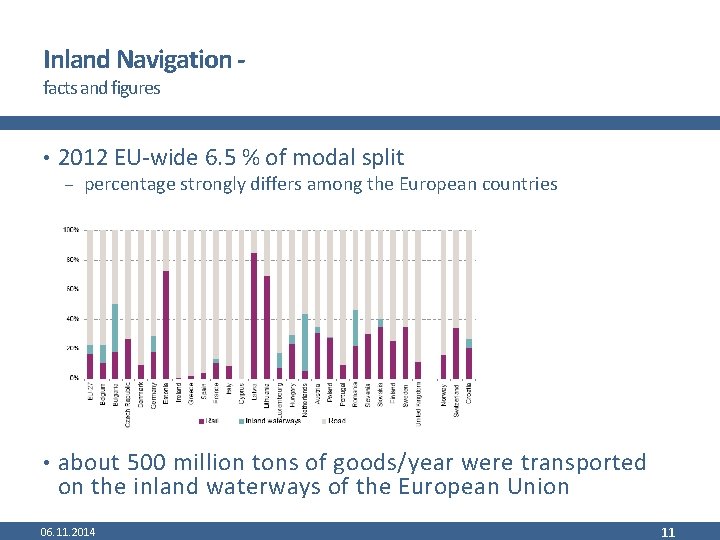
Inland Navigation facts and figures • 2012 EU-wide 6. 5 % of modal split - percentage strongly differs among the European countries • about 500 million tons of goods/year were transported on the inland waterways of the European Union 06. 11. 2014 11
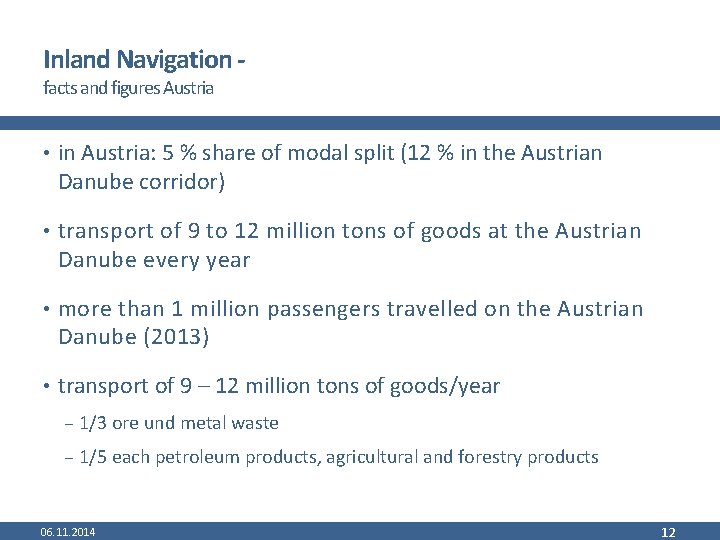
Inland Navigation facts and figures Austria • in Austria: 5 % share of modal split (12 % in the Austrian Danube corridor) • transport of 9 to 12 million tons of goods at the Austrian Danube every year • more than 1 million passengers travelled on the Austrian Danube (2013) • transport of 9 – 12 million tons of goods/year - 1/3 ore und metal waste - 1/5 each petroleum products, agricultural and forestry products 06. 11. 2014 12
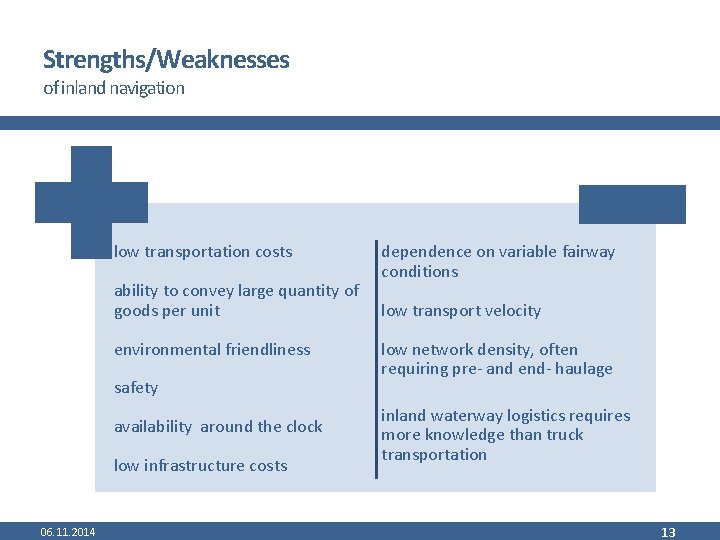
Strengths/Weaknesses of inland navigation low transportation costs ability to convey large quantity of goods per unit environmental friendliness safety availability around the clock low infrastructure costs 06. 11. 2014 dependence on variable fairway conditions low transport velocity low network density, often requiring pre- and end- haulage inland waterway logistics requires more knowledge than truck transportation 13
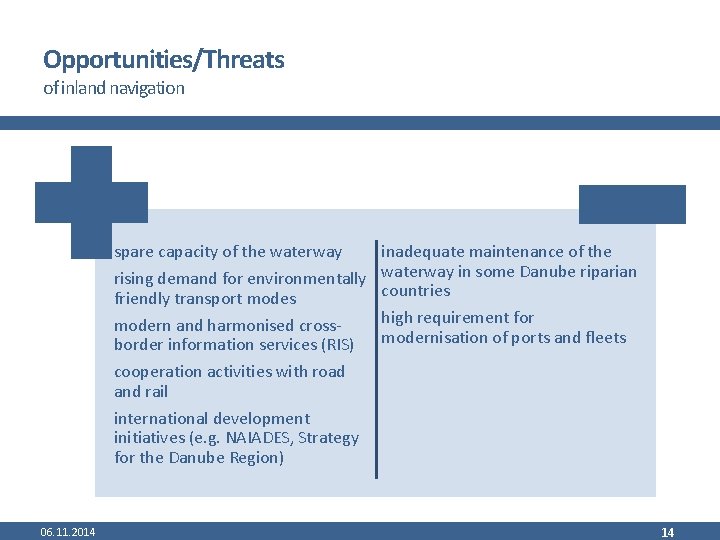
Opportunities/Threats of inland navigation spare capacity of the waterway inadequate maintenance of the rising demand for environmentally waterway in some Danube riparian countries friendly transport modes high requirement for modern and harmonised crossmodernisation of ports and fleets border information services (RIS) cooperation activities with road and rail international development initiatives (e. g. NAIADES, Strategy for the Danube Region) 06. 11. 2014 14
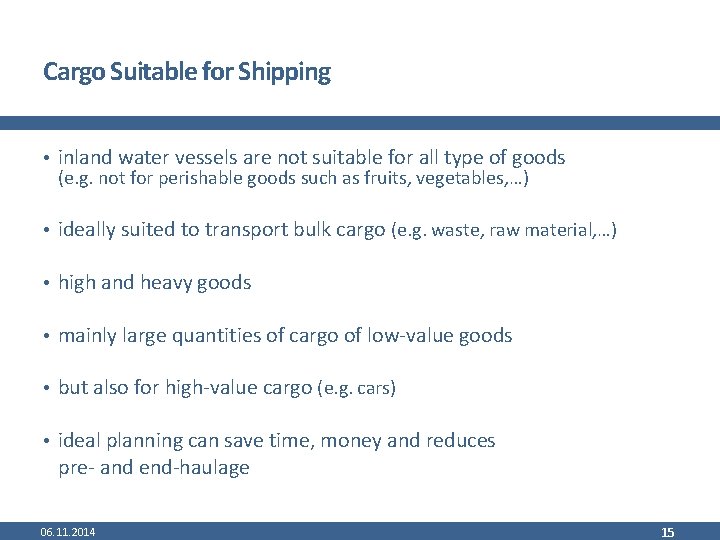
Cargo Suitable for Shipping • inland water vessels are not suitable for all type of goods (e. g. not for perishable goods such as fruits, vegetables, …) • ideally suited to transport bulk cargo (e. g. waste, raw material, …) • high and heavy goods • mainly large quantities of cargo of low-value goods • but also for high-value cargo (e. g. cars) • ideal planning can save time, money and reduces pre- and end-haulage 06. 11. 2014 15
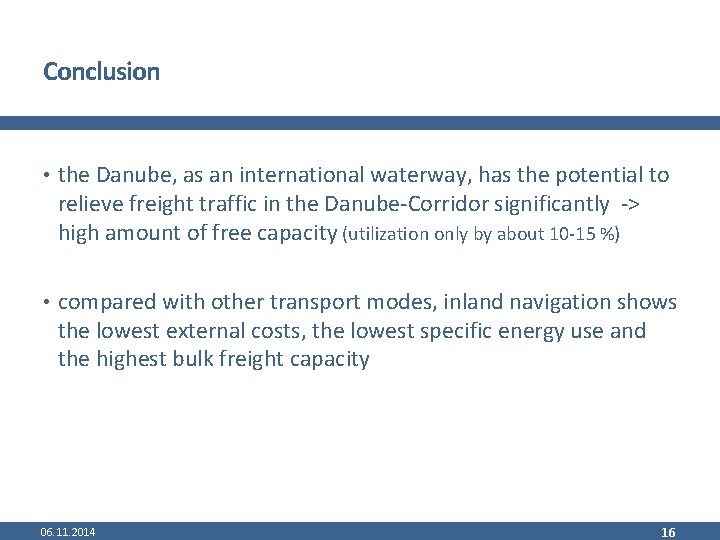
Conclusion • the Danube, as an international waterway, has the potential to relieve freight traffic in the Danube-Corridor significantly -> high amount of free capacity (utilization only by about 10 -15 %) • compared with other transport modes, inland navigation shows the lowest external costs, the lowest specific energy use and the highest bulk freight capacity 06. 11. 2014 16
Sources • viadonau (2013): Manual on Danube Navigation, Vienna. Order: http: //www. via-donau. org/en/economy/online_services/manual_on_danube_navigation/ • viadonau (2014): Danube Navigation in Austria– Annual Report 2013, Vienna. Download : http: //www. via-donau. org/en/newsroom/brochures/ • INe. S Danube information platform on intermodal inland navigation Homepage : http: //www. ines-danube. info/? lang=en • Posset, Gierlinger, Gronalt, Peherstorfer, Pripfl, Starkl (2014): Intermodaler Verkehr Europa, Wien. Bestellen: http: //www. logistikum. at/forschung/verkehrslogistik/intermodaler-verkehr-ineuropa/kontaktbestellung. html 06. 11. 2014 17
Contact Lisa-Maria Putz, BSc MA Project Leader REWWay Logistikum – University of Applied Sciences Upper Austria FH OÖ Forschungs & Entwicklungs Gmb. H Wehrgrabengasse 1 -3, 4400 Steyr/Austria Tel. : +43 50804 -33253 Fax: +43 50804 -33299 e-mail: lisa-maria. putz@fh-steyr. at web 1: www. logistikum. at web 2: www. fh-ooe. at 06. 08. 2014 18
- Slides: 18