
TRANSPORT LIBERALIZATION Maritime status CONTENTS Global Maritime overview
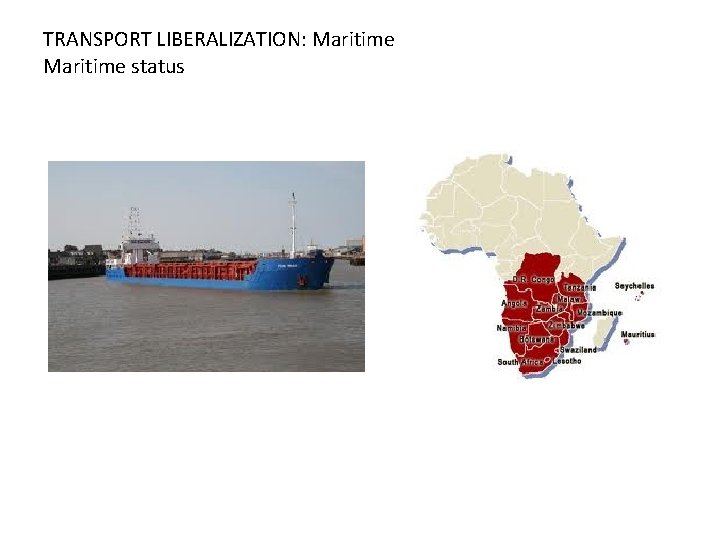
TRANSPORT LIBERALIZATION: Maritime status
CONTENTS • Global Maritime overview • Maritime trade in services by country • Key issues and recommendations • Way forward
MARITIME SECTOR OVERVIEW
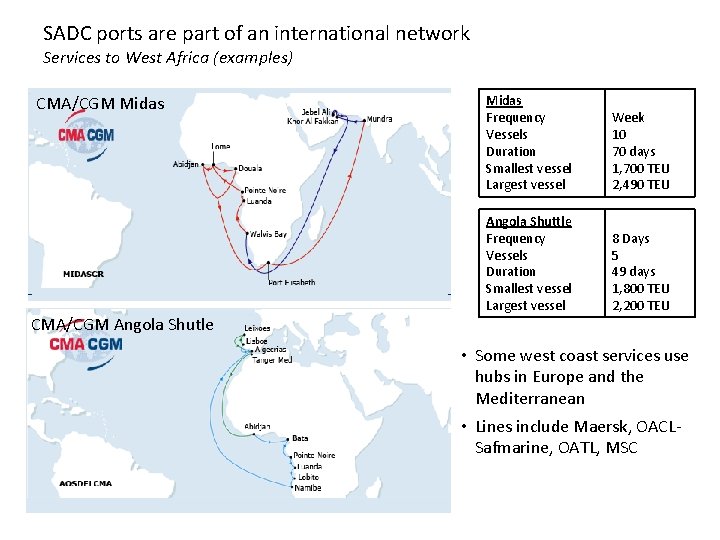
SADC ports are part of an international network Services to West Africa (examples) CMA/CGM Midas CMA/CGM Angola Shutle Midas Frequency Vessels Duration Smallest vessel Largest vessel Week 10 70 days 1, 700 TEU 2, 490 TEU Angola Shuttle Frequency Vessels Duration Smallest vessel Largest vessel 8 Days 5 49 days 1, 800 TEU 2, 200 TEU • Some west coast services use hubs in Europe and the Mediterranean • Lines include Maersk, OACLSafmarine, OATL, MSC
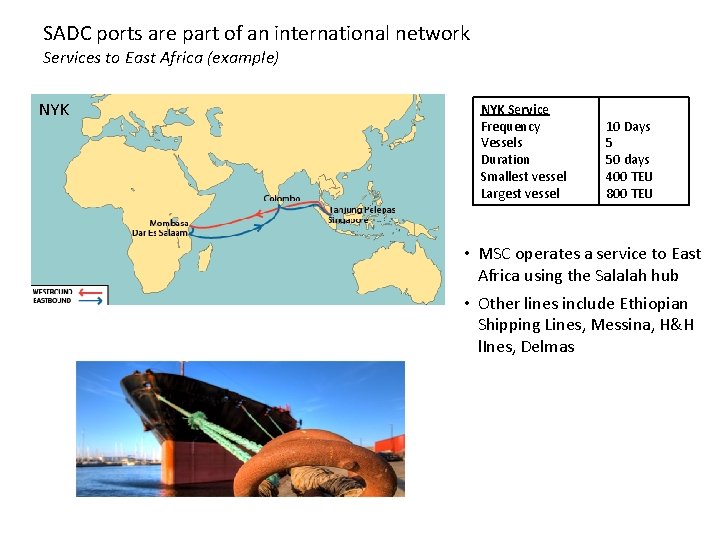
SADC ports are part of an international network Services to East Africa (example) NYK Service Frequency Vessels Duration Smallest vessel Largest vessel 10 Days 5 50 days 400 TEU 800 TEU • MSC operates a service to East Africa using the Salalah hub • Other lines include Ethiopian Shipping Lines, Messina, H&H l. Ines, Delmas
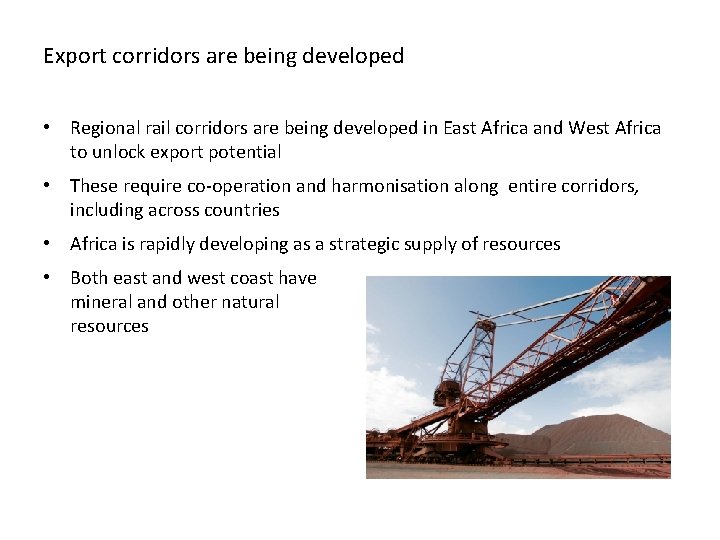
Export corridors are being developed • Regional rail corridors are being developed in East Africa and West Africa to unlock export potential • These require co-operation and harmonisation along entire corridors, including across countries • Africa is rapidly developing as a strategic supply of resources • Both east and west coast have mineral and other natural resources
Maritime industry developments • Larger vessels require upgraded infrastructure – Largest container ship is the Maersk Triple-E class (18, 000 TEU) – Largest container vessel to call in Durban (MSC Sola - 11, 660 TEU) • Ports aspire to hub status – Improved frequency, service levels – Reduced cost/TEU • The industry dominated by relatively few international entities – Global terminal operators control 71% of container capacity (includes public sector operators e. g. PSA) – Top 5 operators control almost 50% of capacity • Shipping lines are coming off a period in which they incurred severe losses
Key issues • Ports handle over 90% of import-export cargoes • Shipping lines are highly mobile • Port and hinterland capacity has not kept pace with demand throughout the Region • Congestion and delays result in higher costs to cargo owners (missed calls, surcharges, etc. ) • An under-developed maritime sector constrains economic growth
Factor that support a successful maritime sector • Connectivity – Trade routes – Hinterland • Volume • Infrastructure • Support services • Trading environment • Partnerships
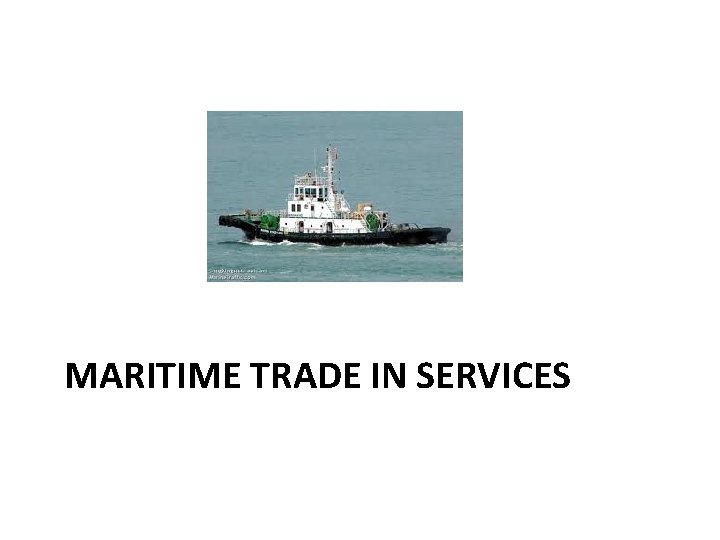
MARITIME TRADE IN SERVICES
Maritime trade in services • The SADC Protocol on Trade in Services (PTCM) in transportation is expected to reduce or remove barriers that impede the flow of trade between SADC countries • The maritime sector for this study includes vessel operations (sea freight and sea passengers), and supporting services for maritime transport, namely WTO codes 7211, 7212 and 745** • Maritime countries within SADC are the Democratic Republic of the Congo(DRC), Angola, Namibia, South Africa, Mozambique, Tanzania, Mauritius and the Seychelles • The objective of the PTCM is facilitate an efficient, cost effective and fully integrated infrastructure and operations • The process is expected to result in request-offers by August and initial offers (including transport) by November 2012
PTIS (maritime) key elements • Maritime transport is an area of strategic importance to regional economic growth • Realising the potential of this sector requires harmonised international and regional transport policies and regulations • It is understood that developing coastal shipping, encouraging joint ventures with the private sector are key components for developing the sector • Regional co-operation and harmonised tariff structures should not result in uncompetitive business practices
Issues affecting implementation • The port sector has strong control and influence from government in all SADC countries. The industry often reflects national priorities • Investment backlogs, inefficient port operations and undeveloped skills are critical factors affecting the industry • Relatively low volumes limit the ability of SADC maritime nations to negotiate service and price advantages with large international carriers • Creating capacity and requires large-scale investment. Skills development also requires investment and co-ordinated effort • SADC countries are at different levels of implementation regarding international maritime regulations and conventions
Liberalisation status (maritime) • No maritime states currently restrict foreign flagged vessels. Angola is considering a state-owned shipping company • Coastal maritime trade is restricted in Angola, Tanzania • Private sector participation – Only Mozambique has private sector involvement in port authority functions – All SADC countries support concession arrangements for port operations – Only Mozambique has an initiative to privatise marine services. South Africa considers this an option
MARITIME TRADE IN SERVICE BY COUNTRY
Maritime trade in services by country • Angola • Democratic republic of the Congo • Mauritius • Mozambique • Namibia • South Africa • Seychelles • Tanzania
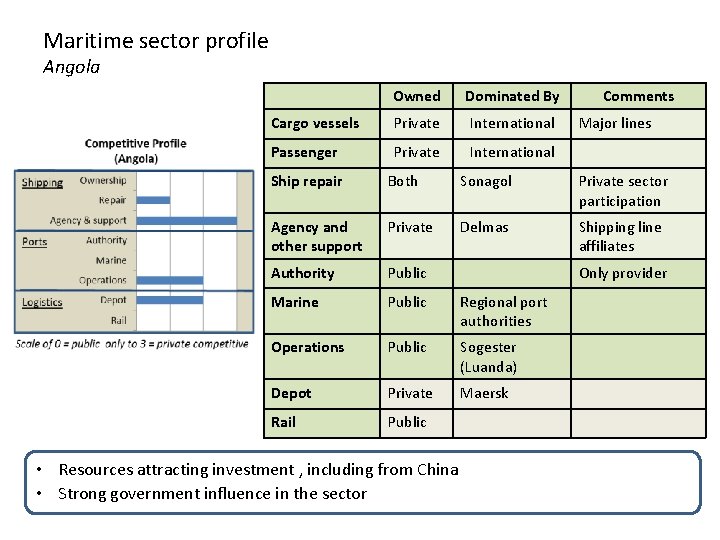
Maritime sector profile Angola Owned Dominated By Cargo vessels Private International Passenger Private International Comments Major lines Ship repair Both Sonagol Private sector participation Agency and other support Private Delmas Shipping line affiliates Authority Public Marine Public Regional port authorities Operations Public Sogester (Luanda) Depot Private Maersk Rail Public • Resources attracting investment , including from China • Strong government influence in the sector Only provider
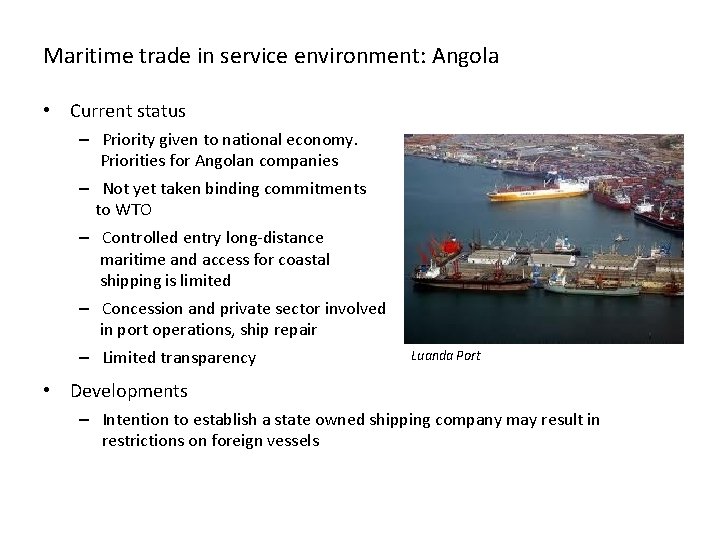
Maritime trade in service environment: Angola • Current status – Priority given to national economy. Priorities for Angolan companies – Not yet taken binding commitments to WTO – Controlled entry long-distance maritime and access for coastal shipping is limited – Concession and private sector involved in port operations, ship repair – Limited transparency Luanda Port • Developments – Intention to establish a state owned shipping company may result in restrictions on foreign vessels
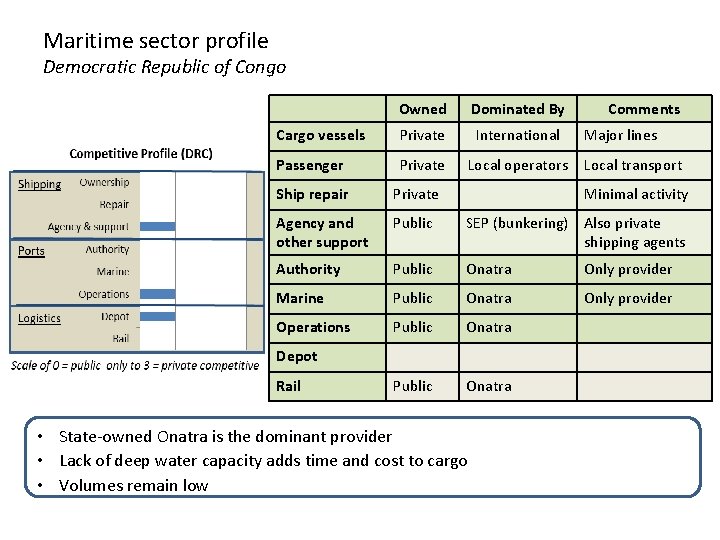
Maritime sector profile Democratic Republic of Congo Owned Dominated By Cargo vessels Private International Passenger Private Local operators Comments Major lines Local transport Ship repair Private Minimal activity Agency and other support Public SEP (bunkering) Also private shipping agents Authority Public Onatra Only provider Marine Public Onatra Only provider Operations Public Onatra Depot Rail • State-owned Onatra is the dominant provider • Lack of deep water capacity adds time and cost to cargo • Volumes remain low
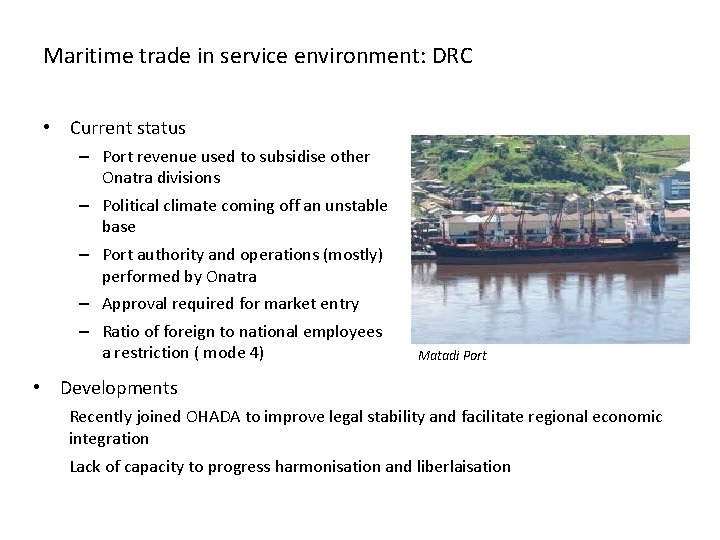
Maritime trade in service environment: DRC • Current status – Port revenue used to subsidise other Onatra divisions – Political climate coming off an unstable base – Port authority and operations (mostly) performed by Onatra – Approval required for market entry – Ratio of foreign to national employees a restriction ( mode 4) Matadi Port • Developments Recently joined OHADA to improve legal stability and facilitate regional economic integration Lack of capacity to progress harmonisation and liberlaisation
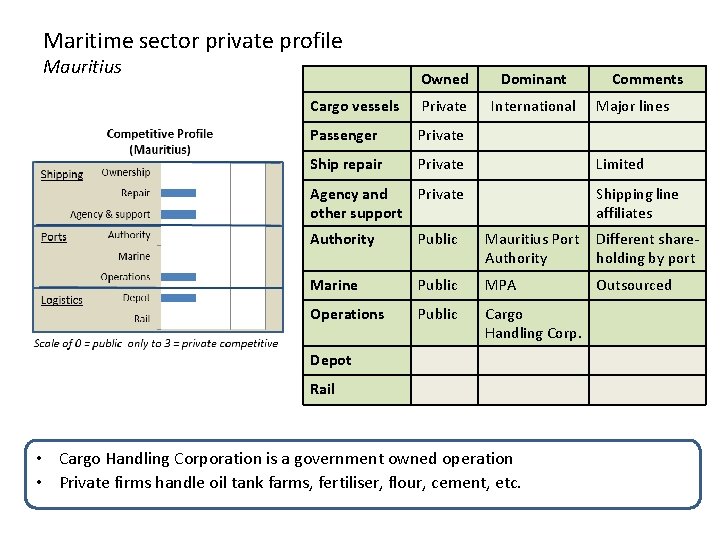
Maritime sector private profile Mauritius Owned Dominant Cargo vessels Private International Passenger Private Ship repair Private Comments Major lines Limited Agency and Private other support Shipping line affiliates Authority Public Mauritius Port Authority Different shareholding by port Marine Public MPA Outsourced Operations Public Cargo Handling Corp. Depot Rail • Cargo Handling Corporation is a government owned operation • Private firms handle oil tank farms, fertiliser, flour, cement, etc.
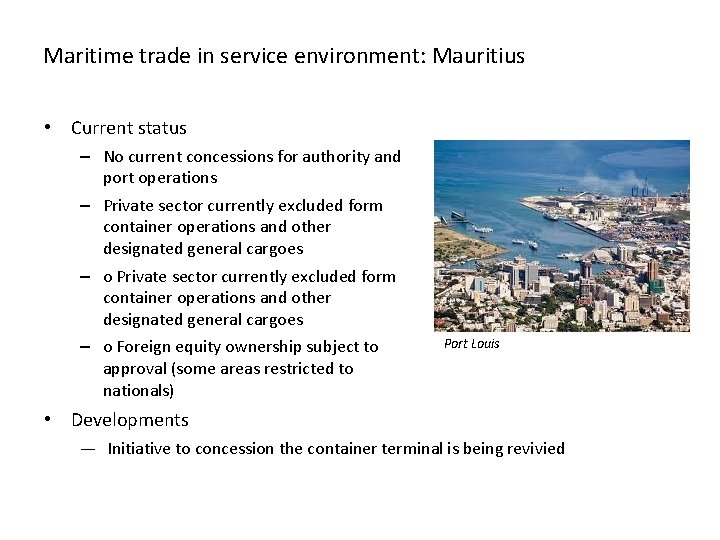
Maritime trade in service environment: Mauritius • Current status – No current concessions for authority and port operations – Private sector currently excluded form container operations and other designated general cargoes – o Foreign equity ownership subject to approval (some areas restricted to nationals) Port Louis • Developments — Initiative to concession the container terminal is being revivied
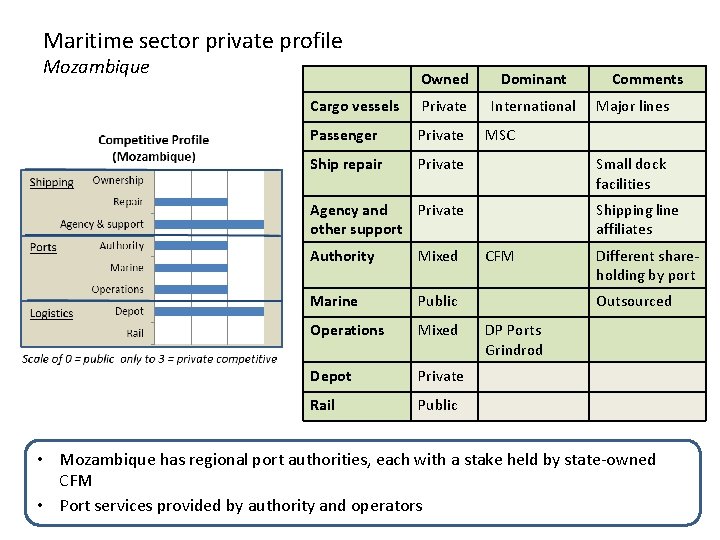
Maritime sector private profile Mozambique Owned Dominant Cargo vessels Private International Passenger Private Ship repair Private Mixed Marine Public Operations Mixed Depot Private Rail Public Major lines MSC Small dock facilities Agency and Private other support Authority Comments Shipping line affiliates CFM Different shareholding by port Outsourced DP Ports Grindrod • Mozambique has regional port authorities, each with a stake held by state-owned CFM • Port services provided by authority and operators
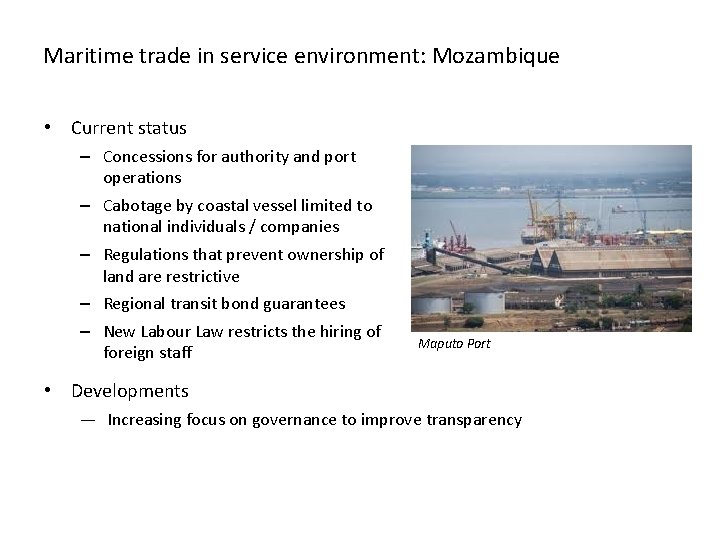
Maritime trade in service environment: Mozambique • Current status – Concessions for authority and port operations – Cabotage by coastal vessel limited to national individuals / companies – Regulations that prevent ownership of land are restrictive – Regional transit bond guarantees – New Labour Law restricts the hiring of foreign staff Maputo Port • Developments — Increasing focus on governance to improve transparency
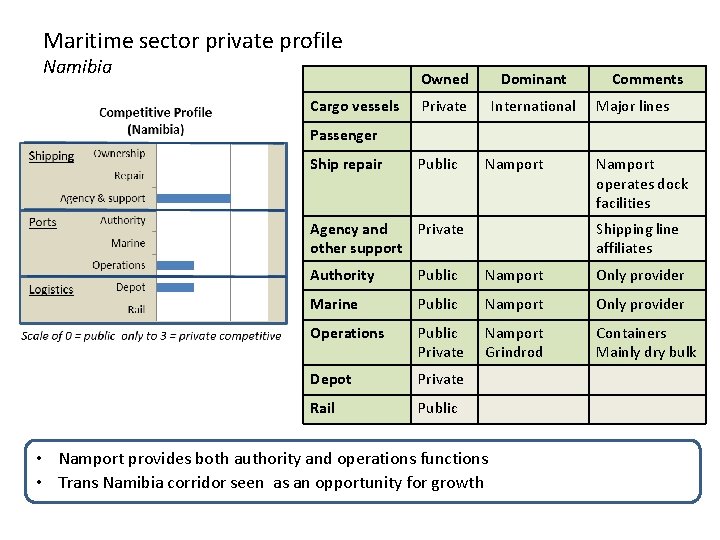
Maritime sector private profile Namibia Cargo vessels Owned Dominant Private International Comments Major lines Passenger Ship repair Public Namport Agency and Private other support Namport operates dock facilities Shipping line affiliates Authority Public Namport Only provider Marine Public Namport Only provider Operations Public Private Namport Grindrod Containers Mainly dry bulk Depot Private Rail Public • Namport provides both authority and operations functions • Trans Namibia corridor seen as an opportunity for growth
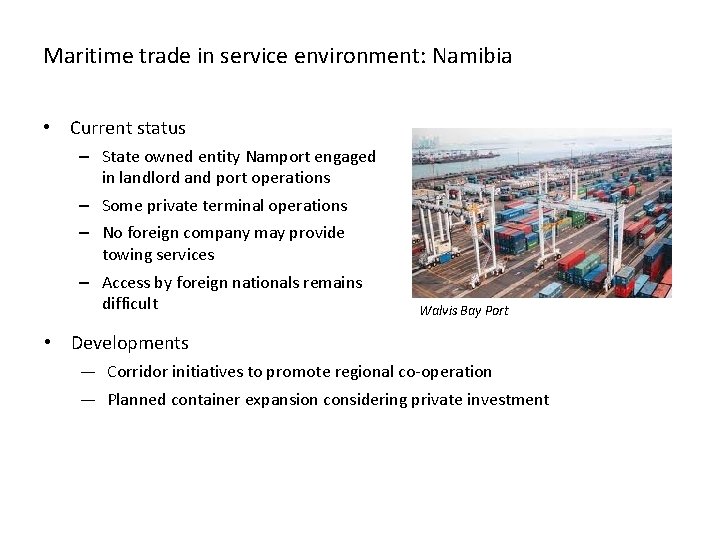
Maritime trade in service environment: Namibia • Current status – State owned entity Namport engaged in landlord and port operations – Some private terminal operations – No foreign company may provide towing services – Access by foreign nationals remains difficult Walvis Bay Port • Developments ― Corridor initiatives to promote regional co-operation ― Planned container expansion considering private investment
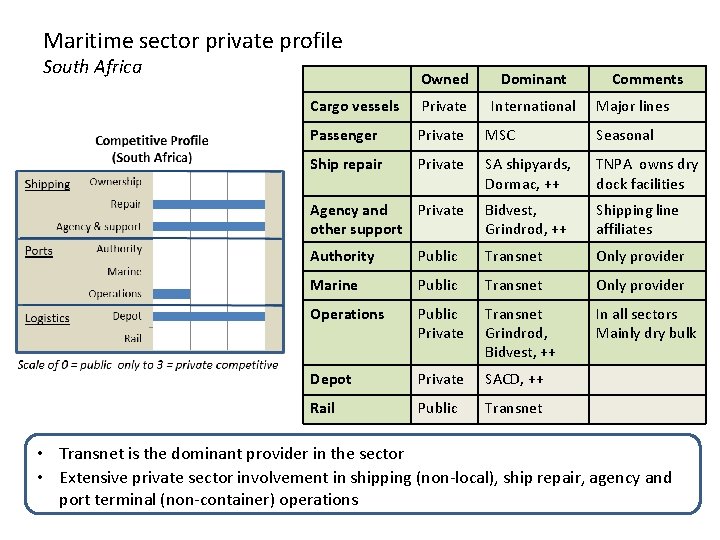
Maritime sector private profile South Africa Owned Dominant Comments Cargo vessels Private International Passenger Private MSC Seasonal Ship repair Private SA shipyards, Dormac, ++ TNPA owns dry dock facilities Agency and Private other support Bidvest, Grindrod, ++ Shipping line affiliates Authority Public Transnet Only provider Marine Public Transnet Only provider Operations Public Private Transnet Grindrod, Bidvest, ++ In all sectors Mainly dry bulk Depot Private SACD, ++ Rail Public Transnet Major lines • Transnet is the dominant provider in the sector • Extensive private sector involvement in shipping (non-local), ship repair, agency and port terminal (non-container) operations
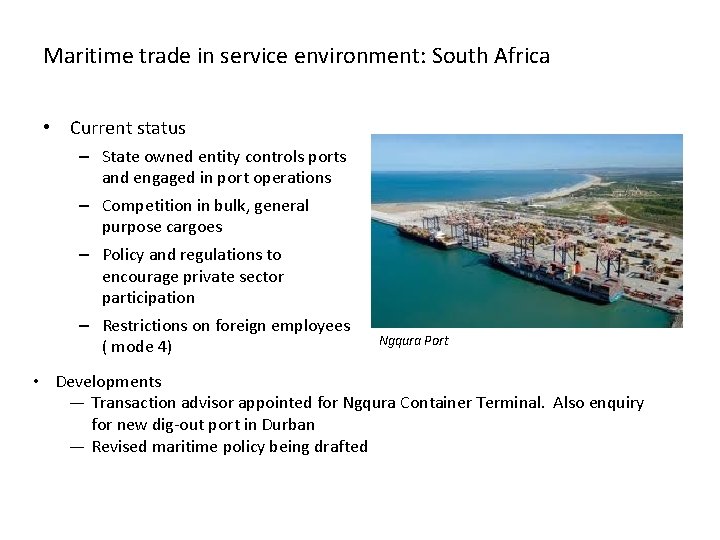
Maritime trade in service environment: South Africa • Current status – State owned entity controls ports and engaged in port operations – Competition in bulk, general purpose cargoes – Policy and regulations to encourage private sector participation – Restrictions on foreign employees ( mode 4) Ngqura Port • Developments — Transaction advisor appointed for Ngqura Container Terminal. Also enquiry for new dig-out port in Durban — Revised maritime policy being drafted
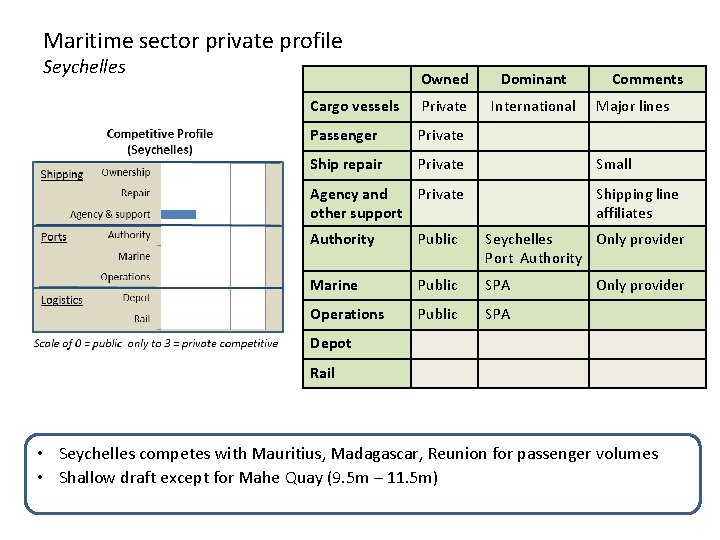
Maritime sector private profile Seychelles Owned Dominant Cargo vessels Private International Passenger Private Ship repair Private Comments Major lines Small Agency and Private other support Shipping line affiliates Authority Public Seychelles Only provider Port Authority Marine Public SPA Operations Public SPA Only provider Depot Rail • Seychelles competes with Mauritius, Madagascar, Reunion for passenger volumes • Shallow draft except for Mahe Quay (9. 5 m – 11. 5 m)
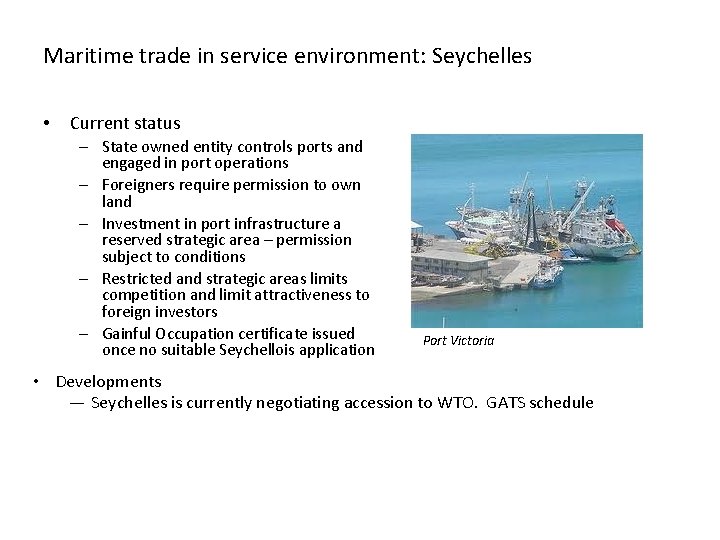
Maritime trade in service environment: Seychelles • Current status – State owned entity controls ports and engaged in port operations – Foreigners require permission to own land – Investment in port infrastructure a reserved strategic area – permission subject to conditions – Restricted and strategic areas limits competition and limit attractiveness to foreign investors – Gainful Occupation certificate issued once no suitable Seychellois application Port Victoria • Developments — Seychelles is currently negotiating accession to WTO. GATS schedule
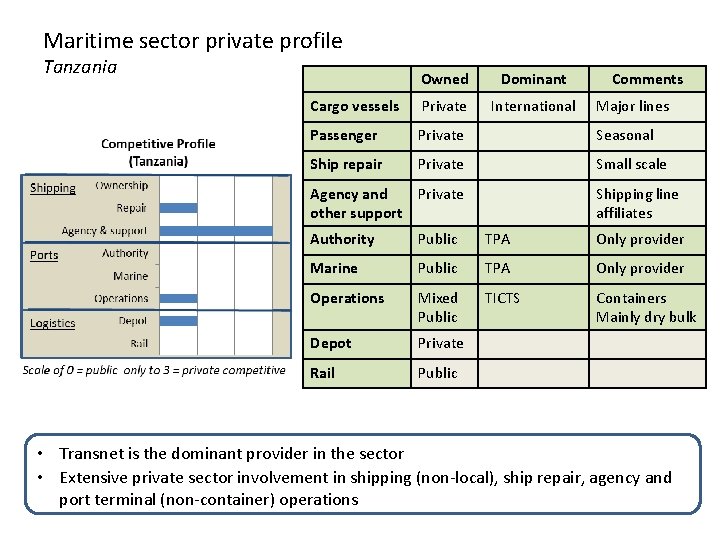
Maritime sector private profile Tanzania Owned Dominant Cargo vessels Private International Passenger Private Seasonal Ship repair Private Small scale Agency and Private other support Comments Major lines Shipping line affiliates Authority Public TPA Only provider Marine Public TPA Only provider Operations Mixed Public TICTS Containers Mainly dry bulk Depot Private Rail Public • Transnet is the dominant provider in the sector • Extensive private sector involvement in shipping (non-local), ship repair, agency and port terminal (non-container) operations
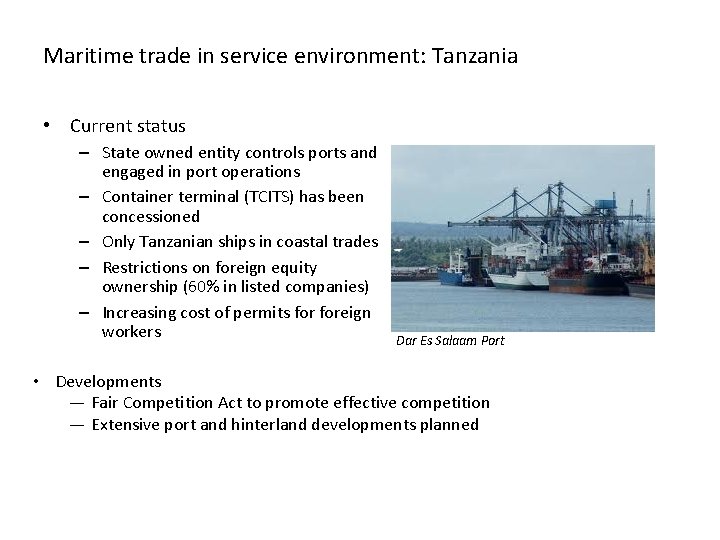
Maritime trade in service environment: Tanzania • Current status – State owned entity controls ports and engaged in port operations – Container terminal (TCITS) has been concessioned – Only Tanzanian ships in coastal trades – Restrictions on foreign equity ownership (60% in listed companies) – Increasing cost of permits foreign workers Dar Es Salaam Port • Developments — Fair Competition Act to promote effective competition — Extensive port and hinterland developments planned
KEY ISSUE AND RECOMMENDATIONS



- Slides: 36