
Transport Layer Transportlayer services Multiplexing and demultiplexing Connectionless
- Slides: 21
Transport Layer § § § Transport-layer services Multiplexing and demultiplexing Connectionless transport: UDP Principles of reliable data transfer Connection-oriented transport: TCP Principles of congestion control § TCP congestion control § Evolution of transport-layer functionality COMPSCI 453 Computer Networks Professor Jim Kurose College of Information and Computer Sciences University of Massachusetts Class textbook: Computer Networking: A Top. Down Approach (8 th ed. ) J. F. Kurose, K. W. Ross Pearson, 2020 http: //gaia. cs. umass. edu/kurose_ross
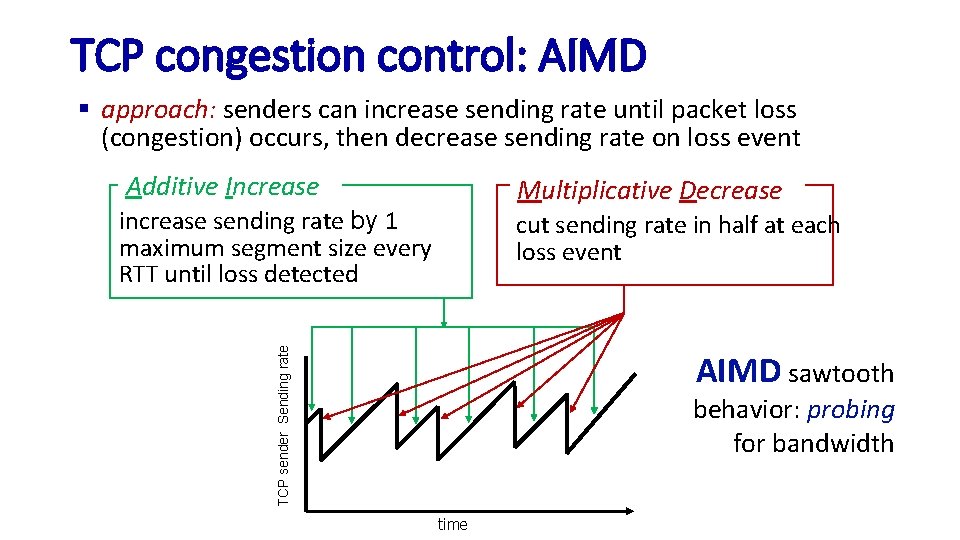
TCP congestion control: AIMD § approach: senders can increase sending rate until packet loss (congestion) occurs, then decrease sending rate on loss event Additive Increase Multiplicative Decrease increase sending rate by 1 maximum segment size every RTT until loss detected TCP sender Sending rate cut sending rate in half at each loss event AIMD sawtooth behavior: probing for bandwidth time
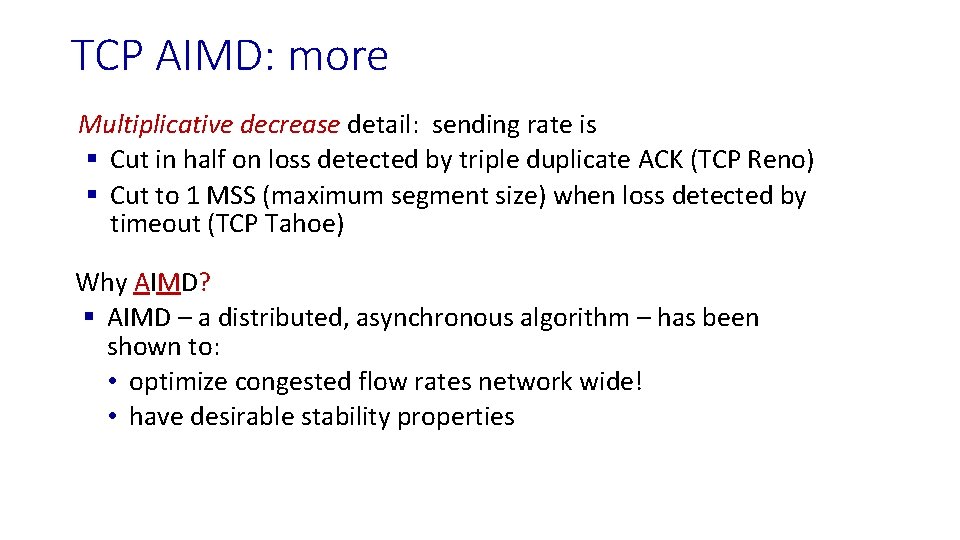
TCP AIMD: more Multiplicative decrease detail: sending rate is § Cut in half on loss detected by triple duplicate ACK (TCP Reno) § Cut to 1 MSS (maximum segment size) when loss detected by timeout (TCP Tahoe) Why AIMD? § AIMD – a distributed, asynchronous algorithm – has been shown to: • optimize congested flow rates network wide! • have desirable stability properties
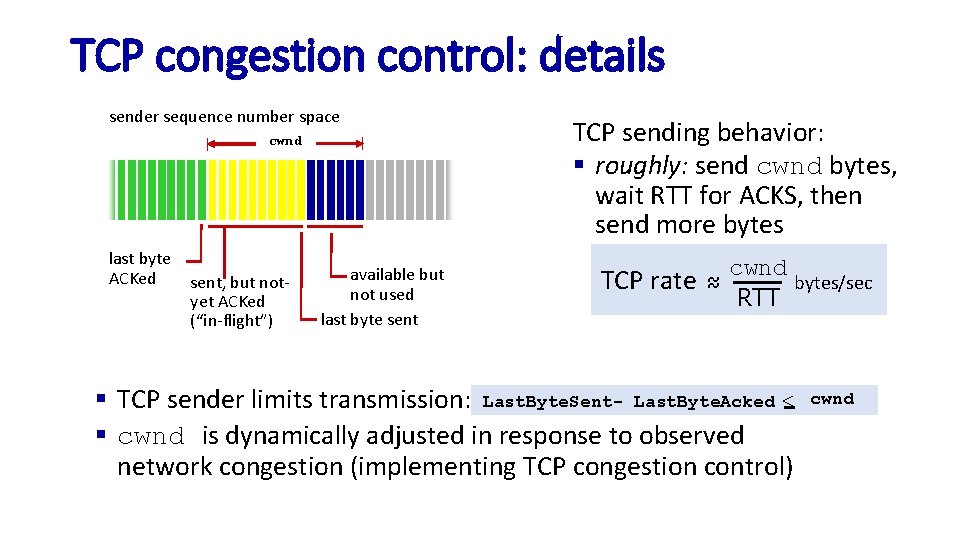
TCP congestion control: details sender sequence number space cwnd last byte ACKed sent, but notyet ACKed (“in-flight”) available but not used last byte sent TCP sending behavior: § roughly: send cwnd bytes, wait RTT for ACKS, then send more bytes TCP rate ~ ~ cwnd bytes/sec RTT § TCP sender limits transmission: Last. Byte. Sent- Last. Byte. Acked < § cwnd is dynamically adjusted in response to observed network congestion (implementing TCP congestion control) cwnd
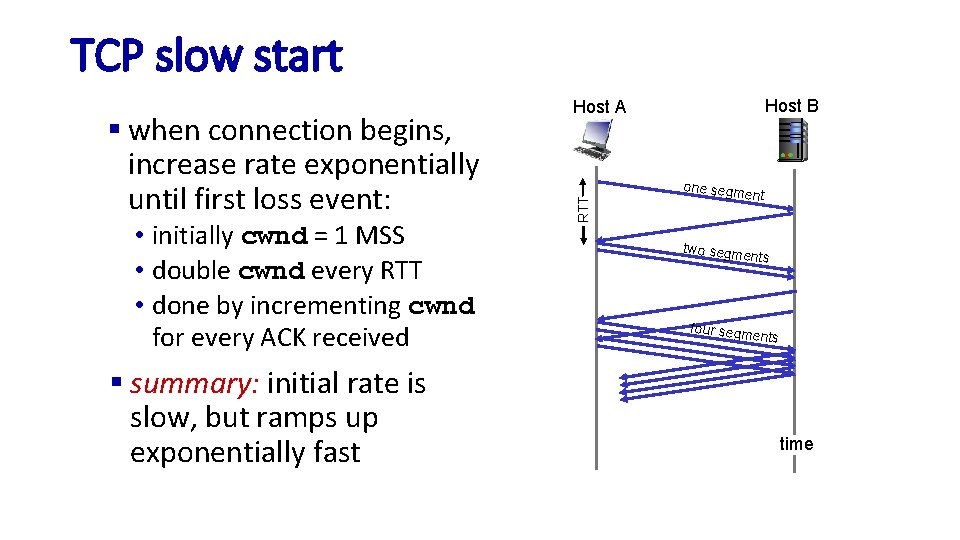
TCP slow start • initially cwnd = 1 MSS • double cwnd every RTT • done by incrementing cwnd for every ACK received § summary: initial rate is slow, but ramps up exponentially fast RTT § when connection begins, increase rate exponentially until first loss event: Host B Host A one segm ent two segm ents four segm ents time
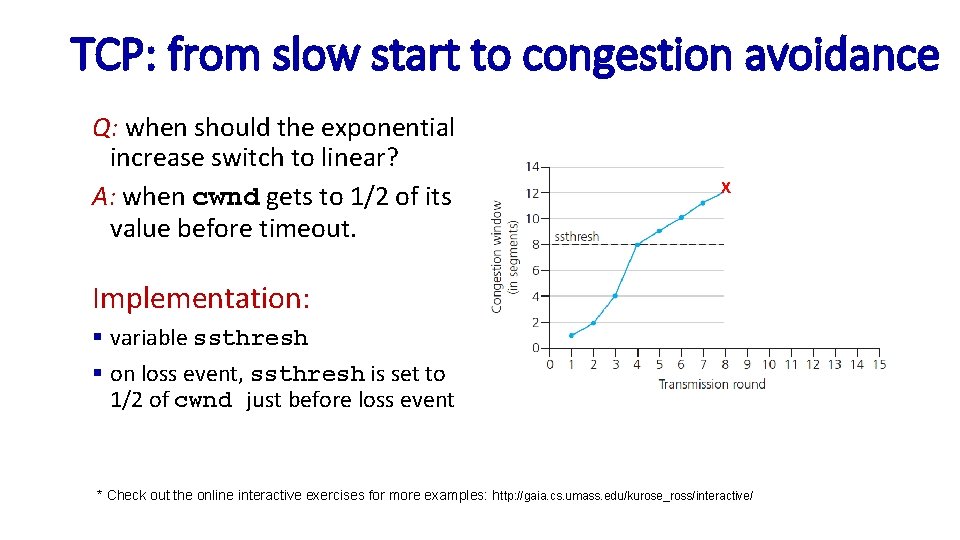
TCP: from slow start to congestion avoidance Q: when should the exponential increase switch to linear? A: when cwnd gets to 1/2 of its value before timeout. X Implementation: § variable ssthresh § on loss event, ssthresh is set to 1/2 of cwnd just before loss event * Check out the online interactive exercises for more examples: http: //gaia. cs. umass. edu/kurose_ross/interactive/
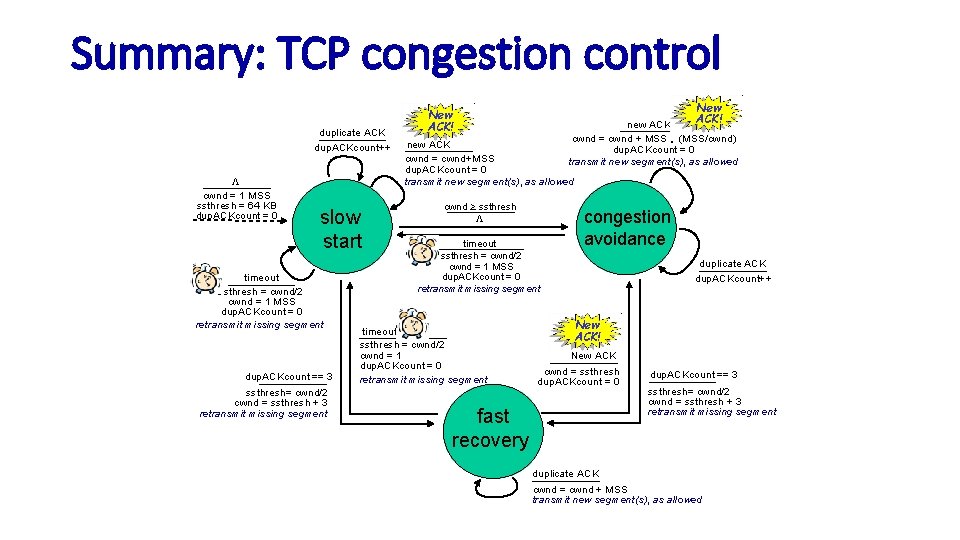
Summary: TCP congestion control duplicate ACK dup. ACKcount++ L cwnd = 1 MSS ssthresh = 64 KB dup. ACKcount = 0 slow start timeout ssthresh = cwnd/2 cwnd = 1 MSS dup. ACKcount = 0 retransmit missing segment dup. ACKcount == 3 ssthresh= cwnd/2 cwnd = ssthresh + 3 retransmit missing segment New ACK! new ACK cwnd = cwnd + MSS (MSS/cwnd) dup. ACKcount = 0 transmit new segment(s), as allowed . new ACK cwnd = cwnd+MSS dup. ACKcount = 0 transmit new segment(s), as allowed cwnd > ssthresh L timeout ssthresh = cwnd/2 cwnd = 1 MSS dup. ACKcount = 0 retransmit missing segment timeout ssthresh = cwnd/2 cwnd = 1 dup. ACKcount = 0 retransmit missing segment fast recovery New ACK! congestion avoidance duplicate ACK dup. ACKcount++ New ACK! New ACK cwnd = ssthresh dup. ACKcount = 0 dup. ACKcount == 3 ssthresh= cwnd/2 cwnd = ssthresh + 3 retransmit missing segment duplicate ACK cwnd = cwnd + MSS transmit new segment(s), as allowed
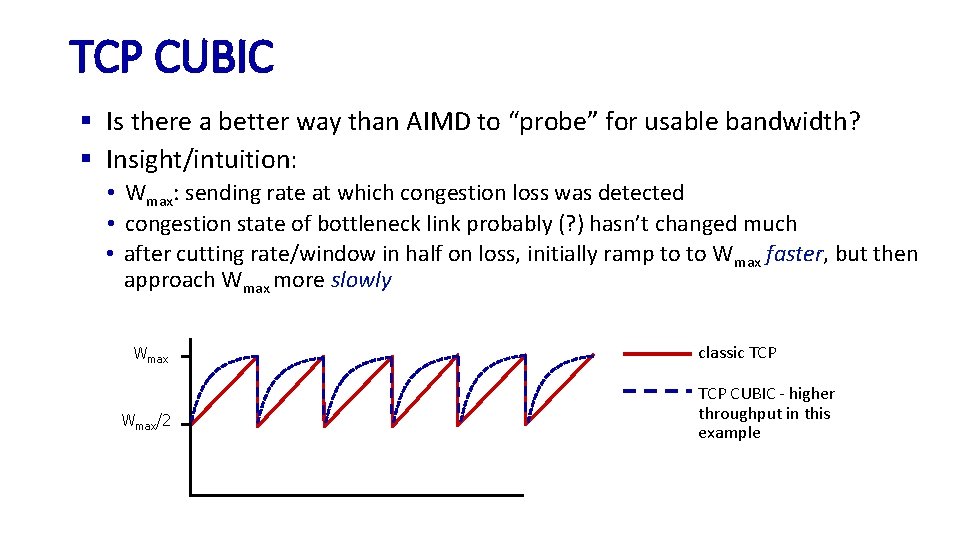
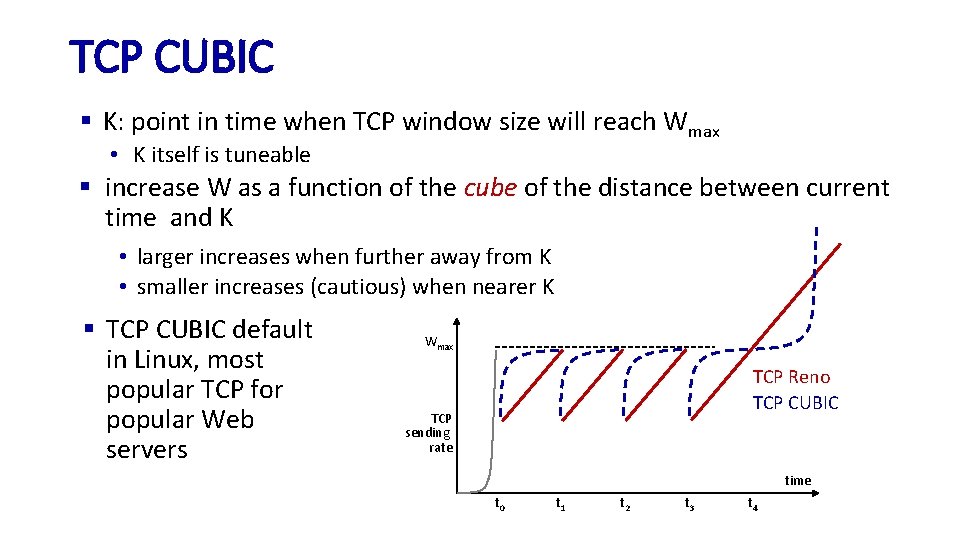
TCP CUBIC § Is there a better way than AIMD to “probe” for usable bandwidth? § Insight/intuition: • Wmax: sending rate at which congestion loss was detected • congestion state of bottleneck link probably (? ) hasn’t changed much • after cutting rate/window in half on loss, initially ramp to to Wmax faster, but then approach Wmax more slowly Wmax/2 classic TCP CUBIC - higher throughput in this example
TCP CUBIC § K: point in time when TCP window size will reach Wmax • K itself is tuneable § increase W as a function of the cube of the distance between current time and K • larger increases when further away from K • smaller increases (cautious) when nearer K § TCP CUBIC default in Linux, most popular TCP for popular Web servers Wmax TCP Reno TCP CUBIC TCP sending rate time t 0 t 1 t 2 t 3 t 4
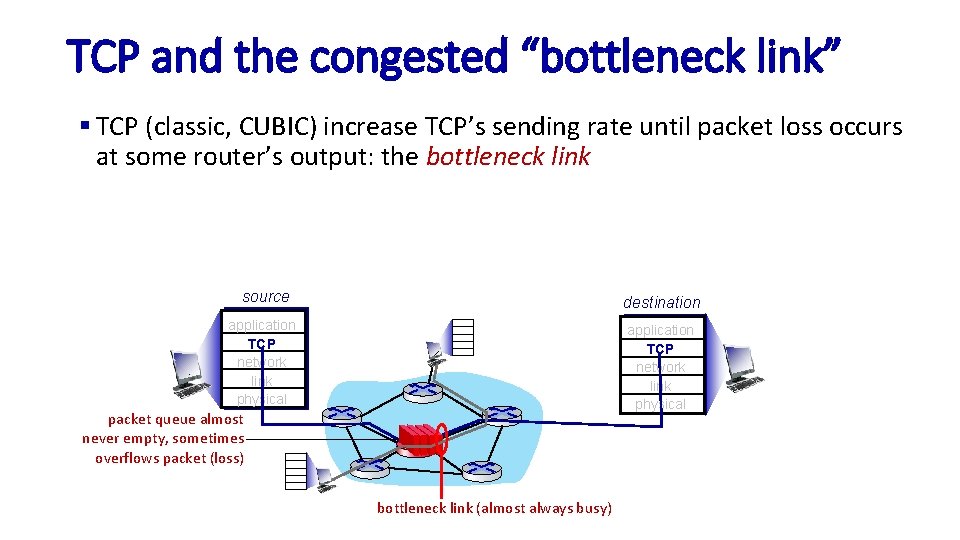
TCP and the congested “bottleneck link” § TCP (classic, CUBIC) increase TCP’s sending rate until packet loss occurs at some router’s output: the bottleneck link source destination application TCP network link physical packet queue almost never empty, sometimes overflows packet (loss) bottleneck link (almost always busy)
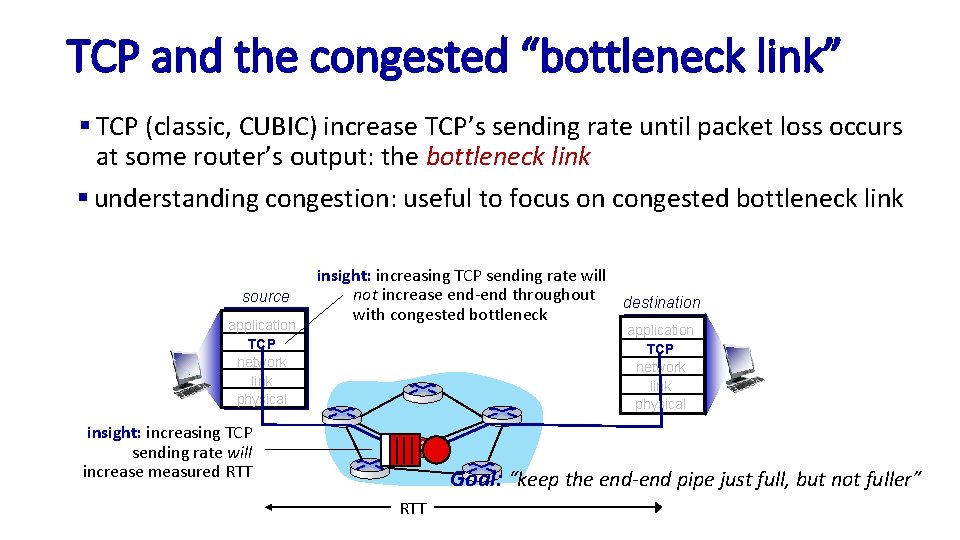
TCP and the congested “bottleneck link” § TCP (classic, CUBIC) increase TCP’s sending rate until packet loss occurs at some router’s output: the bottleneck link § understanding congestion: useful to focus on congested bottleneck link source application TCP network link physical insight: increasing TCP sending rate will not increase end-end throughout destination with congested bottleneck application TCP network link physical insight: increasing TCP sending rate will increase measured RTT Goal: “keep the end-end pipe just full, but not fuller” RTT
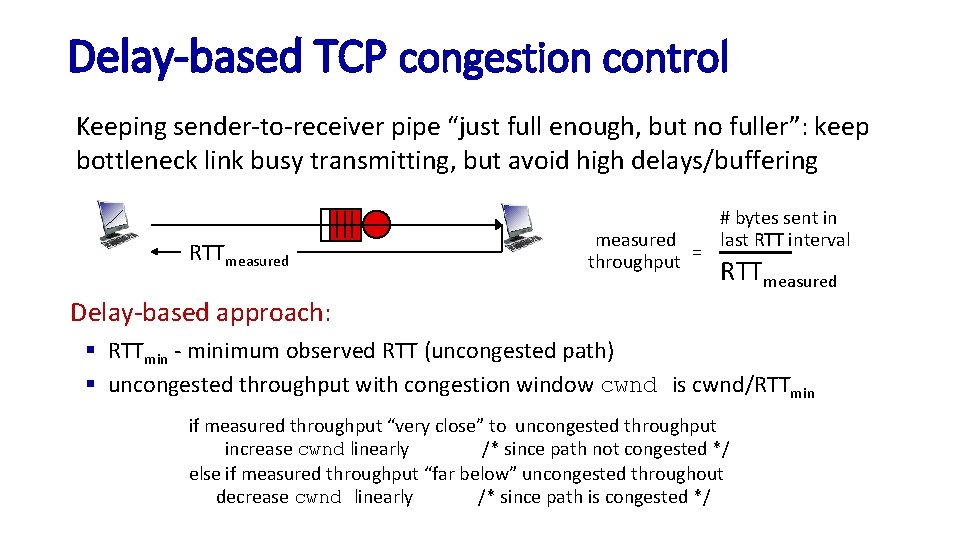
Delay-based TCP congestion control Keeping sender-to-receiver pipe “just full enough, but no fuller”: keep bottleneck link busy transmitting, but avoid high delays/buffering RTTmeasured throughput = # bytes sent in last RTT interval RTTmeasured Delay-based approach: § RTTmin - minimum observed RTT (uncongested path) § uncongested throughput with congestion window cwnd is cwnd/RTTmin if measured throughput “very close” to uncongested throughput increase cwnd linearly /* since path not congested */ else if measured throughput “far below” uncongested throughout decrease cwnd linearly /* since path is congested */
Delay-based TCP congestion control § congestion control without inducing/forcing loss § maximizing throughout (“keeping the just pipe full… ”) while keeping delay low (“…but not fuller”) § a number of deployed TCPs take a delay-based approach § BBR deployed on Google’s (internal) backbone network
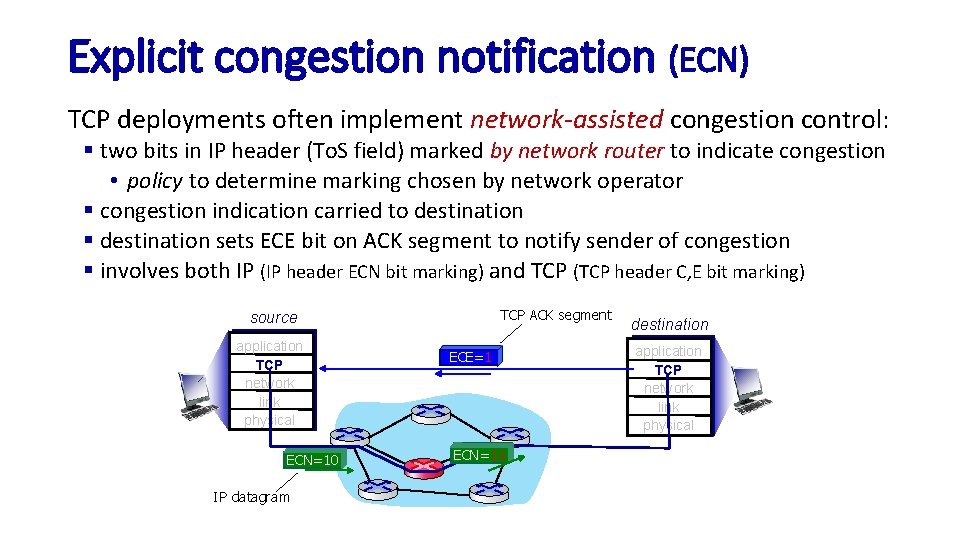
Explicit congestion notification (ECN) TCP deployments often implement network-assisted congestion control: § two bits in IP header (To. S field) marked by network router to indicate congestion • policy to determine marking chosen by network operator § congestion indication carried to destination § destination sets ECE bit on ACK segment to notify sender of congestion § involves both IP (IP header ECN bit marking) and TCP (TCP header C, E bit marking) TCP ACK segment source application TCP network link physical ECN=10 IP datagram ECE=1 ECN=11 destination application TCP network link physical
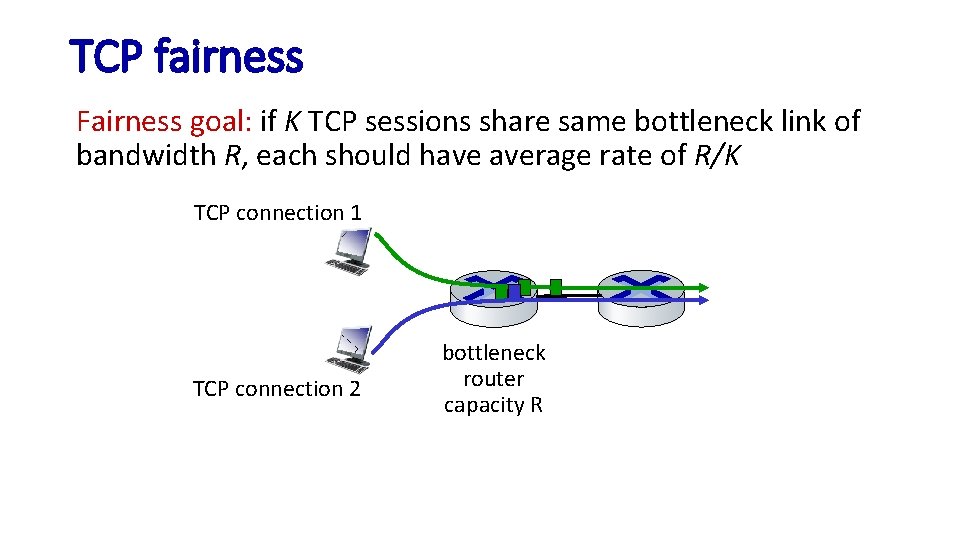
TCP fairness Fairness goal: if K TCP sessions share same bottleneck link of bandwidth R, each should have average rate of R/K TCP connection 1 TCP connection 2 bottleneck router capacity R
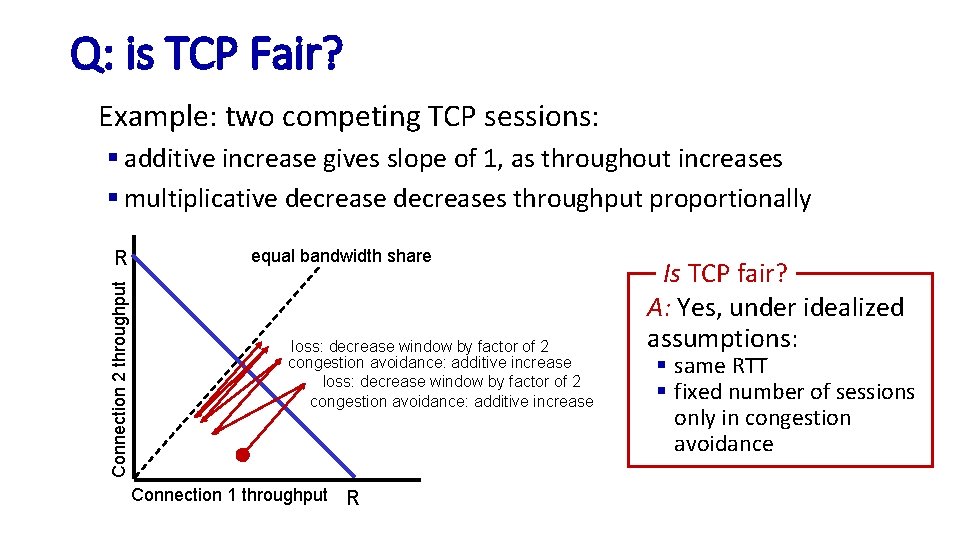
Q: is TCP Fair? Example: two competing TCP sessions: § additive increase gives slope of 1, as throughout increases § multiplicative decreases throughput proportionally Connection 2 throughput R equal bandwidth share loss: decrease window by factor of 2 congestion avoidance: additive increase Connection 1 throughput R Is TCP fair? A: Yes, under idealized assumptions: § same RTT § fixed number of sessions only in congestion avoidance
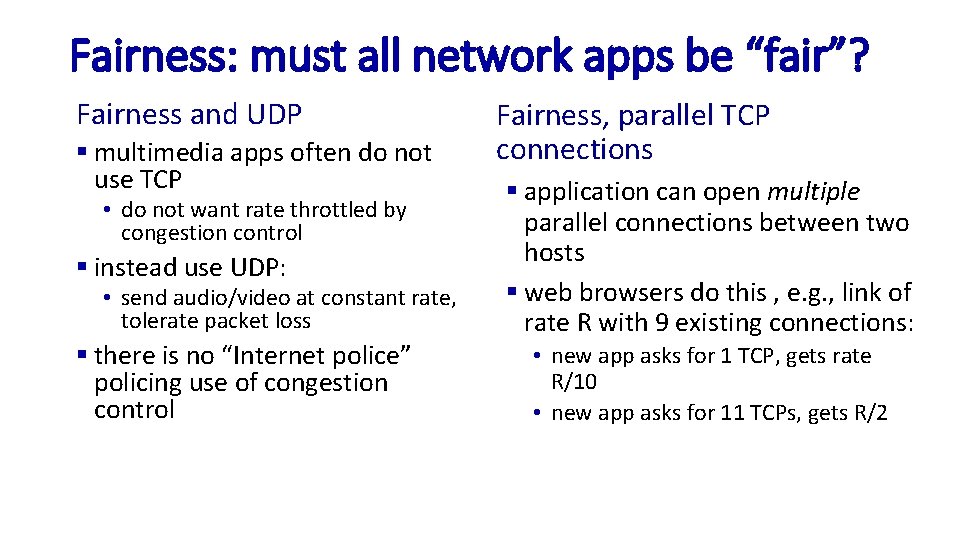
Fairness: must all network apps be “fair”? Fairness and UDP § multimedia apps often do not use TCP • do not want rate throttled by congestion control § instead use UDP: • send audio/video at constant rate, tolerate packet loss § there is no “Internet police” policing use of congestion control Fairness, parallel TCP connections § application can open multiple parallel connections between two hosts § web browsers do this , e. g. , link of rate R with 9 existing connections: • new app asks for 1 TCP, gets rate R/10 • new app asks for 11 TCPs, gets R/2
Transport Layer § § § Transport-layer services Multiplexing and demultiplexing Connectionless transport: UDP Principles of reliable data transfer Connection-oriented transport: TCP Principles of congestion control § TCP congestion control § Evolution of transport-layer functionality Video: 2020, J. F. Kurose, All Rights Reserved Powerpoint: 1996 -2020, J. F. Kurose, K. W. Ross, All Rights Reserved COMPSCI 453 Computer Networks Professor Jim Kurose College of Information and Computer Sciences University of Massachusetts Class textbook: Computer Networking: A Top. Down Approach (8 th ed. ) J. F. Kurose, K. W. Ross Pearson, 2020 http: //gaia. cs. umass. edu/kurose_ross
Backup slides
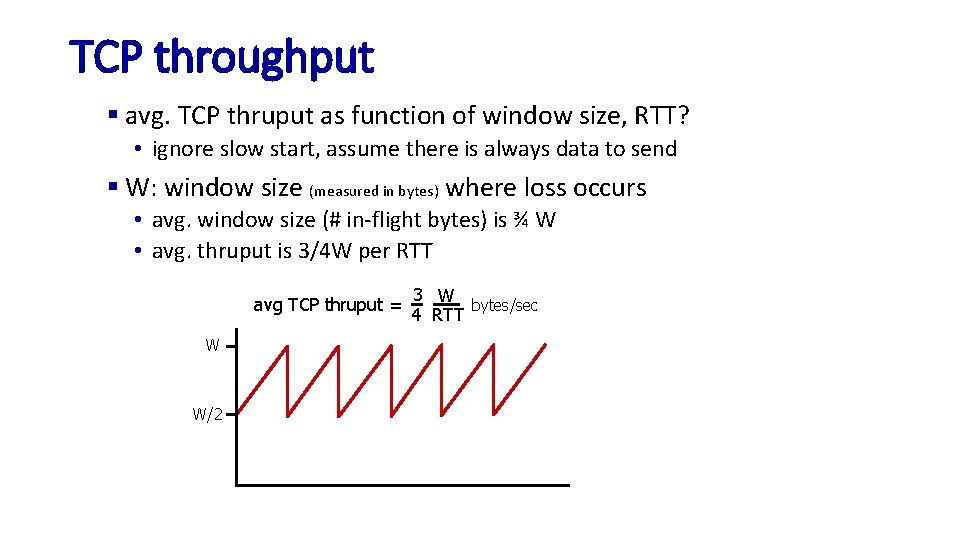
TCP throughput § avg. TCP thruput as function of window size, RTT? • ignore slow start, assume there is always data to send § W: window size (measured in bytes) where loss occurs • avg. window size (# in-flight bytes) is ¾ W • avg. thruput is 3/4 W per RTT avg TCP thruput = W W/2 3 W bytes/sec 4 RTT
TCP Congestion Control “Classic” TCP: loss-based, end-end § additive increase, multiplicative decrease § “slow” start § CUBIC § Enhanced TCPs: • delay-based congestion control TCP • explicit congestion notification § TCP fairness