
Transport Layer Security TLS Bill Burr william burrnist
Transport Layer Security (TLS) Bill Burr william. burr@nist. gov November 2, 2001
Transport Layer Security (TLS) ¨ Version 3. 1 of Secure Socket Layer (SSL) – “standardized” by IETF RFC 2246 – Several earlier versions • V 2 not very secure ¨ End-to-end between a client and server – Sits on top of TCP – Requires reliable connection ¨ Most important Internet crypto protocol? – Secure web pages – E-mail and LDAP access control
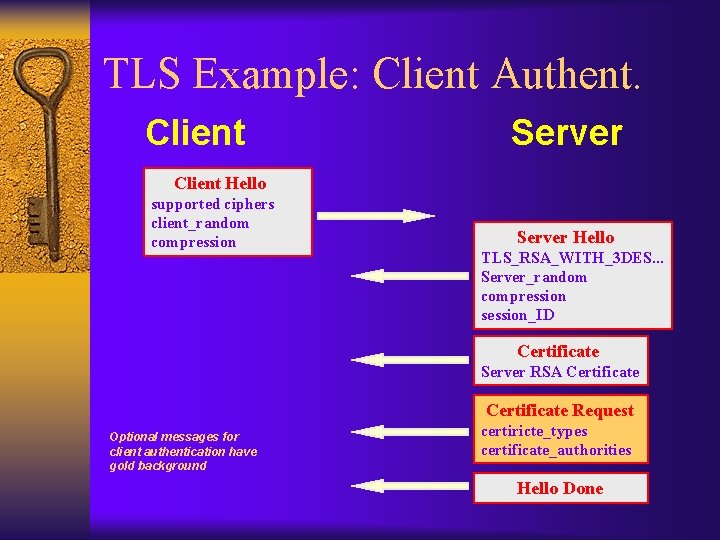
TLS Example: Client Authent. Client Server Client Hello supported ciphers client_random compression Server Hello TLS_RSA_WITH_3 DES. . . Server_random compression session_ID Certificate Server RSA Certificate Request Optional messages for client authentication have gold background certiricte_types certificate_authorities Hello Done
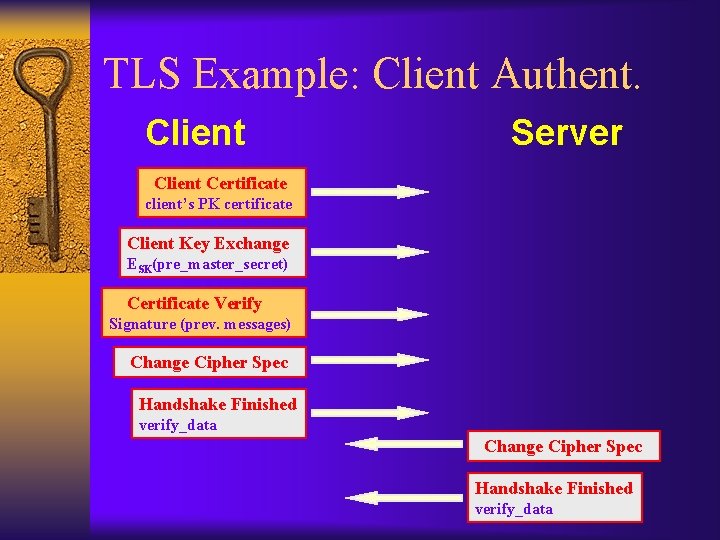
TLS Example: Client Authent. Client Server Client Certificate client’s PK certificate Client Key Exchange ESK(pre_master_secret) Certificate Verify Signature (prev. messages) Change Cipher Spec Handshake Finished verify_data
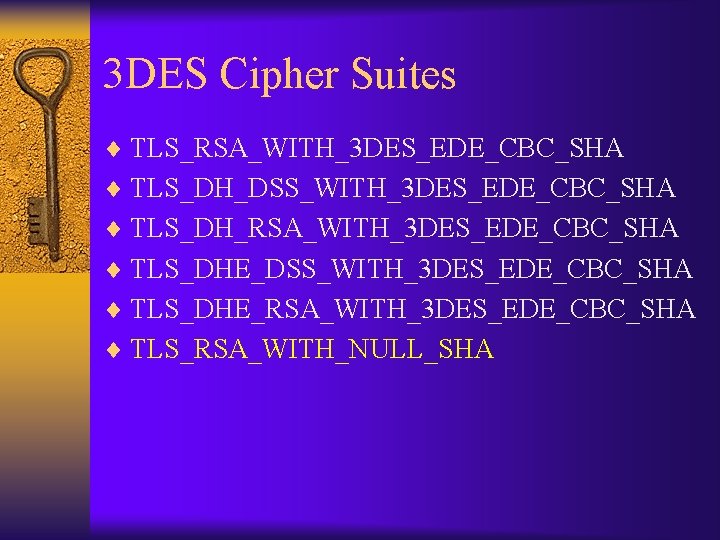
3 DES Cipher Suites ¨ TLS_RSA_WITH_3 DES_EDE_CBC_SHA ¨ TLS_DH_DSS_WITH_3 DES_EDE_CBC_SHA ¨ TLS_DH_RSA_WITH_3 DES_EDE_CBC_SHA ¨ TLS_DHE_DSS_WITH_3 DES_EDE_CBC_SHA ¨ TLS_DHE_RSA_WITH_3 DES_EDE_CBC_SHA ¨ TLS_RSA_WITH_NULL_SHA

AES Cipher Suites ¨ TLS_RSA_WITH_AES_128_CBC_SHA ¨ TLS_DH_DSS_WITH_AES_128_CBC_SHA ¨ TLS_DH_RSA_WITH_AES_128_CBC_SHA ¨ TLS_DHE_DSS_WITH_AES_128_CBC_SHA ¨ TLS_DHE_RSA_WITH_AES_128_CBC_SHA ¨ TLS_RSA_WITH_AES_256_CBC_SHA ¨ TLS_DH_DSS_WITH_AES_256_CBC_SHA ¨ TLS_DH_RSA_WITH_AES_256_CBC_SHA ¨ TLS_DHE_DSS_WITH_AES_256_CBC_SHA ¨ TLS_DHE_RSA_WITH_AES_256_CBC_SHA
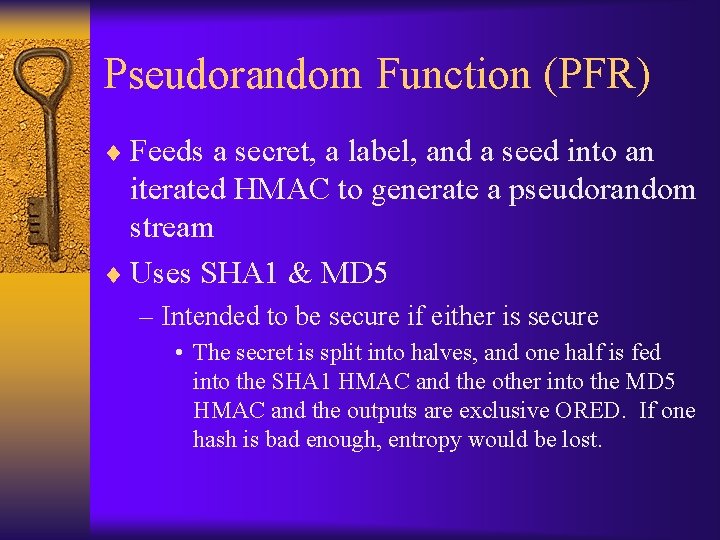
Pseudorandom Function (PFR) ¨ Feeds a secret, a label, and a seed into an iterated HMAC to generate a pseudorandom stream ¨ Uses SHA 1 & MD 5 – Intended to be secure if either is secure • The secret is split into halves, and one half is fed into the SHA 1 HMAC and the other into the MD 5 HMAC and the outputs are exclusive ORED. If one hash is bad enough, entropy would be lost.
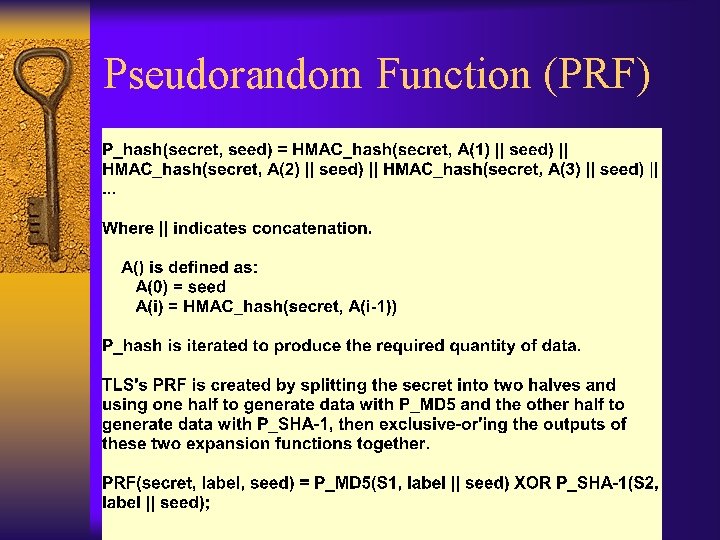
Pseudorandom Function (PRF)
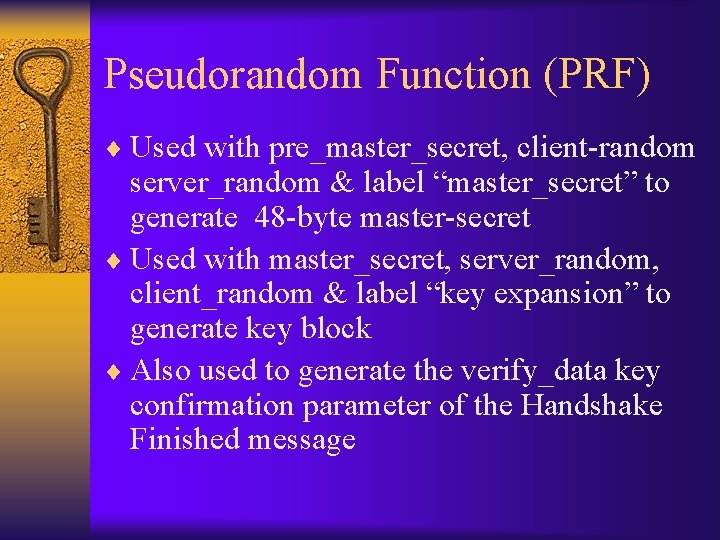
Pseudorandom Function (PRF) ¨ Used with pre_master_secret, client-random server_random & label “master_secret” to generate 48 -byte master-secret ¨ Used with master_secret, server_random, client_random & label “key expansion” to generate key block ¨ Also used to generate the verify_data key confirmation parameter of the Handshake Finished message
Proposed Client Guidance ¨ Only do TLS (version 3. 1) – But client is normally expected to be able to do highest version specified in Client Hello, plus every previous version! ¨ Server can choose any suite the client includes in Client Hello message ¨ Offer only 3 DES or AES Cipher suites – Never include 40 or 56 -bit suites – Encryption not required but anonymous cipher suites not allowed ¨ 1024 -bit RSA/DSA client certificates are OK until 2015
Proposed Server Guidance ¨ Implement only TLS, not SSL – Clients that can’t do TLS are out of luck ¨ Use only 3 DES or AES Cipher Suites ¨ Server key management certificate subject key size needs to match confidentiality requirements – If data must be kept secret after 2015, then RSA/DSA encryption keys larger than 1024 are needed.
For Maximum Security ¨ RSA or DSA authentication with ephemeral Diffie -Hellman key exchange – E. g. , TLS_DHE_RSA_WITH_AES_128_CBC_SHA – Perfect forward secrecy – Potentially large DH keys for long term confidentiality, with whatever authentication key size is currently needed ¨ But, – How many products do ephemeral Diffie-Hellman? – Performance price
Issues ¨ Do implementations check server identity? ¨ Use of same RSA server key for authentication and key management ¨ Is payload SHA-1 HMAC strong enough for 112, 128 & 256 -bit encryption? ¨ Is 96 -bit verify-data key confirmation strong enough for 112, 128 & 256 -bit encryption? ¨ Is the PRF strong enough for 112, 128 & 256 -bit encryption? – Does MD 5 HMAC poison the well? ¨ “Non-standard” signature formts ¨ Diffie-Hellman doesn’t follow a NIST scheme
Questions and Discussion
- Slides: 14