
Transport Layer EECS 489 Computer Networks http www

- Slides: 71
Transport Layer EECS 489 Computer Networks http: //www. eecs. umich. edu/courses/eecs 489/w 07 Z. Morley Mao Wednesday Jan 24, 2007 Acknowledgement: Some slides taken from Kurose&Ross and Katz&Stoica Mao W 07 1
Adminstrivia § Homework 1 was due yesterday – 1/23 - You can use your late days § PA 1 has been posted - A simplified Web server - You need to find a project partner for this assignment - If you want to work in groups of three or by yourself, please email us to get permission. § Reading assignment for this week - Chapter 3 of the book - You should have read Chapter 1 and 2. Mao W 07 2
Discussion on email § Why do we have so much spam? - How would you design the email system to prevent spam? § How does anonymous email work? Mao W 07 3
Discussion on DNS § § Is it easy to attack the DNS system? Why is DNS caching good? Why is DNS caching bad? DNS is “exploited” for server load balancing, how? - Local DNS servers are usually close to local clients § If you were to design DNS differently today, how would you? - Any problems with the current DNS system? Mao W 07 4
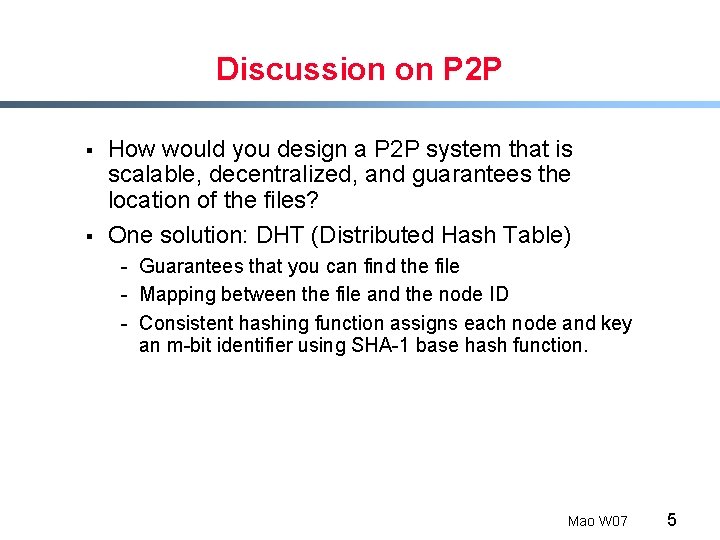
Discussion on P 2 P § § How would you design a P 2 P system that is scalable, decentralized, and guarantees the location of the files? One solution: DHT (Distributed Hash Table) - Guarantees that you can find the file - Mapping between the file and the node ID - Consistent hashing function assigns each node and key an m-bit identifier using SHA-1 base hash function. Mao W 07 5
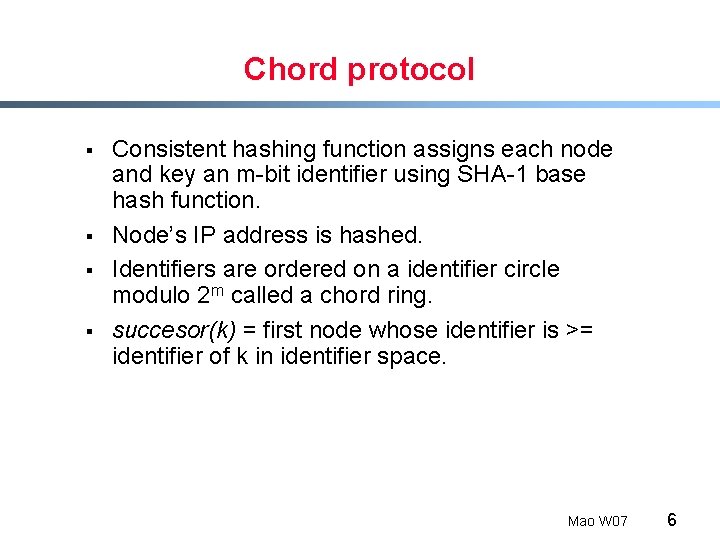
Chord protocol § § Consistent hashing function assigns each node and key an m-bit identifier using SHA-1 base hash function. Node’s IP address is hashed. Identifiers are ordered on a identifier circle modulo 2 m called a chord ring. succesor(k) = first node whose identifier is >= identifier of k in identifier space. Mao W 07 6
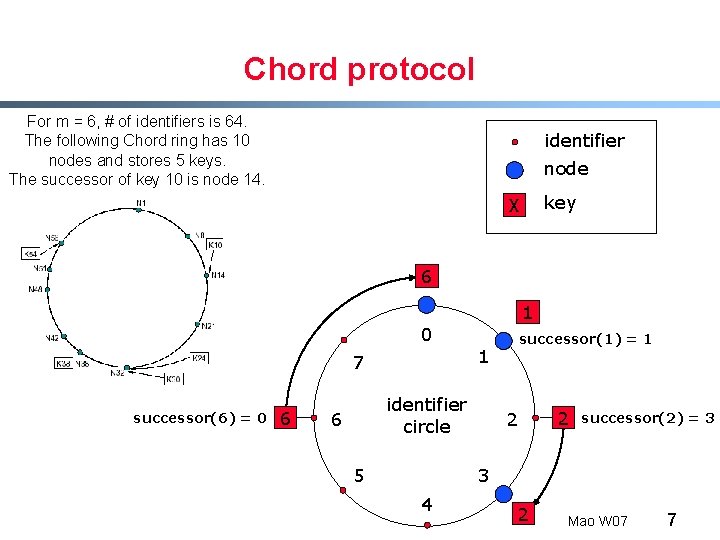
Chord protocol For m = 6, # of identifiers is 64. The following Chord ring has 10 nodes and stores 5 keys. The successor of key 10 is node 14. identifier node key X 6 1 0 1 7 successor(6) = 0 6 identifier circle 6 successor(1) = 1 5 2 2 successor(2) = 3 3 4 2 Mao W 07 7
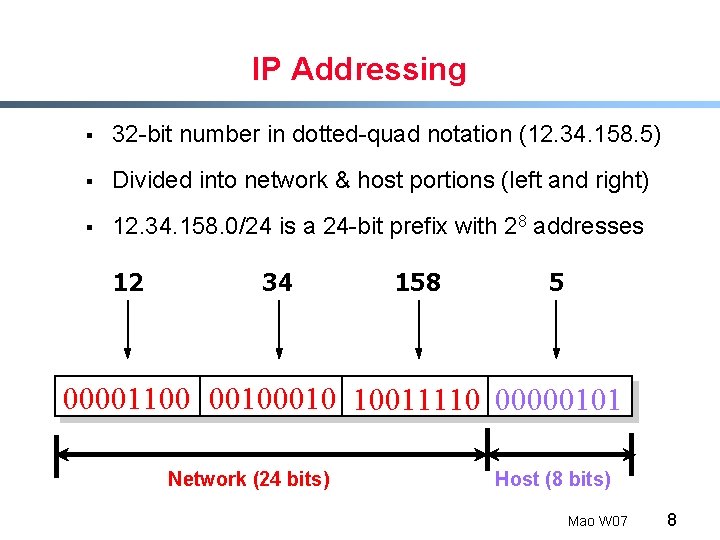
IP Addressing § 32 -bit number in dotted-quad notation (12. 34. 158. 5) § Divided into network & host portions (left and right) § 12. 34. 158. 0/24 is a 24 -bit prefix with 28 addresses 12 34 158 5 00001100 0010 10011110 00000101 Network (24 bits) Host (8 bits) Mao W 07 8
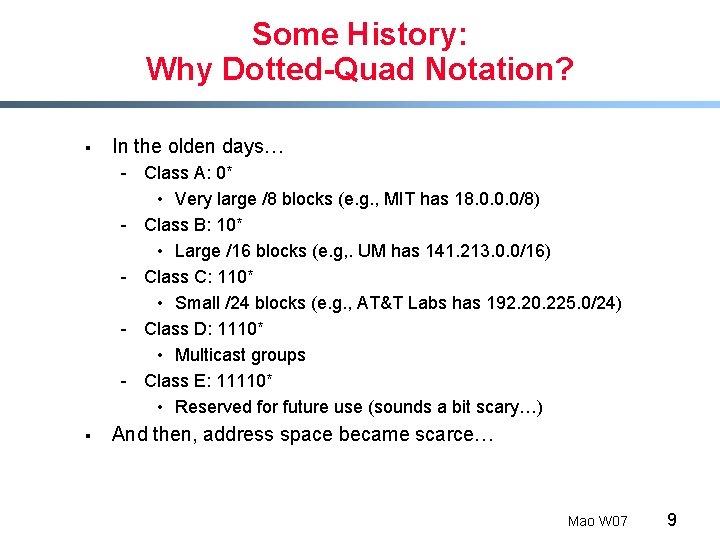
Some History: Why Dotted-Quad Notation? § In the olden days… - Class A: 0* • Very large /8 blocks (e. g. , MIT has 18. 0. 0. 0/8) - Class B: 10* • Large /16 blocks (e. g, . UM has 141. 213. 0. 0/16) - Class C: 110* • Small /24 blocks (e. g. , AT&T Labs has 192. 20. 225. 0/24) - Class D: 1110* • Multicast groups - Class E: 11110* • Reserved for future use (sounds a bit scary…) § And then, address space became scarce… Mao W 07 9
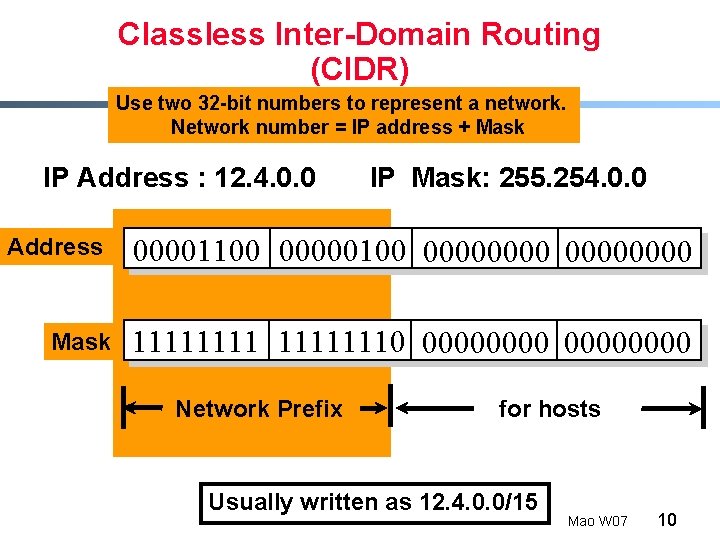
Classless Inter-Domain Routing (CIDR) Use two 32 -bit numbers to represent a network. Network number = IP address + Mask IP Address : 12. 4. 0. 0 Address Mask IP Mask: 255. 254. 0. 0 00001100 00000000 11111110 00000000 Network Prefix for hosts Usually written as 12. 4. 0. 0/15 Mao W 07 10
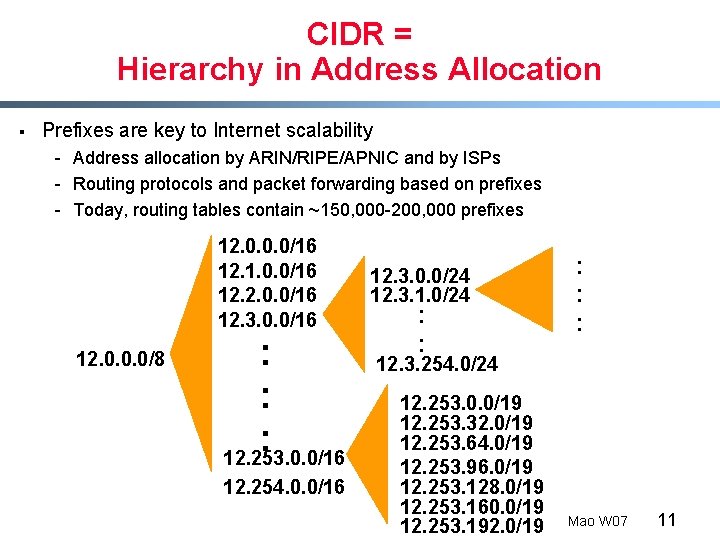
CIDR = Hierarchy in Address Allocation § Prefixes are key to Internet scalability - Address allocation by ARIN/RIPE/APNIC and by ISPs - Routing protocols and packet forwarding based on prefixes - Today, routing tables contain ~150, 000 -200, 000 prefixes 12. 0. 0. 0/16 12. 1. 0. 0/16 12. 2. 0. 0/16 12. 3. 0. 0/16 12. 0. 0. 0/8 : : : 12. 253. 0. 0/16 12. 254. 0. 0/16 12. 3. 0. 0/24 12. 3. 1. 0/24 : : : 12. 3. 254. 0/24 12. 253. 0. 0/19 12. 253. 32. 0/19 12. 253. 64. 0/19 12. 253. 96. 0/19 12. 253. 128. 0/19 12. 253. 160. 0/19 12. 253. 192. 0/19 Mao W 07 11
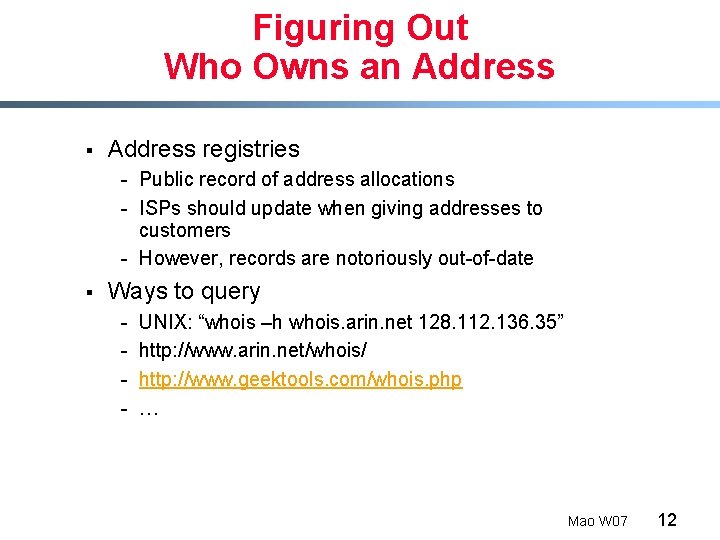
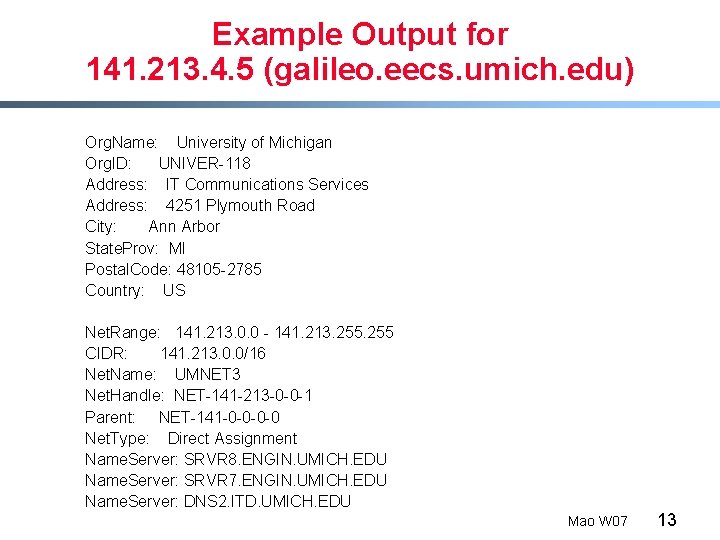
Figuring Out Who Owns an Address § Address registries - Public record of address allocations - ISPs should update when giving addresses to customers - However, records are notoriously out-of-date § Ways to query - UNIX: “whois –h whois. arin. net 128. 112. 136. 35” http: //www. arin. net/whois/ http: //www. geektools. com/whois. php … Mao W 07 12
Example Output for 141. 213. 4. 5 (galileo. eecs. umich. edu) Org. Name: University of Michigan Org. ID: UNIVER-118 Address: IT Communications Services Address: 4251 Plymouth Road City: Ann Arbor State. Prov: MI Postal. Code: 48105 -2785 Country: US Net. Range: 141. 213. 0. 0 - 141. 213. 255 CIDR: 141. 213. 0. 0/16 Net. Name: UMNET 3 Net. Handle: NET-141 -213 -0 -0 -1 Parent: NET-141 -0 -0 Net. Type: Direct Assignment Name. Server: SRVR 8. ENGIN. UMICH. EDU Name. Server: SRVR 7. ENGIN. UMICH. EDU Name. Server: DNS 2. ITD. UMICH. EDU Mao W 07 13
There is more… Comment: Abuse contact for 141. 213. 128. 0/17 is abuse@umich. edu. Comment: For DMCA info see http: //www. umich. edu/~itua/copyright/ Reg. Date: 1990 -08 -02 Updated: 2003 -03 -27 Abuse. Handle: CEAC-ARIN Abuse. Name: College of Engineering Abuse Contact Abuse. Phone: +1 -734 -936 -2486 Abuse. Email: abuse@engin. umich. edu Tech. Handle: PMK 5 -ARIN Tech. Name: Killey, Paul M. Tech. Phone: +1 -734 -763 -4910 Tech. Email: paul@engin. umich. edu Org. Tech. Handle: UA 11 -ORG-ARIN Org. Tech. Name: UMnet Administration Org. Tech. Phone: +1 -734 -647 -4200 Org. Tech. Email: umnet-admin@umich. edu Mao W 07 14
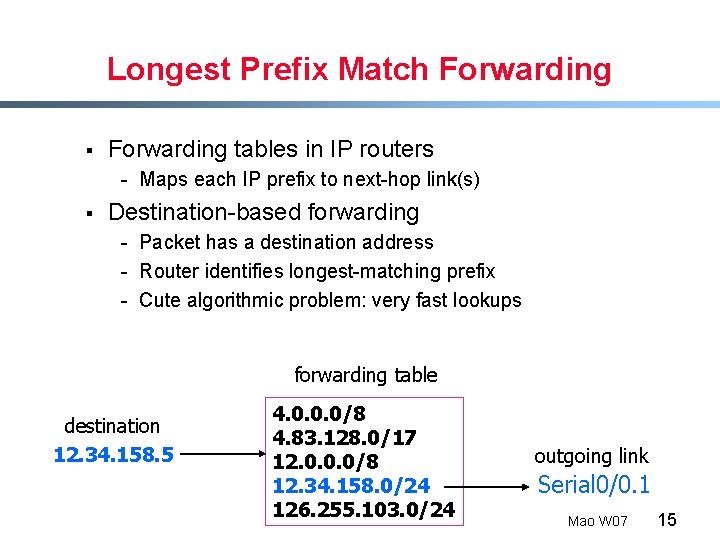
Longest Prefix Match Forwarding § Forwarding tables in IP routers - Maps each IP prefix to next-hop link(s) § Destination-based forwarding - Packet has a destination address - Router identifies longest-matching prefix - Cute algorithmic problem: very fast lookups forwarding table destination 12. 34. 158. 5 4. 0. 0. 0/8 4. 83. 128. 0/17 12. 0. 0. 0/8 12. 34. 158. 0/24 126. 255. 103. 0/24 outgoing link Serial 0/0. 1 Mao W 07 15
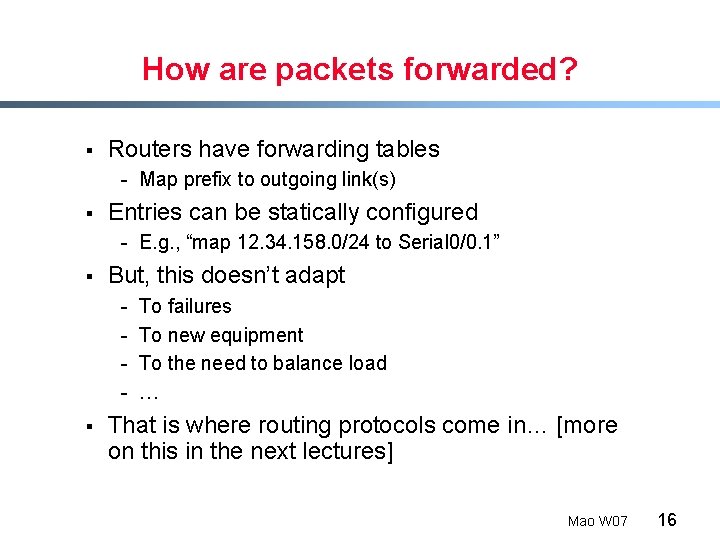
How are packets forwarded? § Routers have forwarding tables - Map prefix to outgoing link(s) § Entries can be statically configured - E. g. , “map 12. 34. 158. 0/24 to Serial 0/0. 1” § But, this doesn’t adapt - § To failures To new equipment To the need to balance load … That is where routing protocols come in… [more on this in the next lectures] Mao W 07 16
Discussions § IP address space scarcity - What can we do about it? § § § Increased IP address fragmentation Does an IP address identify the actual user? How does one achieve mobility while maintaining the same IP address? Mao W 07 17
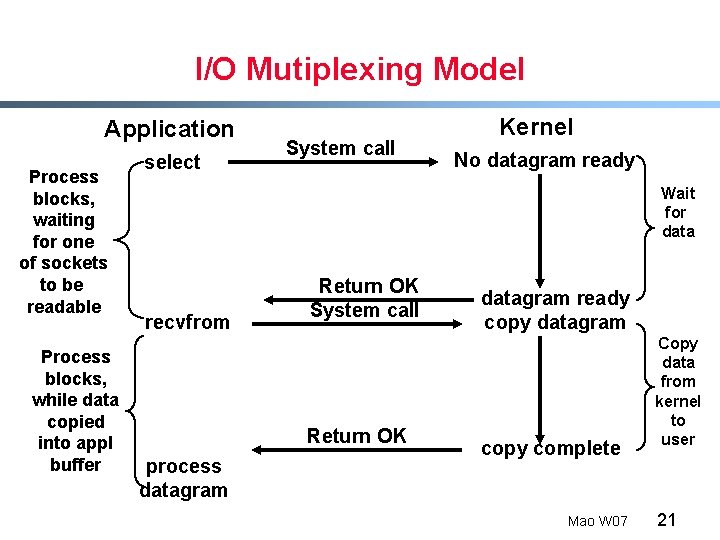
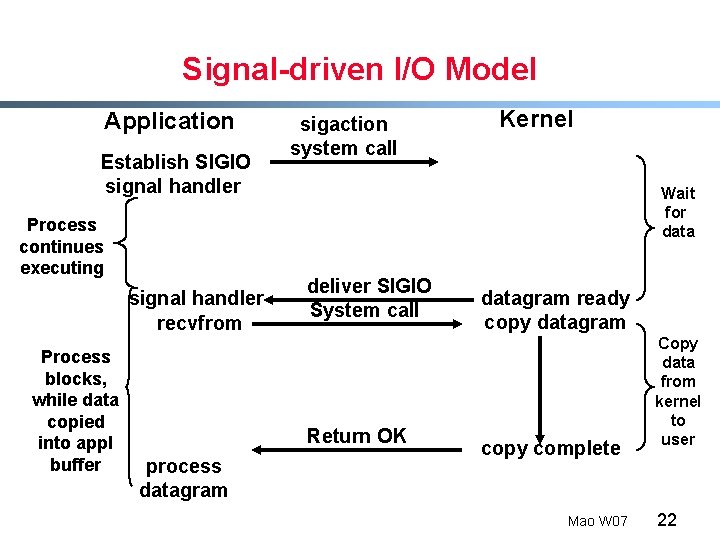
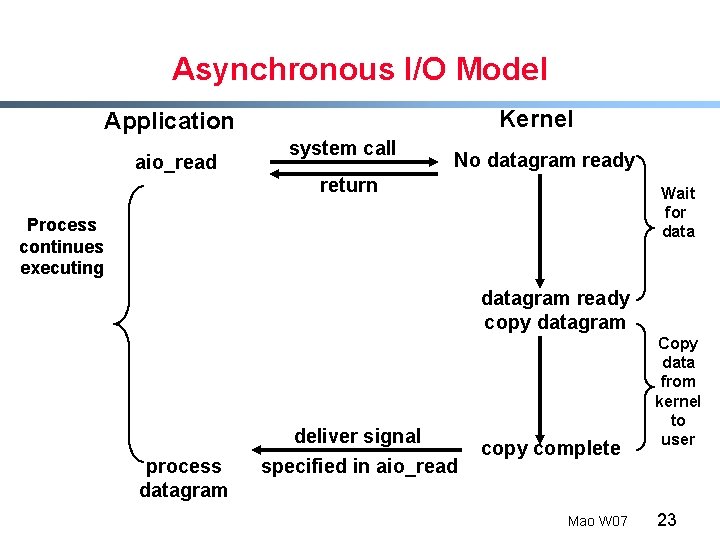
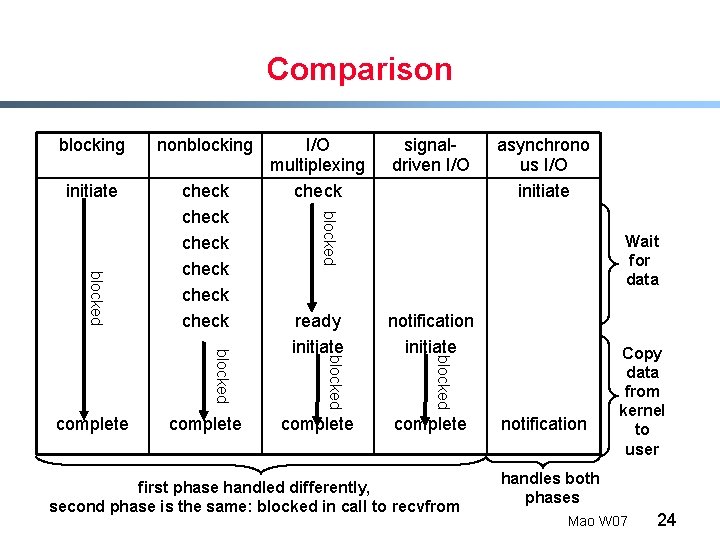
I/O Models § Five different I/O models - Blocking I/O - Nonblocking I/O - I/O multiplexing (select and poll) • Threads with blocking I/O - Signal driven I/O (SIGIO) - Asynchronous I/O (aio_* functions) • Not widely supported § Synchronous Blocking vs. nonblocking (system call) - Whether the system call blocks until data is ready § Synchronous vs. asynchronous (I/O operation) - Whether the I/O operation causes requesting process to be blocked Mao W 07 18
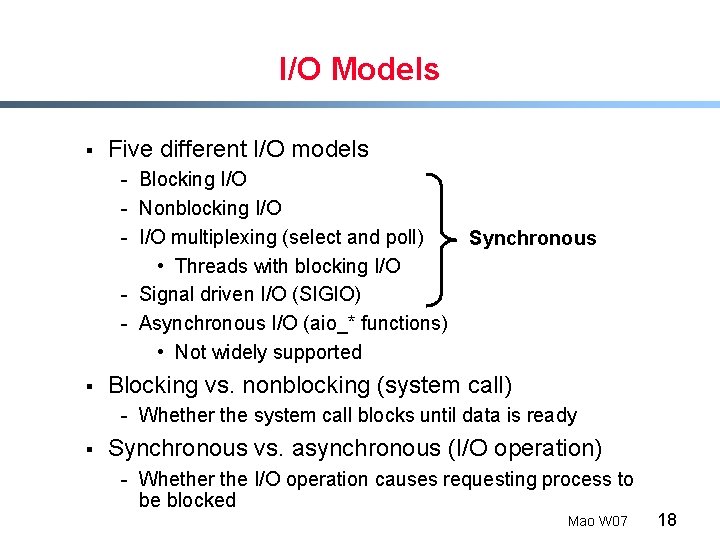
Blocking I/O Model Application recvfrom System call Kernel No datagram ready Wait for data Process blocks datagram ready copy datagram Return OK copy complete Copy data from Kernel to user process datagram Mao W 07 19
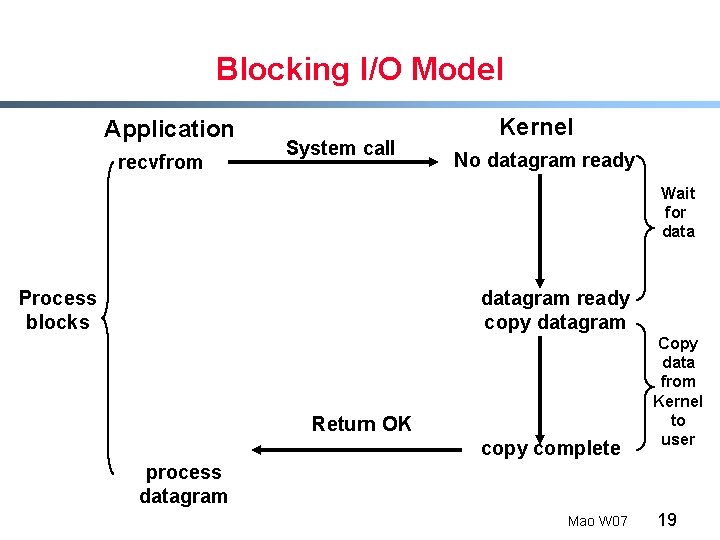
Nonblocking I/O Model Application recvfrom Process repeatedly calls recvfrom (polling) recvfrom System call Kernel No datagram ready EAGAIN System call Wait for data EAGAIN System call datagram ready copy datagram Return OK copy complete Copy data from Kernel to user process datagram Mao W 07 20
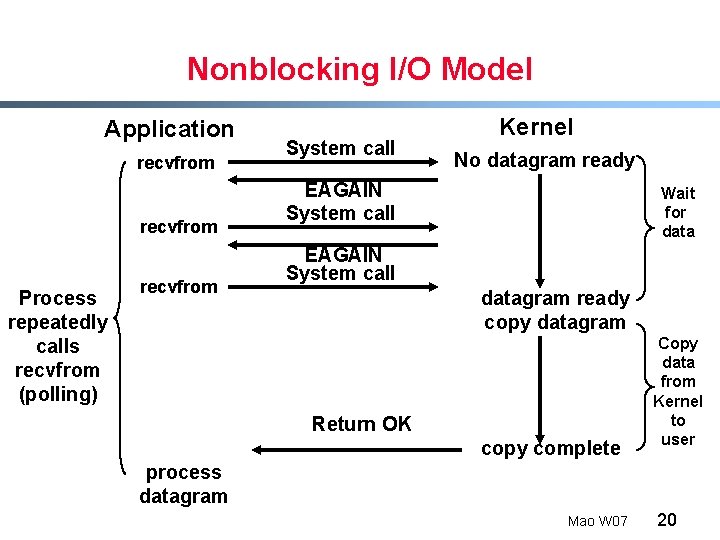
I/O Mutiplexing Model Application Process blocks, waiting for one of sockets to be readable Process blocks, while data copied into appl buffer select System call Kernel No datagram ready Wait for data recvfrom Return OK System call Return OK process datagram ready copy datagram copy complete Mao W 07 Copy data from kernel to user 21
Signal-driven I/O Model Application Establish SIGIO signal handler Process continues executing signal handler recvfrom Process blocks, while data copied into appl buffer sigaction system call Wait for data deliver SIGIO System call Return OK process datagram Kernel datagram ready copy datagram copy complete Mao W 07 Copy data from kernel to user 22
Asynchronous I/O Model Kernel Application aio_read system call No datagram ready return Wait for data Process continues executing datagram ready copy datagram deliver signal process datagram specified in aio_read copy complete Mao W 07 Copy data from kernel to user 23
Comparison initiate check check asynchrono us I/O initiate Wait for data notification initiate complete blocked complete signaldriven I/O ready initiate blocked complete I/O multiplexing check blocked nonblocking blocked blocking first phase handled differently, second phase is the same: blocked in call to recvfrom notification Copy data from kernel to user handles both phases Mao W 07 24
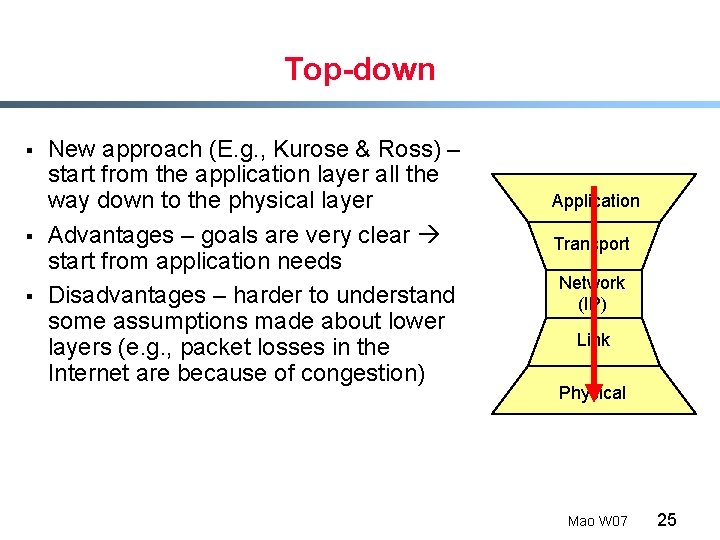
Top-down § § § New approach (E. g. , Kurose & Ross) – start from the application layer all the way down to the physical layer Advantages – goals are very clear start from application needs Disadvantages – harder to understand some assumptions made about lower layers (e. g. , packet losses in the Internet are because of congestion) Application Transport Network (IP) Link Physical Mao W 07 25
Transport Layer Our goals: § understand principles behind transport layer services: - multiplexing/demultiple xing - reliable data transfer - flow control - congestion control § learn about transport layer protocols in the Internet: - UDP: connectionless transport - TCP: connectionoriented transport - TCP congestion control Mao W 07 26
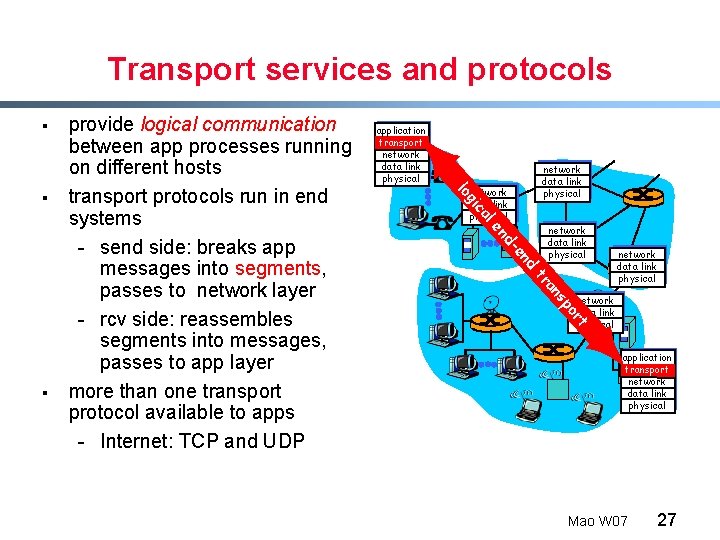
Transport services and protocols § network data link physical al ic d en d- en network data link physical po s an tr rt § application transport network data link physical g lo § provide logical communication between app processes running on different hosts transport protocols run in end systems - send side: breaks app messages into segments, passes to network layer - rcv side: reassembles segments into messages, passes to app layer more than one transport protocol available to apps - Internet: TCP and UDP application transport network data link physical Mao W 07 27
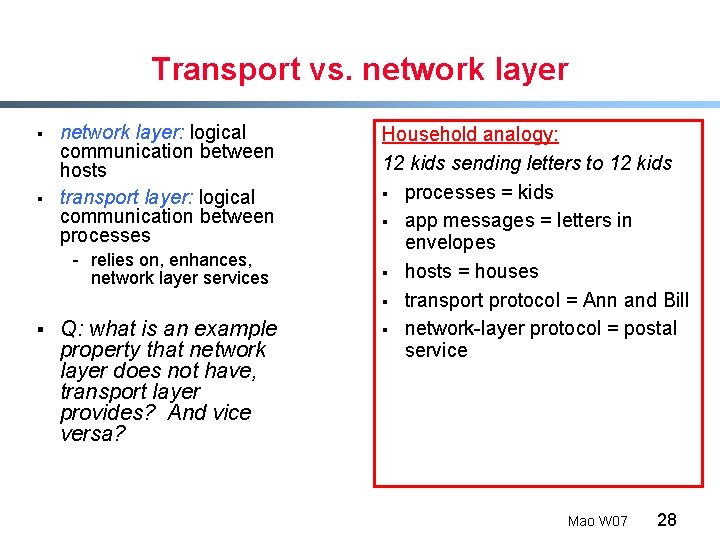
Transport vs. network layer § § network layer: logical communication between hosts transport layer: logical communication between processes - relies on, enhances, network layer services § Q: what is an example property that network layer does not have, transport layer provides? And vice versa? Household analogy: 12 kids sending letters to 12 kids § processes = kids § app messages = letters in envelopes § hosts = houses § transport protocol = Ann and Bill § network-layer protocol = postal service Mao W 07 28
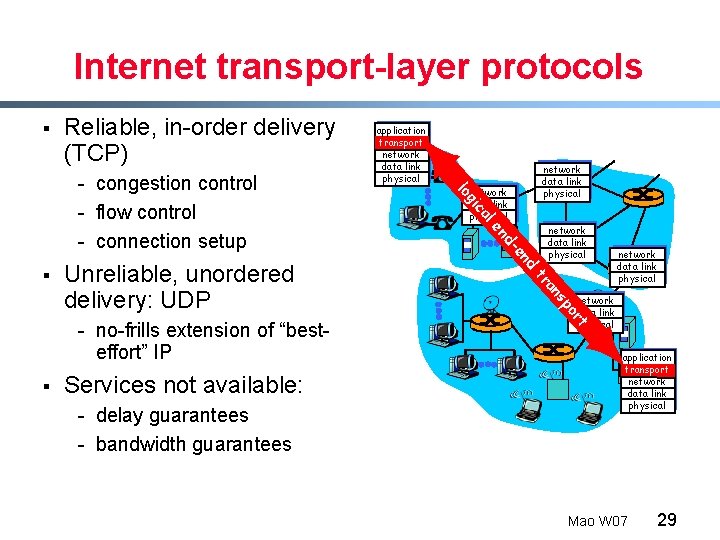
Internet transport-layer protocols § Reliable, in-order delivery (TCP) network data link physical po s an rt - delay guarantees - bandwidth guarantees network data link physical tr Services not available: d en d- § en - no-frills extension of “besteffort” IP al Unreliable, unordered delivery: UDP network data link physical ic § network data link physical g lo - congestion control - flow control - connection setup application transport network data link physical Mao W 07 29
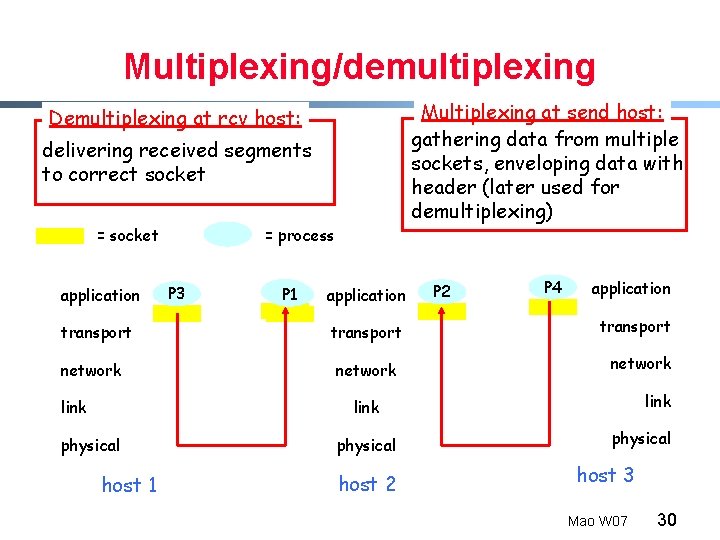
Multiplexing/demultiplexing Multiplexing at send host: gathering data from multiple sockets, enveloping data with header (later used for demultiplexing) Demultiplexing at rcv host: delivering received segments to correct socket = socket application transport network link = process P 3 P 1 application transport network P 2 P 4 application transport network link physical host 1 physical host 2 physical host 3 Mao W 07 30
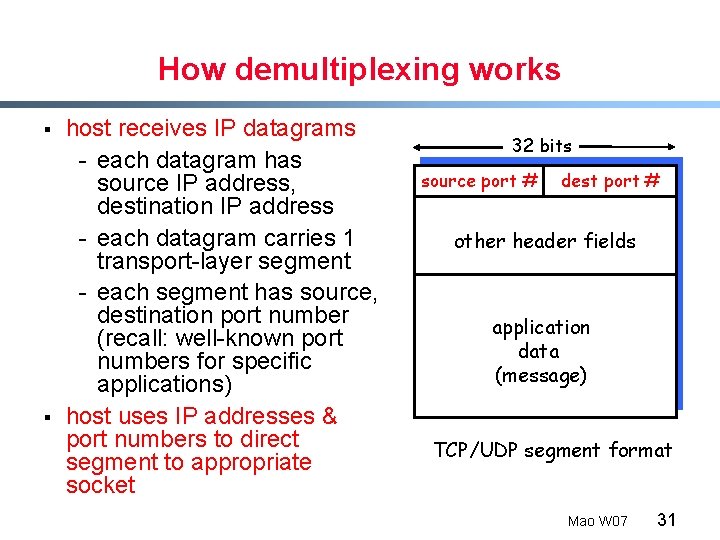
How demultiplexing works § § host receives IP datagrams - each datagram has source IP address, destination IP address - each datagram carries 1 transport-layer segment - each segment has source, destination port number (recall: well-known port numbers for specific applications) host uses IP addresses & port numbers to direct segment to appropriate socket 32 bits source port # dest port # other header fields application data (message) TCP/UDP segment format Mao W 07 31
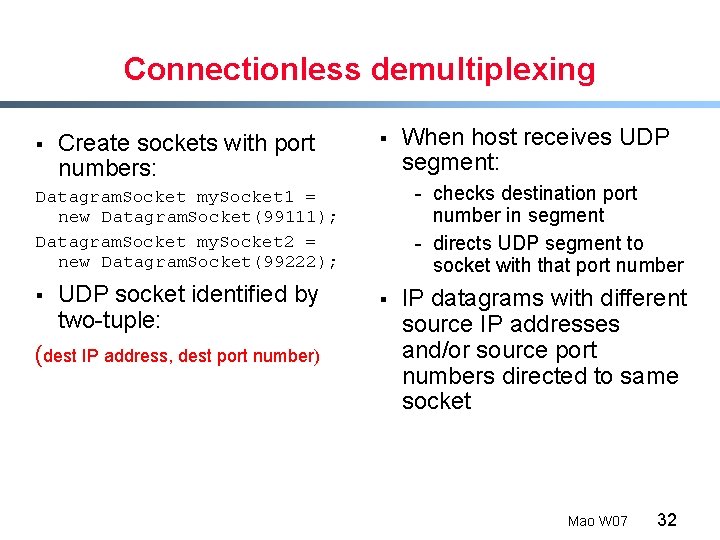
Connectionless demultiplexing § Create sockets with port numbers: § - checks destination port number in segment - directs UDP segment to socket with that port number Datagram. Socket my. Socket 1 = new Datagram. Socket(99111); Datagram. Socket my. Socket 2 = new Datagram. Socket(99222); § UDP socket identified by two-tuple: (dest IP address, dest port number) When host receives UDP segment: § IP datagrams with different source IP addresses and/or source port numbers directed to same socket Mao W 07 32
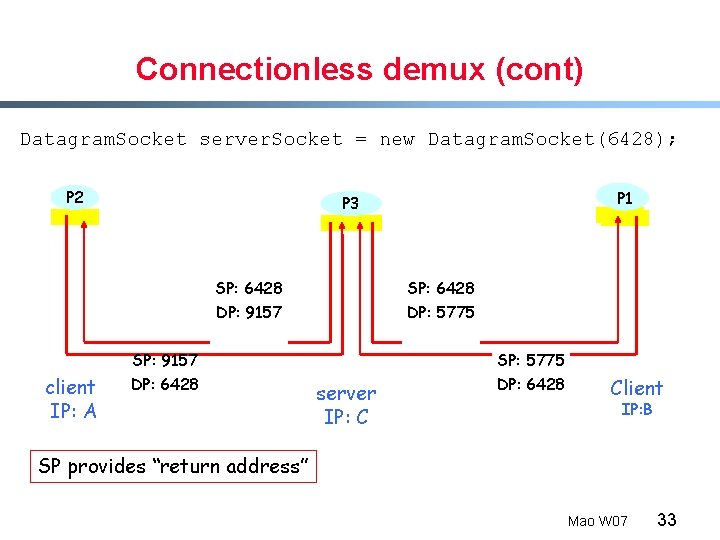
Connectionless demux (cont) Datagram. Socket server. Socket = new Datagram. Socket(6428); P 2 SP: 6428 DP: 9157 SP: 6428 DP: 5775 SP: 9157 client IP: A P 1 P 3 DP: 6428 server IP: C SP: 5775 DP: 6428 Client IP: B SP provides “return address” Mao W 07 33
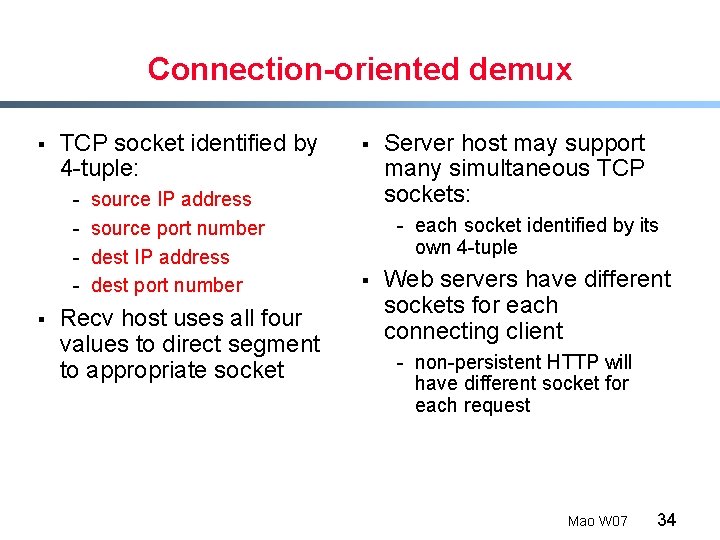
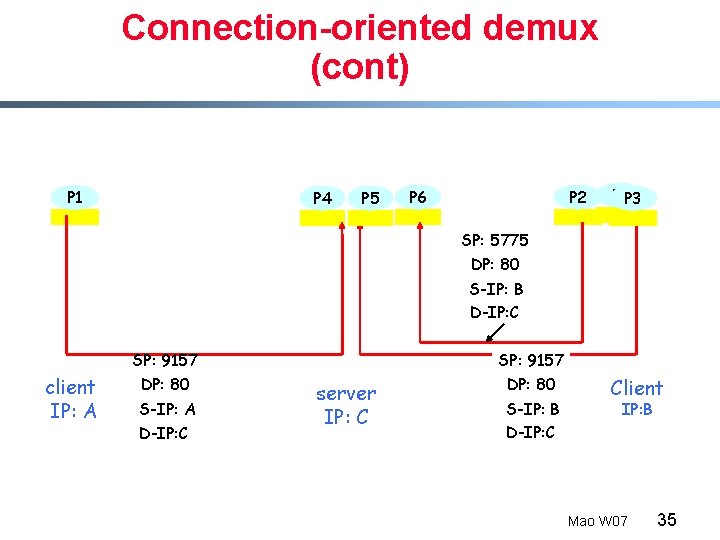
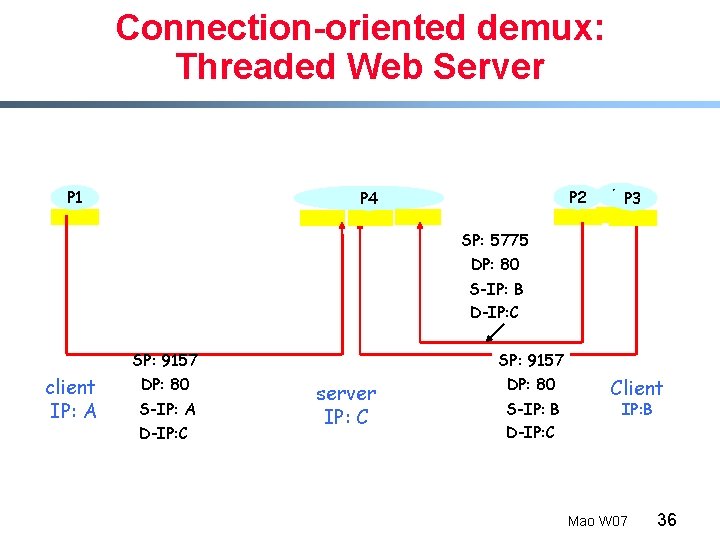
Connection-oriented demux § TCP socket identified by 4 -tuple: - § source IP address source port number dest IP address dest port number Recv host uses all four values to direct segment to appropriate socket § Server host may support many simultaneous TCP sockets: - each socket identified by its own 4 -tuple § Web servers have different sockets for each connecting client - non-persistent HTTP will have different socket for each request Mao W 07 34
Connection-oriented demux (cont) P 1 P 4 P 5 P 2 P 6 P 1 P 3 SP: 5775 DP: 80 S-IP: B D-IP: C client IP: A SP: 9157 DP: 80 S-IP: A D-IP: C SP: 9157 server IP: C DP: 80 S-IP: B D-IP: C Client IP: B Mao W 07 35
Connection-oriented demux: Threaded Web Server P 1 P 2 P 4 P 1 P 3 SP: 5775 DP: 80 S-IP: B D-IP: C client IP: A SP: 9157 DP: 80 S-IP: A D-IP: C SP: 9157 server IP: C DP: 80 S-IP: B D-IP: C Client IP: B Mao W 07 36
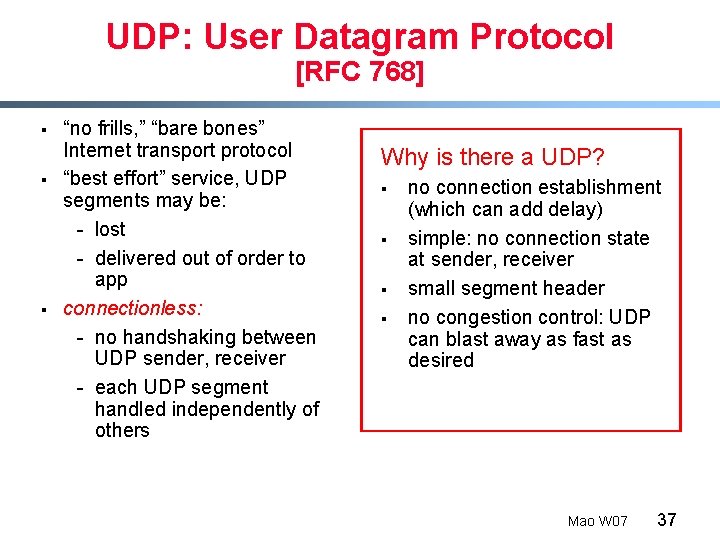
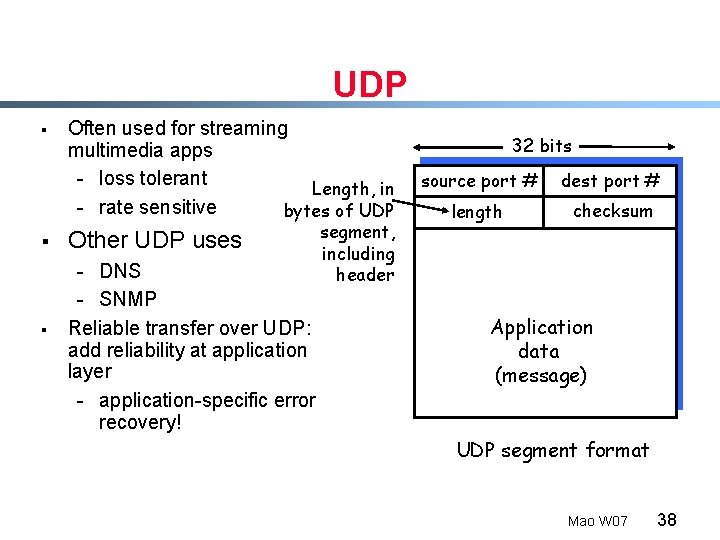
UDP: User Datagram Protocol [RFC 768] § § § “no frills, ” “bare bones” Internet transport protocol “best effort” service, UDP segments may be: - lost - delivered out of order to app connectionless: - no handshaking between UDP sender, receiver - each UDP segment handled independently of others Why is there a UDP? § § no connection establishment (which can add delay) simple: no connection state at sender, receiver small segment header no congestion control: UDP can blast away as fast as desired Mao W 07 37
UDP § § § Often used for streaming multimedia apps - loss tolerant Length, in - rate sensitive bytes of UDP Other UDP uses - DNS - SNMP Reliable transfer over UDP: add reliability at application layer - application-specific error recovery! segment, including header 32 bits source port # dest port # length checksum Application data (message) UDP segment format Mao W 07 38
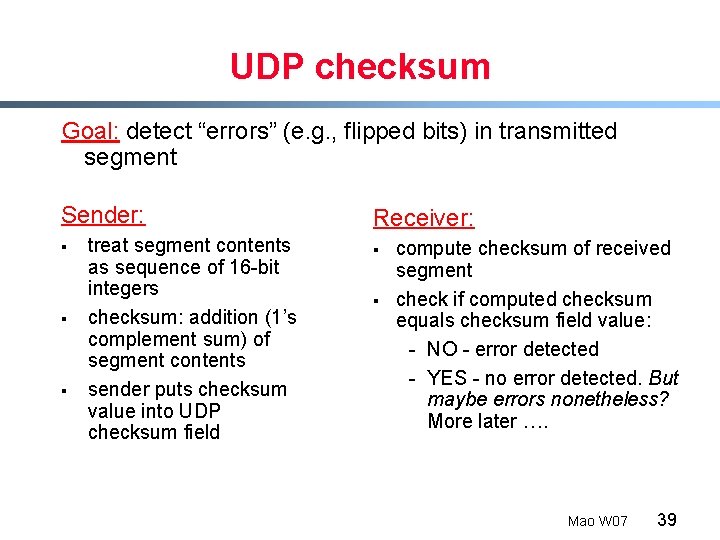
UDP checksum Goal: detect “errors” (e. g. , flipped bits) in transmitted segment Sender: § § § treat segment contents as sequence of 16 -bit integers checksum: addition (1’s complement sum) of segment contents sender puts checksum value into UDP checksum field Receiver: § § compute checksum of received segment check if computed checksum equals checksum field value: - NO - error detected - YES - no error detected. But maybe errors nonetheless? More later …. Mao W 07 39
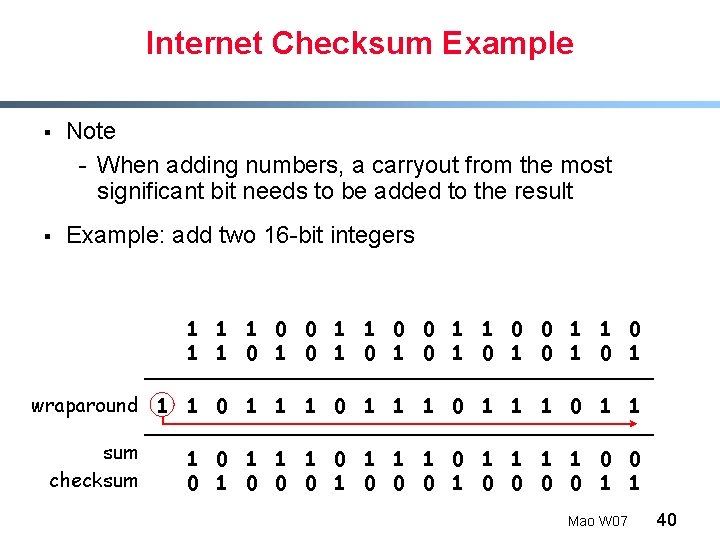
Internet Checksum Example § Note - When adding numbers, a carryout from the most significant bit needs to be added to the result § Example: add two 16 -bit integers 1 1 0 0 1 1 1 0 1 0 1 wraparound 1 1 0 1 1 sum 1 1 0 1 1 0 0 checksum 1 0 0 0 0 1 1 Mao W 07 40
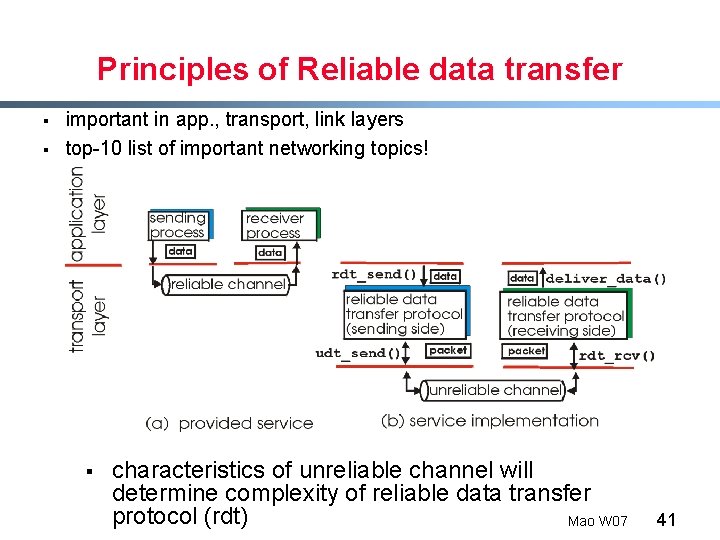
Principles of Reliable data transfer § § important in app. , transport, link layers top-10 list of important networking topics! § characteristics of unreliable channel will determine complexity of reliable data transfer protocol (rdt) Mao W 07 41
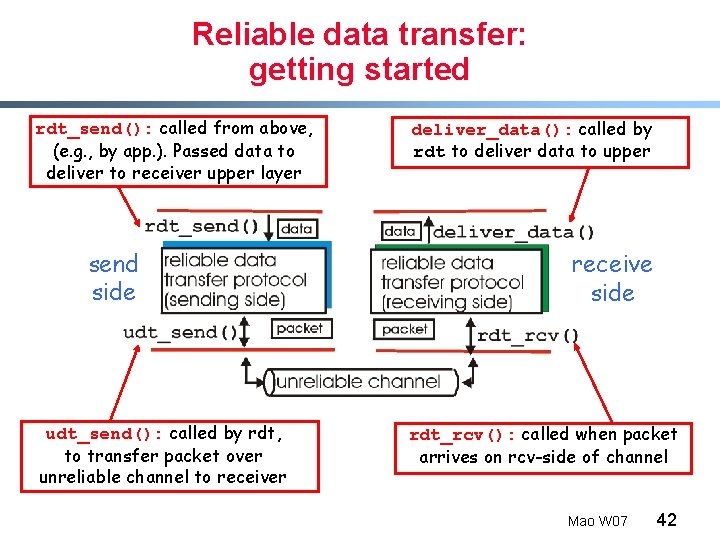
Reliable data transfer: getting started rdt_send(): called from above, (e. g. , by app. ). Passed data to deliver to receiver upper layer send side udt_send(): called by rdt, to transfer packet over unreliable channel to receiver deliver_data(): called by rdt to deliver data to upper receive side rdt_rcv(): called when packet arrives on rcv-side of channel Mao W 07 42
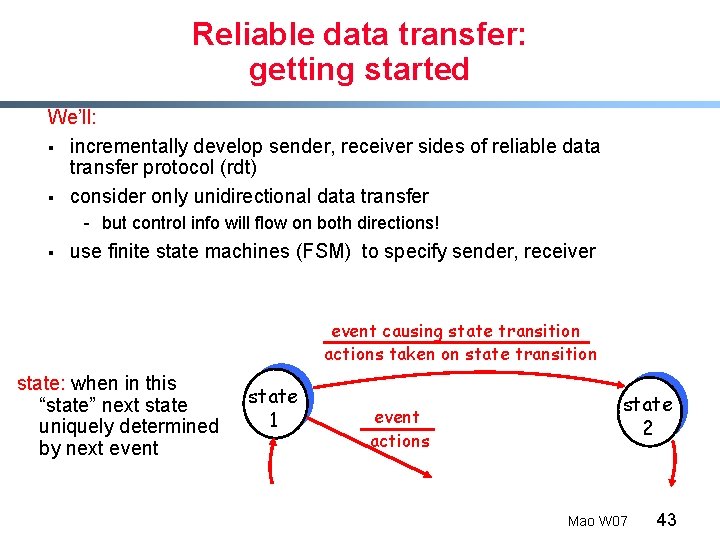
Reliable data transfer: getting started We’ll: § incrementally develop sender, receiver sides of reliable data transfer protocol (rdt) § consider only unidirectional data transfer - but control info will flow on both directions! § use finite state machines (FSM) to specify sender, receiver event causing state transition actions taken on state transition state: when in this “state” next state uniquely determined by next event state 1 event actions state 2 Mao W 07 43
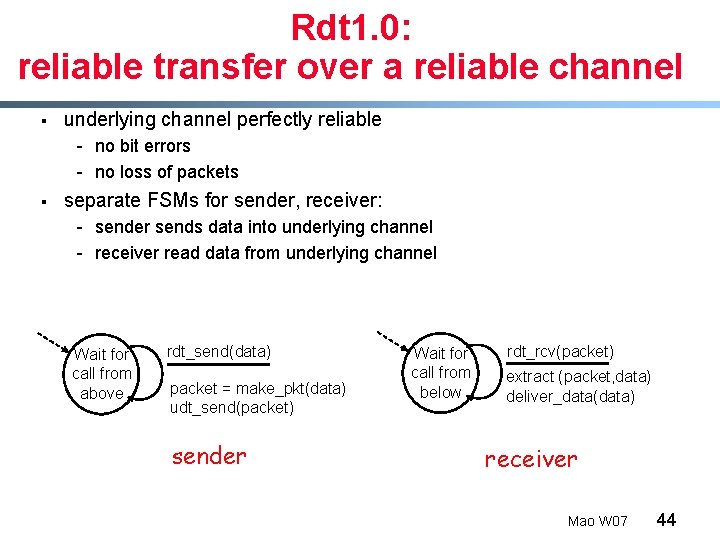
Rdt 1. 0: reliable transfer over a reliable channel § underlying channel perfectly reliable - no bit errors - no loss of packets § separate FSMs for sender, receiver: - sender sends data into underlying channel - receiver read data from underlying channel Wait for call from above rdt_send(data) packet = make_pkt(data) udt_send(packet) sender Wait for call from below rdt_rcv(packet) extract (packet, data) deliver_data(data) receiver Mao W 07 44
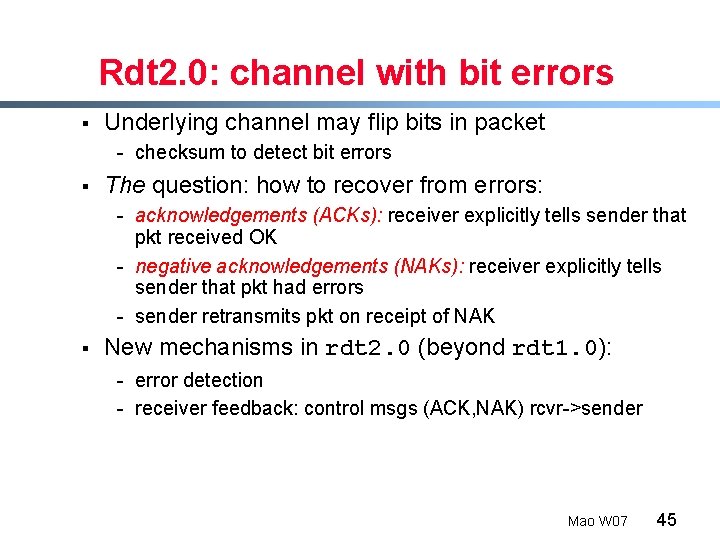
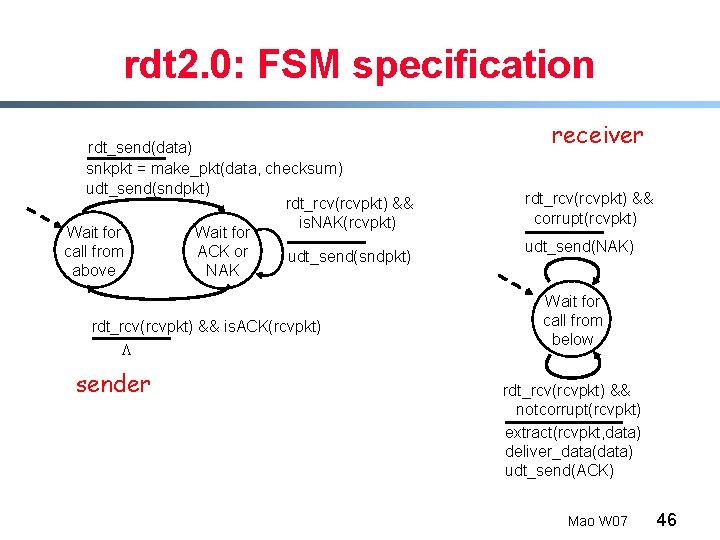
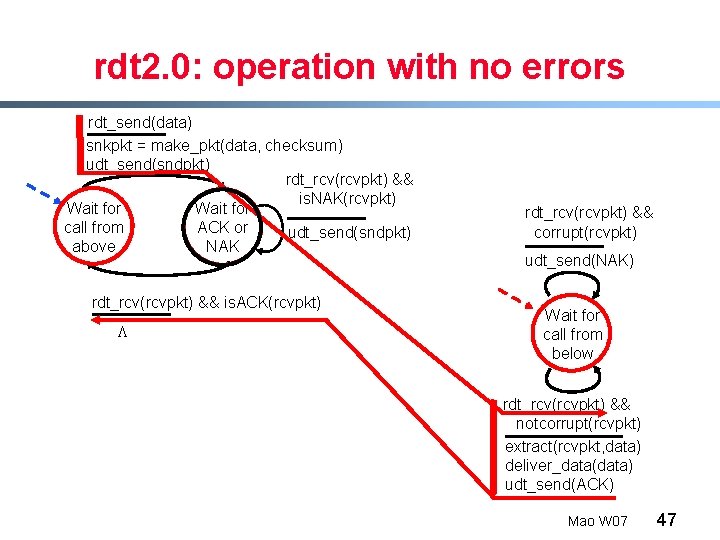
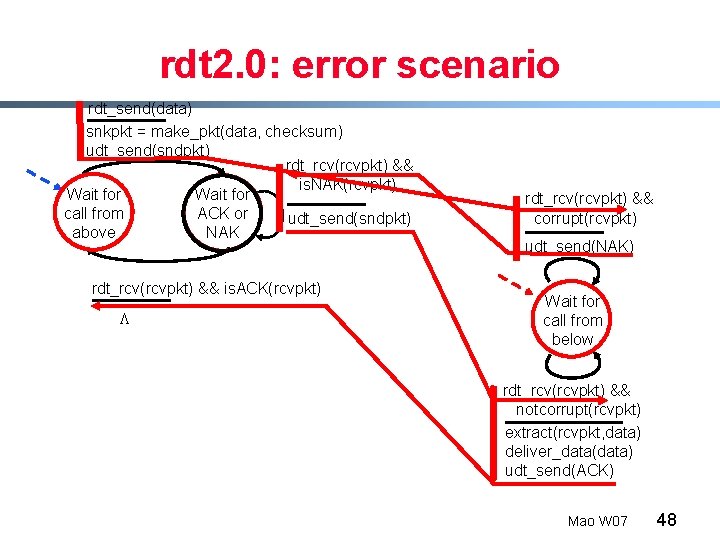
Rdt 2. 0: channel with bit errors § Underlying channel may flip bits in packet - checksum to detect bit errors § The question: how to recover from errors: - acknowledgements (ACKs): receiver explicitly tells sender that pkt received OK - negative acknowledgements (NAKs): receiver explicitly tells sender that pkt had errors - sender retransmits pkt on receipt of NAK § New mechanisms in rdt 2. 0 (beyond rdt 1. 0): - error detection - receiver feedback: control msgs (ACK, NAK) rcvr->sender Mao W 07 45
rdt 2. 0: FSM specification rdt_send(data) snkpkt = make_pkt(data, checksum) udt_send(sndpkt) rdt_rcv(rcvpkt) && is. NAK(rcvpkt) Wait for call from ACK or udt_send(sndpkt) above NAK rdt_rcv(rcvpkt) && is. ACK(rcvpkt) L sender receiver rdt_rcv(rcvpkt) && corrupt(rcvpkt) udt_send(NAK) Wait for call from below rdt_rcv(rcvpkt) && notcorrupt(rcvpkt) extract(rcvpkt, data) deliver_data(data) udt_send(ACK) Mao W 07 46
rdt 2. 0: operation with no errors rdt_send(data) snkpkt = make_pkt(data, checksum) udt_send(sndpkt) rdt_rcv(rcvpkt) && is. NAK(rcvpkt) Wait for call from ACK or udt_send(sndpkt) above NAK rdt_rcv(rcvpkt) && is. ACK(rcvpkt) L rdt_rcv(rcvpkt) && corrupt(rcvpkt) udt_send(NAK) Wait for call from below rdt_rcv(rcvpkt) && notcorrupt(rcvpkt) extract(rcvpkt, data) deliver_data(data) udt_send(ACK) Mao W 07 47
rdt 2. 0: error scenario rdt_send(data) snkpkt = make_pkt(data, checksum) udt_send(sndpkt) rdt_rcv(rcvpkt) && is. NAK(rcvpkt) Wait for call from ACK or udt_send(sndpkt) above NAK rdt_rcv(rcvpkt) && is. ACK(rcvpkt) L rdt_rcv(rcvpkt) && corrupt(rcvpkt) udt_send(NAK) Wait for call from below rdt_rcv(rcvpkt) && notcorrupt(rcvpkt) extract(rcvpkt, data) deliver_data(data) udt_send(ACK) Mao W 07 48
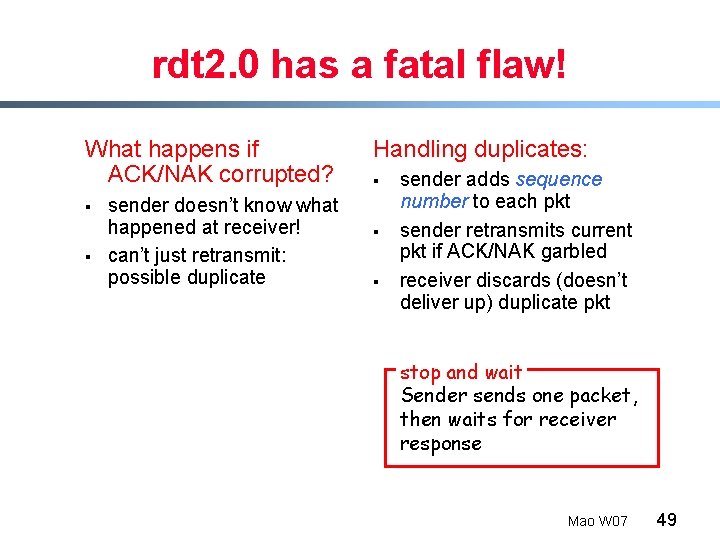
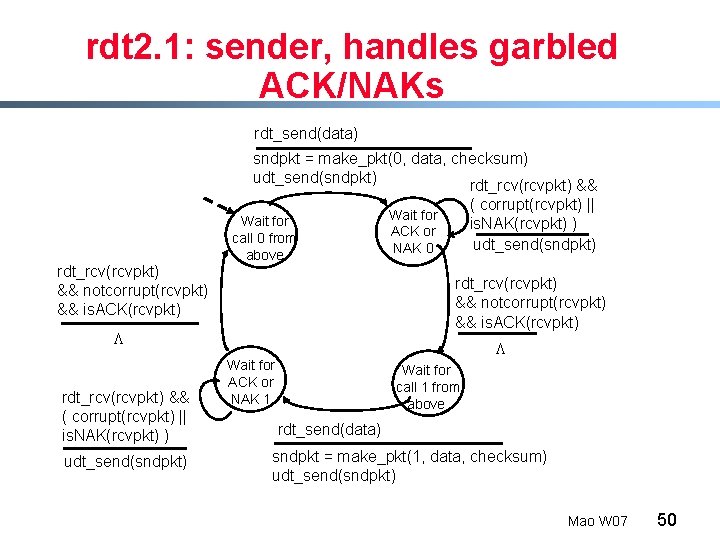
rdt 2. 0 has a fatal flaw! What happens if ACK/NAK corrupted? § § sender doesn’t know what happened at receiver! can’t just retransmit: possible duplicate Handling duplicates: § § § sender adds sequence number to each pkt sender retransmits current pkt if ACK/NAK garbled receiver discards (doesn’t deliver up) duplicate pkt stop and wait Sender sends one packet, then waits for receiver response Mao W 07 49
rdt 2. 1: sender, handles garbled ACK/NAKs rdt_send(data) sndpkt = make_pkt(0, data, checksum) udt_send(sndpkt) rdt_rcv(rcvpkt) && notcorrupt(rcvpkt) && is. ACK(rcvpkt) Wait for call 0 from above rdt_rcv(rcvpkt) && notcorrupt(rcvpkt) && is. ACK(rcvpkt) L rdt_rcv(rcvpkt) && ( corrupt(rcvpkt) || is. NAK(rcvpkt) ) udt_send(sndpkt) Wait for ACK or NAK 0 L Wait for ACK or NAK 1 Wait for call 1 from above rdt_send(data) sndpkt = make_pkt(1, data, checksum) udt_send(sndpkt) Mao W 07 50
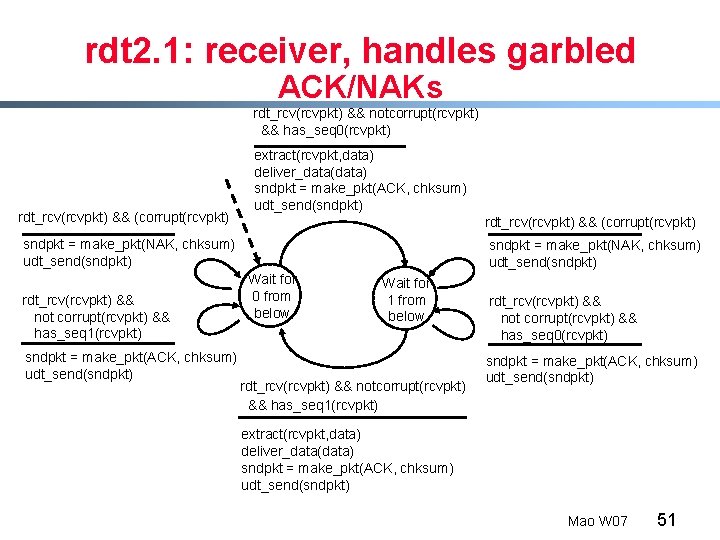
rdt 2. 1: receiver, handles garbled ACK/NAKs rdt_rcv(rcvpkt) && notcorrupt(rcvpkt) && has_seq 0(rcvpkt) rdt_rcv(rcvpkt) && (corrupt(rcvpkt) extract(rcvpkt, data) deliver_data(data) sndpkt = make_pkt(ACK, chksum) udt_send(sndpkt) rdt_rcv(rcvpkt) && (corrupt(rcvpkt) sndpkt = make_pkt(NAK, chksum) udt_send(sndpkt) rdt_rcv(rcvpkt) && not corrupt(rcvpkt) && has_seq 1(rcvpkt) sndpkt = make_pkt(ACK, chksum) udt_send(sndpkt) sndpkt = make_pkt(NAK, chksum) udt_send(sndpkt) Wait for 0 from below Wait for 1 from below rdt_rcv(rcvpkt) && notcorrupt(rcvpkt) && has_seq 1(rcvpkt) rdt_rcv(rcvpkt) && not corrupt(rcvpkt) && has_seq 0(rcvpkt) sndpkt = make_pkt(ACK, chksum) udt_send(sndpkt) extract(rcvpkt, data) deliver_data(data) sndpkt = make_pkt(ACK, chksum) udt_send(sndpkt) Mao W 07 51
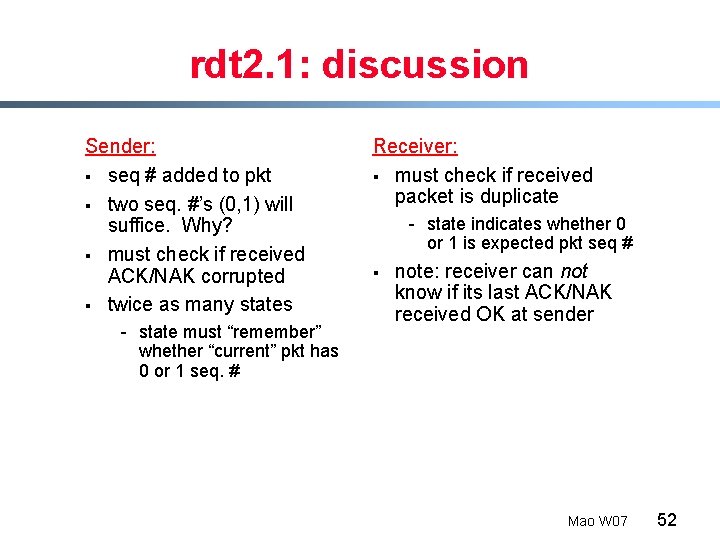
rdt 2. 1: discussion Sender: § seq # added to pkt § two seq. #’s (0, 1) will suffice. Why? § must check if received ACK/NAK corrupted § twice as many states - state must “remember” whether “current” pkt has 0 or 1 seq. # Receiver: § must check if received packet is duplicate - state indicates whether 0 or 1 is expected pkt seq # § note: receiver can not know if its last ACK/NAK received OK at sender Mao W 07 52
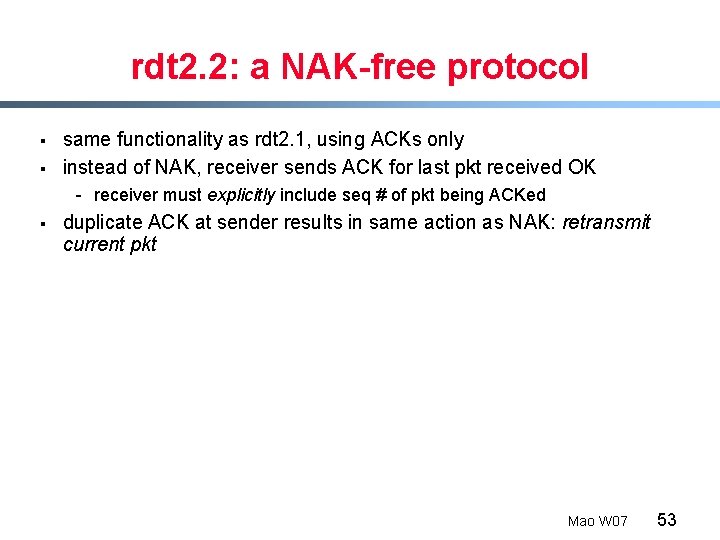
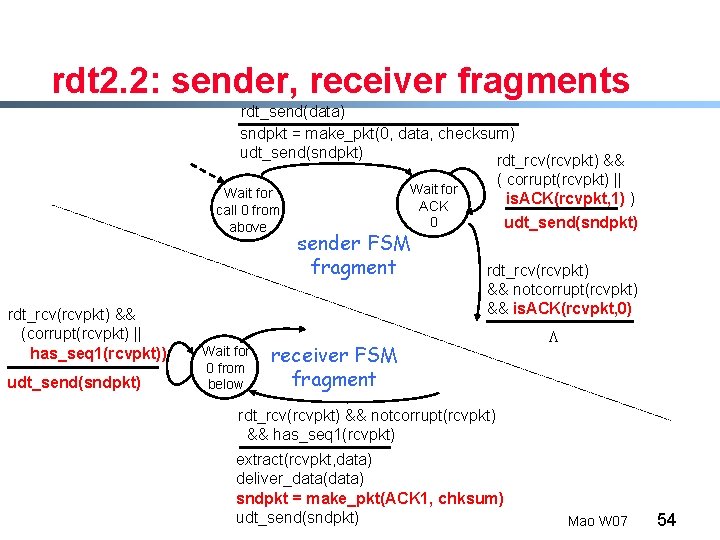
rdt 2. 2: a NAK-free protocol § § same functionality as rdt 2. 1, using ACKs only instead of NAK, receiver sends ACK for last pkt received OK - receiver must explicitly include seq # of pkt being ACKed § duplicate ACK at sender results in same action as NAK: retransmit current pkt Mao W 07 53
rdt 2. 2: sender, receiver fragments rdt_send(data) sndpkt = make_pkt(0, data, checksum) udt_send(sndpkt) rdt_rcv(rcvpkt) && Wait for call 0 from above rdt_rcv(rcvpkt) && (corrupt(rcvpkt) || has_seq 1(rcvpkt)) udt_send(sndpkt) Wait for 0 from below ( corrupt(rcvpkt) || is. ACK(rcvpkt, 1) ) udt_send(sndpkt) Wait for ACK 0 sender FSM fragment rdt_rcv(rcvpkt) && notcorrupt(rcvpkt) && is. ACK(rcvpkt, 0) receiver FSM fragment L rdt_rcv(rcvpkt) && notcorrupt(rcvpkt) && has_seq 1(rcvpkt) extract(rcvpkt, data) deliver_data(data) sndpkt = make_pkt(ACK 1, chksum) udt_send(sndpkt) Mao W 07 54
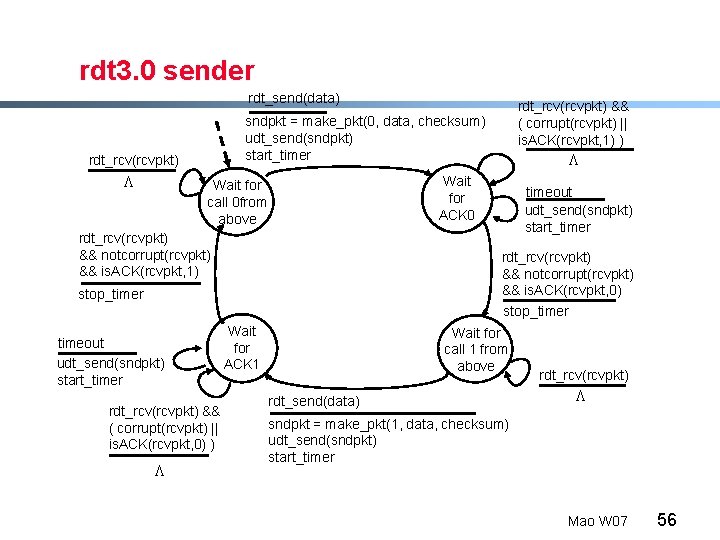
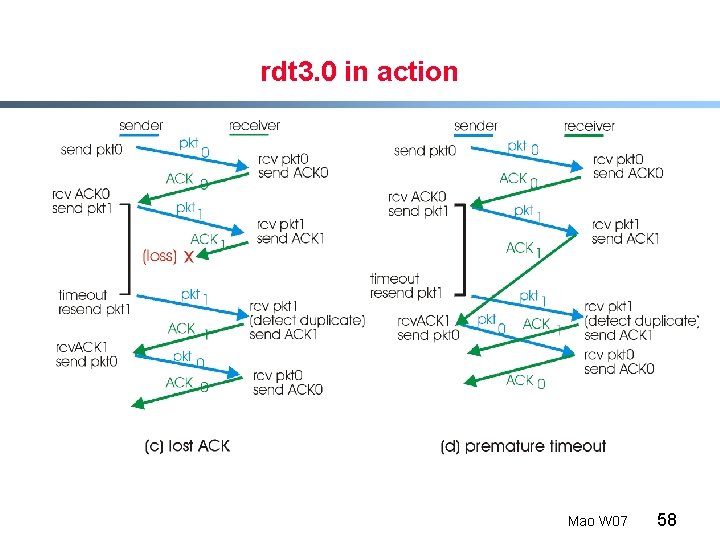
rdt 3. 0: channels with errors and loss New assumption: underlying channel can also lose packets (data or ACKs) - checksum, seq. #, ACKs, retransmissions will be of help, but not enough Approach: sender waits “reasonable” amount of time for ACK § § § retransmits if no ACK received in this time if pkt (or ACK) just delayed (not lost): - retransmission will be duplicate, but use of seq. #’s already handles this - receiver must specify seq # of pkt being ACKed requires countdown timer Mao W 07 55
rdt 3. 0 sender rdt_send(data) sndpkt = make_pkt(0, data, checksum) udt_send(sndpkt) start_timer rdt_rcv(rcvpkt) L rdt_rcv(rcvpkt) && notcorrupt(rcvpkt) && is. ACK(rcvpkt, 1) rdt_rcv(rcvpkt) && ( corrupt(rcvpkt) || is. ACK(rcvpkt, 0) ) timeout udt_send(sndpkt) start_timer rdt_rcv(rcvpkt) && notcorrupt(rcvpkt) && is. ACK(rcvpkt, 0) stop_timer timeout udt_send(sndpkt) start_timer L Wait for ACK 0 Wait for call 0 from above L rdt_rcv(rcvpkt) && ( corrupt(rcvpkt) || is. ACK(rcvpkt, 1) ) Wait for ACK 1 Wait for call 1 from above rdt_send(data) rdt_rcv(rcvpkt) L sndpkt = make_pkt(1, data, checksum) udt_send(sndpkt) start_timer Mao W 07 56
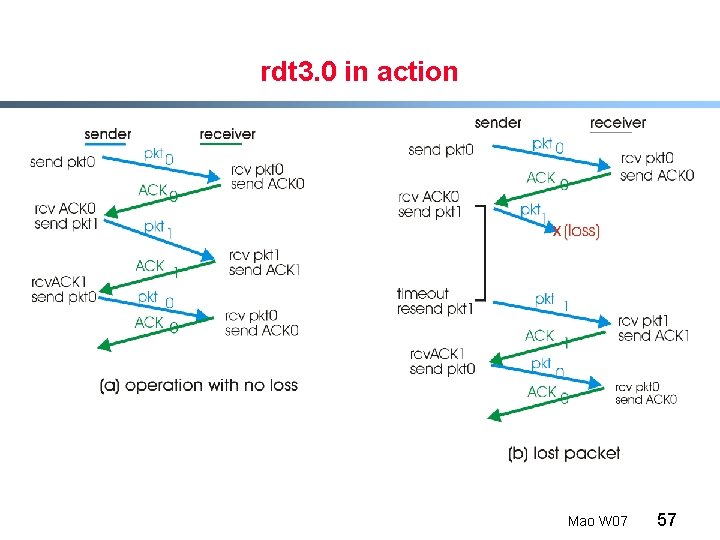
rdt 3. 0 in action Mao W 07 57
rdt 3. 0 in action Mao W 07 58
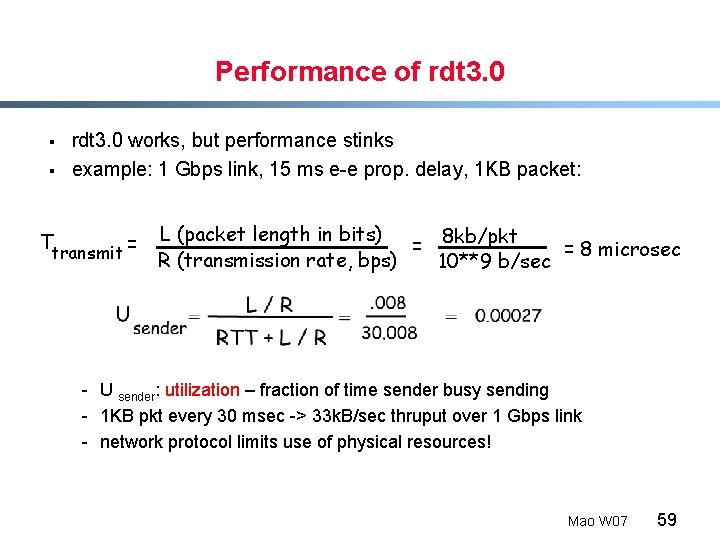
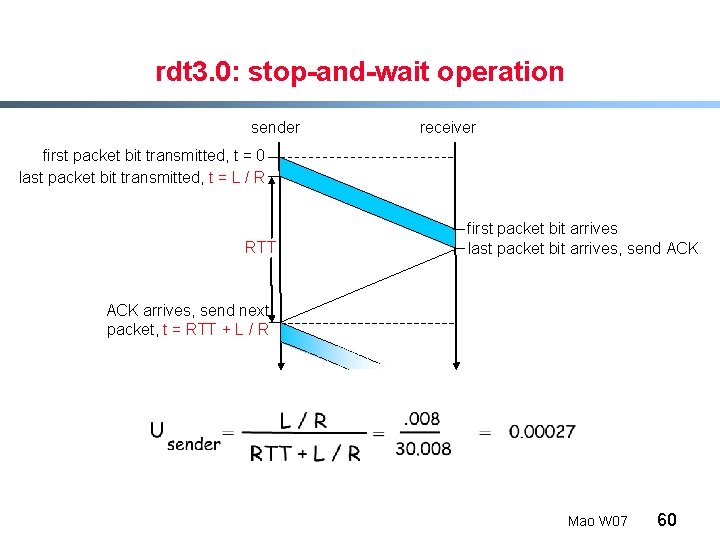
Performance of rdt 3. 0 § § rdt 3. 0 works, but performance stinks example: 1 Gbps link, 15 ms e-e prop. delay, 1 KB packet: Ttransmit = L (packet length in bits) 8 kb/pkt = = 8 microsec R (transmission rate, bps) 10**9 b/sec - U sender: utilization – fraction of time sender busy sending - 1 KB pkt every 30 msec -> 33 k. B/sec thruput over 1 Gbps link - network protocol limits use of physical resources! Mao W 07 59
rdt 3. 0: stop-and-wait operation sender receiver first packet bit transmitted, t = 0 last packet bit transmitted, t = L / R RTT first packet bit arrives last packet bit arrives, send ACK arrives, send next packet, t = RTT + L / R Mao W 07 60
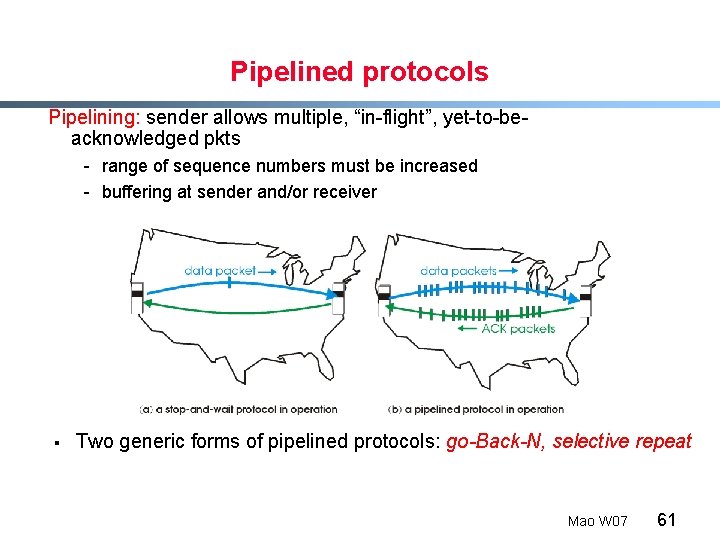
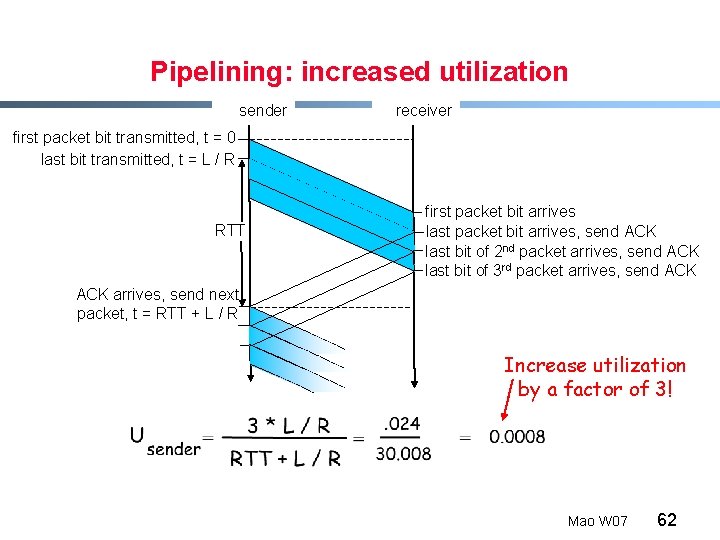
Pipelined protocols Pipelining: sender allows multiple, “in-flight”, yet-to-beacknowledged pkts - range of sequence numbers must be increased - buffering at sender and/or receiver § Two generic forms of pipelined protocols: go-Back-N, selective repeat Mao W 07 61
Pipelining: increased utilization sender receiver first packet bit transmitted, t = 0 last bit transmitted, t = L / R RTT first packet bit arrives last packet bit arrives, send ACK last bit of 2 nd packet arrives, send ACK last bit of 3 rd packet arrives, send ACK arrives, send next packet, t = RTT + L / R Increase utilization by a factor of 3! Mao W 07 62
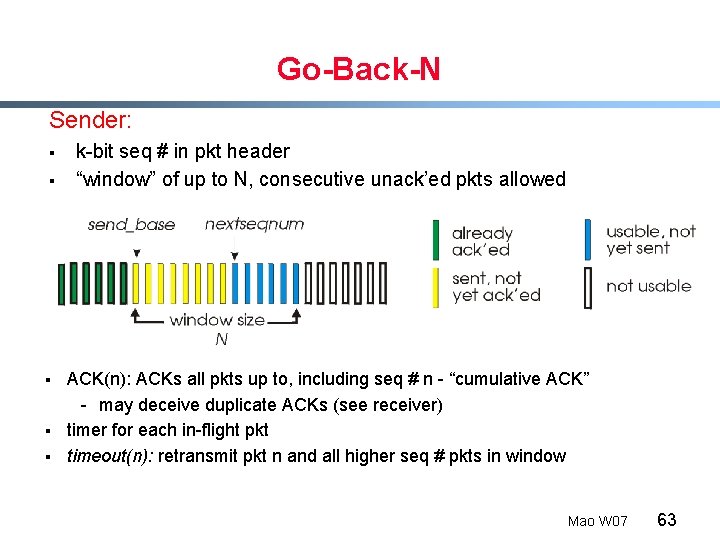
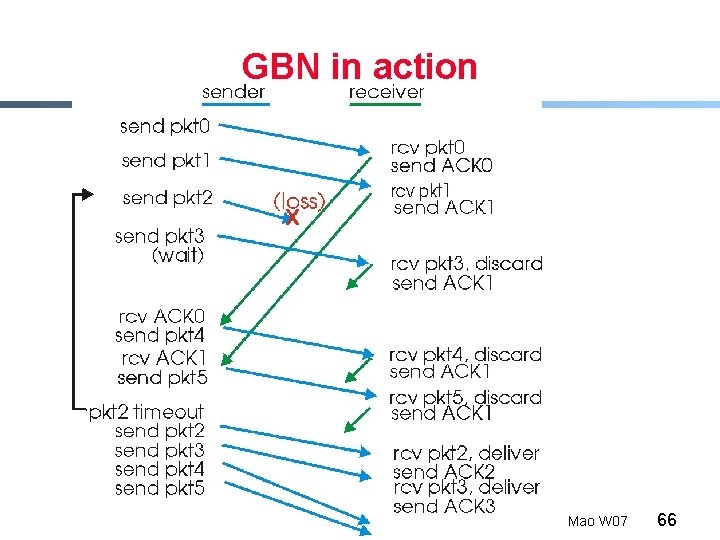
Go-Back-N Sender: § § § k-bit seq # in pkt header “window” of up to N, consecutive unack’ed pkts allowed ACK(n): ACKs all pkts up to, including seq # n - “cumulative ACK” - may deceive duplicate ACKs (see receiver) timer for each in-flight pkt timeout(n): retransmit pkt n and all higher seq # pkts in window Mao W 07 63
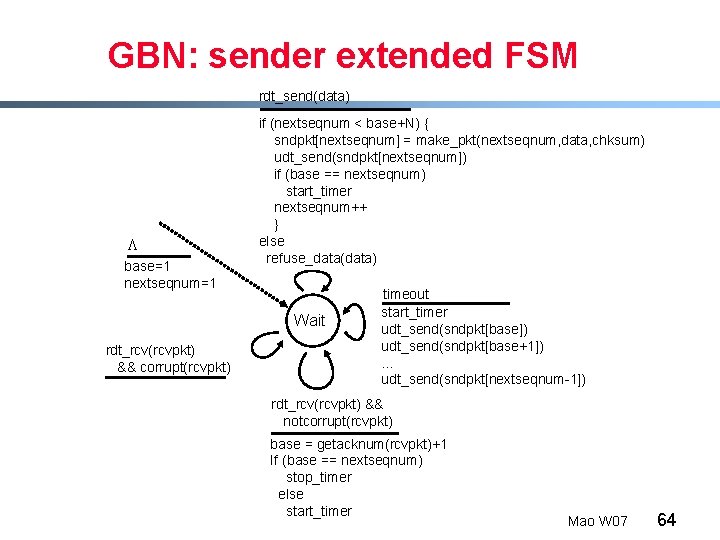
GBN: sender extended FSM rdt_send(data) L base=1 nextseqnum=1 if (nextseqnum < base+N) { sndpkt[nextseqnum] = make_pkt(nextseqnum, data, chksum) udt_send(sndpkt[nextseqnum]) if (base == nextseqnum) start_timer nextseqnum++ } else refuse_data(data) Wait rdt_rcv(rcvpkt) && corrupt(rcvpkt) timeout start_timer udt_send(sndpkt[base]) udt_send(sndpkt[base+1]) … udt_send(sndpkt[nextseqnum-1]) rdt_rcv(rcvpkt) && notcorrupt(rcvpkt) base = getacknum(rcvpkt)+1 If (base == nextseqnum) stop_timer else start_timer Mao W 07 64
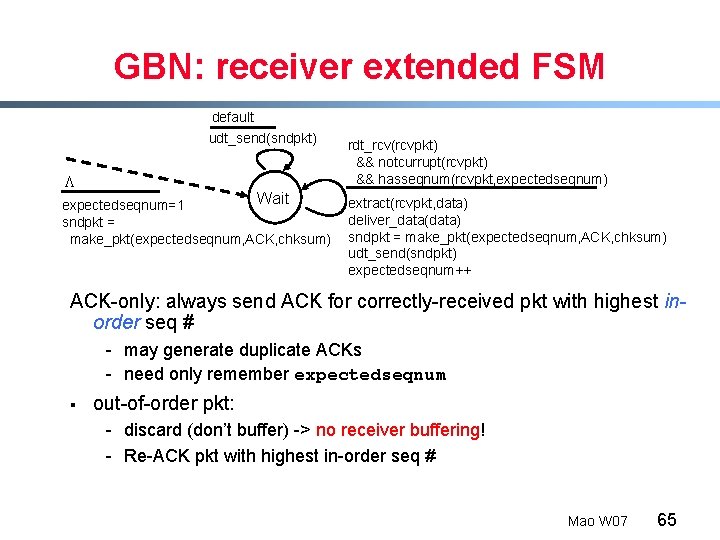
GBN: receiver extended FSM default udt_send(sndpkt) L Wait expectedseqnum=1 sndpkt = make_pkt(expectedseqnum, ACK, chksum) rdt_rcv(rcvpkt) && notcurrupt(rcvpkt) && hasseqnum(rcvpkt, expectedseqnum) extract(rcvpkt, data) deliver_data(data) sndpkt = make_pkt(expectedseqnum, ACK, chksum) udt_send(sndpkt) expectedseqnum++ ACK-only: always send ACK for correctly-received pkt with highest inorder seq # - may generate duplicate ACKs - need only remember expectedseqnum § out-of-order pkt: - discard (don’t buffer) -> no receiver buffering! - Re-ACK pkt with highest in-order seq # Mao W 07 65
GBN in action Mao W 07 66
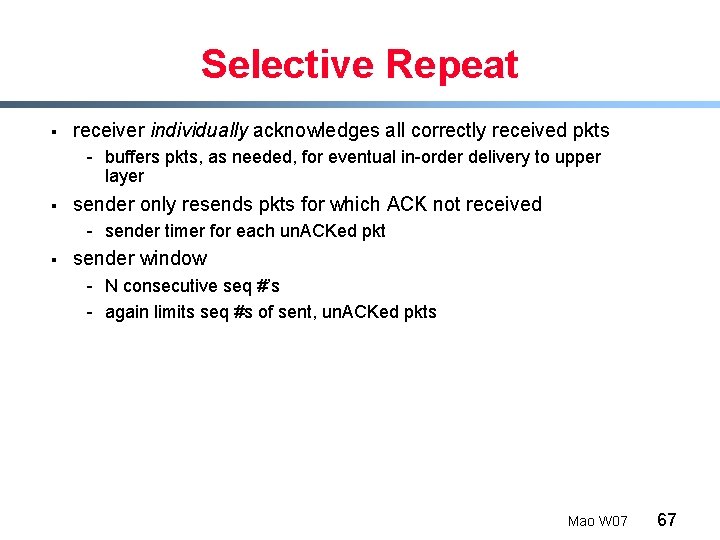
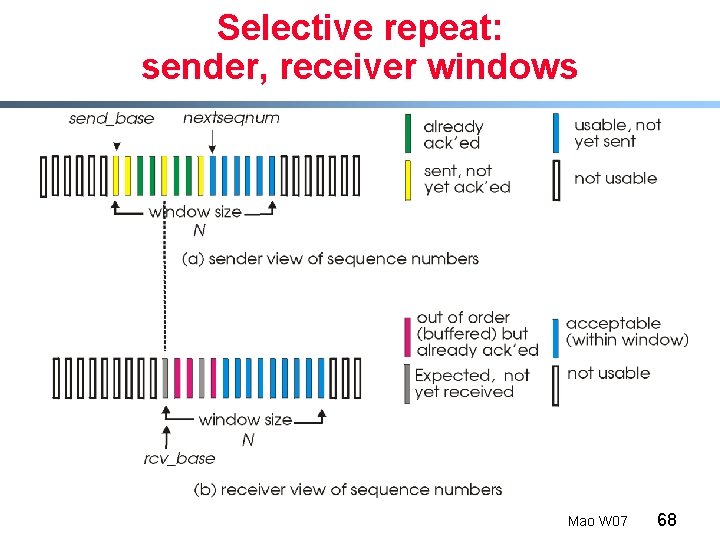
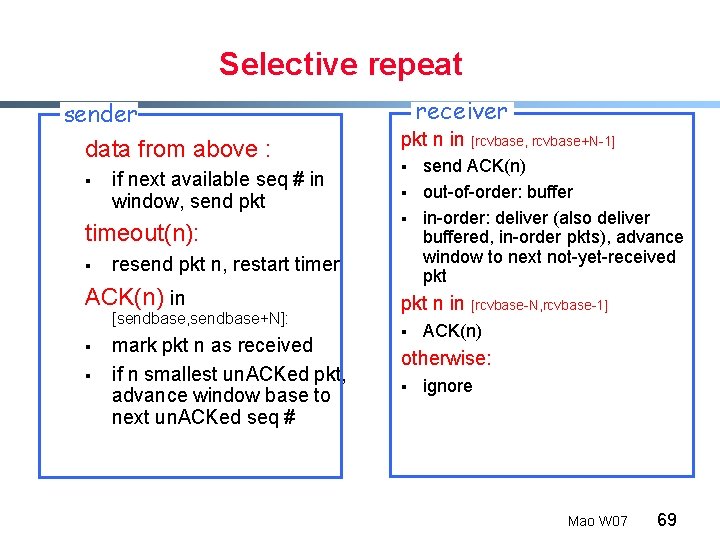
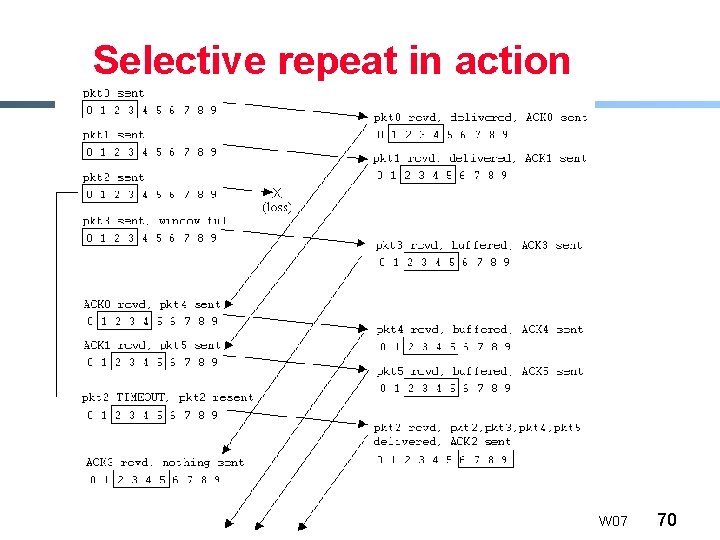
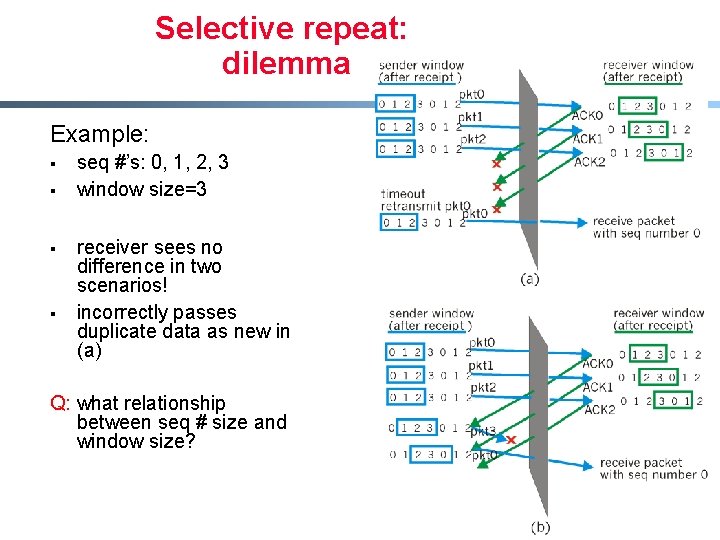
Selective Repeat § receiver individually acknowledges all correctly received pkts - buffers pkts, as needed, for eventual in-order delivery to upper layer § sender only resends pkts for which ACK not received - sender timer for each un. ACKed pkt § sender window - N consecutive seq #’s - again limits seq #s of sent, un. ACKed pkts Mao W 07 67
Selective repeat: sender, receiver windows Mao W 07 68
Selective repeat sender data from above : § if next available seq # in window, send pkt timeout(n): § [sendbase, sendbase+N]: § pkt n in [rcvbase, rcvbase+N-1] § § § resend pkt n, restart timer ACK(n) in § receiver mark pkt n as received if n smallest un. ACKed pkt, advance window base to next un. ACKed seq # send ACK(n) out-of-order: buffer in-order: deliver (also deliver buffered, in-order pkts), advance window to next not-yet-received pkt n in [rcvbase-N, rcvbase-1] § ACK(n) otherwise: § ignore Mao W 07 69
Selective repeat in action Mao W 07 70
Selective repeat: dilemma Example: § § seq #’s: 0, 1, 2, 3 window size=3 receiver sees no difference in two scenarios! incorrectly passes duplicate data as new in (a) Q: what relationship between seq # size and window size? Mao W 07 71