
Transport Layer Computer Networks Autumn 2000 John Kristoff
- Slides: 34
Transport Layer Computer Networks Autumn 2000 John Kristoff 1
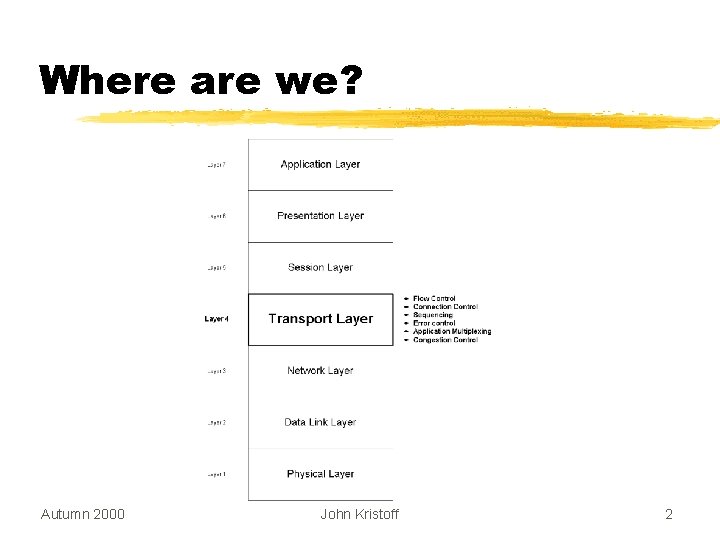
Where are we? Autumn 2000 John Kristoff 2
Recall Ñ Network Layer Ñ Provides host-to-host communication Ñ Source and destination addresses identify host interfaces Ñ Machine-to-machine networking Autumn 2000 John Kristoff 3
Transport Protocols Ñ Ñ Provide application-to-application communication Need extended addressing mechanism to identify applications Called end-to-end Optionally provide: ÑReliability ÑFlow Control ÑCongestion Control Autumn 2000 John Kristoff 4
Example Transport Layer: Transmission Control Protocol (TCP) Ñ Ñ Ñ Ñ Standardized by IETF as RFC 793 Most popular layer 4 protocol Connection-oriented protocol Conceptually between applications and IP Full-duplex operation Byte-stream interface Of utmost importance for this class! Ñ The book: TCP/IP Illustrated, Volume I - W. R. Stevens Ñ Also see: http: //condor. depaul. edu/~jkristof/tcp. html Autumn 2000 John Kristoff 5
TCP Feature Summary Provides a completely reliable (no data duplication or loss), connection-oriented, full-duplex stream transport service that allows two application programs to form a connection, send data in either direction and then terminate the connection. Autumn 2000 John Kristoff 6
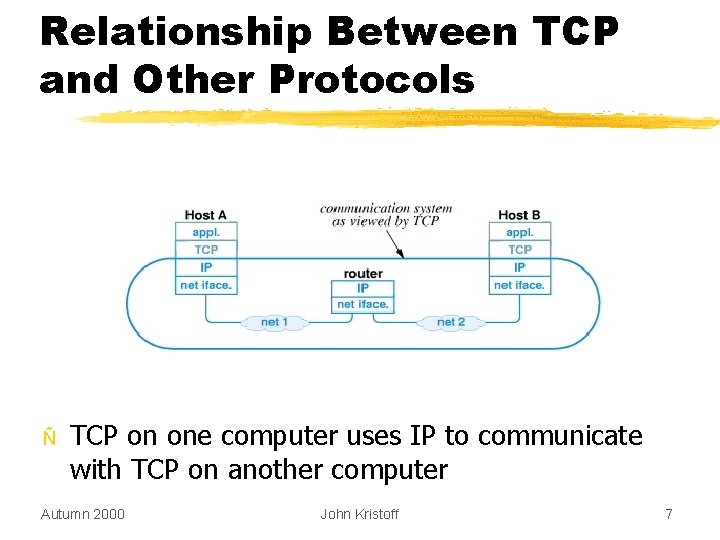
Relationship Between TCP and Other Protocols Ñ TCP on one computer uses IP to communicate with TCP on another computer Autumn 2000 John Kristoff 7
Apparent Contradiction Ñ IP offers best-effort (unreliable) delivery Ñ TCP uses IP Ñ TCP provides completely reliable transfer Ñ How is this possible? Autumn 2000 John Kristoff 8
Achieving Reliability Ñ Reliable connection setup Ñ Reliable data transmission Ñ Reliable connection shutdown Autumn 2000 John Kristoff 9
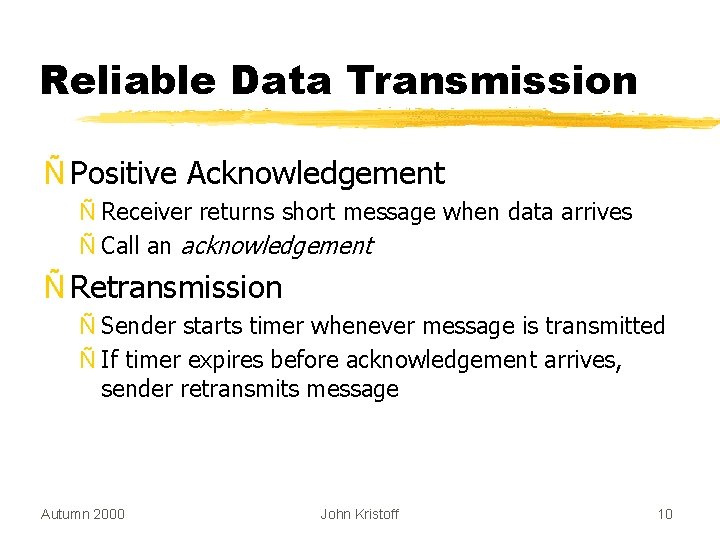
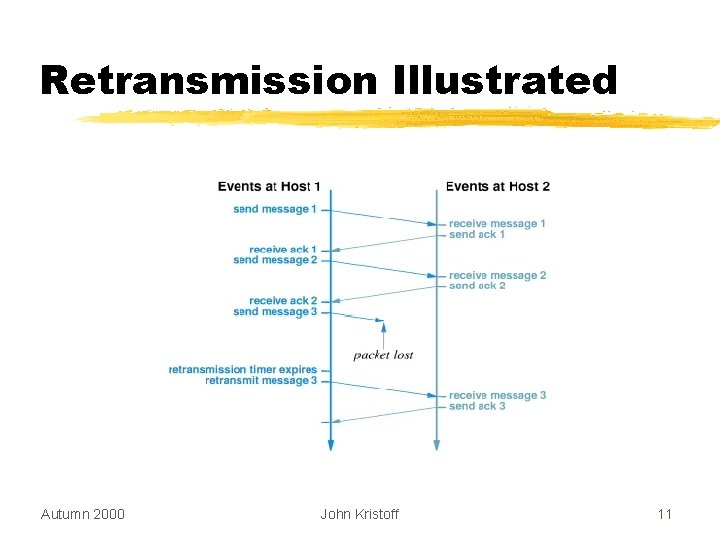
Reliable Data Transmission Ñ Positive Acknowledgement Ñ Receiver returns short message when data arrives Ñ Call an acknowledgement Ñ Retransmission Ñ Sender starts timer whenever message is transmitted Ñ If timer expires before acknowledgement arrives, sender retransmits message Autumn 2000 John Kristoff 10
Retransmission Illustrated Autumn 2000 John Kristoff 11
How Long Should TCP Wait Before Retransmitting? Ñ Time for acknowledgement to arrive depends on Ñ Distance to destination Ñ Current traffic conditions Ñ Multiple connections can be open simultaneously Ñ Traffic conditions change rapidly Autumn 2000 John Kristoff 12
Important Point The delay required for data to reach a destination and an acknowledgement to return depends on traffic in the internet as well as the distance to the destination. Since it allows multiple application programs to communicate with multiple destinations concurrently, TCP must handle a variety of delays that can change rapidly. Autumn 2000 John Kristoff 13
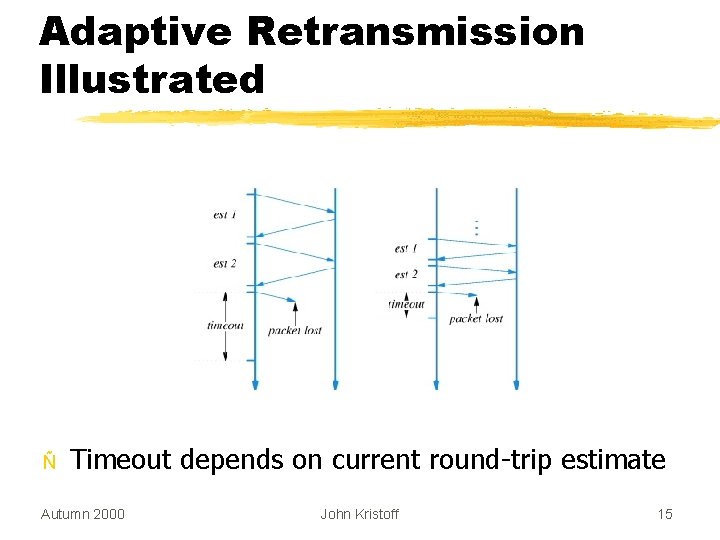
Solving the Retransmission Problem Ñ Keep estimate of round trip time on each connection Ñ Use current estimate to set retransmission timer Ñ Known as adaptive retransmission Ñ Key to TCP� s success Autumn 2000 John Kristoff 14
Adaptive Retransmission Illustrated Ñ Timeout depends on current round-trip estimate Autumn 2000 John Kristoff 15
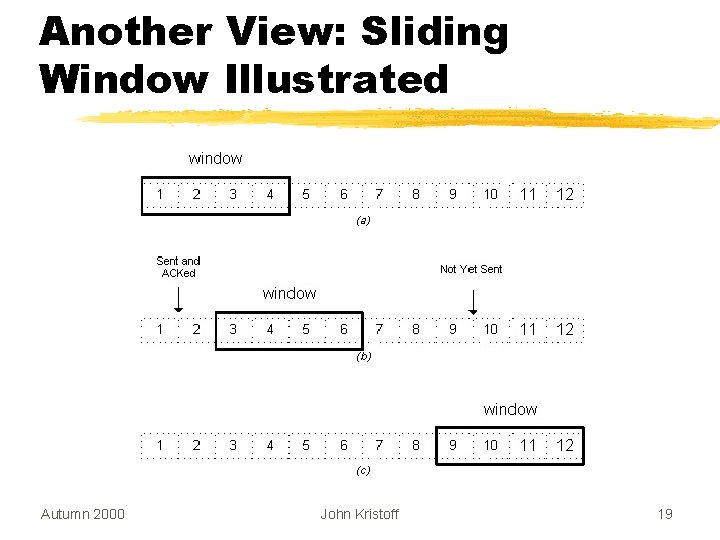
TCP Flow Control Ñ Receiver Ñ Advertises available buffer space Ñ Called the window Ñ Sender Ñ Can send up to entire window before ACK arrives Ñ Also called a sliding window protocol Autumn 2000 John Kristoff 16
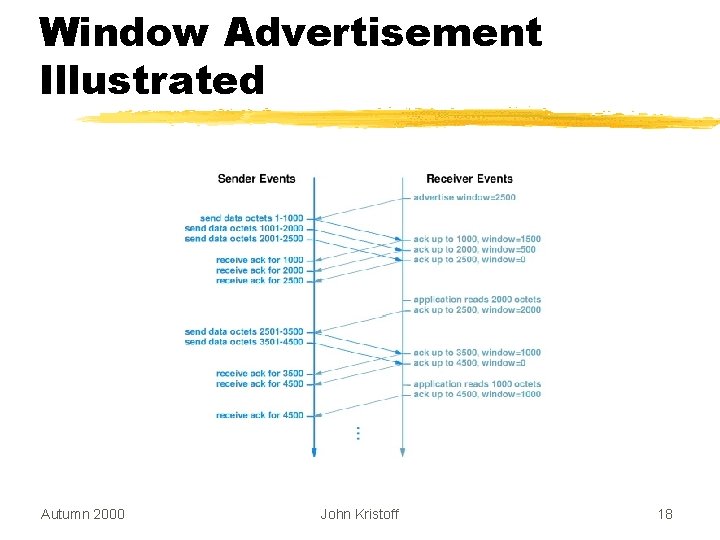
Window Advertisement Ñ Each acknowledgement carries new window information Ñ Called window advertisement Ñ Can be zero (called closed window) Ñ Interpretation: I have received up through X and can take Y more octets Autumn 2000 John Kristoff 17
Window Advertisement Illustrated Autumn 2000 John Kristoff 18
Another View: Sliding Window Illustrated Autumn 2000 John Kristoff 19
Startup and Shutdown Ñ Connection Startup Ñ Must be reliable Ñ Connection Shutdown Ñ Must be graceful Ñ Difficult Autumn 2000 John Kristoff 20
Why Startup/Shutdown is Difficult Ñ Segments can be Ñ lost Ñ duplicated Ñ delayed Ñ delivered out of order Ñ either side can crash Ñ either side can reboot Ñ Need to avoid duplicate shutdown "message�from affecting later connection Autumn 2000 John Kristoff 21
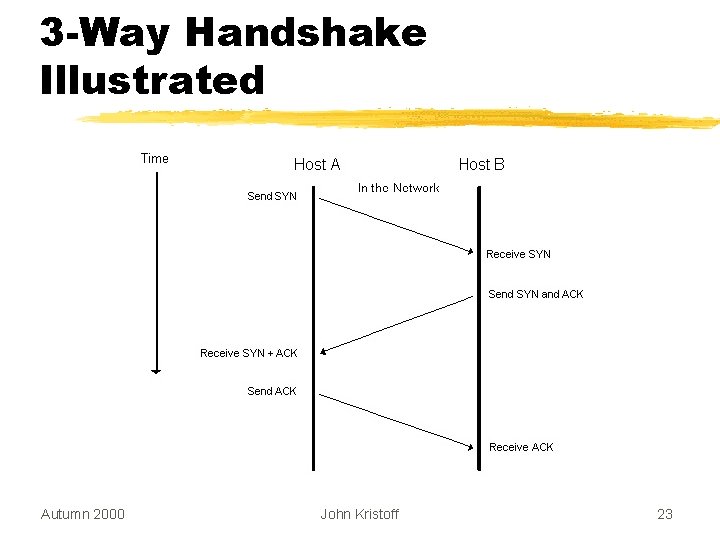
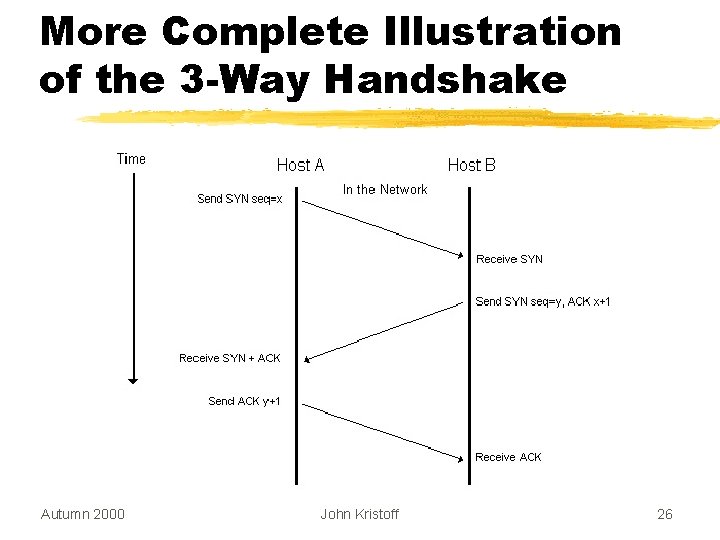
TCP� s Startup Solution Ñ Use three-message exchange Ñ Known as the 3 -way handshake Ñ Necessary and sufficient for unambiguous, reliable startup Ñ SYN messages used for connection establishment Autumn 2000 John Kristoff 22
3 -Way Handshake Illustrated Autumn 2000 John Kristoff 23
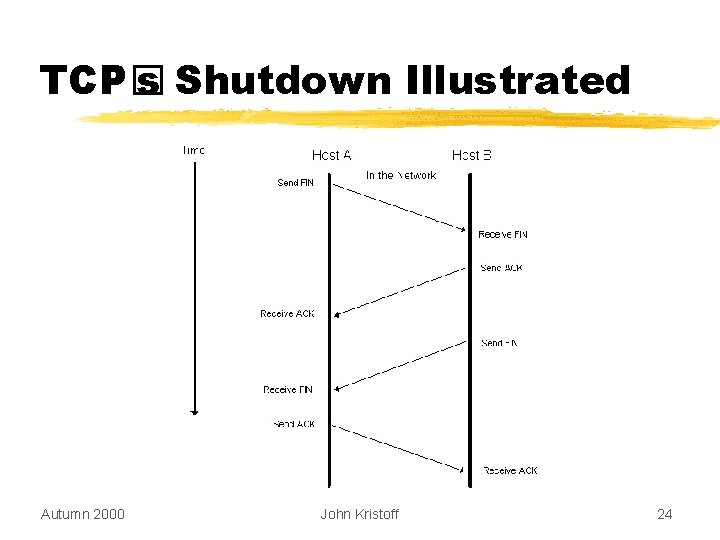
TCP� s Shutdown Illustrated Autumn 2000 John Kristoff 24
Byte Stream Sequencing Ñ Ñ Ñ Segments are labeled with a sequence number Protects from out-of-order delivery 32 -bit number Limited size of byte stream? Initial Sequence Numbers (ISNs) must be exchanged at TCP connection establishment Autumn 2000 John Kristoff 25
More Complete Illustration of the 3 -Way Handshake Autumn 2000 John Kristoff 26
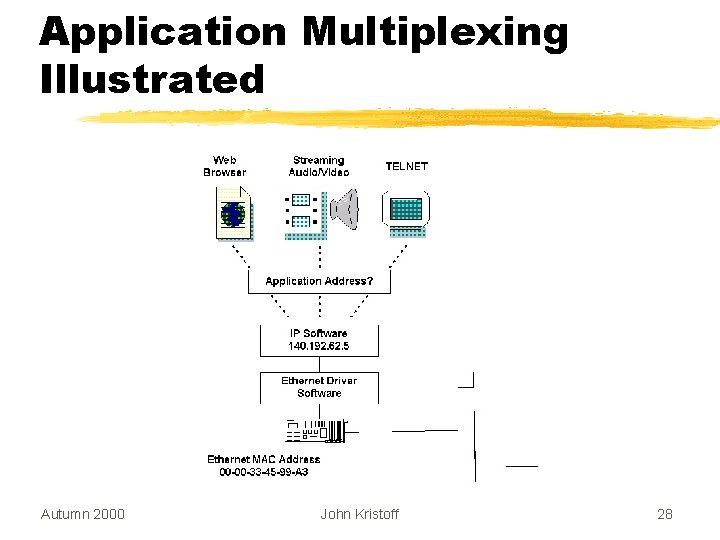
Application Multiplexing Ñ Cannot extend IP address Ñ No unused bits Ñ Cannot use OS dependent quantity Ñ Process ID Ñ Task number Ñ Job name Ñ Must work on all computer systems Autumn 2000 John Kristoff 27
Application Multiplexing Illustrated Autumn 2000 John Kristoff 28
Protocol Ports Ñ Ñ Each application assigned a unique integer Server Ñ Follows standard Ñ Always uses same port number Ñ Usually uses lower port numbers Ñ Client Ñ Obtains unused port from protocol software Ñ Usually uses higher port numbers Autumn 2000 John Kristoff 29
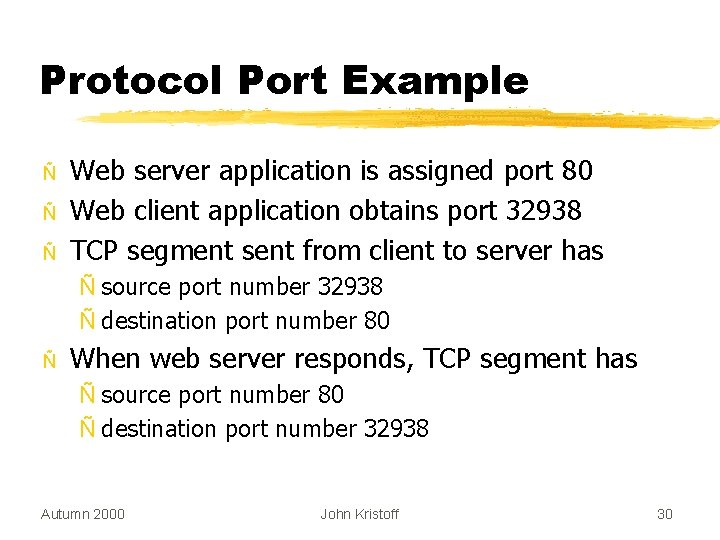
Protocol Port Example Ñ Ñ Ñ Web server application is assigned port 80 Web client application obtains port 32938 TCP segment sent from client to server has Ñ source port number 32938 Ñ destination port number 80 Ñ When web server responds, TCP segment has Ñ source port number 80 Ñ destination port number 32938 Autumn 2000 John Kristoff 30
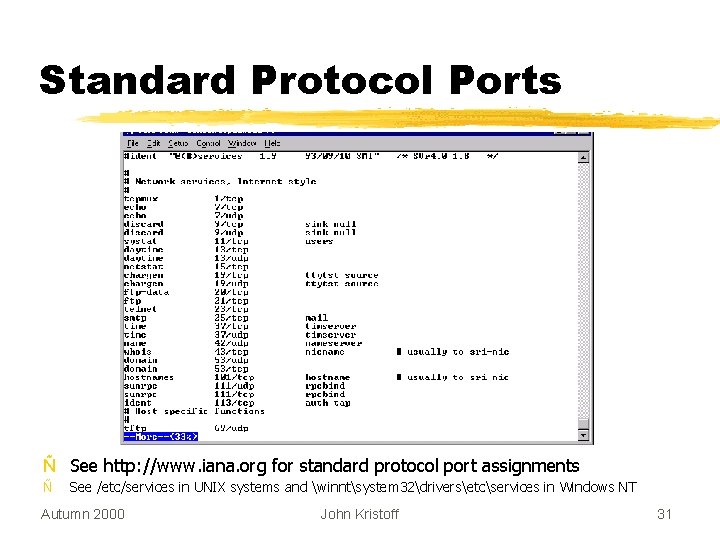
Standard Protocol Ports Ñ See http: //www. iana. org for standard protocol port assignments Ñ See /etc/services in UNIX systems and winntsystem 32driversetcservices in Windows NT Autumn 2000 John Kristoff 31
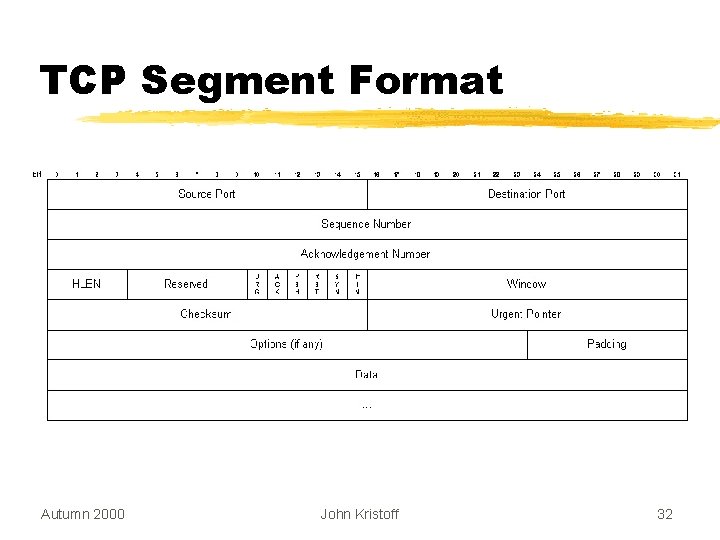
TCP Segment Format Autumn 2000 John Kristoff 32
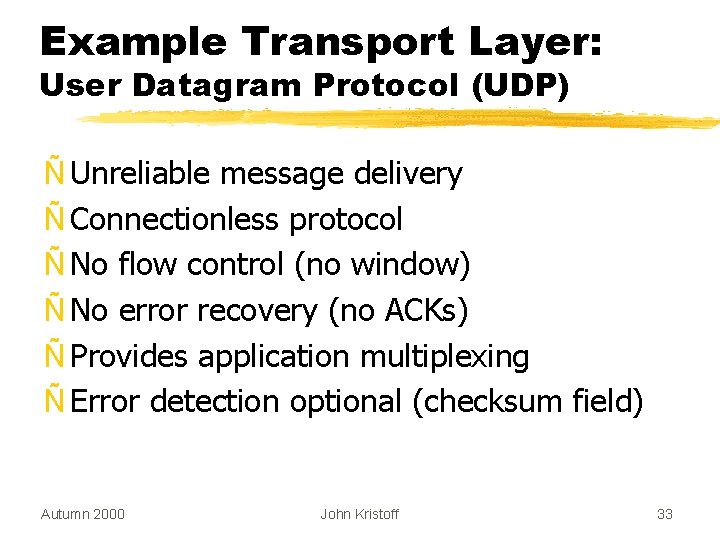
Example Transport Layer: User Datagram Protocol (UDP) Ñ Unreliable message delivery Ñ Connectionless protocol Ñ No flow control (no window) Ñ No error recovery (no ACKs) Ñ Provides application multiplexing Ñ Error detection optional (checksum field) Autumn 2000 John Kristoff 33
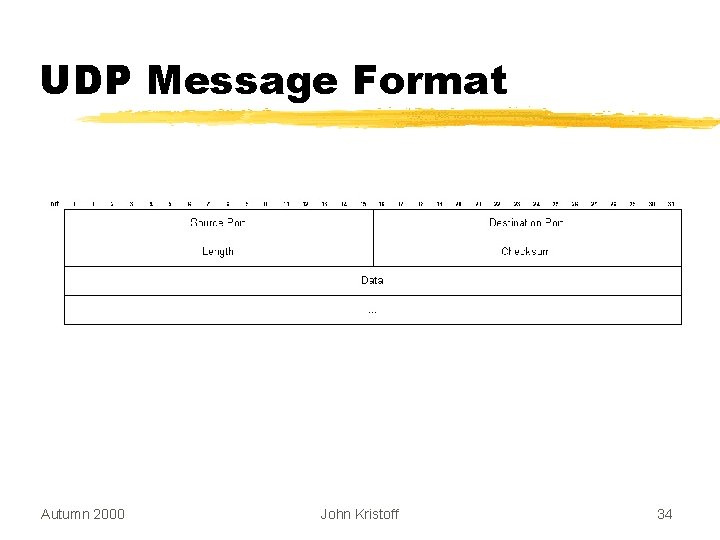
UDP Message Format Autumn 2000 John Kristoff 34