
Transport in Plants II cont Water Balance of
Transport in Plants II (cont. ) Water Balance of Plants It is wise to bring some water, when one goes out to look for water. Arab Proverb
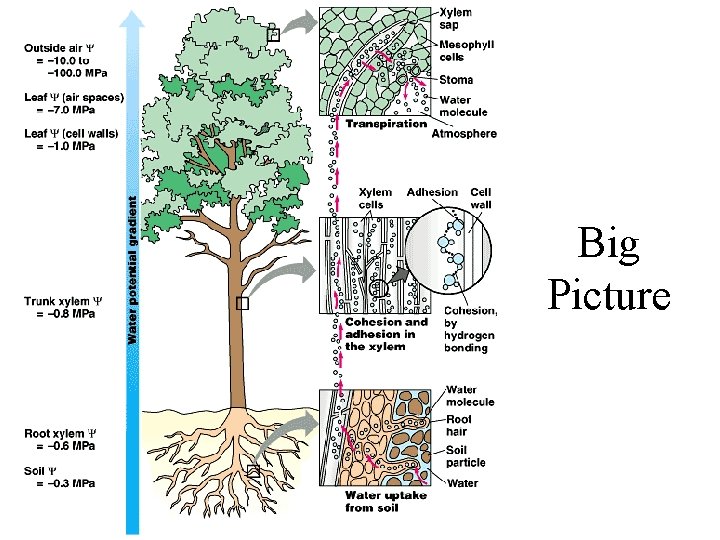
Big Picture
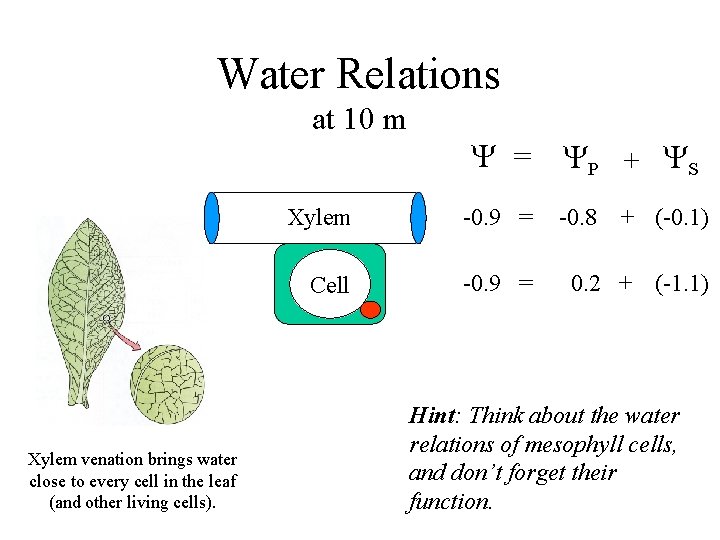
Water Relations at 10 m Xylem venation brings water close to every cell in the leaf (and other living cells). Y = YP + YS Xylem -0. 9 = Cell -0. 9 = -0. 8 + (-0. 1) 0. 2 + (-1. 1) Hint: Think about the water relations of mesophyll cells, and don’t forget their function.
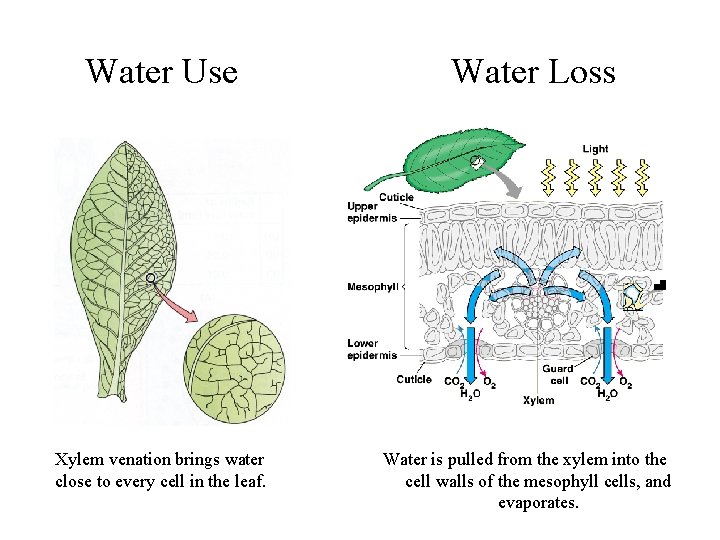
Water Use Xylem venation brings water close to every cell in the leaf. Water Loss Water is pulled from the xylem into the cell walls of the mesophyll cells, and evaporates.
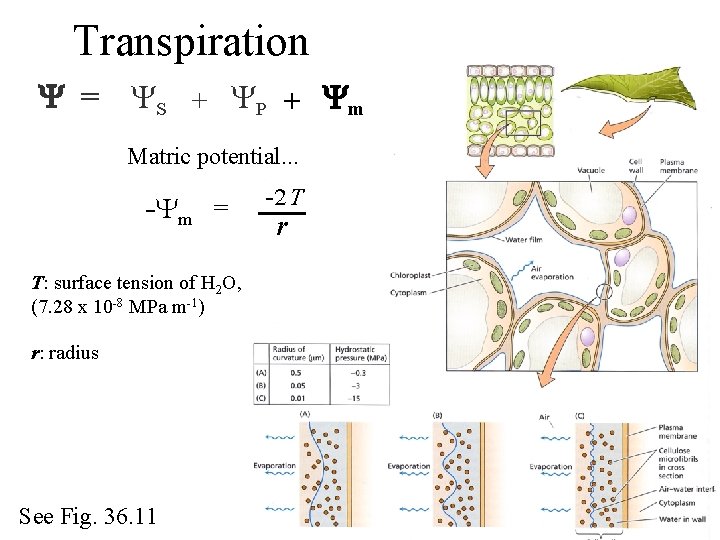
Transpiration Y = YS + YP + Ym Matric potential. . . -Y m = T: surface tension of H 2 O, (7. 28 x 10 -8 MPa m-1) r: radius See Fig. 36. 11 -2 T r
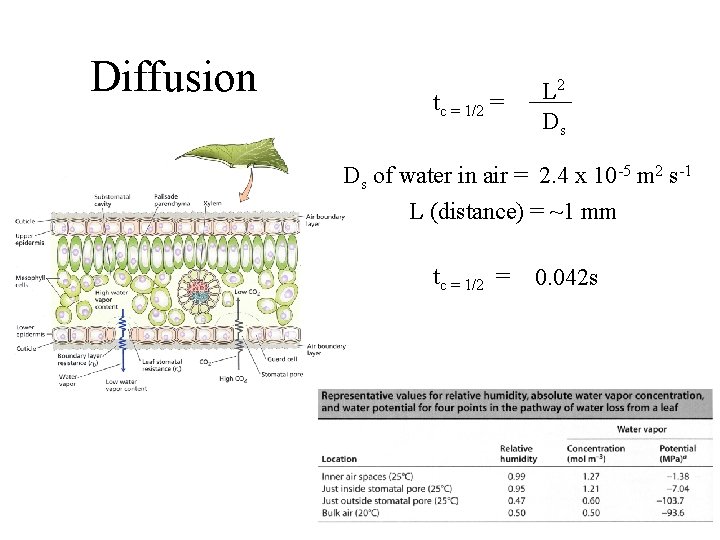
Diffusion tc = 1/2 = L 2 Ds Ds of water in air = 2. 4 x 10 -5 m 2 s-1 L (distance) = ~1 mm tc = 1/2 = 0. 042 s
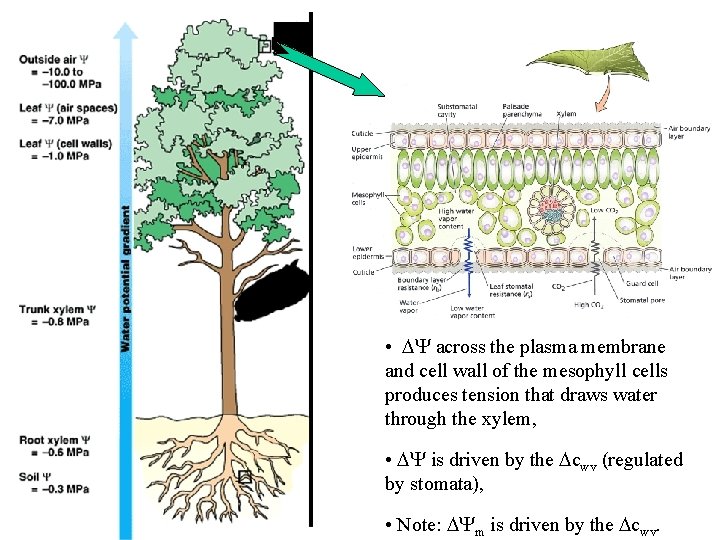
• DY across the plasma membrane and cell wall of the mesophyll cells produces tension that draws water through the xylem, • DY is driven by the Dcwv (regulated by stomata), • Note: DYm is driven by the Dcwv.
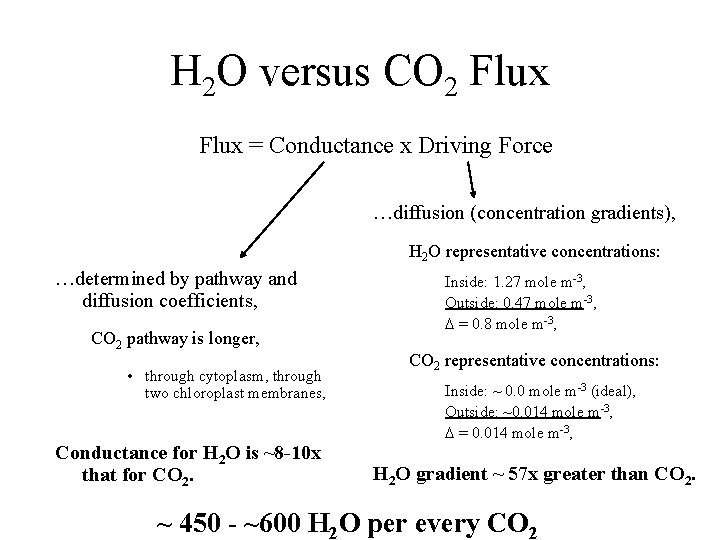
H 2 O versus CO 2 Flux = Conductance x Driving Force …diffusion (concentration gradients), H 2 O representative concentrations: …determined by pathway and diffusion coefficients, CO 2 pathway is longer, • through cytoplasm, through two chloroplast membranes, Conductance for H 2 O is ~8 -10 x that for CO 2. Inside: 1. 27 mole m-3, Outside: 0. 47 mole m-3, D = 0. 8 mole m-3, CO 2 representative concentrations: Inside: ~ 0. 0 mole m-3 (ideal), Outside: ~0. 014 mole m-3, D = 0. 014 mole m-3, H 2 O gradient ~ 57 x greater than CO 2. ~ 450 - ~600 H 2 O per every CO 2
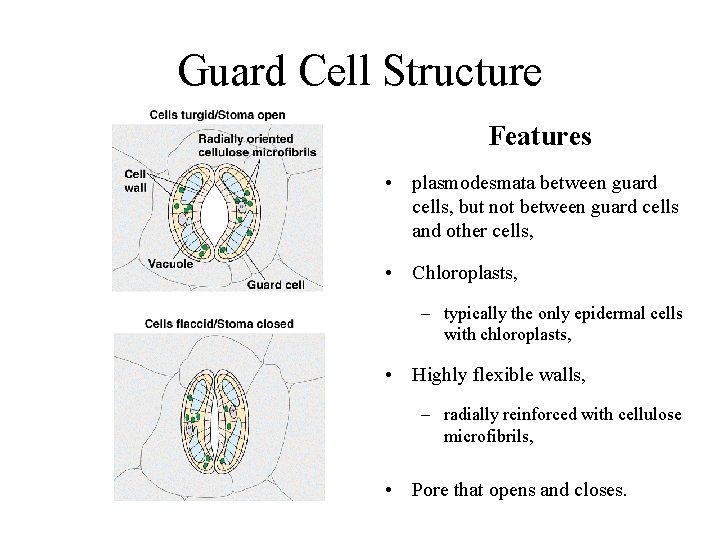
Guard Cell Structure Features • plasmodesmata between guard cells, but not between guard cells and other cells, • Chloroplasts, – typically the only epidermal cells with chloroplasts, • Highly flexible walls, – radially reinforced with cellulose microfibrils, • Pore that opens and closes.

Guard Cell Function
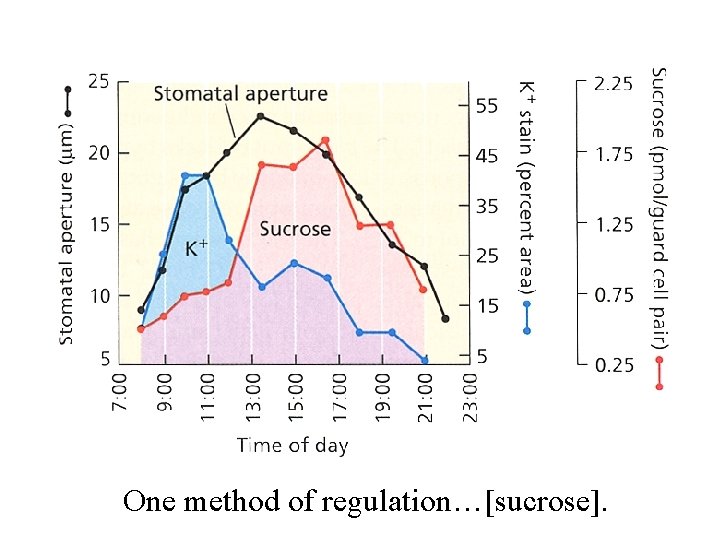
One method of regulation…[sucrose].
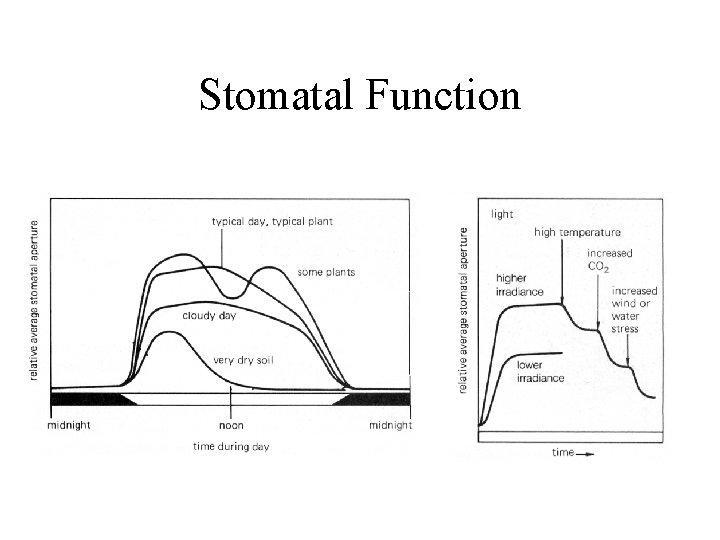
Stomatal Function
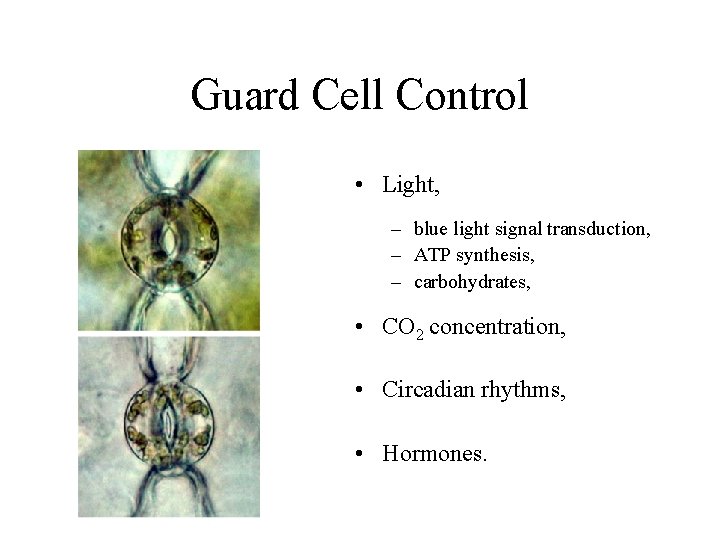
Guard Cell Control • Light, – blue light signal transduction, – ATP synthesis, – carbohydrates, • CO 2 concentration, • Circadian rhythms, • Hormones.

Big Picture
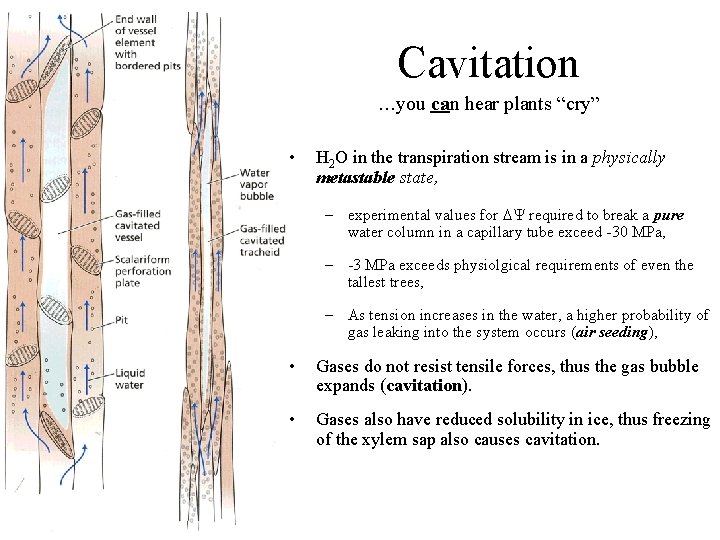
Cavitation. . . you can hear plants “cry” • H 2 O in the transpiration stream is in a physically metastable state, – experimental values for DY required to break a pure water column in a capillary tube exceed -30 MPa, – -3 MPa exceeds physiolgical requirements of even the tallest trees, – As tension increases in the water, a higher probability of gas leaking into the system occurs (air seeding), • Gases do not resist tensile forces, thus the gas bubble expands (cavitation). • Gases also have reduced solubility in ice, thus freezing of the xylem sap also causes cavitation.
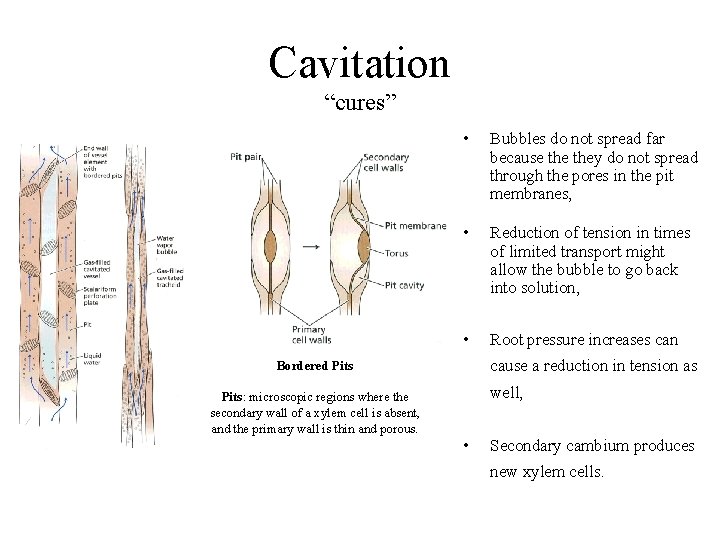
Cavitation “cures” • Bubbles do not spread far because they do not spread through the pores in the pit membranes, • Reduction of tension in times of limited transport might allow the bubble to go back into solution, • Root pressure increases can cause a reduction in tension as Bordered Pits: microscopic regions where the secondary wall of a xylem cell is absent, and the primary wall is thin and porous. well, • Secondary cambium produces new xylem cells.
Transport in Plants IV Phloem There is no sugar cane that is sweet at both ends. …Chinese proverb
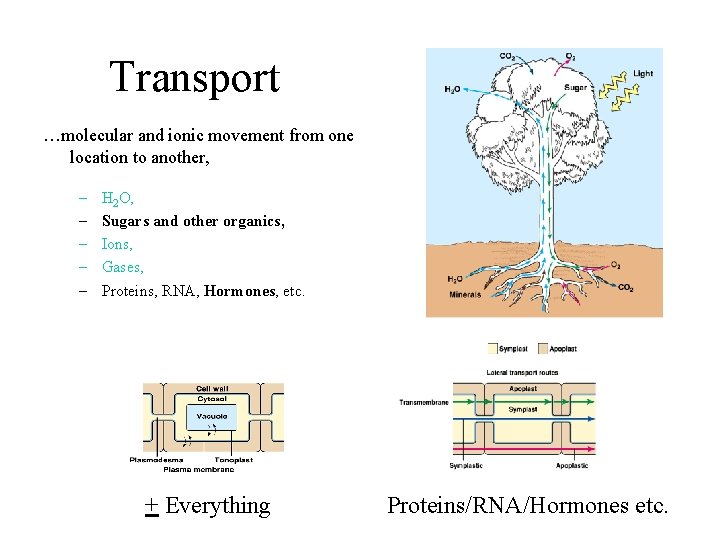
Transport …molecular and ionic movement from one location to another, – – – H 2 O, Sugars and other organics, Ions, Gases, Proteins, RNA, Hormones, etc. + Everything Proteins/RNA/Hormones etc.

Phloem Transport overview • Long distance, bi-directional flow of sugars, – – Sugar alcohols, Organic acids, Amino acids, Hormones, • Source (phloem loading), • Sink (phloem unloading), • Pressure is manipulated at source and sink in order to create bulk flow in phloem conducting cells.
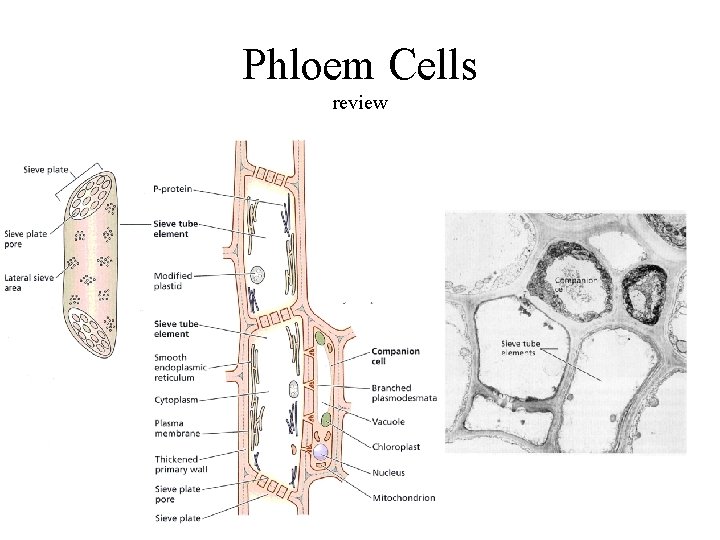
Phloem Cells review
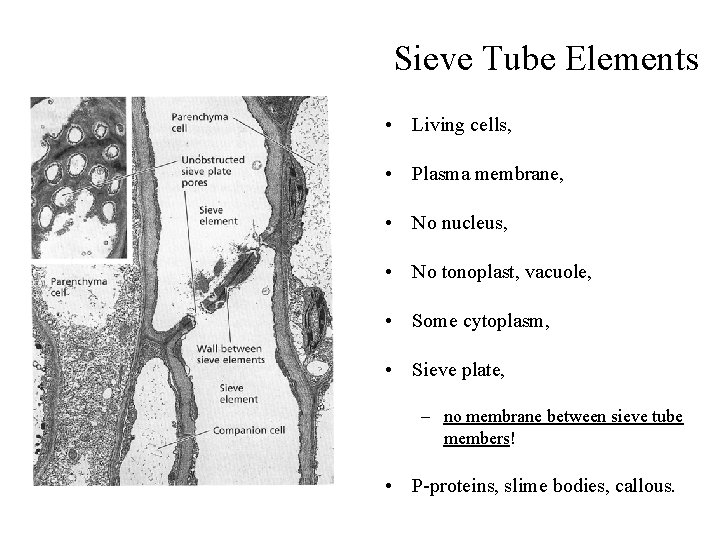
Sieve Tube Elements • Living cells, • Plasma membrane, • No nucleus, • No tonoplast, vacuole, • Some cytoplasm, • Sieve plate, – no membrane between sieve tube members! • P-proteins, slime bodies, callous.
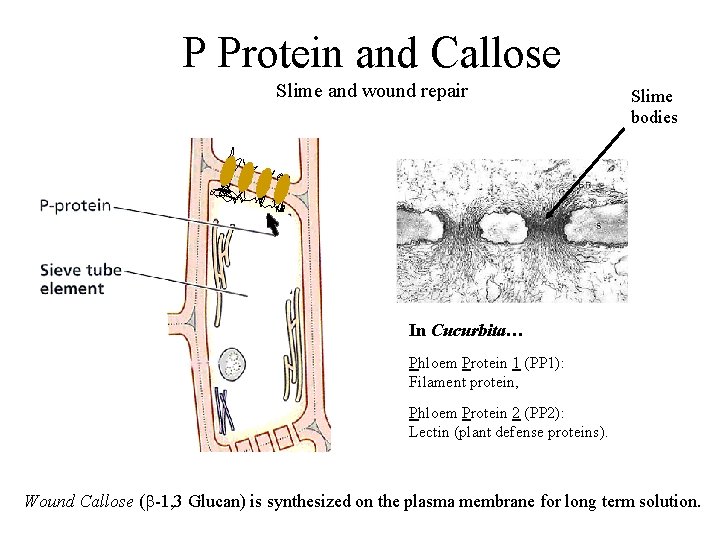
P Protein and Callose Slime and wound repair Slime bodies In Cucurbita… Phloem Protein 1 (PP 1): Filament protein, Phloem Protein 2 (PP 2): Lectin (plant defense proteins). Wound Callose (b-1, 3 Glucan) is synthesized on the plasma membrane for long term solution.
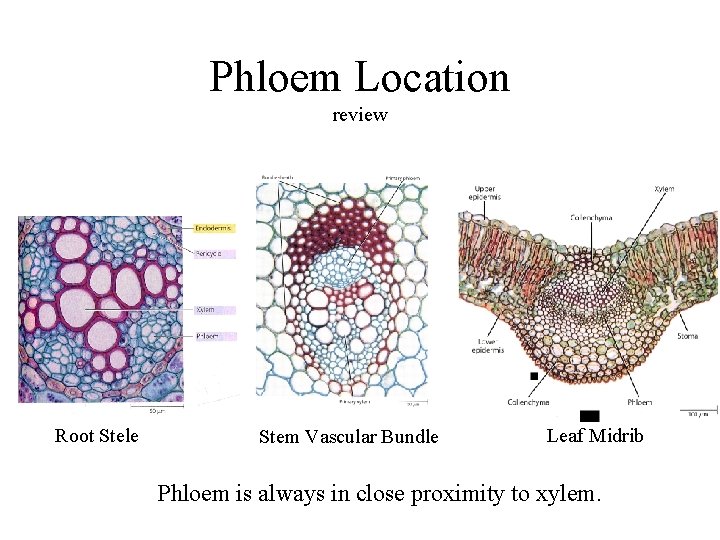
Phloem Location review Root Stele Stem Vascular Bundle Leaf Midrib Phloem is always in close proximity to xylem.
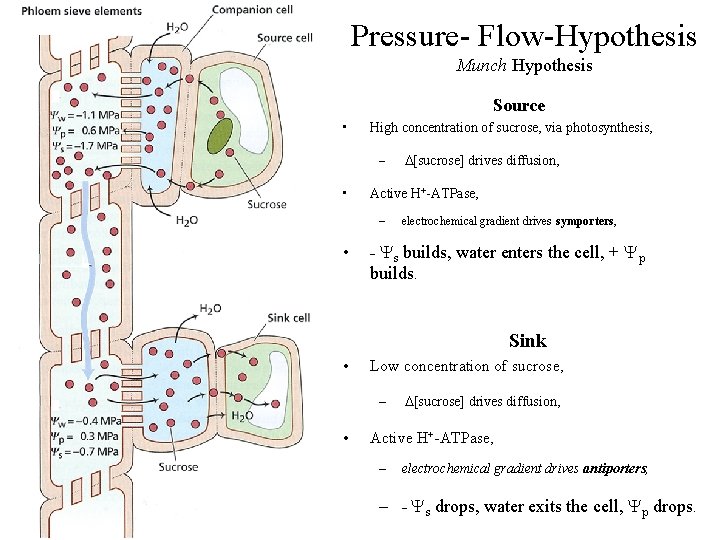
Pressure- Flow-Hypothesis Munch Hypothesis Source • High concentration of sucrose, via photosynthesis, – • Active H+-ATPase, – • D[sucrose] drives diffusion, electrochemical gradient drives symporters, - Ys builds, water enters the cell, + Yp builds. Sink • Low concentration of sucrose, – • D[sucrose] drives diffusion, Active H+-ATPase, – electrochemical gradient drives antiporters, – - Ys drops, water exits the cell, Yp drops.
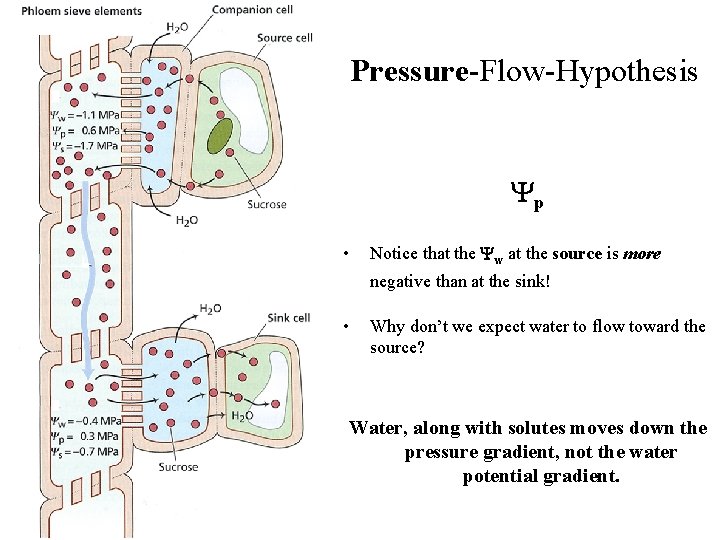
Pressure-Flow-Hypothesis Yp • Notice that the Yw at the source is more negative than at the sink! • Why don’t we expect water to flow toward the source? Water, along with solutes moves down the pressure gradient, not the water potential gradient.
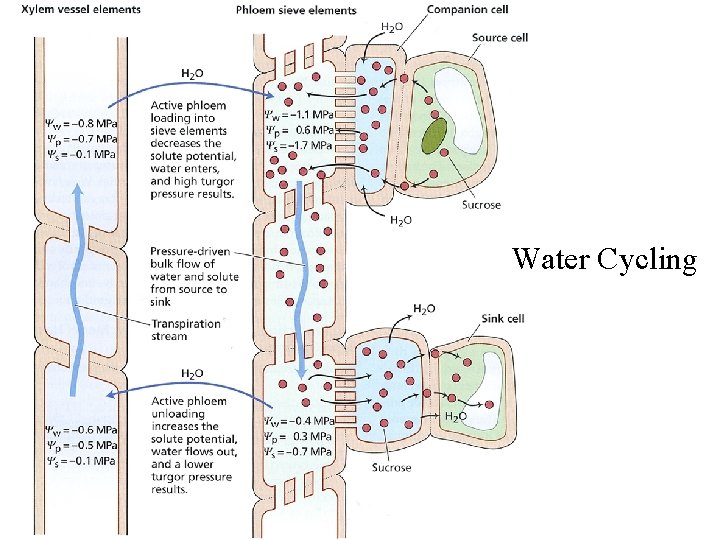
Water Cycling
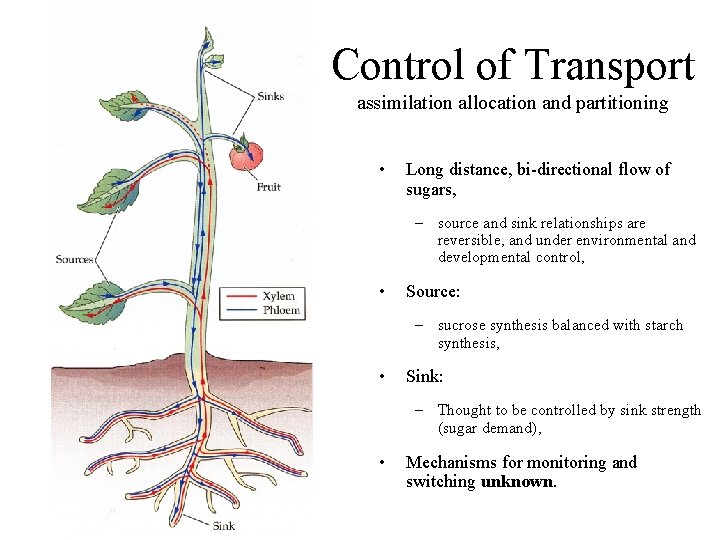
Control of Transport assimilation allocation and partitioning • Long distance, bi-directional flow of sugars, – source and sink relationships are reversible, and under environmental and developmental control, • Source: – sucrose synthesis balanced with starch synthesis, • Sink: – Thought to be controlled by sink strength (sugar demand), • Mechanisms for monitoring and switching unknown.
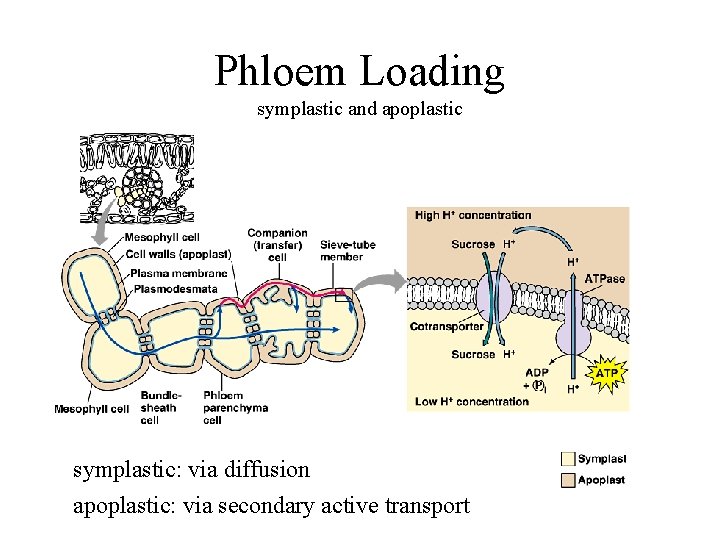
Phloem Loading symplastic and apoplastic symplastic: via diffusion apoplastic: via secondary active transport
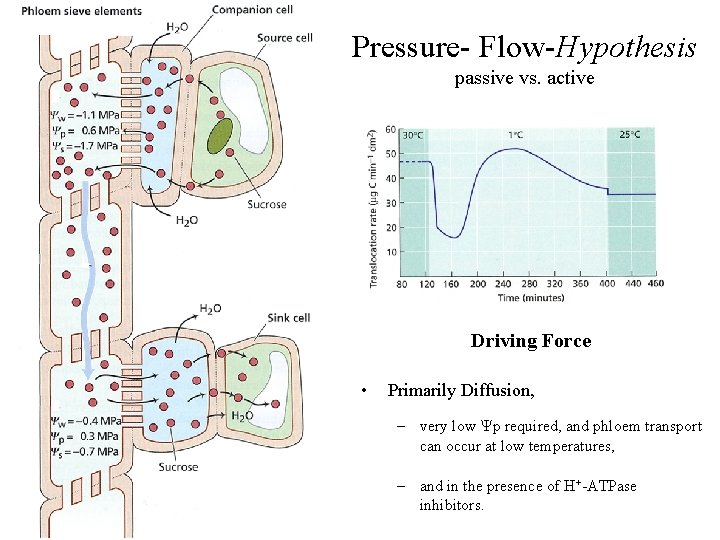
Pressure- Flow-Hypothesis passive vs. active Driving Force • Primarily Diffusion, – very low Yp required, and phloem transport can occur at low temperatures, – and in the presence of H+-ATPase inhibitors.

Long Distance Transport Sugars, Amino Acids Organics, Hormones, etc. Concept Map Function Phloem Transport Requires Special Anatomy Pressure-Flow-Hypothesis Companion Cells Sugar Loading Source creates High P Sugar Unloading Sink DP drives bulk flow creates Low P Metabolic and genetic drivers of sieve tubes. Sieve Tubes Membrane lined pipes Sieve Plates Pores, P protein, Callose

Exam I Friday • All class time allowed. • 80 pts Mult/Mult Choice (~18 questions). • 20 pts Essay Question, • 16 pts content, 4 pts essay quality, figures welcome.
- Slides: 31