
Transport description of viscous effects CheMing Ko Texas

- Slides: 17
Transport description of viscous effects Che-Ming Ko Texas A&M University § Introduction § A multi-phase transport (AMPT) model § Anisotropic flow - Elliptic flow - Higher-order anisotropic flow - Rapidity dependence - System size dependence - Flavor dependence § Summary Collaborators: Lie-wen Chen (SJTU), Zie-wei Lin (Univ. Alabama), Bin Zhang (Arkansas State Univ. ) 1
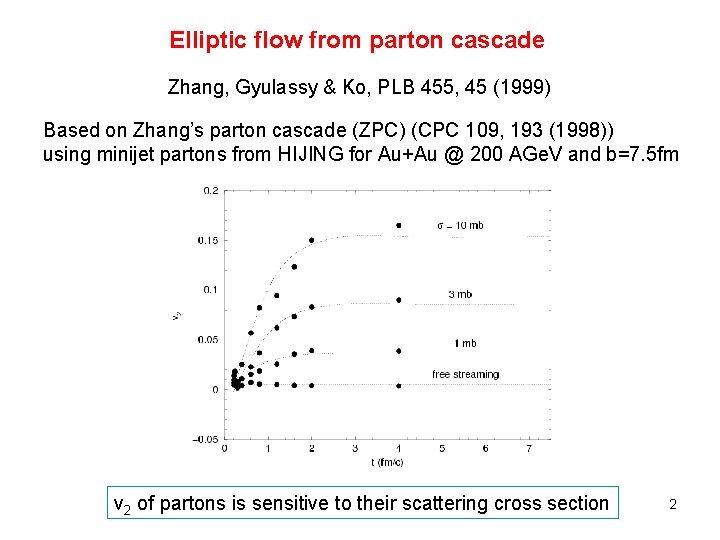
Elliptic flow from parton cascade Zhang, Gyulassy & Ko, PLB 455, 45 (1999) Based on Zhang’s parton cascade (ZPC) (CPC 109, 193 (1998)) using minijet partons from HIJING for Au+Au @ 200 AGe. V and b=7. 5 fm v 2 of partons is sensitive to their scattering cross section 2
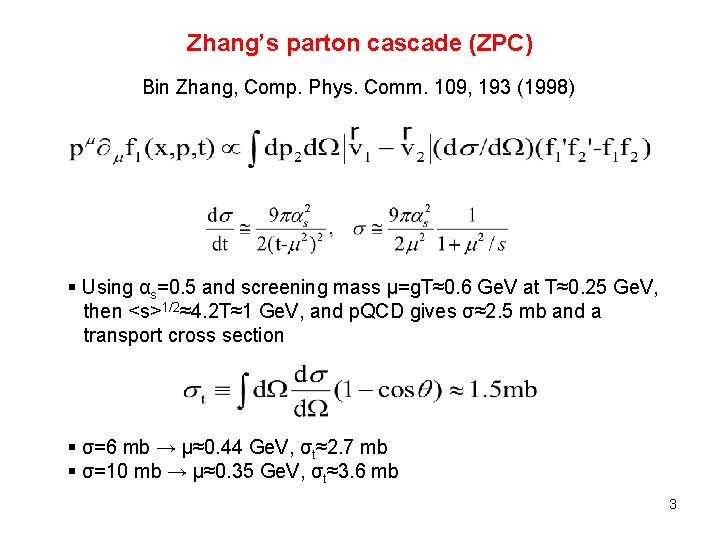
Zhang’s parton cascade (ZPC) Bin Zhang, Comp. Phys. Comm. 109, 193 (1998) § Using αs=0. 5 and screening mass μ=g. T≈0. 6 Ge. V at T≈0. 25 Ge. V, then <s>1/2≈4. 2 T≈1 Ge. V, and p. QCD gives σ≈2. 5 mb and a transport cross section § σ=6 mb → μ≈0. 44 Ge. V, σt≈2. 7 mb § σ=10 mb → μ≈0. 35 Ge. V, σt≈3. 6 mb 3
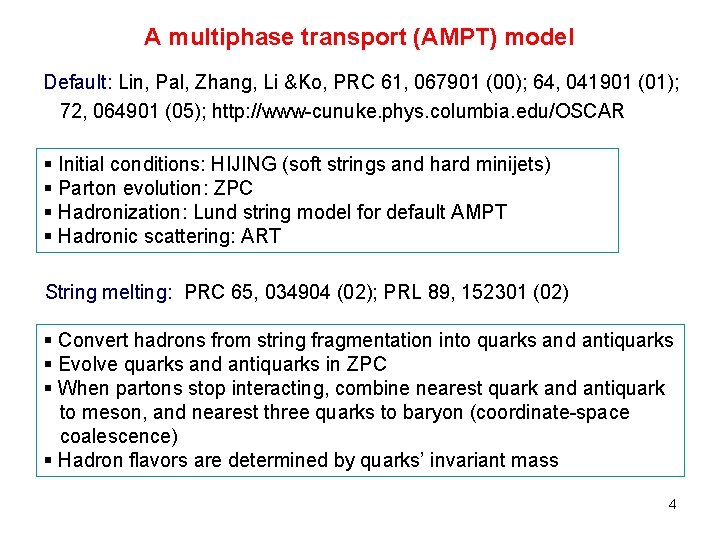
A multiphase transport (AMPT) model Default: Lin, Pal, Zhang, Li &Ko, PRC 61, 067901 (00); 64, 041901 (01); 72, 064901 (05); http: //www-cunuke. phys. columbia. edu/OSCAR § Initial conditions: HIJING (soft strings and hard minijets) § Parton evolution: ZPC § Hadronization: Lund string model for default AMPT § Hadronic scattering: ART String melting: PRC 65, 034904 (02); PRL 89, 152301 (02) § Convert hadrons from string fragmentation into quarks and antiquarks § Evolve quarks and antiquarks in ZPC § When partons stop interacting, combine nearest quark and antiquark to meson, and nearest three quarks to baryon (coordinate-space coalescence) § Hadron flavors are determined by quarks’ invariant mass 4
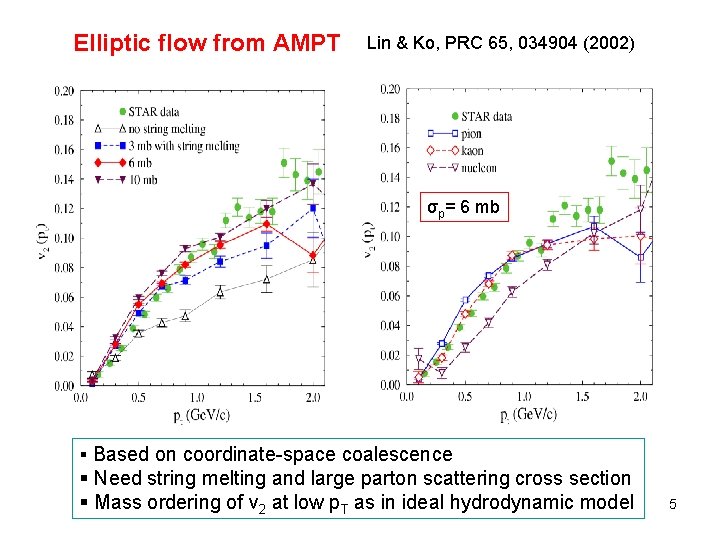
Elliptic flow from AMPT Lin & Ko, PRC 65, 034904 (2002) σp= 6 mb § Based on coordinate-space coalescence § Need string melting and large parton scattering cross section § Mass ordering of v 2 at low p. T as in ideal hydrodynamic model 5
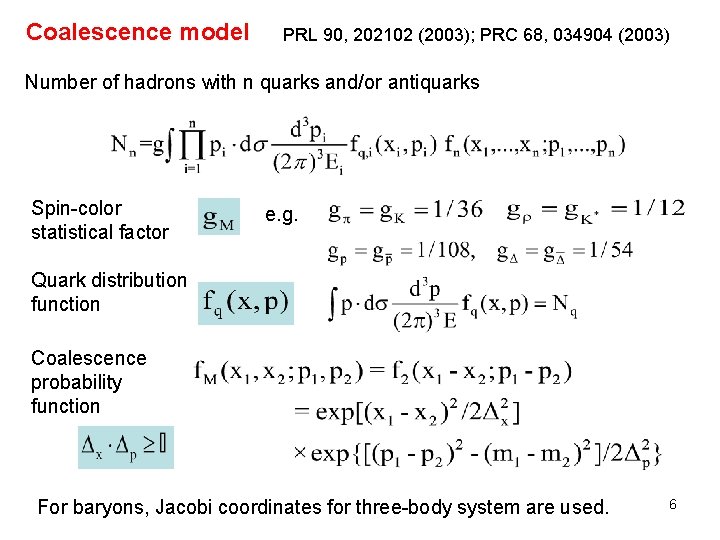
Coalescence model PRL 90, 202102 (2003); PRC 68, 034904 (2003) Number of hadrons with n quarks and/or antiquarks Spin-color statistical factor e. g. Quark distribution function Coalescence probability function For baryons, Jacobi coordinates for three-body system are used. 6
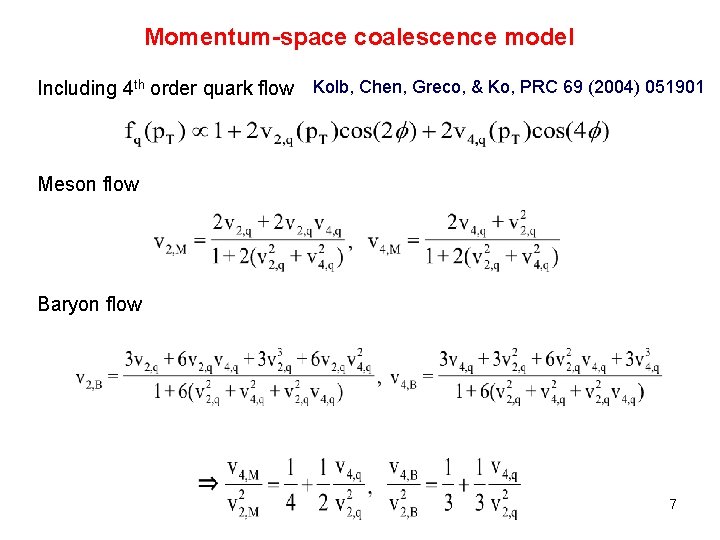
Momentum-space coalescence model Including 4 th order quark flow Kolb, Chen, Greco, & Ko, PRC 69 (2004) 051901 Meson flow Baryon flow 7
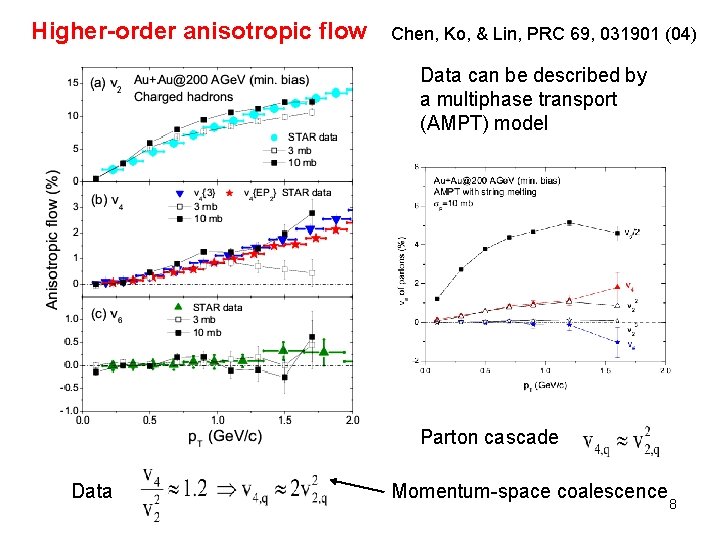
Higher-order anisotropic flow Chen, Ko, & Lin, PRC 69, 031901 (04) Data can be described by a multiphase transport (AMPT) model Parton cascade Data Momentum-space coalescence 8
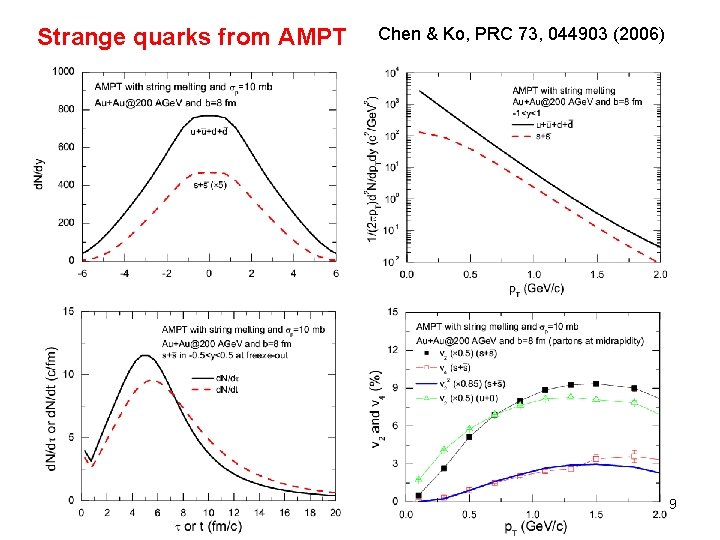
Strange quarks from AMPT Chen & Ko, PRC 73, 044903 (2006) 9
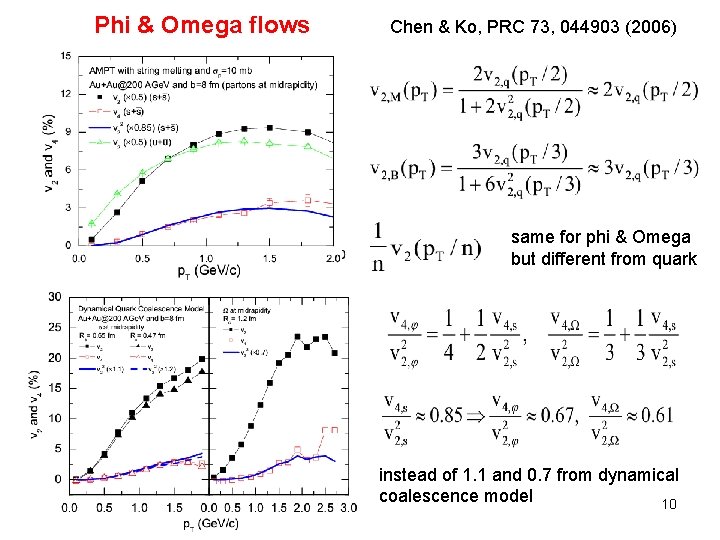
Phi & Omega flows Chen & Ko, PRC 73, 044903 (2006) same for phi & Omega but different from quark instead of 1. 1 and 0. 7 from dynamical coalescence model 10
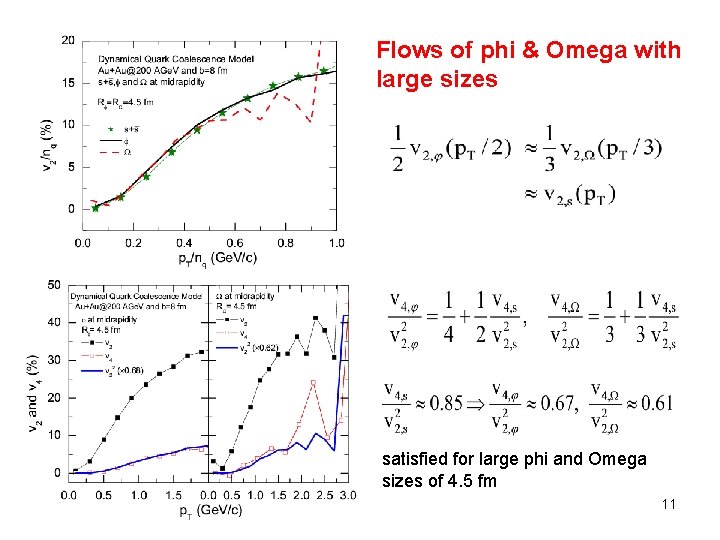
Flows of phi & Omega with large sizes satisfied for large phi and Omega sizes of 4. 5 fm 11
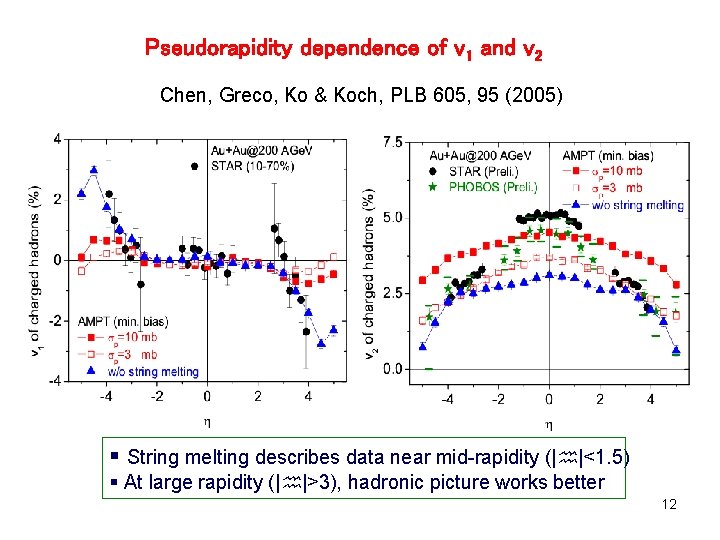
Pseudorapidity dependence of v 1 and v 2 Chen, Greco, Ko & Koch, PLB 605, 95 (2005) § String melting describes data near mid-rapidity (| |<1. 5) § At large rapidity (| |>3), hadronic picture works better 12
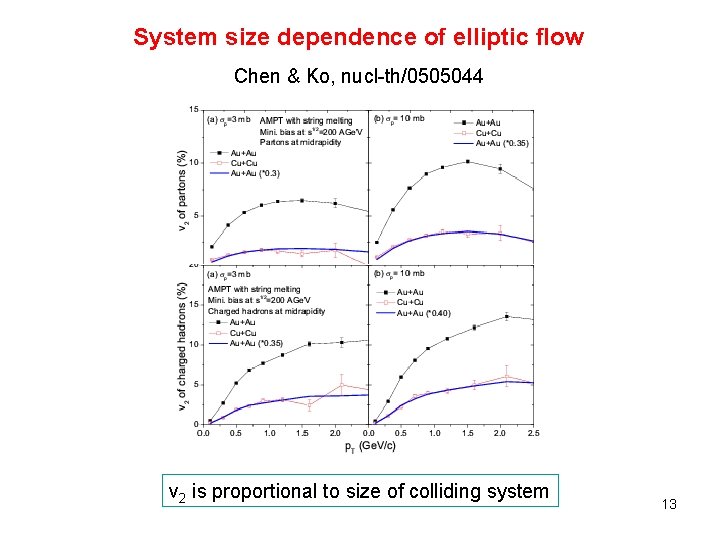
System size dependence of elliptic flow Chen & Ko, nucl-th/0505044 v 2 is proportional to size of colliding system 13
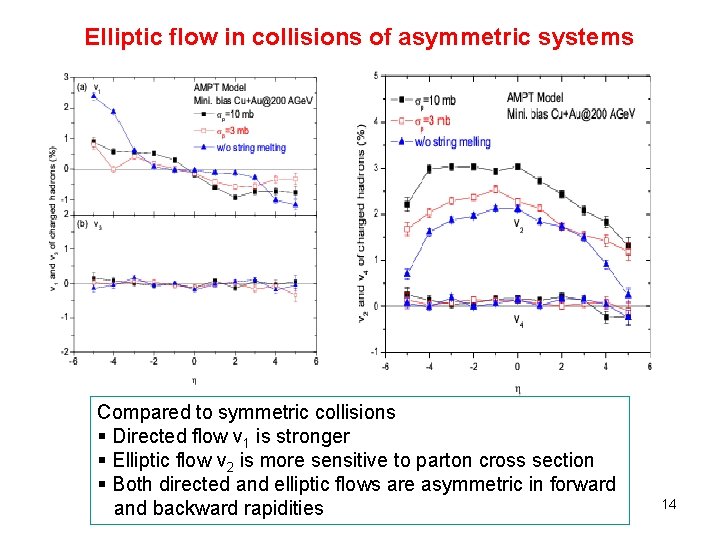
Elliptic flow in collisions of asymmetric systems Compared to symmetric collisions § Directed flow v 1 is stronger § Elliptic flow v 2 is more sensitive to parton cross section § Both directed and elliptic flows are asymmetric in forward and backward rapidities 14
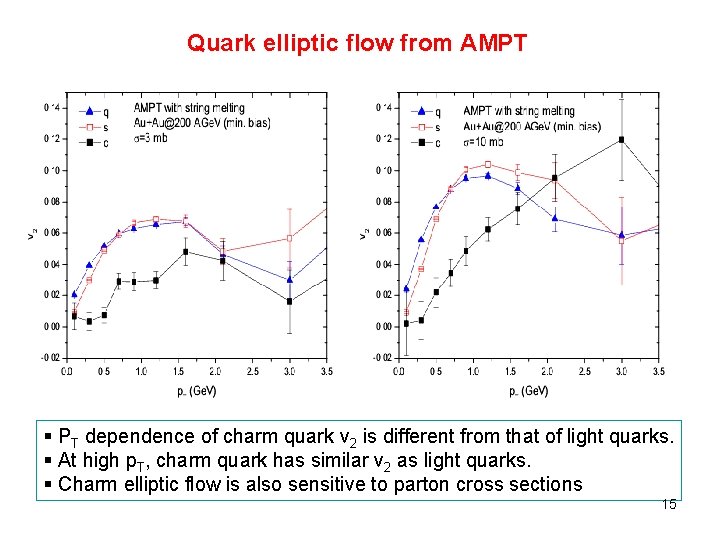
Quark elliptic flow from AMPT § PT dependence of charm quark v 2 is different from that of light quarks. § At high p. T, charm quark has similar v 2 as light quarks. § Charm elliptic flow is also sensitive to parton cross sections 15
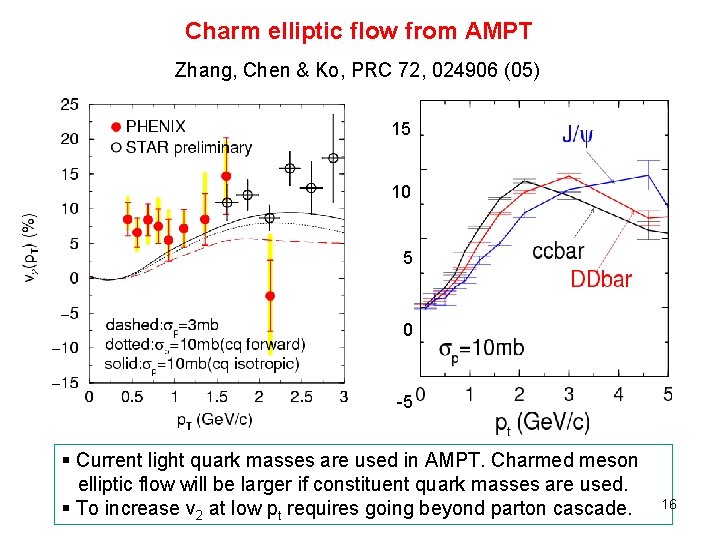
Charm elliptic flow from AMPT Zhang, Chen & Ko, PRC 72, 024906 (05) 15 10 5 0 -5 § Current light quark masses are used in AMPT. Charmed meson elliptic flow will be larger if constituent quark masses are used. § To increase v 2 at low pt requires going beyond parton cascade. 16
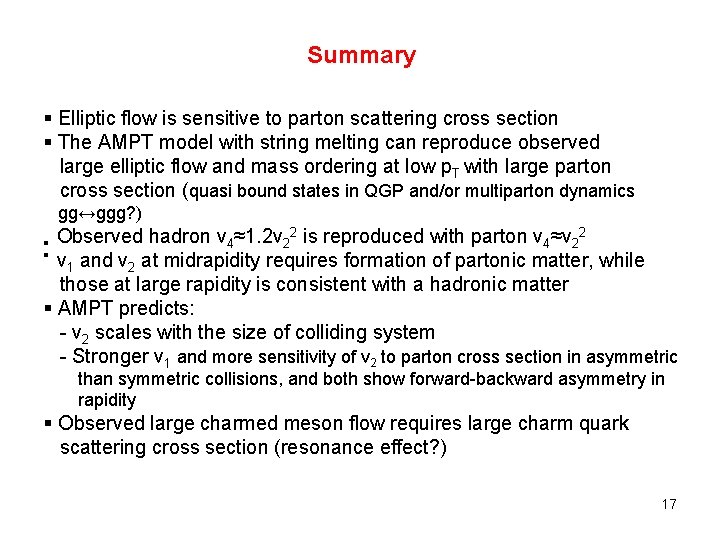
Summary § Elliptic flow is sensitive to parton scattering cross section § The AMPT model with string melting can reproduce observed large elliptic flow and mass ordering at low p. T with large parton cross section (quasi bound states in QGP and/or multiparton dynamics gg↔ggg? ) Observed hadron v 4≈1. 2 v 22 is reproduced with parton v 4≈v 22 v 1 and v 2 at midrapidity requires formation of partonic matter, while those at large rapidity is consistent with a hadronic matter § AMPT predicts: - v 2 scales with the size of colliding system - Stronger v 1 and more sensitivity of v 2 to parton cross section in asymmetric § § than symmetric collisions, and both show forward-backward asymmetry in rapidity § Observed large charmed meson flow requires large charm quark scattering cross section (resonance effect? ) 17