
Transport across the cell membrane Active Transport requires
Transport across the cell membrane Active Transport – requires energy in the form of ATP (Na+K+ pump, endocytosis & exocytosis) Passive Transport – no energy required (diffusion, osmosis, facilitated diffusion)
l Active transport is responsible for cells containing relatively high concentrations of potassium ions but low concentrations of sodium ions. l The mechanism responsible for this is the sodium-potassium pump which moves these two ions in opposite directions across the plasma membrane.
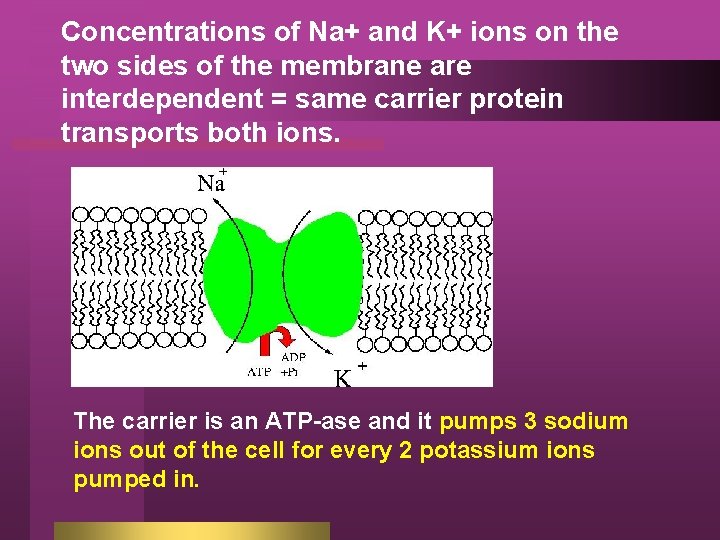
Concentrations of Na+ and K+ ions on the two sides of the membrane are interdependent = same carrier protein transports both ions. The carrier is an ATP-ase and it pumps 3 sodium ions out of the cell for every 2 potassium ions pumped in.
Function of the pump l The Na+/K+-pump helps maintain resting potential that assist s transport & regulates cell volume l low concentration of sodium ions within cell l high levels of potassium ions within the cell

Facilitated Diffusion l Cells need to bring in substances (glucose, amino acids) by facilitated diffusion l Carrier proteins combine with and transport substances across the cell membrane l Possible because active transport maintains a concentration gradient

Osmosis l Movement of sodium from one side of a cell membrane to the other side creates an osmotic gradient that drives the absorption of water. l Water diffuses back into the cell carrying needed substances
Endocytosis & Exocytosis l Larger substances are moved into & out of the cell by vesicle formation l Requires ATP
- Slides: 7