
Transport across Cell Membranes Exchange of many substance

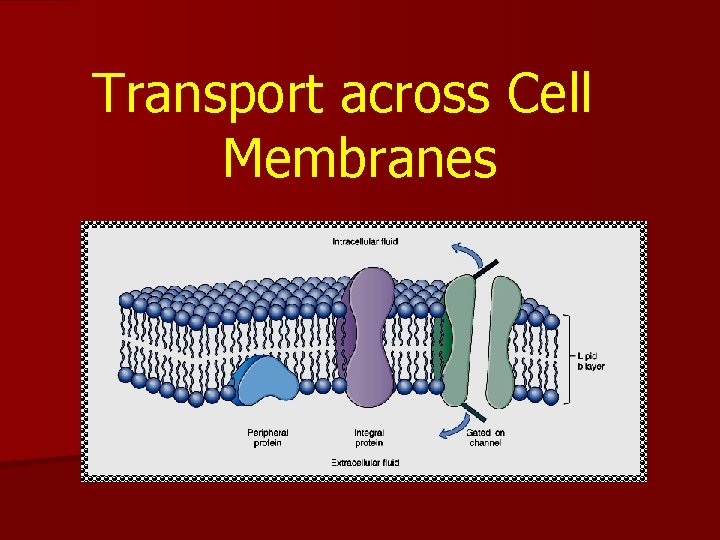
Transport across Cell Membranes
– Exchange of many substance occur between – cells and interstisium through cell membrane – Transport occur passively and actively
Transport across Cell Membranes Several types of mechanisms are responsible for transport of substances across cell membranes 1 -Diffusion 2 -Osmosis 3 -Active transport 4 -Vesicular transport system
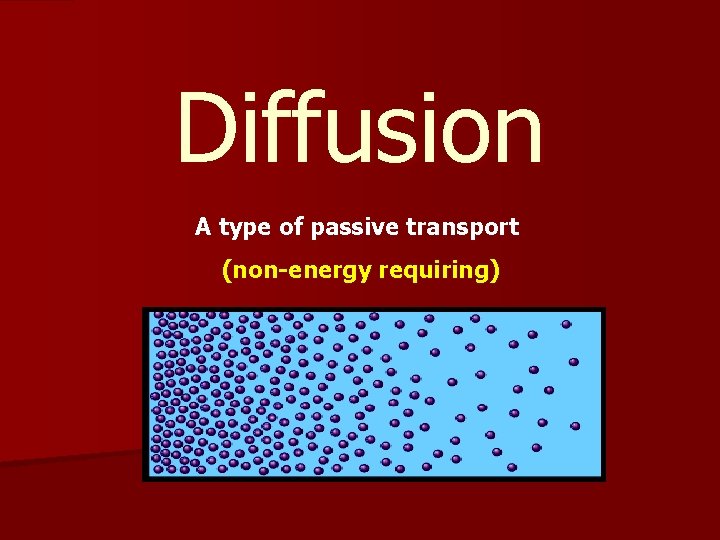
Diffusion A type of passive transport (non-energy requiring)
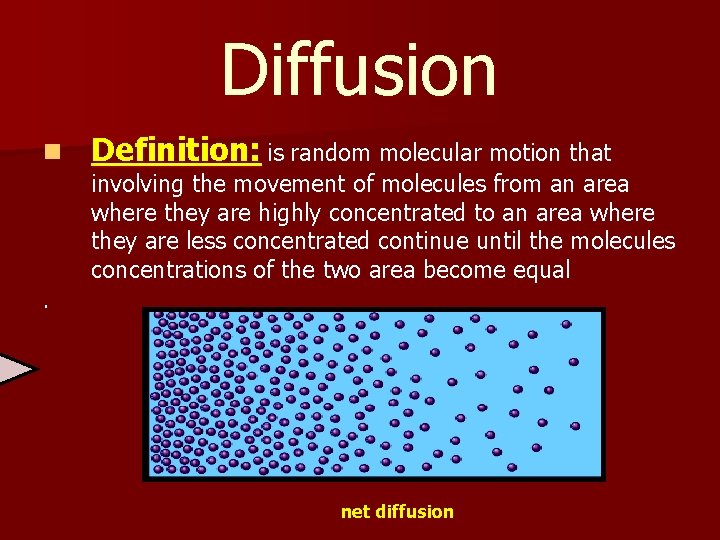
Diffusion n Definition: is random molecular motion that involving the movement of molecules from an area where they are highly concentrated to an area where they are less concentrated continue until the molecules concentrations of the two area become equal . net diffusion
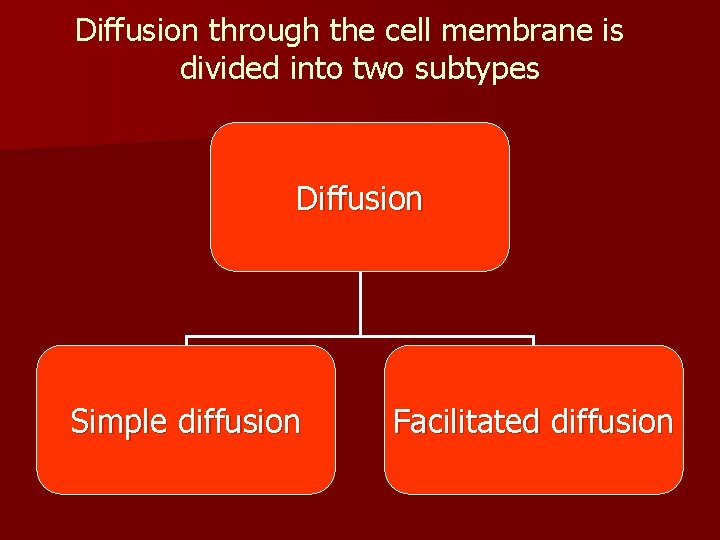
Diffusion through the cell membrane is divided into two subtypes Diffusion Simple diffusion Facilitated diffusion
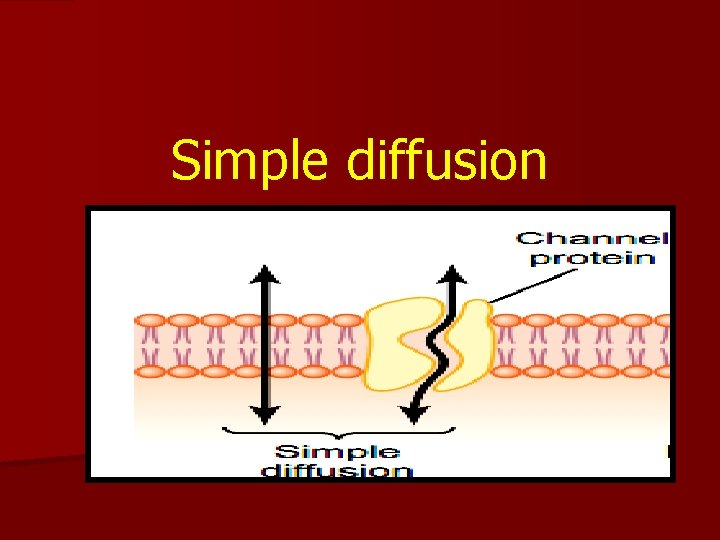
Simple diffusion
Simple diffusion n 1. 2. Substances may be transported down an electrochemical gradient (downhill) Simple diffusion is not mediated by carrier proteins Simple diffusion can occur through the cell membrane by two pathways: Through the interstices of the lipid bilayer if the diffusing substance is lipid soluble Through protein channels that penetrate lipid bilayer (transmembrane protein)
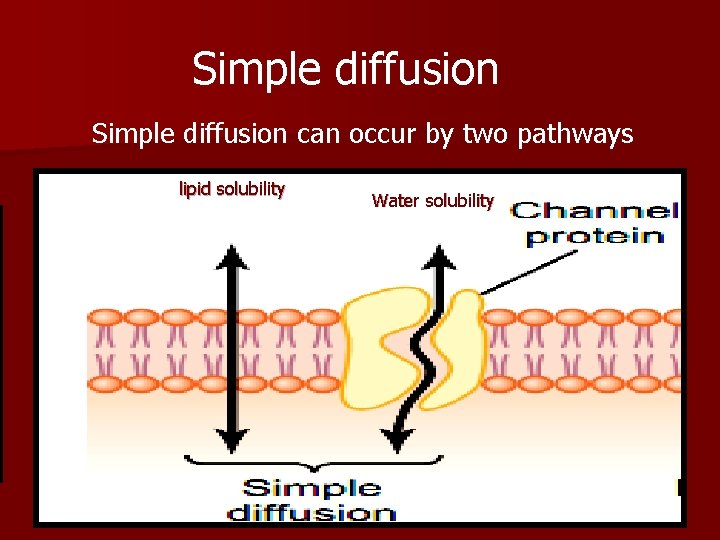
Simple diffusion can occur by two pathways lipid solubility Water solubility
Simple diffusion Diffusion of Lipid-Soluble Substances Through the Lipid Bilayer. n One of the most important factors that determines how rapidly a substance diffuses through the lipid bilayer is the lipid solubility of the substance n For instance, the lipid solubilities of oxygen, nitrogen, carbon dioxide, and alcohols are high n The rate of diffusion of each of these substances through the membrane is directly proportional to its lipid solubility.
Simple diffusion Diffusion of Water-Soluble Substances Through the Lipid Bilayer. 2. Diffusion of Water-Soluble Substances mediated by protein channels whether ion or water Diffusion of ion occur through the two type of channels: Voltage gated channel Ligand gated channel n Diffusion of water occur through channels called n n 1. aquaporins
Simple diffusion of Electrolytes If the diffusing solute is an ion or an electrolyte , there are two additional consequences of the presence of charge on the solute. First, if there is a potential difference across the membrane, that potential difference will alter the net rate of diffusion of a charged solute. For example, the diffusion of K+ ions will be slowed if K+ is diffusing into an area of positive charge, and it will be accelerated if K+ is diffusing into an area of negative charge. This effect of potential difference can either add to or negate the effects of differences in concentrations, depending on the orientation of the potential difference and the charge on the diffusing ion. n n Second, when a charged solute diffuses down a concentration gradient, that diffusion can itself generate a potential difference across a membrane called a diffusion potential
Diffusion Through Protein Channels, and “Gating” of These Channels Substances can move by simple diffusion directly along these channels from one side of the membrane to the other. n The protein channels are distinguished by two important characteristics: 1. They are often selectively permeable to certain substances 2. Many of the channels can be opened or closed by gates n
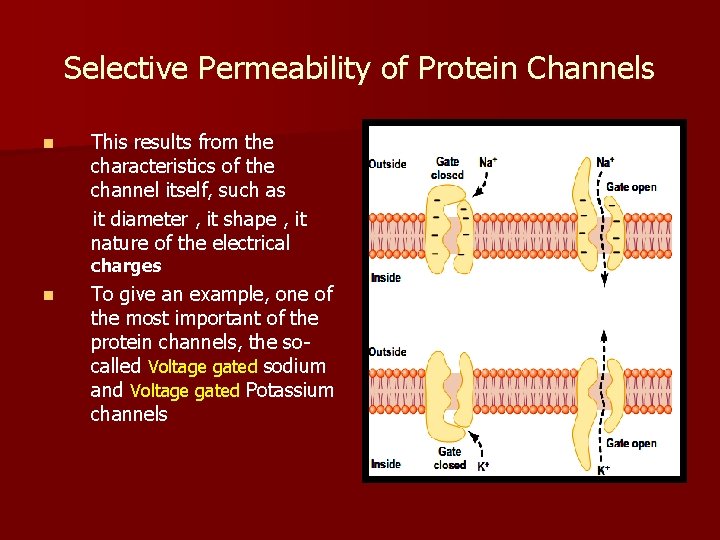
Selective Permeability of Protein Channels n This results from the characteristics of the channel itself, such as it diameter , it shape , it nature of the electrical charges n To give an example, one of the most important of the protein channels, the socalled Voltage gated sodium and Voltage gated Potassium channels
Gating of Protein Channels. n n n 1. 2. 3. 4. Gating of protein channels provides a means of controlling ion permeability of the channels. Gating of protein channels which can close the opening of the channel or can be lifted away from the opening by a conformational change in the shape of the protein molecule itself The opening and closing of gates are controlled in several ways: Voltage gating: - In this instance, the molecular conformation of the gate responds to the electrical potential across the cell membrane e. g. Voltage gated Na+ channels {-55 m. V (open) and +35 m. V (close) } Chemical (ligand) gating are opened or closed in response to a ligand (ligand-gated). The ligand is often external (eg, a neurotransmitter or a hormone). However, it can also be internal; intracellular Ca 2+, c. AMP, …) Pressure gating: - are also opened by mechanical stretch. phosphorylation gating Protein phosphorylation or dephosphorylation regulate opening and closing of some ion channels
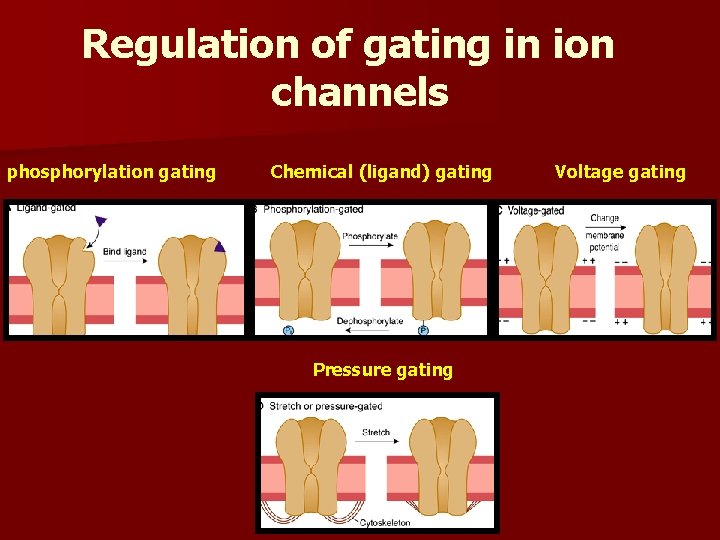
Regulation of gating in ion channels phosphorylation gating Chemical (ligand) gating Pressure gating Voltage gating
Facilitated Diffusion
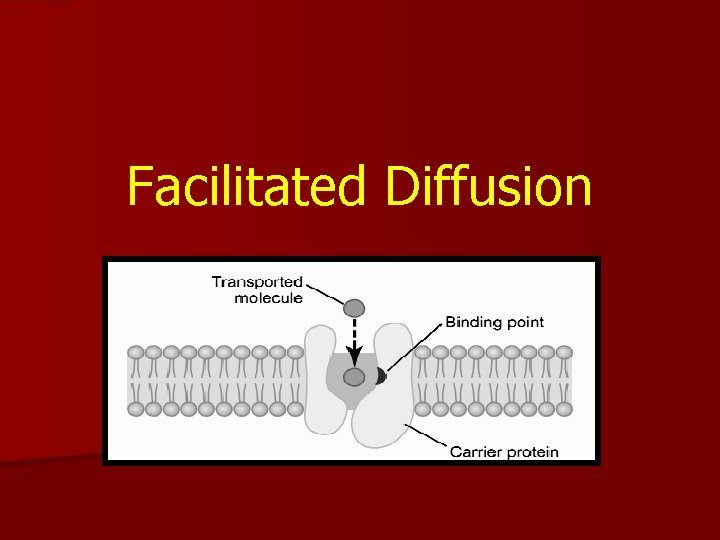
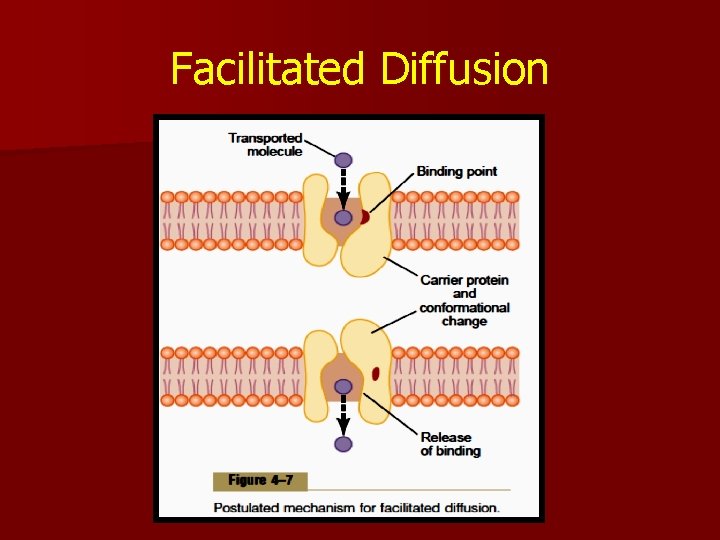
Facilitated Diffusion n n Facilitated diffusion is also called carrier-mediated diffusion because a substance transported in this manner diffuses through the membrane using a specific carrier protein to help. Facilitated diffusion differs from simple diffusion in the following important way: Rate : Unlike simple diffusion , the rate of facilitated diffusion n increases as concentration gradient increases until all of binding sites are fill (saturation). At this point , the rate diffusion of can no longer increase with increasing particle concentration. This maximum rate called the Vmax. Substances that cross cell membranes by facilitated diffusion are glucose and most of the amino acids.
Facilitated Diffusion
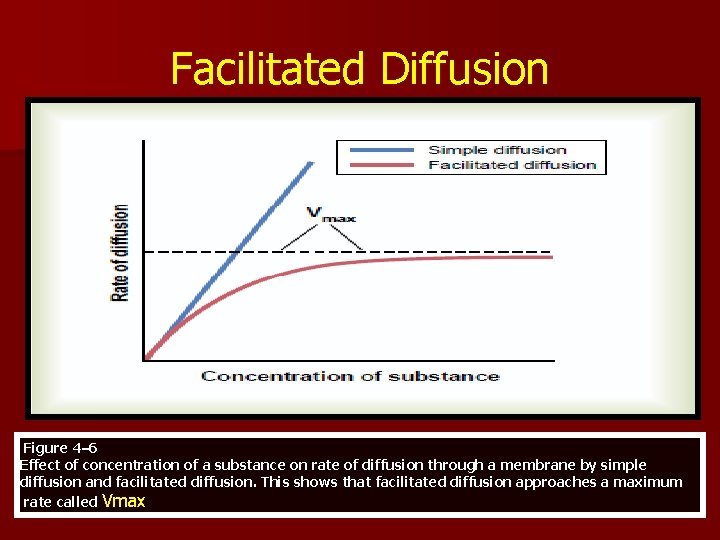
Facilitated Diffusion Figure 4– 6 Effect of concentration of a substance on rate of diffusion through a membrane by simple diffusion and facilitated diffusion. This shows that facilitated diffusion approaches a maximum rate called Vmax
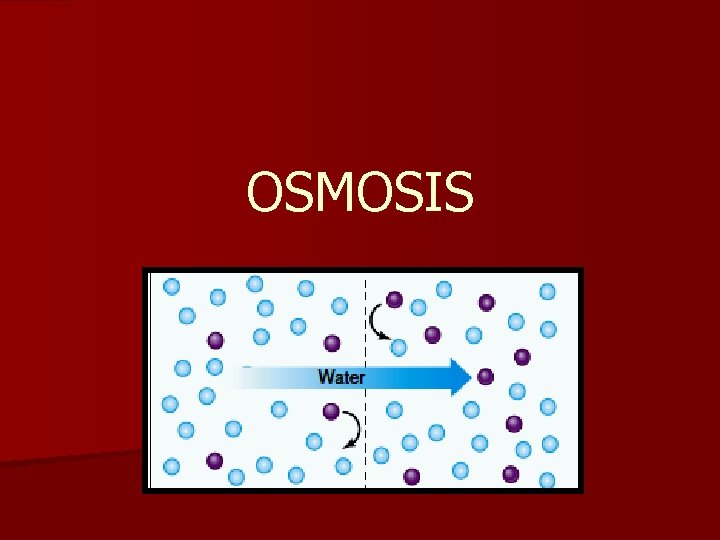
OSMOSIS
OSMOSIS is define as the flow of water across a semipermeable membrane from a compartment in which the solute concentration is lower to one in which the solute concentration is greater. n A semipermeable membrane is define as a membrane permeable to water but impermeable to solute. n Osmosis takes place because the presence of solute decreases concentration of water n Water tends to flow from where its concentration is higher to where its concentration is lower n
Osmotic pressure n n n Osmotic pressure define as pressure necessary to prevent solvent migration Concentration differences of impermeable solutes establish osmotic pressure differences Osmotic pressure difference causes water to flow by osmosis The concentration of osmotically active particles is usually expressed in osmoles i. e. solute depends upon the number of particles (molecules or ions) of solute in solution and not upon the chemical nature of the solute. The osmotic pressure exerted by osmoles in a solution. The osmolarity is number of osmoles per liter of solution
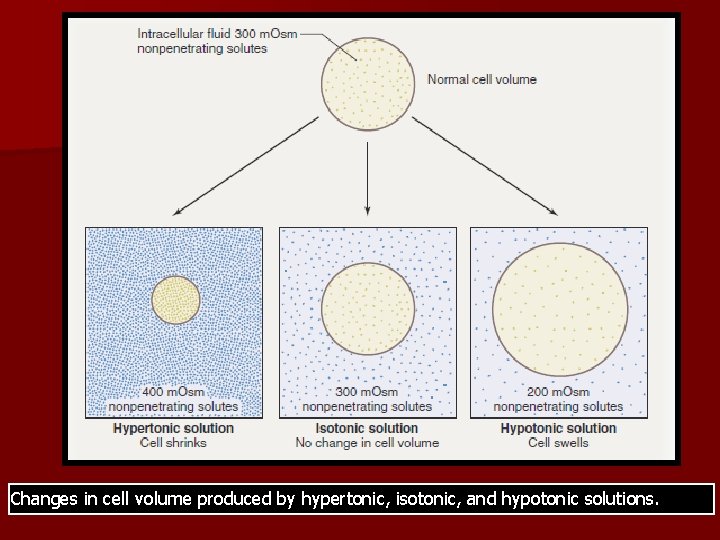
Changes in cell volume produced by hypertonic, isotonic, and hypotonic solutions.
Active Transport
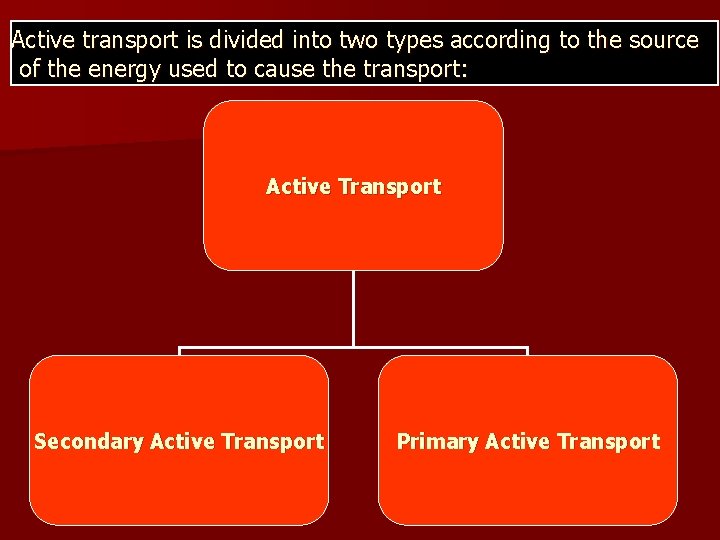
Active transport is divided into two types according to the source of the energy used to cause the transport: Active Transport Secondary Active Transport Primary Active Transport
Active Transport Important note n In both instances, transport depends on carrier proteins that penetrate through the cell membrane, as is true for facilitated diffusion. However, in active transport, the carrier protein functions differently from the carrier in facilitated diffusion because it is capable of imparting energy to the transported substance to move it against the electrochemical gradient. n The major primary active-transport proteins found in most cells are (1) Na, K-ATPase; (2) Ca-ATPase; (3) H-ATPase; and (4) H, K-ATPase. n
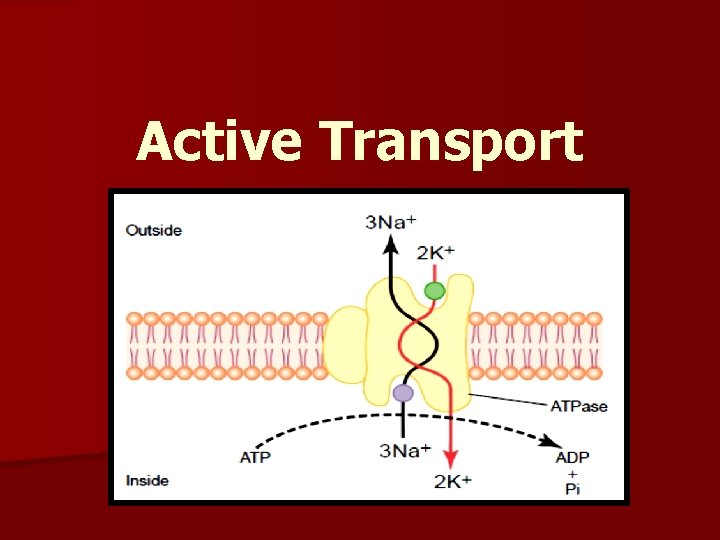
Primary Active Transport • n (1) • 1. n n n Primary Active Transport processes directly use the energy obtained from hydrolysis of ATP to transport material against electrochemical gradient The major primary active-transport proteins found in most cells are Na, K-ATPase; (2) Ca-ATPase; (3) H-ATPase; and (4) H, KATPase. The most common of these active transport system is Sodium. Potassium Pump Function. Sodium-Potassium Pump maintaining the sodium and potassium concentration differences across the cell membrane, as well as for establishing a negative electrical voltage inside the cells. Returning to the cell into the resting state (RMP) after action potential is over Regulation of the cell volume
Primary Active Transport Composition. Sodium-Potassium Pump The Sodium-Potassium Pump is a complex of two separate globular proteins: a larger one called the α subunit, with a molecular weight of about 100, 000, and a smaller one called the β subunit, with a molecular weight of about 55, 000. Although the function of the smaller protein is not known , the larger protein has three specific features that are important for the functioning of the pump: 1. It has three receptor sites for binding sodium ions on the portion of the protein that protrudes to the inside of the cell. 2. It has two receptor sites for potassium ions on the outside. 3. The inside portion of this protein near the sodium binding sites has ATPase activity.
Primary Active Transport Process. Sodium-Potassium Pump When two potassium ions bind on the outside of the carrier protein and three sodium ions bind on the inside, the ATPase function of the protein becomes activated. This then cleaves one molecule of ATP, splitting it to denosine diphosphate (ADP) and liberating a high-energy phosphate bond of energy. This liberated energy is then believed to cause a chemical and conformational change in the protein carrier molecule, extruding the three sodium ions to the outside and the two potassium ions to the inside.
Primary Active Transport Regulation of Na, K ATPase Activity n n n Pump activity is affected by second messenger molecules (eg, c. AMP and diacylglycerol [DAG]). Thyroid hormones increase pump activity by a genomic action to increase the formation of Na, K ATPase molecules Aldosterone also increases the number of pumps, Dopamine in the kidney inhibits the pump by phosphorylating it Insulin increases pump activity
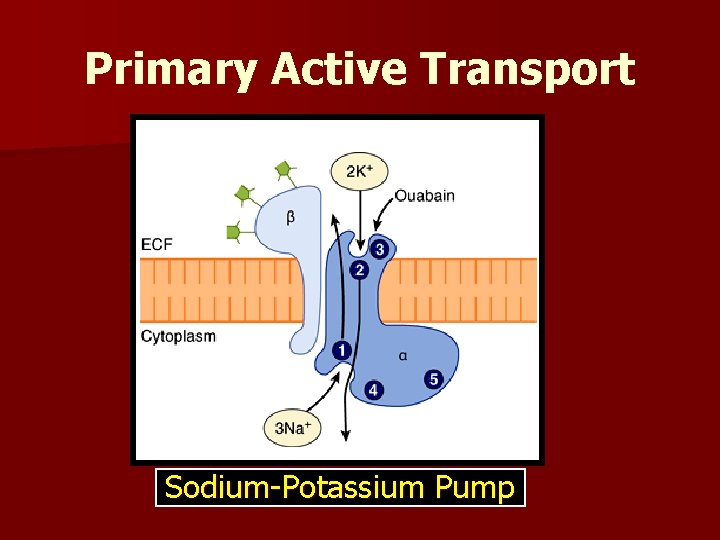
Primary Active Transport Sodium-Potassium Pump
Secondary Active Transport n Secondary Active Transport processes use the energy stored in the Na+ concentration gradient to transport material against electrochemical gradient n There are two types of secondary active transport, distinguishable by the direction of movement of the uphill solute. If the uphill solute moves in the same direction as Na+, it is called cotransport, or symport. If the uphill solute moves in the opposite direction of Na+, it is called countertransport, antiport, or exchange.
Secondary Active Transport Cotransport (symport) is a form of secondary active transport in which all solutes are transported in the same direction across the cell membrane. Na+ moves into the cell on the carrier down its electrochemical gradient; the solutes, cotransported with Na+, also move into the cell For example, n Na+-glucose cotransport and Na+-amino acid cotransport are present in the luminal membranes of the epithelial cells of both small intestine and renal proximal tubule. n cotransport involving the renal tubule is Na+-K+-2 Cl- cotransport, which is present in the luminal membrane of epithelial cells of the thick ascending limb n In each example, the Na+ gradient established by the Na+-K+ ATPase is used to transport solutes such as glucose , amino acids , K+, or Cl- against electrochemical gradients.
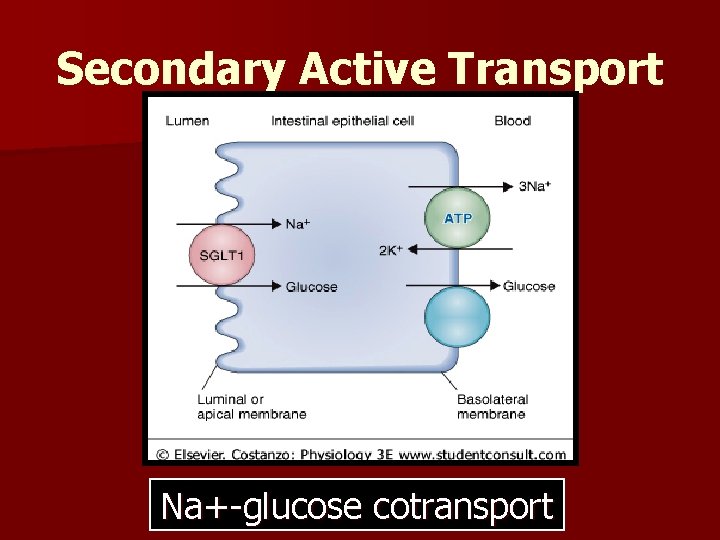
Secondary Active Transport Na+-glucose cotransport
Secondary Active Transport Countertransport n Countertransport (antiport or exchange) is a form of secondary active transport in which solutes move in opposite directions across the cell membrane. Na+ moves into the cell on the carrier down its electrochemical gradient; the solutes that are countertransported or exchanged for Na+ move out of the cell. n For example Countertransport of Ca 2+-Na+ exchange and by Na+-H+ exchange n As with cotransport, each process uses the Na+ gradient established by the Na+-K+ ATPase as an energy source; Na+ moves downhill and Ca 2+ or H+ moves uphill.
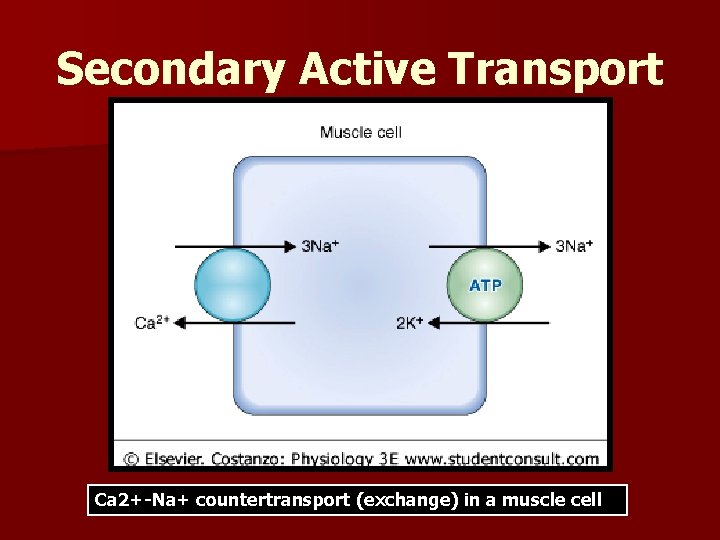
Secondary Active Transport Ca 2+-Na+ countertransport (exchange) in a muscle cell
Vesicular transport system
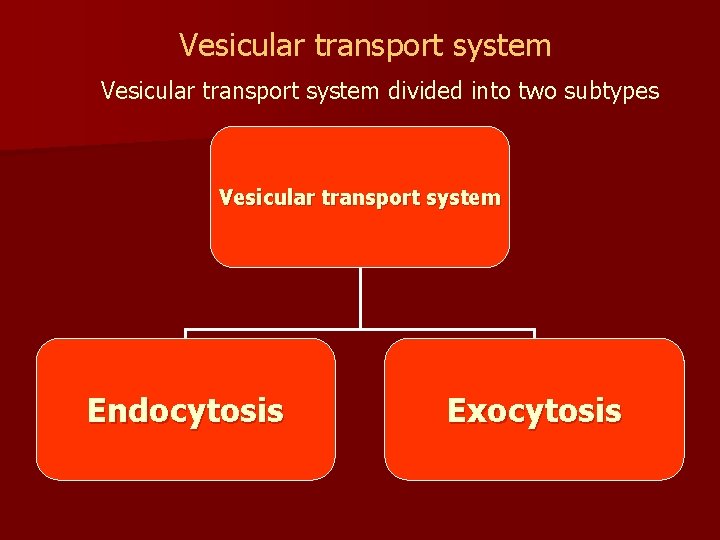
Vesicular transport system divided into two subtypes Vesicular transport system Endocytosis Exocytosis
Exocytosis
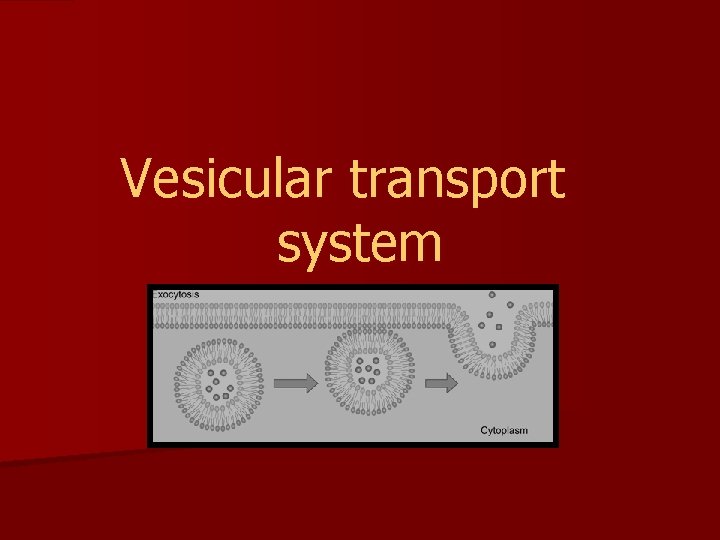
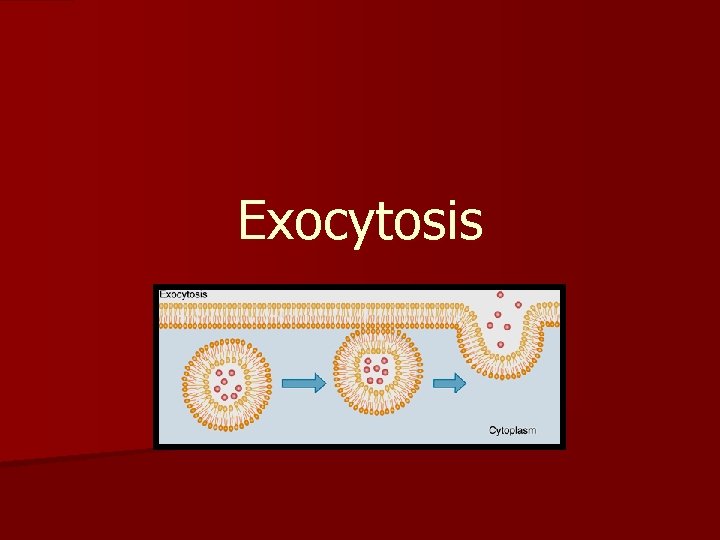
Exocytosis Vesicles containing material for export are targeted to the cell membrane. The area of fusion then breaks down, leaving the contents of the vesicle outside and the cell membrane intact. This is the Ca 2+-dependent process of exocytosis) n Note that secretion from the cell occurs via two pathways In the nonconstitutive pathway, proteins from the Golgi apparatus initially enter secretory granules, where processing of prohormones to the mature hormones occurs before exocytosis. The other pathway, the constitutive pathway, involves the prompt transport of proteins to the cell membrane in vesicles, with little or no processing or storage. The nonconstitutive pathway is sometimes called the regulated pathway, but this term is misleading because the output of proteins by the constitutive pathway is also regulated. n Exocytosis requires calcium and energy n
Endocytosis
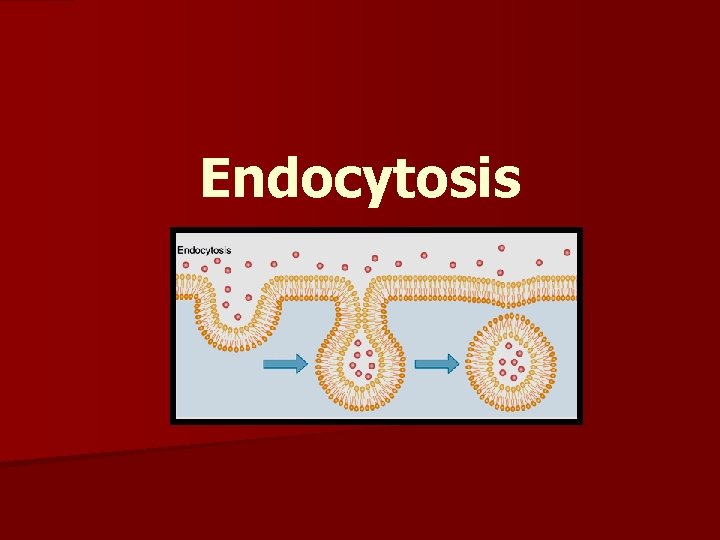
Endocytosis n n Endocytosis is the reverse of exocytosis There are various types of endocytosis named for the size of particles being ingested as well as the regulatory requirements for the particular process. These include: - Phagocytosis, pinocytosis , Clathrinmediated endocytosis , caveolae-dependent uptake, nonclathrin/noncaveolae endocytosis
Endocytosis n Phagocytosis ("cell eating") is the process by which bacteria, dead tissue, or other bits of microscopic material are engulfed by cells such as the polymorphonuclear leukocytes of the blood. Process of Phagocytosis occur as the following 1. The material makes contact with the cell membrane, which then invaginates 2. 3. The invagination of the cell membrane is pinched off Engulfed material in the membrane-enclosed vacuole and the cell membrane intact n Pinocytosis ("cell drinking") is a similar process with the vesicles much smaller n in size and the substances ingested are in solution
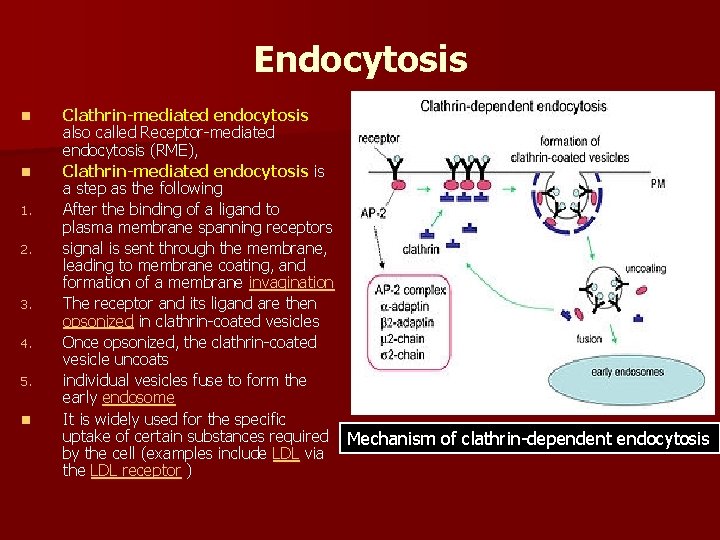
Endocytosis n n 1. 2. 3. 4. 5. n Clathrin-mediated endocytosis also called Receptor-mediated endocytosis (RME), Clathrin-mediated endocytosis is a step as the following After the binding of a ligand to plasma membrane spanning receptors signal is sent through the membrane, leading to membrane coating, and formation of a membrane invagination The receptor and its ligand are then opsonized in clathrin-coated vesicles Once opsonized, the clathrin-coated vesicle uncoats individual vesicles fuse to form the early endosome It is widely used for the specific uptake of certain substances required Mechanism of clathrin-dependent endocytosis by the cell (examples include LDL via the LDL receptor )
Endocytosis n Caveolae are the most common reported non-clathrin coated plasma membrane buds, which exist on the surface of many, but not all cell types. They consist of the cholesterol-binding protein caveolin (Vip 21) with a bilayer enriched in cholesterol and glycolipids. Caveolae are small (approx. 50 nm in diameter) flask-shape pits in the membrane that resemble the shape of a cave (hence the name caveolae). They can constitute up to a third of the plasma membrane area of the cells of some tissues, being especially abundant in smooth muscle, type I pneumocytes, fibroblasts, adipocytes, and endothelial cells. [3]
- Slides: 47