
Transport Across a Cell Membrane The makeup of
Transport Across a Cell Membrane • The makeup of a cell membrane effects its permeability • Three factors determine whether or not a substance is easily able to cross a cell membrane: • 1. Polarity • 2. Charge • 3. Size
Passive Transport • Passive transport involves the movement of material across the cell membrane without the input of energy on the part of the cell • There are three basic forms of passive transport: • 1. Simple diffusion • 2. Facilitated diffusion • Osmosis

Simple Diffusion • Diffusion is the random movement of particles from areas of high concentration to areas of low concentration • Simple diffusion of material across a cell membrane occurs only with substances that can move easily across a cell membrane
Facilitated Diffusion • For molecules that, due to certain characteristics, are not able to simply diffuse across a cell membrane the movement may be aided (facilitated) by carrier proteins that provide an environment acceptable to the movement of these molecule along a concentration gradient
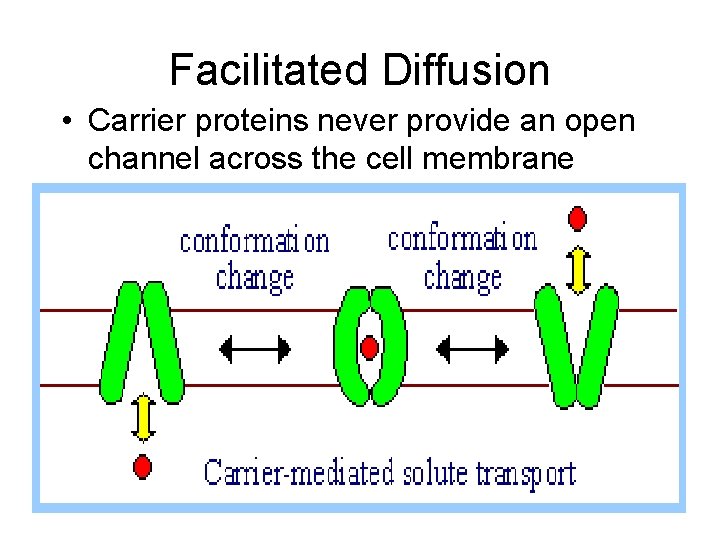
Facilitated Diffusion • Carrier proteins never provide an open channel across the cell membrane
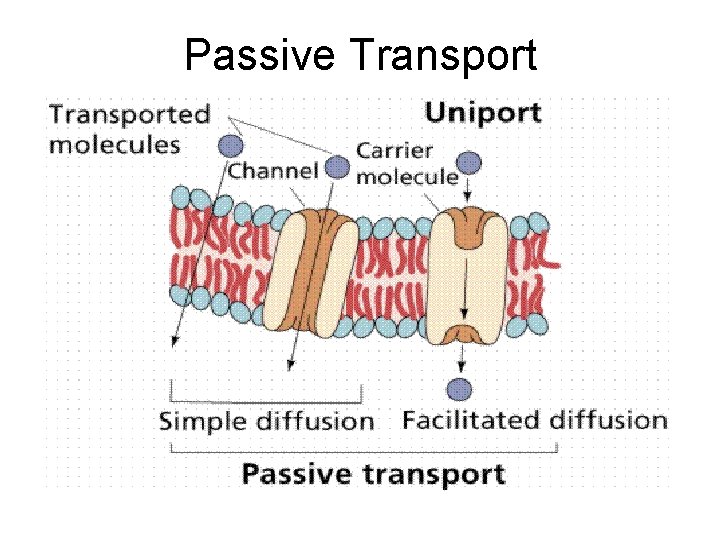
Passive Transport
Osmosis • Osmosis is the diffusion of water across a selectively permeable membrane in response to differences in solute concentration between the ECF and the protoplasm • Water will diffuse from the area of higher water concentration to the area of lower water concentration
Equilibrium • Once the contraction of water become equal on both sides of the membrane the system has reached equilibrium • Water molecules will continue to move between the two sides but there will be no net movement of water at equilibrium
Isotonic Solutions • These are solutions in which the solutes concentration outside the cell is equal to that inside the cell • The major function of blood is to keep your internal environment in an isotonic balance called homeostasis (the maintenance of a constant environment despite internal and external changes)
Hypotonic Solutions • A hypotonic solution has a lower solute concentration (higher water concentration) than inside a cell • This results in a net movement of water into the cell • If the hypotonic solution is maintained it will result in excess water movement into a cell causing it to explode (hemolysis/turgor)
Hypertonic Solutions • A hypertonic solution has a higher solute concentration (lower water concentration) and inside a cell • This results in a net movement of water out of the cell • If the hypertonic solution is maintained it will result in excess movement of water out of the cell causing it to shrink (crenelation/plasmolysis)
• http: //www. tvdsb. on. ca/westmin/science/sbi 3 a 1/Cells/Osmosis. htm
Active Transport • Active transport is the movement of materials across a cell membrane against their concentration gradient with the expenditure of energy in the form of ATP • There a three main types of active transport: • 1. Ion pumps • 2. Co-transport • 3. Endocytosis
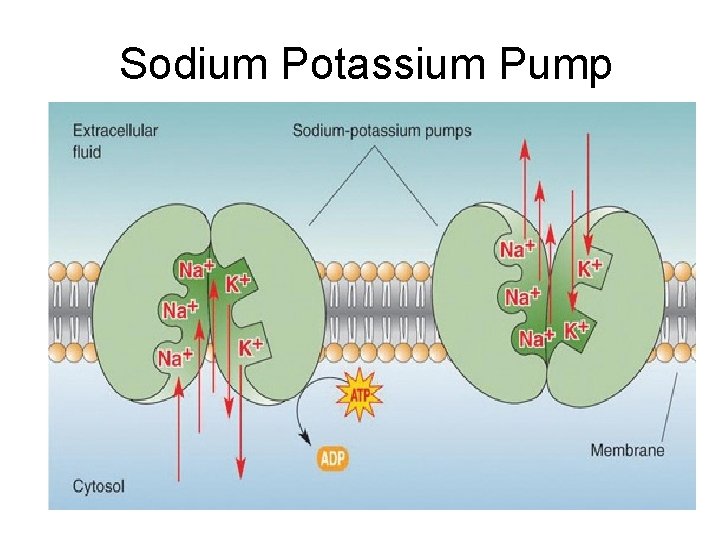
Ion Pumps • Primary active transport involves using energy (through ATP hydrolysis) at the membrane protein • This causes a change in the shape of the protein that results in the transport of the molecule through the protein. • AN example of this is the Na+-K+ pump. • The Na+-K+ pump is an antiport, it transports K+ into the cell and Na+ out of the cell at the same time, with the expenditure of ATP
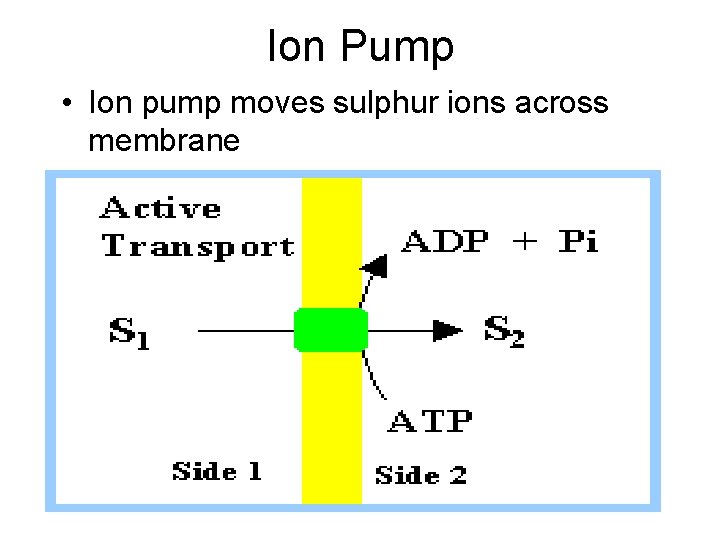
Ion Pump • Ion pump moves sulphur ions across membrane
Sodium Potassium Pump
Co-Transport • Other transporters use the energy already stored in the gradient of a directly-pumped ion • First direct active transport of the ion establishes a concentration gradient. • Then this concentration gradient uses facilitated diffusion to pass the ion back into the cell • The ion’ passage through a integral protein pumps some other molecule or ion along with it against its gradient
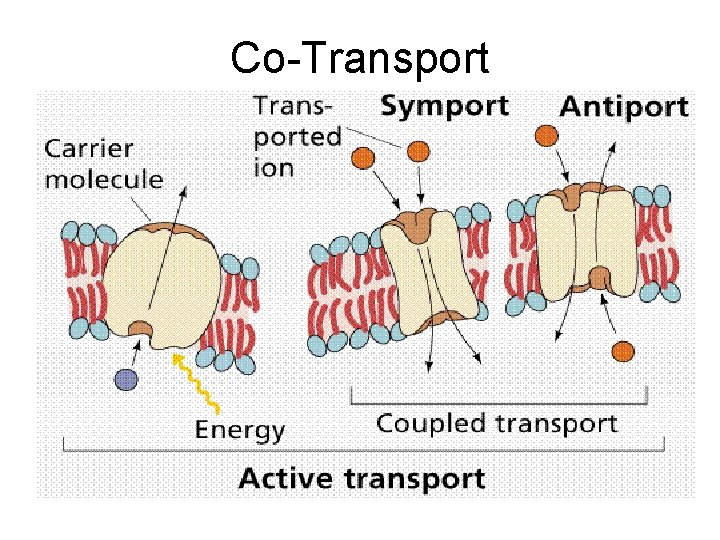
Co-Transport

• http: //www. northland. cc. mn. us/biology/Biol ogy 1111/animations/transport 1. html
Endocytosis • Endocytosis is the process by which cells take in very large molecules • There are two types of endocytosis: 1. Pinocytosis, where cells take up dissolved molecules by engulfing small amounts of the external solution (Cells of the small intestine take up fat droplets via pinocytosis. )
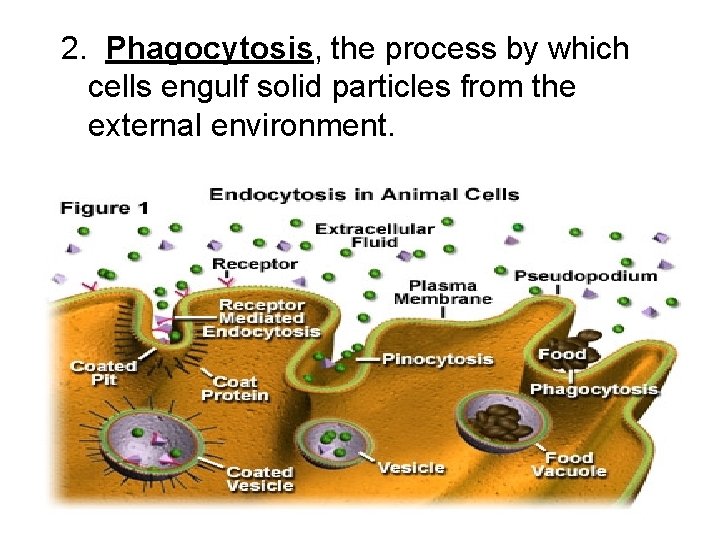
2. Phagocytosis, the process by which cells engulf solid particles from the external environment.
Exocytosis • Exocytosis is the process by which large molecules held within the cell are transported to the external environment (waste, proteins and other products of cellular functions) • Small vesicles break off from the Golgi apparatus and move toward the cell membrane. • The vesicles fuse with the cell membrane and the material is released into the external environment
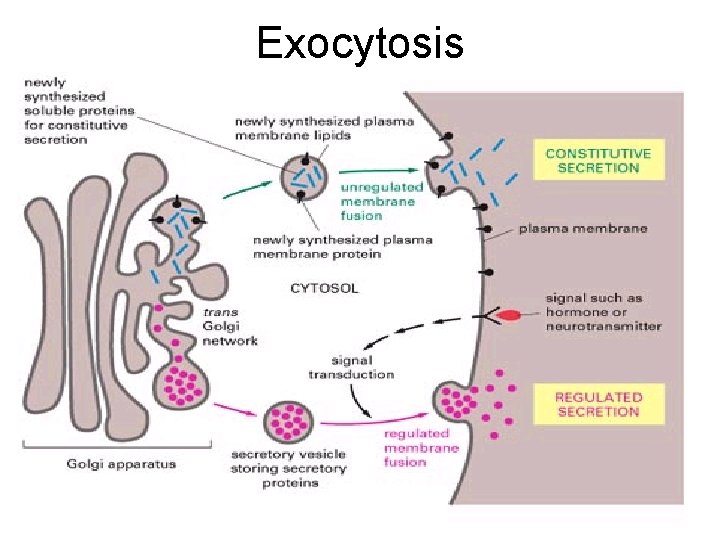
Exocytosis
- Slides: 23