
Transparent Firstclass Futures and Distributed Components Antonio Cansado
Transparent First-class Futures and Distributed Components Antonio Cansado, Ludovic Henrio, Eric Madelaine • Introduction: components, futures, and challenges • Statically Representing Futures • An Example • Extension and Conclusion
INTRODUCTION: COMPONENTS, FUTURES, AND CHALLENGES
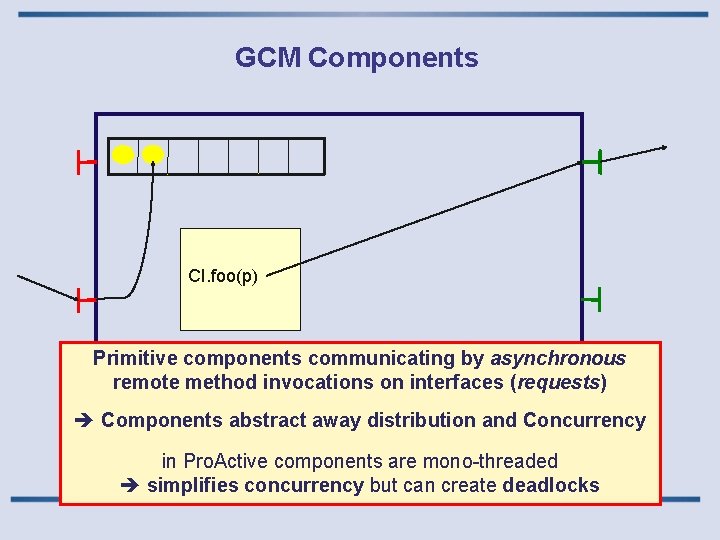
GCM Components CI. foo(p) Primitive components communicating by asynchronous remote method invocations on interfaces (requests) Components abstract away distribution and Concurrency in Pro. Active components are mono-threaded simplifies concurrency but can create deadlocks
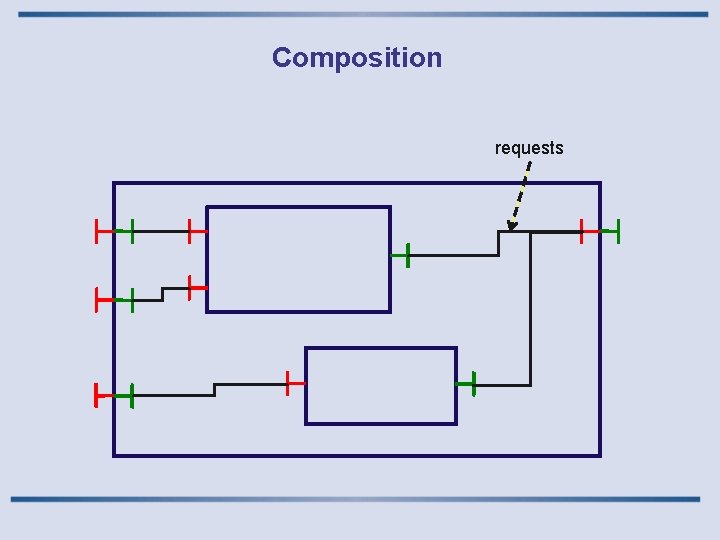
Composition requests
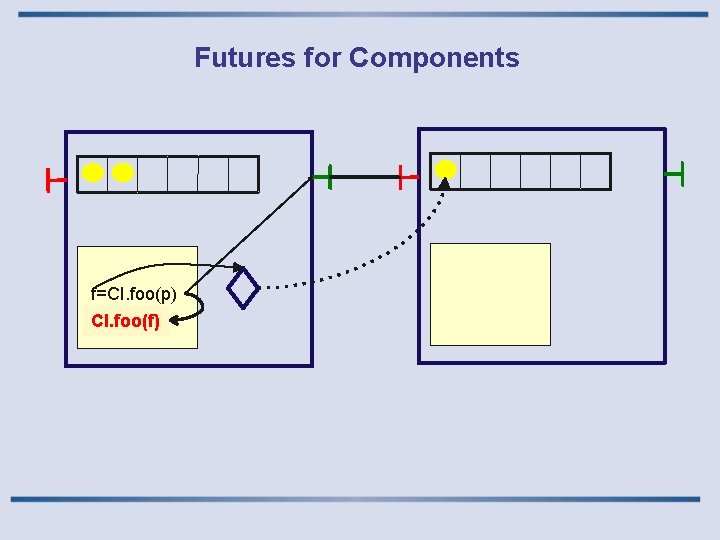
Futures for Components f=CI. foo(p) CI. foo(f)
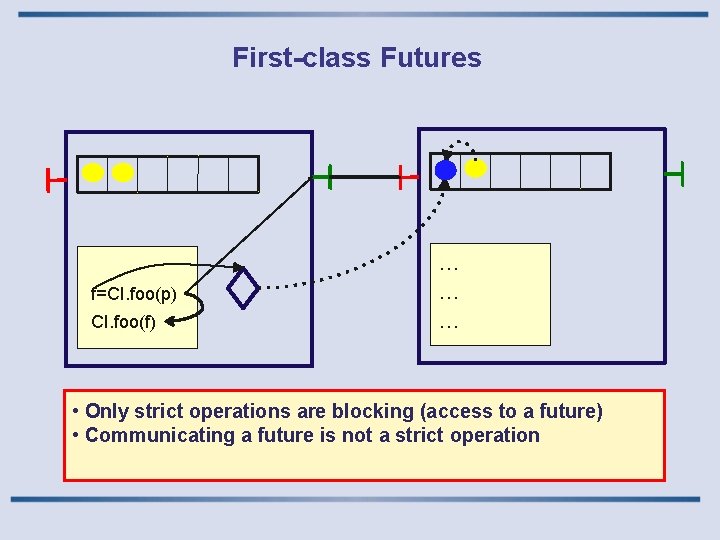
First-class Futures f=CI. foo(p) CI. foo(f) … … … • Only strict operations are blocking (access to a future) • Communicating a future is not a strict operation
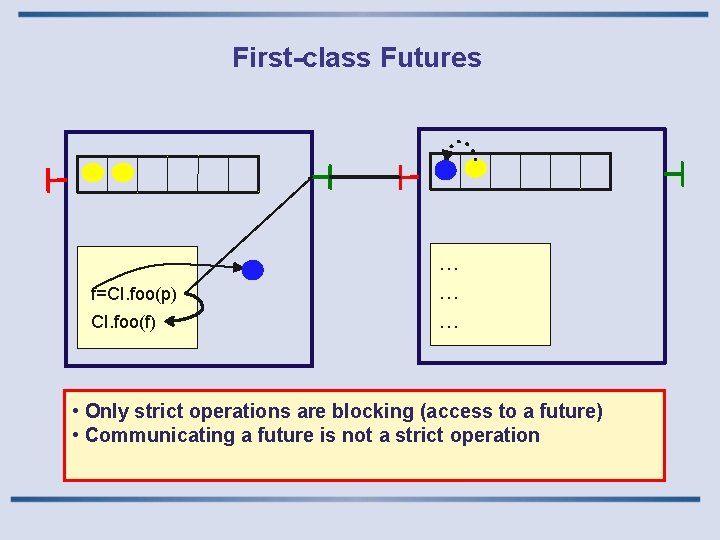
First-class Futures f=CI. foo(p) CI. foo(f) … … … • Only strict operations are blocking (access to a future) • Communicating a future is not a strict operation
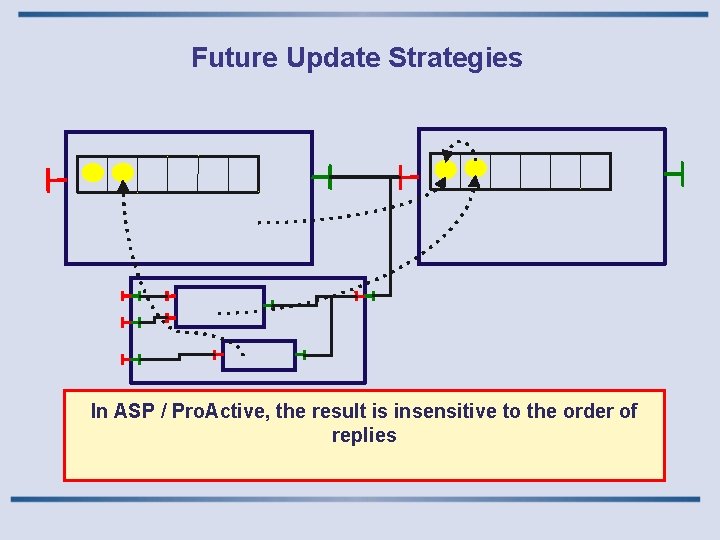
Future Update Strategies In ASP / Pro. Active, the result is insensitive to the order of replies
Challenges Related to Component and Futures Objective: build a behavioural model for components using transparent first-class futures. Detect dead-locks, reachability, … Requirements/Challenges: • A static representation for futures • A static approximation of the flow of futures
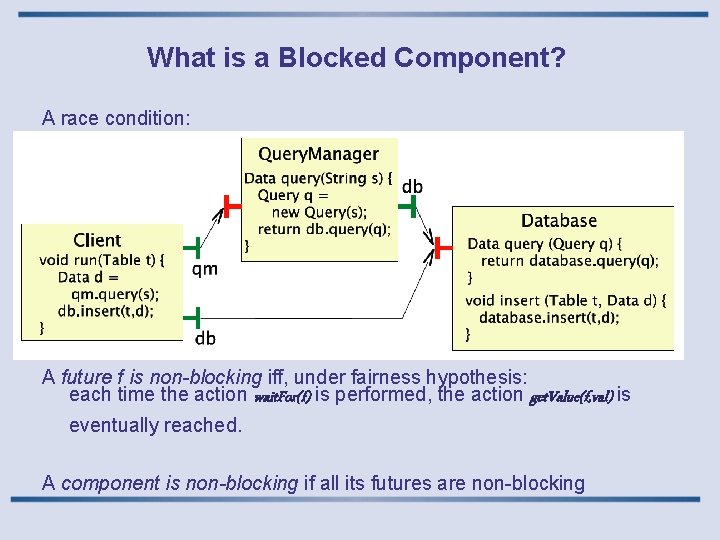
What is a Blocked Component? A race condition: A future f is non-blocking iff, under fairness hypothesis: each time the action wait. For(f) is performed, the action get. Value(f, val) is eventually reached. A component is non-blocking if all its futures are non-blocking
Components and Futures • Components abstract distribution Future creation points • But future flow still to be inferred component specification language (e. g. JDC) • Futures create transparent channels that do not directly follow bindings • Components provide interface definition which can be complemented with future flow information
A STATIC REPRESENTATION FOR FUTURES
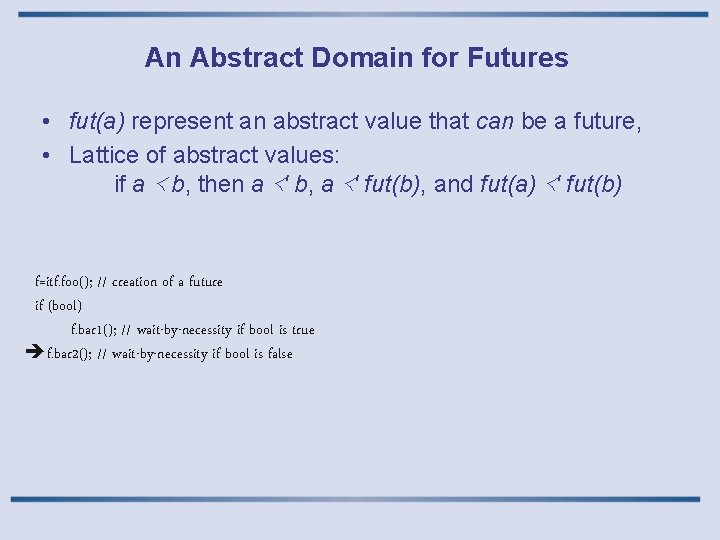
An Abstract Domain for Futures • fut(a) represent an abstract value that can be a future, • Lattice of abstract values: if a ≺ b, then a ≺′ b, a ≺′ fut(b), and fut(a) ≺′ fut(b) f=itf. foo(); // creation of a future if (bool) f. bar 1(); // wait-by-necessity if bool is true f. bar 2(); // wait-by-necessity if bool is false
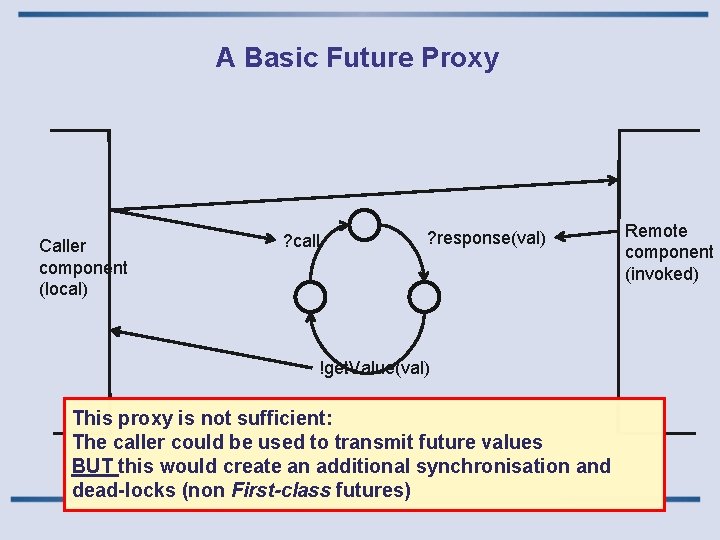
A Basic Future Proxy Caller component (local) ? call ? response(val) !get. Value(val) This proxy is not sufficient: The caller could be used to transmit future values BUT this would create an additional synchronisation and dead-locks (non First-class futures) Remote component (invoked)
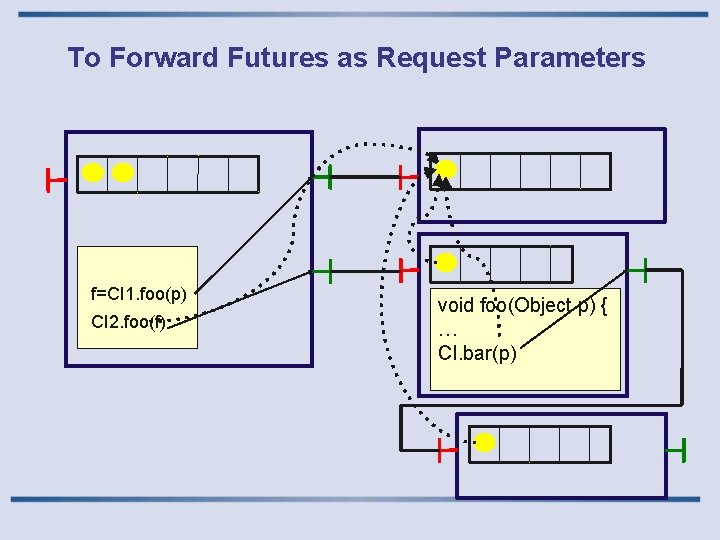
To Forward Futures as Request Parameters f=CI 1. foo(p) CI 2. foo(f) void foo(Object p) { … CI. bar(p)
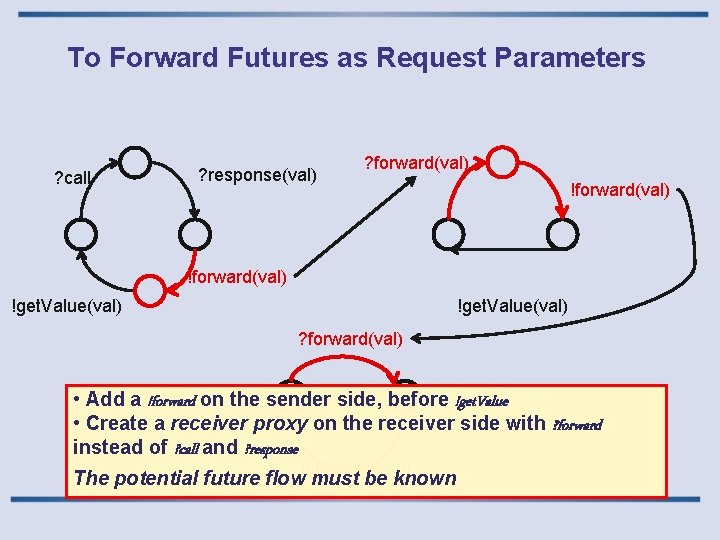
To Forward Futures as Request Parameters ? call ? response(val) ? forward(val) !forward(val) !get. Value(val) ? forward(val) • Add a !forward on the sender side, before !get. Value • Create a receiver proxy on the receiver side with ? forward instead of ? call and ? response !get. Value(val) The potential future flow must be known
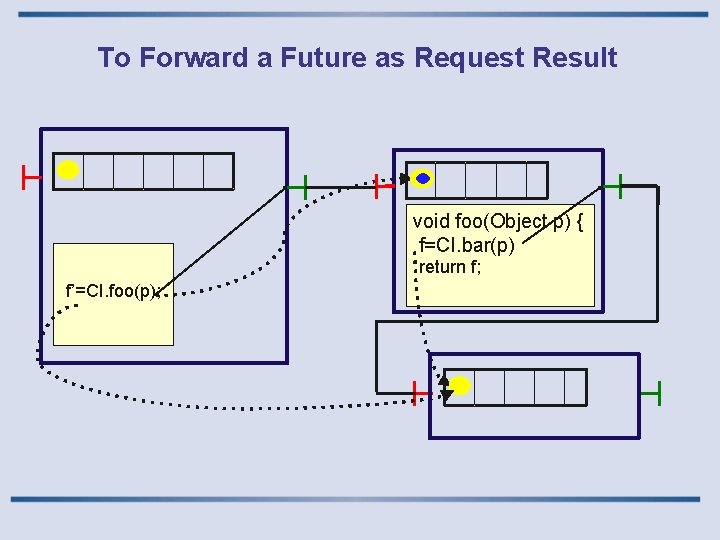
To Forward a Future as Request Result void foo(Object p) { f=CI. bar(p) return f; f’=CI. foo(p);
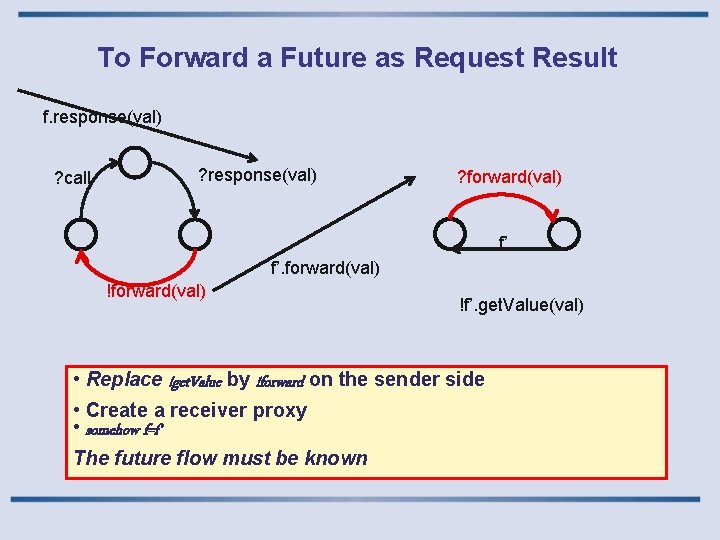
To Forward a Future as Request Result f. response(val) ? call ? response(val) ? forward(val) f’ f’. forward(val) !f’. get. Value(val) • Replace !get. Value by !forward on the sender side • Create a receiver proxy • somehow f=f’ The future flow must be known
Future Update Strategies and Behavioural Specification Our behavioural proxy implements a forward-based strategy • responses follow the flow of future references, • Like in Pro. Active, • We proved that all strategies are equivalent, • Behaviour is compositional, provided the future flow is given. • What kind of proxy to use? Sometimes use several proxies and choose when composing behaviours.
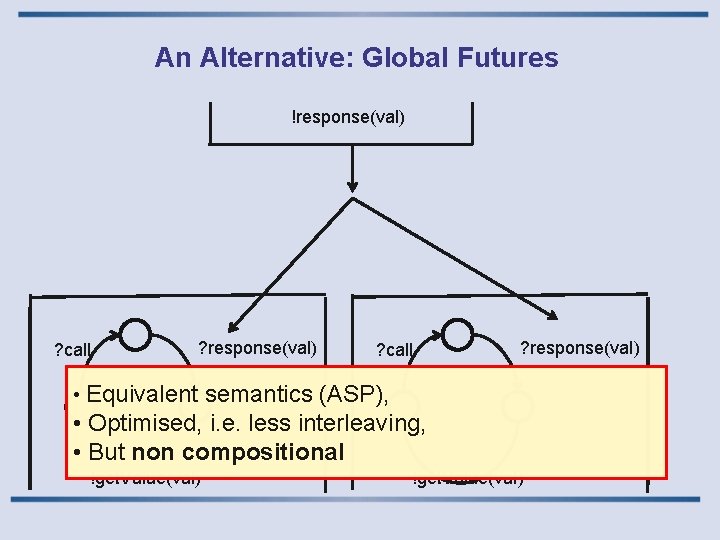
An Alternative: Global Futures !response(val) ? call ? response(val) • Equivalent semantics (ASP), • Optimised, i. e. less interleaving, • But non compositional !get. Value(val)
AN EXAMPLE
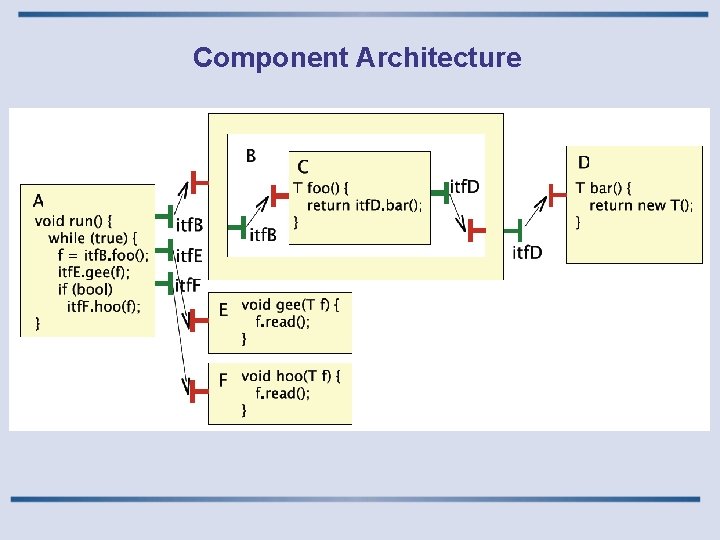
Component Architecture
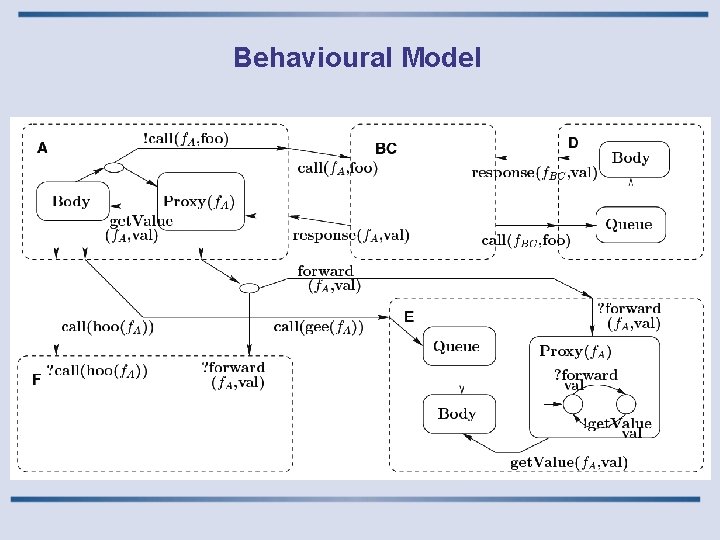
Behavioural Model
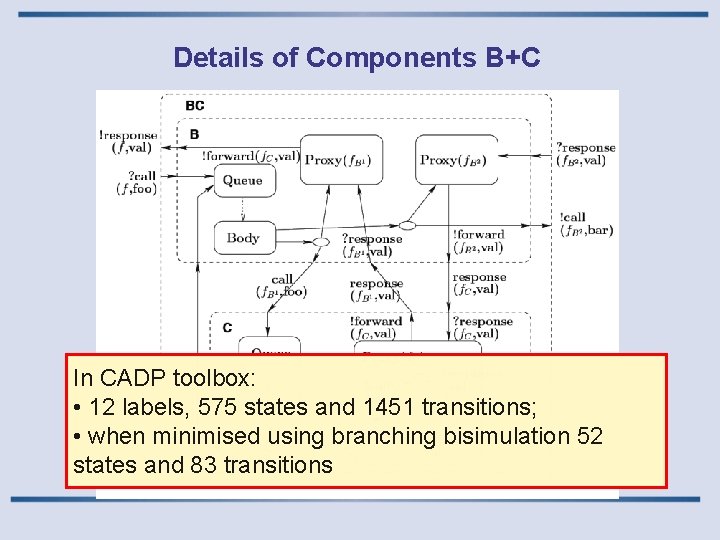
Details of Components B+C In CADP toolbox: • 12 labels, 575 states and 1451 transitions; • when minimised using branching bisimulation 52 states and 83 transitions
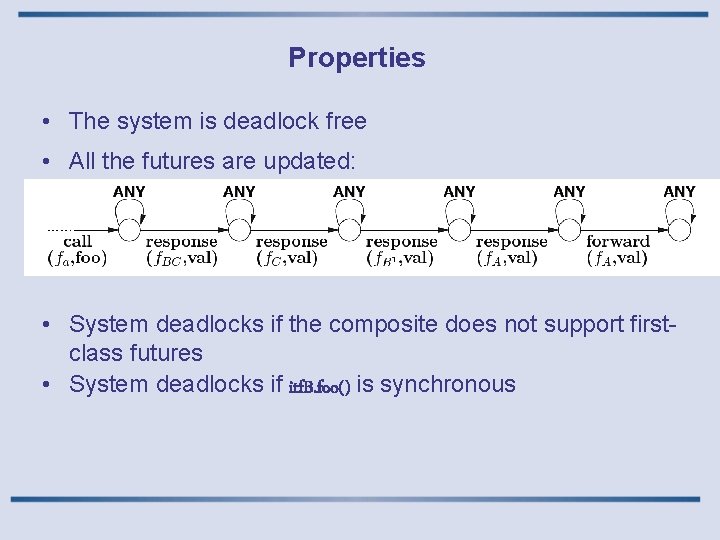
Properties • The system is deadlock free • All the futures are updated: • System deadlocks if the composite does not support firstclass futures • System deadlocks if itf. B. foo() is synchronous

EXTENSION AND CONCLUSION
Extending the Interface Definitions • • • To be safe, the behavioural model must consider as a future every variable that may be a future Even more complex for objects and fields Extend interface definition with strictness annotations: strict parameters do not need a proxy for future interface DB { Data query(Query q); void insert(Table t, @Strict. Value Data d); } • To be ensured by the middleware at serialization: before sending the value check that it is not a future
Conclusion • A generic model for futures o New lattice of abstract values o Proxy for future, with modifications forwarding futures as request/response o Applied to GCM components, but could be applied to other models (cf Ambient. Talk, Creol, λfut) o A strategy that guarantees that all futures are updated • To specify behaviours and prove properties, particularly deadlocks (cycle of wait-by-necessity on futures in GCM/Pro. Active) • Suggest an extension of interface definition language
- Slides: 28