
TRANSPARENT ASSIGNMENTS PROMOTE EQUITABLE OPPORTUNITIES FOR STUDENT SUCCESS
TRANSPARENT ASSIGNMENTS PROMOTE EQUITABLE OPPORTUNITIES FOR STUDENT SUCCESS Mary-Ann Winkelmes, Ph. D. Coordinator, Instructional Development & Research, UNLV Senior Fellow, Association of American Colleges & Universities Nevada Humanities Board of Directors member Founder and Principal Investigator, UNIVERSITY OF NEVADA, LAS VEGAS © 2014 Mary-Ann Winkelmes
UNIVERSITY OF NEVADA, LAS VEGAS © 2014 Mary-Ann Winkelmes
Overview PURPOSE: – Understand how transparently designed assignments can offer equitable opportunities for all college students to succeed; and consider applications TASKS: – Review: summary of research findings – Apply: in your own courses CRITERIA: You’ll leave with – Understanding of our research – Strategies (draft) for applying transparency in assignments UNIVERSITY OF NEVADA, LAS VEGAS © 2014 Mary-Ann Winkelmes
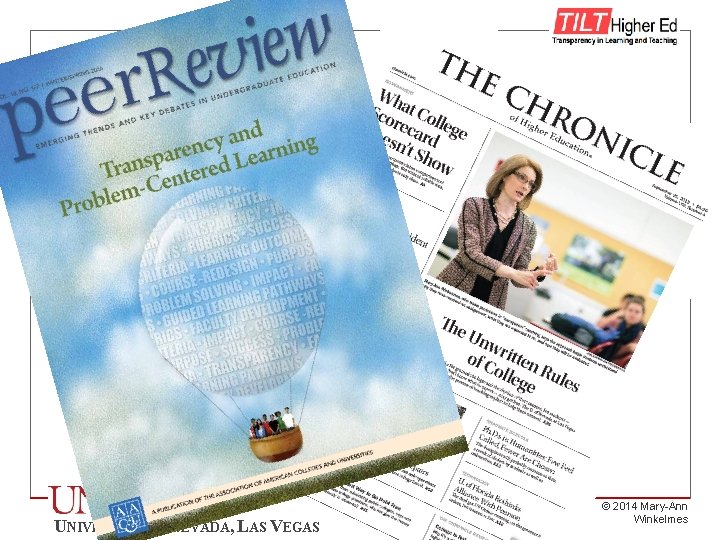
• Partnership with – Grant from: TG • Co-PIs: Tia Brown Mc. Nair, Ashley Finley, AAC&U • Schools: – – – – Community College of Philadelphia Queensborough Community College, Bayside, NY St Edward's Univ. Austin, TX Univ. of Houston – Downtown, TX California State University, LA Winston-Salem State University, NC Heritage University, Toppenish, WA • Publication: Peer Review (Spring 2016) UNIVERSITY OF NEVADA, LAS VEGAS © 2014 Mary-Ann Winkelmes

Research Team: Transparency Project team members, UNLV Matthew Bernacki, Ph. D. (consultant) Jeffrey Butler, Ph. D. (research, analysis) David Copeland (consultant) Jennifer Golanics, J. D. , M. Ed. (analysis) Sherry Marks (budget) Mary. Kay Orgill (consultant) Kati Harriss Weavil M. Ed. Candidate (analysis) Michelle Zochowski, M. Ed. candidate (analysis) UNIVERSITY OF NEVADA, LAS VEGAS © 2014 Mary-Ann Winkelmes
CONTEXT UNIVERSITY OF NEVADA, LAS VEGAS © 2014 Mary-Ann Winkelmes
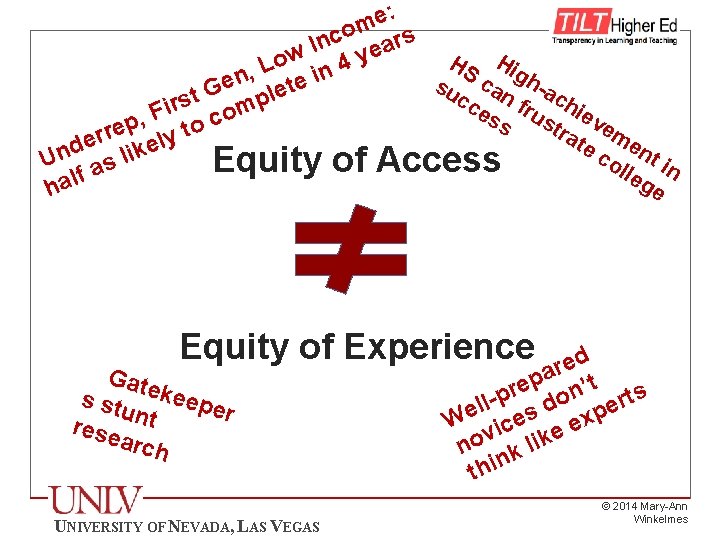
: e m s o c r n I a H e w y H o S igh L in 4 , n ca e s e -ac t u G e n l t c p ce fru hie rs om i F ss , c str ve p o e t ate me rr ely e d co nt Un as lik in Equity of Access l l e f ge hal Equity of Experience Ga t s st ekeepe unt r rese arch UNIVERSITY OF NEVADA, LAS VEGAS d e ar t p re on’ rts p ll d xpe e s e W ic e e v k no k li n thi © 2014 Mary-Ann Winkelmes
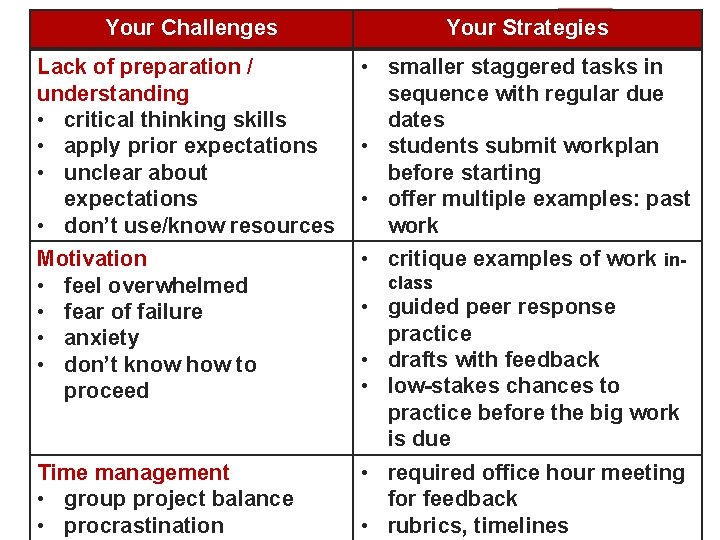
Your Challenges Your Strategies Lack of preparation / understanding • critical thinking skills • apply prior expectations • unclear about expectations • don’t use/know resources • smaller staggered tasks in sequence with regular due dates • students submit workplan before starting • offer multiple examples: past work • critique examples of work in- Motivation • feel overwhelmed • fear of failure • anxiety • don’t know how to proceed Time management • group project balance NIVERSITY OF NEVADA, LAS VEGAS • Uprocrastination class • guided peer response practice • drafts with feedback • low-stakes chances to practice before the big work is due • required office hour meeting for feedback © 2014 Mary-Ann Winkelmes • rubrics, timelines
What is Transparency? • Transparent teaching and learning methods explicitly focus on how and why students are learning course content in particular ways. UNIVERSITY OF NEVADA, LAS VEGAS © 2014 Mary-Ann Winkelmes
How can Transparency help students? • Transparent teaching/learning methods benefit students who are unfamiliar with college success strategies by explicating learning/teaching processes. § Greater benefits for underrepresented and firstgeneration students Winkelmes, AAC&U’s Liberal Education 99, 2 (Spring 2013) UNIVERSITY OF NEVADA, LAS VEGAS © 2014 Mary-Ann Winkelmes
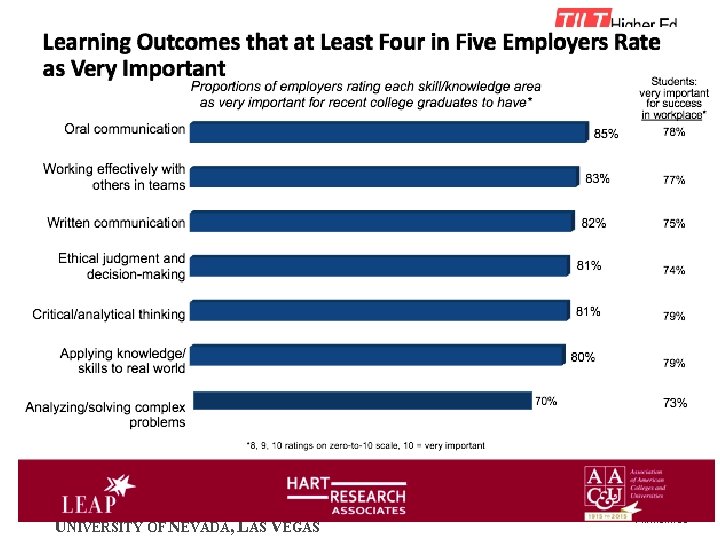
Transparency and Problem-centered Learning AAC&U and Transparency Project collaboration (p. 10) – 7 MSIs, 1800 students, 35 faculty • • 425 First generation students 402 non-white students 479 low-income students 297 multiracial students – 2 x simple teaching intervention (2 assignments) – Boosted students’ learning in 3 important ways (medium-large effect for underserved students): ion t n e • Academic confidence t A, re P G d ease r c n I • Sense of belonging • Skills valued most by employers UNIVERSITY OF NEVADA, LAS VEGAS © 2014 Mary-Ann Winkelmes
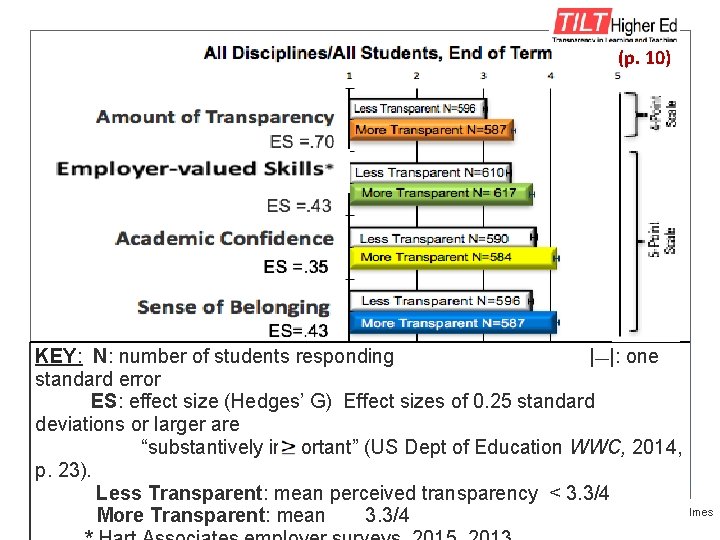
(p. 10) *Hart Research Associates, Falling Short? College Learning and Career Success. Washington, DC: AAC&U, __|: one 2015. KEY: N: number of students responding | KEY: _|: one standard error ES: effect size (Hedges’ G)** N: number of students responding | standard error Less Transparent: mean perceived transparency <3. 3/4 More Transparent: mean ES: effect size (Hedges’ G) Effect sizes of 0. 25 standard 3. 3/4 deviations or larger are * Hart Research Associates. Falling Short? Learning and Career Success. Washington, DC: AAC&U, “substantively important” (US Dept of Education WWC, 2014, 2015. p. 23). ** Effect sizes of 0. 25 standard deviations or larger are “substantively important. ” (US Dept of Ed. Less Transparent: mean perceived transparency < 3. 3/4 What Works Clearinghouse Procedures and Standards Handbook version 3. 0. Web. March, 2014, p. © 2014 Mary-Ann © 2015 Mary-Ann Winkelmes More Transparent: mean 3. 3/4 Winkelmes 23. ) UNIVERSITY OF NEVADA, LAS VEGAS
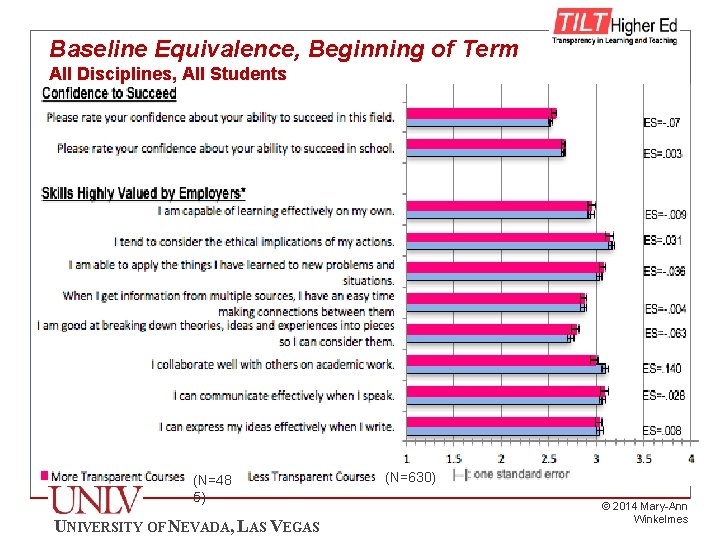
Baseline Equivalence, Beginning of Term All Disciplines, All Students (N=48 5) UNIVERSITY OF NEVADA, LAS VEGAS (N=630) © 2014 Mary-Ann Winkelmes
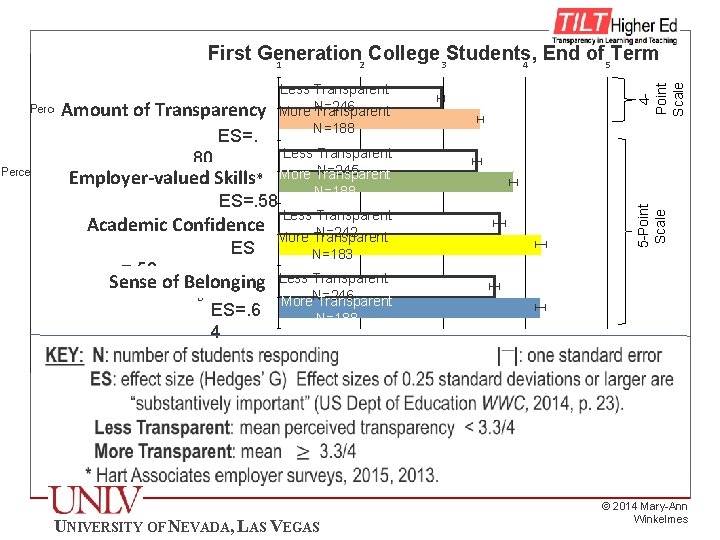
Less Transparent N=246 More Transparent Amount of Transparency Perceived Amount of Transparency in the Course N=188 Employer-valued Skills* Perceived Improvement of Skills that Employers Value* ES=. 58 ES =. 50 Sense of Belongingness ES=. 6 4 Less Transparent N=245 More Transparent N=188 Less Transparent N=242 More Transparent N=183 5 -Point Scale ES=. 80 Academic Confidence to Succeed in School 4 Point Scale First Generation College Students, End of Term 1 2 3 4 5 Less Transparent N=246 More Transparent N=188 UNIVERSITY OF NEVADA, LAS VEGAS © 2014 Mary-Ann Winkelmes
UNIVERSITY OF NEVADA, LAS VEGAS © 2014 Mary-Ann Winkelmes
UNIVERSITY OF NEVADA, LAS VEGAS © 2014 Mary-Ann Winkelmes
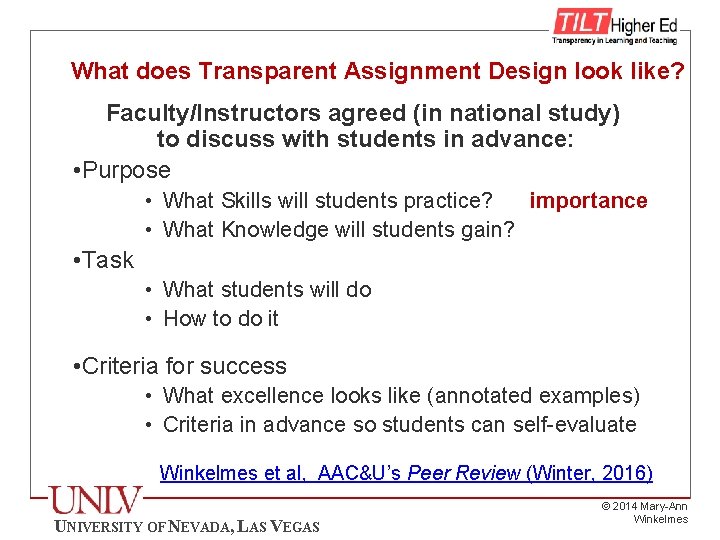
What does Transparent Assignment Design look like? Faculty/Instructors agreed (in national study) to discuss with students in advance: • Purpose • What Skills will students practice? importance • What Knowledge will students gain? • Task • What students will do • How to do it • Criteria for success • What excellence looks like (annotated examples) • Criteria in advance so students can self-evaluate Winkelmes et al, AAC&U’s Peer Review (Winter, 2016) UNIVERSITY OF NEVADA, LAS VEGAS © 2014 Mary-Ann Winkelmes
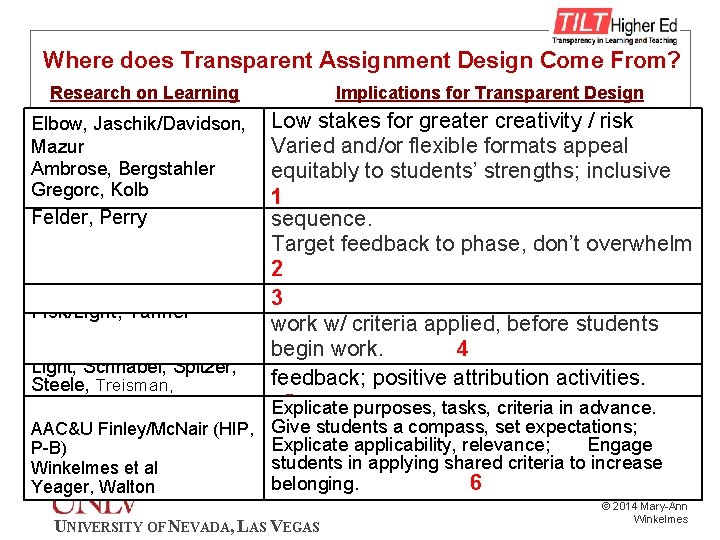
Where does Transparent Assignment Design Come From? Research on Learning Elbow, Jaschik/Davidson, Mazur Ambrose, Bergstahler Gregorc, Kolb Bass, Bloom, Colomb, Felder, Perry Doyle, Felder, Tanner, Winkelmes Fisk/Light, Tanner Aronson, Dweck, Fisk, Light, Schnabel, Spitzer, Steele, Treisman, Yeager/Walton, Vygosky AAC&U Finley/Mc. Nair (HIP, P-B) Winkelmes et al Yeager, Walton Implications for Transparent Design Low stakes for greater creativity / risk Varied and/or flexible formats appeal equitably to students’ strengths; inclusive Build critical thinking skills in intentional 1 sequence. Target feedback to phase, don’t overwhelm Specify pertinent knowledge/skills, criteria 2 and encourage self-monitoring. 3 Provide annotated examples of successful work w/ criteria applied, before students begin work. 4 Structure and require peer instruction, feedback; positive attribution activities. 5 Explicate purposes, tasks, criteria in advance. Give students a compass, set expectations; Explicate applicability, relevance; Engage students in applying shared criteria to increase belonging. 6 UNIVERSITY OF NEVADA, LAS VEGAS © 2014 Mary-Ann Winkelmes
Apply all that research to designing transparent, equitable assignments! UNIVERSITY OF NEVADA, LAS VEGAS © 2014 Mary-Ann Winkelmes
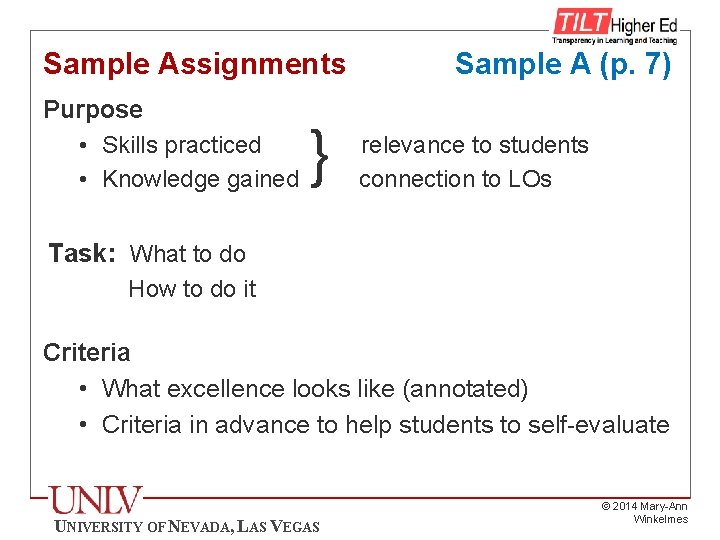
Sample Assignments Sample A (p. 7) Purpose • Skills practiced relevance to students • Knowledge gained connection to LOs } Task: What to do How to do it Criteria • What excellence looks like (annotated) • Criteria in advance to help students to self-evaluate UNIVERSITY OF NEVADA, LAS VEGAS © 2014 Mary-Ann Winkelmes
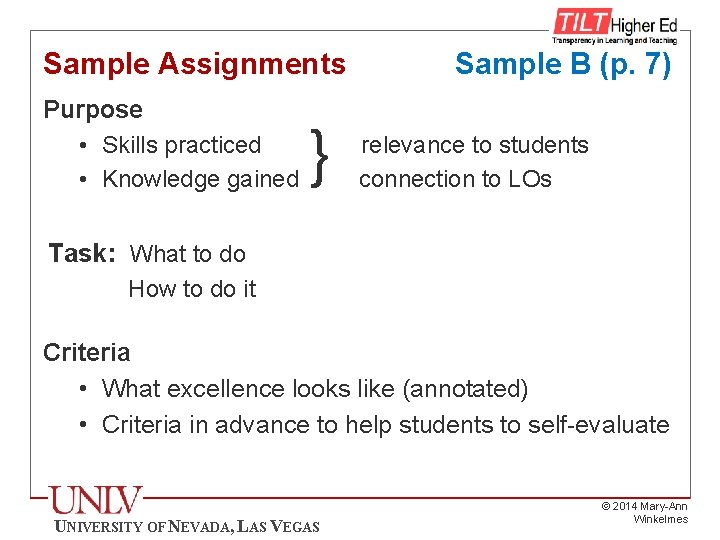
Sample Assignments Sample B (p. 7) Purpose • Skills practiced relevance to students • Knowledge gained connection to LOs } Task: What to do How to do it Criteria • What excellence looks like (annotated) • Criteria in advance to help students to self-evaluate UNIVERSITY OF NEVADA, LAS VEGAS © 2014 Mary-Ann Winkelmes
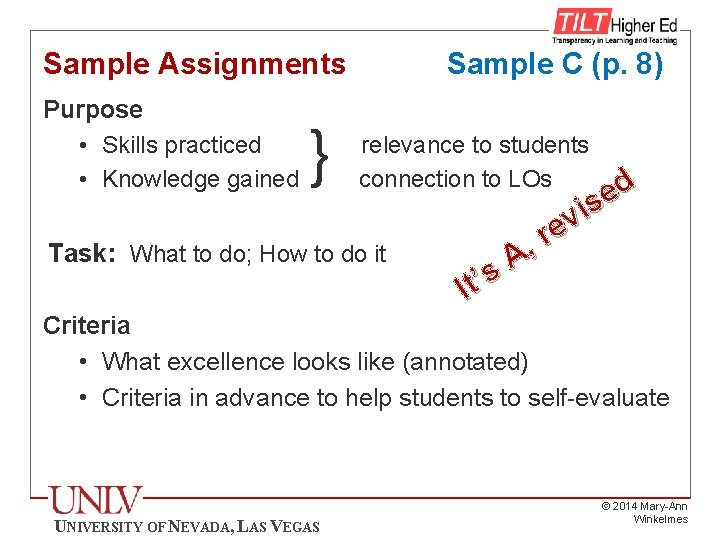
Sample Assignments Sample C (p. 8) Purpose • Skills practiced relevance to students • Knowledge gained connection to LOs } Task: What to do; How to do it d e s i v e r , A s ’ t I Criteria • What excellence looks like (annotated) • Criteria in advance to help students to self-evaluate UNIVERSITY OF NEVADA, LAS VEGAS © 2014 Mary-Ann Winkelmes
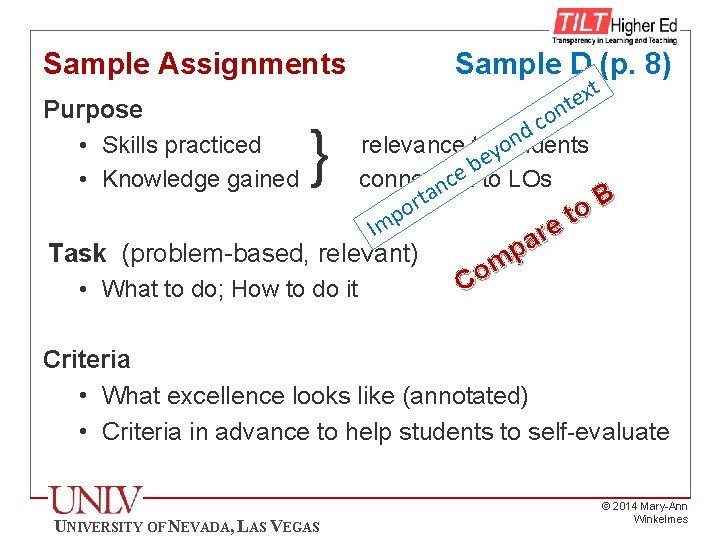
Sample Assignments Sample D (p. 8) t x e t n Purpose o c nd • Skills practiced relevance to students o y e e b • Knowledge gained connection to LOs c n a t B r o o p t m I e r a p Task (problem-based, relevant) m o C • What to do; How to do it } Criteria • What excellence looks like (annotated) • Criteria in advance to help students to self-evaluate UNIVERSITY OF NEVADA, LAS VEGAS © 2014 Mary-Ann Winkelmes
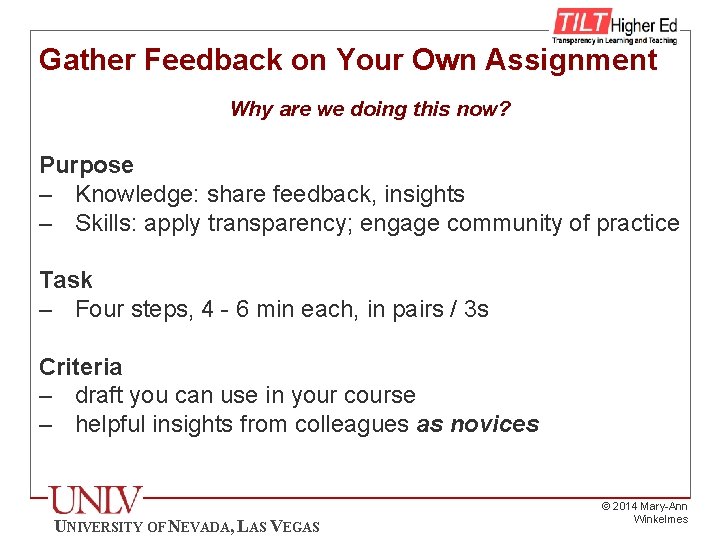
Gather Feedback on Your Own Assignment Why are we doing this now? Purpose – Knowledge: share feedback, insights – Skills: apply transparency; engage community of practice Task – Four steps, 4 - 6 min each, in pairs / 3 s Criteria – draft you can use in your course – helpful insights from colleagues as novices UNIVERSITY OF NEVADA, LAS VEGAS © 2014 Mary-Ann Winkelmes
5 minute BREAK • Sit next to a disciplinary stranger when you return UNIVERSITY OF NEVADA, LAS VEGAS © 2014 Mary-Ann Winkelmes
Choose an Assignment from Your Course • from 1 st half of the term • after students are acquainted with basic tools and terminology the course uses • when students are starting to apply those and try them out Describe this assignment to a partner (2 min each) UNIVERSITY OF NEVADA, LAS VEGAS © 2014 Mary-Ann Winkelmes
Feedback on Your Assignments, part 1 of 3 handout: page 6 As a novice student, offer feedback on the Purpose In pairs or 3 s, discuss and define (6 min total) Five years after taking your course, • What essential knowledge should students retain from doing this assignment? • What skills should students be able to perform from doing this assignment? (p. 2 may help) • Why are these important to students? UNIVERSITY OF NEVADA, LAS VEGAS © 2014 Mary-Ann Winkelmes
Feedback on Your Assignments, part 2 of 3 handout page 6 As a novice student, offer feedback on the Task In pairs, discuss and define (6 min total) As a novice, list the steps you’d take to do the assignment. UNIVERSITY OF NEVADA, LAS VEGAS © 2014 Mary-Ann Winkelmes
Feedback on Your Assignments, part 3 of 3 handout page 6 As a novice student, offer feedback on the Criteria In pairs or 3 s, discuss and define (6 min total) As a novice: – Are you confident you are doing the task effectively? – Are you confident you are doing excellent work? – Do you have annotated good examples? To answer yes, what would you need? UNIVERSITY OF NEVADA, LAS VEGAS © 2014 Mary-Ann Winkelmes
Additional Research-based Strategies handout page 1 Offer feedback in pairs, 3 s (4 min total) • Which additional research-based methods could be used? (chart, p. 1) UNIVERSITY OF NEVADA, LAS VEGAS © 2014 Mary-Ann Winkelmes
How did we do in this peer activity? Purpose – Knowledge: share feedback, insights – Skills: apply transparency; engage community of practice Task – Four steps, 4 - 6 min each, in pairs / 3 s Criteria – draft you can use in your course – helpful insights from colleagues as novices – Strategies (chart, page 1) UNIVERSITY OF NEVADA, LAS VEGAS © 2014 Mary-Ann Winkelmes
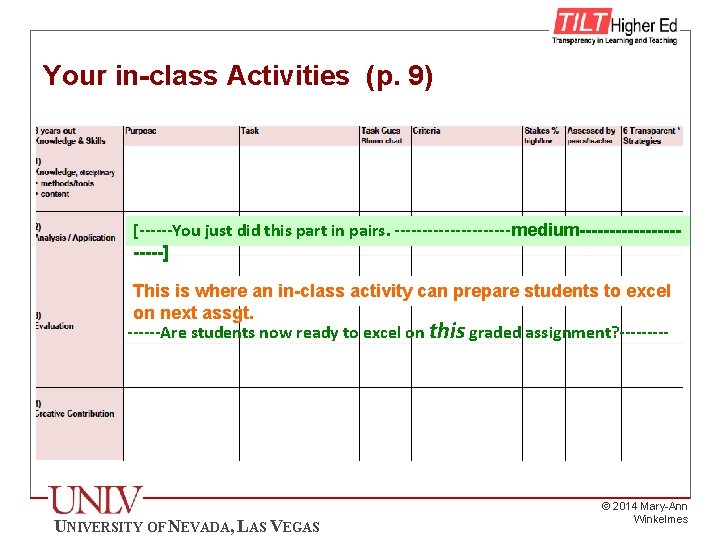
Your in-class Activities (p. 9) [------You just did this part in pairs. -----------medium-----------] This is where an in-class activity can prepare students to excel on next assgt. ------Are students now ready to excel on this graded assignment? ----- UNIVERSITY OF NEVADA, LAS VEGAS © 2014 Mary-Ann Winkelmes
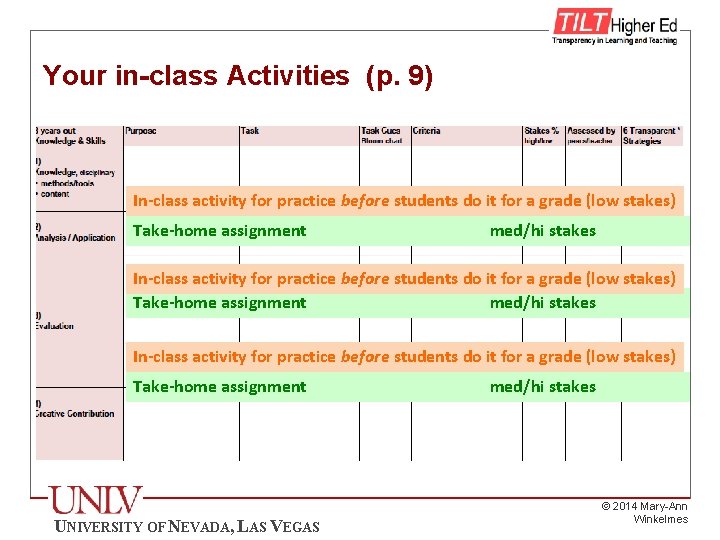
Your in-class Activities (p. 9) In-class activity for practice before students do it for a grade (low stakes) Take-home assignment med/hi stakes In-class activity for practice before students do it for a grade (low stakes) Take-home assignment UNIVERSITY OF NEVADA, LAS VEGAS med/hi stakes © 2014 Mary-Ann Winkelmes
How did we do? PURPOSE: – Consider and apply research on college students’ learning to the design of transparent course assignments / activities that offer equitable opportunities for all students to succeed TASKS: – Review research findings – Apply to revising your assignments and activities CRITERIA: You’ll leave with – Overview of research – Strategies to revise your assignments and activities – Draft ideas for an assignment, an activity Long term: improved student confidence, skills, success UNIVERSITY OF NEVADA, LAS VEGAS © 2014 Mary-Ann Winkelmes
Strategies for Impact • Courses: Intro (large, small), Gateway, High DWF, Majors/Pathways, Gen Ed • Networks: Community Colleges, Research Intensive, Liberal Arts, Regional, Teaching/Learning Centers, STEM Ed Ctrs, Disciplinary Association conferences. . . UNIVERSITY OF NEVADA, LAS VEGAS © 2014 Mary-Ann Winkelmes
Please join us! http: //www. unlv. edu/provost/teachingandlearning Transparent 2 nd Tuesdays at 2: 00 pm https: //zoom. us/s/337401450 UNIVERSITY OF NEVADA, LAS VEGAS © 2014 Mary-Ann Winkelmes

UNIVERSITY OF NEVADA, LAS VEGAS © 2014 Mary-Ann Winkelmes
Expanding Inclusive Teaching Practices: What's Needed? Mary-Ann Winkelmes Coordinator, Instructional Development & Research University of Nevada, Las Vegas UNIVERSITY OF NEVADA, LAS VEGAS © 2014 Mary-Ann Winkelmes
Overview • Review research, with new impact data • Question/answer • Discuss: What resources would you need 1. to implement transparent instruction on your own; 2. to encourage inclusive teaching practices more broadly at your institution UNIVERSITY OF NEVADA, LAS VEGAS © 2014 Mary-Ann Winkelmes
UNIVERSITY OF NEVADA, LAS VEGAS © 2014 Mary-Ann Winkelmes
• Partnership with – Grant from: TG • Co-PIs: Tia Brown Mc. Nair, Ashley Finley, AAC&U • Schools: – – – – Community College of Philadelphia Queensborough Community College, Bayside, NY St Edward's Univ. Austin, TX Univ. of Houston – Downtown, TX California State University, LA Winston-Salem State University, NC Heritage University, Toppenish, WA • Publication: Peer Review (Spring 2016) UNIVERSITY OF NEVADA, LAS VEGAS © 2014 Mary-Ann Winkelmes
Early Engagement Hypothesis Context: • We lose the greatest numbers of underserved students from college in their first year. • Two teaching practices that show learning benefits for all students, especially underserved: – Problem-centered for underserved engagement (Finley, Mc. Nair 2013) – Transparency in teaching/learning (Winkelmes 2013) Hypothesis: Combining these in introductory courses might improve students’ learning experiences, the quality of students’ work, and students’ persistence/retention. UNIVERSITY OF NEVADA, LAS VEGAS © 2014 Mary-Ann Winkelmes
Research Question What is the effect when teachers provide two transparently designed take-home assignments (compared to the unrevised, business-as-usual take-home assignments in the comparison group) on spring-term first -year college students’ learning experiences, especially underserved students’ experiences, as measured by: • amount of transparency students perceived in the course • students’ self-ratings of three important predictors of success: academic confidence, sense of belonging, and mastery of skills that employers value (measured by the Transparency Survey) • direct assessment of students’ work as indicated by scored student work samples, selected randomly • short-term retention rates. UNIVERSITY OF NEVADA, LAS VEGAS © 2014 Mary-Ann Winkelmes
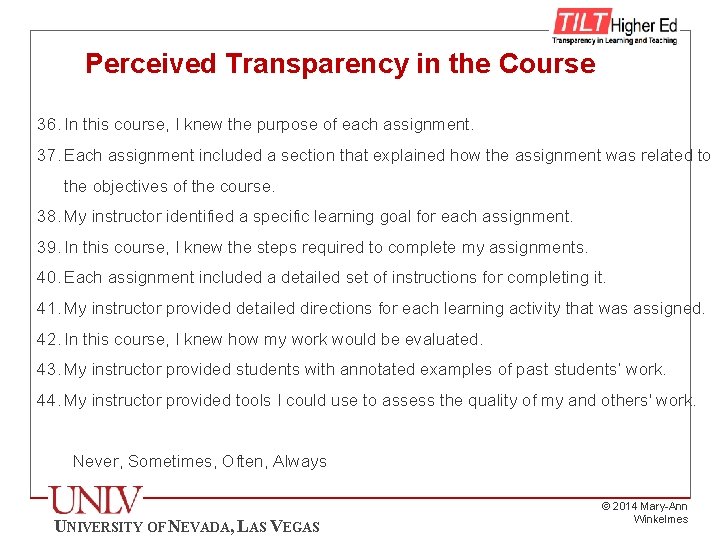
Perceived Transparency in the Course 36. In this course, I knew the purpose of each assignment. 37. Each assignment included a section that explained how the assignment was related to the objectives of the course. 38. My instructor identified a specific learning goal for each assignment. 39. In this course, I knew the steps required to complete my assignments. 40. Each assignment included a detailed set of instructions for completing it. 41. My instructor provided detailed directions for each learning activity that was assigned. 42. In this course, I knew how my work would be evaluated. 43. My instructor provided students with annotated examples of past students’ work. 44. My instructor provided tools I could use to assess the quality of my and others' work. Never, Sometimes, Often, Always UNIVERSITY OF NEVADA, LAS VEGAS © 2014 Mary-Ann Winkelmes
UNIVERSITY OF NEVADA, LAS VEGAS © 2014 Mary-Ann Winkelmes
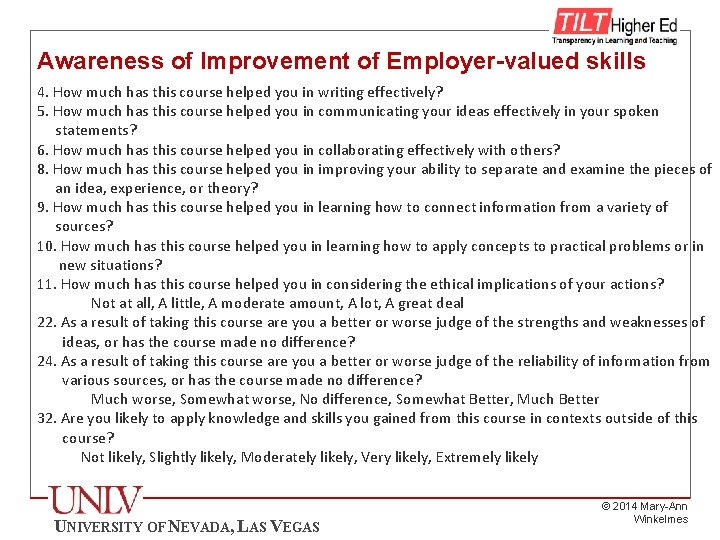
Awareness of Improvement of Employer-valued skills 4. How much has this course helped you in writing effectively? 5. How much has this course helped you in communicating your ideas effectively in your spoken statements? 6. How much has this course helped you in collaborating effectively with others? 8. How much has this course helped you in improving your ability to separate and examine the pieces of an idea, experience, or theory? 9. How much has this course helped you in learning how to connect information from a variety of sources? 10. How much has this course helped you in learning how to apply concepts to practical problems or in new situations? 11. How much has this course helped you in considering the ethical implications of your actions? Not at all, A little, A moderate amount, A lot, A great deal 22. As a result of taking this course are you a better or worse judge of the strengths and weaknesses of ideas, or has the course made no difference? 24. As a result of taking this course are you a better or worse judge of the reliability of information from various sources, or has the course made no difference? Much worse, Somewhat worse, No difference, Somewhat Better, Much Better 32. Are you likely to apply knowledge and skills you gained from this course in contexts outside of this course? Not likely, Slightly likely, Moderately likely, Very likely, Extremely likely UNIVERSITY OF NEVADA, LAS VEGAS © 2014 Mary-Ann Winkelmes
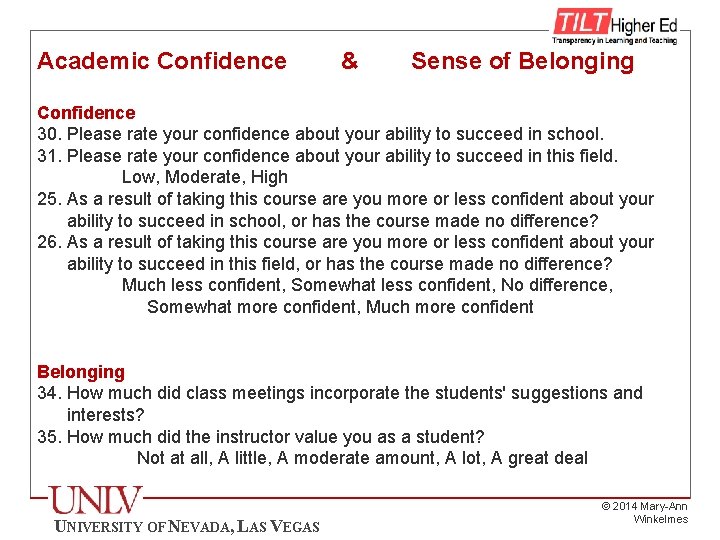
Academic Confidence & Sense of Belonging Confidence 30. Please rate your confidence about your ability to succeed in school. 31. Please rate your confidence about your ability to succeed in this field. Low, Moderate, High 25. As a result of taking this course are you more or less confident about your ability to succeed in school, or has the course made no difference? 26. As a result of taking this course are you more or less confident about your ability to succeed in this field, or has the course made no difference? Much less confident, Somewhat less confident, No difference, Somewhat more confident, Much more confident Belonging 34. How much did class meetings incorporate the students' suggestions and interests? 35. How much did the instructor value you as a student? Not at all, A little, A moderate amount, A lot, A great deal UNIVERSITY OF NEVADA, LAS VEGAS © 2014 Mary-Ann Winkelmes
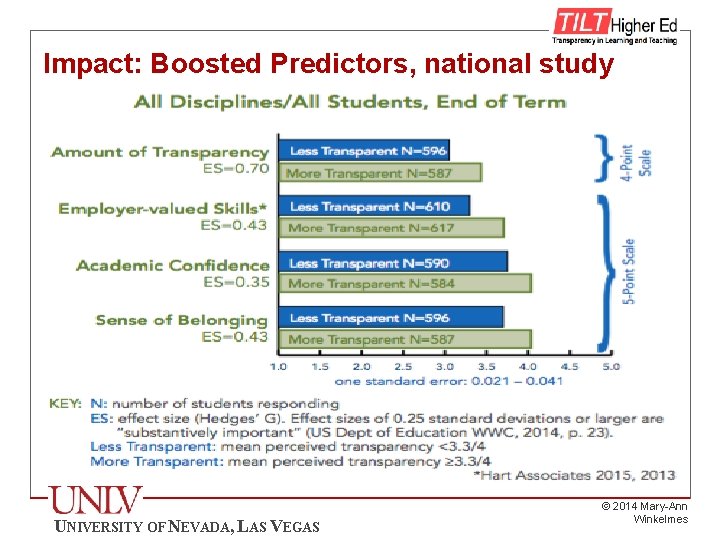
Impact: Boosted Predictors, national study UNIVERSITY OF NEVADA, LAS VEGAS © 2014 Mary-Ann Winkelmes
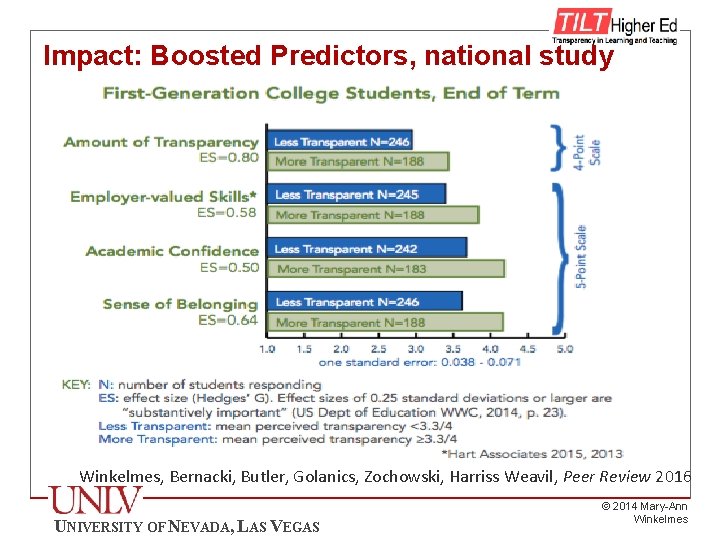
Impact: Boosted Predictors, national study Winkelmes, Bernacki, Butler, Golanics, Zochowski, Harriss Weavil, Peer Review 2016 UNIVERSITY OF NEVADA, LAS VEGAS © 2014 Mary-Ann Winkelmes
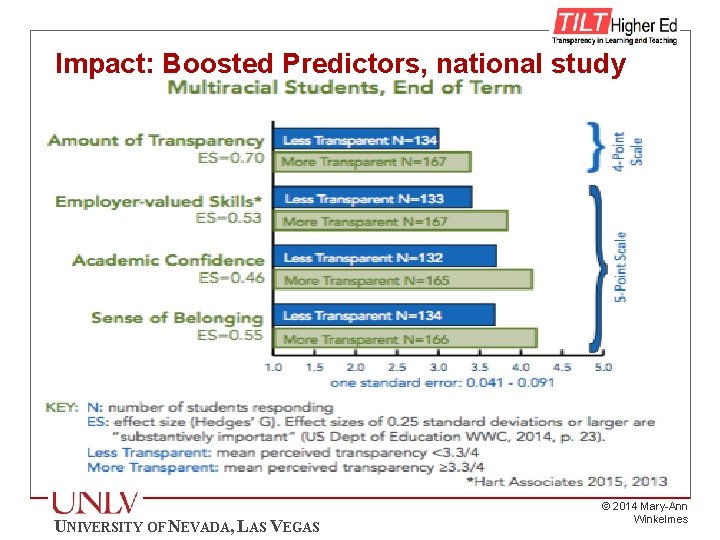
Impact: Boosted Predictors, national study UNIVERSITY OF NEVADA, LAS VEGAS © 2014 Mary-Ann Winkelmes
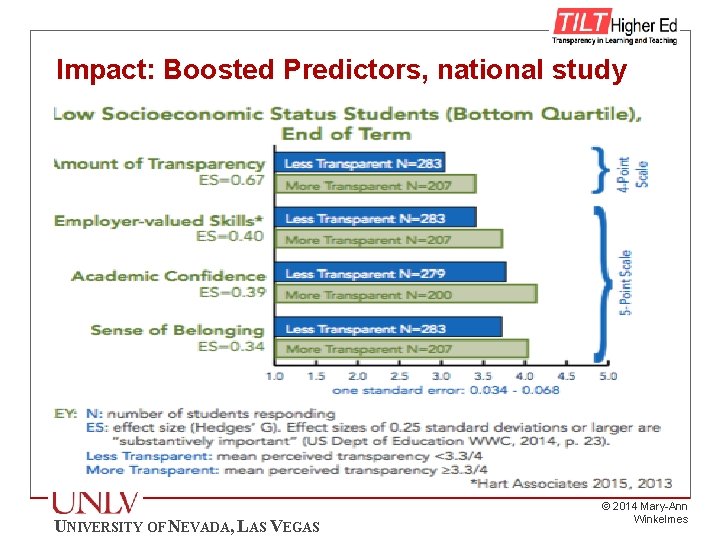
Impact: Boosted Predictors, national study UNIVERSITY OF NEVADA, LAS VEGAS © 2014 Mary-Ann Winkelmes
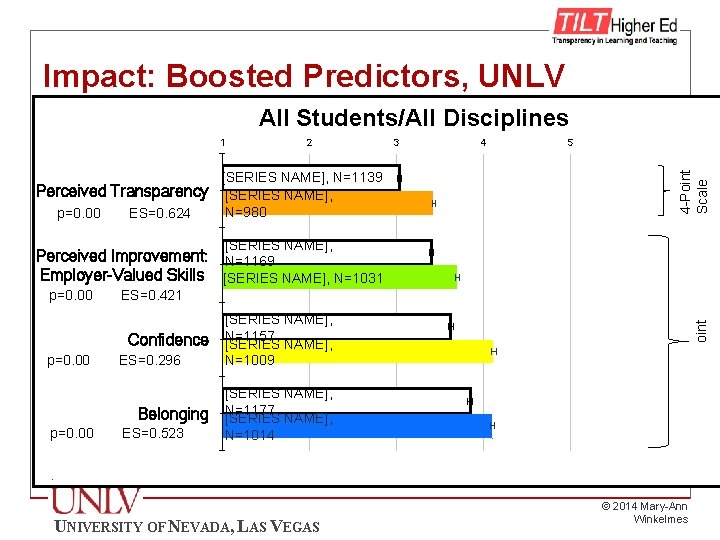
Impact: Boosted Predictors, UNLV All Students/All Disciplines 2 [SERIES NAME], N=1139 Perceived Transparency [SERIES NAME], N=980 p=0. 00 ES=0. 624 3 4 5 4 -Point Scale 1 [SERIES NAME], Perceived Improvement: N=1169 Employer-Valued Skills [SERIES NAME], N=1031 ES=0. 421 p=0. 00 ES=0. 296 Belonging p=0. 00 ES=0. 523 5 -Point Confidence [SERIES NAME], N=1157 [SERIES NAME], N=1009 [SERIES NAME], N=1177 [SERIES NAME], N=1014 . UNIVERSITY OF NEVADA, LAS VEGAS © 2014 Mary-Ann Winkelmes
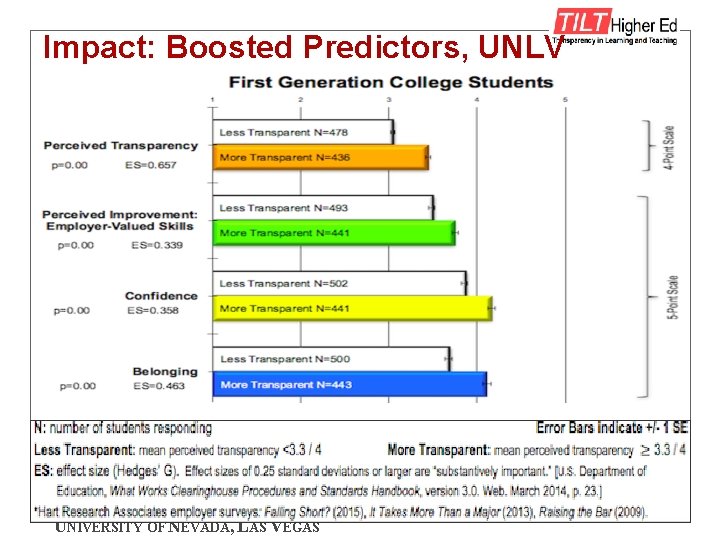
Impact: Boosted Predictors, UNLV UNIVERSITY OF NEVADA, LAS VEGAS © 2014 Mary-Ann Winkelmes
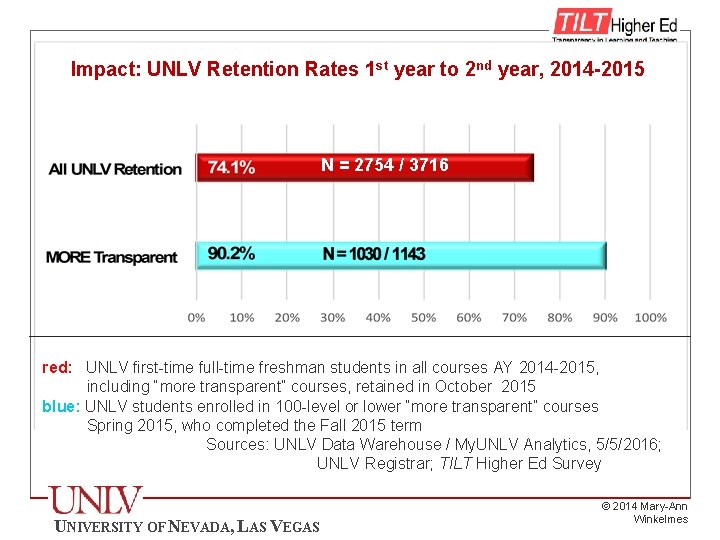
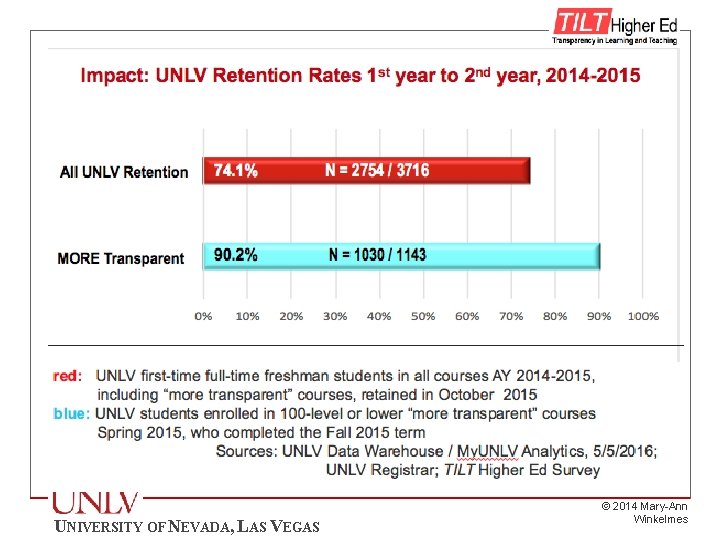
Impact: UNLV Retention Rates 1 st year to 2 nd year, 2014 -2015 N = 2754 / 3716 red: UNLV first-time full-time freshman students in all courses AY 2014 -2015, including “more transparent” courses, retained in October 2015 blue: UNLV students enrolled in 100 -level or lower “more transparent” courses Spring 2015, who completed the Fall 2015 term Sources: UNLV Data Warehouse / My. UNLV Analytics, 5/5/2016; UNLV Registrar; TILT Higher Ed Survey UNIVERSITY OF NEVADA, LAS VEGAS © 2014 Mary-Ann Winkelmes
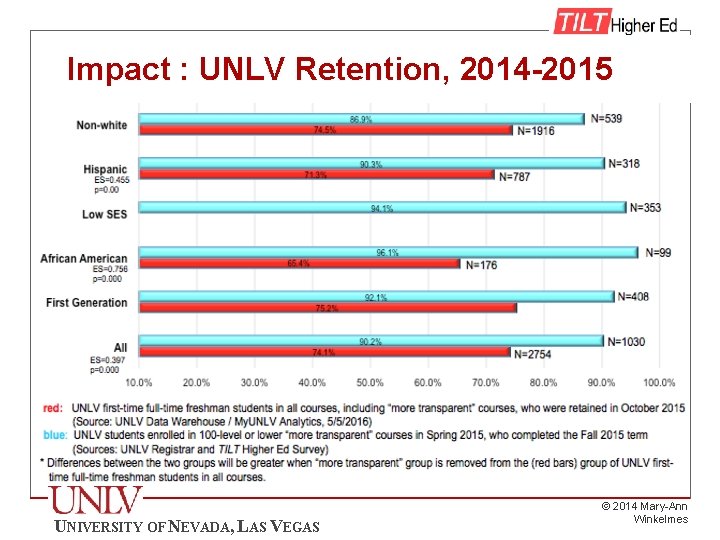
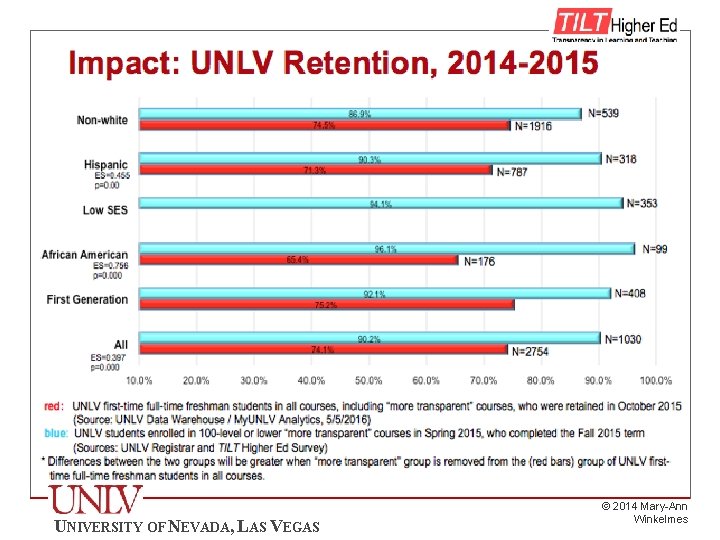
Impact : UNLV Retention, 2014 -2015 UNIVERSITY OF NEVADA, LAS VEGAS © 2014 Mary-Ann Winkelmes
UNLV General Education Assessment Summit, 2014 FYS Instructors surveyed: • placed “Major Emphasis” on communication skills: – Effective writing within a discipline – Collaborate effectively with others UNIVERSITY OF NEVADA, LAS VEGAS © 2014 Mary-Ann Winkelmes
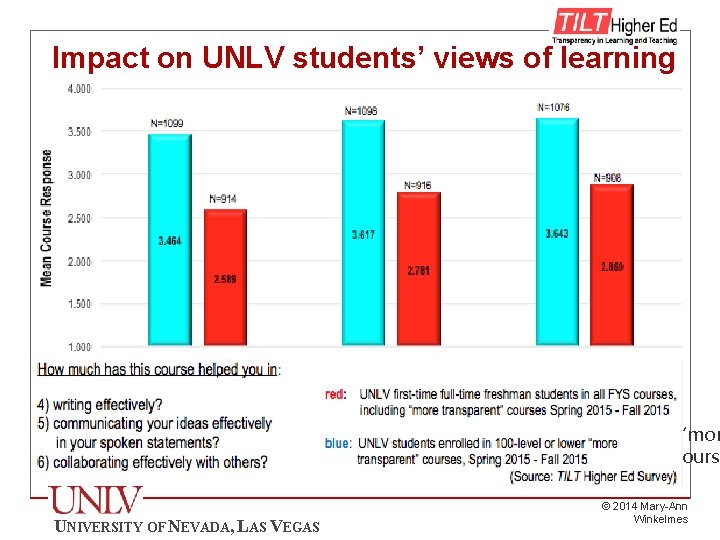
Impact on UNLV students’ views of learning How much did this course help you in: written communication spoken comm collaborating effectively red: UNLV first-time full-time freshman students in all courses, including “mor blue: UNLV students enrolled in 100 -level or lower “more transparent” course UNIVERSITY OF NEVADA, LAS VEGAS © 2014 Mary-Ann Winkelmes
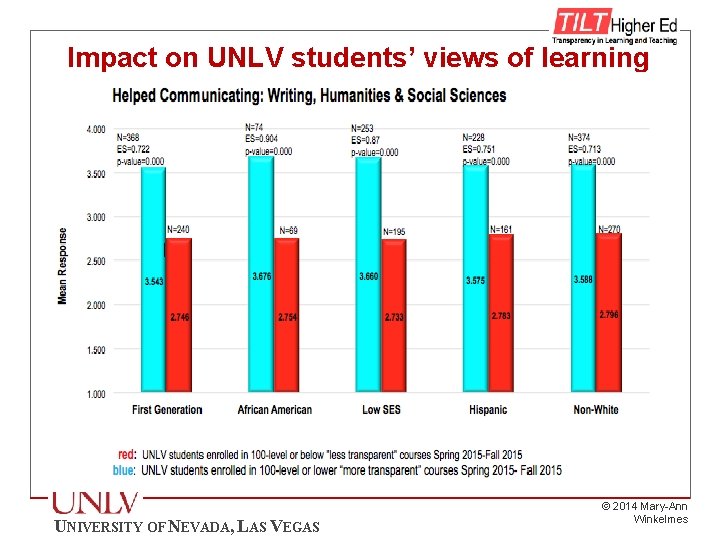
Impact on UNLV students’ views of learning UNIVERSITY OF NEVADA, LAS VEGAS © 2014 Mary-Ann Winkelmes
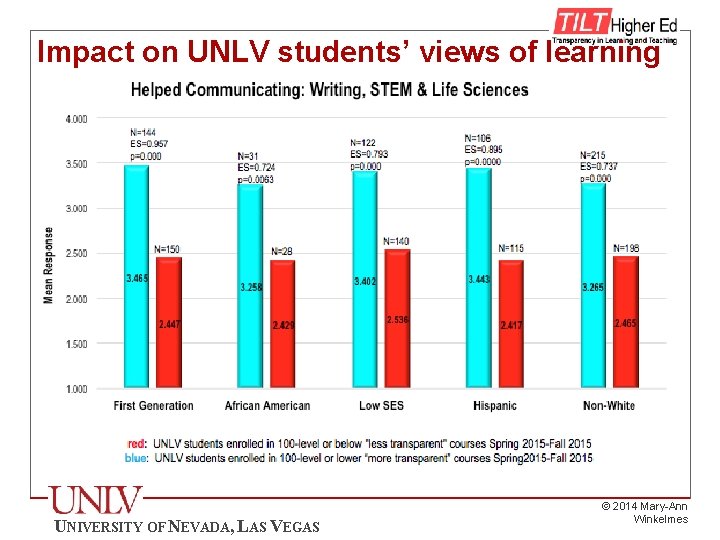
Impact on UNLV students’ views of learning UNIVERSITY OF NEVADA, LAS VEGAS © 2014 Mary-Ann Winkelmes
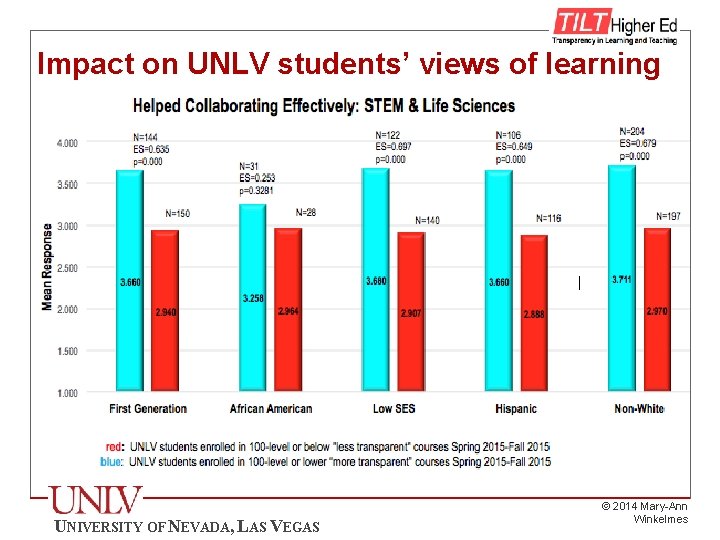
Impact on UNLV students’ views of learning UNIVERSITY OF NEVADA, LAS VEGAS © 2014 Mary-Ann Winkelmes
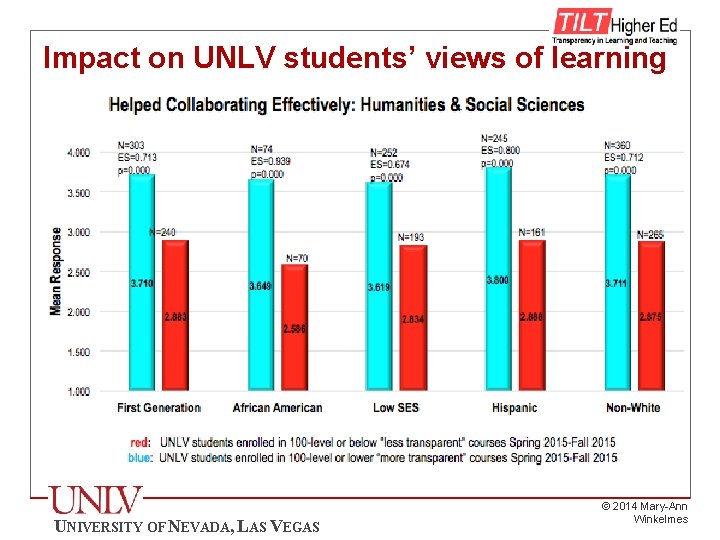
Impact on UNLV students’ views of learning UNIVERSITY OF NEVADA, LAS VEGAS © 2014 Mary-Ann Winkelmes
Strategies for Impact • Courses: Intro (large, small), Gateway, High DWF, Majors/Pathways, Gen Ed • Networks: Community Colleges, Research Intensive, Liberal Arts, Regional, Teaching/Learning Centers, STEM Ed Ctrs, Disciplinary Association conferences. . . UNIVERSITY OF NEVADA, LAS VEGAS © 2014 Mary-Ann Winkelmes
Questions and Comments UNIVERSITY OF NEVADA, LAS VEGAS © 2014 Mary-Ann Winkelmes
DISCUSS in groups; Report back Individual Instructors • What resources do you need to implement transparently designed assignments at your own discretion in your own courses? • Where can you find those resources? UNIVERSITY OF NEVADA, LAS VEGAS © 2014 Mary-Ann Winkelmes
DISCUSS in groups; Report back Institutions • What specific goals at your institution might benefit from an inclusive teaching initiative? – retention rates – graduation rates – increased diversity of students, and/or faculty and staff – increased student satisfaction, faculty/staff satisfaction – community engagement – research productivity – scholarship of teaching and learning UNIVERSITY OF NEVADA, LAS VEGAS © 2014 Mary-Ann Winkelmes
DISCUSS in groups; Report back Institutions What kinds of courses would help us achieve the greatest impact on underserved students? • intro (large, small); freshman seminars; remedial/bridge; • High DFW; Gen Ed; Pathways through major; Gateway What kinds of campus units might make strong partners in an inclusive teaching initiative? • academic advising; tutoring; campus recreation • Library; registrar; community engagement / diversity • online education; continuing education UNIVERSITY OF NEVADA, LAS VEGAS © 2014 Mary-Ann Winkelmes
Please join us! http: //www. unlv. edu/provost/teachingandlearning http: //tinyurl. com/jsqykkh Transparent 2 nd Tuesdays at 2: 00 pm https: //zoom. us/s/337401450 UNIVERSITY OF NEVADA, LAS VEGAS © 2014 Mary-Ann Winkelmes
Available Resources: • TILT Survey and team reports on impact (confidence, belonging, employer skills) • DRAFT Checklist for designing a Transparent Assignment • DRAFT pilot test: Feedback from students to revise instructions for increased transparency UNIVERSITY OF NEVADA, LAS VEGAS © 2014 Mary-Ann Winkelmes
- Slides: 68