
Transparency tube as a surrogate for turbidity suspended

Transparency tube as a surrogate for turbidity, suspended solids and total phosphorus in rivers and reservoirs Nicole Reid, Jane Herbert , and Dean Baas MSU Extension Land & Water Program W. K. Kellogg Biological Station

Transparency Tube 120 cm tall clear plastic tube with a Secchi disk pattern at the bottom and ruler (cm) along side. The tube measures water transparency in streams. Transparency – a measure of how much light passes through the water. Transparency is effected by turbidity Turbidity – measurement of the amount of light scattered by particles in the water. Particles: sand, clay and algae Some effects of high turbidity on water quality • Increase in Temperature • Decrease in Oxygen • Decrease in light penetration • Lost of habitat for aquatic organisms • REDUCES WATER CLARITY
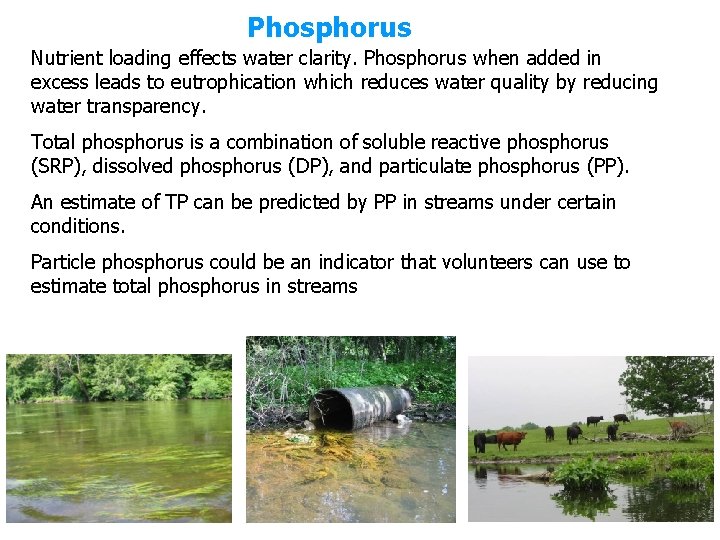
Phosphorus Nutrient loading effects water clarity. Phosphorus when added in excess leads to eutrophication which reduces water quality by reducing water transparency. Total phosphorus is a combination of soluble reactive phosphorus (SRP), dissolved phosphorus (DP), and particulate phosphorus (PP). An estimate of TP can be predicted by PP in streams under certain conditions. Particle phosphorus could be an indicator that volunteers can use to estimate total phosphorus in streams

Project Objective To evaluate the effectiveness of using transparency tubes to estimate total suspended solids (TSS), turbidity (NTU), and total phosphorus (TP) for the purpose of establishing a volunteer phosphorus monitoring network. Kalamazoo River watershed Area: 5, 230 km 2 Thirteen sampling sites, including tributaries were sampled once a week for 10 weeks (June-September 2005). Six run-of-river impoundments on the main stem Small tributary discharge varied from 24 - 63 cfs, main stem discharged varied from 640 – 2340 cfs

Methods Samples were collected without disturbing sediments or surface debris Tube was filled Water was released back into the bucket The height of the water was recorded. The average of two readings was final transparency reading. Released valve was closed when Secchi disk becomes barely visible (target endpoint) Turbidity reading were taken on site and TSS and TP were determine by lab analysis
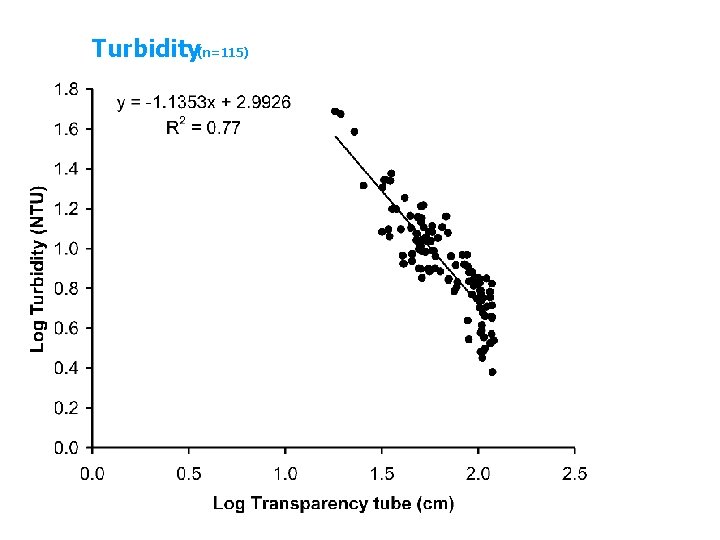
Turbidity(n=115)
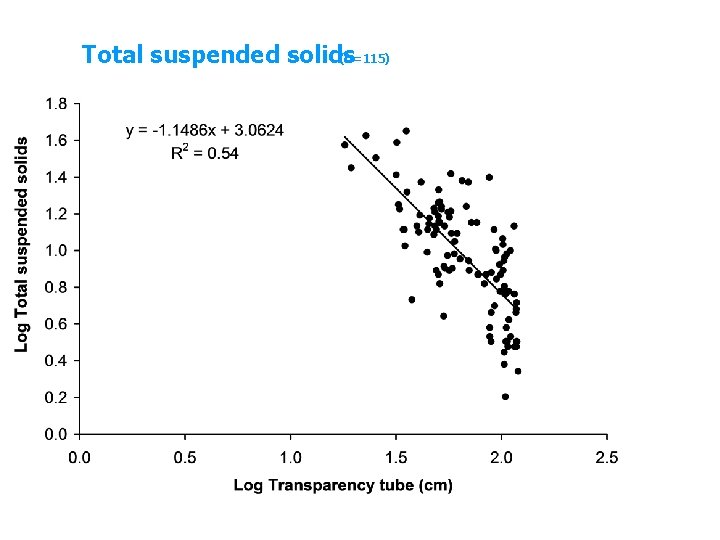
Total suspended solids (n=115)
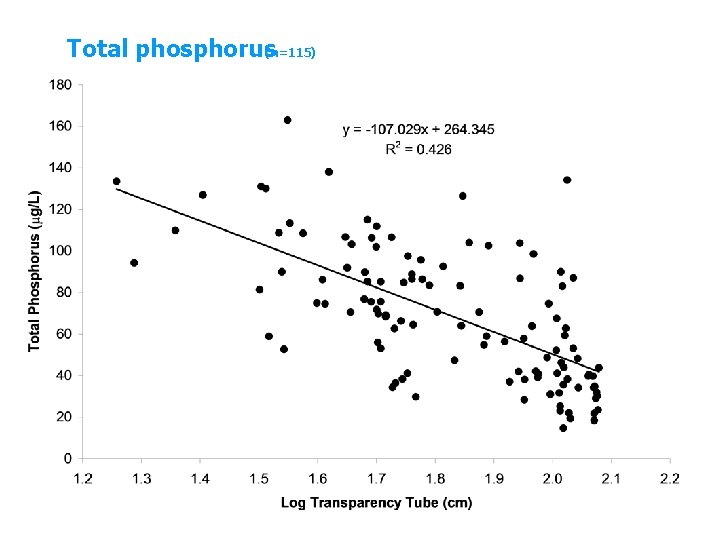
Total phosphorus(n=115)

Results • The transparency tube was a good predictor of turbidity (R 2=0. 78) Transparency tube and turbidity measures similar stream properties (scattering of light by particulates) • The decrease in correlation with total suspended solids (R 2=0. 55) Particles vary in size, shape, and composition within a stream. Indicating that there is no universal relationship among sites and so the sites are unique • Site uniqueness pattern continues for total phosphorus concentrations in streams (R 2=0. 42) Total phosphorus has 3 forms and those forms may vary in concentration and particulate (PP) form is important for transparency.
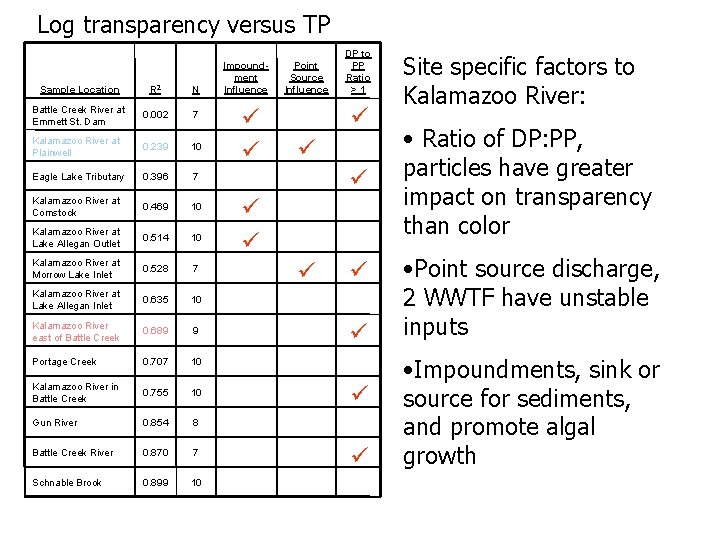
Log transparency versus TP Sample Location R 2 N Battle Creek River at Emmett St. Dam 0. 002 7 Kalamazoo River at Plainwell 0. 239 10 Eagle Lake Tributary 0. 396 7 Kalamazoo River at Comstock 0. 469 10 Kalamazoo River at Lake Allegan Outlet 0. 514 10 Kalamazoo River at Morrow Lake Inlet 0. 528 7 Kalamazoo River at Lake Allegan Inlet 0. 635 10 Kalamazoo River east of Battle Creek 0. 689 9 Portage Creek 0. 707 10 Kalamazoo River in Battle Creek 0. 755 10 Gun River 0. 854 8 Battle Creek River 0. 870 7 Schnable Brook 0. 899 10 Impoundment Influence ü ü Point Source Influence DP to PP Ratio >1 ü ü ü ü ü Site specific factors to Kalamazoo River: • Ratio of DP: PP, particles have greater impact on transparency than color • Point source discharge, 2 WWTF have unstable inputs • Impoundments, sink or source for sediments, and promote algal growth
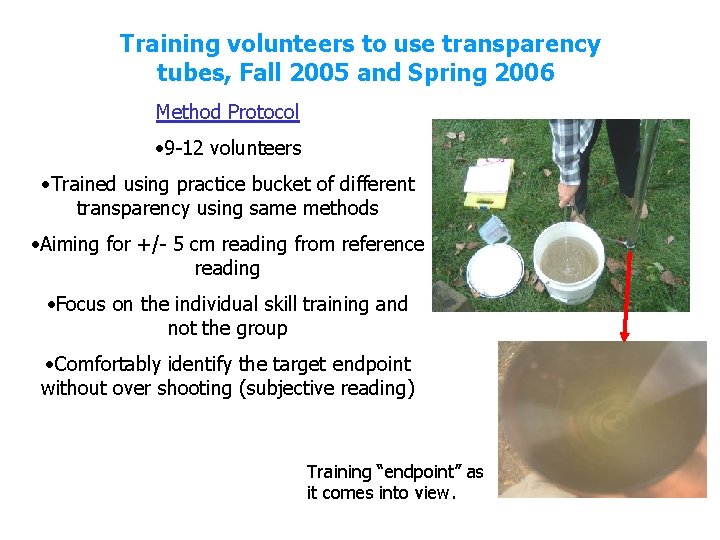
Training volunteers to use transparency tubes, Fall 2005 and Spring 2006 Method Protocol • 9 -12 volunteers • Trained using practice bucket of different transparency using same methods • Aiming for +/- 5 cm reading from reference reading • Focus on the individual skill training and not the group • Comfortably identify the target endpoint without over shooting (subjective reading) Training “endpoint” as it comes into view.
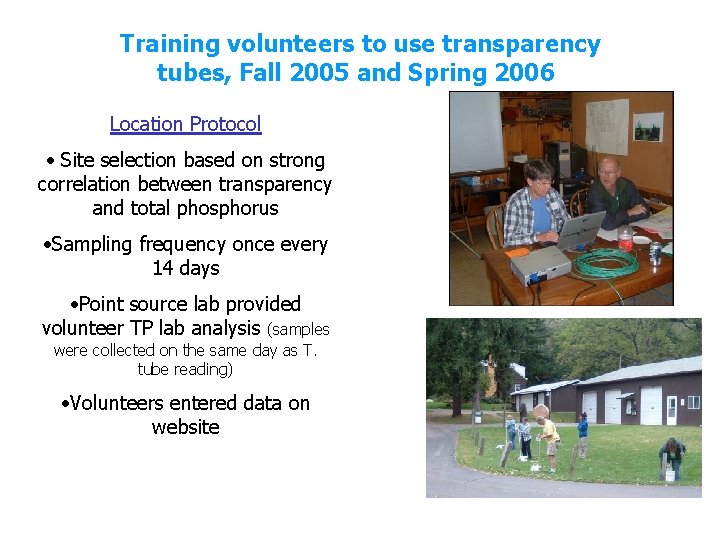
Training volunteers to use transparency tubes, Fall 2005 and Spring 2006 Location Protocol • Site selection based on strong correlation between transparency and total phosphorus • Sampling frequency once every 14 days • Point source lab provided volunteer TP lab analysis (samples were collected on the same day as T. tube reading) • Volunteers entered data on website

Conclusions Data Water clarity measured by transparency tube provided information for general water quality (turbidity) Establish individual site correlation each site is unique and influence by site characteristics Volunteer program Focus on outdoor individual skill training in order to develop consistent transparency tube readings Focus on recognizing the target endpoint – DO NOT go pass target endpoint Estimates of total phosphorus in certain sites can be obtained with transparency tube in volunteer hands
Acknowledgments CSREES Water Quality Program David Weed – Total phosphorus lab analysis Kalamazoo River/Lake Allegan TMDL Implementation Committee Kellogg Biological Station
- Slides: 14