
TRANSPARENCY AND OPENNESS IN LOCAL GOVERNMENT From bazaar
TRANSPARENCY AND OPENNESS IN LOCAL GOVERNMENT From bazaar to modern budgets: the case of funds for investments Sorin Ioniţă Sorin. ionita@expertforum. ro Sofia, Mar 2016 1
Good governance at local level “Good governance” = opposite of corruption / clientelism in broader sense Three angles when assessing it: 1. How much is it present out there: objective evaluations 2. How much is it perceived by public, experts, etc: surveys, panels (subjective) 3. How much do the governments do to address it: policy action (institutions, targets) 2
Good governance at local level 2. Is the most popular with the public opinion, media (easy target) 3. Is monitored in reform programs and tied to conditionality by partners (ex. MCV for BG, RO) 1. Is the most difficult, but also most relevant: it goes directly to realities and social effects Proxies needed for this assessments 3
The case of local procurement ● One of the most sensitive and debated topic by the public opinion in NMS ● In engages vast resources, mostly from the national budget (not only EU funds) ● It is related to the process of innovation ● Most investments funds for local governments (LGs) come in the form of transfers from the central government ● Is this a problem? 4

The case of local procurement Private sector Public sector Government (Finance, Reg Development, Transp, Environment, etc) Intra-gov allocation Contracting authority (mayor) Procurement Contractor (firm) 5
Public Procurement 2. 0 The view of PP should be broader: ● Intra-gov transfers (IGFT) for investments (step 1) should also be transparent, predictable, competitive ● Best practices from pre-accession times? ● If IGFT are opaque, discretionary and possibly clientelistic, how likely is it that step 2 (PP) will be clean ? ! 6
Not very likely! Clientelism ● Local good governance and innovation happen only with right incentives: transparency, openness ● Money with short time horizon are used badly: the “souq” (bazaar) public finance; limitations to efficiency ● Bazaar budgeting (like bazaar economy) does not innovate or invest in capacity; it is spot-market and opportunistic ● Only stable rules allow “deep benefits”: multi-year planning and value-for-money 7
Not very likely! Clientelism Example: The funds for investments in RO, 20042011 (6 instruments, national budget, not EU grants) ● They represent 84% of investments in the 3160 municipalities and 41 County Coucils ● Virtually all the funds for local innovative initiatives 8
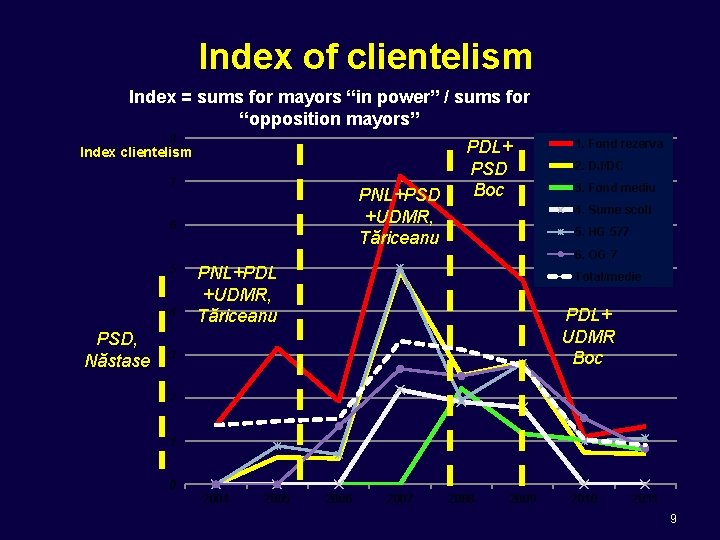
Index of clientelism Index = sums for mayors “in power” / sums for “opposition mayors” 8 Index clientelism 7 PNL+PSD +UDMR, Tăriceanu 6 5 4 PSD, Năstase PDL+ PSD Boc 1. Fond rezerva 2. DJ/DC 3. Fond mediu 4. Sume scoli 5. HG 577 6. OG 7 PNL+PDL +UDMR, Tăriceanu Total/medie PDL+ UDMR Boc 3 2 1 0 2004 2005 2006 2007 2008 2009 2010 2011 9
Conclusions ● The years of economic boom (2006 -08) were those with the biggest budgets and maximum clientelism ● Financially weak local governments are easy prey for political buy-off ● Intra-government allocations must be regarded as part of the broader Public Procurement process: full circle ● View shared lately by DG Markt. Can we link it with the European semester? 10
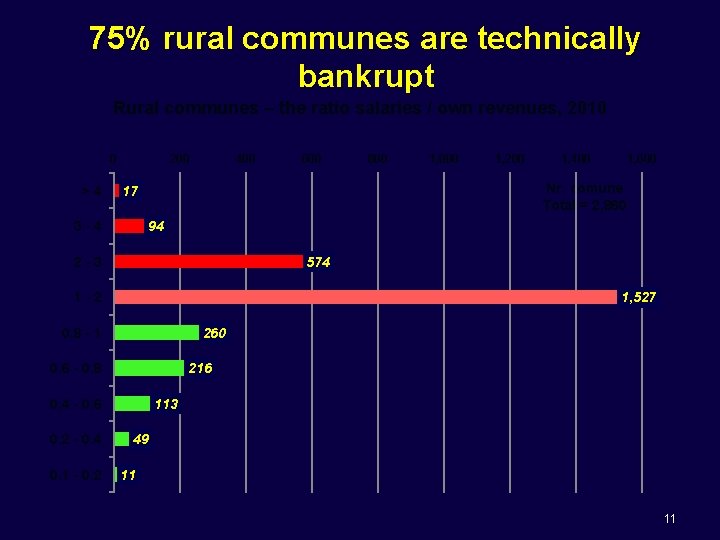
75% rural communes are technically bankrupt Rural communes – the ratio salaries / own revenues, 2010 0 >4 200 400 1, 000 1, 200 1, 400 1, 600 94 2 -3 574 1 -2 1, 527 0. 8 - 1 260 0. 6 - 0. 8 216 0. 4 - 0. 6 0. 1 - 0. 2 800 Nr. comune Total = 2, 860 17 3 -4 0. 2 - 0. 4 600 113 49 11 11
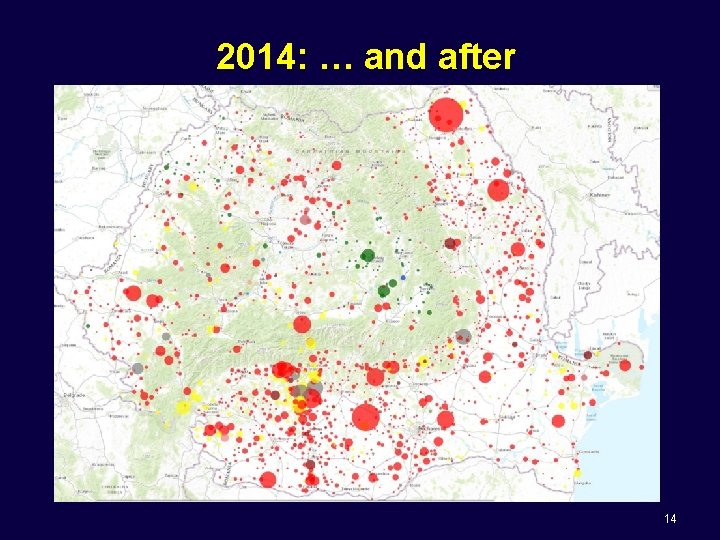
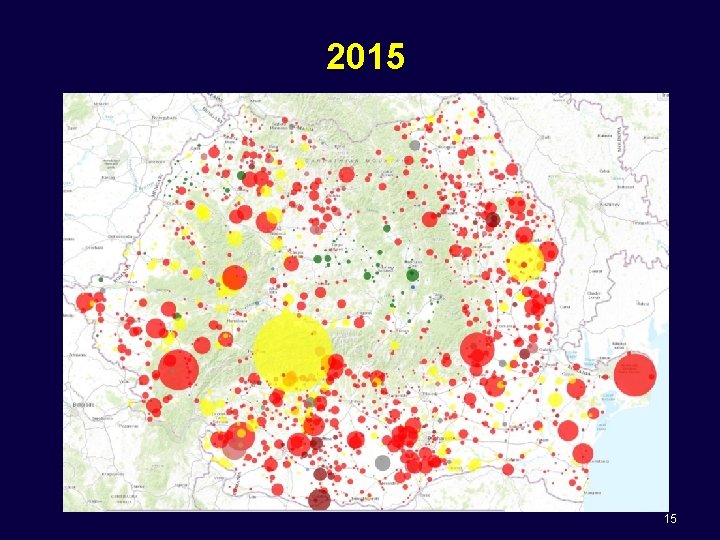
Allocations and political migration ● Right now we analyze the allocations over the interval 2012 -2015 ● Strong relation between sums received and the political migration of mayors (switching over to parties in power) ● “The great wave” of migration in 2014 (about 20% mayors and local councilors) – coincided with the electoral campaigns: local and national 12
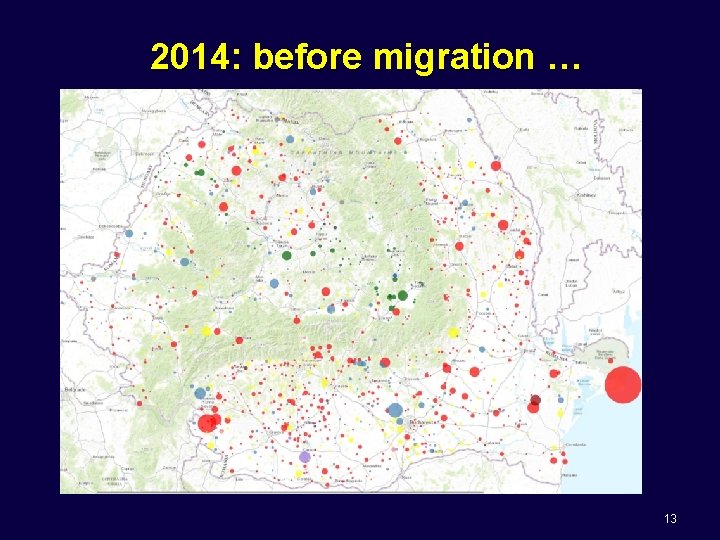
2014: before migration … 13
2014: … and after 14
2015 15
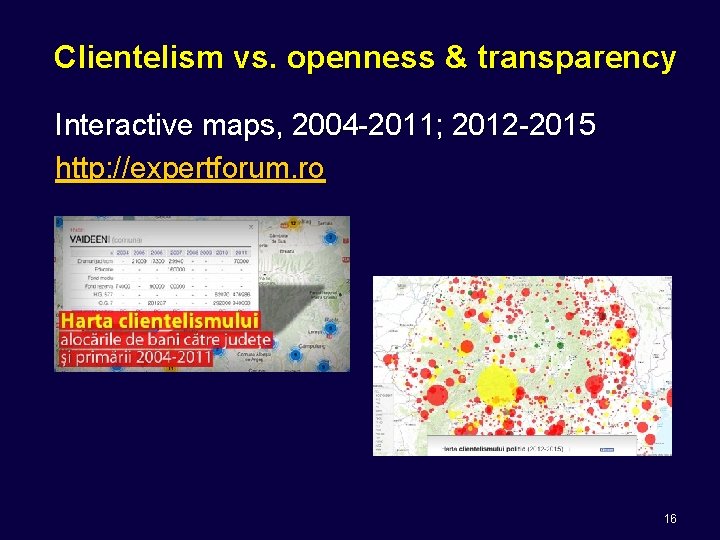
Clientelism vs. openness & transparency Interactive maps, 2004 -2011; 2012 -2015 http: //expertforum. ro 16
SOEs project In 4 states: RO, BG, CZ, IT SOEs are in CEE the main avenue left for grand corruption / state capture 3 channels of clientelism 1. Over-estimated procurement (sifonare) 2. Selling below market, products or assets (net social loss) 3. Clientelism in HR: nepotism, salarizare, etc (OECD) 17
- Slides: 17