
TRANSPARENCY AND CHOICE IN LEARNING HEALTHCARE SYSTEMS JEFFREY
![Learning Healthcare Systems • “[T]he underlying concept is straightforward: harness the power of data](https://slidetodoc.com/presentation_image/5af5f0fa687c8b9e20a432c6d4a5d137/image-4.jpg "Learning Healthcare Systems • “[T]he underlying concept is straightforward: harness the power of data")

- Slides: 30
TRANSPARENCY AND CHOICE IN LEARNING HEALTHCARE SYSTEMS JEFFREY R. BOTKIN, M. D. , M. P. H. Professor of Pediatrics Chief, Division of Medical Ethics and Humanities Associate Vice President for Research University of Utah
Conflicts of Interest • I have no financial relationships that might create a COI for this presentation 2 Botkin 2016
Objectives • Highlight controversies due to lack of transparency in secondary uses of data and biospecimens • Highlight the challenges with informed consent for research in learning healthcare systems • Discuss an approach to transparency and Botkin 2016 3
Learning Healthcare Systems • “[T]he underlying concept is straightforward: harness the power of data and analytics to learn from every patient, and feed the knowledge of “what works best” back to clinicians, public health professionals, patients, and other stakeholders to create cycles of continuous improvement. ” Friedman C et al. Toward a science of learning systems: a research agenda for the high functioning Learning Health System. J Am Med Inform Assoc 2015; 22: 43. 4 Botkin 2016
Ethical Issues • Set aside: Ø Ethical justification for institutional access to personal information for purposes beyond individual benefit Ø Distinctions between research and QA/QI Ø Distinctions between data and biospecimens Ø Consent for specific trials (e. g. , pragmatic RCT’s) • How do we manage potential concerns over privacy and confidentiality for patients in a learning healthcare system? • How do earn and maintain trust? 5 Botkin 2016
Data and Biospecimen Research • Controversies focus on secondary uses of data and biospecimens obtained for clinical purposes Ø No consent typically obtained for research uses Ø May be limited notification about practices in admission consent agreements 6 Botkin 2016
Research Ethics • The federal regulations allow research to be conducted with data and biospecimens without individual consent in many circumstances Ø Research with de-identified data/biospecimens is not human subjects research Ø Waiver/consent alteration criteria for consent are often met in this domain • This domain of research is highly productive and very Botkin 2016 risk low 7
Research Ethics • The conduct of research with data and biospecimens without individual consent is ethically acceptable to investigators, research institutions and IRB’s • Lack of knowledge or consent not acceptable to many in the lay public 8 Botkin 2016
Risks Associated with Data and Biospecimen Research • Few instances of “welfare harms” from data or biospecimen research • Several high-profile instances of “dignitary harms” Ø Henrietta Lacks case Ø Havasupai Tribal case Ø Newborn screening lawsuits Ø The Moore Case Botkin 2016 9
Federal Notice of Proposed Rulemaking (NPRM) for Human Subjects Regulations • NPRM proposed to extend the definition of “human subject” to biospecimens whether or not they are identifiable • Broad consent from individuals would be necessary before biospecimens could be used for research Ø Criteria for waiver of consent would be limited 10 Botkin 2016
Newborn Screening Saves Lives Reauthorization Act of 2014 • Stipulations Ø Research with newborn screening dried bloodspots is humans subjects research whether or not they are deidentified Ø Waiver of parental consent for research use is not permissible Ø This law will be superseded by anticipated changes in the Common Rule Botkin 2016 11
NBS Saves Lives Act • New consent provisions difficult to implement because no consent for NBS • Post partum period is short, hectic, and with many clinical priorities • Consent process likely to result in a substantial decrease in available DBS for research 12 Botkin 2016
Public Responses to NPRM • Biospecimen elements Ø Strongly opposed by academic health centers • Highly burdensome process and ineffective consent model Ø Opposed by lay advocacy groups for health conditions • Might inhibit important research Ø Opposed by commenters from the general public 13 • Concerned about any waiver of consent Botkin 2016
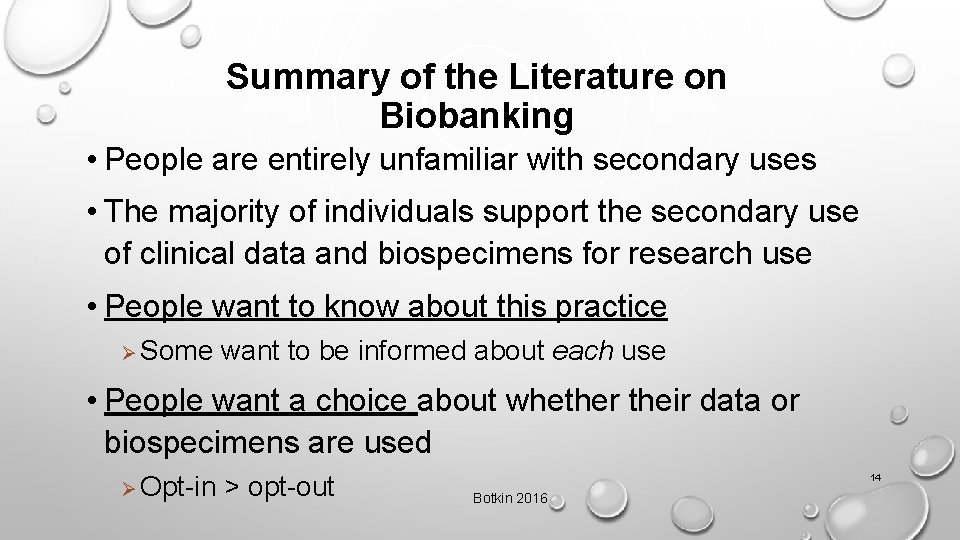
Summary of the Literature on Biobanking • People are entirely unfamiliar with secondary uses • The majority of individuals support the secondary use of clinical data and biospecimens for research use • People want to know about this practice Ø Some want to be informed about each use • People want a choice about whether their data or biospecimens are used Ø Opt-in > opt-out 14 Botkin 2016
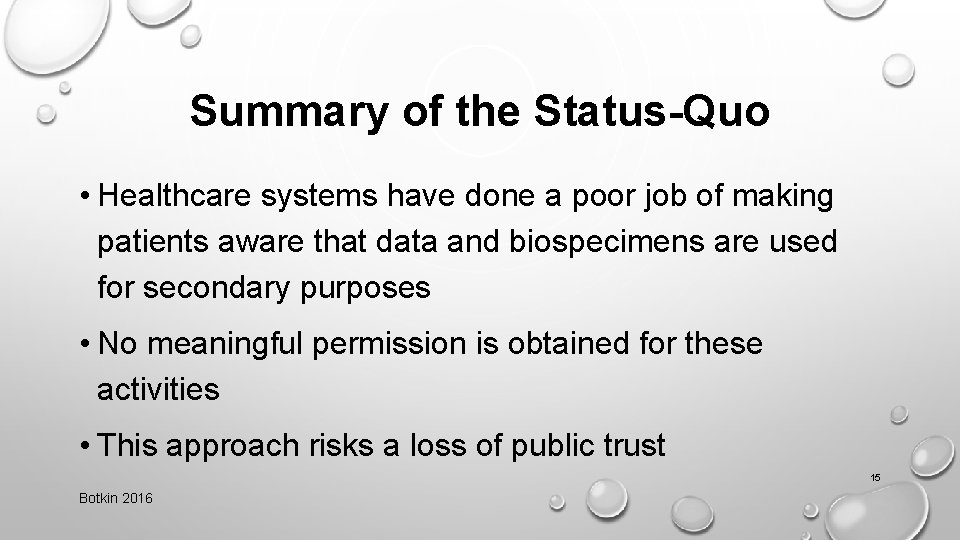
Summary of the Status-Quo • Healthcare systems have done a poor job of making patients aware that data and biospecimens are used for secondary purposes • No meaningful permission is obtained for these activities • This approach risks a loss of public trust 15 Botkin 2016
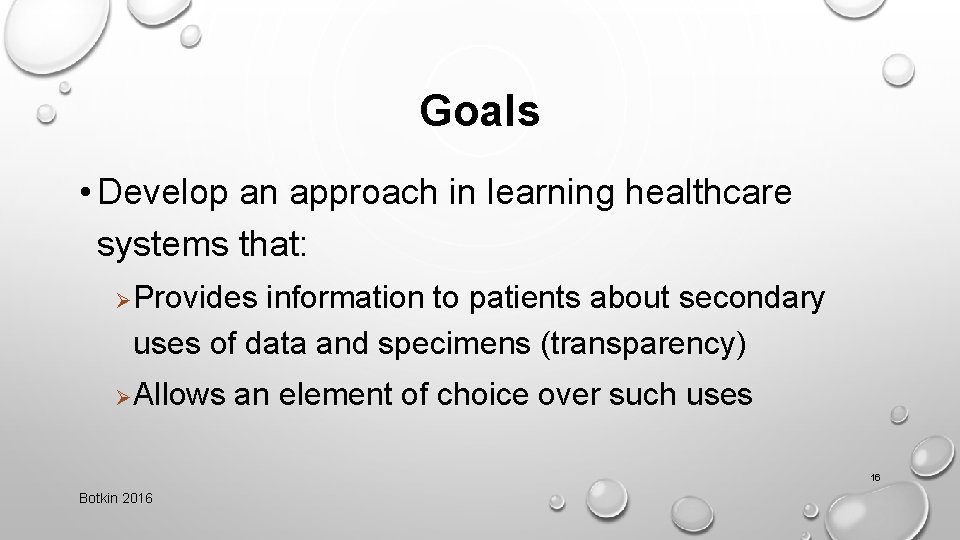
Goals • Develop an approach in learning healthcare systems that: Ø Provides information to patients about secondary uses of data and specimens (transparency) Ø Allows an element of choice over such uses 16 Botkin 2016
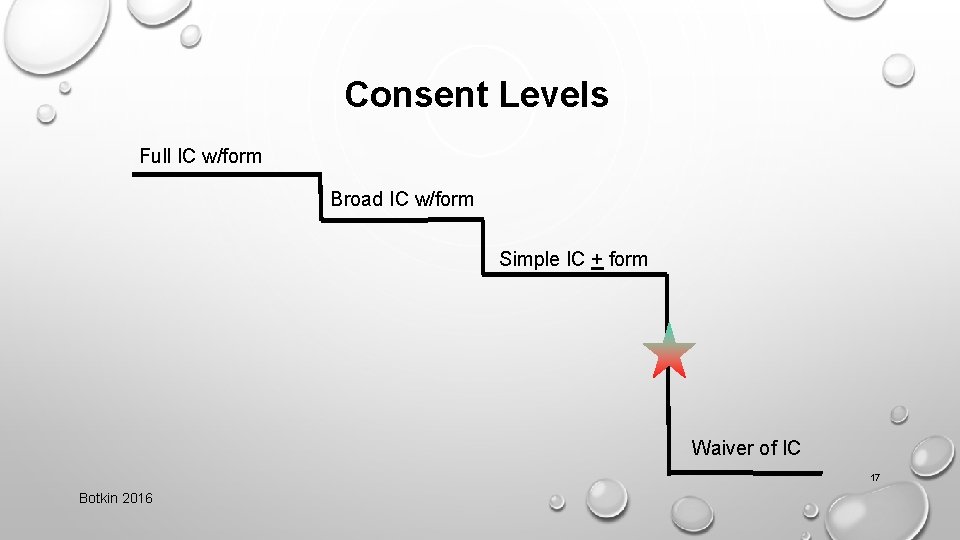
Consent Levels Full IC w/form Broad IC w/form Simple IC + form Waiver of IC 17 Botkin 2016
Informed Consent Challenges • Forms are increasingly complex • Comprehension is limited even when best practices are used • Federal regulations do not require comprehension or an assessment of comprehension • Psychological orientation of patients fosters misconceptions • Few incentives for any of the stakeholders to improve comprehension Botkin 2016 18
Informed Consent • Founded on the notion of “autonomous authorization” (Faden and Beauchamp 1986) Ø Intentional Ø With understanding Ø Without controlling influence 19 Botkin 2016
Informed Consent • What if “autonomous authorization” is not a realistic goal? Ø Can we define more limited goals that permit research when fully autonomous authorization cannot be achieved? Ø Are there different ways to think about the obligations to sources of data and biospecimens? 20 Botkin 2016
The “Fair Transaction Model” of Informed Consent • Franklin Miller & Alan Wertheimer. “The Ethical Challenges of Human Research” Oxford Press 2012 Ø “The criteria for assessing the validity of consent transactions should be based on fair terms of cooperation for the respective parties that reflect the context of the activity for which consent is given. ” • Fairness is relevant to both the participant and the research team Botkin 2016 21
The “Fair Transaction Model” of Informed Consent • “What fairness entails will vary reasonably depending on the risk-benefit profiles presented by different clinical trials. ” Ø High-risk trials require a high level of autonomous authorization • The example of signing forms for mortgages, car rentals, software purchases, etc. Ø The validity of these consent agreements is heavily Botkin 2016 dependent on institutional protections that can justify such 22
The Fair Transaction Model • Permits a limited disclosure of information when risk are low and institutional protections are in place for the participant • Seems to allow a limited or no assessment of whether comprehension has been achieved when risks are low and institutional protections are in place 23 Botkin 2016
The Fair Transaction Model with Data and Biospecimen Research • Secondary research with data and biospecimens is extremely low risk/low burden for sources Ø Strong institutional structures in place to protect sources • Such research has high scientific value • A highly burdensome systems to attempt to obtain fully autonomous authorization for secondary uses is not “fair” to the research enterprise Limited disclosure is acceptable Ø No assessment of comprehension is acceptable Ø • BUT: A complete lack of transparency is not acceptable Botkin 2016 24
SACHRP Proposal on the NPRM • Proposal relevant to secondary research uses of clinical biospecimens • Notice with opt-out Ø Ø “SACHRP recommends that the requirement for broad consent under §_. 104(f) be replaced with a requirement for provision of notice of research practices, with an optout mechanism for those individuals who desire not to allow their biospecimens or identified data to be used for future research. Such a notice and opportunity to opt out do not constitute informed consent, but are more informative and respectful than current regulatory requirements and avoid many of the problems associated with a “broad consent. ” “SACHRP recommends that guidance suggest that no signature be required to acknowledge the provision or receipt of notice of research practices. ” “SACHRP recommends that the guidance to be promulgated by HHS advance the notion of a robust system whereby individuals are made aware of their options, have an opportunity to ask questions and get answers, and be able to exercise readily 25 their opt out rights. ” Botkin 2016 Institutional tracking of those who opt-out; no waiver of opt-out available
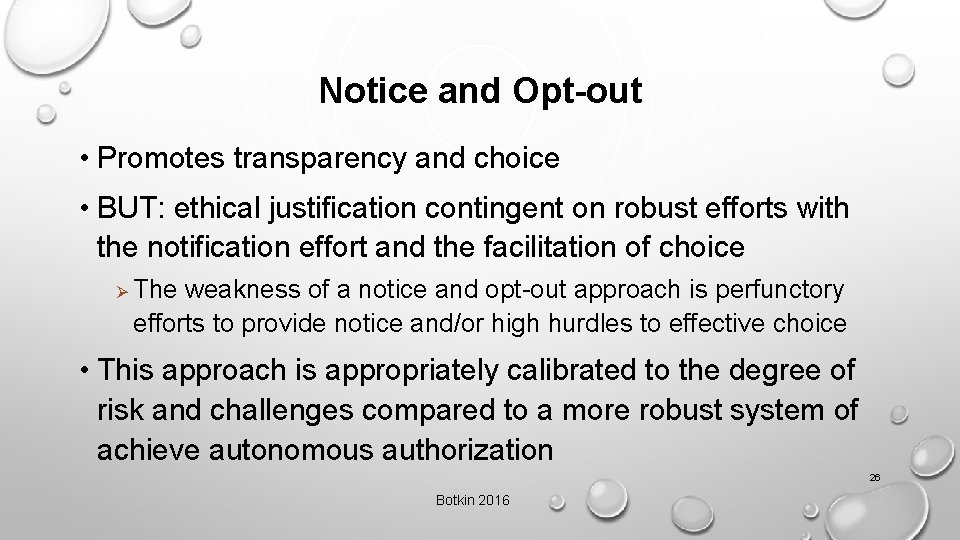
Notice and Opt-out • Promotes transparency and choice • BUT: ethical justification contingent on robust efforts with the notification effort and the facilitation of choice Ø The weakness of a notice and opt-out approach is perfunctory efforts to provide notice and/or high hurdles to effective choice • This approach is appropriately calibrated to the degree of risk and challenges compared to a more robust system of achieve autonomous authorization 26 Botkin 2016
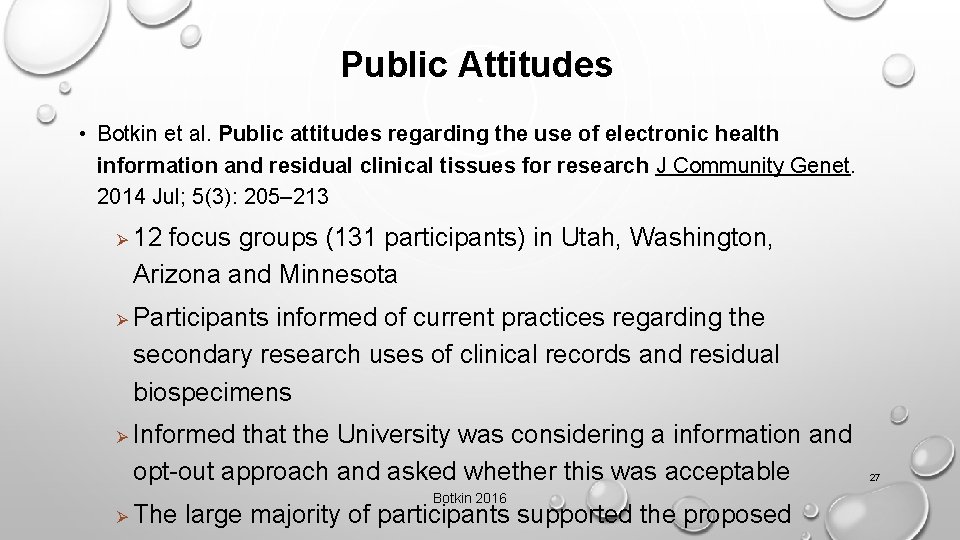
Public Attitudes • Botkin et al. Public attitudes regarding the use of electronic health information and residual clinical tissues for research J Community Genet. 2014 Jul; 5(3): 205– 213 Ø 12 focus groups (131 participants) in Utah, Washington, Arizona and Minnesota Ø Participants informed of current practices regarding the secondary research uses of clinical records and residual biospecimens Ø Informed that the University was considering a information and opt-out approach and asked whether this was acceptable Ø The Botkin 2016 large majority of participants supported the proposed 27
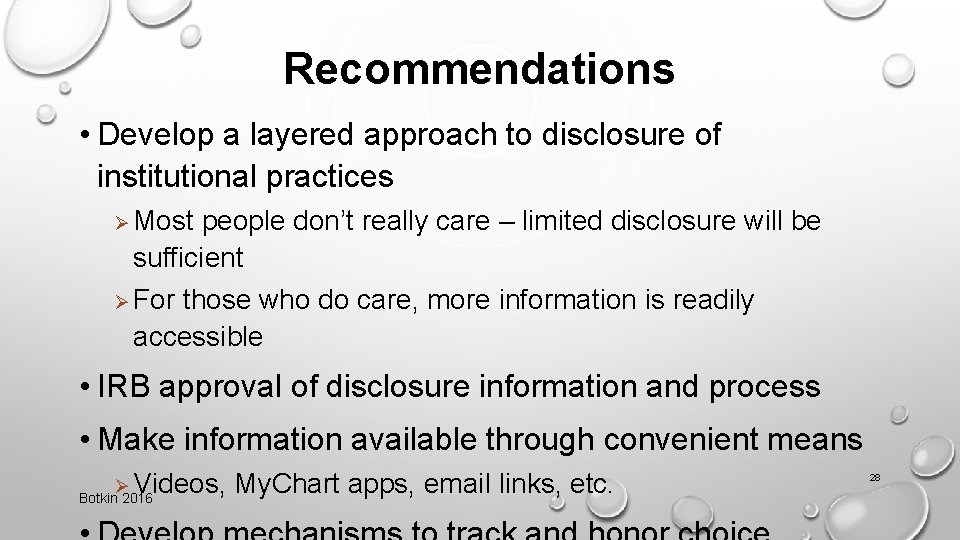
Recommendations • Develop a layered approach to disclosure of institutional practices Ø Most people don’t really care – limited disclosure will be sufficient Ø For those who do care, more information is readily accessible • IRB approval of disclosure information and process • Make information available through convenient means Ø Videos, Botkin 2016 My. Chart apps, email links, etc. 28
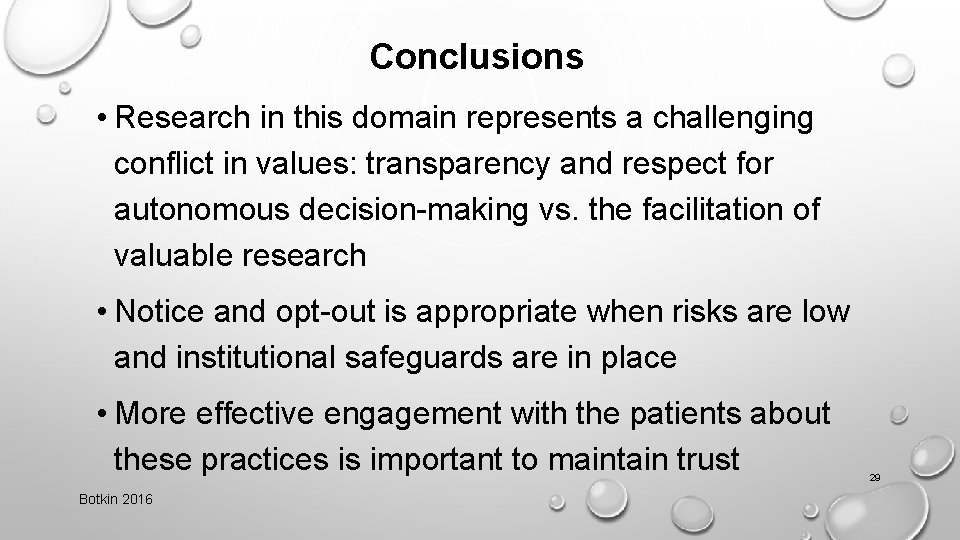
Conclusions • Research in this domain represents a challenging conflict in values: transparency and respect for autonomous decision-making vs. the facilitation of valuable research • Notice and opt-out is appropriate when risks are low and institutional safeguards are in place • More effective engagement with the patients about these practices is important to maintain trust Botkin 2016 29
THANK YOU! 30 Botkin 2016