
Transoceanic Encounters and Global Connections Chapter 22 The
Transoceanic Encounters and Global Connections Chapter 22
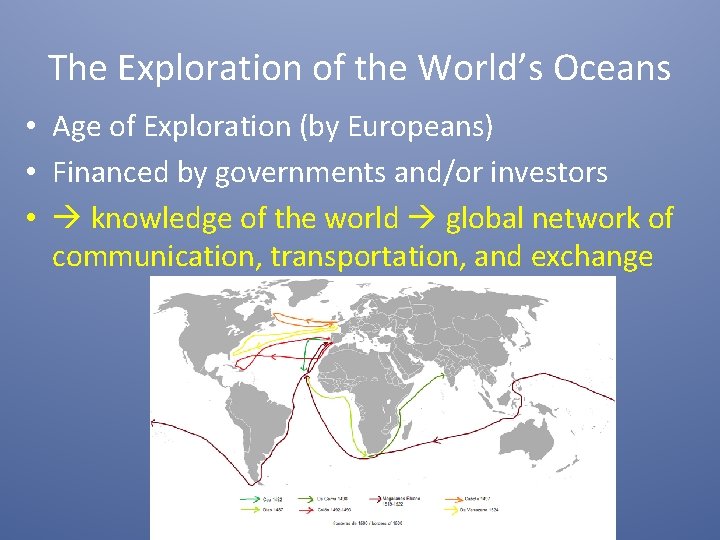
The Exploration of the World’s Oceans • Age of Exploration (by Europeans) • Financed by governments and/or investors • knowledge of the world global network of communication, transportation, and exchange

Motives for Exploration • Combination: resources, land, trade routes, spread Christianity - justified and reinforced each other • Portuguese: resources and cultivable land (esp. for sugar plantations) • Trade routes: wealthy needed spices and gold, wanted direct access(bigger quantities, lower prices) • Missionary efforts: wanted to expand Christendom
The Technology of Exploration • Combination of Mediterranean, N. European, Chinese, and Arabic elements • Ships and sails: rudder, triangular and square sails -> tacking • Navigational instruments: magnetic compass, astrolabe -> direction and latitude • Knowledge of winds and currents: trades and westerlies (in Atlantic and Pacific), monsoons (in Indian) – often required indirect routes (e. g. , volto do mar)

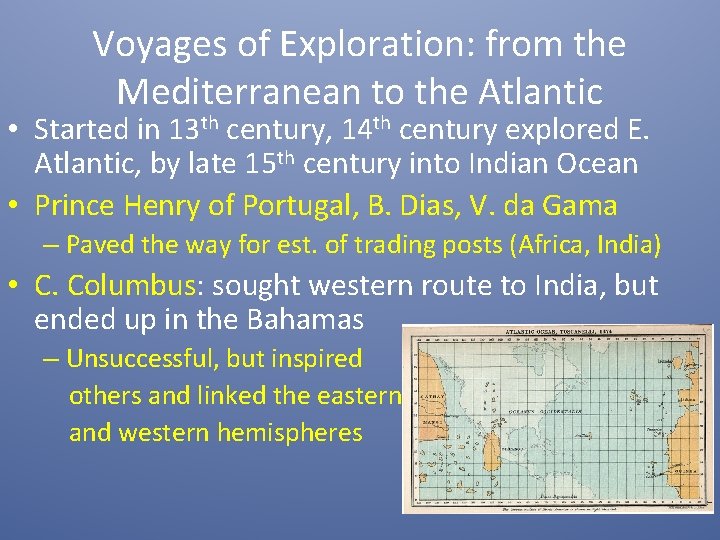
Voyages of Exploration: from the Mediterranean to the Atlantic • Started in 13 th century, 14 th century explored E. Atlantic, by late 15 th century into Indian Ocean • Prince Henry of Portugal, B. Dias, V. da Gama – Paved the way for est. of trading posts (Africa, India) • C. Columbus: sought western route to India, but ended up in the Bahamas – Unsuccessful, but inspired others and linked the eastern and western hemispheres
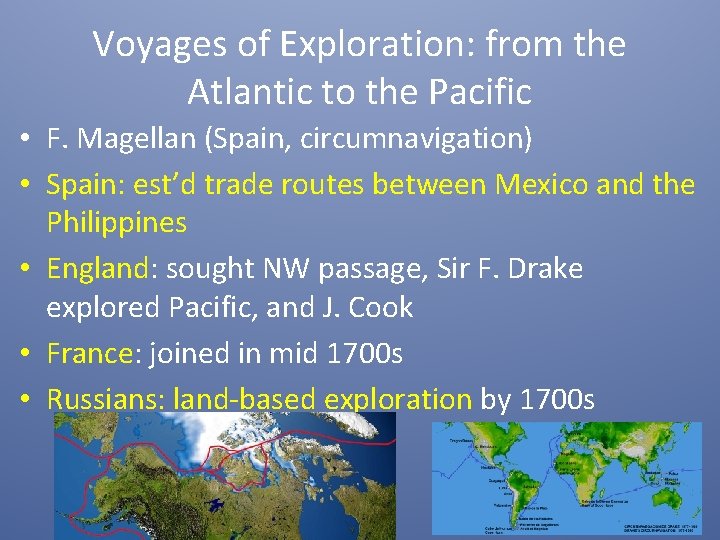
Voyages of Exploration: from the Atlantic to the Pacific • F. Magellan (Spain, circumnavigation) • Spain: est’d trade routes between Mexico and the Philippines • England: sought NW passage, Sir F. Drake explored Pacific, and J. Cook • France: joined in mid 1700 s • Russians: land-based exploration by 1700 s
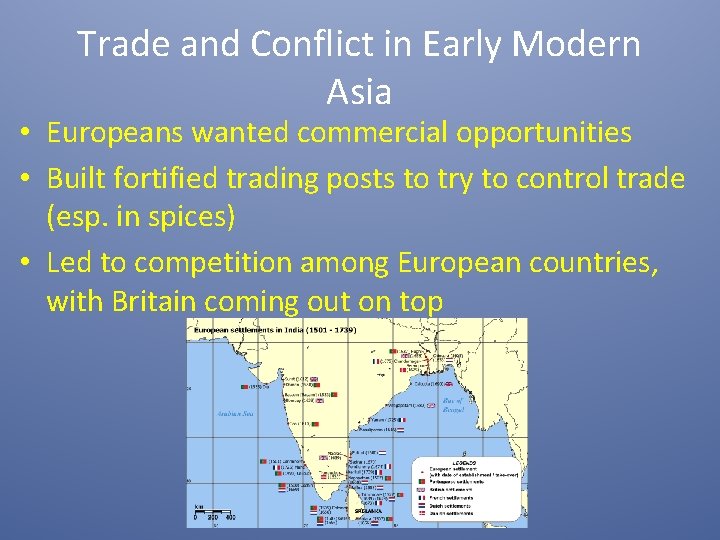
Trade and Conflict in Early Modern Asia • Europeans wanted commercial opportunities • Built fortified trading posts to try to control trade (esp. in spices) • Led to competition among European countries, with Britain coming out on top
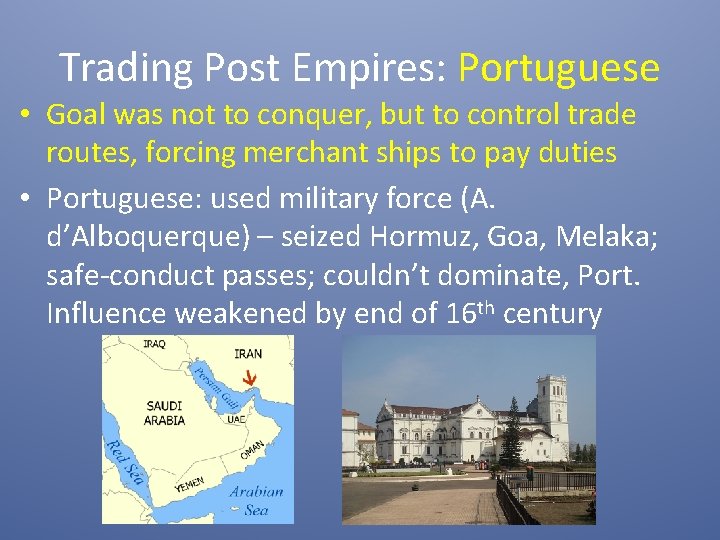
Trading Post Empires: Portuguese • Goal was not to conquer, but to control trade routes, forcing merchant ships to pay duties • Portuguese: used military force (A. d’Alboquerque) – seized Hormuz, Goa, Melaka; safe-conduct passes; couldn’t dominate, Port. Influence weakened by end of 16 th century
Trading Post Empires: English & Dutch • English and Dutch: built trading posts, but didn’t try to control shipping – England: India – Holland: S. Africa and SE Asia • Advantages over Port. : better ships and joint-stock companies (limited risk, increased profits) • English East India Company and United East India Company (VOC): funded by private merchants, with government support (but no oversight) – Charters allowed them the right to buy, sell, build trading posts, make wars – Very successful global trade network
European Conquests in SE Asia • Not very successful at conquering and controlling in East, except in Philippines and Indonesia • Philippines: 1565, Spanish overtook most of islands – Policy: trade (Manila became silk entrepot) and Christianity (tried to convert leaders, generally successful) • Indonesia: Dutch, focused on spice trade – Gained control via military power and manipulation of local politics, but did not rule directly
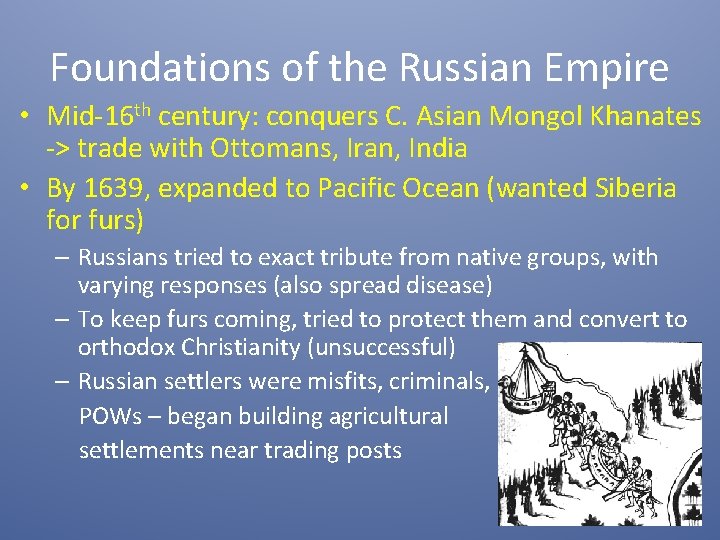
Foundations of the Russian Empire • Mid-16 th century: conquers C. Asian Mongol Khanates -> trade with Ottomans, Iran, India • By 1639, expanded to Pacific Ocean (wanted Siberia for furs) – Russians tried to exact tribute from native groups, with varying responses (also spread disease) – To keep furs coming, tried to protect them and convert to orthodox Christianity (unsuccessful) – Russian settlers were misfits, criminals, POWs – began building agricultural settlements near trading posts
Commercial Rivalries and the Seven Years’ War • Competition and conflict: • Early: Dutch dom’d Indian Ocean • By early 1700 s (cotton and tea), England France dom’d (1746: French seized Madras) • Americas: English pirates and privateers seized Spanish ships, fighting over territory • The Seven Years’ War (1756 -63): global, involved natives

The Great War for Empire (cont. ) • The war: – Europe: Britain and Prussia vs. France, Austria, and Russia – India: British vs. French (plus, each had local allies) – Caribbean: British vs. French and Spanish – North America (French and Indian Wars): British vs. French (plus, each had native allies) • British dom’d: kicked France out of India, took colonies (Canada and Florida) and laid foundation for British hegemony of the next 150 years
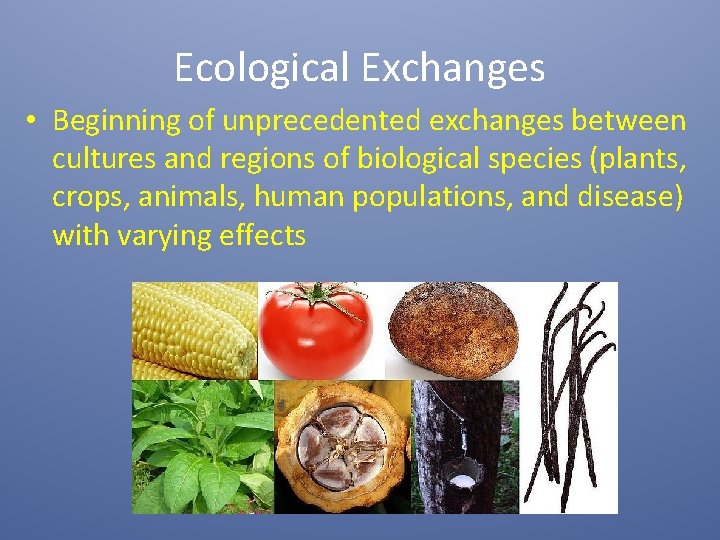
Ecological Exchanges • Beginning of unprecedented exchanges between cultures and regions of biological species (plants, crops, animals, human populations, and disease) with varying effects
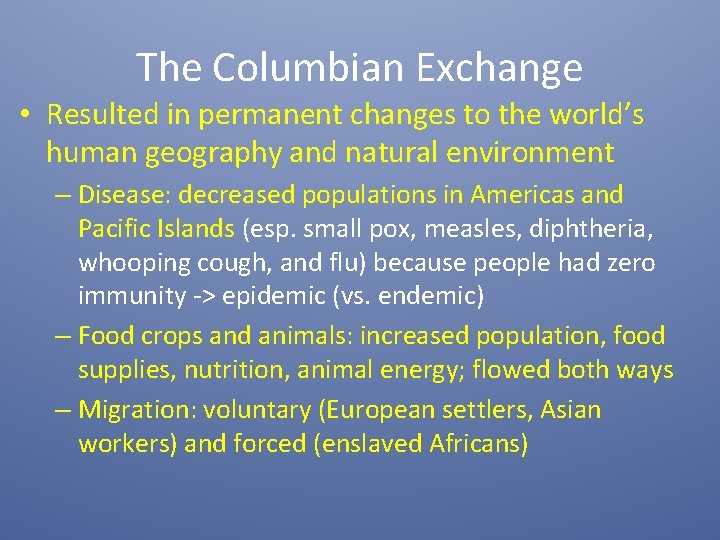
The Columbian Exchange • Resulted in permanent changes to the world’s human geography and natural environment – Disease: decreased populations in Americas and Pacific Islands (esp. small pox, measles, diphtheria, whooping cough, and flu) because people had zero immunity -> epidemic (vs. endemic) – Food crops and animals: increased population, food supplies, nutrition, animal energy; flowed both ways – Migration: voluntary (European settlers, Asian workers) and forced (enslaved Africans)
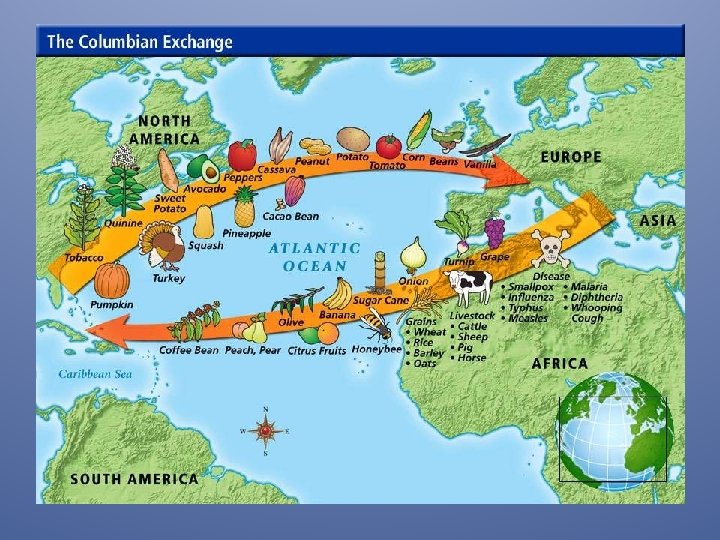
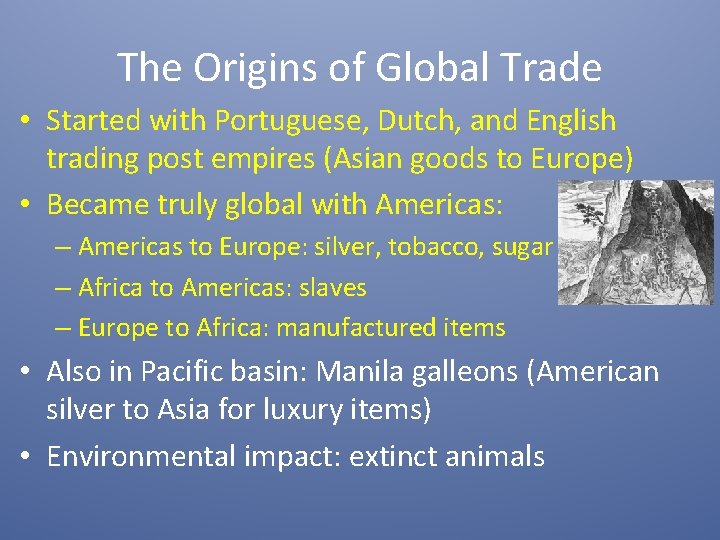
The Origins of Global Trade • Started with Portuguese, Dutch, and English trading post empires (Asian goods to Europe) • Became truly global with Americas: – Americas to Europe: silver, tobacco, sugar – Africa to Americas: slaves – Europe to Africa: manufactured items • Also in Pacific basin: Manila galleons (American silver to Asia for luxury items) • Environmental impact: extinct animals
- Slides: 19