
Transnational Organised Crime in the Caribbean Challenges Lessons
Transnational Organised Crime in the Caribbean: Challenges, Lessons Learned and the Way Forward Presentation by the Ministry of National Security, Government of Jamaica Presenter: Mrs. Michele Lemmon April 7, 2016
OVERVIEW � The Scenario ◦ Gangs & Transnational Organised Crime in Jamaica � Addressing Gangs & Transnational Organised Crime in Jamaica � Lessons Learned and the Way Forward
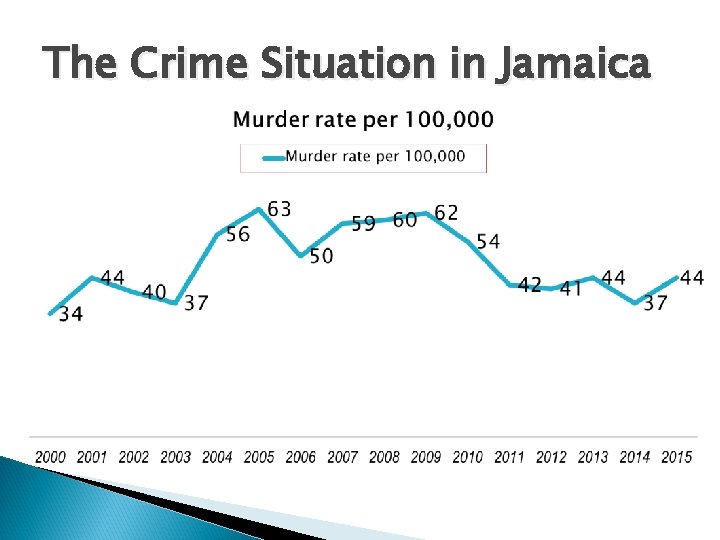
The Crime Situation in Jamaica
Regional Context Caribbean Human Development Report, 2012 states: “Street gangs and organized crime groups are major obstacles to meeting regional development goals. They affect quality of life, erode the development of human and social capital, and divert substantial resources away from more productive uses…. The crimes and corruptive influence of gangs that perpetrate them also lead to decreased economic performance of the country. Crime diverts a country’s limited resources towards crime prevention and control initiatives, and away from sectors that can fuel economic growth and human development such as education and the maintenance of physical infrastructure…. ”
� Jamaica’s high crime rates & the prevalence of transnational criminal gangs cannot be examined in isolation from the situation existing in the wider LAC region. � UNODC identified 7 countries in the region, including 2 from the English-Speaking Caribbean (Jamaica and St Kitts & Nevis), among the top ten with highest homicide rates across the globe (Global Homicide Report, 2013). � The region’s precarious position is impacted by: ◦ home to major centres of illicit drug production; ◦ large unmanned maritime space -creates ideal smuggling routes for all types of contraband; ◦ prevalence & availability of illegal guns and ammunition
� In The Response 2005, Jamaica recorded the highest homicide rate globally, higher than countries that were in a state of open conflict. � GOJ responded to undertake a comprehensive analysis of the crime situation in the island � The result: National Security Policy (2013), NSP, which defined the Tier one threats to Jamaica as follows:
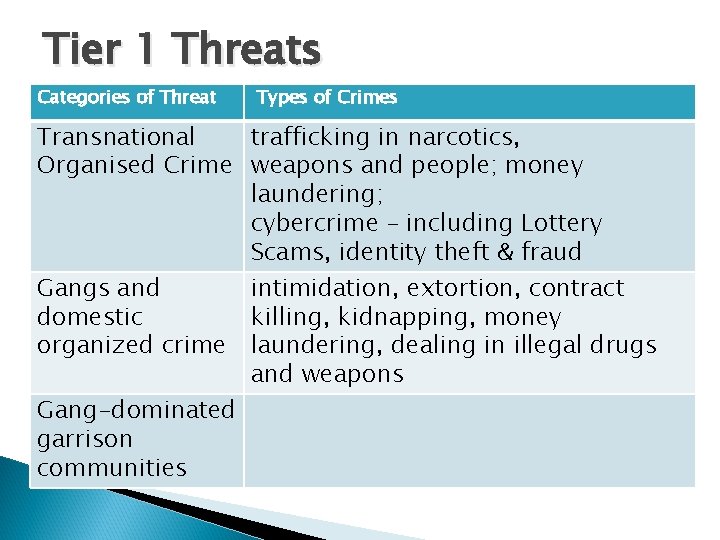
Tier 1 Threats Categories of Threat Types of Crimes Transnational trafficking in narcotics, Organised Crime weapons and people; money laundering; cybercrime – including Lottery Scams, identity theft & fraud Gangs and intimidation, extortion, contract domestic killing, kidnapping, money organized crime laundering, dealing in illegal drugs and weapons Gang-dominated garrison communities
National Security Policy (NSP), 2013 � The Policy also found that the main causes of violence and homicide are transnational criminal organizations and local gangs who are supported by corruption, fraud, extortion and money laundering.
NSP Proposal The adoption of a coherent anti-gang strategy to combat gang activity & reduce high crime levels � Focused enforcement ◦ increased probability of detection & punishment ◦ increased speed of punishment � Community-based Policing ◦ population-centric, counter-insurgency tactics � Support for witnesses and victims ◦ strengthening the Witness Protection Programme � Clear, hold and build � Prevent � Denial recruitment of liberty
Jamaican Gangs � Recent evidence indicates that there are between 250 – 260 gangs operating in Jamaica. � These gangs are spread across all 14 parishes, and together are estimated to account for 70% of all criminal activity in Jamaica, in particular, murders and shootings.
Transnational Crimes Committed by Jamaican Gangs � Gangs (first and second generation) � Gangs perform ◦ often in the employ of organized crime syndicates (third generation gangs) ◦ they perform security functions for illicit commodities at entry ports. ◦ contract killings, abduction, kidnapping, intimidation ◦ enforce “Code of Silence” which organized crime needs in order to operate with impunity in vulnerable communities. Source: JCF
The Illicit Drugs Trade � Transnational criminal organisations (third generation gangs) are now more actively involved in drug trafficking. It is believed they have established a dedicated drug trafficking arm within the gang structure. � Second generation gangs are also actively linked to the drug trafficking syndicates; often times being hired to do protection, as well as logistics. � The drugs for guns trade has seen many of the drug traffickers become also weapons traffickers. They have developed large clientele base among the criminal gangs across the island as they provide a continuous supply of weapons and ammunition
� GOJ Legislative Actions has passed critical legislation over the past ten years to combat the gang problem: � The Criminal Justice (Suppression of Criminal Organisations) Act, 2014, more commonly known as the Anti-Gang Legislation; � The Proceeds of Crime Act, 2007 and Amendment, 2013; and � The Law Reform (Fraudulent Transactions) (Special Provisions) Act, 2013, commonly referred to as the Lottery Scamming Law
Achievements of the Anti-Gang legislation to date � Over 340 persons have been charged under the legislation since its enactment ◦ most for being a member of a criminal organization ◦ in some cases being a leader of a criminal organization � Gangs impacted include some of Jamaica’s most notorious gangs, in Jamaica’s crime hotspots including: ◦ St. Catherine - Klansman; One Order; Strikers Gang; ◦ Clarendon - Savannah Gang ◦ St. James - Alliance and Sparta Gangs;
Law Enforcement Action � In 2012/2013 the JCF established the National Strategic Anti-Gang Unit, which is situated under the Counter-Terrorism and Organised Crime Unit, CTOC. � The National Strategic Anti-Gang Unit: (i) Coordinator for all Anti-Gang activities undertaken by the JCF (ii) Secretariat for the National Anti-Gang Tasking & Coordination Committee. � Area level Anti-Gang Coordinating Committees and Divisional level Proactive Investigation Units have also been established.
Operational Anti-Gang Initiatives Operational policies developed by the JCF: �‘ 6 -D’ Strategy; �Standard Operating Procedures; �List of Anti-Gang triggers; and �Gang Investigators Checklist.
The 6–D Strategy The 6 -D Strategy mandates the JCF to: � Disrupt organised crime and gangs � Deny freedom of movement and freedom of action to gang members � Disarm gang members by taking their guns � Defend the communities from their influence and violence and employ effective law enforcement � Dissuade citizens from involvement in Organised Crime and Gangs � Deprive the syndicated and gangs of the proceeds of their crime
Establishment of the Major Organised Crime and Anti-Corruption Agency The Major Organised Crime and Anti-Corruption Agency, MOCA, established in August 2014 as an independent law enforcement agency In 2015, MOCA arrested: � 26 persons for activities related to major organized crime � 14 persons for public sector corruption � 180 persons for economic/financial crime � 47 persons for police corruption Based on those arrests, 216 persons have been charged with various breaches of the law.
Get the Guns Campaign � It is estimated that some 70% of criminal activity in particular murders and shooting are committed using a firearm. ◦ Below the global average of 75. 7% (UNODC Global Study on Homicide 2013) � In September 2015, Get the Guns Campaign launched ◦ Between September 2015 to March 2016 a total of 298 firearms and 3633 rounds of ammunition have been seized.
Emerging Trends – Organised Crime and Lottery Scamming � Criminal gangs have become reliant on illegal lottery scamming activities operating predominantly in Western parishes. � Established gangs have sought to take control of the illicit enterprise of lottery scamming through: ◦ recruit or pressure lottery scammers into service on their behalf. ◦ extort & perpetrate violence against and on behalf of lottery scammers. ◦ Engage lottery scammers and offer them protection from other criminals who target them for extortion purposes. ◦ encourage scammers to join their gangs to have a consistent flow of cash for their criminal networks
Emerging Trends – Lottery Scamming & Guns for Drugs Trade � Lottery Scamming has also significantly impacted the illicit guns for drugs trade, by increasing the demand for illegal weapons and ammunition and is fast becoming one of the driving forces behind firearms trafficking in Jamaica. � Guns have now become a common feature among lottery scammers who, in an effort to protect their new found wealth and potential status in the communities are buying firearms.
Efforts Against Lottery Scamming � Since the passage of the Law Reform (Fraudulent Transaction) (Special Provisions) Act of 2013, eight hundred (800) persons have been charged for various breaches with Possession of Identity Information accounting for the vast majority of persons arrested. To date, seventy (70) persons have been convicted.
Emerging Trends: Regional Dimension Evidence that lottery scammers are: (i) Using remittance services in Eastern Caribbean territories to access their illgotten gains; (i) Targeting citizens in other countries outside of the USA
Challenges in combating the Gang Problem � The presence of a pervasive gang culture in which gangs/dons are seen as doing positive things in communities. Reduces the willingness of some residents to support the investigative process. �A culture of silence - communities with high gang density � Insufficient resources to undertake convert (undercover) operations (incl. to recruit persons with access to the gangs)
� Limited experience/capacity in investigating organized crime and gangs � Chronic levels of fear for residents who are mindful to assist/give statements in furtherance of the prosecution � Limited social intervention services for gang infested communities.

� Develop The Way Forward a comprehensive National Anti-Gang Strategy, at the policy level, to include both law enforcement and social intervention activities � Establish a National Anti-Gang Review Committee, to be housed in the Ministry of National Security � Legislative Review capacity in the JCF (e. g. training in proactive investigation techniques) and other arms of the State � Build
� Increased collaboration with social organizations to implement social intervention programmes in order to reduce the attraction of the gang culture particularly among the youth � Increase efforts to build trust and confidence of the public, particularly inner city residents, in the JCF � Increased collaboration with countries in the LAC region, including through training/sharing of experiences & expertise; and formalised bilateral cooperation agreements.

- Slides: 28