
Transmutation of Waste Using ZPinch Fusion October 1
Transmutation of Waste Using Z-Pinch Fusion October 1, 2009 Ben Cipiti & Gary Rochau V. D. Cleary 1, J. T. Cook 1, S. Durbin 1, R. L. Keith 1, T. A. Mehlhorn 1, C. W. Morrow 1, C. L. Olson 1, G. E. Rochau 1, J. D. Smith 1, M. Turgeon 1, M. Young 1, L. El-Guebaly 2, R. Grady 2, P. Phruksarojanakun 2, I. Sviatoslavsky 2, P. Wilson 2, A. B. Alajo 3, A. Guild-Bingham 3, P. Tsvetkov 3, M. Youssef 4, W. Meier 5, F. Venneri 6, T. R. Johnson 7, J. L. Willit 7, T. E. Drennen 8, W. Kamery 8 1 Sandia National Laboratories, Albuquerque, NM of Wisconsin, Madison, WI 3 Texas A&M University, College Station, TX 4 University of California, Los Angeles, CA 5 Lawrence Livermore National Laboratory, Livermore, CA 6 General Atomics, San Diego, CA 7 Argonne National Laboratory, Chicago, IL 8 Hobart & William Smith College, Geneva, NY 2 University Sandia is a multiprogram laboratory operated by Sandia Corporation, a Lockheed Martin Company, for the United States Department of Energy’s National Nuclear Security Administration 1 under contract DE-AC 04 -94 AL 85000.

Overview The Z-Pinch Transmutation study was funding through LDRD funds from FY 06 -FY 07, but the work builds off the Z-Pinch Power Plant Study. Outline Z-Pinch Facility In-Zinerator Concept Engineering Challenges Transmutation Results 2

Z-Pinch Facility 3 Fusion Target
Z-Pinch Operation Marx generators deliver the pulse of power through water lines to a magnetically insulated transmission line (power plant would require linear transformer driver). Past operation delivered 1. 8 MJ of x-rays to the target in about 5 ns, but Z was recently upgraded, so future work may increase the power delivery. Using deuterium gas targets, yields close to 4 x 10¹³ n per target have been achieved (D-D) ~ 1016 n per target D-T. 4
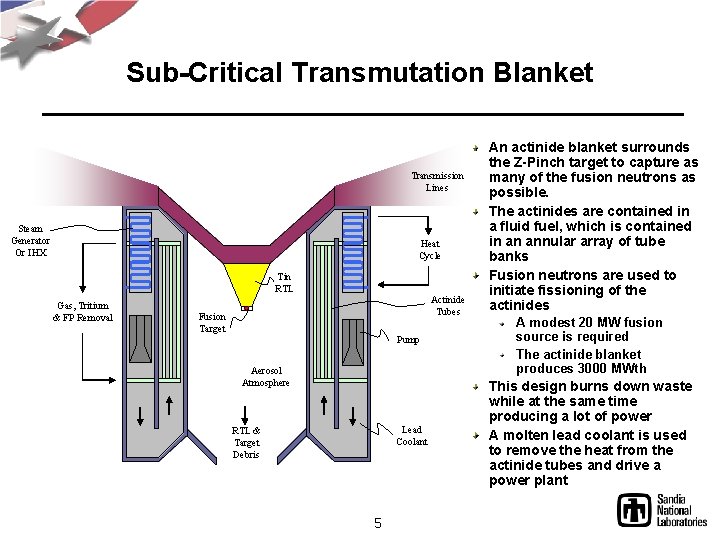
Sub-Critical Transmutation Blanket Transmission Lines Steam Generator Or IHX Heat Cycle Tin RTL Gas, Tritium & FP Removal Actinide Tubes Fusion Target Pump Aerosol Atmosphere Lead Coolant RTL & Target Debris 5 An actinide blanket surrounds the Z-Pinch target to capture as many of the fusion neutrons as possible. The actinides are contained in a fluid fuel, which is contained in an annular array of tube banks Fusion neutrons are used to initiate fissioning of the actinides A modest 20 MW fusion source is required The actinide blanket produces 3000 MWth This design burns down waste while at the same time producing a lot of power A molten lead coolant is used to remove the heat from the actinide tubes and drive a power plant
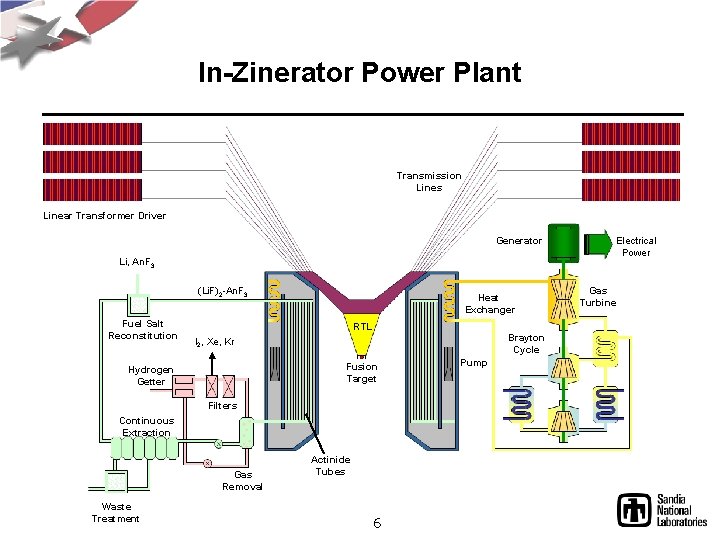
In-Zinerator Power Plant Transmission Lines Linear Transformer Driver Generator Li, An. F 3 (Li. F)2 -An. F 3 Fuel Salt Reconstitution Heat Exchanger RTL Brayton Cycle I 2, Xe, Kr Fusion Target Hydrogen Getter Filters Continuous Extraction Gas Removal Waste Treatment Actinide Tubes 6 Pump Electrical Power Gas Turbine
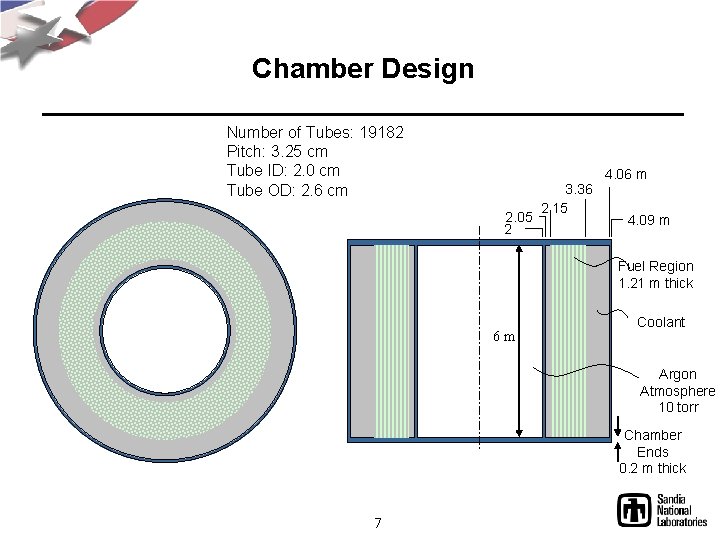
Chamber Design Number of Tubes: 19182 Pitch: 3. 25 cm Tube ID: 2. 0 cm Tube OD: 2. 6 cm 2. 05 2 3. 36 2. 15 4. 06 m 4. 09 m Fuel Region 1. 21 m thick 6 m Coolant Argon Atmosphere 10 torr Chamber Ends 0. 2 m thick 7
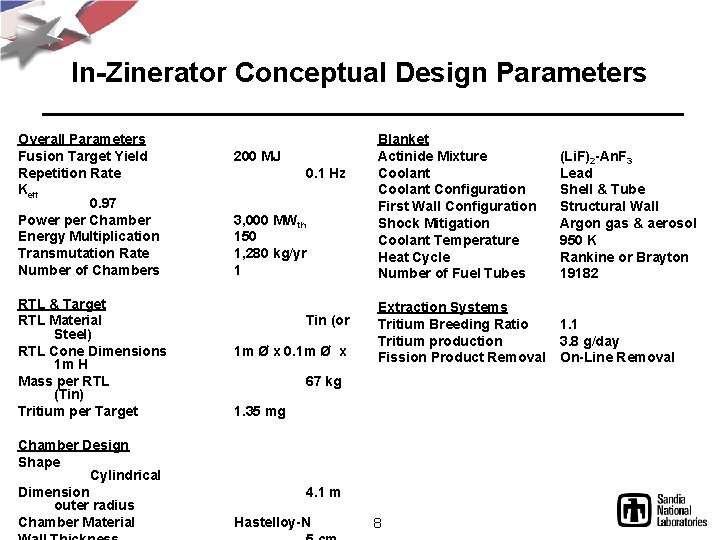
In-Zinerator Conceptual Design Parameters Overall Parameters Fusion Target Yield Repetition Rate Keff 0. 97 Power per Chamber Energy Multiplication Transmutation Rate Number of Chambers RTL & Target RTL Material Steel) RTL Cone Dimensions 1 m H Mass per RTL (Tin) Tritium per Target Chamber Design Shape Cylindrical Dimension outer radius Chamber Material 200 MJ 0. 1 Hz 3, 000 MWth 150 1, 280 kg/yr 1 Tin (or 1 m Ø x 0. 1 m Ø x Blanket Actinide Mixture Coolant Configuration First Wall Configuration Shock Mitigation Coolant Temperature Heat Cycle Number of Fuel Tubes (Li. F)2 -An. F 3 Lead Shell & Tube Structural Wall Argon gas & aerosol 950 K Rankine or Brayton 19182 Extraction Systems Tritium Breeding Ratio Tritium production Fission Product Removal 1. 1 3. 8 g/day On-Line Removal 67 kg 1. 35 mg 4. 1 m Hastelloy-N 8
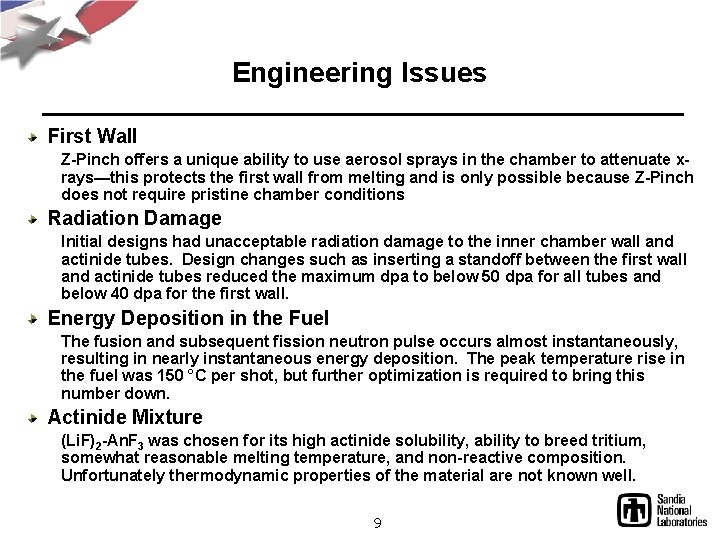
Engineering Issues First Wall Z-Pinch offers a unique ability to use aerosol sprays in the chamber to attenuate xrays—this protects the first wall from melting and is only possible because Z-Pinch does not require pristine chamber conditions Radiation Damage Initial designs had unacceptable radiation damage to the inner chamber wall and actinide tubes. Design changes such as inserting a standoff between the first wall and actinide tubes reduced the maximum dpa to below 50 dpa for all tubes and below 40 dpa for the first wall. Energy Deposition in the Fuel The fusion and subsequent fission neutron pulse occurs almost instantaneously, resulting in nearly instantaneous energy deposition. The peak temperature rise in the fuel was 150 °C per shot, but further optimization is required to bring this number down. Actinide Mixture (Li. F)2 -An. F 3 was chosen for its high actinide solubility, ability to breed tritium, somewhat reasonable melting temperature, and non-reactive composition. Unfortunately thermodynamic properties of the material are not known well. 9
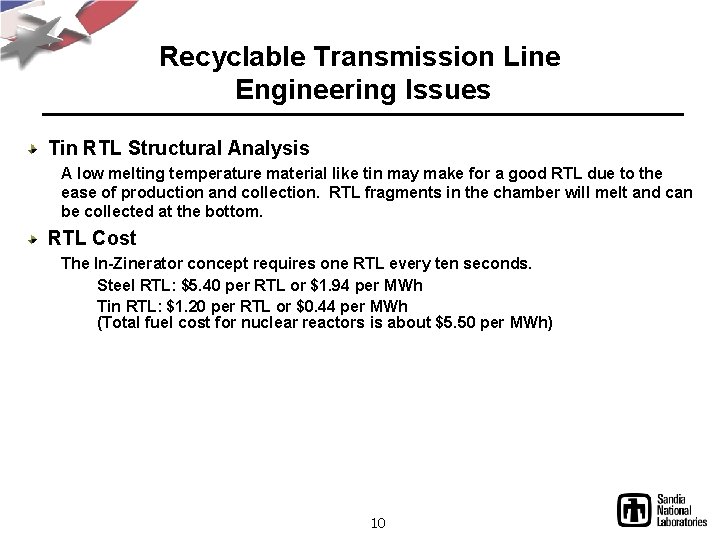
Recyclable Transmission Line Engineering Issues Tin RTL Structural Analysis A low melting temperature material like tin may make for a good RTL due to the ease of production and collection. RTL fragments in the chamber will melt and can be collected at the bottom. RTL Cost The In-Zinerator concept requires one RTL every ten seconds. Steel RTL: $5. 40 per RTL or $1. 94 per MWh Tin RTL: $1. 20 per RTL or $0. 44 per MWh (Total fuel cost for nuclear reactors is about $5. 50 per MWh) 10
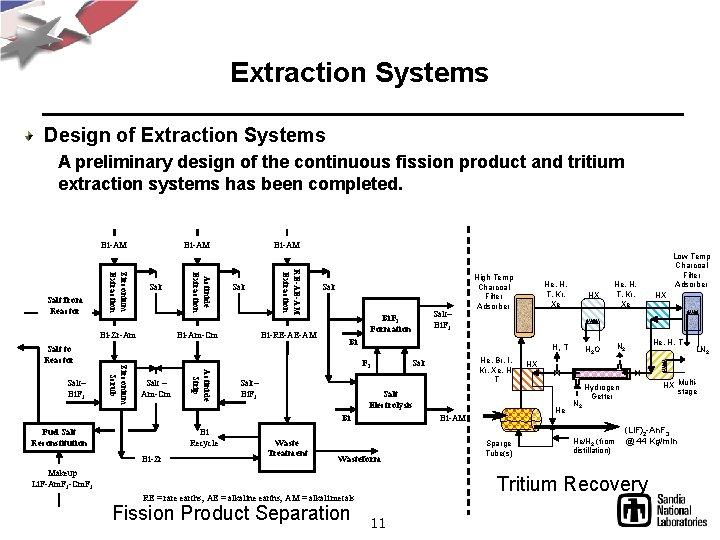
Extraction Systems Design of Extraction Systems A preliminary design of the continuous fission product and tritium extraction systems has been completed. Bi-AM Bi-Zr-Am Bi-AM Salt Bi-Am-Cm RE-AE-AM Extraction Salt Actinide Extraction Zirconium Extraction Salt from Reactor Bi-AM Bi-RE-AE-AM Salt to Reactor Salt – Am-Cm Actinide Strip Zirconium Scrub Salt– Bi. F 3 Salt Bi F 2 Salt– Bi. F 3 Bi Recycle Bi-Zr He, Br, I, Kr, Xe, H, T Salt Electrolysis Bi Fuel Salt Reconstitution Salt– Bi. F 3 Formation High Temp Charcoal Filter Adsorber Waste Treatment Makeup Li. F-Am. F 3 -Cm. F 3 H, T H 2 O Sparge Tube(s) He, H, T, Kr, Xe N 2 11 HX He, H, T LN 2 HX Multistage Hydrogen Getter He/H 2 (from distillation) (Li. F)2 -An. F 3 @ 44 Kg/min Tritium Recovery RE = rare earths; AE = alkaline earths; AM = alkali metals Fission Product Separation HX He Bi-AM Wasteform He, H, T, Kr, Xe Low Temp Charcoal Filter Adsorber
Modeling MCNP was used to optimize the baseline design to reach the desired keff, power level, chamber size, tritium breeding, etc. MCise was used to calculate time dependent burnup rates, fission production, and isotopic change ORIGEN was used to then calculate the activity and heat load to determine the net effectiveness of transmutation 12
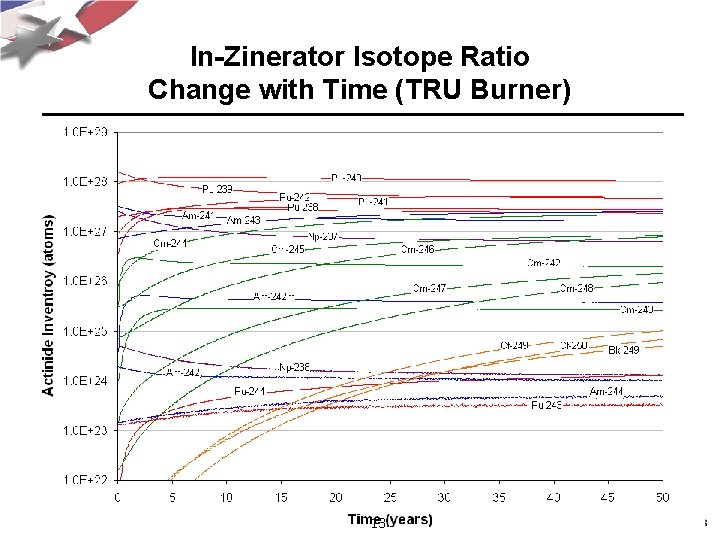
In-Zinerator Isotope Ratio Change with Time (TRU Burner) 13
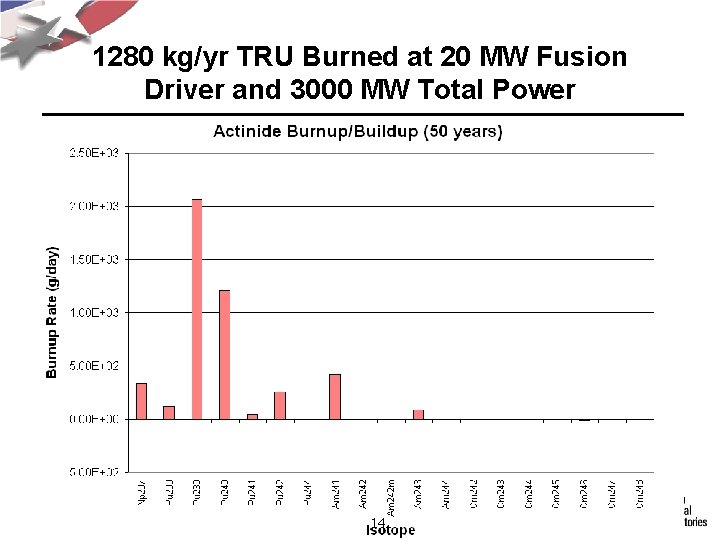
1280 kg/yr TRU Burned at 20 MW Fusion Driver and 3000 MW Total Power 14
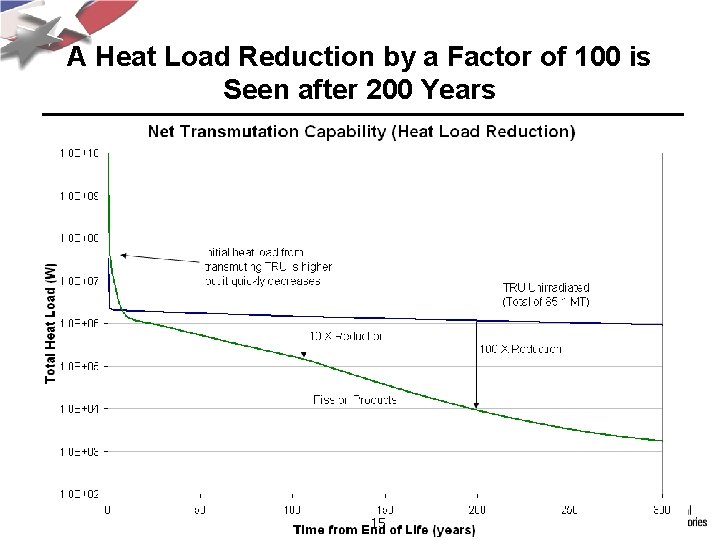
A Heat Load Reduction by a Factor of 100 is Seen after 200 Years 15
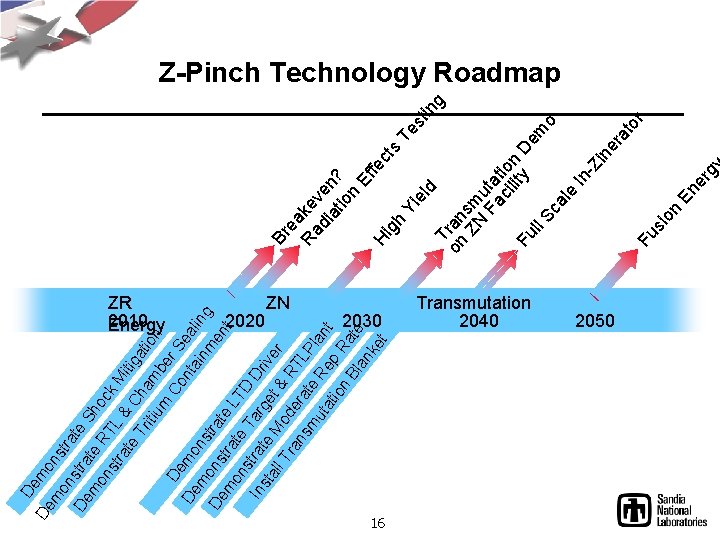
De De mo n m on stra De stra te S t m on e R hoc k. M str TL at & iti e Tr Cha gati itiu o m be n m De Co r S ea m nt De o a ns inm ling m o De ns trat en e tra m t LT on te str Ta D D In rg sta ate et rive M ll T od & R r ra TL ns era Pl t m a ut e R ep nt at ion Ra Bl an te ke t ea Ra ke di ven at ? io n Ef fe Hi ct gh s Te Yi st el in d g Tr on an ZN sm Fa uta cil tion ity D Fu em ll S o ca le In -Z in er at or Fu sio n En er gy Br Z-Pinch Technology Roadmap ZR 2010 Energy 2020 ZN 2030 16 Transmutation 2040 2050
- Slides: 16