
TRANSMISSION OF PLANT VIRUSES CelltoCell Movement of Plant

- Slides: 47
TRANSMISSION OF PLANT VIRUSES
Cell-to-Cell Movement of Plant Viruses • Plant viruses move cell-to-cell slowly through plasmodesmata • Most plant viruses move cell-to-cell as complexes of non-structural protein and genomic RNA • The viral protein that facilitates movement is called the “movement protein” (MP) • Coat protein is often dispensable for cell-to-cell movement
Cell-to-Cell Movement of Plant Viruses • Several unrelated lineages of MP proteins have been described • MPs act as host range determinants • MP alone causes expansion of normally constricted plasmodesmata pores; MPs then traffic through rapidly • MPs are homologs of proteins that naturally traffic m. RNAs between cells • MPs may act as suppressors of gene silencing
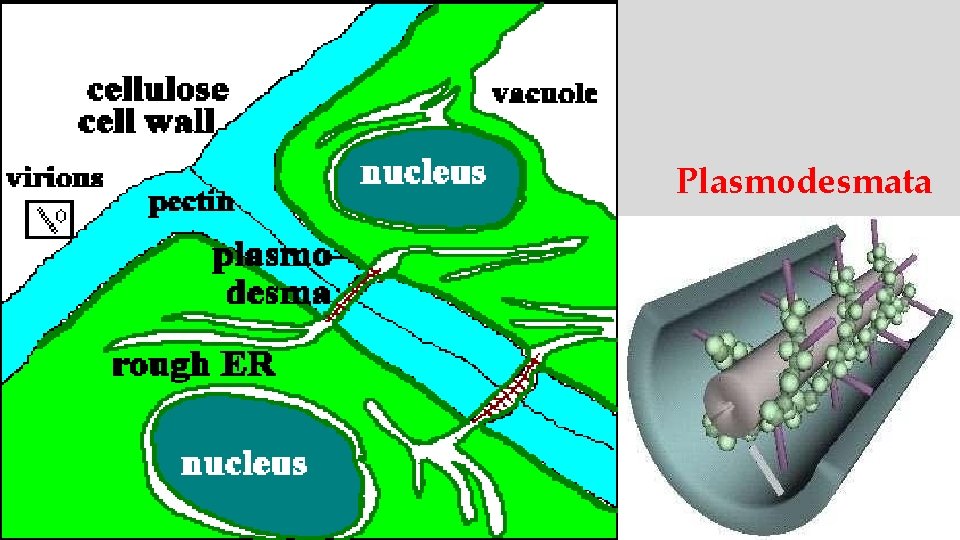
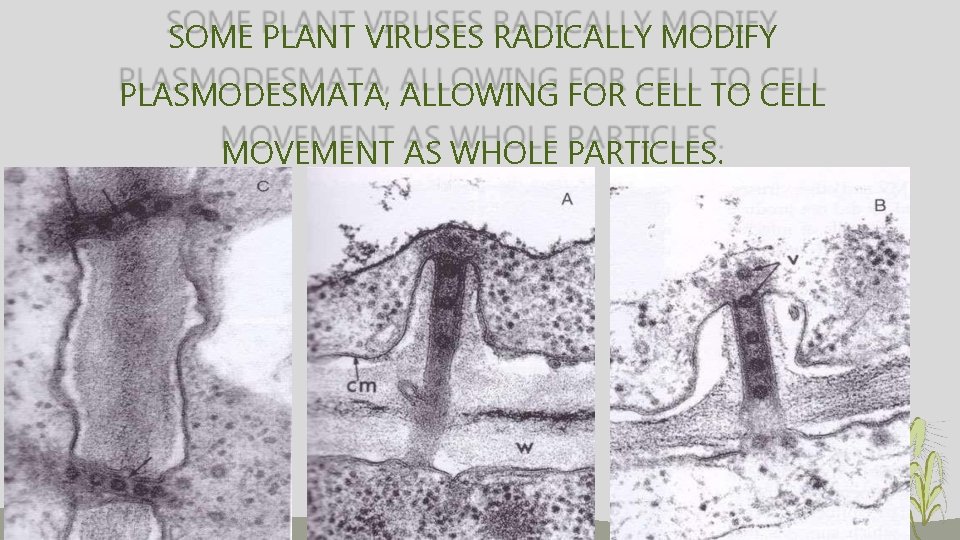
Plasmodesmata
SOME PLANT VIRUSES RADICALLY MODIFY PLASMODESMATA, ALLOWING FOR CELL TO CELL MOVEMENT AS WHOLE PARTICLES.
• Systemic spread of plant viruses is primarily through vascular tissue, especially phloem
Plant Virus Transmission • Generally, viruses must enter plant through healable wounds - they do not enter through natural openings (no receptors) • Insect vectors are most important means of natural spread • Type of transmission or vector relationship determines epidemiology • Seed transmission is relatively common, but specific for virus and plant
TYPES OF PLANT VIRUS TRANSMISSION • HORIZONTAL TRANSMISSION • Horizontal transmission is by vectors, human pruning shears and tools, and other direct, external contamination. • VERTICAL TRANSMISSION • Vertical transmission occurs when a plant gets it from its parent plant. Either through asexual propagation (cuttings) or in sexual reproduction via infected seeds.
TRANSMISSION METHODS • Non-Insect transmission: Sap inoculation/ Mechanical: TMV, PVY Seed: BCMV, Fungi: Olpidium brassicae- TNV Vegetative & graft transmission: PVY, PLRV, Fruit viruses Nematodes: Xiphinema index: Grapevine fan leaf virus Dodder: CMV, TRV Insect Transmission: PVY, CMV, BGMV • Insect Transmission: PVY, CMV, BGMV
• Mechanical transmission o Deliberate – rub-inoculation o Field – farm tools, etc. o Greenhouse – cutting tools, plant handling o Some viruses transmitted only by mechanical means, others cannot be transmitted mechanically o Occurs when plant come in contact with other plant and leaves rub together By the action of humans Mechanical transmission involves the introduction of infective virus or biologically active virus into a suitable site in the living cells through wounds or abrasions in the plant surface This method is generally used for experimental purposes under laboratory conditions- also known as Sap inoculation
METHODS • Leaf rub • Cotton swab • Pinprick • Microinjection • Steps: • Sap extraction • Extraction medium • Use of additives • Choice of suitable host: most common are Nicotiana spp. , Chenopodium spp. , Cucumis sativus, Gomphrena, Datura spp, Phaseolus vulgaris
MECHANICAL TRANSMISSION AFFECTED BY: • Source & preparation of Inoculum • Leaf- most common source • Have high conc of virus • Roots: TNV • Fruits, flower & pollens • Symptoms expression • Virus concentration • Extraction medium (Water & Buffer) • Buffers (Po 4 , borate, citrate, Tris-HCL) • Retain infectivity • Stability • Intact virus • Avoid aggregation • Buffer p. H: 7 -8 p. H
• Metal ions and ionic strength • Some viruses require divalent metal ions (Ca+ or Mg 2+) for retention of infectivity and structural integrity • p. H, chelating agents and ionic strength help in virus stabilization in extracted sap. • Chelating agents eg. EDTA • Help in removal of host ribosomes; avoid virus aggregation; prevent oxidantion of polyphenols • Reducing agents: ( Thioglycolic acid, Ascorbic acid, cysteine hydrichlooride sodium sulphite, 2 -mercaptaethanol) • These prevent oxidation of plant extract and preserve infectivity of the virus
• Substances protecting against phenolics: • cysteine hydrichlooride, sodium sulphite: prevent action of phenol oxidases. • PVP-polyvinyl pyrrolidine, PEG: reduces binding of virus with phenols • Additives that removes plant protein and ribosomes • Mg bentonite- reduces contamination of virus extract with nucleases and ribosomes (mainly !9 s protein) • Charcoal: adsorb host pigments • Na EDTA @ 0. 01 M ph 7. 4 • Enzymes: • eg. Pectinase is used to degrade mucilage in sap of cocoa leaves prior to precipitation of CSSC, Trypsin -Tu. Mv
VEGETATIVE AND GRAFT TRANSMISSION • Aim is to establish organic union between the cut surfaces of tissues of two different hosts • Shoot-Scion • Root bearing portion - stock • If either stock or scion is infected the virus usually moves to the healthy portion and express symptoms • A pre-requisite for successful graft transmission is the perfect union of the cambium layers of the stock and the scion. • Eg. CTV, Apple mosaic virus etc.
DODDER TRANSMISSION • Cuscuta spp. (Benett (1940) • About 20 spp. • C. campestris & C. subinclusa are common • E. g. Phytoplasma • Vegetative propagations • Cuttings • Tubers • Corms etc. • Bulbs
Plant Virus Transmission by Vectors • TRANSMISSION BY VECTORS: GENERAL o Arthropods most important o Most by insects with sucking mouthparts • Aphids most important, and most studied • Leafhoppers next most important o Some by insects with biting mouthparts o Nematodes are important vectors o “Fungi” (protists) may transmit soilborne viruses o Life cycle of vector and virus/vector relationships determine virus epidemiology o A given virus species generally has only a single type of vector
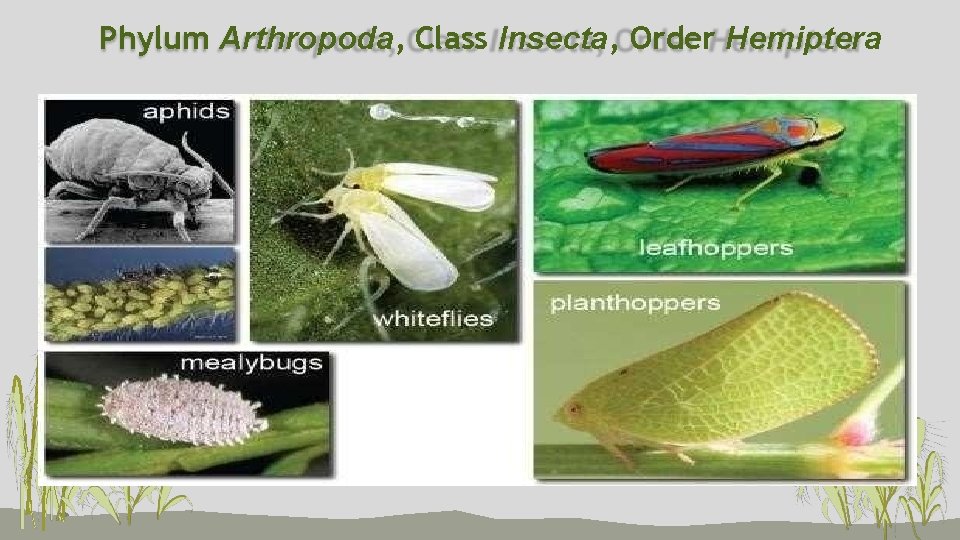
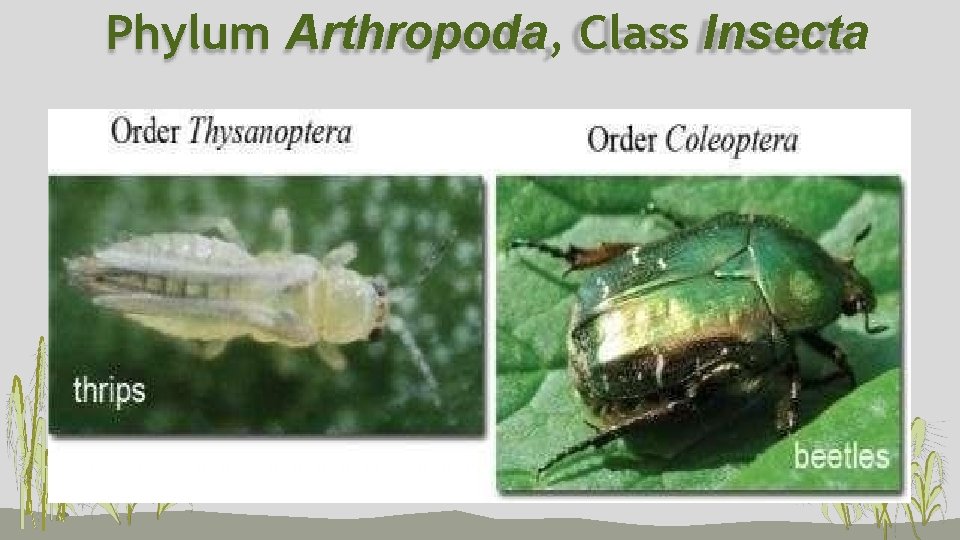
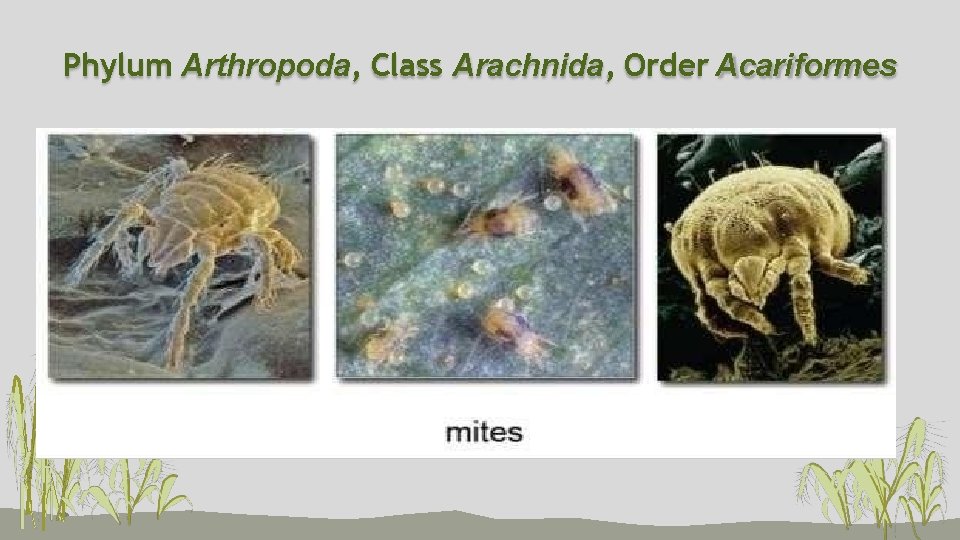
• Insect transmission (vectors) o Aphids most important o Leafhoppers o Whiteflies o Thrips o Mealybugs o Beetles o Mites (Arachnidae) o Ants, grasshoppers, etc. – mechanical o Bees, other pollinators – pollen transmission
Phylum Arthropoda, Class Insecta, Order Hemiptera
Phylum Arthropoda, Class Insecta
Phylum Arthropoda, Class Arachnida, Order Acariformes
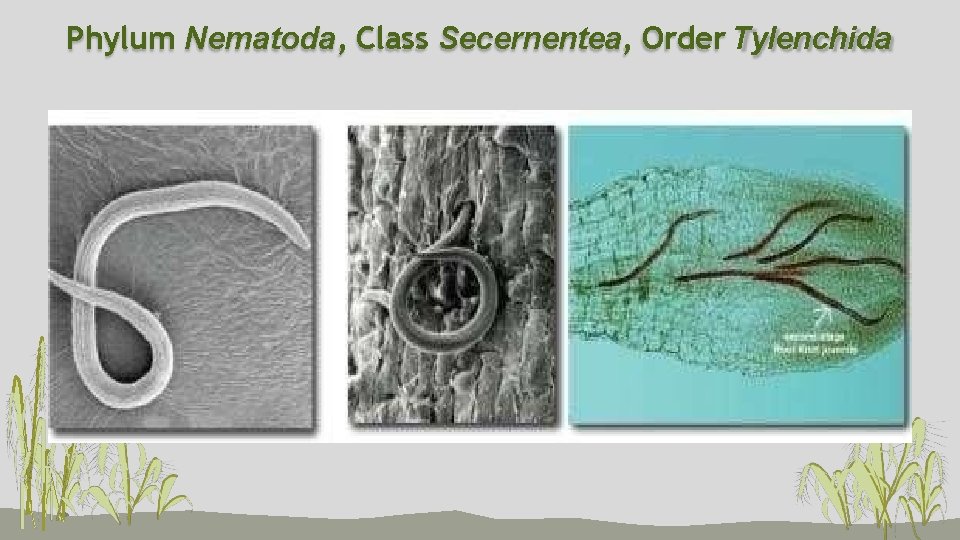
Phylum Nematoda, Class Secernentea, Order Tylenchida
• Kingdom: Fungi • Phylum: Chytridiomycota • Class: Chytridiomycetes Order: Incertae sedis Family: Olpidiaceae Genus: Olpidium
• Kingdom: Rhizaria Phylum: Cercozoa Class: Plasmodiophorea • Order: Plasmodiophorida • Family: Plasmodiophoridae • Genus: Polymyxa
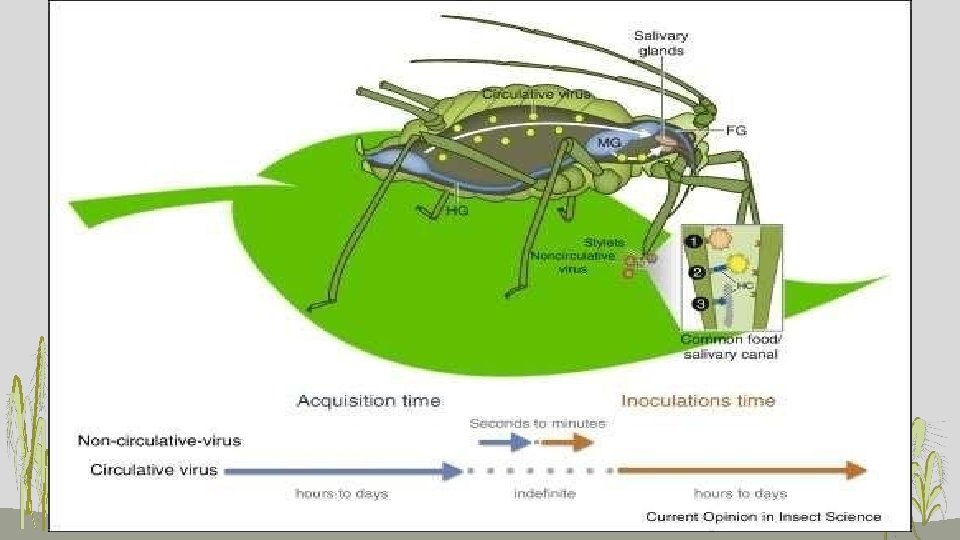
Types of vector relationships Terms apply mainly, but not exclusively, to aphid transmission • Non-persistent transmission ovirus acquired quickly, retained short period (hours), transmitted quickly o“stylet-borne” transmission ovirus acquired and transmitted during exploratory probes to epidermis
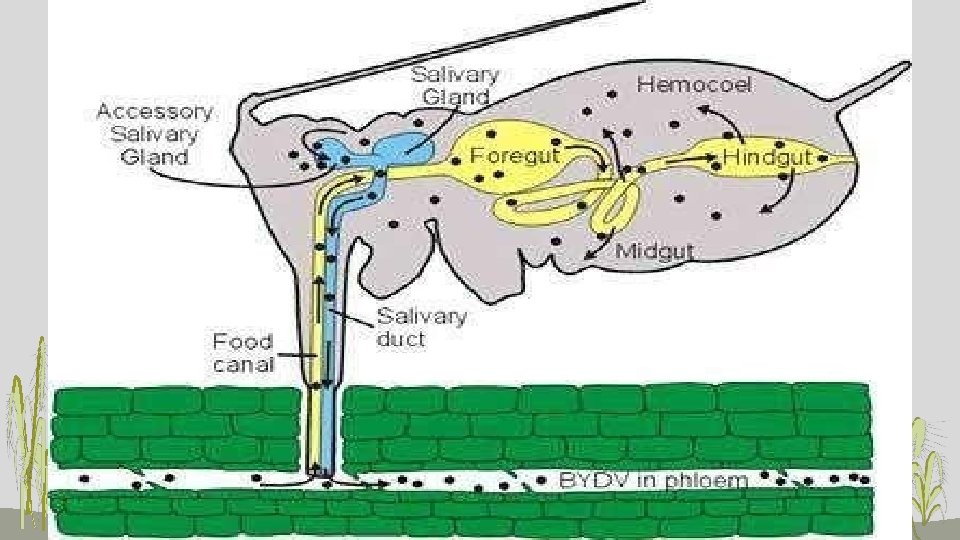
• PERSISTENT TRANSMISSION o virus acquired slowly, retained long period (weeks), transmitted slowly o circulative or propagative transmission o virus acquired and transmitted during feeding probes to phloem • Virus persist in their vector for >100 hrs and in some cases for whole life of vector • Virus multiply and circulate in vector body • Latent period is present • Moulting has no effect of virus • After virus uptake-- alimentary canal gut wall cirulate In the body fluid (Haemolymph) • glands causing contamination of salive transmission • Also called as • Circulative propagative • Trans-ovarial transmission • E. g. PLRV, RDV, PYDV, BYDV salivary
• CIRCULATIVE TRANSMISSION: (syn. persistent transmission) virus transmission characterized by a long period of acquisition of the virus by a vector (typically an insect), a latent period of several hours before the vector is able to transmit the virus, and retention of the virus by the vector for a long period, usually several days; the virus circulates in the body of the vector (aphid vector feeding on a plant host showing the internal route of the viruses that cause barley yellow dwarf)
• Semi-persistent transmission o virus acquired fairly quickly, retained moderate period (days), transmitted fairly quickly o virus acquired and transmitted during exploratory probes • Virus persist in its vector for 10 -100 hrs. • Acquired from phloem region with long feeding • No latent period • Do not circulate and multiply in its vector • Infectivity lost in moulting • Particles accumulate at special sites • High vector specificity • E. g. CTV, Ca. MV, BYV
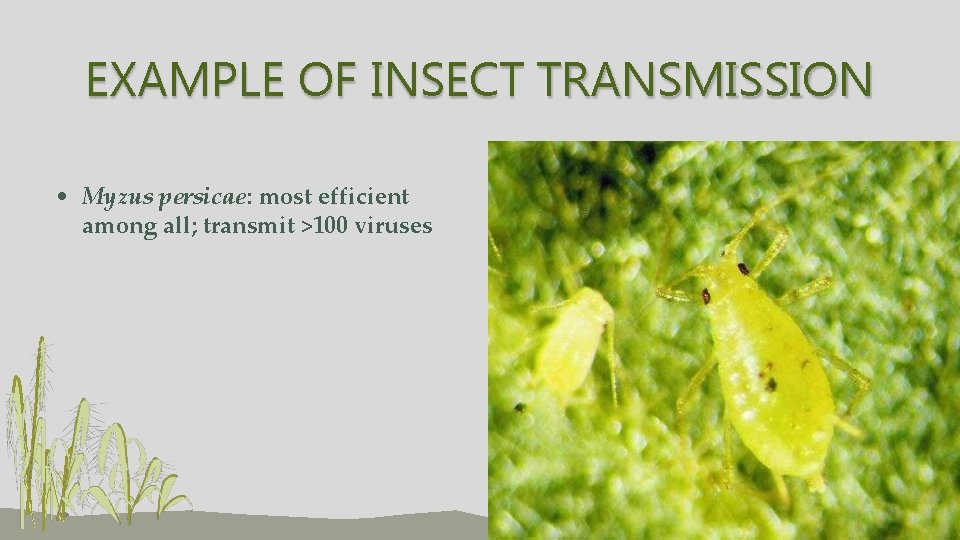
EXAMPLE OF INSECT TRANSMISSION • Myzus persicae: most efficient among all; transmit >100 viruses
CONCEPT OF HELPER VIRUS • These are the viruses transmitted by aphid vectors under certain conditions • A aphid transmit can transmit the virus only if the source plant is infected by second virus. • So it is a dependent virus and second virus is referred as the helper virus • virus
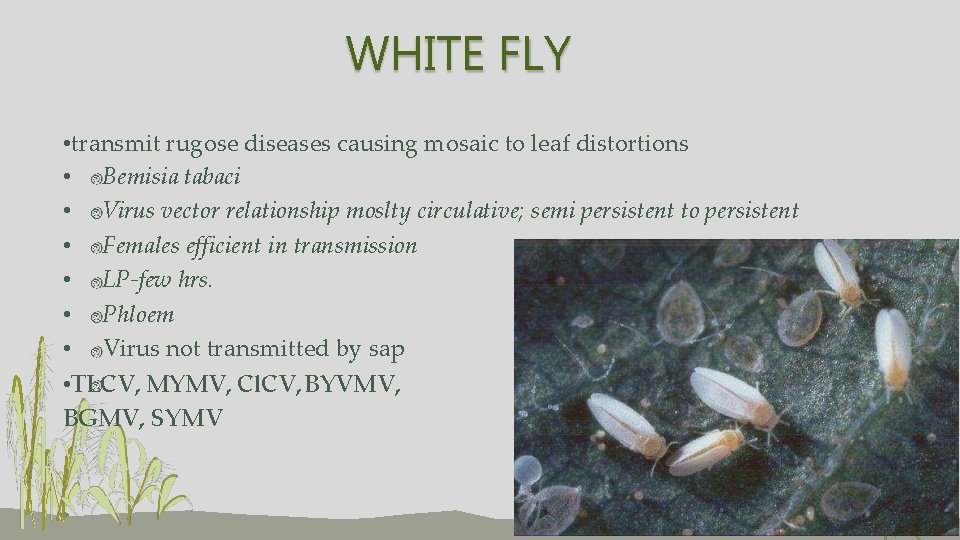
WHITE FLY • transmit rugose diseases causing mosaic to leaf distortions • Bemisia tabaci • Virus vector relationship moslty circulative; semi persistent to persistent • Females efficient in transmission • LP-few hrs. • Phloem • Virus not transmitted by sap • TLCV, MYMV, Cl. CV, BYVMV, BGMV, SYMV
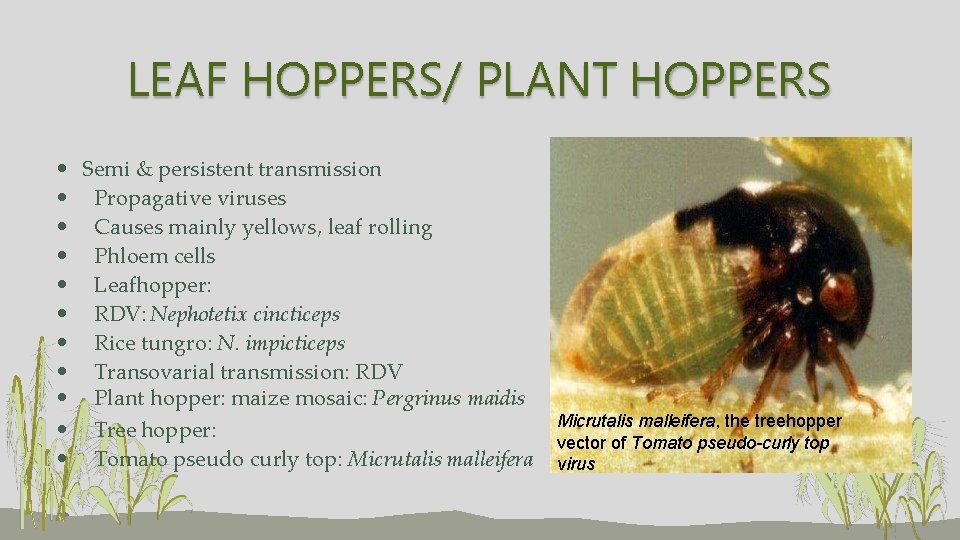
LEAF HOPPERS/ PLANT HOPPERS • Semi & persistent transmission • Propagative viruses • Causes mainly yellows, leaf rolling • Phloem cells • Leafhopper: • RDV: Nephotetix cincticeps • Rice tungro: N. impicticeps • Transovarial transmission: RDV • Plant hopper: maize mosaic: Pergrinus maidis • Tree hopper: • Tomato pseudo curly top: Micrutalis malleifera, the treehopper vector of Tomato pseudo-curly top virus
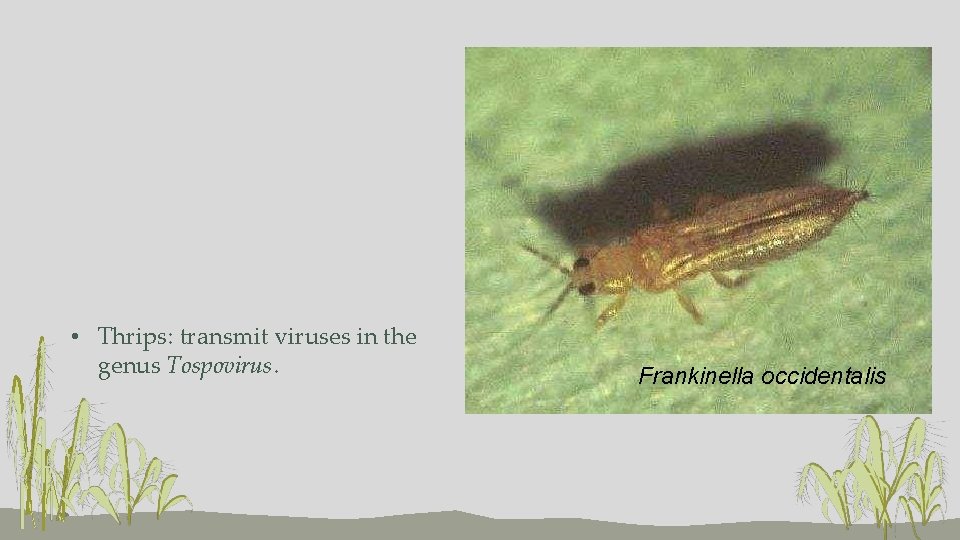
• Thrips: transmit viruses in the genus Tospovirus. Frankinella occidentalis
BEETLE TRANSMISSION • Acq. Feeding : upto 24 hrs • Persistent transmission • Cowpea mosaic virus: Ceratoma trifurcata • Turnip yellow mosaic: Phyllotreta sp.
NEMATODE TRANSISSION • Nematodes as vectors of plant viruses initiated research in Nematology and Virology Hewitt et al. (1958) • Helped in understanding of the transmission and etiology of an important group of soil-borne plant virus diseases. • Two single-stranded RNA virus genera, Nepovirus (NEPO) and Tobravirus (TOBRA), have nematode vectors • Nepoviruses: Comoviridae family • Tobraviruses: family not yet assigned
TOBRAVIRUS • Tobraviruses (Tobacco Rattle viruses) have nematode vectors (Lamberti and Roca, 1987). • Tobraviruses are straight tubular particles with two size ranges, 180210 nm and 45 -115 nm. Trichodorus and Paratrichodorus are vectors. • Nepoviruses (Nematodetransmitted Polyhedral viruses) • Nepoviruses are isometric (polyhedral) particles around 30 nm in diameter (1 nm=10 -9 m, 1 μm=10 -6 m). The only known nematode vectors are in the genera Xiphinema and Longidorus
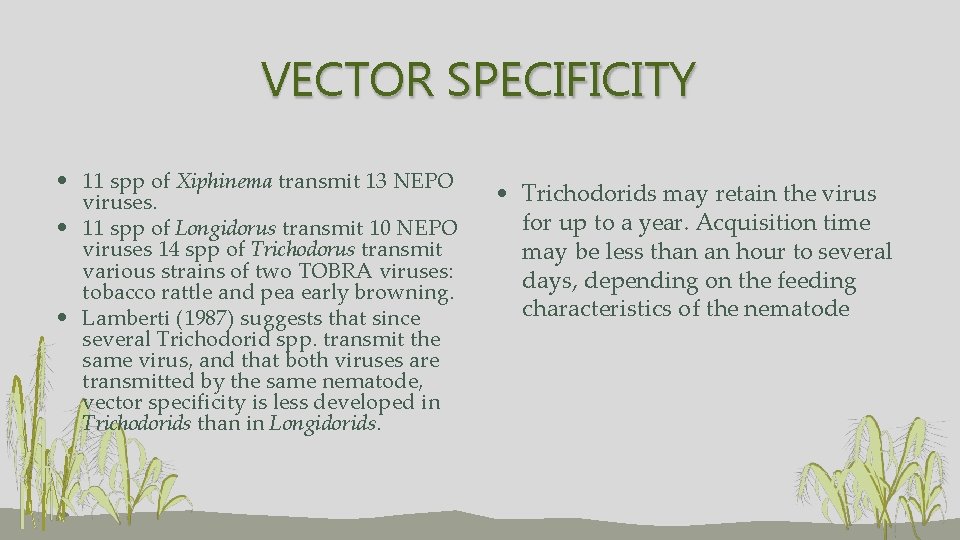
VECTOR SPECIFICITY • 11 spp of Xiphinema transmit 13 NEPO viruses. • 11 spp of Longidorus transmit 10 NEPO viruses 14 spp of Trichodorus transmit various strains of two TOBRA viruses: tobacco rattle and pea early browning. • Lamberti (1987) suggests that since several Trichodorid spp. transmit the same virus, and that both viruses are transmitted by the same nematode, vector specificity is less developed in Trichodorids than in Longidorids. • Trichodorids may retain the virus for up to a year. Acquisition time may be less than an hour to several days, depending on the feeding characteristics of the nematode
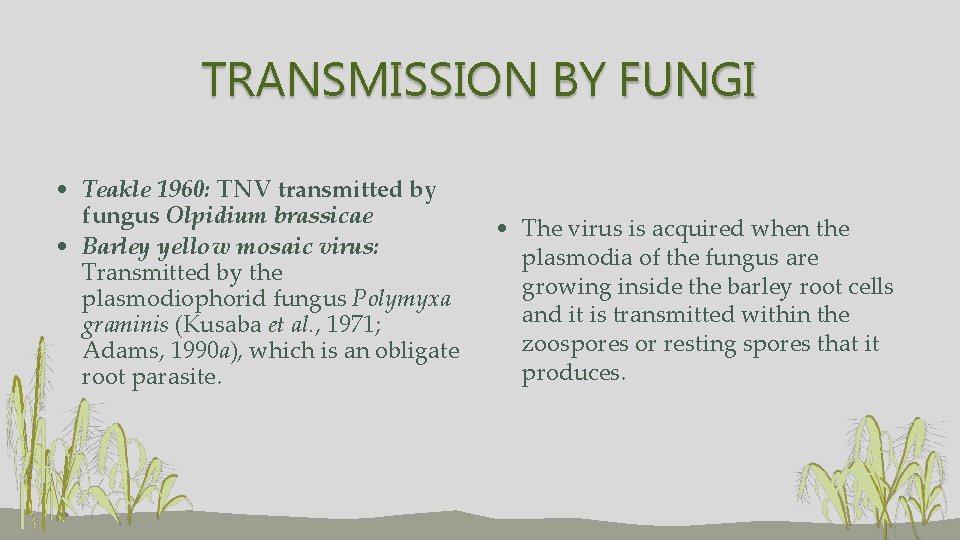
TRANSMISSION BY FUNGI • Teakle 1960: TNV transmitted by fungus Olpidium brassicae • Barley yellow mosaic virus: Transmitted by the plasmodiophorid fungus Polymyxa graminis (Kusaba et al. , 1971; Adams, 1990 a), which is an obligate root parasite. • The virus is acquired when the plasmodia of the fungus are growing inside the barley root cells and it is transmitted within the zoospores or resting spores that it produces.
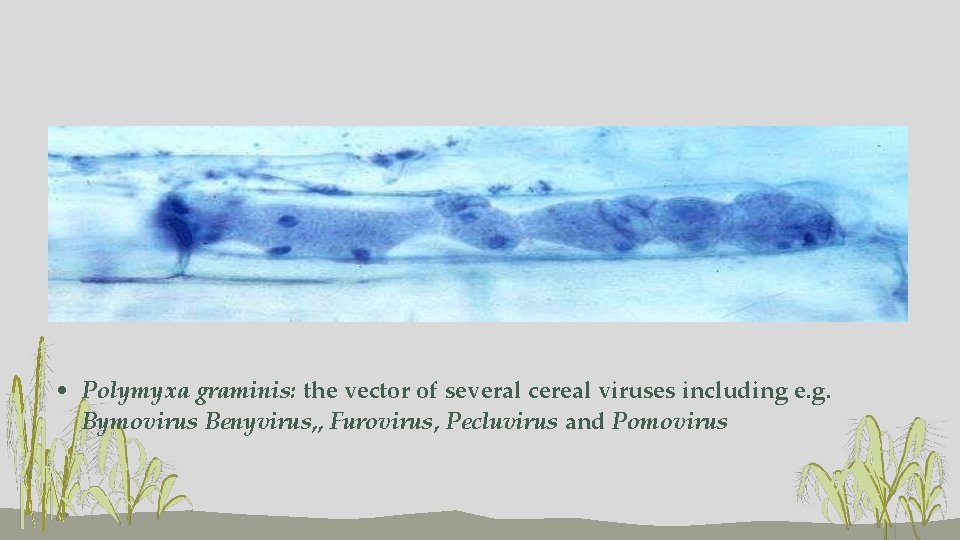
• Polymyxa graminis: the vector of several cereal viruses including e. g. Bymovirus Benyvirus, , Furovirus, Pecluvirus and Pomovirus
BIMODAL TRANSMISSION • While aphid transmit non-circulative viruses either in non-persistent or semipersistent manner • Few viruses have been known to be transmitted in both the manners • This typical mode of transmission was first referred as bimodal transmission by Chalfant and Chapman (1962) in case of Ca. MV by M. persicae and B. brassicae.
SEED TRANSMISSION • Seed transmission occurs in two ways • Externally seed borne • due to external contamination of the seed with virus particles (TMV, PVX) • Internally seed borne (BCMV, BYMV, ULCV) • due to infection of the living tissues of the embryo. • Virus may be found in different parts of the seed but generally in embryonic tissues • The embryo become infected by two routes • Directly from mother plant • By pollens • Developing embryo can be infected before fertilization by the infection of the gametes or by direct invasion of the embryo after fertilization • Virus moves through the testa of immature seed after fertilization and reach micropylar region for embryo infection to occur. Micropyle is in close contact with the base of embryonic suspensor that help in nutrient flow to embryo.
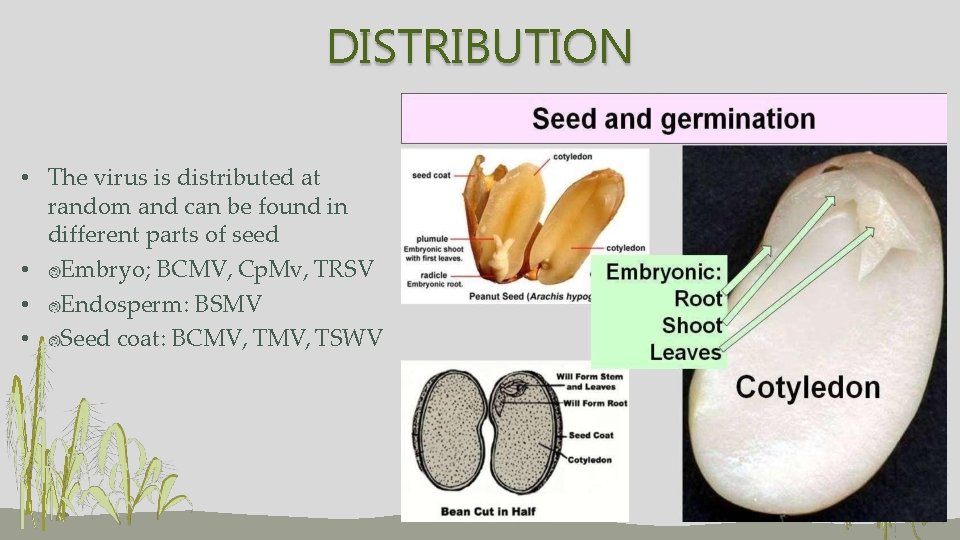
DISTRIBUTION • The virus is distributed at random and can be found in different parts of seed • Embryo; BCMV, Cp. Mv, TRSV • Endosperm: BSMV • Seed coat: BCMV, TSWV