
Transmission Media and Impairments Textbook Chapter 2 p
Transmission Media and Impairments Textbook: Chapter 2 (p. 30 to p. 35) Chapter 6 (p. 95 to p. 97) Data Communications (E&T 2760): Transmisssion Media and Impairments 1
Agenda l Transmission Media – – l twisted pair cable coaxial cable optical fiber radio wave Transmission Impairments – noise – distortion – attenuation l Bit Error Rate Test Data Communications (E&T 2760): Transmisssion Media and Impairments 2
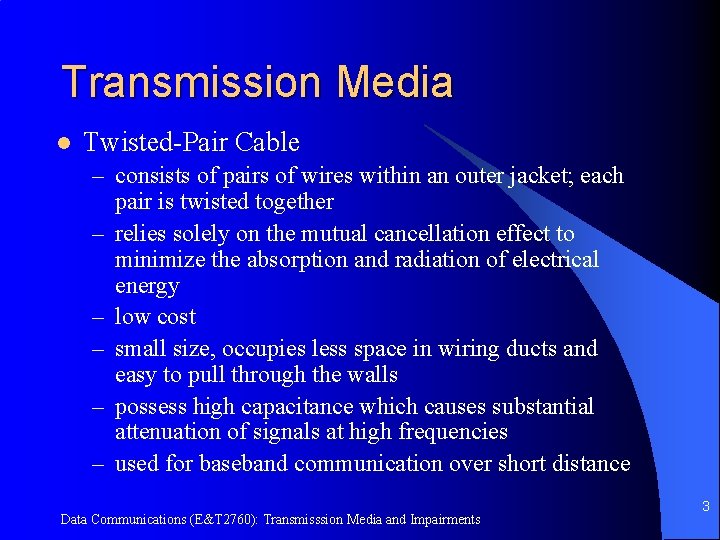
Transmission Media l Twisted-Pair Cable – consists of pairs of wires within an outer jacket; each pair is twisted together – relies solely on the mutual cancellation effect to minimize the absorption and radiation of electrical energy – low cost – small size, occupies less space in wiring ducts and easy to pull through the walls – possess high capacitance which causes substantial attenuation of signals at high frequencies – used for baseband communication over short distance Data Communications (E&T 2760): Transmisssion Media and Impairments 3
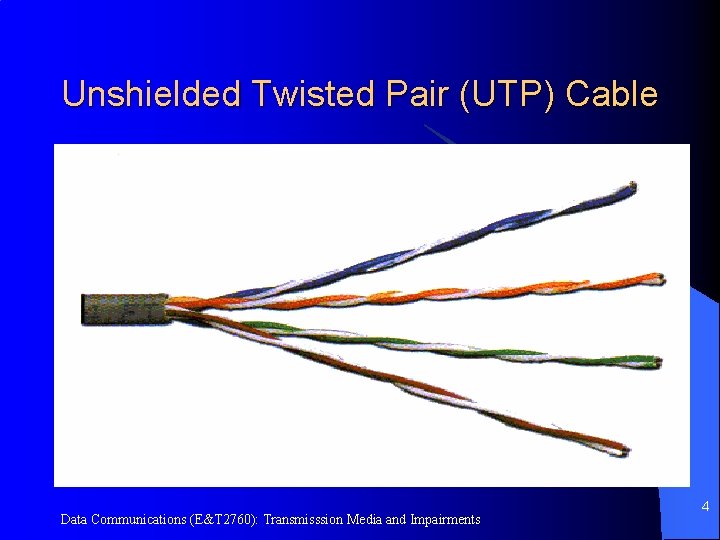
Unshielded Twisted Pair (UTP) Cable Data Communications (E&T 2760): Transmisssion Media and Impairments 4
Transmission Media l Coaxial Cable – consists of a center copper conductor, a layer of flexible insulation, a shield of woven copper braid or metallic foil, and an outer cable jacket – excellent shielding capability highly immune to external interference l enable much higher frequencies of operation, typically up to hundreds of megahertz – very little electromagnetic radiation reduce the possibility for eavesdropping – bulky and somewhat inflexible difficult to install Data Communications (E&T 2760): Transmisssion Media and Impairments 5
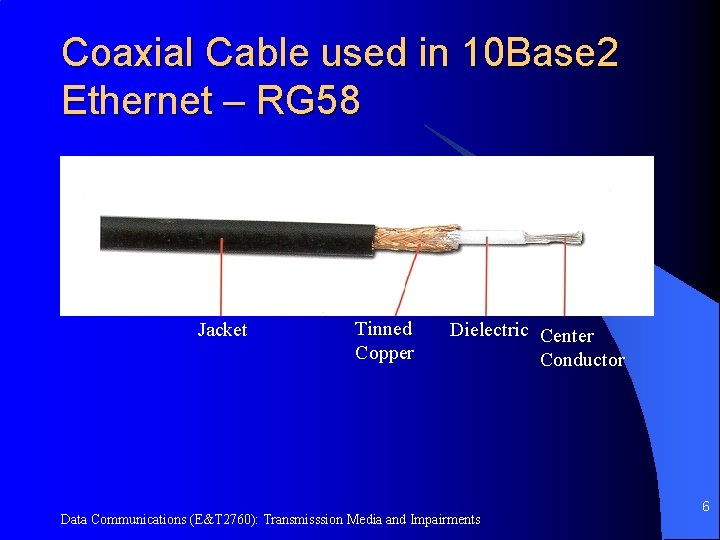
Coaxial Cable used in 10 Base 2 Ethernet – RG 58 Jacket Tinned Copper Dielectric Center Conductor Data Communications (E&T 2760): Transmisssion Media and Impairments 6
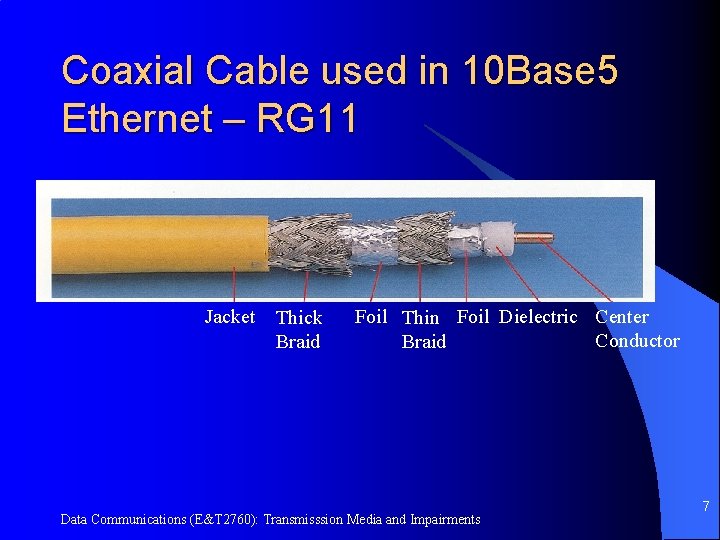
Coaxial Cable used in 10 Base 5 Ethernet – RG 11 Jacket Thick Braid Foil Thin Foil Dielectric Center Conductor Braid Data Communications (E&T 2760): Transmisssion Media and Impairments 7
Transmission Media l Optical Fiber – made of glass fibers, carries light – completely immune from crosstalk and EMI l l l handle even higher transmission rates with lower losses than are possible with coaxial cables data rates in excess of 2 Gbps enable propagation over several tens of kilometers without signal regeneration – no electromagnetic radiation secure – small size, occupies less space in wiring ducts – requires additional training of personnel and expensive precision splicing and measurement equipment to install Data Communications (E&T 2760): Transmisssion Media and Impairments 8
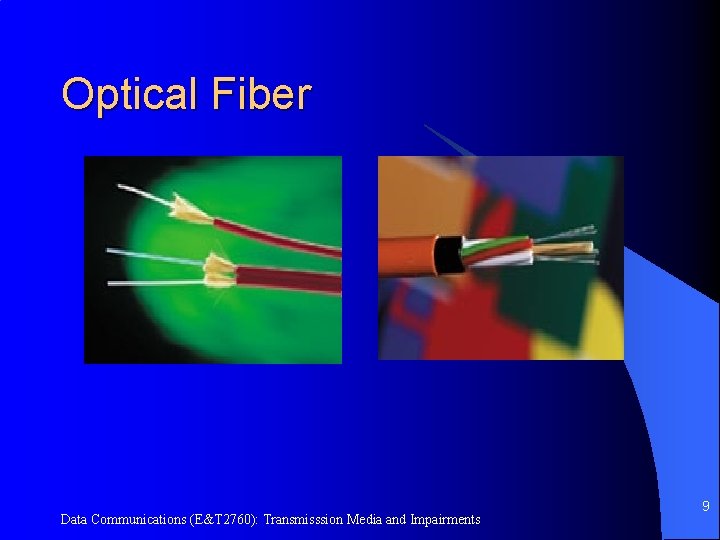
Optical Fiber Data Communications (E&T 2760): Transmisssion Media and Impairments 9
Transmission Media l Radio Wave – used in: l l l point-to-point operation, over difficult or hostile terrain broadcasting application mobile applications – disadvantages: l l l performance dependent upon the frequency of operation, geographical location and time signal fading insecure Data Communications (E&T 2760): Transmisssion Media and Impairments 10
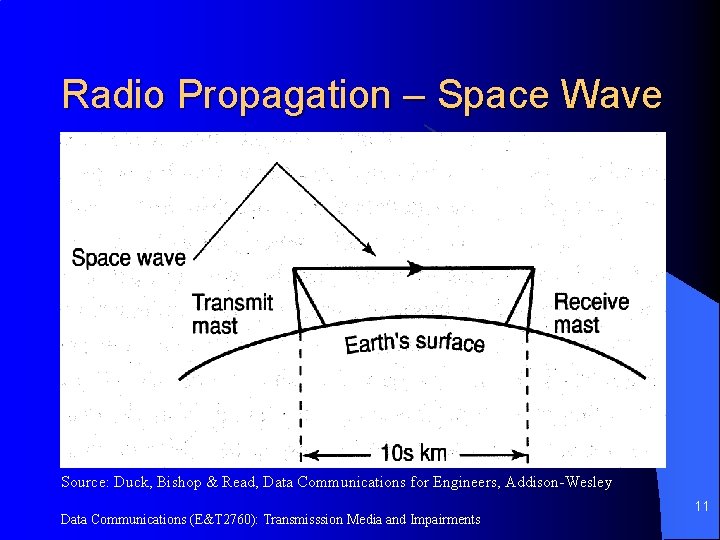
Radio Propagation – Space Wave Source: Duck, Bishop & Read, Data Communications for Engineers, Addison-Wesley Data Communications (E&T 2760): Transmisssion Media and Impairments 11
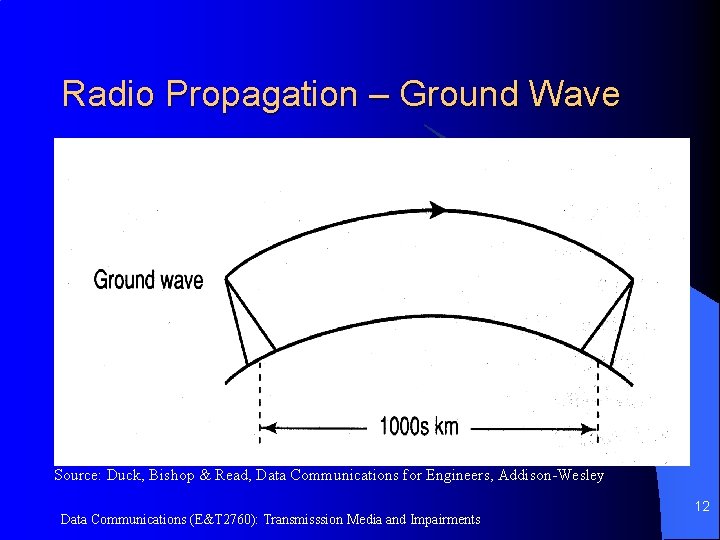
Radio Propagation – Ground Wave Source: Duck, Bishop & Read, Data Communications for Engineers, Addison-Wesley Data Communications (E&T 2760): Transmisssion Media and Impairments 12
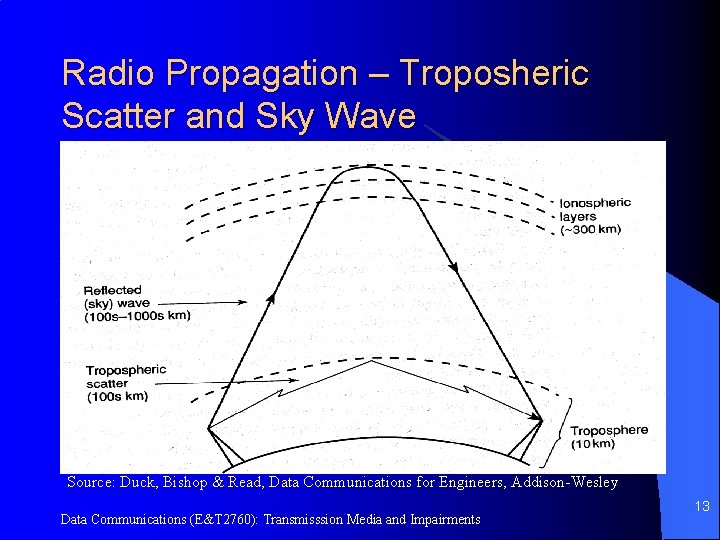
Radio Propagation – Troposheric Scatter and Sky Wave Source: Duck, Bishop & Read, Data Communications for Engineers, Addison-Wesley Data Communications (E&T 2760): Transmisssion Media and Impairments 13
Transmission Impairments l Noise – Thermal noise l l l present in all electronic devices and metallic transmission media caused by thermal agitation of electrons within the material cannot be eliminated – Impulse noise l l picked up from external sources such as lighting or noisy electromechanical equipment fairly high amplitude and relatively long duration corrupt substantial number of bits – Crosstalk l arises from unwanted electrical coupling between adjacent wires Data Communications (E&T 2760): Transmisssion Media and Impairments 14
Transmission Impairments l Distortion – Delay distortion/dispersion l l different signal frequency components travel at different speeds within the transmission media and hence arrive at the receiver at slightly different times cause Intersymbol Interference (i. e. neighboring bits spread into each other) Data Communications (E&T 2760): Transmisssion Media and Impairments 15
Transmission Impairments l Attenuation – If an electrical signal is transmitted over a long distance (e. g. a few kilometers), the signal to noise ratio becomes too low that erroneous reception of data occurs. – Introduce further distortion when the attenuation is frequency dependent l can be overcome with equalizers – Attenuation in optic fiber cables is dramatically less than in other transmission media Data Communications (E&T 2760): Transmisssion Media and Impairments 16
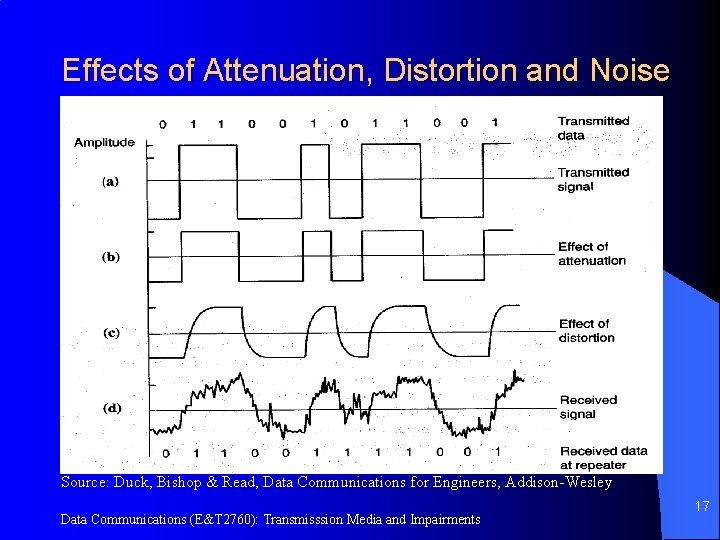
Effects of Attenuation, Distortion and Noise Source: Duck, Bishop & Read, Data Communications for Engineers, Addison-Wesley Data Communications (E&T 2760): Transmisssion Media and Impairments 17
Bit Error Rate Test continuously transmit pseudo-random test patterns onto a serial link l the data stream is looped backed, received and verified l isolate faults (whether the communication problem is due to a faulty DCE or a link breakdown? ) and measure bit error rates of communication circuits l Data Communications (E&T 2760): Transmisssion Media and Impairments 18
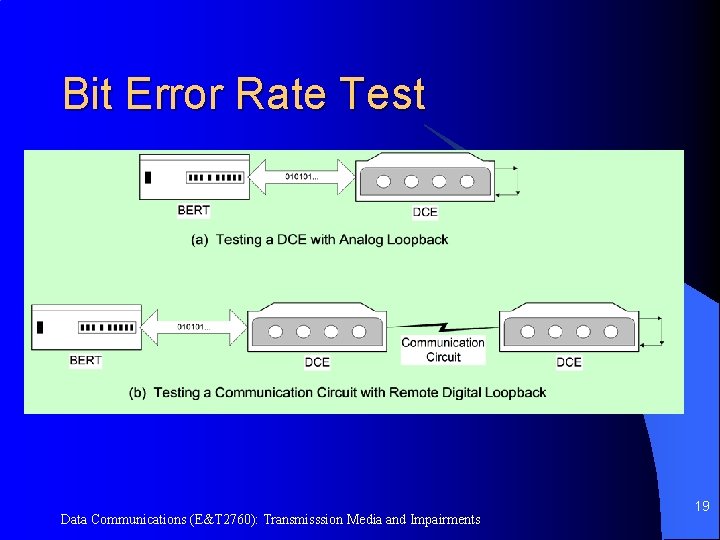
Bit Error Rate Test Data Communications (E&T 2760): Transmisssion Media and Impairments 19
Where to Get More Information l Textbook – Chapter 2, p. 30 to p. 35 l “How to find phone-line faults and what to do about them”, Jack Douglass, Data Communications, September 1988 Data Communications (E&T 2760): Transmisssion Media and Impairments 20
- Slides: 20