
Transmission Line Properties The physical characteristics geometry and
- Slides: 5
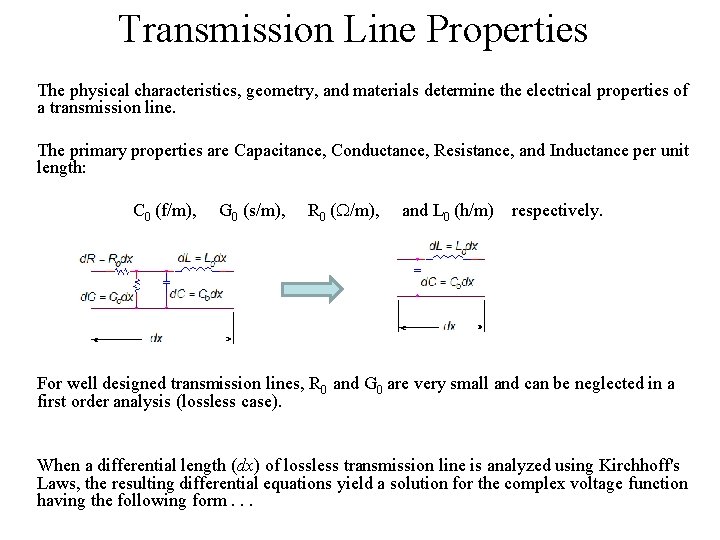
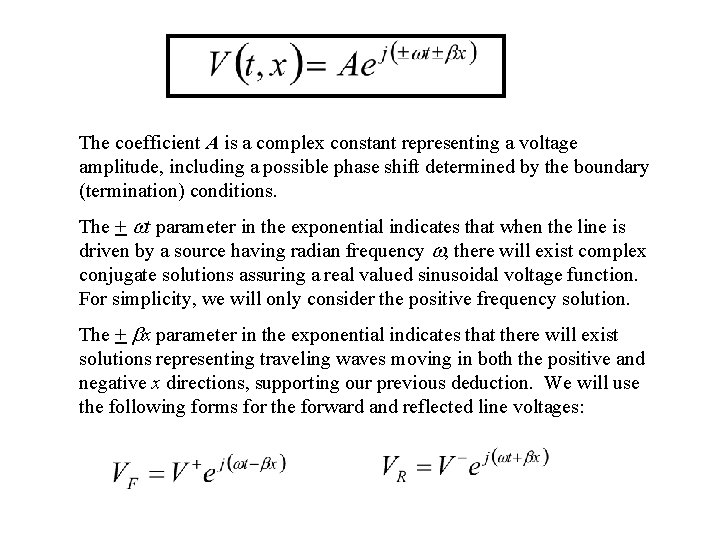
Transmission Line Properties The physical characteristics, geometry, and materials determine the electrical properties of a transmission line. The primary properties are Capacitance, Conductance, Resistance, and Inductance per unit length: C 0 (f/m), G 0 (s/m), R 0 (W/m), and L 0 (h/m) respectively. For well designed transmission lines, R 0 and G 0 are very small and can be neglected in a first order analysis (lossless case). When a differential length (dx) of lossless transmission line is analyzed using Kirchhoff's Laws, the resulting differential equations yield a solution for the complex voltage function having the following form. . .
The coefficient A is a complex constant representing a voltage amplitude, including a possible phase shift determined by the boundary (termination) conditions. The + wt parameter in the exponential indicates that when the line is driven by a source having radian frequency w, there will exist complex conjugate solutions assuring a real valued sinusoidal voltage function. For simplicity, we will only consider the positive frequency solution. The + bx parameter in the exponential indicates that there will exist solutions representing traveling waves moving in both the positive and negative x directions, supporting our previous deduction. We will use the following forms for the forward and reflected line voltages:
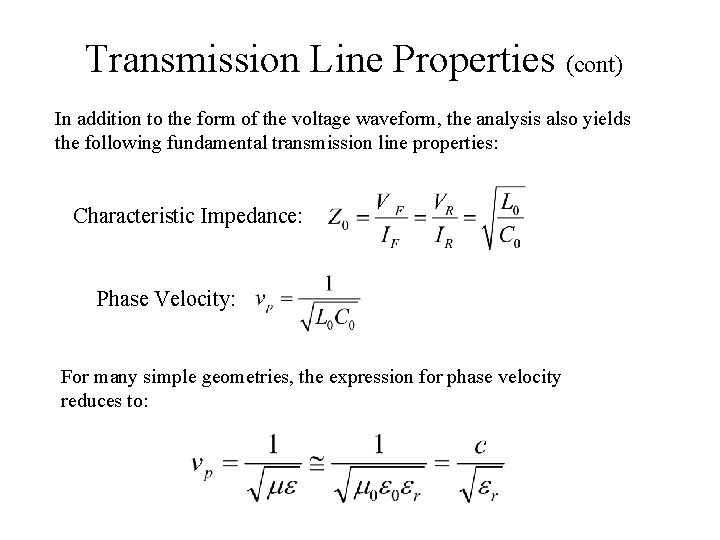
Transmission Line Properties (cont) In addition to the form of the voltage waveform, the analysis also yields the following fundamental transmission line properties: Characteristic Impedance: Phase Velocity: For many simple geometries, the expression for phase velocity reduces to:
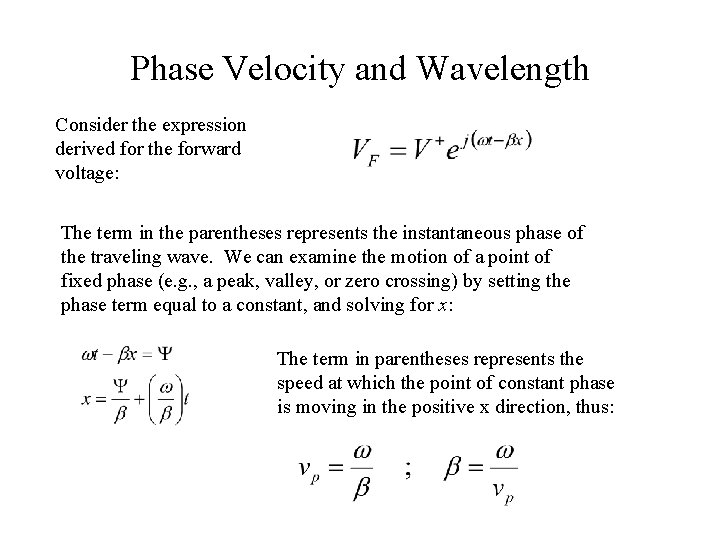
Phase Velocity and Wavelength Consider the expression derived for the forward voltage: The term in the parentheses represents the instantaneous phase of the traveling wave. We can examine the motion of a point of fixed phase (e. g. , a peak, valley, or zero crossing) by setting the phase term equal to a constant, and solving for x: The term in parentheses represents the speed at which the point of constant phase is moving in the positive x direction, thus:
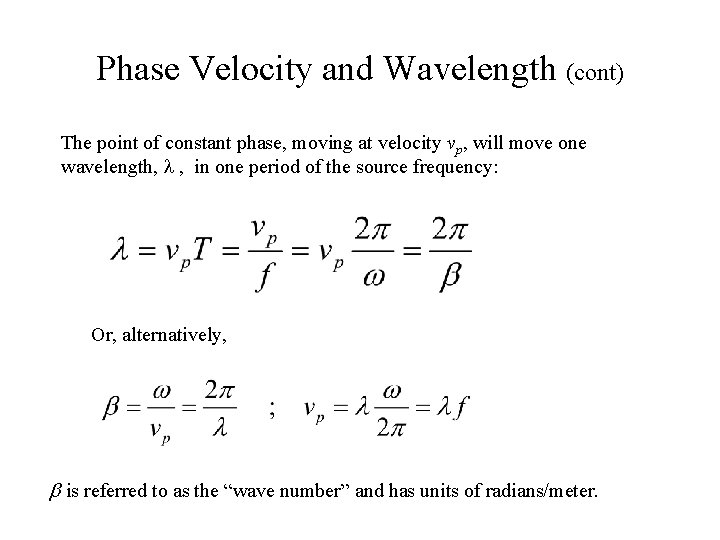
Phase Velocity and Wavelength (cont) The point of constant phase, moving at velocity vp, will move one wavelength, l , in one period of the source frequency: Or, alternatively, b is referred to as the “wave number” and has units of radians/meter.