
Transmission electron microscopy TEM is a microscopy technique

- Slides: 10
Transmission electron microscopy (TEM) is a microscopy technique in which a beam of electrons is transmitted through an ultrathin specimen, interacting with the specimen as it passes through it. An image is formed from the interaction of the electrons transmitted through the specimen; the image is magnified and focused onto an imaging device. Higher resolution imaging requires thinner samples and higher energies of incident electrons, which means that the sample can no longer be considered to be absorbing electrons. Resolution in TEM ranges from few nanometers to atomic level ( Angstrom). TEMs consist of the following components: An electron source Thermionic Gun Electron beam Electromagnetic lenses Vacuum chamber 2 Condensers Sample stage fluorescent screen Computer
TEM provides information on : 1. Topography 2. Morphology 3. Compositional 4 - Crystalline Fig -1 - instrument of TEM
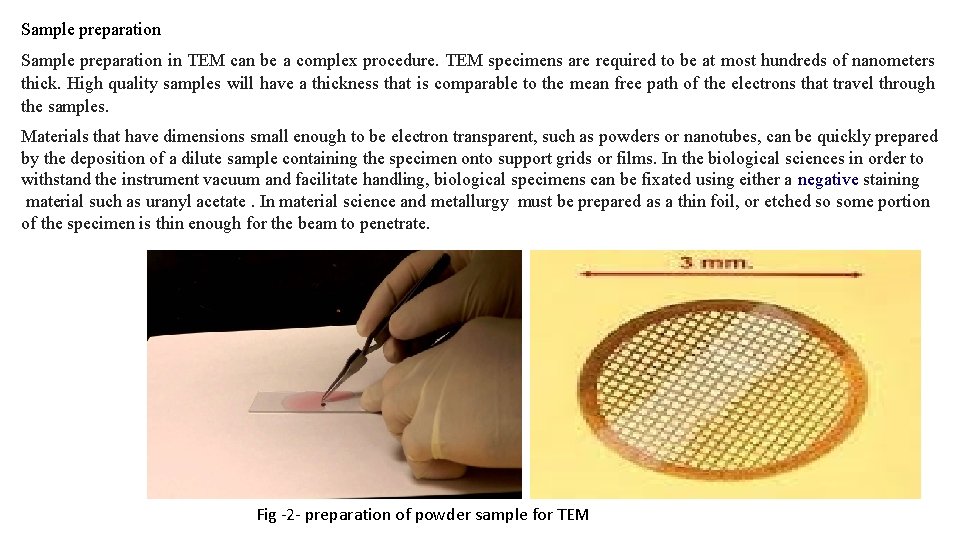
Sample preparation in TEM can be a complex procedure. TEM specimens are required to be at most hundreds of nanometers thick. High quality samples will have a thickness that is comparable to the mean free path of the electrons that travel through the samples. Materials that have dimensions small enough to be electron transparent, such as powders or nanotubes, can be quickly prepared by the deposition of a dilute sample containing the specimen onto support grids or films. In the biological sciences in order to withstand the instrument vacuum and facilitate handling, biological specimens can be fixated using either a negative staining material such as uranyl acetate. In material science and metallurgy must be prepared as a thin foil, or etched so some portion of the specimen is thin enough for the beam to penetrate. Fig -2 - preparation of powder sample for TEM
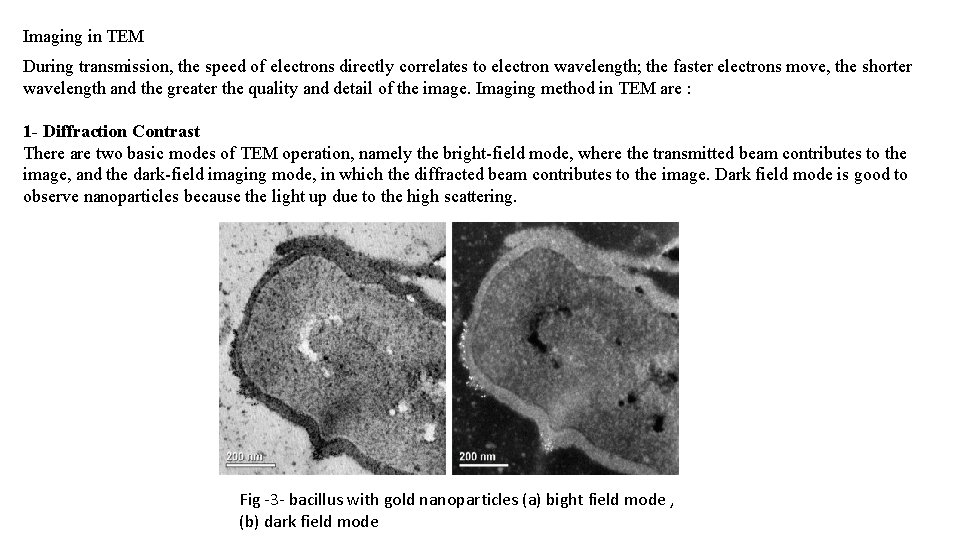
Imaging in TEM During transmission, the speed of electrons directly correlates to electron wavelength; the faster electrons move, the shorter wavelength and the greater the quality and detail of the image. Imaging method in TEM are : 1 - Diffraction Contrast There are two basic modes of TEM operation, namely the bright-field mode, where the transmitted beam contributes to the image, and the dark-field imaging mode, in which the diffracted beam contributes to the image. Dark field mode is good to observe nanoparticles because the light up due to the high scattering. Fig -3 - bacillus with gold nanoparticles (a) bight field mode , (b) dark field mode
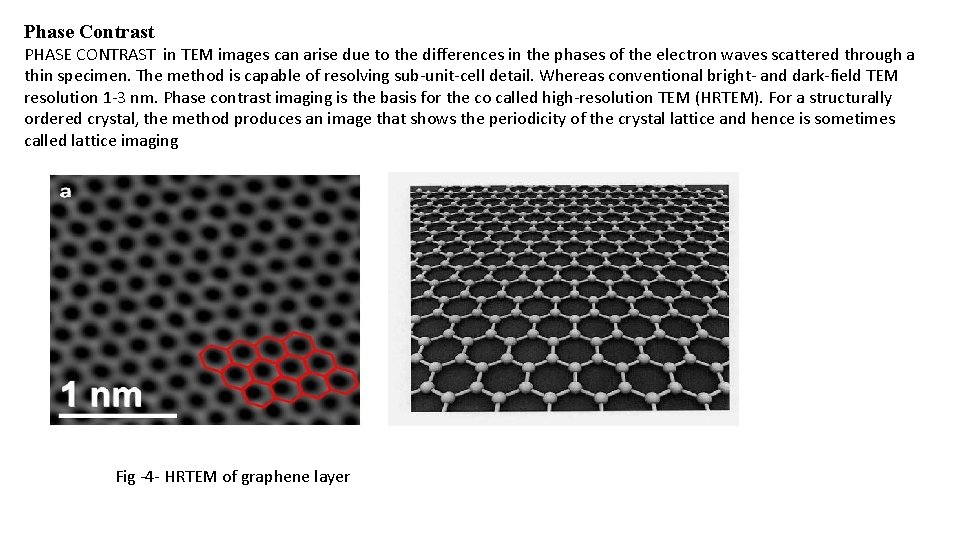
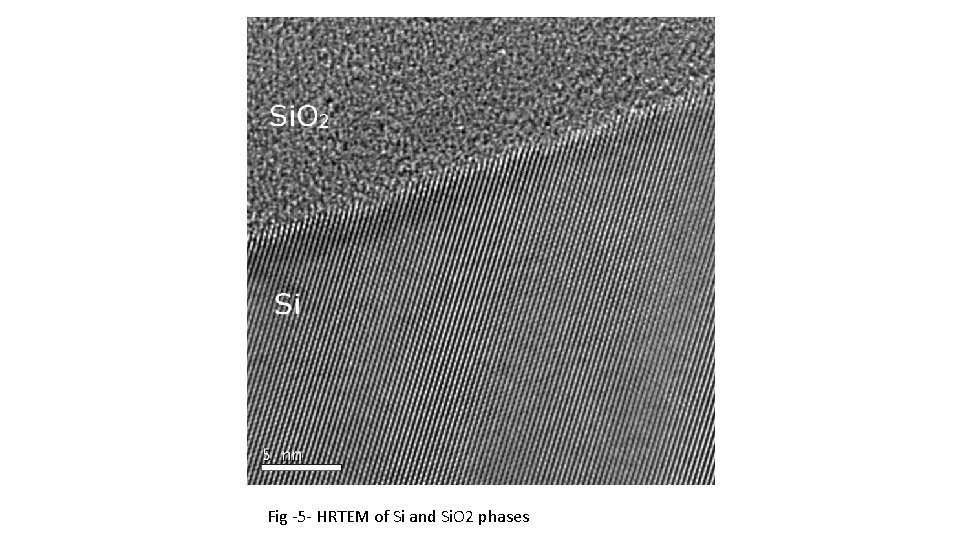
Phase Contrast PHASE CONTRAST in TEM images can arise due to the differences in the phases of the electron waves scattered through a thin specimen. The method is capable of resolving sub-unit-cell detail. Whereas conventional bright- and dark-field TEM resolution 1 -3 nm. Phase contrast imaging is the basis for the co called high-resolution TEM (HRTEM). For a structurally ordered crystal, the method produces an image that shows the periodicity of the crystal lattice and hence is sometimes called lattice imaging Fig -4 - HRTEM of graphene layer
Fig -5 - HRTEM of Si and Si. O 2 phases
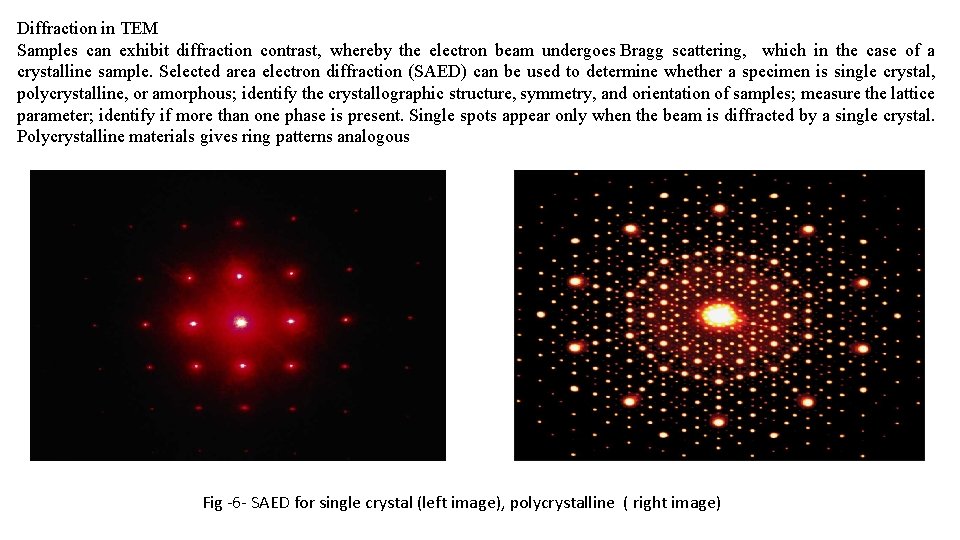
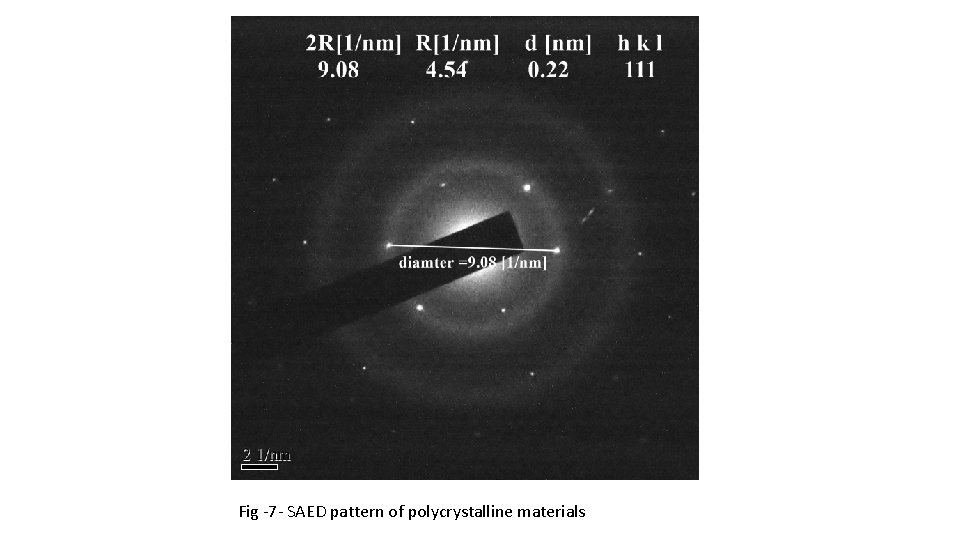
Diffraction in TEM Samples can exhibit diffraction contrast, whereby the electron beam undergoes Bragg scattering, which in the case of a crystalline sample. Selected area electron diffraction (SAED) can be used to determine whether a specimen is single crystal, polycrystalline, or amorphous; identify the crystallographic structure, symmetry, and orientation of samples; measure the lattice parameter; identify if more than one phase is present. Single spots appear only when the beam is diffracted by a single crystal. Polycrystalline materials gives ring patterns analogous Fig -6 - SAED for single crystal (left image), polycrystalline ( right image)
Fig -7 - SAED pattern of polycrystalline materials
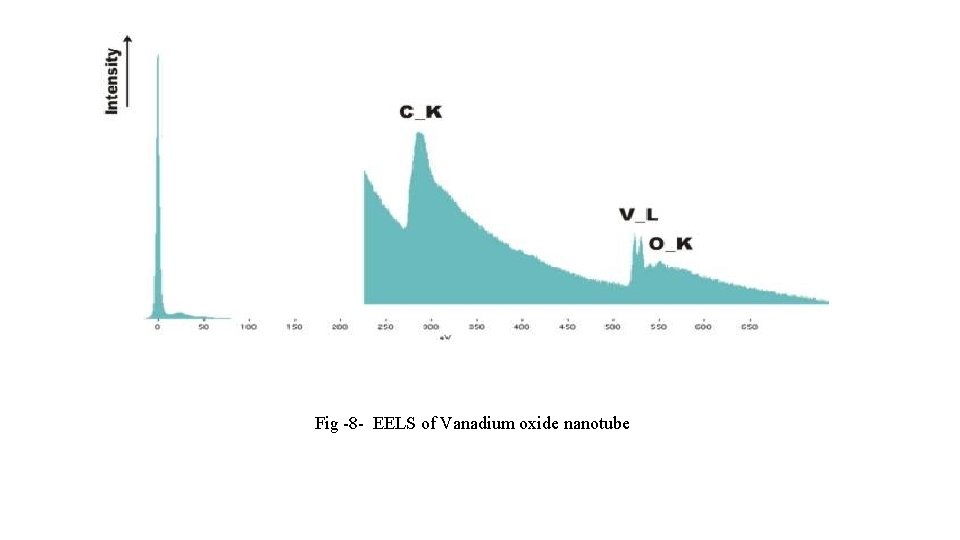
Electron energy-loss spectroscopy (EELS) is an analytical technique that measures the change in kinetic energy of electrons after they have interacted with a specimen. Electron energy-loss spectroscopy (EELS) involves measurement of the amount of energy needs to remove the electron from the shells Zero-loss peak at 0 e. V: It mainly contains electrons that still have the original beam energy E 0, i. e. , they have only interacted elastically or not at all with the specimen ( incident electrons do not loss any energy). Low-loss region (< 100 e. V) Here, the electrons that have induced plasmon oscillations occur. High-Loss region (> 100 e. V) For the ionization of atoms, a specific minimum energy, the critical ionization energy E C or ionization threshold, must be transferred from the incident electron to the expelled inner-shell electron, which leads to ionization edges in the spectrum at energy losses that are characteristic for an element. Thus, EELS is complementary to. X-ray spectroscopy, and it can be utilized for qualitative and quantitative element analysis as well.
Fig -8 - EELS of Vanadium oxide nanotube