
TRANSMEDIA Convergence Collaboration Participation Co Creation and Immersion
TRANSMEDIA Convergence, Collaboration, Participation, Co. Creation and Immersion
Entertainment Marketer Film: Odeon Cinemas – worked with Disney, Warner Bros, Twentieth Century Fox etc Television: BBC Worldwide, GMBD, Multimedia Games: Nice Technology – Creatures IP ENTERTAINMENT: BACKGROUND
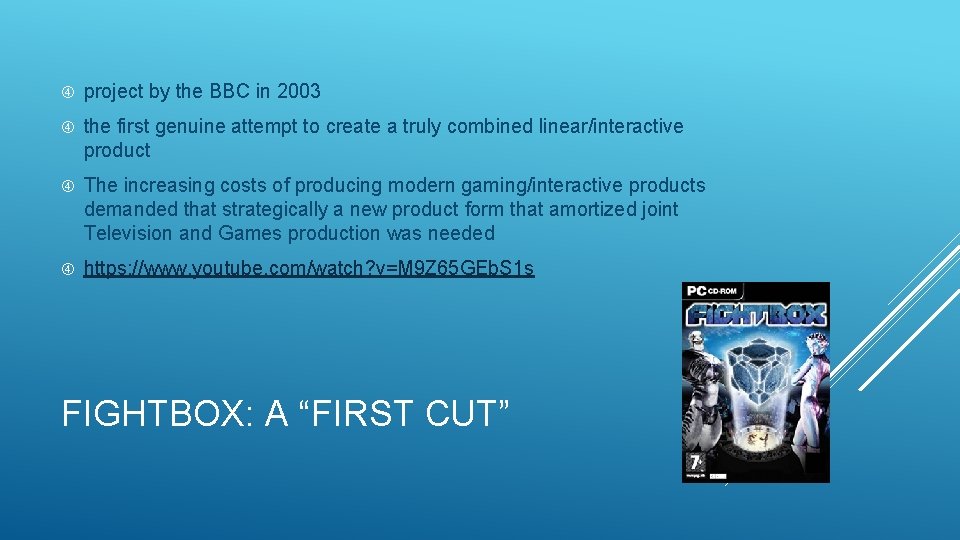
project by the BBC in 2003 the first genuine attempt to create a truly combined linear/interactive product The increasing costs of producing modern gaming/interactive products demanded that strategically a new product form that amortized joint Television and Games production was needed https: //www. youtube. com/watch? v=M 9 Z 65 GEb. S 1 s FIGHTBOX: A “FIRST CUT”
“a process where integral elements of a fiction get dispersed systematically across multiple delivery channels for the purpose of creating a unified and co-ordinated entertainment experience. Ideally, each medium makes its own unique contribution to the unfolding of the story”. Source: Henry Jenkins, Convergence Culture TRANSMEDIA: DEFINITION
![There was a lack of understanding in television [business unit] of interactive products](http://slidetodoc.com/presentation_image/71eff2b92e5df1f140a882bfb327bd93/image-5.jpg "There was a lack of understanding in television [business unit] of interactive products")
There was a lack of understanding in television [business unit] of interactive products and what interactive elements needed to be incorporated into the new product. This, in turn, resulted in financial cost accounting and sponsorship difficulties; Marrying the development process, differing timescales and the milestone targets of the two formats proved highly problematic; This was, to a large degree, down to immature and insufficiently developed and advanced technology; There was insufficient attraction in watching others [gamers] play: consumers wanted to play, interact and participate in a game - not observe it; Rights issues existed: different rights-holders, i. e. television, wanted to retain ownership of the IP so as to retain control of the creative process – the issues of business silos, ownership, and control were pertinent. However, the concept was feasible “FIGHTBOX”: BARRIERS TO SUCCESS
Consumer Technology Content Narration Distribution Communications Commercial TRANSMEDIA: KEY ELEMENTS
There is a process of “cognitive convergence” underway: the bringing together of consumers and ideas to form new content via shared mental models, (Hodhod & Magerko, 2016) Entertainment = social experiences via sharing ideas emanating from “collective intelligence” and utilising networked technology, (Mc. Gonigal, 2003) Consumers will augment existing value in any given system by innovating within or adding to it, (Chesborough, 2003, Dahlander & Gann, 2010) Open-Innovation User Communities, (OUIC’s), Dong & Wu, (2015) Fuchs, (2017): digital users are insufficiently creative and cannot therefore create usergenerated content of the necessary quality Richard Leinfellner, ex-Electronic Arts: “what is the customer thinking and can their consciousness fulfil their fantasies? ” TRANSMEDIA: CONSUMER
Technology in theory is potentially diluting Fuch’s criticism many-to-many facilitated technology will bring consumers and communities together and enable “collective intelligence” to facilitate the creation of new content, (Levy, 1997) The “network effect” whereby large numbers of users come together collectively is likely to promulgate this via what Katz & Shapiro, (1986) describe as “network externalities” or whereby each new user provides additional value OUIC’s will coalesce on new technology/social media platforms to develop user-generated content, (Dong & Wu, 2015) Debatable currently whether technological capabilities can fully deliver this or sufficiently blend with each other to realise required convergence levels, (Bolin, 2015) Incompatible standards and the exercise or proprietary control, (Economides & Flyer, 1997) Sony: Virtual Reality, (VR), technology is still around 3 -5 years away from reaching the capability levels required to deliver true, immersive, “bottom-up” [consumer user-created] content TRANSMEDIA: TECHNOLOGY
Deeper: immersive digital universes with different storylines for different audiences; Control: consumers will imbue parts of a story with their meaning; Forking paths: non-linear/sequential directions will appear that generate value; Open-worlds created via digital tools that create complex systems; Mystery boxes: whereby communities become the creative mechanism; Experimentation: in interactive worlds; Empathy: via social media and cognitive development of subconscious to develop emergent stories. Source: Rose: The Art of Immersion, 2012 IMMERSIVE CONTENT FEATURES
Kozinents, 1999: experiences and/or lifestyles developed around different interests and then augmented in the digital space via social media Mack, (2016): current entertainment propositions such as film worlds are designed to align with cinematic rules rather than digitally programming ones Consumers work collaboratively together: “teens are empowered by participation”, (Martens, 2011) Production shared in a collective environment in what is, in effect, a co-creation system is a factor, (Xiang & Chen, 2008) Integration in communities and interaction and communication to create content collaboratively, (Mc. Gonigal, 2003) Telo, (2013): content produced via complex participative and collaborative practices Hababi, Laroche and Richard, (2016): value-creation in the digital space revolves around social networking, building social capital, shared consciousness among members via “meaning” developed by networked connections and a sense of connectedness and commitment to rituals Mc. Gonigal, (2003) believes that the collective talents of participants will overrule the ability of producers to control a franchise Lucas Film creating a Star Wars canon via a Story Group to develop new narratives within an over-arching universe within a “digital backlot” TRANSMEDIA: CONTENT
What constitutes transmedia “content” is more than just text – but storytelling remains central New forms of narration will emerge in the new immersive digital entertainment world, (Rheingold, 2007) Fans via fan fiction will be able to directly participate in the expansion of a fictional world to create new situations and characters, (Scolari, (2009) The structure of narratives will be able to be told by different points-of-view: consumers will create different points of entry for different audiences, (Ryan et. al, 2017) Buselle & Bilnandzic, (2008: user “representations” drawn from the digital world to construct meaning, create content and develop associated narratives “Hybrid stories” facilitated by technology, (Abba, 2009) Need to understanding how audiences can and will become engaged with stories in a digital context essential to developing and furthering new collaborative, participative, co-created content and how they are “transported” into a “storyworld”, (Sangalang, et. al, 2013) “technology is changing the way we tell stories”, Warner Bros Digital Television TRANSMEDIA NARRATION
Collective intelligence or the “fourth space” will require a new communication tools – do they currently exist? The transfer or transformation of messages or tranmediations will occur across digital mediums and interpretative communities and communications will drive these into narrative worlds, (Green et. al, 2004 van Laer et. al, (2013) the medium and the context in which a narrative is delivered will affect it’s potential to be transported or extended to a wider audience and, therefore, affect participation Mc. Quail and Windhal, (2015): new skills and feedback mechanisms are required in the digital world to enable actions and behaviour to be modified “Communities” offer a potentially new was to collect user-generated content: communications within communities will also become more important, (Mc. Quail & Windahl, 2015). Key creators or “influencers” will emerge and develop reputations and status, (Jeppesen & Frederiksen, 2006) Participation structures, entextualization and remediation have yet to be determined, (Katriel, 2015) Da Costa, (2006): groups, communities and societies will contain continuous negotiation of individual preferences that revolve around societal dynamics The appeal of communities, and the original, emergent knowledge that develops in the unmediated digital communications space, will provide intrinsic value for consumers via attendant community characteristics, such as interactivity and relationships, (Srej, 2012) TRANSMEDIA: COMMUNICATION
Accretive power: customers become assets on platforms Pipelines, Platforms and the New Rules of Strategy, (van Alstyne, Parker and Choudary, (Harvard Business Review, 2016) Resource Control to Resource Orchestration Internal Optimization to External Interaction A Focus on Customer Value to a Focus on Ecosystem Value What are the common elements on each platform? (Mack, 2016) Control of IP and “terms of trade”, (Tauscher & Laudien, 2017) – digital platforms as regulatory frameworks “Today, it is all about the distribution and global networks volume business model”, (The Economist, 2016) TRANSMEDIA: DISTRIBUTION
In the digital world value comes from plenty, (Thomas. et. al, 2005) Need to create a whole new system – an ecosystem model, (Johnson & Suskiewicz, 2013) Ubiquity over scarcity leads to innovation via external complementors, (Baldwin & Henkel, 2012) Business model analytical framework: economics of matching, assembling and knowledge management, (Brousseau & Penard, 2007) New business models need to be system based, holistic and wider than current boundaries, (Zott et. al, 2001) “Network externality” effects influenced by size, strength, coalition partners, value generation, (Economides& Flyer, 1997) New business models need to deliver consumer value via revised value-chain, (Tauscher & Laudien, 2017) Investment driven in the intangible economy by: synergies, scalability, sunkeness and spillovers, (Haskel & Westlake, 2017) Sony: “we need to come up with a new system” TRANSMEDIA: COMMERCIAL
Main Research Question: What is the potential role of user-participation and innovation in the development of new, immersive entertainment storytelling and content? Sub-questions: What technological space do developers/IP holders need to provide to facilitate effective user-innovation and participation? What is the user profile and creative skill-set that can develop immersive, emergent entertainment storytelling and content forms? PHD: RESEARCH QUESTIONS
- Slides: 15