
TRANSLOAD FACILITY SITE ANALYSIS TFSA SCENE 2 October
TRANSLOAD FACILITY SITE ANALYSIS (TFSA) SCENE 2 October 4, 2016
TFSA - History Statewide Transportation Freight Summit – September 2013 § Large group meeting and modal breakout sessions § Interest from freight stakeholders and local units of government to identify multimodal freight transportation needs, issues and trends § Freight breakout session – Identified need for a Statewide Freight Advisory Committee § Multi-modal in nature; four meetings between April and September 2014 § Stakeholders from transportation companies (truck and rail), industry organizations, manufacturers, OSOW industry, LUGS, economic development organizations, state agencies, Kansas Turnpike Authority and FHWA § Identified multimodal freight trends, issues and needs: current, near term and long term § Identified Kansas Freight Corridors of Significance § Multiple recommendations

KFAC Heat Map
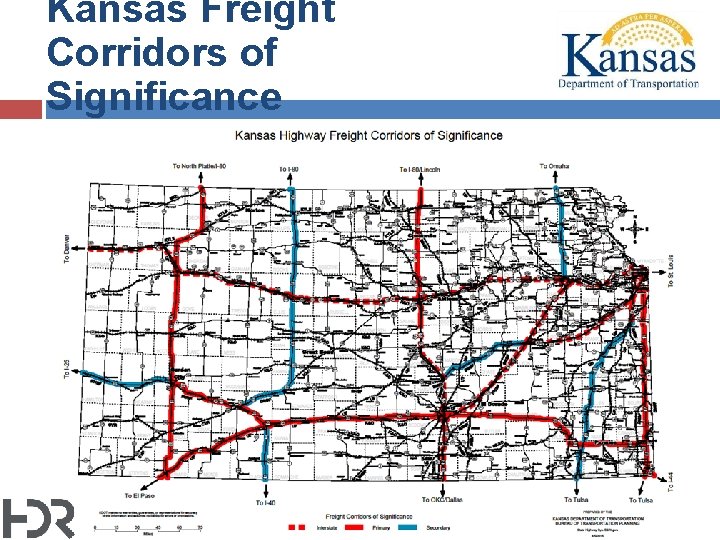
Kansas Freight Corridors of Significance
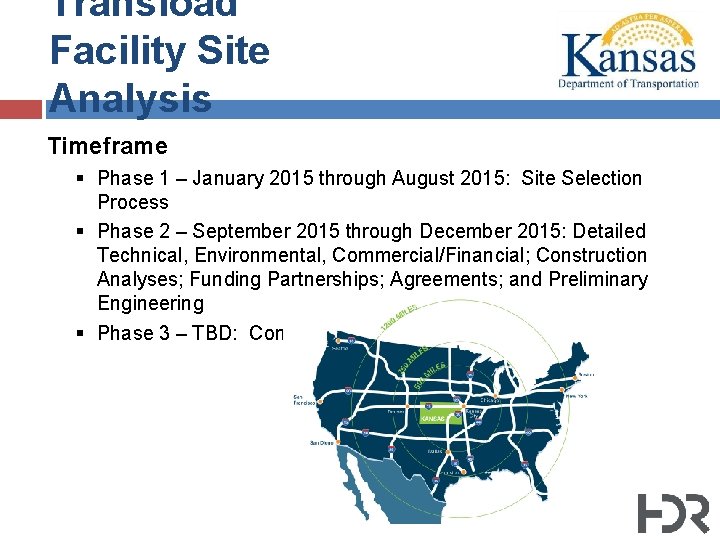
Transload Facility Site Analysis Timeframe § Phase 1 – January 2015 through August 2015: Site Selection Process § Phase 2 – September 2015 through December 2015: Detailed Technical, Environmental, Commercial/Financial; Construction Analyses; Funding Partnerships; Agreements; and Preliminary Engineering § Phase 3 – TBD: Construction
TFSA Advisory Committee Transload Facility Site Analysis Advisory Committee § Two meetings – February and June 2015 § Members representing – agriculture, manufacturing, chambers of commerce, Class I and short line railroads, trucking companies, economic development organizations, industry organizations, and the FHWA § Departments of Commerce and Agriculture Served in Advisory Capacity § Consultant – HDR; Subconsultant Dodd Consulting Group, Inc. § Overview of transload facility characteristics, operations and benefits § Inventory of existing transload facilities in Kansas § Transload facility site location criteria § Engagement of the advisory committee § Site recommendations for potential transload facilities § Review technical memos
TFSA Advisory Committee Transload Facility Site Analysis Advisory Committee Role § Provide advice and recommendations § Listen to and understand any concerns, issues, trends and needs § Reflect input and comments in site assessment process as appropriate § Serve as a collaborative, interdisciplinary sounding board for the TFSA teams from KDOT and HDR § Provide insight and perspective on various siting criteria and priorities
TFSA Site Selection Criteria Site Criteria § Minimum of 40 contiguous acres § § § o Room to expand o Zoning o Existing or potential environmental issues o Property terrain characteristics Rail Access o Existing – if yes, what is frequency of service? Can the site be served without blocking mainline traffic o Adjacent with connection o Adjacent with no connection o Build-in (distance) Will Railroad Serve the Site Highway Access to Interstate, U. S. or state highway routes Local Roadway Access Potential geometric impediments for truck traffic (especially OSOW)
TFSA Site Selection Criteria § Utilities o Currently available - If so, which utilities o If not currently available what is the process, timeframe and cost to locate § Anchor Commodity/Customer o Is there an existing or potential anchor business o Are there existing commodities currently being shipped by truck in the absence of rail service o Which commodities/sectors are prospective customers § § § Construction Agricultural Manufacturing Warehousing Multi-use § Local Trucking Partners § Competing Transload Facilities o Are there existing transload facilities in the proposed catchment area o If so, what commodities are handled o Would it compete for market share
TFSA Site Selection Criteria § Community Involvement o Will the community support a transload facility o What is the level of support o Is there a local workforce available o Is workforce training available o Will the local unit(s) of government contribute to the construction of a transload facility and any ancillary improvements (e. g. local roadways, utilities, economic development incentives, etc. ).
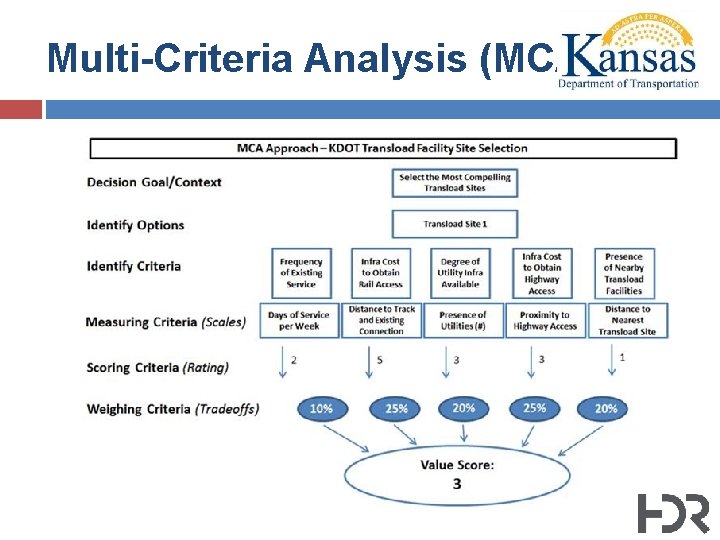
Multi-Criteria Analysis (MCA)
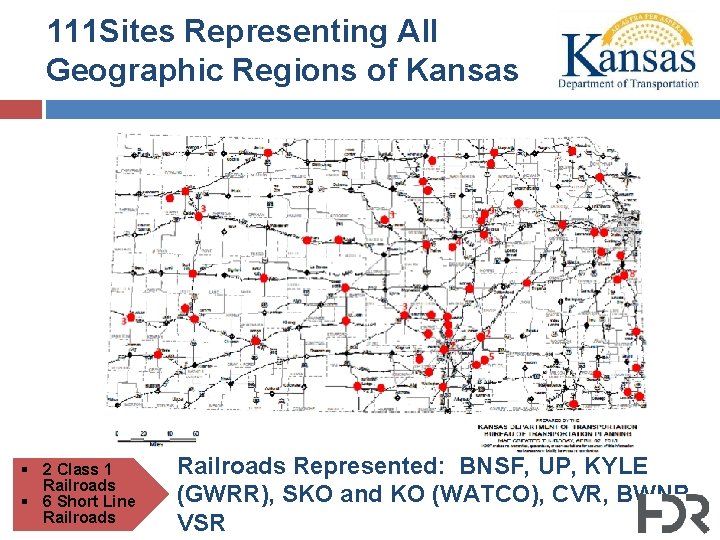
111 Sites Representing All Geographic Regions of Kansas § 2 Class 1 Railroads § 6 Short Line Railroads Represented: BNSF, UP, KYLE (GWRR), SKO and KO (WATCO), CVR, BWNR, VSR
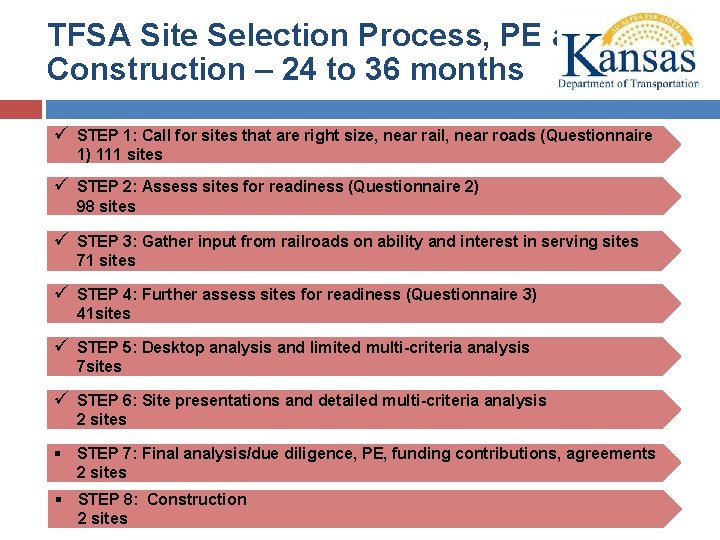
TFSA Site Selection Process, PE and Construction – 24 to 36 months ü STEP 1: Call for sites that are right size, near rail, near roads (Questionnaire 1) 111 sites ü STEP 2: Assess sites for readiness (Questionnaire 2) 98 sites ü STEP 3: Gather input from railroads on ability and interest in serving sites 71 sites ü STEP 4: Further assess sites for readiness (Questionnaire 3) 41 sites ü STEP 5: Desktop analysis and limited multi-criteria analysis 7 sites ü STEP 6: Site presentations and detailed multi-criteria analysis 2 sites § STEP 7: Final analysis/due diligence, PE, funding contributions, agreements 2 sites § STEP 8: Construction 2 sites
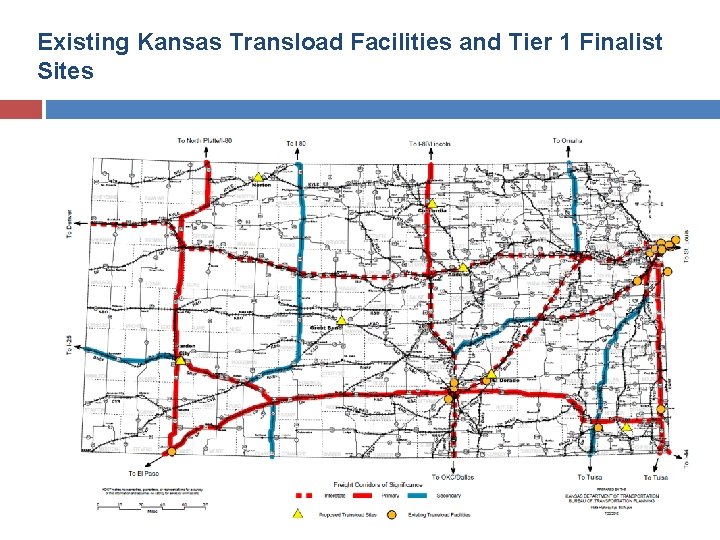
Existing Kansas Transload Facilities and Tier 1 Finalist Sites
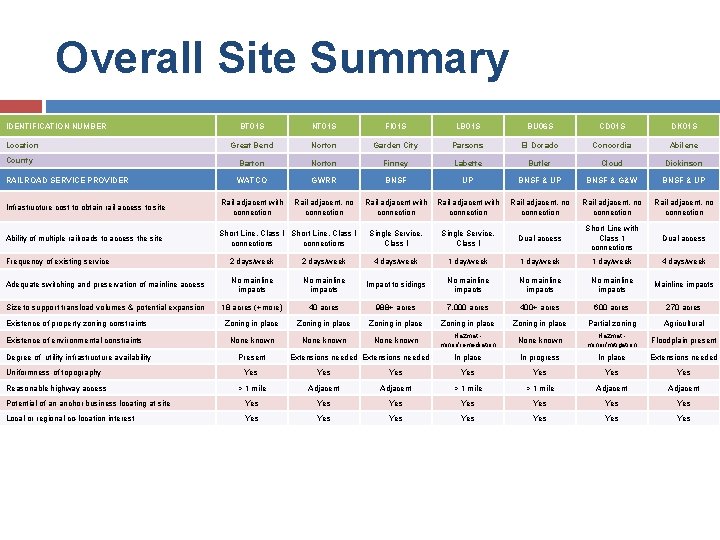
Overall Site Summary IDENTIFICATION NUMBER Location BT 01 S NT 01 S FI 01 S LB 01 S BU 06 S CD 01 S DK 01 S Great Bend Norton Garden City Parsons El Dorado Concordia Abilene County Barton Norton Finney Labette Butler Cloud Dickinson RAILROAD SERVICE PROVIDER WATCO GWRR BNSF UP BNSF & G&W BNSF & UP Infrastructure cost to obtain rail access to site Rail adjacent with connection Rail adjacent, no connection Ability of multiple railroads to access the site Short Line, Class I connections Rail adjacent with connection Single Service, Class I Dual access Short Line with Class 1 connections Dual access Frequency of existing service 2 days/week 4 days/week 1 day/week 4 days/week Adequate switching and preservation of mainline access No mainline impacts Impact to sidings No mainline impacts Mainline impacts Size to support transload volumes & potential expansion 18 acres (+more) 40 acres 988+ acres 7, 000 acres 400+ acres 600 acres 270 acres Zoning in place Zoning in place Partial zoning Agricultural None known Hazmat - minor/remediation None known Hazmat - minor/mitigation Floodplain present In place In progress In place Extensions needed Existence of property zoning constraints Existence of environmental constraints Degree of utility infrastructure availability None known Present None known Extensions needed Uniformness of topography Yes Yes Reasonable highway access > 1 mile Adjacent Potential of an anchor business locating at site Yes Yes Local or regional co-location interest Yes Yes
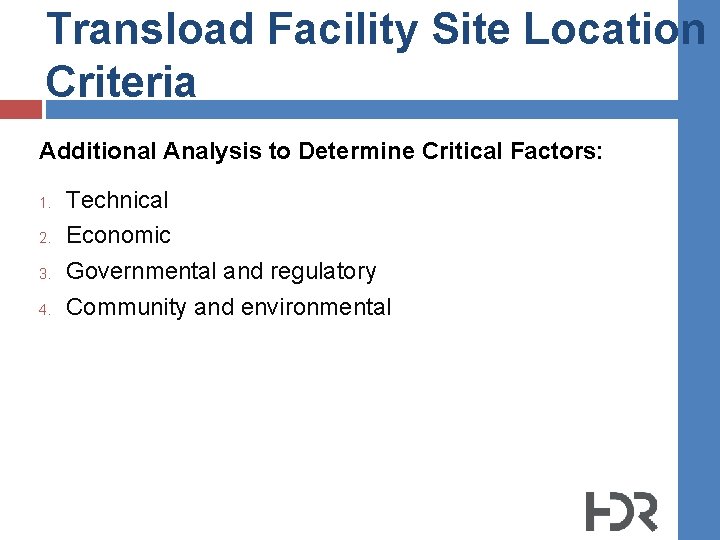
Transload Facility Site Location Criteria Additional Analysis to Determine Critical Factors: 1. 2. 3. 4. Technical Economic Governmental and regulatory Community and environmental
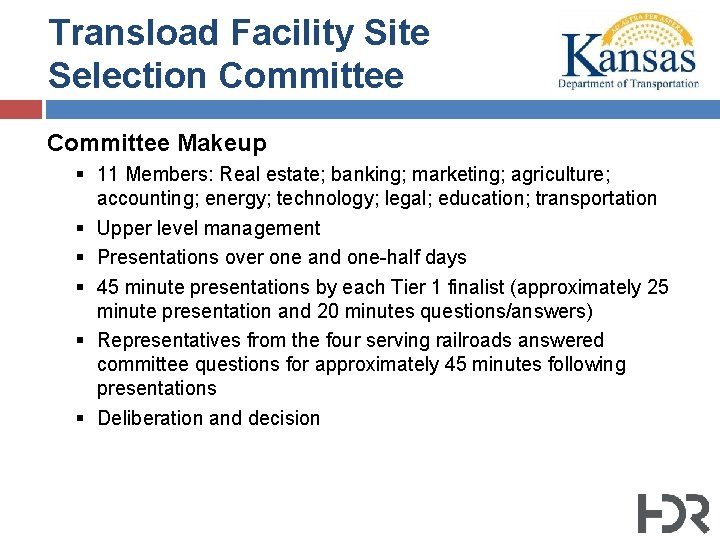
Transload Facility Site Selection Committee Makeup § 11 Members: Real estate; banking; marketing; agriculture; accounting; energy; technology; legal; education; transportation § Upper level management § Presentations over one and one-half days § 45 minute presentations by each Tier 1 finalist (approximately 25 minute presentation and 20 minutes questions/answers) § Representatives from the four serving railroads answered committee questions for approximately 45 minutes following presentations § Deliberation and decision
Your Role over the Next Two Days Listen to presentations Note important factors (Evaluation Sheet) Ask questions Provide a recommendation of top 1 or 2 sites
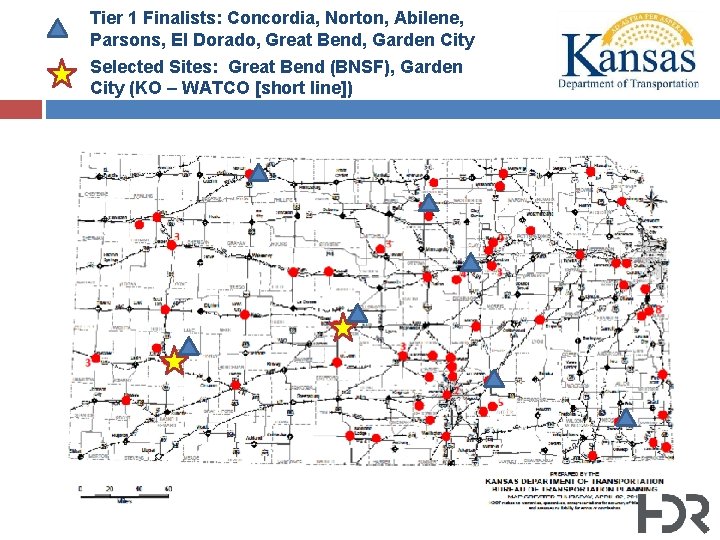
Tier 1 Finalists: Concordia, Norton, Abilene, Parsons, El Dorado, Great Bend, Garden City Selected Sites: Great Bend (BNSF), Garden City (KO – WATCO [short line])
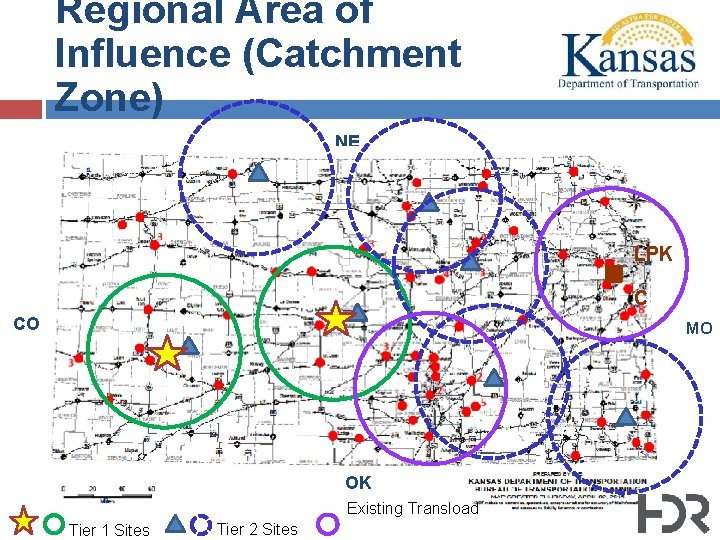
Regional Area of Influence (Catchment Zone) NE LPK C CO MO OK Existing Transload Tier 1 Sites Tier 2 Sites
Moving Forward § Follow-up Meetings/Interviews With Representatives From Garden City and Great Bend (TFSA Phase II – Discovery Phase): Identify Potential Gaps in Information and Data Identify Potential “Red Flags” That Would Need Further Analysis Detailed Site Visits Individual Workshops With Garden City and Great Bend Preliminary Engineering Partnerships/Agreements: KDOT; Local Units of Government; KDOC; Railroad(s); Utilities; Private Sector o Construction o o o
Additional Due Diligence Top 2 Sites § Technical: Gain full understanding of project elements and potential phasing opportunities o o o Design Current Infrastructure Condition (road, rail and utilities) Road Improvements and costs; timeframe Rail Improvements and costs; timeframe Utilities and costs; timeframe Topography Issues (if any) § Environmental: Provide detail on potential environmental constrains and permitting timeline o Identify Required Permits and Timeframe to Acquire o Identify any Environmental Constraints/Mitigation that may be present and Timeframe to Mitigate
Additional Due Diligence Top 2 Sites § Commercial/Financial: Assess economic viability of site in terms of lifecycle cost as compared to revenue o Identify/Confirm § Site Owner § Site Developer § Site Operator § Anchor Tenant § Funding Partners (in addition to KDOT) – city, county, developer/operator, tenants, railroad: what is level of funding commitment? § Are there additional potential funding sources – e. g. Kansas Department of Commerce Programs? Federal Programs? § Are there other incentives (e. g. tax) being offered?
Additional Due Diligence Top 2 Sites § Commercial/Financial: Assess economic viability of site in terms of lifecycle cost as compared to revenue o Detailed Business, Marketing and Operating Plans o Coordination With Other Communities Within Regional Zone of Influence o Detailed Information About Future Tenants – type(s) of business(es) o Detailed Information About Potential Customers in Catchment Area o Potential Revenue Sources Derived From: Leases; Transload Operations; Warehousing; Other o Pricing Structure: Lease Rates; Transload Rates; Other o Rail Service and Car Supply o Short-Haul Trucking Partner(s) o What is the Estimated Cost of the Project? What is the Level of Confidence in the Estimate? What is the Construction Timeframe? § § Site Construction Rail Improvements Roadway Improvements Utility Improvements
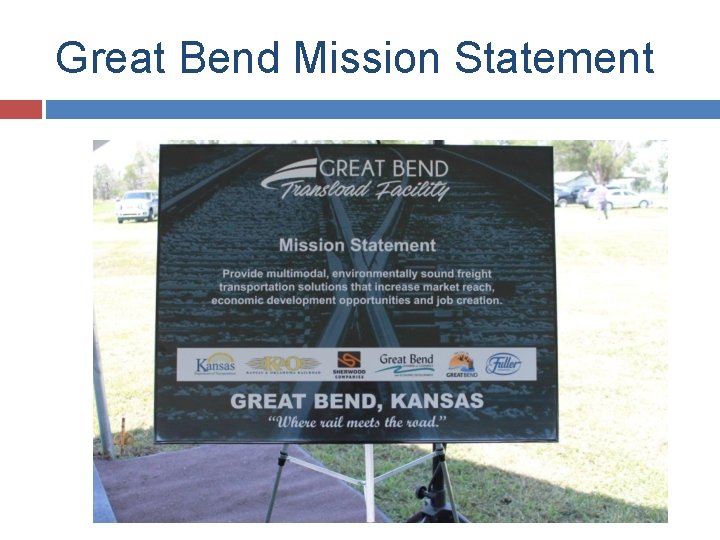
Great Bend Mission Statement

Great Bend Transload Facility Design
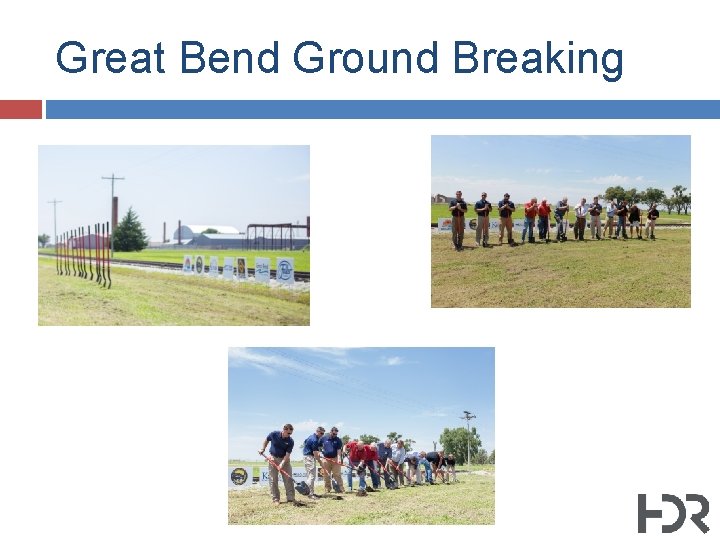
Great Bend Ground Breaking
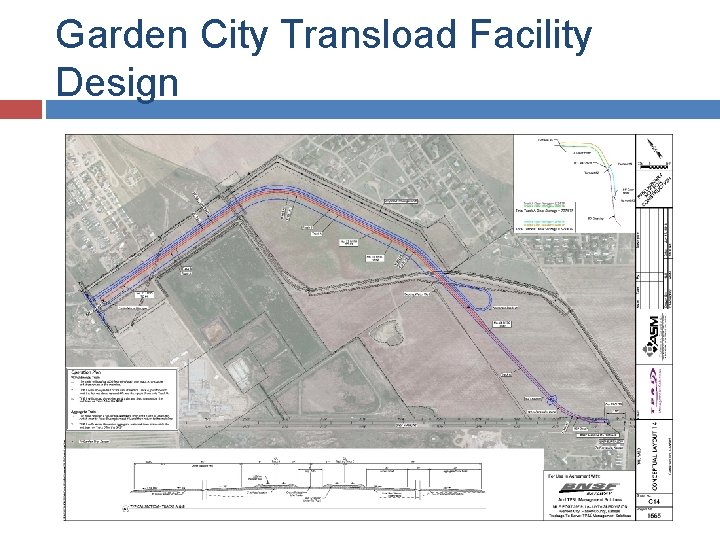
Garden City Transload Facility Design
THANK YOU! QUESTIONS… John W. Maddox, CPM Freight and Rail Program Manager Bureau of Transportation Planning 785 -296 -3228 johnm@ksdot. org Kevin Keller, PE Vice President/Sr. Professional Associate HDR, Inc. 913 -638 -2571 kevin. keller@hdrinc. com
- Slides: 29