
TRANSLATIONAL EQUILIBRIUM Ex A 20 0 kg object
TRANSLATIONAL EQUILIBRIUM
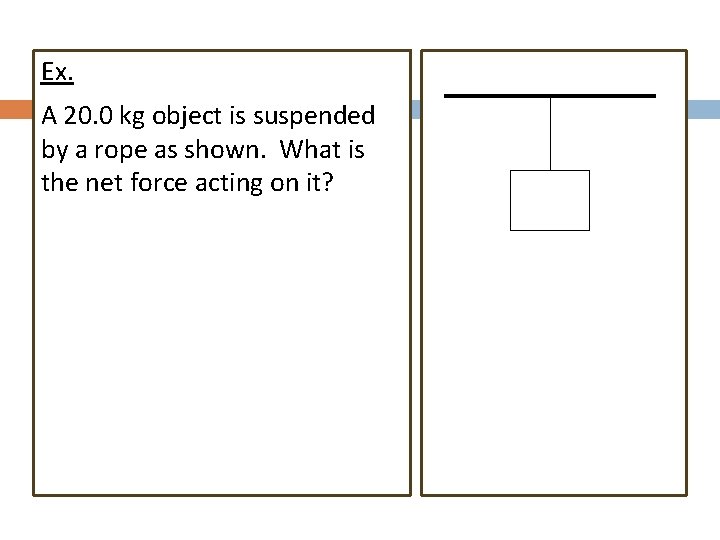
Ex. A 20. 0 kg object is suspended by a rope as shown. What is the net force acting on it?
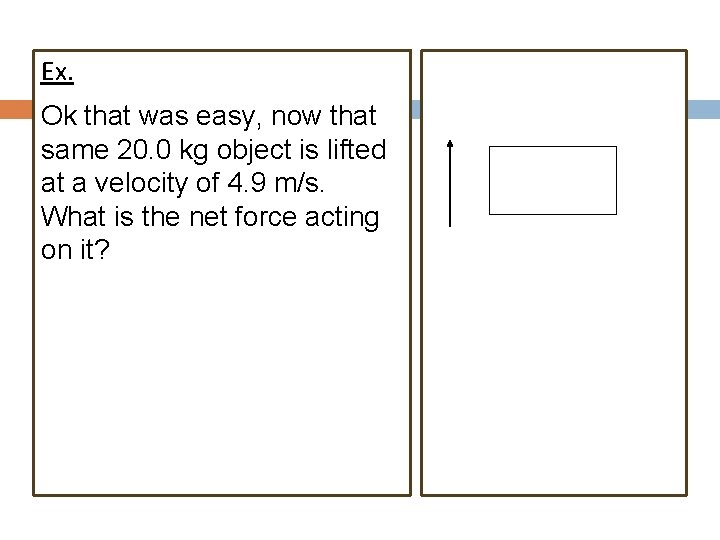
Ex. Ok that was easy, now that same 20. 0 kg object is lifted at a velocity of 4. 9 m/s. What is the net force acting on it?
Because in both cases the net force on the objects is zero they are said to be in equilibrium. If the object is stationary it is said to be in static equilibrium while an object moving at a constant velocity is in dynamic equilibrium. These are both cases where the object is in translational equilibrium. In this case the sum of all forces is zero.
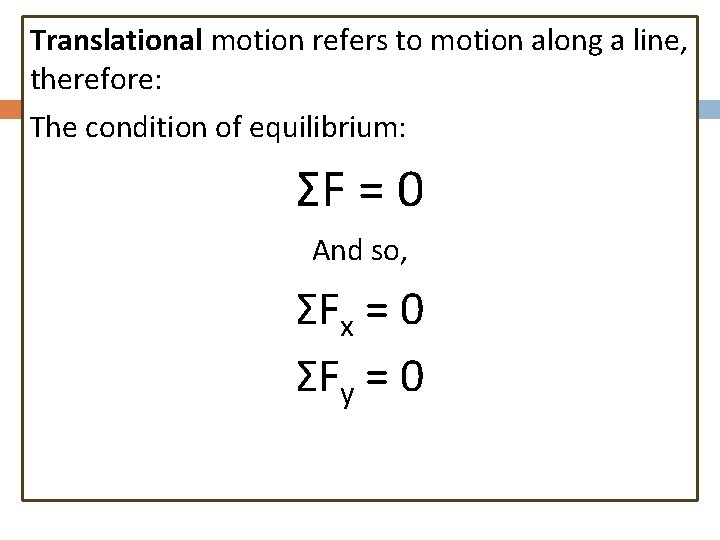
Translational motion refers to motion along a line, therefore: The condition of equilibrium: ΣF = 0 And so, ΣFx = 0 ΣFy = 0
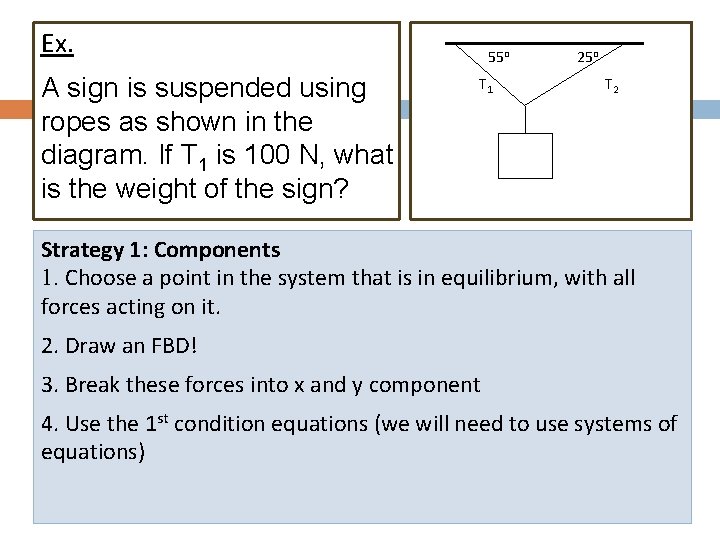
Ex. A sign is suspended using ropes as shown in the diagram. If T 1 is 100 N, what is the weight of the sign? 55 o T 1 25 o T 2 Strategy 1: Components 1. Choose a point in the system that is in equilibrium, with all forces acting on it. 2. Draw an FBD! 3. Break these forces into x and y component 4. Use the 1 st condition equations (we will need to use systems of equations)
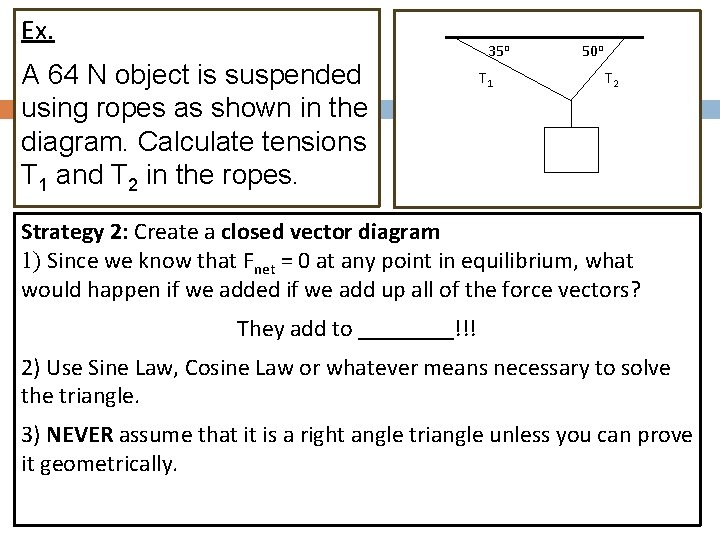
Ex. A 64 N object is suspended using ropes as shown in the diagram. Calculate tensions T 1 and T 2 in the ropes. 35 o T 1 50 o T 2 Strategy 2: Create a closed vector diagram 1) Since we know that Fnet = 0 at any point in equilibrium, what would happen if we added if we add up all of the force vectors? They add to ____!!! 2) Use Sine Law, Cosine Law or whatever means necessary to solve the triangle. 3) NEVER assume that it is a right angle triangle unless you can prove it geometrically.
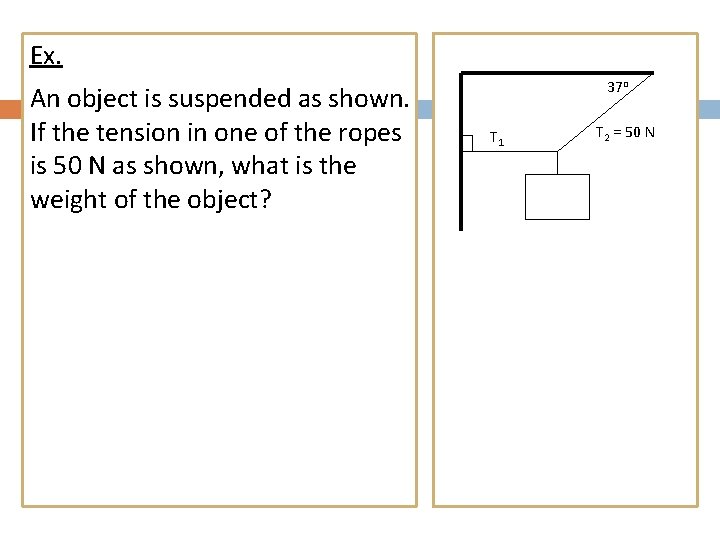
Ex. An object is suspended as shown. If the tension in one of the ropes is 50 N as shown, what is the weight of the object? 37 o T 1 T 2 = 50 N
- Slides: 8