
Translation Tools Translation Memory Systems Text Concordance Tools
- Slides: 13
Translation Tools Translation Memory Systems Text Concordance Tools Useful Websites 30. 11. -2. 1007 practical aspects 1
Translation Memory Systems General principles and features Scope of application with legal texts: pros and cons Demonstration of Omega. T Hands-on experience with Omega. T 30. 11. -2. 1007 practical aspects 2
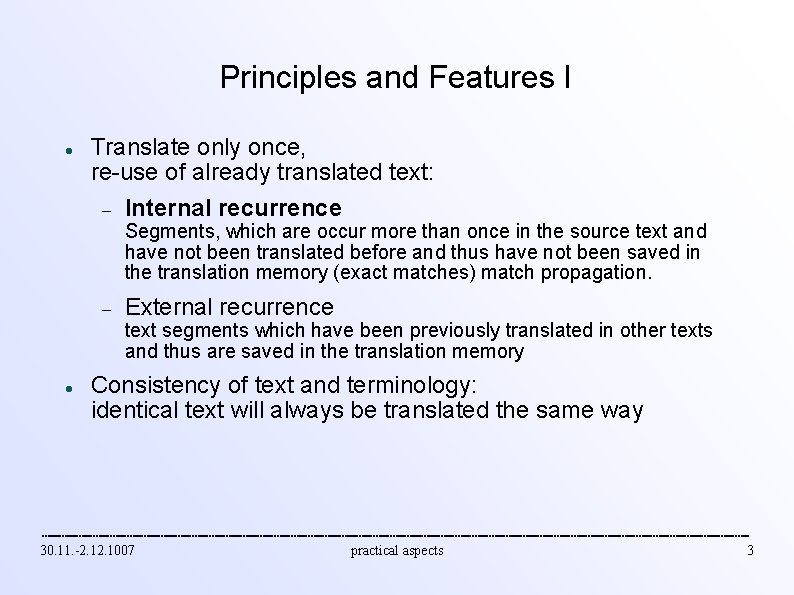
Principles and Features I Translate only once, re-use of already translated text: Internal recurrence Segments, which are occur more than once in the source text and have not been translated before and thus have not been saved in the translation memory (exact matches) match propagation. External recurrence text segments which have been previously translated in other texts and thus are saved in the translation memory Consistency of text and terminology: identical text will always be translated the same way 30. 11. -2. 1007 practical aspects 3
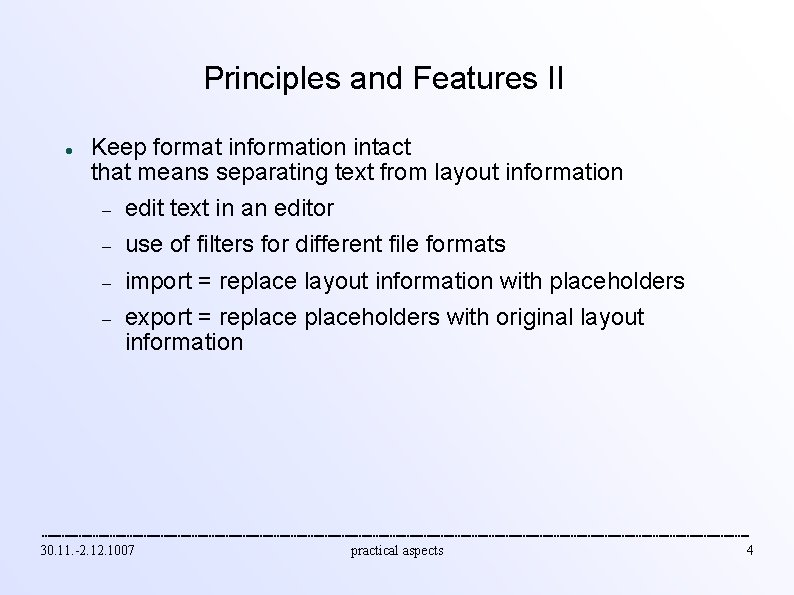
Principles and Features II Keep format information intact that means separating text from layout information edit text in an editor use of filters for different file formats import = replace layout information with placeholders export = replaceholders with original layout information 30. 11. -2. 1007 practical aspects 4
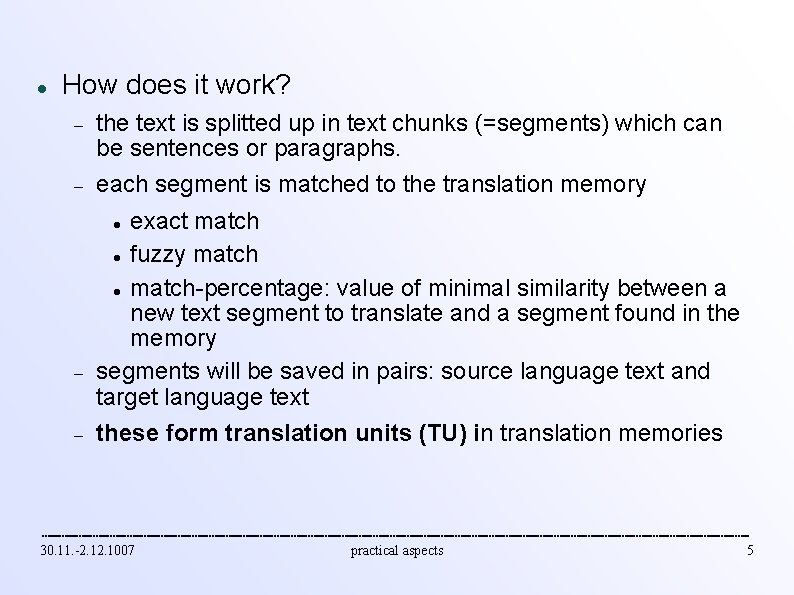
How does it work? the text is splitted up in text chunks (=segments) which can be sentences or paragraphs. each segment is matched to the translation memory exact match fuzzy match-percentage: value of minimal similarity between a new text segment to translate and a segment found in the memory segments will be saved in pairs: source language text and target language text these form translation units (TU) in translation memories 30. 11. -2. 1007 practical aspects 5
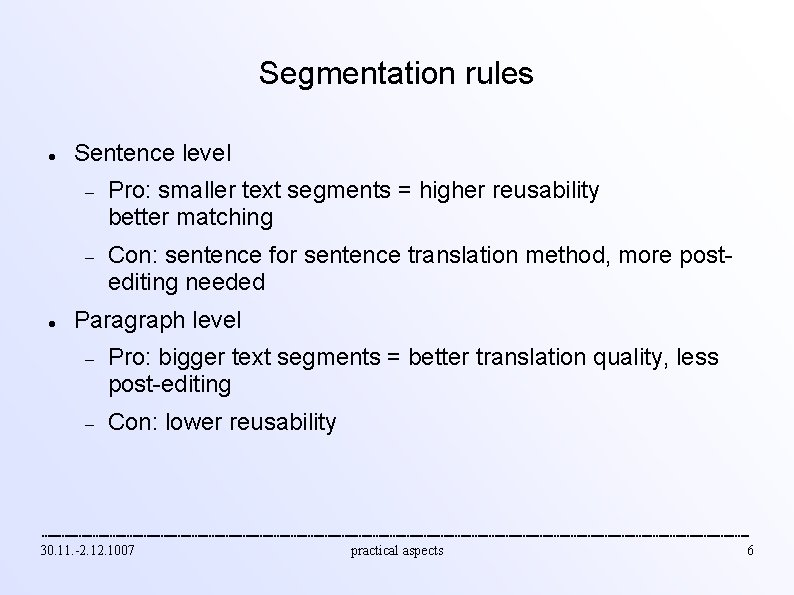
Segmentation rules Sentence level Pro: smaller text segments = higher reusability better matching Con: sentence for sentence translation method, more postediting needed Paragraph level Pro: bigger text segments = better translation quality, less post-editing Con: lower reusability 30. 11. -2. 1007 practical aspects 6
Best context for the use of TM Conventionalized text structures Stereotypical formulations Identical macrostructure Frequent updates of a text 30. 11. -2. 1007 practical aspects 7
Legal texts types Best suited for translation memory systems are highly standardized legal text types such as: bylaws (e. g. http: //www. weown. net/cooperat. htm) contracts, agreements (e. g. http: //www. lomb. cgil. it/rsuibm/1999627 a. htm) sentences administrative legal texts 30. 11. -2. 1007 practical aspects 8
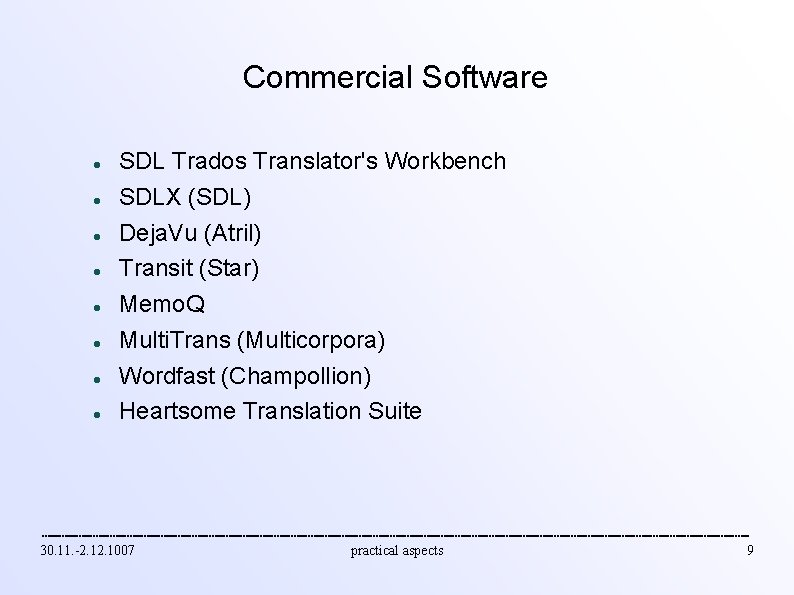
Commercial Software SDL Trados Translator's Workbench SDLX (SDL) Deja. Vu (Atril) Transit (Star) Memo. Q Multi. Trans (Multicorpora) Wordfast (Champollion) Heartsome Translation Suite 30. 11. -2. 1007 practical aspects 9
Omega. T Open. Source Translation Memory http: //www. omegat. org/omegat. html requirements Java Runtime Environment (http: //www. sun. com) 30. 11. -2. 1007 practical aspects 10
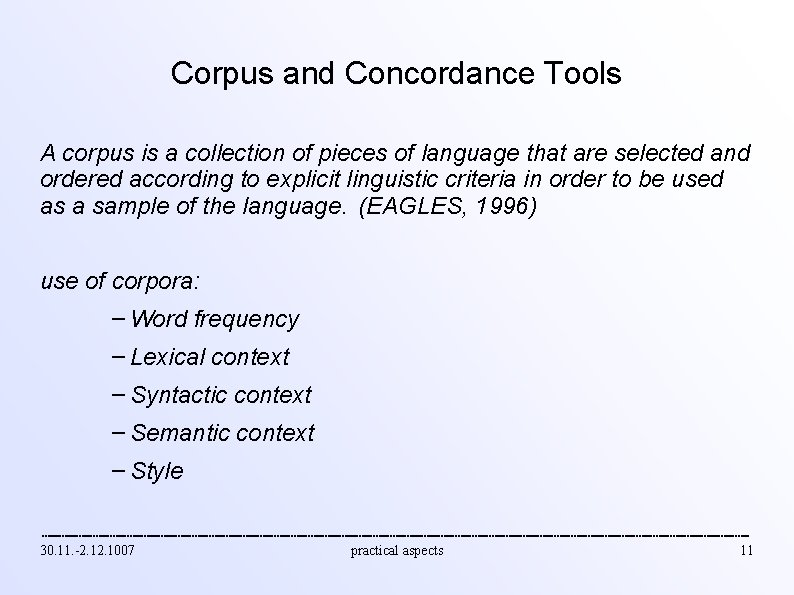
Corpus and Concordance Tools A corpus is a collection of pieces of language that are selected and ordered according to explicit linguistic criteria in order to be used as a sample of the language. (EAGLES, 1996) use of corpora: – Word frequency – Lexical context – Syntactic context – Semantic context – Style 30. 11. -2. 1007 practical aspects 11
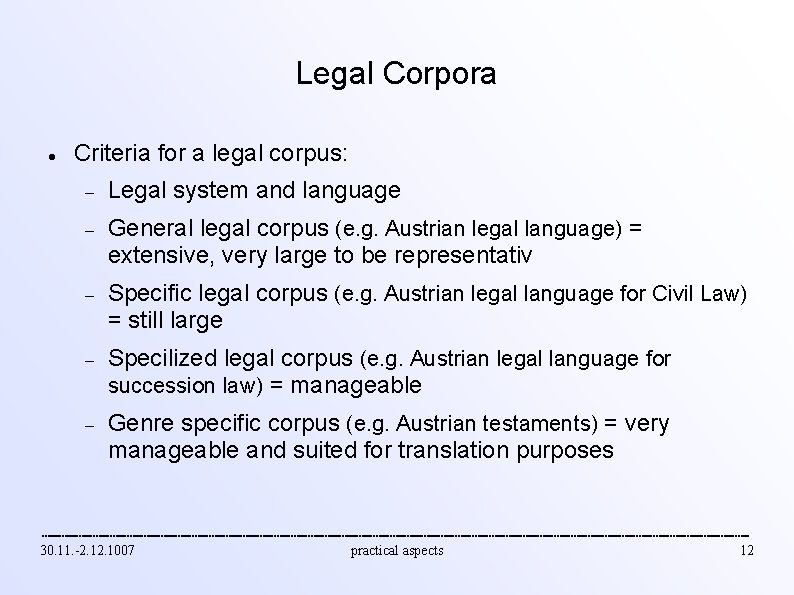
Legal Corpora Criteria for a legal corpus: Legal system and language General legal corpus (e. g. Austrian legal language) = extensive, very large to be representativ Specific legal corpus (e. g. Austrian legal language for Civil Law) = still large Specilized legal corpus (e. g. Austrian legal language for succession law) = manageable Genre specific corpus (e. g. Austrian testaments) = very manageable and suited for translation purposes 30. 11. -2. 1007 practical aspects 12
Concordance Tools Text. Stat 2 http: //www. niederlandistik. fuberlin. de/textstat/software-en. html Ant. Conc 3. 2 http: //www. antlab. sci. waseda. ac. jp/software. html Literature: Pearson, Jennifer; Bowker, Lynne (2002): Working with specialized language. a practical guide to using corpora. Routledge, London. Bowker, Lynne (2002): Computer-aided Translation Technology. A Practical Introduction. University of Ottawa Press, Ottawa. . 30. 11. -2. 1007 practical aspects 13