
Translation techniques and strategies 1 translation loss The
- Slides: 28
Translation techniques and strategies
1. translation loss The term translation loss refers to the incomplete replication of the ST in the TT – that is, the inevitable loss of textually and culturally relevant features.
This term is intended to suggest that translators should not agonize over the loss, but should concentrate on reducing it. Once one accepts the concept of inevitable translation loss, a TT that is not, even in all important respects, a replica of the ST being not a theoretical anomaly.
The translator can concentrate on the realistic aim of reducing translation loss, rather than the unrealistic one of seeking the ultimate TT.
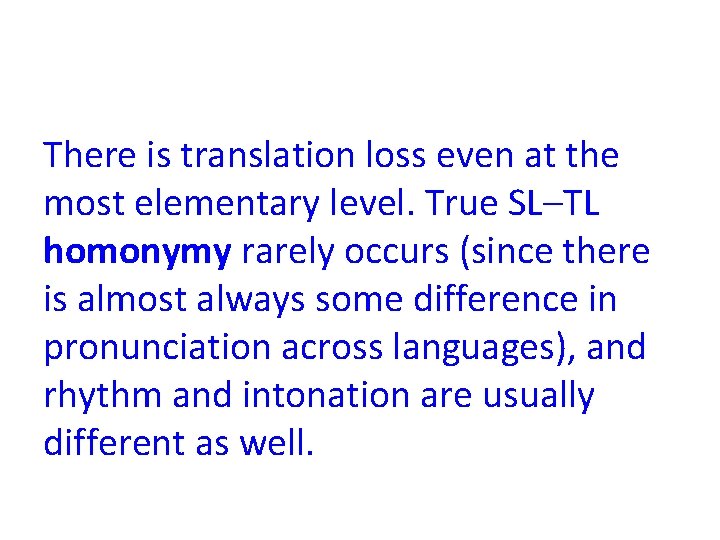
There is translation loss even at the most elementary level. True SL–TL homonymy rarely occurs (since there is almost always some difference in pronunciation across languages), and rhythm and intonation are usually different as well.
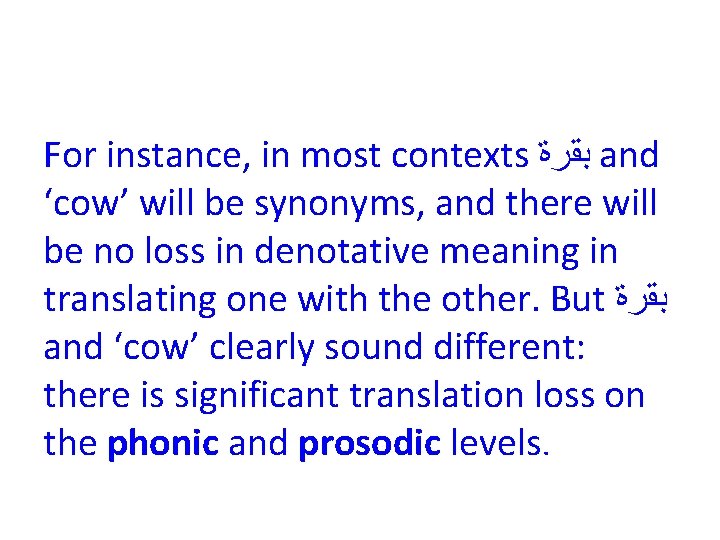
For instance, in most contexts ﺑﻘﺮﺓ and ‘cow’ will be synonyms, and there will be no loss in denotative meaning in translating one with the other. But ﺑﻘﺮﺓ and ‘cow’ clearly sound different: there is significant translation loss on the phonic and prosodic levels.
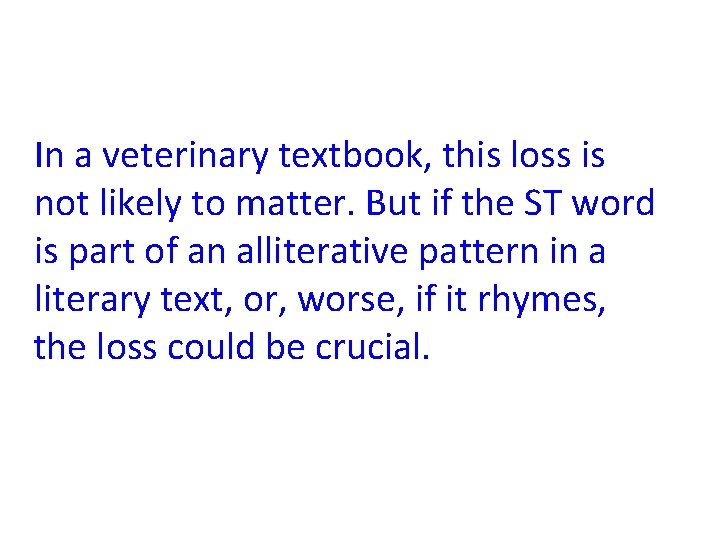
In a veterinary textbook, this loss is not likely to matter. But if the ST word is part of an alliterative pattern in a literary text, or, worse, if it rhymes, the loss could be crucial.
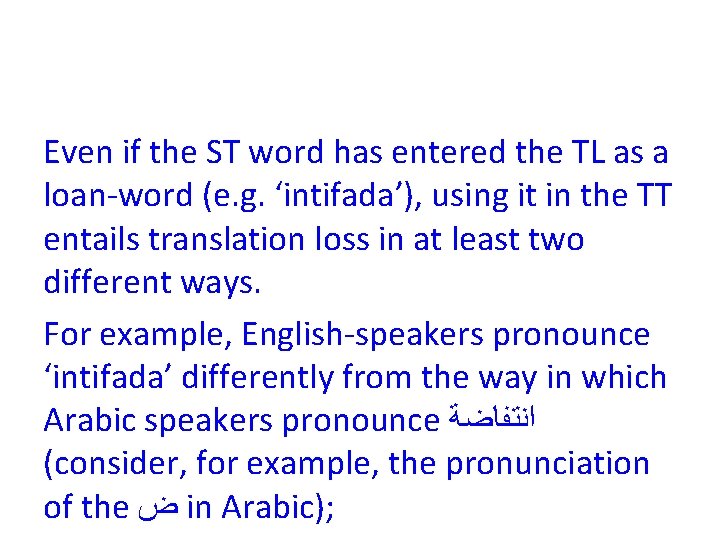
Even if the ST word has entered the TL as a loan-word (e. g. ‘intifada’), using it in the TT entails translation loss in at least two different ways. For example, English-speakers pronounce ‘intifada’ differently from the way in which Arabic speakers pronounce ﺍﻧﺘﻔﺎﺿﺔ (consider, for example, the pronunciation of the ﺽ in Arabic);
so using it in an English TT involves loss on the phonic level. In any case, ‘intifada’ still sounds foreign in English, despite the relative frequency of use in newspapers and political writing over the past few years.
Accordingly, using ‘intifada’ in an English TT introduces a foreign element which is not present in an Arabic ST, thereby losing the cultural neutrality of the ST expression.
If translation loss is inevitable even in translating single words, it is obviously going to feature at more complex levels as well – in respect of connotations, for example, or of sentence structure, discourse, language variety, and so on
2. Translation by omission The most obvious form of translation loss is when something which occurs in the ST is simply omitted from the TT. Such omission occurs fairly frequently in Arabic/English translation given the huge difference between the two languages.
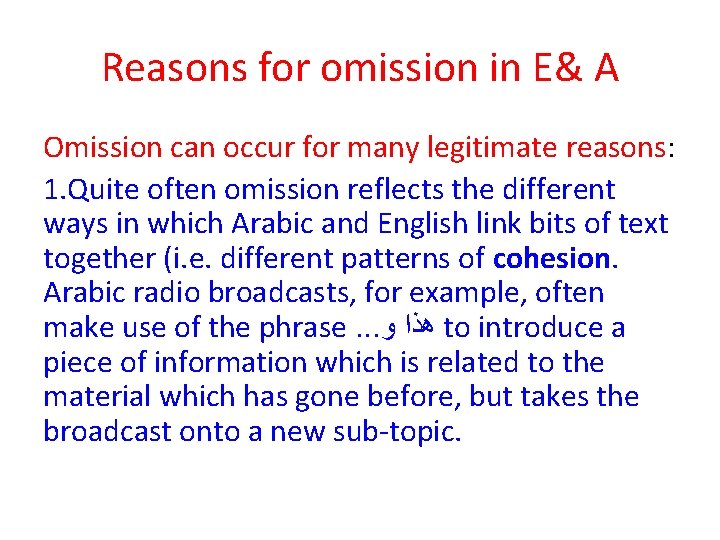
Reasons for omission in E& A Omission can occur for many legitimate reasons: 1. Quite often omission reflects the different ways in which Arabic and English link bits of text together (i. e. different patterns of cohesion. Arabic radio broadcasts, for example, often make use of the phrase. . . ﻫﺬﺍ ﻭ to introduce a piece of information which is related to the material which has gone before, but takes the broadcast onto a new sub-topic.
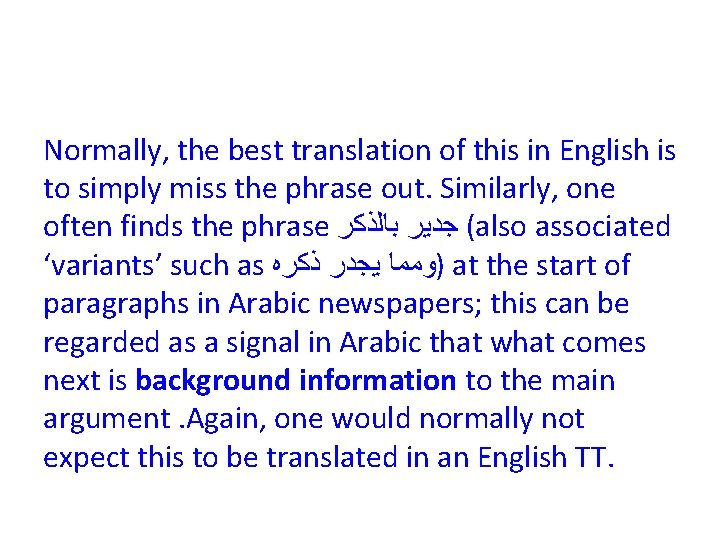
Normally, the best translation of this in English is to simply miss the phrase out. Similarly, one often finds the phrase ﺟﺪﻳﺮ ﺑﺎﻟﺬﻛﺮ (also associated ‘variants’ such as )ﻭﻣﻤﺎ ﻳﺠﺪﺭ ﺫﻛﺮﻩ at the start of paragraphs in Arabic newspapers; this can be regarded as a signal in Arabic that what comes next is background information to the main argument. Again, one would normally not expect this to be translated in an English TT.
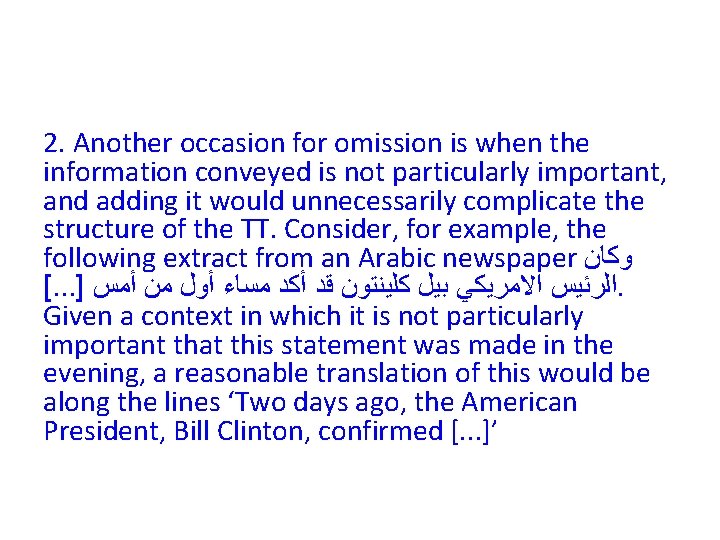
2. Another occasion for omission is when the information conveyed is not particularly important, and adding it would unnecessarily complicate the structure of the TT. Consider, for example, the following extract from an Arabic newspaper ﻭﻛﺎﻥ [. . . ] ﺍﻟﺮﺋﻴﺲ ﺍﻻﻣﺮﻳﻜﻲ ﺑﻴﻞ ﻛﻠﻴﻨﺘﻮﻥ ﻗﺪ ﺃﻜﺪ ﻣﺴﺎﺀ ﺃﻮﻝ ﻣﻦ ﺃﻤﺲ. Given a context in which it is not particularly important that this statement was made in the evening, a reasonable translation of this would be along the lines ‘Two days ago, the American President, Bill Clinton, confirmed [. . . ]’
Unlike Arabic, English does not afford a particularly elegant or stylistically normal way in this context of expressing the concept ‘two days ago in the evening’.
3. Cultural difference provides another area in which simple omission may be a reasonable strategy. For example, when a Christian-oriented Lebanese newspaper refers to the former Phalangist leader as ﺍﻟﺸﻴﺦ ﺑﻴﺎﺭ ﺟﻤﻴﻞ , the obvious translation is ‘Pierre Gemayel’.
Similarly, in most contexts, the phrase ﺑﺎﺑﺎ ﺍﻟﻔﺎﺗﻴﻜﺎﻥ ﻳﻮﺣﻨﺎ ﺑﻮﻟﺲ ﺍﻟﺜﺎﻧﻲ is likely to be most reasonably translated as ‘Pope John-Paul II’ with the omission of any English equivalent of the ST ; ﺍﻟﻔﺎﺗﻴﻜﺎﻥ most Western readers are likely to be unaware of any popes (such as the Coptic pope) other than the Catholic
3. Translation by addition is translation in which something is added to the TT which is not present in the ST. Like omission, addition is a fairly common feature of Arabic/English translation and is therefore worth specifically identifying.
Examples of translation by addition frequently occur where either general considerations of English usage or specific contexts require something to be added. Consider the phrase from a newspaper text about the Kosovo war of 1999 ﻣﻨﺬ ﺍﻟﻬﻴﻤﻨﺔ ﺍﻟﺘﺮﻛﻴﺔ. This is much more acceptably translated as ‘ever since the days of Turkish hegemony’ than as ‘ever since Turkish hegemony’ (‘time of Turkish hegemony’ would also be possible).
The operative principle here seems to be that English resists regarding ‘hegemony’ as a concept involving time more strongly than does Arabic with respect to ﻫﻴﻤﻨﺔ. In English it is therefore necessary to add ‘days of’ (or something similar).
A similar example, which involves the specific context, rather than general considerations of usage, is the following from the novel ﻣﺪﻳﻨﺔ ﺍﻟﺒﻐﻲ by ﻋﻴﺴﻰ ﺑﺸﺎﺭﺓ. ﻫﻮ ﻛﺎﺗﻢ ﺃﻨﻔﺎﺳﻪ ﻭﻣﻐﻤﺾ ﻋﻴﻨﻴﻪ ﻋﻤﺎ ﻳﺠﺮﻱ He was holding his breath and had closed his eyes to what was going on around him
The context here is fairly personal; the author is interested in the events immediately surrounding the central character of the novel, ﺻﺎﺑﺮ. The translator has accordingly chosen to add ‘around him’, since this is an obvious idiomatic means of expressing the personal nature of what is involved.
There is, however, no equivalent of ‘around him’ (e. g. )ﺣﻮﻟﻪ in the Arabic ST (although it would be perfectly possible to have one); nor is any dictionary likely to list ‘to go on around [one]’ as an equivalent of ﺟﺮﻯ. Accordingly, it is justifiable to identify this as a case of translation by addition.
4. Controlling translation loss As we have suggested, translation loss is an inevitable consequence of the fact that languages and cultures are different. Given this, the challenge to the translator is not to eliminate it, but to control and channel it by deciding which features, in a given ST, it is most important to respect, and which can
The translator has always to be asking, and answering, such questions as: does it matter if ‘Do you like Egypt? ’ does not reflect the distinction between ﻫﻞ ﺃﻌﺠﺒﺘﻚ ﻣﺼﺮ؟ and ﻫﻞ ﺗﻌﺠﺒﻚ ? ﻣﺼﺮ؟ Does it matter if ﻣﻮﺑﺎﻳﻞ is foreign in Arabic, but ‘mobile phone’ is not foreign in English, and sounds different
• If ﺇﻟﻠﻲ ﻓﺎﺕ ﻣﺎﺕ is phonically, rhythmically, grammatically, lexically and metaphorically different from ‘Let bygones be bygones’? As we have already suggested, there is no once-and-for-all answer to questions like these.
Everything depends on the purpose of the translation and on what the role of the textual feature is in its context. Sometimes a given translation loss will matter a lot, sometimes little. Whether the final decision is simple or complicated, it does have to be made, every time, and the translator is the only one who can make it.