
TRANSLATION RNA PROTEIN Do Now On the Modeling

- Slides: 19
TRANSLATION: RNA PROTEIN Do Now: On the “Modeling DNA” handout, determine the complimentary DNA sequence and the m. RNA sequence by using the sequence given
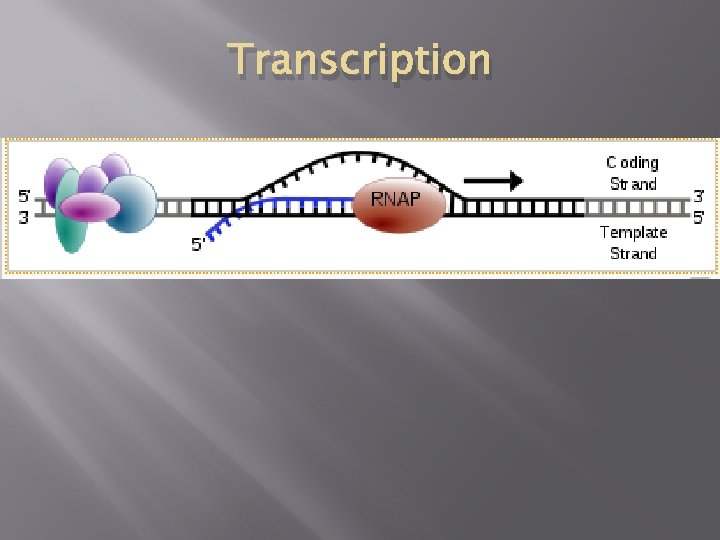
Old News � TRANSCRIPTION: process that makes an RNA copy of DNA. � RNA is single-stranded, and T is replaced by U (A-U; G-C) � RNA polymerase makes RNA, using bases complimentary to a DNA sequence.
Transcription
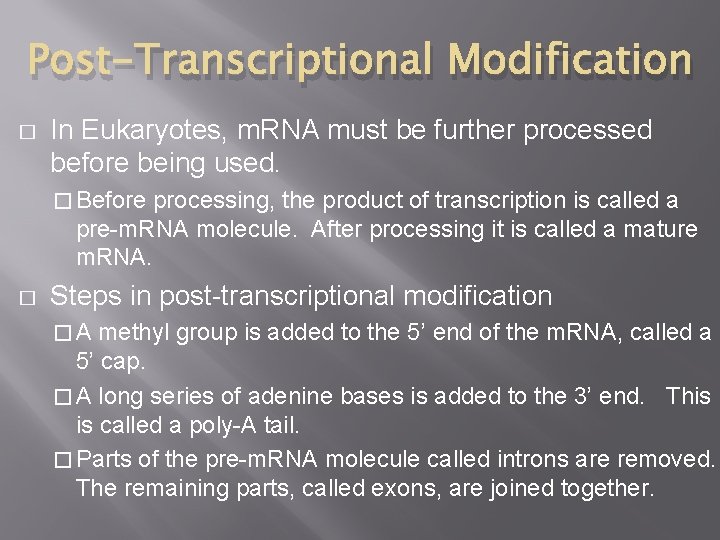
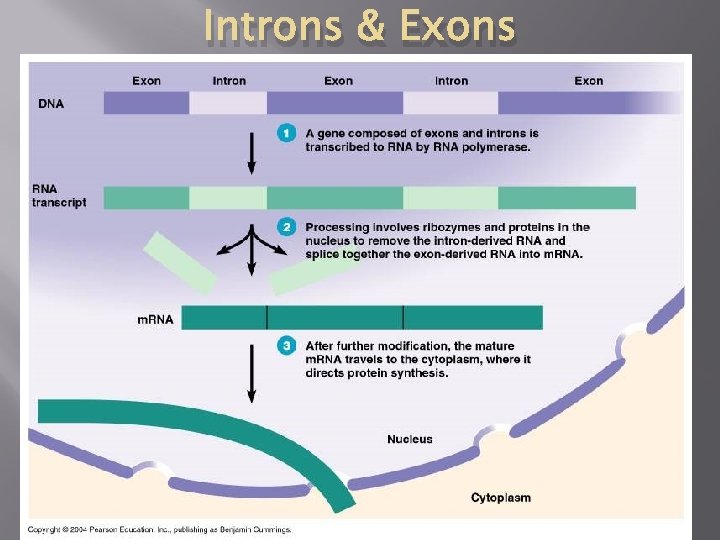
Post-Transcriptional Modification � In Eukaryotes, m. RNA must be further processed before being used. � Before processing, the product of transcription is called a pre-m. RNA molecule. After processing it is called a mature m. RNA. � Steps in post-transcriptional modification �A methyl group is added to the 5’ end of the m. RNA, called a 5’ cap. � A long series of adenine bases is added to the 3’ end. This is called a poly-A tail. � Parts of the pre-m. RNA molecule called introns are removed. The remaining parts, called exons, are joined together.
Introns & Exons
Which is which? � � � Introns are “intervening sequences” which must be cut out. Exons are “expressed sequences” which remain and are spliced together. Remember – prokaryotes DON’T do this.
Translation: RNA Protein � The m. RNA copy of a gene leaves the nucleus, and heads to the ribosomes to be used. � Ribosomes build proteins by following the m. RNA instructions
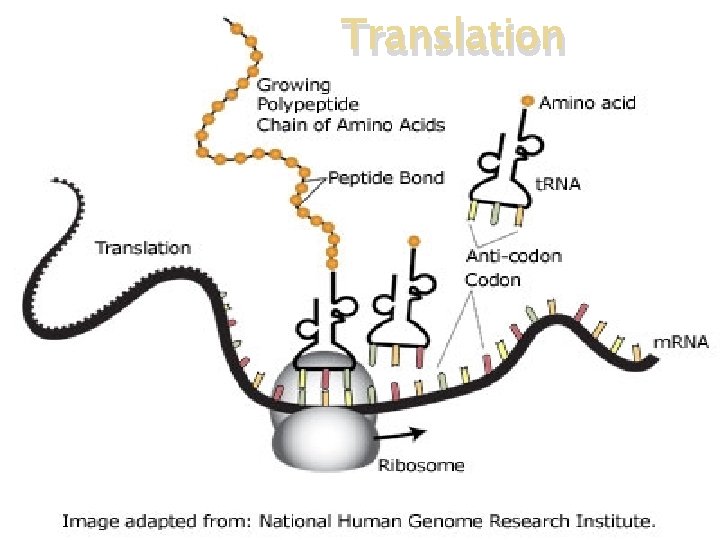
Translation
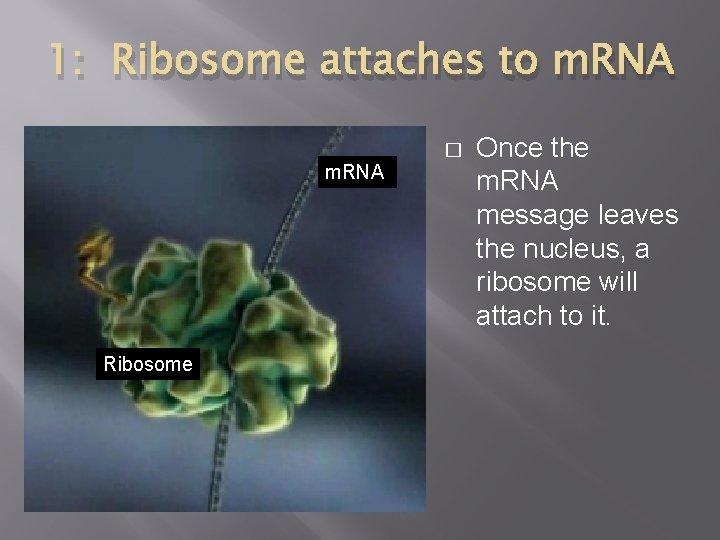
1: Ribosome attaches to m. RNA � m. RNA Ribosome Once the m. RNA message leaves the nucleus, a ribosome will attach to it.
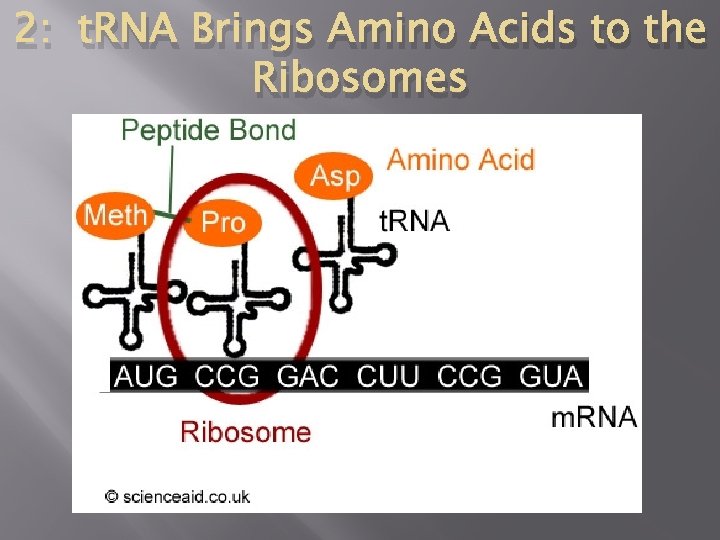
2: t. RNA Brings Amino Acids to the Ribosomes
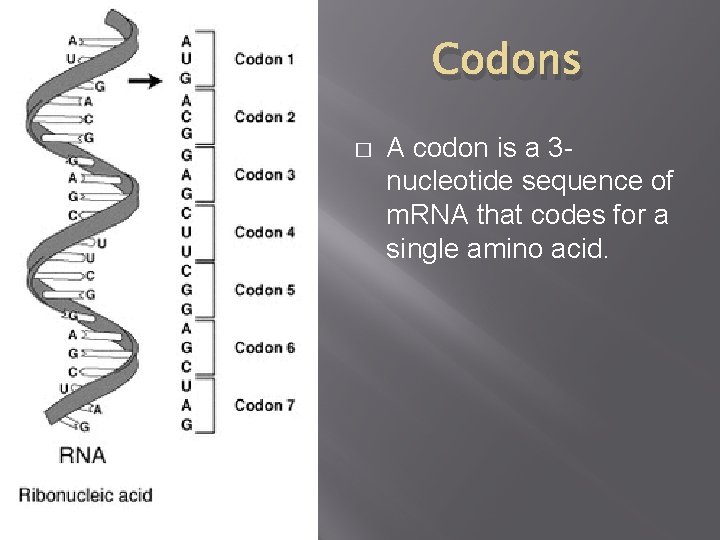
Codons � A codon is a 3 nucleotide sequence of m. RNA that codes for a single amino acid.
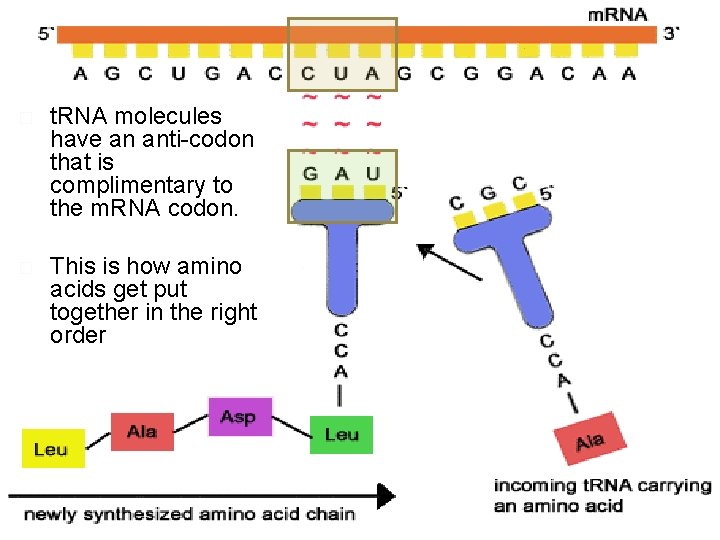
� t. RNA molecules have an anti-codon that is complimentary to the m. RNA codon. � This is how amino acids get put together in the right order
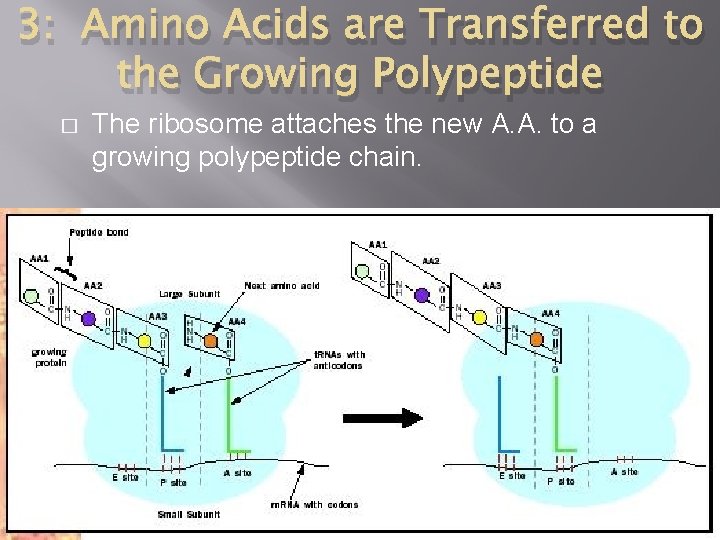
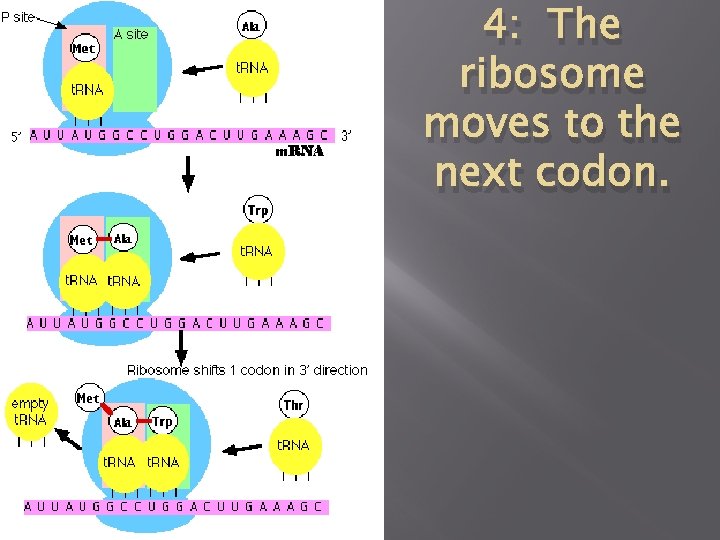
3: Amino Acids are Transferred to the Growing Polypeptide � The ribosome attaches the new A. A. to a growing polypeptide chain.
4: The ribosome moves to the next codon.
5. Translation stops at a stop codon � Stop codons code for a t. RNA molecule that doesn’t carry any amino acids. � The new protein is released.
6. Protein modification � After the stop codon is reached, the ribosome lets go of the m. RNA. Both will be used again. � Most proteins are modified by other enzymes before they are ready to be used by the cell.
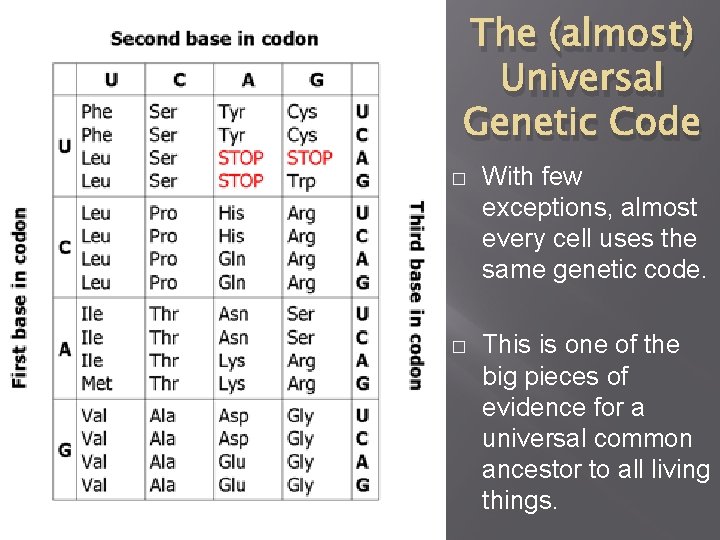
The (almost) Universal Genetic Code � With few exceptions, almost every cell uses the same genetic code. � This is one of the big pieces of evidence for a universal common ancestor to all living things.
Recap � Translation makes proteins, using the instructions in an m. RNA molecule. � A codon is 3 nucleotides that code for a single amino acid. � Ribosomes build the proteins from amino acids carried by t. RNA molecules. � t. RNA molecules “decode” the message into protein form by matching their anti-codons with the m. RNA codons. � The universal genetic code can be used to figure out the sequence of amino acids in a protein from an m. RNA sequence.
How to figure out an amino acid sequence of a protein from a DNA Sequence. � STEP 1: Transcription. � If the template DNA strand is given, the m. RNA transcript will be complimentary to it. � If the coding strand is given, the m. RNA transcript will be the same (except U replaces T) � STEP 2: Post-Transcriptional modification. � Remove � any indicated introns from the sequence. STEP 3: Use the Universal genetic code to translate the m. RNA into amino acids. The first codon used is the first AUG (met) from the 5’ end. Stop at the first stop codon.