
Translation PROTEIN SYNTHESIS Transcription Nucleic acid sequence a
- Slides: 16
Translation PROTEIN SYNTHESIS
• Transcription = Nucleic acid sequence (a gene) an identical copy of the Nucleic acid sequence (m. RNA) • Translation = Nucleic acid sequence (m. RNA) a sequence of Amino acids (a protein). • How do we decode the sequence of nucleotides on m. RNA and turn it into a sequence of amino acids (a protein)?
• How many different amino acids are there? • So can one base code for one amino acid ex. Can adenosine (the base) code for tryprophan (an amino acid)? • Can two bases? • What about three?
Meet t. RNA … “the decoder” • There are 64 species of t. RNA, each species recognizes the code for an amino acid or a start or stop signal • Why 64?
Codons and Anticodons • A codon is a group of three nucleotides on an m. RNA molecule • An Anticodon is the complimentary group of three nucleotides on a t. RNA • When the codon is recognized by the complimentary anticodon on the t. RNA the correct amino acid corresponding to that codon is made available.
4 Components used in Translation 1. m. RNA- the message to be translated into protein. 2. Amino acids- the building blocks that are linked together to form the protein. 3. Ribosomes- the “machines” that carry out translation.
4. t. RNA (transfer RNA)- brings an amino acid to the m. RNA and ribosome. • • • One end of a t. RNA molecule has an anticodon that complements with an m. RNA codon. The other end has a specific amino acid. A t. RNA molecule with a particular anticodon always carries the same type of amino acid.
How does translation occur? 1. The ribosome binds to the m. RNA molecule. 2. The t. RNA with the anticodon that complements the first codon on the m. RNA binds to the first site on the ribosome. 3. Another t. RNA with the anticodon that complements the second codon on the m. RNA binds to the second site on the ribosome.
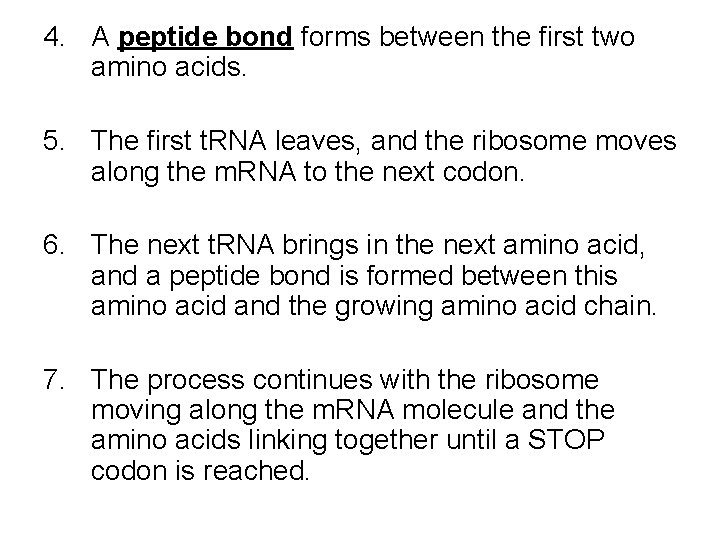
4. A peptide bond forms between the first two amino acids. 5. The first t. RNA leaves, and the ribosome moves along the m. RNA to the next codon. 6. The next t. RNA brings in the next amino acid, and a peptide bond is formed between this amino acid and the growing amino acid chain. 7. The process continues with the ribosome moving along the m. RNA molecule and the amino acids linking together until a STOP codon is reached.
The CODE of translation
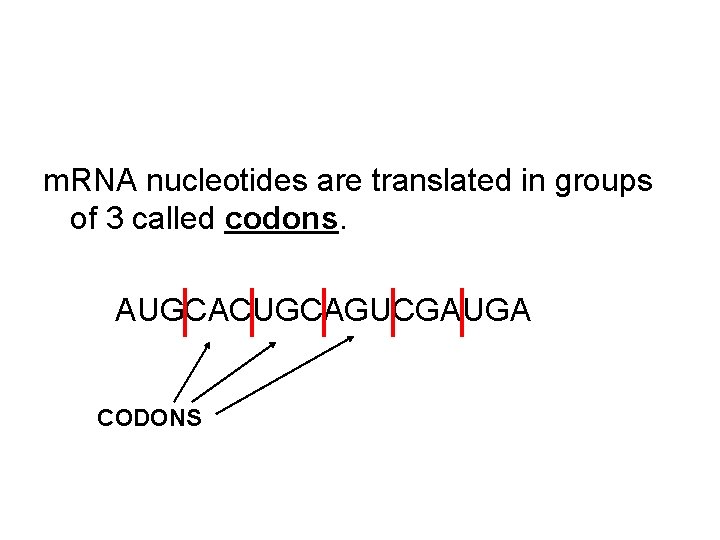
m. RNA nucleotides are translated in groups of 3 called codons. AUGCACUGCAGUCGAUGA CODONS
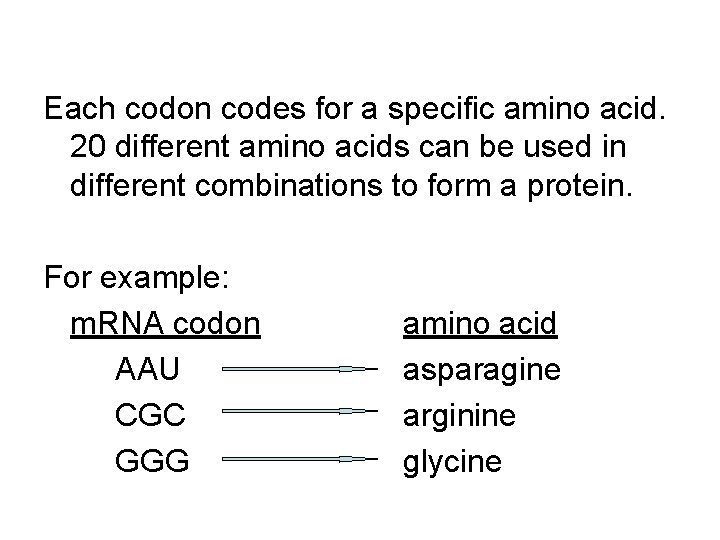
Each codon codes for a specific amino acid. 20 different amino acids can be used in different combinations to form a protein. For example: m. RNA codon AAU CGC GGG amino acid asparagine arginine glycine
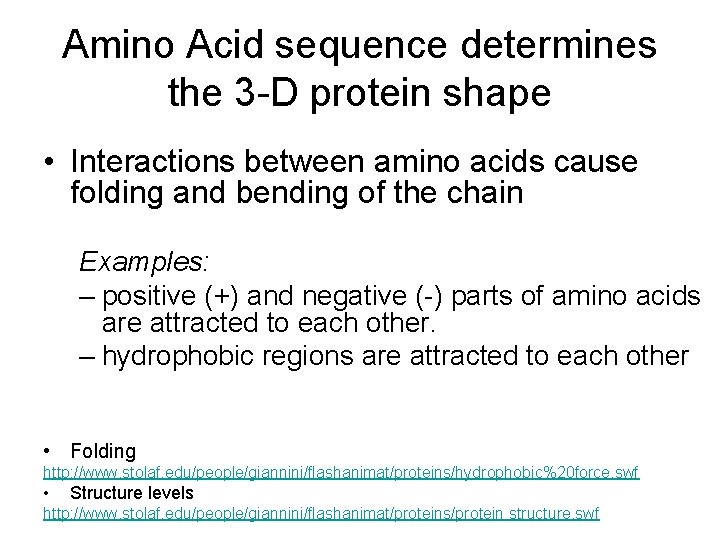
Amino Acid sequence determines the 3 -D protein shape • Interactions between amino acids cause folding and bending of the chain Examples: – positive (+) and negative (-) parts of amino acids are attracted to each other. – hydrophobic regions are attracted to each other • Folding http: //www. stolaf. edu/people/giannini/flashanimat/proteins/hydrophobic%20 force. swf • Structure levels http: //www. stolaf. edu/people/giannini/flashanimat/proteins/protein structure. swf
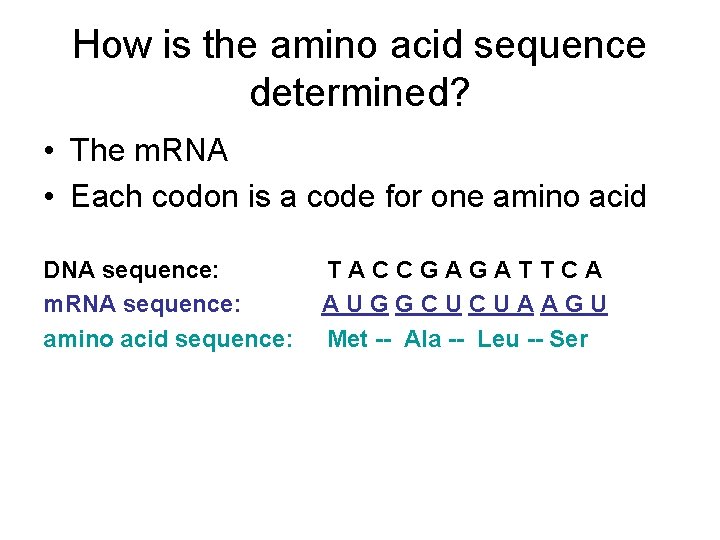
How is the amino acid sequence determined? • The m. RNA • Each codon is a code for one amino acid DNA sequence: m. RNA sequence: amino acid sequence: TACCGAGATTCA AUGGCUCUAAGU Met -- Ala -- Leu -- Ser
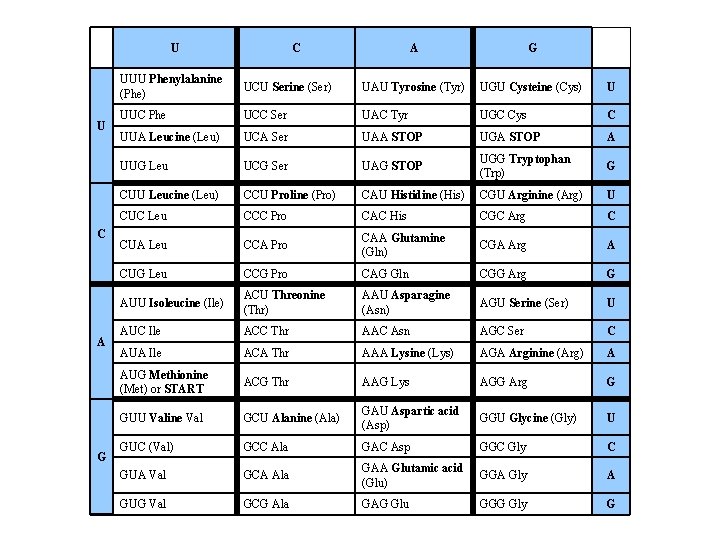
U U C A G UUU Phenylalanine (Phe) UCU Serine (Ser) UAU Tyrosine (Tyr) UGU Cysteine (Cys) U UUC Phe UCC Ser UAC Tyr UGC Cys C UUA Leucine (Leu) UCA Ser UAA STOP UGA STOP A UUG Leu UCG Ser UAG STOP UGG Tryptophan (Trp) G CUU Leucine (Leu) CCU Proline (Pro) CAU Histidine (His) CGU Arginine (Arg) U CUC Leu CCC Pro CAC His CGC Arg C CUA Leu CCA Pro CAA Glutamine (Gln) CGA Arg A CUG Leu CCG Pro CAG Gln CGG Arg G AUU Isoleucine (Ile) ACU Threonine (Thr) AAU Asparagine (Asn) AGU Serine (Ser) U AUC Ile ACC Thr AAC Asn AGC Ser C AUA Ile ACA Thr AAA Lysine (Lys) AGA Arginine (Arg) A AUG Methionine (Met) or START ACG Thr AAG Lys AGG Arg G GUU Valine Val GCU Alanine (Ala) GAU Aspartic acid (Asp) GGU Glycine (Gly) U GUC (Val) GCC Ala GAC Asp GGC Gly C GUA Val GCA Ala GAA Glutamic acid (Glu) GGA Gly A GUG Val GCG Ala GAG Glu GGG Gly G
Your turn • Decoder construction-DNA Bingo • Translation exercise (Find the secret message) • Genes to proteins-practice worksheet. – or • Complete the “Translation Practice” worksheet