
TRANSLATION Protein Synthesis Assembling Amino Acids Protein Structure
TRANSLATION Protein Synthesis Assembling Amino Acids
Protein Structure p Proteins (polymers) are composed from many amino acids (monomers) which create covalent peptide bonds during a dehydration synthesis or condensation reaction p The specific sequence of amino acids determines which protein is created. oxytocin cys-tyr-gln-asn-cys-pro-leu-gly somatostatin ala-gly-cys-lys-asn-phe-trp-lys-phe-thr-ser-cys

Amino Acid Structure A centrally located carbon with four attachments: 1. hydrogen atom 2. carboxyl group (–COOH) 3. amino group (–NH 2) 4. R group (distinguishes between amino acids) p Amino acids bond during dehydration synthesis or condensation reactions
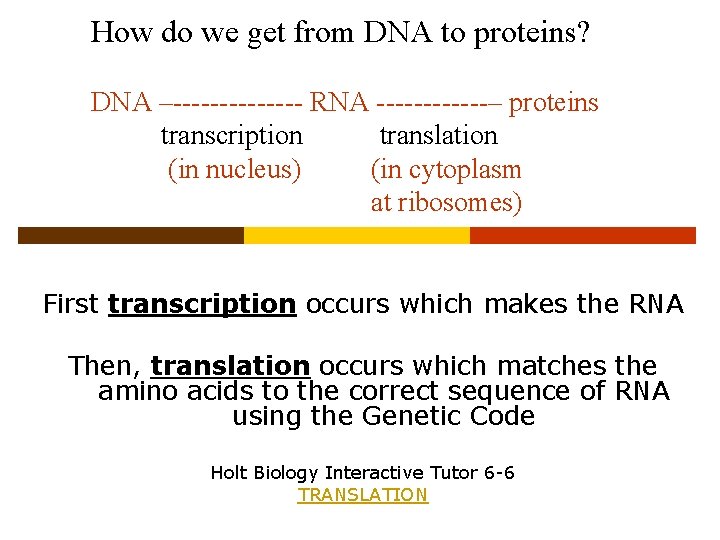
How do we get from DNA to proteins? DNA –------- RNA ------– proteins transcription translation (in nucleus) (in cytoplasm at ribosomes) First transcription occurs which makes the RNA Then, translation occurs which matches the amino acids to the correct sequence of RNA using the Genetic Code Holt Biology Interactive Tutor 6 -6 TRANSLATION
The Genetic Code p It is the matching of the RNA sequence to the correct amino acid to make proteins. p It is based on codons, 3 nitrogen bases next to each other on an m. RNA chain. p The 3 bases on a t. RNA are called the anticodon, they are the complement of the codon.
The Genetic Code continued. . . p There are 64 codons, but 20 amino acids, so each amino acid has multiple codons that code for it. There are 4 special start/stop codons that signal the beginning or end of a protein chain. p START – AUG p STOP – UAA, UAG, UGA p
Start/Stop Codons p AUG is the start codon. A protein will not be made unless this is at the beginning. It also codes for methionine. p UAA, UAG, and UGA code for the end of protein. p Protein synthesis will not start or stop unless these are read.
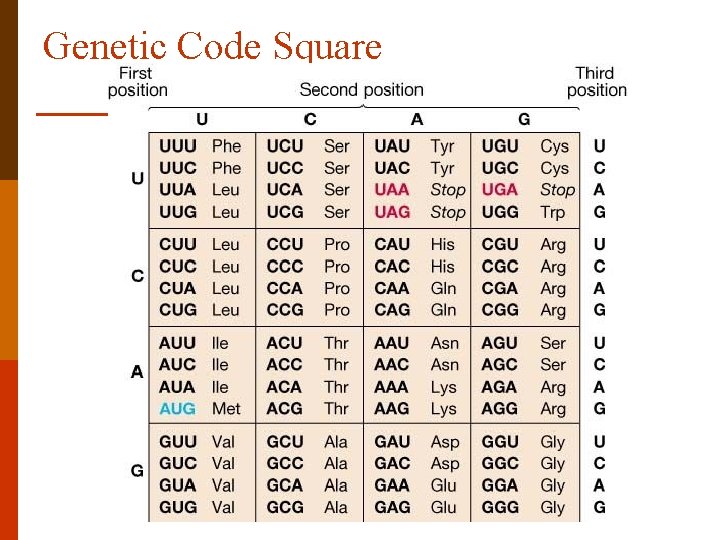
Genetic Code Square
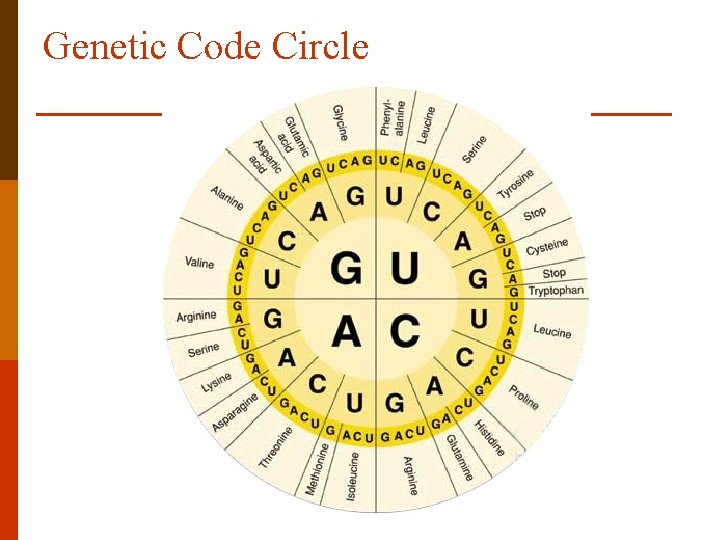
Genetic Code Circle
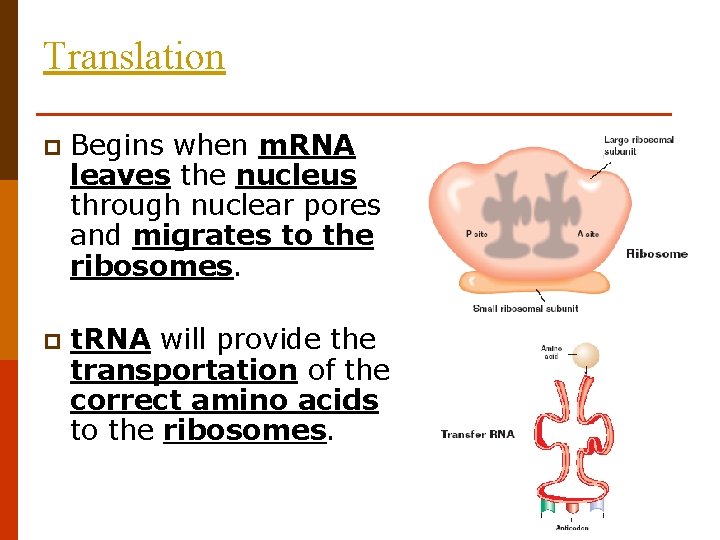
Translation p Begins when m. RNA leaves the nucleus through nuclear pores and migrates to the ribosomes. p t. RNA will provide the transportation of the correct amino acids to the ribosomes.
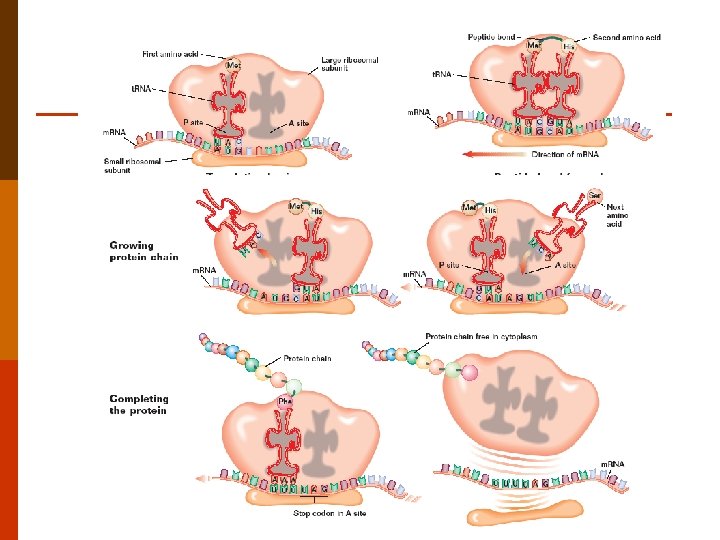

Translation p p Step 1: Ribosome attachs to the start codon (AUG) of the m. RNA. Step 2: A t. RNA w/ the anticodon of UAC and a methionine binds to the m. RNA inside the ribosome. Step 3: At the 2 nd binding site, the next codon is read and a t. RNA is attached Step 4: When the second t. RNA attaches, the amino acids attached to the 1 st t. RNA releases from the t. RNA and binds to the new amino acid with a peptide bond
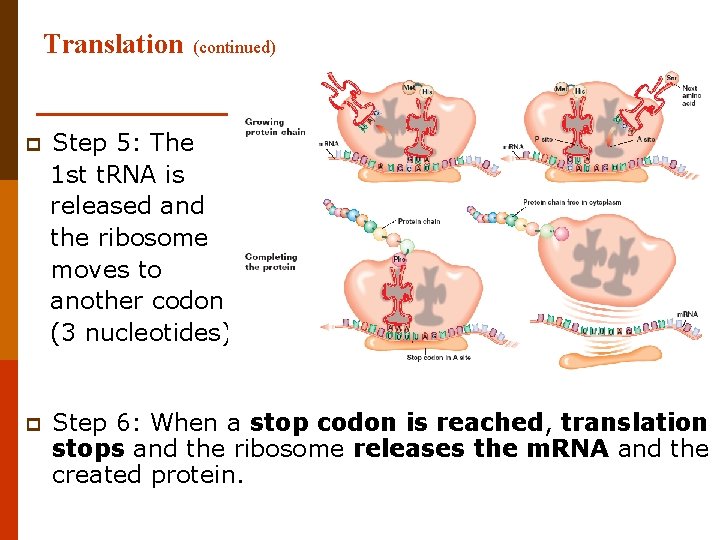
Translation (continued) p Step 5: The 1 st t. RNA is released and the ribosome moves to another codon (3 nucleotides). p Step 6: When a stop codon is reached, translation stops and the ribosome releases the m. RNA and the created protein.
Animations p http: //www. stolaf. edu/people/giannini/flas hanimat/molgenetics/translation. swf p http: //www. lewport. wnyric. org/JWANAMA KER/animations/Protein%20 Synthesis%20 -%20 long. html p http: //biology. kenyon. edu/slonc/bio 3/ribo 3. html
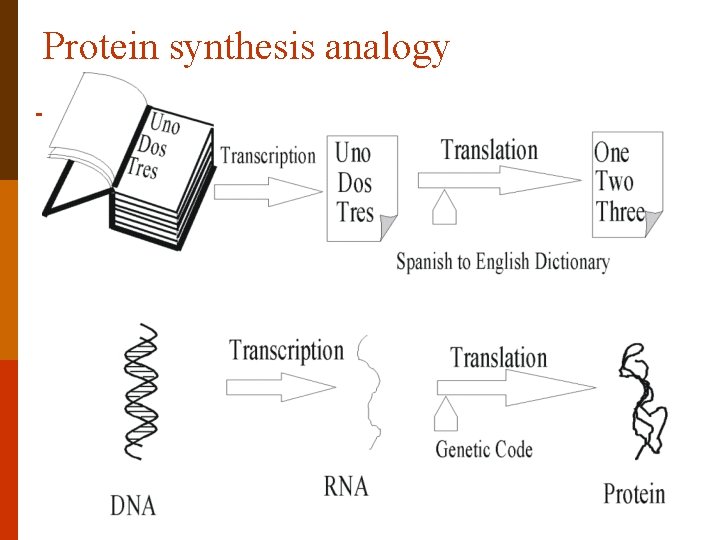
Protein synthesis analogy
- Slides: 15