
Translation of EER model into relational model Jose

- Slides: 35
Translation of EER model into relational model Jose M. Peña jose. m. pena@liu. se
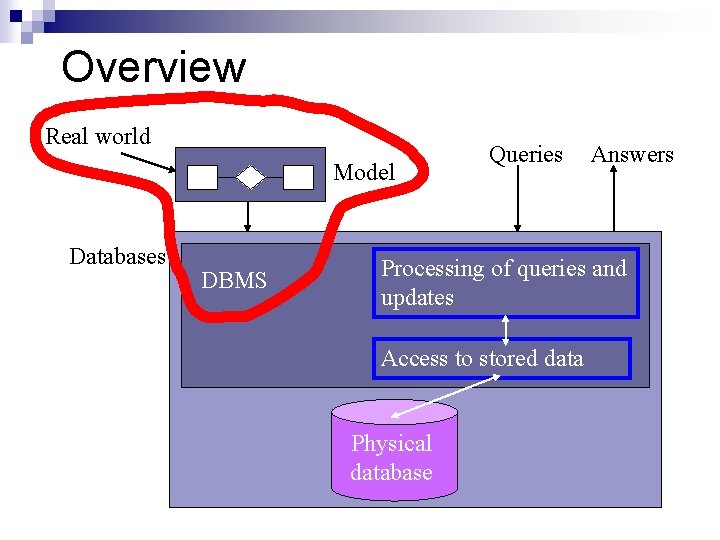
Overview Real world Model Databases DBMS Queries Answers Processing of queries and updates Access to stored data Physical database
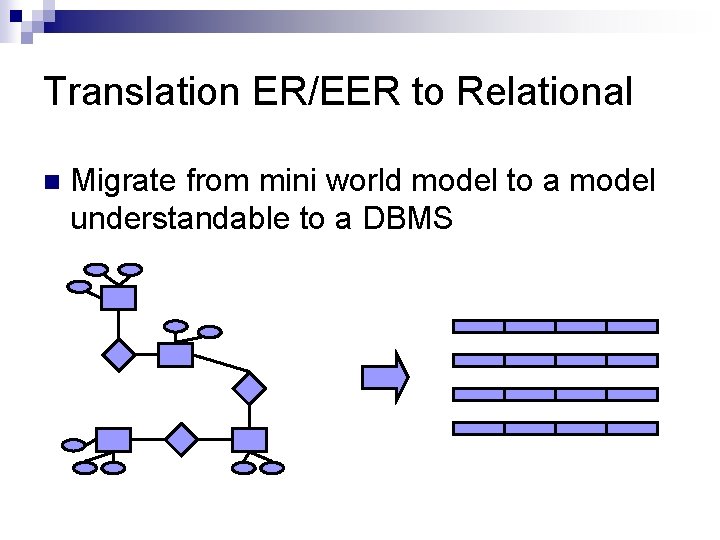
Translation ER/EER to Relational n Migrate from mini world model to a model understandable to a DBMS
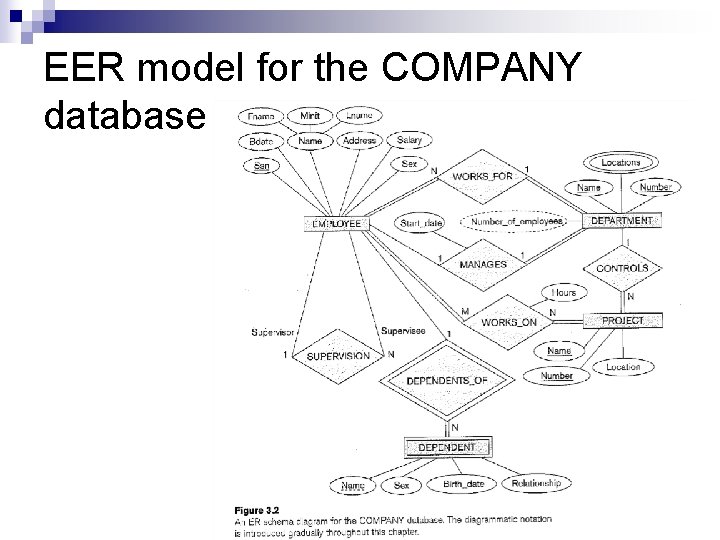
EER model for the COMPANY database
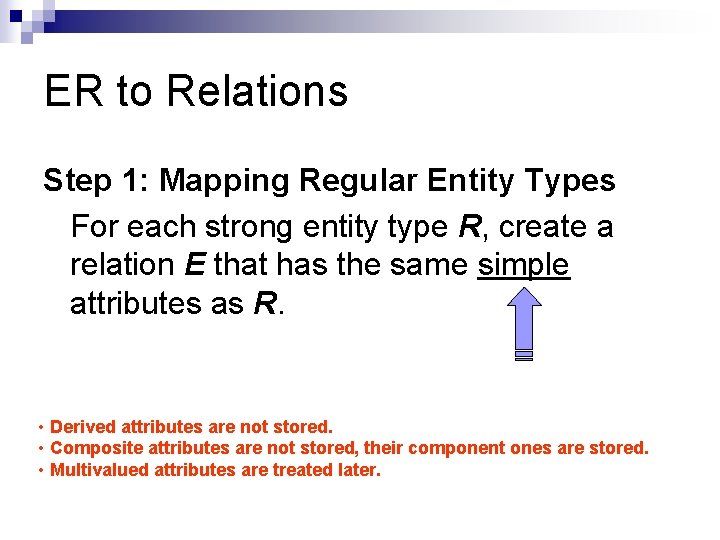
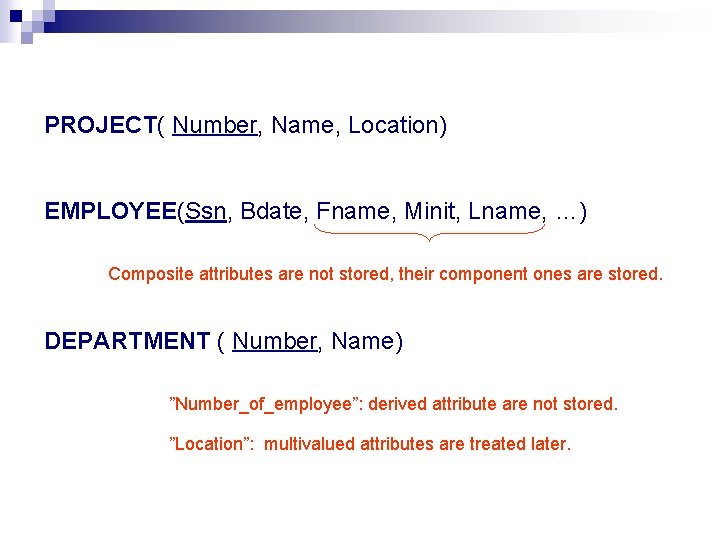
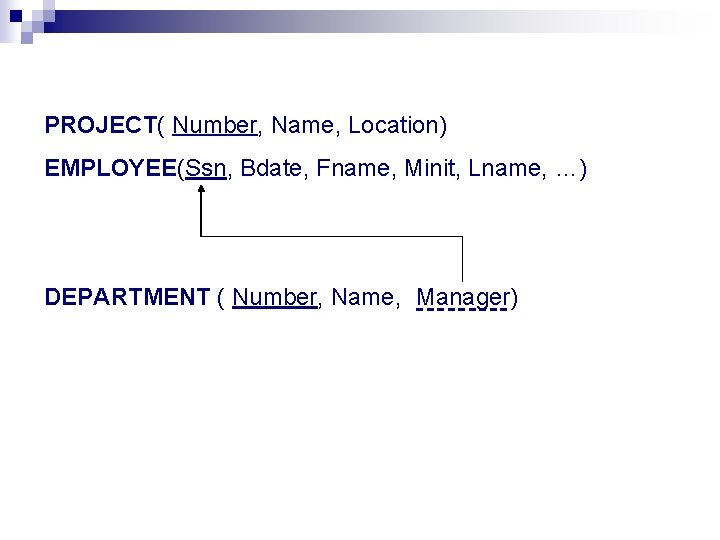
ER to Relations Step 1: Mapping Regular Entity Types For each strong entity type R, create a relation E that has the same simple attributes as R. • Derived attributes are not stored. • Composite attributes are not stored, their component ones are stored. • Multivalued attributes are treated later.
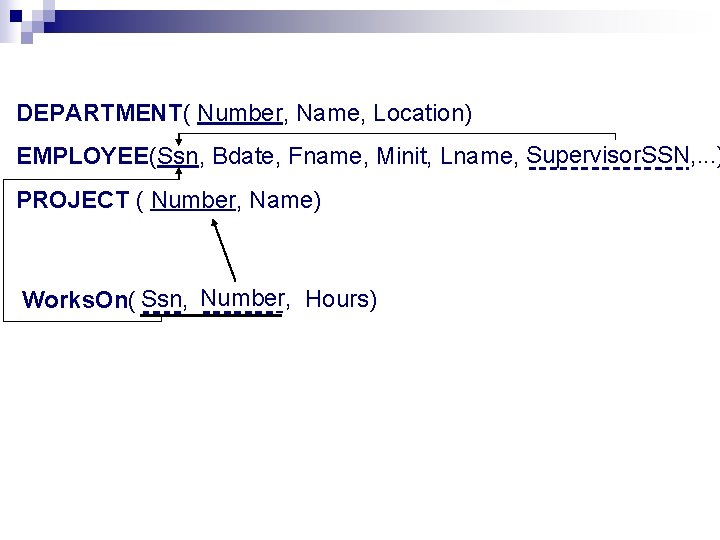
PROJECT( Number, Name, Location) EMPLOYEE(Ssn, Bdate, Fname, Minit, Lname, …) Composite attributes are not stored, their component ones are stored. DEPARTMENT ( Number, Name) ”Number_of_employee”: derived attribute are not stored. ”Location”: multivalued attributes are treated later.
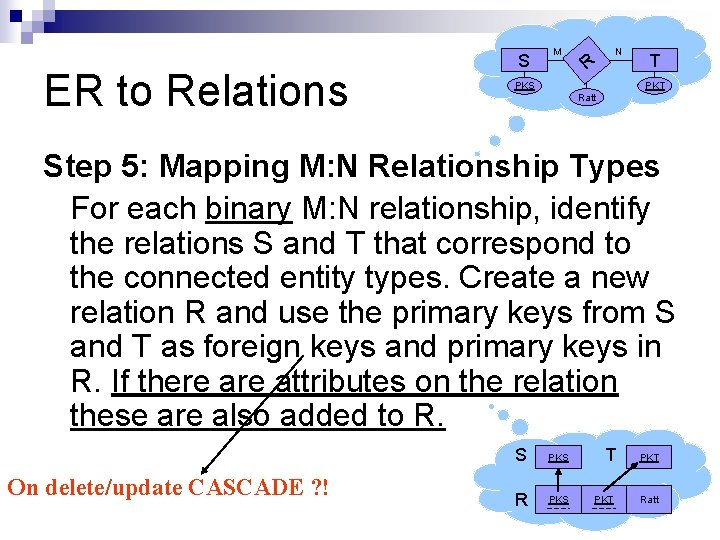
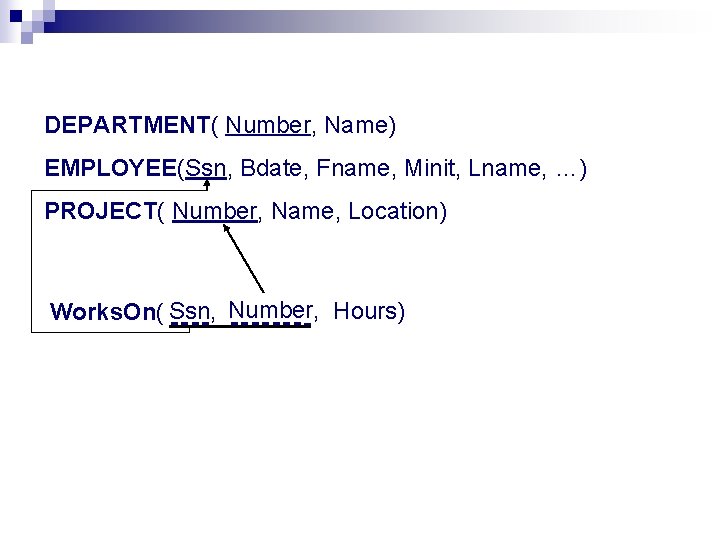
ER to Relations S M N R PKS T PKT Ratt Step 5: Mapping M: N Relationship Types For each binary M: N relationship, identify the relations S and T that correspond to the connected entity types. Create a new relation R and use the primary keys from S and T as foreign keys and primary keys in R. If there attributes on the relation these are also added to R. On delete/update CASCADE ? ! S PKS T PKT R PKS PKT Ratt
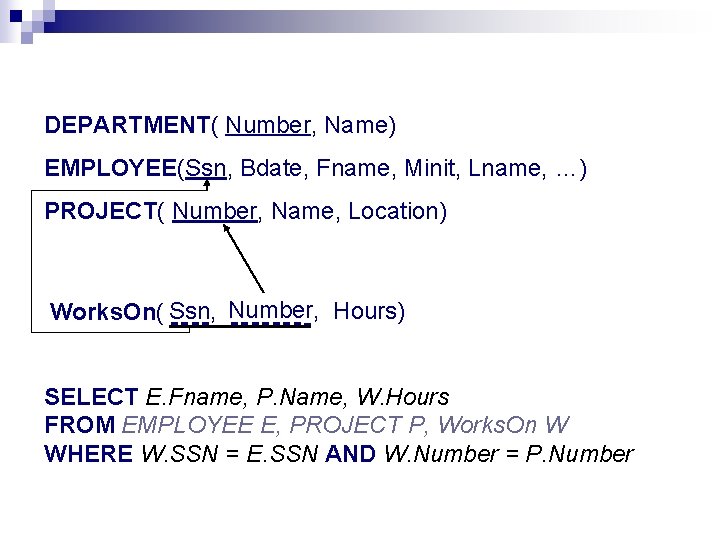
DEPARTMENT( Number, Name) EMPLOYEE(Ssn, Bdate, Fname, Minit, Lname, …) PROJECT( Number, Name, Location) Works. On( Ssn, Number, Hours)
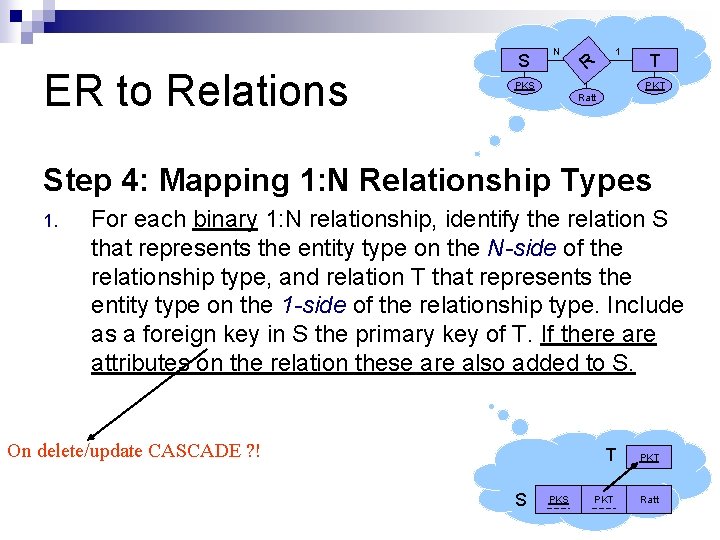
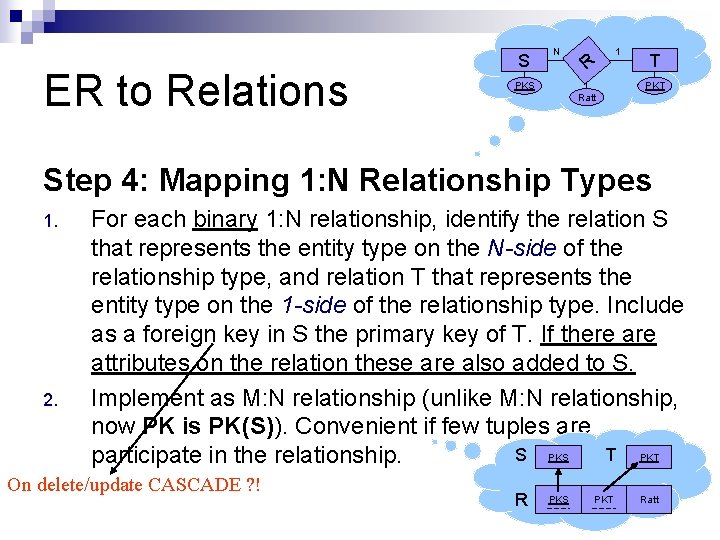
ER to Relations S N 1 R PKS T PKT Ratt Step 4: Mapping 1: N Relationship Types 1. For each binary 1: N relationship, identify the relation S that represents the entity type on the N-side of the relationship type, and relation T that represents the entity type on the 1 -side of the relationship type. Include as a foreign key in S the primary key of T. If there attributes on the relation these are also added to S. On delete/update CASCADE ? ! S PKS T PKT Ratt
DEPARTMENT( Number, Name, Location) EMPLOYEE(Ssn, Bdate, Fname, Minit, Lname, Supervisor. SSN, . . . ) …) PROJECT ( Number, Name) Works. On( Ssn, Number, Hours)
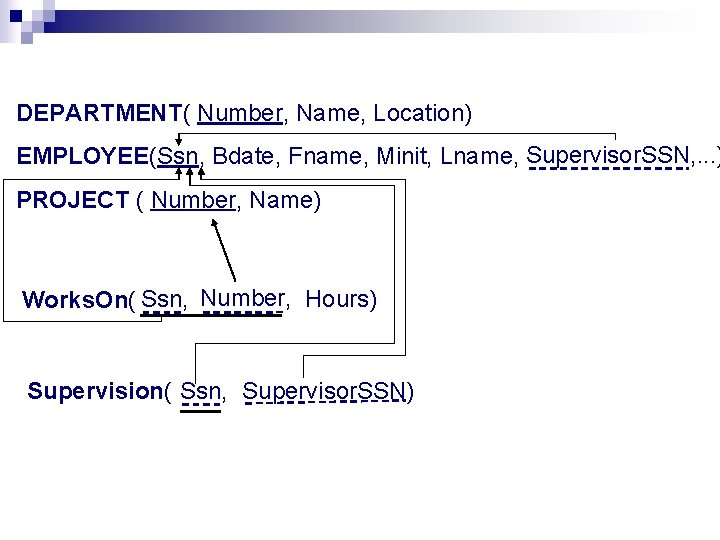
ER to Relations S N R PKS 1 T PKT Ratt Step 4: Mapping 1: N Relationship Types 1. 2. For each binary 1: N relationship, identify the relation S that represents the entity type on the N-side of the relationship type, and relation T that represents the entity type on the 1 -side of the relationship type. Include as a foreign key in S the primary key of T. If there attributes on the relation these are also added to S. Implement as M: N relationship (unlike M: N relationship, now PK is PK(S)). Convenient if few tuples are S PKS T PKT participate in the relationship. On delete/update CASCADE ? ! R PKS PKT Ratt
DEPARTMENT( Number, Name, Location) EMPLOYEE(Ssn, Bdate, Fname, Minit, Lname, Supervisor. SSN, . . . ) …) PROJECT ( Number, Name) Works. On( Ssn, Number, Hours) Supervision( Ssn, Supervisor. SSN)
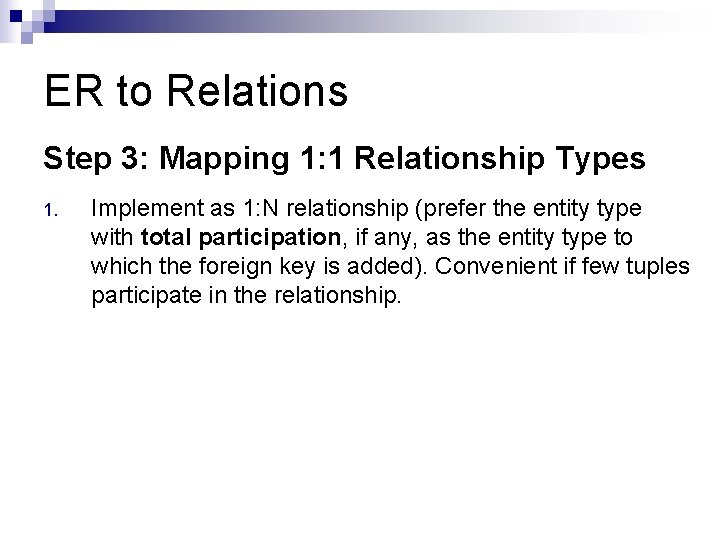
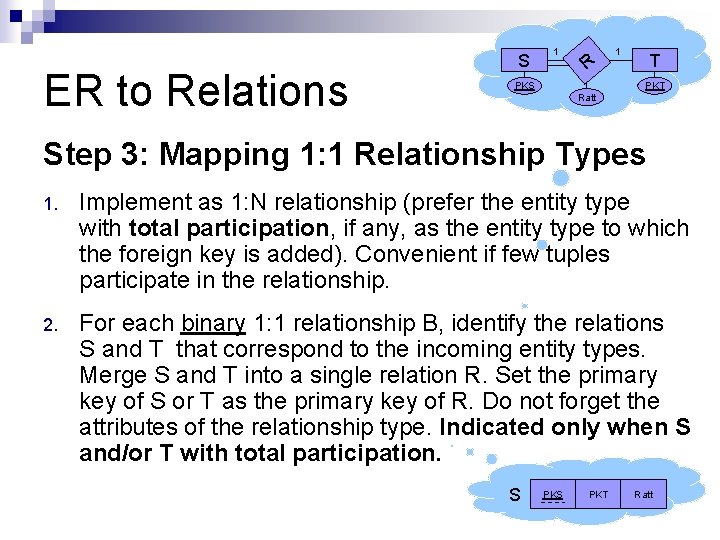
ER to Relations Step 3: Mapping 1: 1 Relationship Types 1. Implement as 1: N relationship (prefer the entity type with total participation, if any, as the entity type to which the foreign key is added). Convenient if few tuples participate in the relationship.
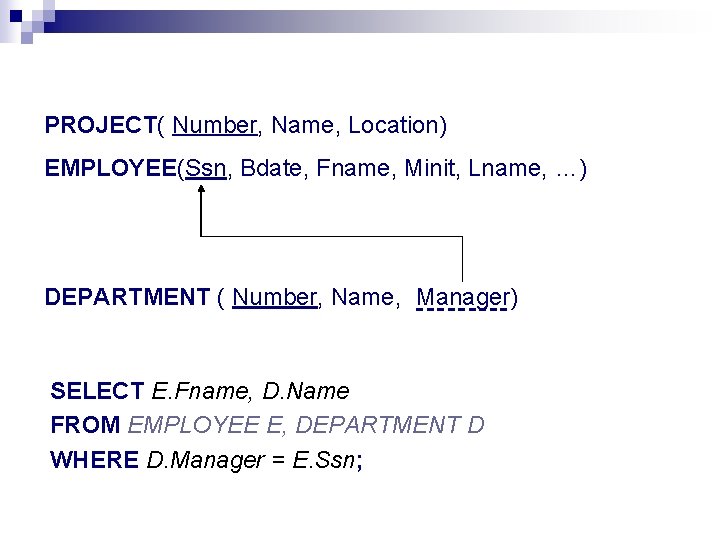
PROJECT( Number, Name, Location) EMPLOYEE(Ssn, Bdate, Fname, Minit, Lname, …) DEPARTMENT ( Number, Name, Manager)
ER to Relations S 1 R PKS 1 T PKT Ratt Step 3: Mapping 1: 1 Relationship Types 1. Implement as 1: N relationship (prefer the entity type with total participation, if any, as the entity type to which the foreign key is added). Convenient if few tuples participate in the relationship. 2. For each binary 1: 1 relationship B, identify the relations S and T that correspond to the incoming entity types. Merge S and T into a single relation R. Set the primary key of S or T as the primary key of R. Do not forget the attributes of the relationship type. Indicated only when S and/or T with total participation. S PKT Ratt
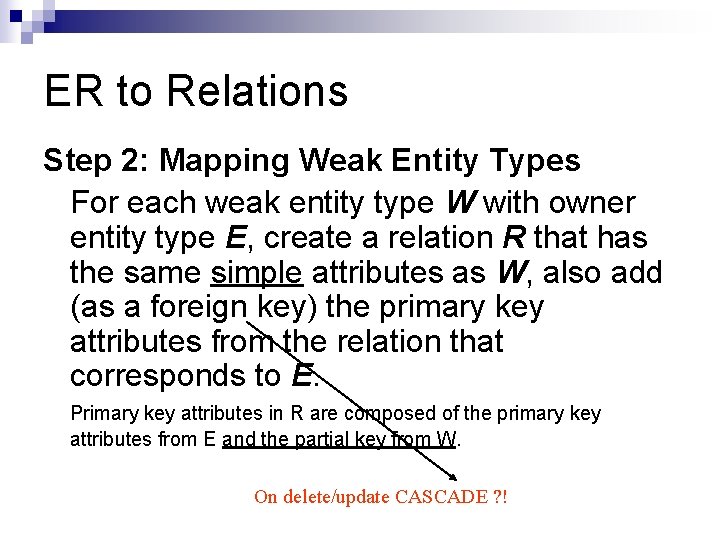
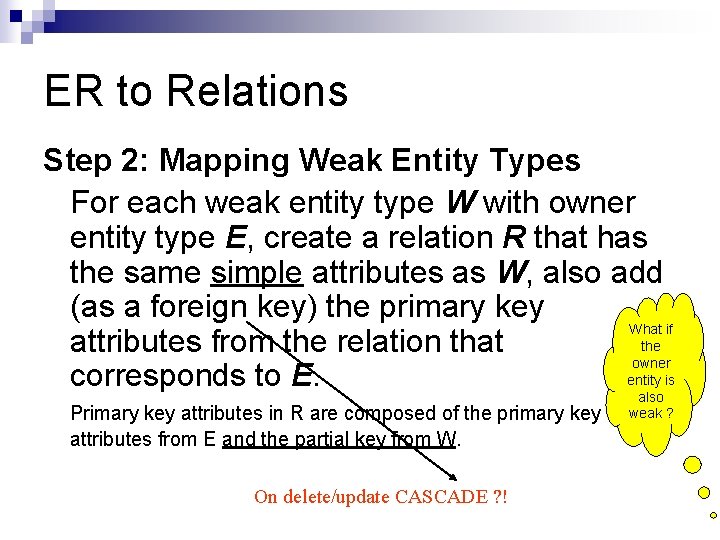
ER to Relations Step 2: Mapping Weak Entity Types For each weak entity type W with owner entity type E, create a relation R that has the same simple attributes as W, also add (as a foreign key) the primary key attributes from the relation that corresponds to E. Primary key attributes in R are composed of the primary key attributes from E and the partial key from W. On delete/update CASCADE ? !
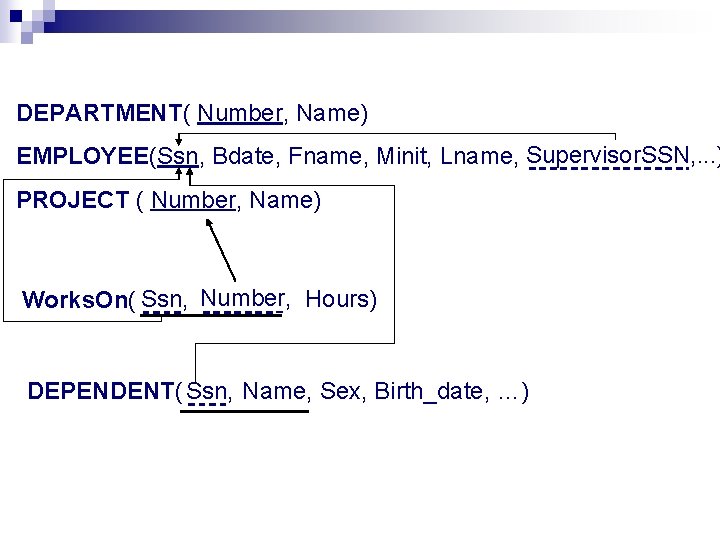
DEPARTMENT( Number, Name) EMPLOYEE(Ssn, Bdate, Fname, Minit, Lname, Supervisor. SSN, . . . ) …) PROJECT ( Number, Name) Works. On( Ssn, Number, Hours) DEPENDENT( Ssn, Name, Sex, Birth_date, …)
ER to Relations Step 2: Mapping Weak Entity Types For each weak entity type W with owner entity type E, create a relation R that has the same simple attributes as W, also add (as a foreign key) the primary key What if the attributes from the relation that owner entity is corresponds to E. also Primary key attributes in R are composed of the primary key attributes from E and the partial key from W. On delete/update CASCADE ? ! weak ?
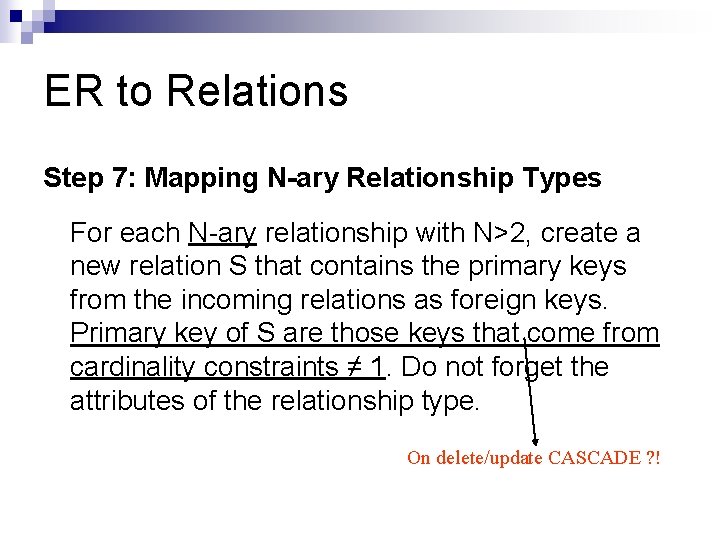
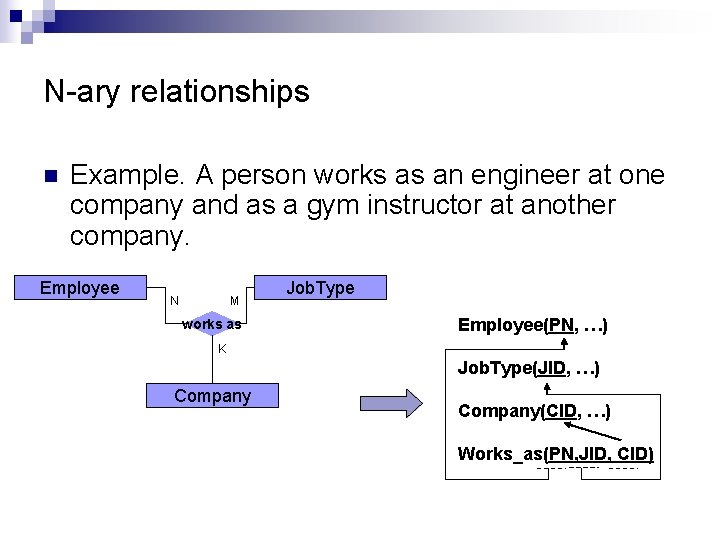
ER to Relations Step 7: Mapping N-ary Relationship Types For each N-ary relationship with N>2, create a new relation S that contains the primary keys from the incoming relations as foreign keys. Primary key of S are those keys that come from cardinality constraints ≠ 1. Do not forget the attributes of the relationship type. On delete/update CASCADE ? !
N-ary relationships n Example. A person works as an engineer at one company and as a gym instructor at another company. Employee N M works as Job. Type Employee(PN, …) K Job. Type(JID, …) Company(CID, …) Works_as(PN, JID, CID)
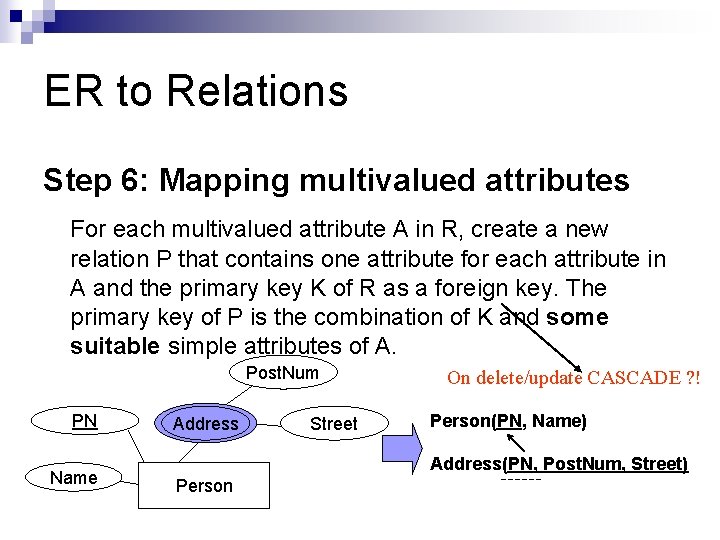
ER to Relations Step 6: Mapping multivalued attributes For each multivalued attribute A in R, create a new relation P that contains one attribute for each attribute in A and the primary key K of R as a foreign key. The primary key of P is the combination of K and some suitable simple attributes of A. Post. Num PN Name Address Street On delete/update CASCADE ? ! Person(PN, Name) Address(PN, Post. Num, Street) Person
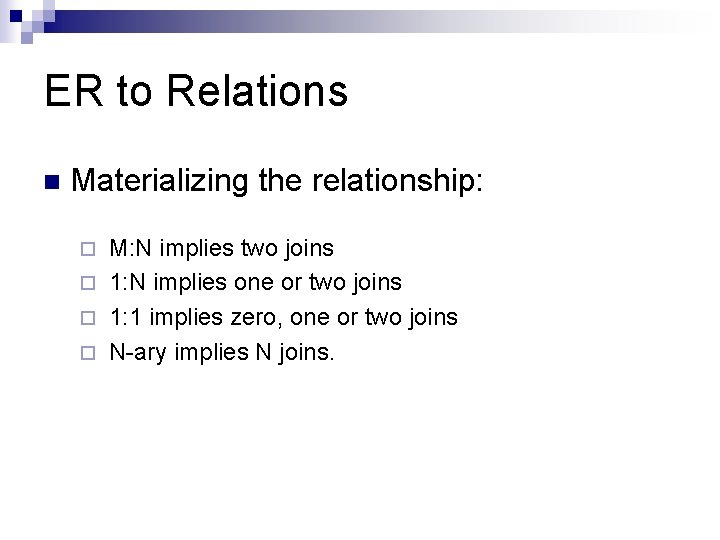
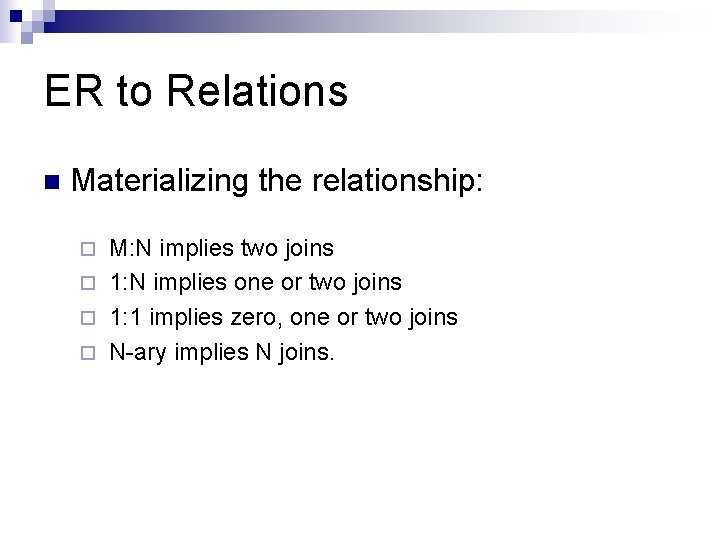
ER to Relations n Materializing the relationship: M: N implies two joins ¨ 1: N implies one or two joins ¨ 1: 1 implies zero, one or two joins ¨ N-ary implies N joins. ¨
DEPARTMENT( Number, Name) EMPLOYEE(Ssn, Bdate, Fname, Minit, Lname, …) PROJECT( Number, Name, Location) Works. On( Ssn, Number, Hours) SELECT E. Fname, P. Name, W. Hours FROM EMPLOYEE E, PROJECT P, Works. On W WHERE W. SSN = E. SSN AND W. Number = P. Number
ER to Relations n Materializing the relationship: M: N implies two joins ¨ 1: N implies one or two joins ¨ 1: 1 implies zero, one or two joins ¨ N-ary implies N joins. ¨
PROJECT( Number, Name, Location) EMPLOYEE(Ssn, Bdate, Fname, Minit, Lname, …) DEPARTMENT ( Number, Name, Manager) SELECT E. Fname, D. Name FROM EMPLOYEE E, DEPARTMENT D WHERE D. Manager = E. Ssn;
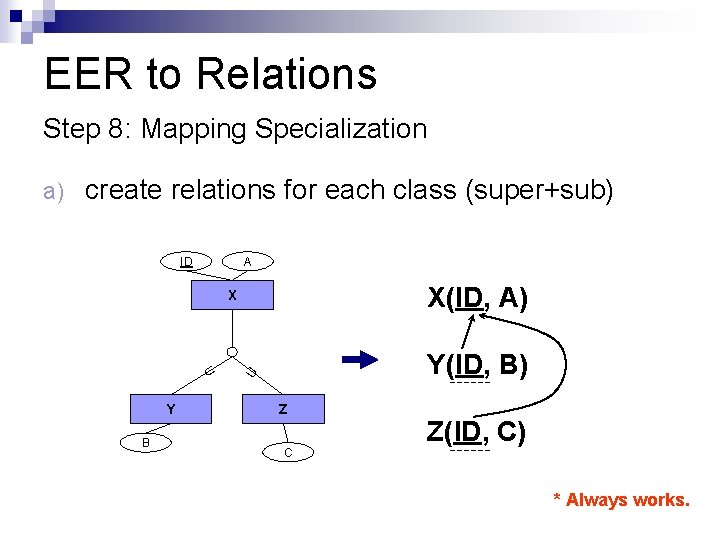
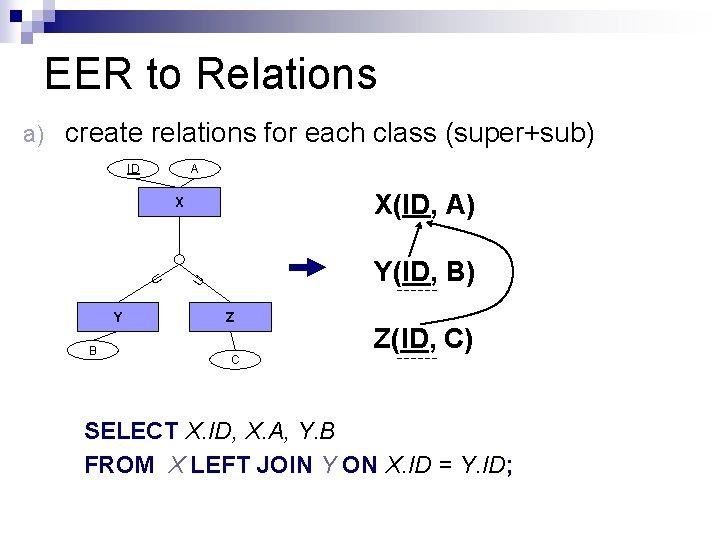
EER to Relations Step 8: Mapping Specialization create relations for each class (super+sub) ID A X(ID, A) X U Y B Y(ID, B) U a) Z C Z(ID, C) * Always works.
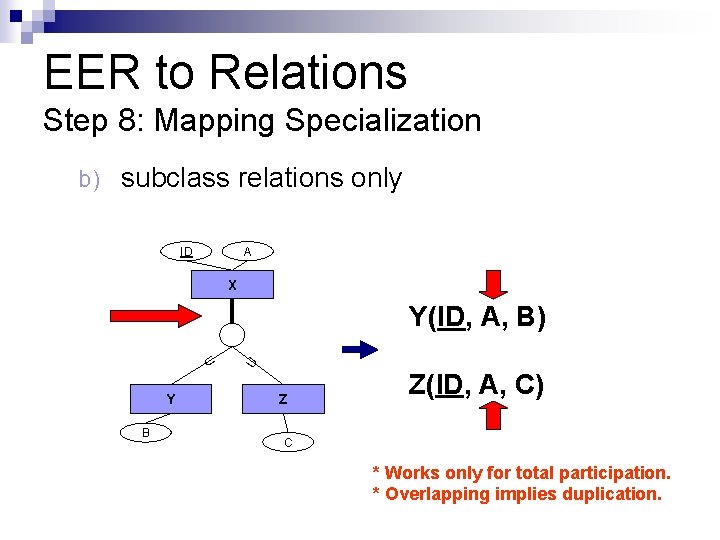
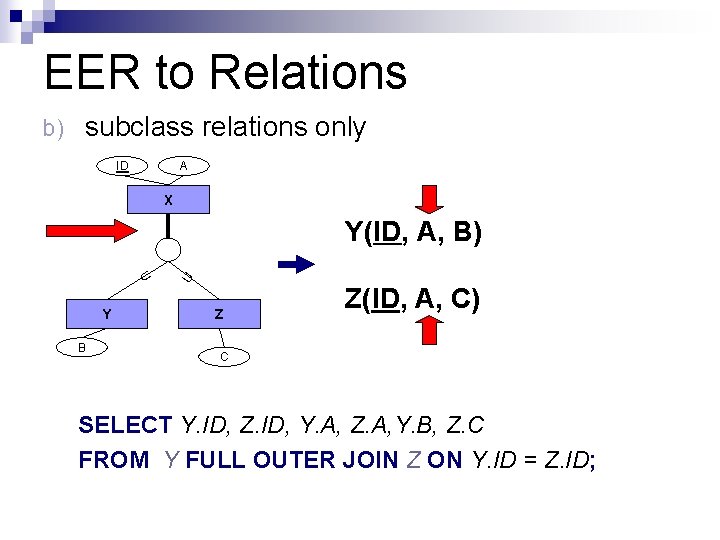
EER to Relations Step 8: Mapping Specialization subclass relations only ID A X Y(ID, A, B) U Y B U b) Z Z(ID, A, C) C * Works only for total participation. * Overlapping implies duplication.
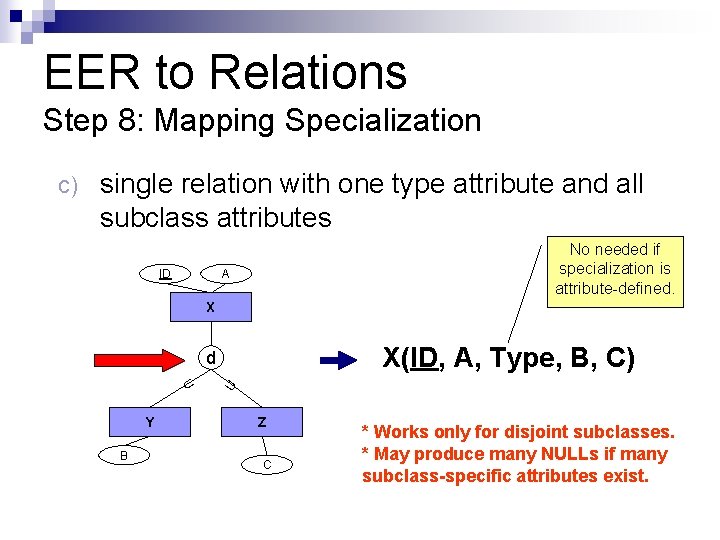
EER to Relations Step 8: Mapping Specialization single relation with one type attribute and all subclass attributes ID No needed if specialization is attribute-defined. A X X(ID, A, Type, B, C) d U Y B U c) Z C * Works only for disjoint subclasses. * May produce many NULLs if many subclass-specific attributes exist.
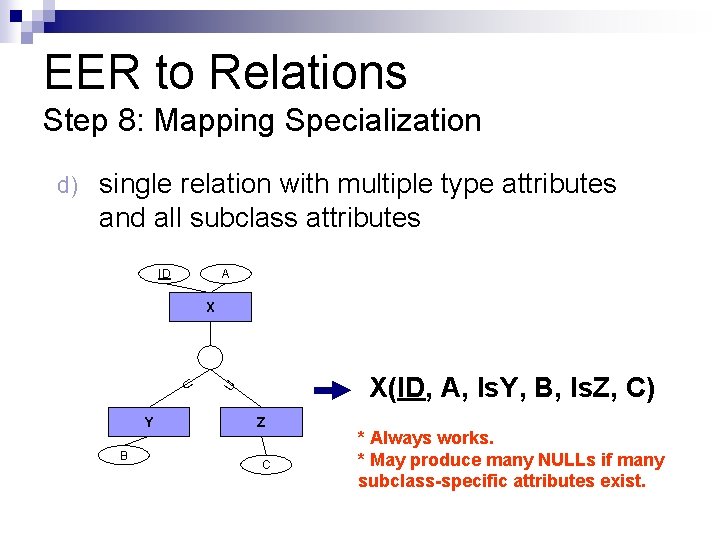
EER to Relations Step 8: Mapping Specialization single relation with multiple type attributes and all subclass attributes ID A X U Y B X(ID, A, Is. Y, B, Is. Z, C) U d) Z C * Always works. * May produce many NULLs if many subclass-specific attributes exist.
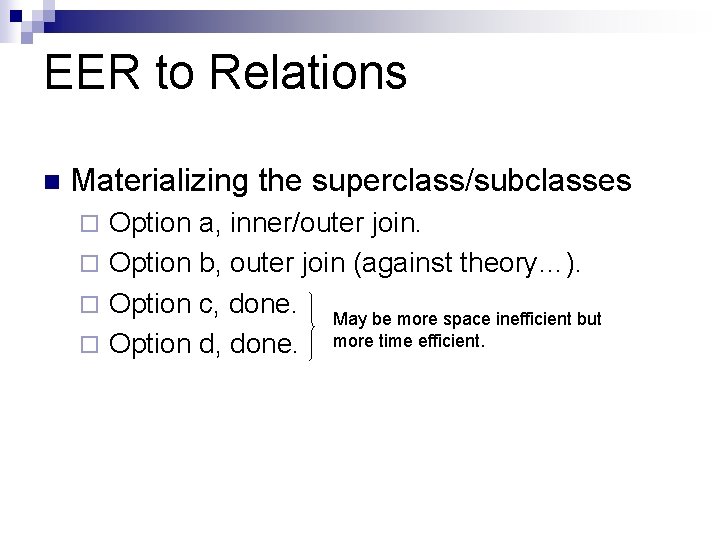
EER to Relations n Materializing the superclass/subclasses Option a, inner/outer join. ¨ Option b, outer join (against theory…). ¨ Option c, done. May be more space inefficient but ¨ Option d, done. more time efficient. ¨
EER to Relations create relations for each class (super+sub) ID A X(ID, A) X U Y B Y(ID, B) U a) Z C Z(ID, C) SELECT X. ID, X. A, Y. B FROM X LEFT JOIN Y ON X. ID = Y. ID;
EER to Relations subclass relations only ID A X Y(ID, A, B) U Y B U b) Z Z(ID, A, C) C SELECT Y. ID, Z. ID, Y. A, Z. A, Y. B, Z. C FROM Y FULL OUTER JOIN Z ON Y. ID = Z. ID;
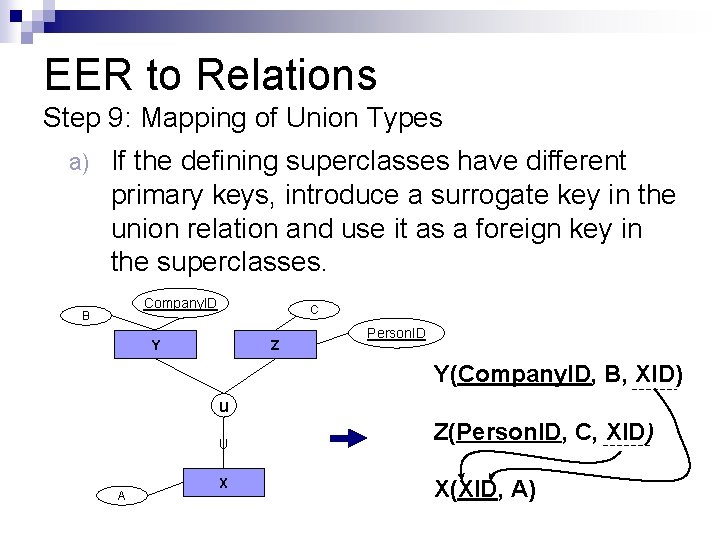
EER to Relations Step 9: Mapping of Union Types a) If the defining superclasses have different primary keys, introduce a surrogate key in the union relation and use it as a foreign key in the superclasses. Company. ID B C Y Z Person. ID Y(Company. ID, B, XID) u U A X Z(Person. ID, C, XID) X(XID, A)
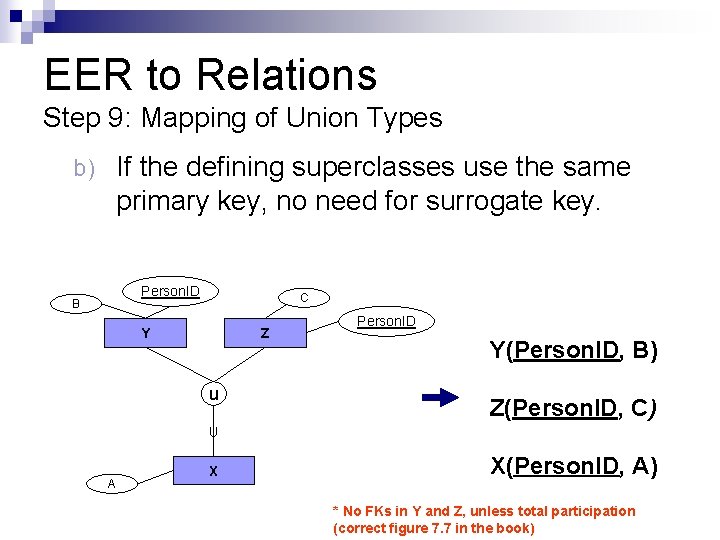
EER to Relations Step 9: Mapping of Union Types If the defining superclasses use the same primary key, no need for surrogate key. b) Person. ID B C Y Z u Person. ID Y(Person. ID, B) Z(Person. ID, C) U A X X(Person. ID, A) * No FKs in Y and Z, unless total participation (correct figure 7. 7 in the book)
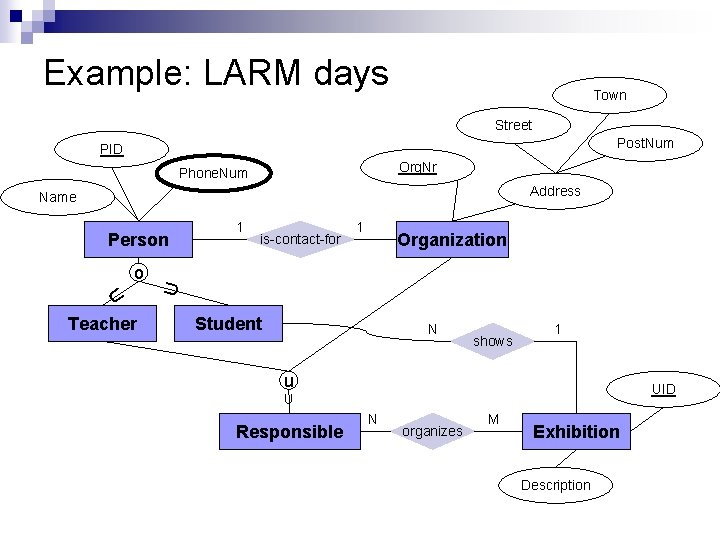
Example: LARM days Town Street Post. Num PID Org. Nr Phone. Num Address Name Person 1 is-contact-for 1 Organization U Teacher U o Student N shows 1 u UID U Responsible N organizes M Exhibition Description