
Translation Domestication Foreignization Translation is not a matter

- Slides: 20
Translation Domestication & Foreignization ﺍﻟﺘﻘﺮﻳﺐ )ﺍﻟﺘﻮﻃﻴﻦ( ﻭﺍﻟﺘﻐﺮﻳﺐ
"Translation is not a matter of words only: it is a matter of making intelligible a whole culture. " Anthony Burgess “The purpose of translation is to promote understanding and communication between different linguistic and cultural communities. ” “Linguistic competences are not the only requirement […]though the most important one- another important requirement is [having] enough acquaintance with the target culture” Hui Guo
Translation is not just about transmitting a text/speech from one language to another, it is , rather, a set of procedures and strategies to be followed in order to produce a new, coherent and appropriate text that fulfills the goal of translation and transmits, as much as possible, the meaning of the source text.
Among these translation strategies, we find two basic translation strategies Domestication Foregnization They were termed by American translation theorist Lawerence Venuti.
This presentation answers the following questions: What are, then, the notions of Foreignization and domestication? what is the relationship between them? Where did they come from? What characteristics distinguish them from each other and from the other translation strategies How do they function within translation? What is the benefit of adopting any of them when translating? And to what extent did the contribution of the functionalist approach succeed in solving this issue by adopting the Skopos
WHAT IS FOREIGNIZATION? Linguistically speaking, the term «foreignization» comes from the adjective foreign, meaning something that is strange and different. In the field of translation, « foreignization often refers to the preserving of the original cultural context, in terms of setting, names… etc »
WHAT IS FOREIGNIZATION? In Forignization, according to Venuti, the translator: focuses his/her efforts ‟to register the linguistic and cultural difference of the foreign text, sending the reader abroad. ” preserves the cultural and linguistic aspects and values of the source text (ST) and transform them into the target text (TT) retaining in the meantime the ST constituents’ flavour. creates a sense of strangeness and cultural distance from the target audience.
WHAT IS DOMESTICATION? Domestication comes linguistically from the verb «to domesticate» , which means «to make a wild animal used to living with or working for humans» In translation studies, Domestication is a strategy that “is adopted to minimize the strangeness of the foreign text for target language readers” It is the strategy adopted in order to produce a transparent, fluent and easy translation that conforms to the norms and rules of the target audience’s culture and language without any traces or existence of any aspect of the ST in the TT.
In the contemporary international translation field, the person who has initiated the controversy between domestication and foreignization is Eugene Nida, whom is regarded as the representative of those who favour domesticating translation. While it is the Italian scholar Lawrence Venuti who has led the debate to a white-hot state. He can be regarded as the spokesman for those who favour foreignizing translation.
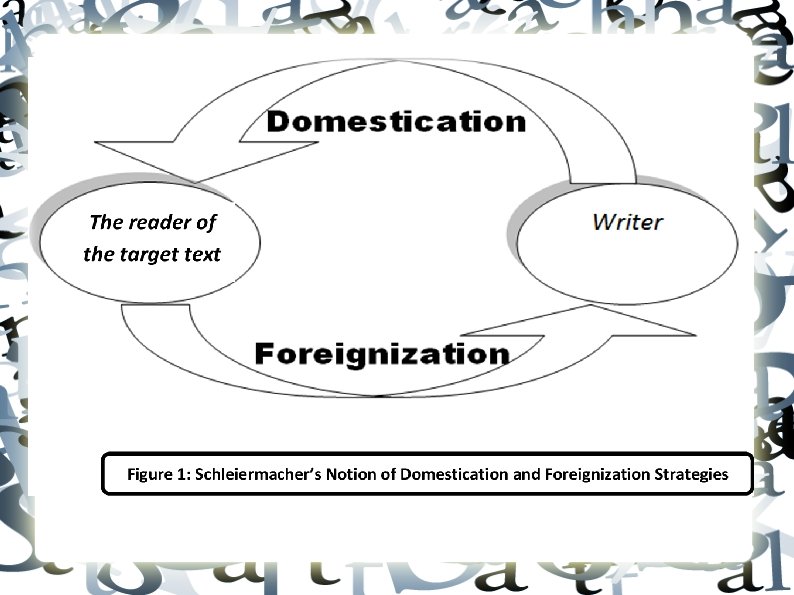
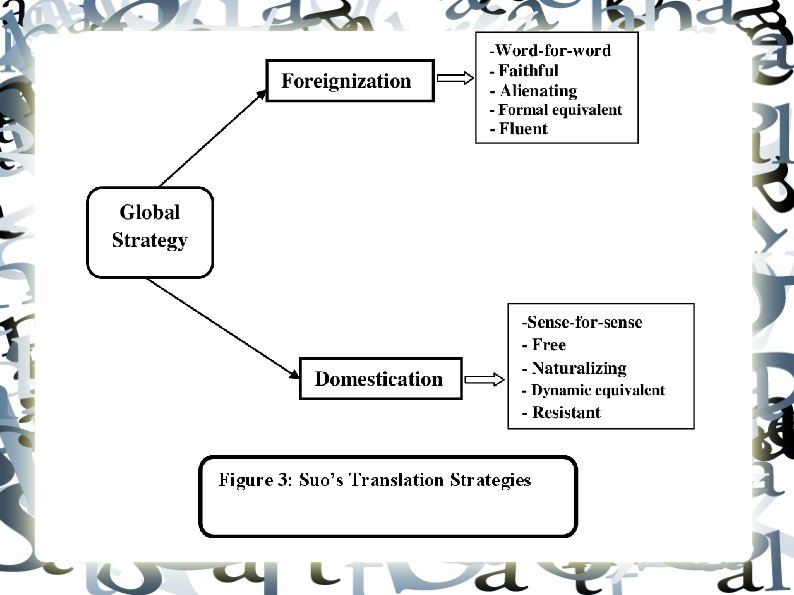
Foreignization is author- centered and sourceculture oriented , while domestication is readercentered and target-culture oriented. The following diagrams show the relationship between ‘foreignization’ and ‘domestication’
The above diagrams show that: foreignization and domestication are two headings or subordinates situated under the umbrella of ‘Translation strategies/technics’ Foreignization, in a way or another, embraces all the other strategies that aim at faithfulness and commitment to the ST, while Domestication involves all the technics that aim at creating a text in a new, different and creative style sticking in the meantime to the meaning of the ST. they involve as much as possible all the other different translation strategies that deal with the linguistic and cultural differences in translation.
domestication strategy helps the readers overcome both linguistic and cultural barriers and make the target text more readable and easier to understand, on the contrary, Foreignization introduces the reader to the source culture and deepen their knowledge about the ‘other’ foreign linguistic and cultural values, traditions, expressions, idioms.
Both Foreignization and Domestication are translation tools that facilitate, simplify and emphasize the purpose of communication and contribute each in its way to the realization of this purpose. Foreignization does it by introducing the readers to to the environment of the foreign culture and language and enriching their knowledge about the ‘other’, while Domestication does it by bringing the ‘Other’ closer to the readers and helping them get in touch with this (Other) in simple and easy ways.
Reconciliation The Skopos theory The Skopos theory: the word ‘Skopos’ is derived from Greek and denotes ‘purpose’ Skopos theory is a concept from the field of translation studies. It provides an insight into the nature of translation as a purposeful activity; [purpose driven]
The Skopos theory was established by the German linguist Hans Vermeer and comprises the idea that translating and interpreting should primarily take into account the function of both the source and target text. This functionalist approach to translation emerged in order to solve and answer the questions concerning Foreignization and Domestication and their use and function in translation. It suggests that the use either of foreignization or domestication depends on the skopos [purpose] of translation.
Conclusion From the above mentioned points, we can say that the functionalist approach to translation, introduced by Vermeer, doesn’t prefer domestication or foreignization, it rather considers both of them as translation tools [strategies or techniques] that can be adopted either individually or mutually according to the Skopos [purpose] of translation. They have different functions inside translation. Both of them have positive and negative points. The translator should [however] take a dynamic view to determine which strategy s/he should use in translation.
References Hui Guo. “A Brief Analysis of Culture and Translation. ” Theory and Practice in Language Studies, Vol. 2, No. 2, pp. 343 -347, February 2012. doi: 10. 4304/tpls. 2. 2. 343 -347 Paloposki, Outi “Domestication and foreignization. ” Handbook of Translation Studies. John Benjamins Publishing Company. Amsterdam Suo, Xuxiang. “A New Perspective on Literary Translation Strategies Based on Skopos Theory” Theory and Practice in Language Studies, Vol. 5, No. 1, pp. 176 -183, January 2015 http: //dx. doi. org/10. 17507/tpls. 0501. 24 Venuti, Lawrence. The Translator’s Invisibility: A history of translation. Routledge: New. York, 1995.