
Translation Broadly Conceived Sergey Tyulenev Durham University UK
Translation Broadly Conceived Sergey Tyulenev Durham University, UK sergey. tyulenev@durham. ac. uk Personal website www. tyulenev. org
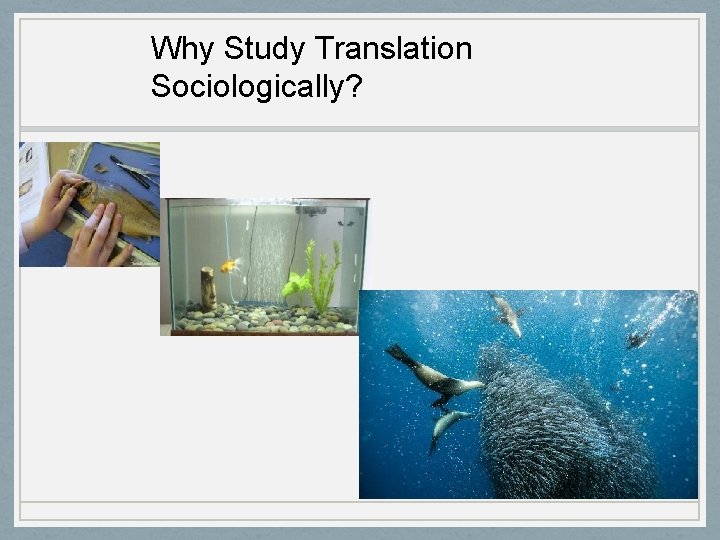
Why Study Translation Sociologically?
Translation: a complex phenomenon with many kinds Translation is necessarily a social activity in the sense that it is performed in a situation of social interaction as a social action with all the properties of a social action and in the sense that it is performed by social actors, whether human or non-human.
What is Public Sphere? PS is the sector of public life that serves as a platform in which a range of multifarious and multifaceted topics, considered socially important, are conferred about.

What is Public Sphere? In an arena a number of speakers communicate with each other, observed by an audience seated in the gallery. […T]here are mediators (that is, journalists) who organize the exchange between speakers […] In the catacombs below the arena is a backstage area in which speakers and mediators prepare their communications and seek advice […] from public relations coaches. The entire complex of arena, gallery and backstage area can be called a forum. Wessler, Hartmut, Bernhard Peters, Michael Brüggemann, Katharina Kleinen-von Königslöw and Stefanie Sifft. 2008. Transnationalization of Public Spheres. Houndmills, Basingstoke, Hampshire: Palgrave Macmillan (p. 4).
Translation: a complex phenomenon with many kinds It has different manifestations. In TS, usually one, interlingual, kind of translation has been focused on. However, if we want to understand the social functioning of translation, we need to go beyond just that one kind.

[…] a dense line of horsemen appeared at the end of the square and thundered past us at a furious pace, swords drawn, yelling hoarsely. One of the riders was particularly aggressive. Time after time he raced past, his horse’s hooves close to our boot-tips, while he leaned towards us, howling and grimacing savagely, his sword whirling appallingly close to our scalps. I tentatively asked the sheriff what this meant and was told that the rider was simply showing off. But Baba [one of the African drivers on Heyerdahl’s team] added that he was showing his contempt for us, who were not Moslem. The sultan, on the other hand, showed no contempt. On the contrary, he evinced the greatest interest when he heard that we wanted to learn how to build papyrus boats. (Thor Heyerdahl, 1979: 60)
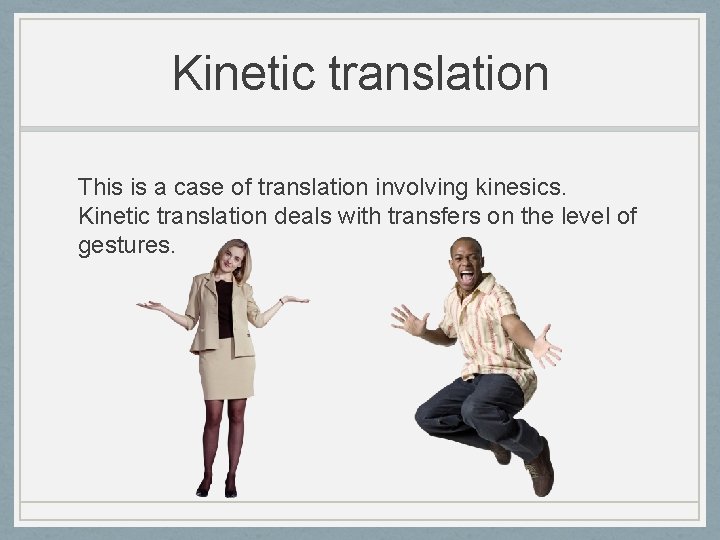
Kinetic translation This is a case of translation involving kinesics. Kinetic translation deals with transfers on the level of gestures.
How Kinetic Translation Works The translation of gestures is done by scanning the body language or gestures of one’s interlocutor and transferring the images directly into one’s mind where they are subconsciously or consciously interpreted. Morris et al. (1979): kinetic translation can be conscious or unconscious: some gestures are individual and idiosyncratic and made unconsciously like beating time to one’s words while speaking; some gestures are culturally determined like winking and shaking one’s fingers as if having touched something hot in a silent conversation between two men after they saw a woman pass by.
In the PS, it has long been realized that cultures differ in their kinesics. Therefore travellers may be advised to be prepared to interpret (=translate) the kinetic communication of different peoples which can use unfamiliar gestures or use familiar gestures not in the same way the travellers are accustomed to in their home countries.
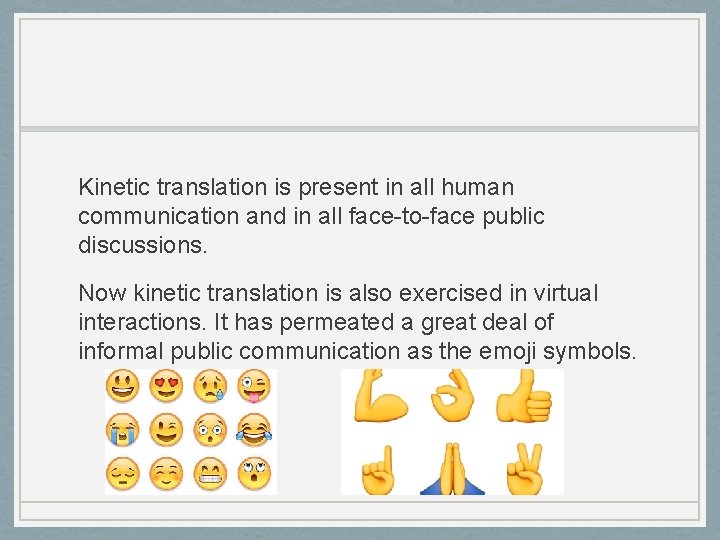
Kinetic translation is present in all human communication and in all face-to-face public discussions. Now kinetic translation is also exercised in virtual interactions. It has permeated a great deal of informal public communication as the emoji symbols.
Intralingual translation otherwise referred to as re-wording handles transfers within one verbal language. It is one of the commonest types of intracultural translation. Participants retell and reword constantly when they explain their own or others’ ideas; they use words of the same language in order to make other words clear and by doing so they clarify or sometimes perhaps, on the contrary, they obfuscate what has already been said in other words.
Intralingual Translation Il’ia Mil’shtein, a well-known Russian journalist, started one of his blog posts about the military unrest in the east of Ukraine with his intralingual translation, within the Russian language. He intralingually translated the Russian Press Secretary Dmitrii Peskov’s dismissal of criticisms of Russia for stationing three of its motorized rifle divisions near the Ukrainian border in July 2017. Mil’shtein’s text read as follows: “Translated from the Press. Secretarian [language] into Russian, [Peskov’s] phrase means ‘none of your damn business’ [ne vashe sobach’e delo]. ” Mil’shtein explained that he sensed irritation in the Press Secretary’s comment, which he made plain in his version of Peskov’s officialise. https: //snob. ru/selected/entry/127303? utm_source=push&utm_me dium=push_notification&utm_campaign=breaking&utm_content=c ollumn (accessed 19 September, 2017).
Another axis of intralingual translation is between the professional and common domains of a language. For instance, the word ‘hack’ and its derivatives, which only recently was known exclusively to hackers themselves and perhaps to those hunting them, is still a new arrival to the common vocabulary. Therefore some feel that the term still requires translation. Bradley Mitchell translated the term and its derivatives as follows:
In computer networking, hacking is any technical effort to manipulate the normal behavior of network connections and connected systems. A hacker is any person engaged in hacking. The term hacking historically referred to constructive, clever technical work that was not necessarily related to computer systems. Today, however, hacking and hackers are most commonly associated with malicious programming attacks on networks and computers over the Internet. (https: //www. lifewire. com/definitionof-hacking-817991; accessed 19 September, 2017)

intralingual translation may be offered because the speaker thinks that his/her interlocutors may not or do not understand what s/he says. Another scenario is when intralingual translation is solicited by such phrases (in English) as ‘What do you mean? ’ or ‘What is X? ’.
Interlingual translation or translation proper, is the transfer between two or more languages. In TS, interlingual translation is by far the most studied type of translation. Interlingual translation is a necessary component of transfers across linguistic boundaries. Paradoxically, there is little mention of translation in the publications on PS
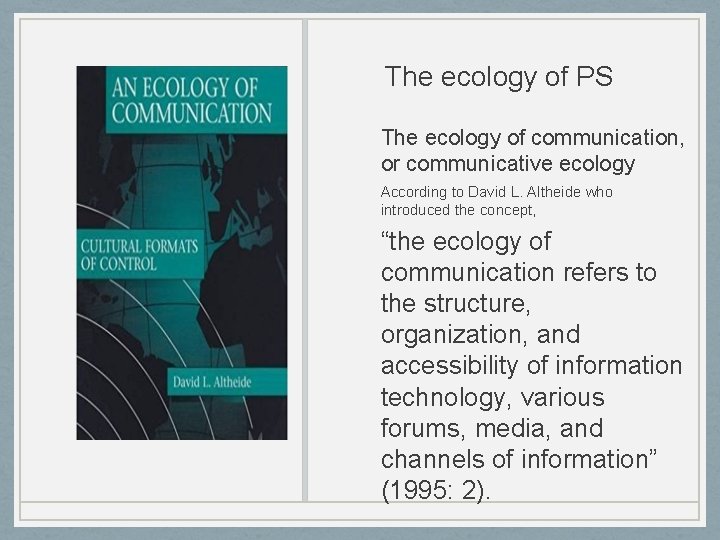
The ecology of PS The ecology of communication, or communicative ecology According to David L. Altheide who introduced the concept, “the ecology of communication refers to the structure, organization, and accessibility of information technology, various forums, media, and channels of information” (1995: 2).
ECOLOGY The term ‘ecology’ comes from Greek eco-, or oikos, ‘house’ + logos, ‘word’ and, in a broader sense, ‘study’ or ‘science’, cf. sociology, psychology, geology etc.

In biology: ‘ecology’ = the living world not as a collection of individual species but as an entirety of crossspecies’ relations and the environment in which they exist. The focus: COLLECTIVITY AND MUTUALITY in a particular habitat with its unique dynamics of relationships between different species belonging both to flora and fauna and taking into account local climatic phenomena.
The concept of ecology, when applied to studies of inter-human communication, strives for wide-angle lenses to fit in as much of the social background as possible. Communicative ecology studies human interactions in all their forms and those forms’ links, ties and bonds, whether in an intimate tête-à-tête or in a technologically mediated long distance videoconference:

The concept of ecology, when applied to studies of interhuman communication, strives for wide-angle lenses to fit in as much of the social background as possible. Communicative ecology studies human interactions in all their forms and those forms’ links, ties and bonds, whether in an intimate tête-àtête or in a technologically mediated long distance videoconference.
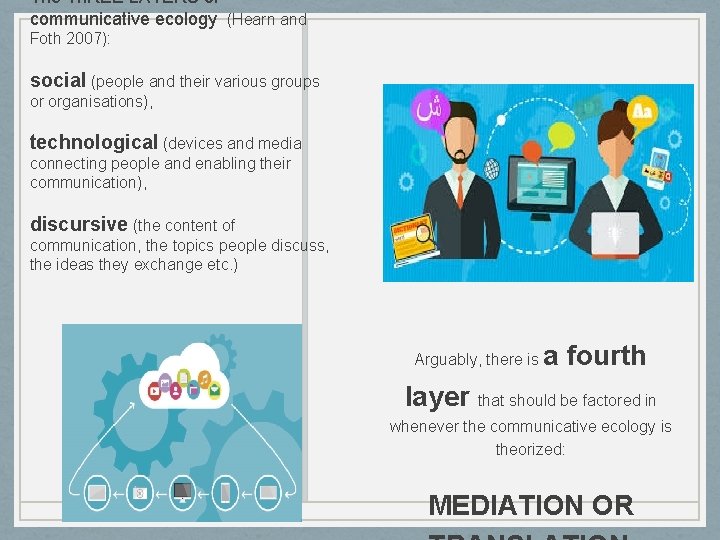
The Th. REE LAYERS of communicative ecology (Hearn and Foth 2007): social (people and their various groups or organisations), technological (devices and media connecting people and enabling their communication), discursive (the content of communication, the topics people discuss, the ideas they exchange etc. ) Arguably, there is a fourth layer that should be factored in whenever the communicative ecology is theorized: MEDIATION OR
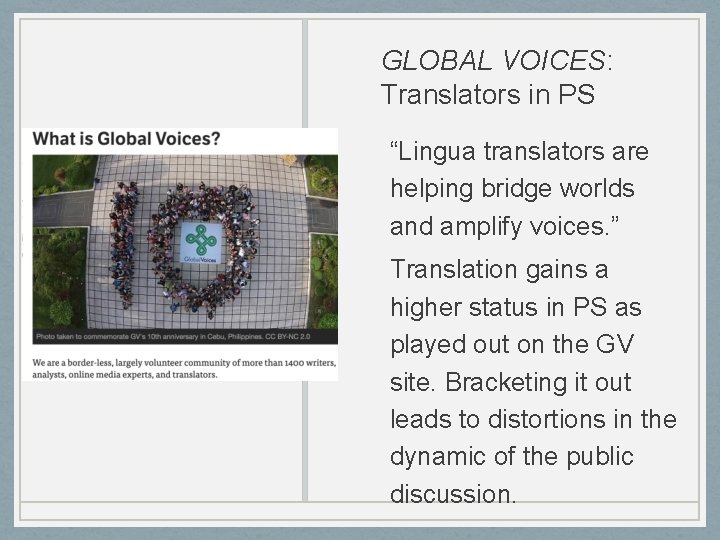
GLOBAL VOICES: Translators in PS “Lingua translators are helping bridge worlds and amplify voices. ” Translation gains a higher status in PS as played out on the GV site. Bracketing it out leads to distortions in the dynamic of the public discussion.

As technology affects communication, its formats and its contents (Altheide 1995), translation also affects the social realm in general and PS in particular. Translators can choose the texts they translate => translators influence the configuration of the pool of topics discussed in the globalized blogosphere. Different blogs are translated into more or fewer languages and thereby are made more or less visible in PS.
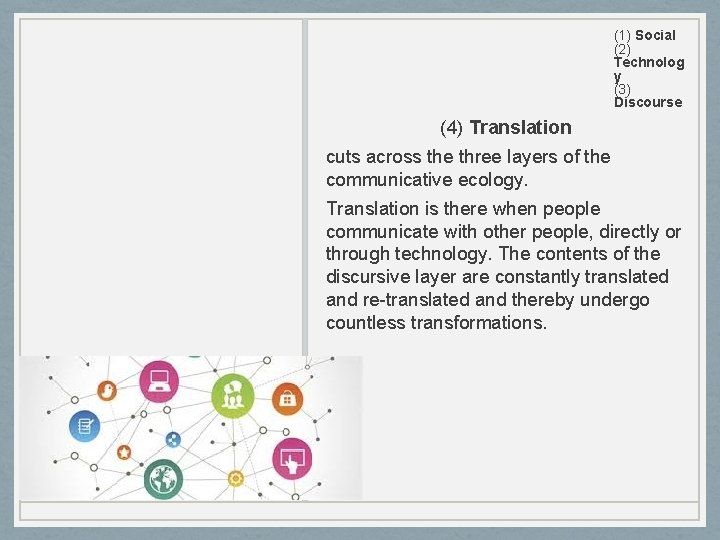
(1) Social (2) Technolog y (3) Discourse (4) Translation cuts across the three layers of the communicative ecology. Translation is there when people communicate with other people, directly or through technology. The contents of the discursive layer are constantly translated and re-translated and thereby undergo countless transformations.
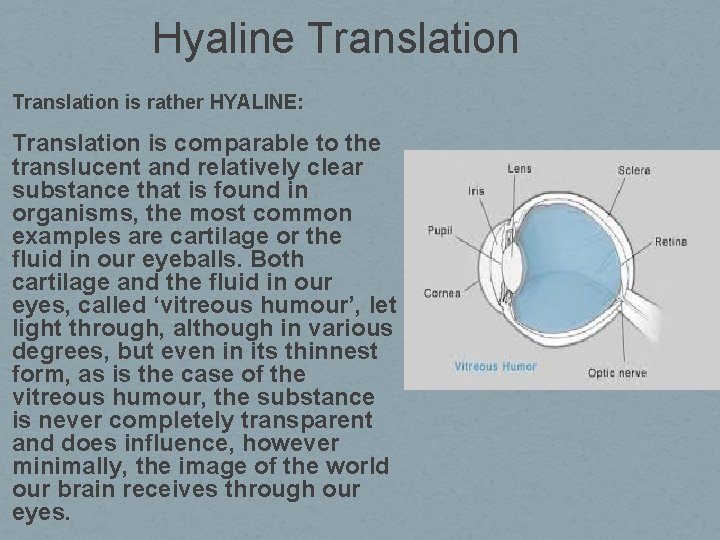
Hyaline Translation is rather HYALINE: Translation is comparable to the translucent and relatively clear substance that is found in organisms, the most common examples are cartilage or the fluid in our eyeballs. Both cartilage and the fluid in our eyes, called ‘vitreous humour’, let light through, although in various degrees, but even in its thinnest form, as is the case of the vitreous humour, the substance is never completely transparent and does influence, however minimally, the image of the world our brain receives through our eyes.
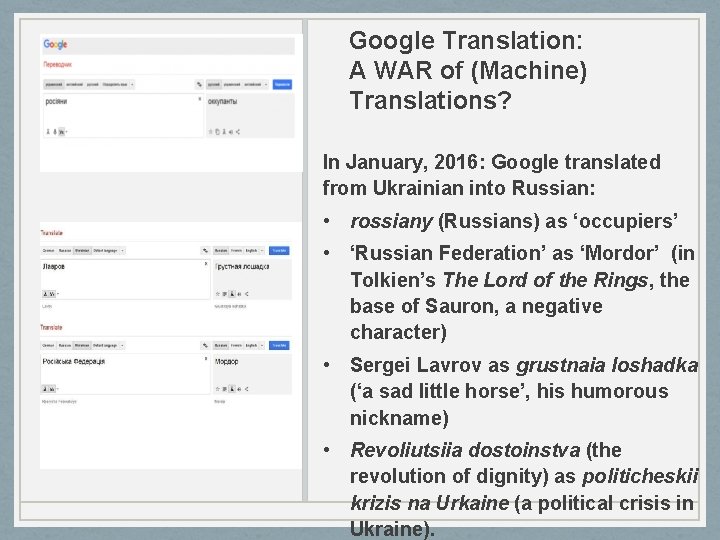
Google Translation: A WAR of (Machine) Translations? In January, 2016: Google translated from Ukrainian into Russian: • rossiany (Russians) as ‘occupiers’ • ‘Russian Federation’ as ‘Mordor’ (in Tolkien’s The Lord of the Rings, the base of Sauron, a negative character) • Sergei Lavrov as grustnaia loshadka (‘a sad little horse’, his humorous nickname) • Revoliutsiia dostoinstva (the revolution of dignity) as politicheskii krizis na Urkaine (a political crisis in Ukraine).
Translation in the PS Literature There is little, if anything, said on the problem of translation. Debate is not linked to translation, yet PS presupposes a dialogue/compromise which is impossible without translation as the mediating agent.
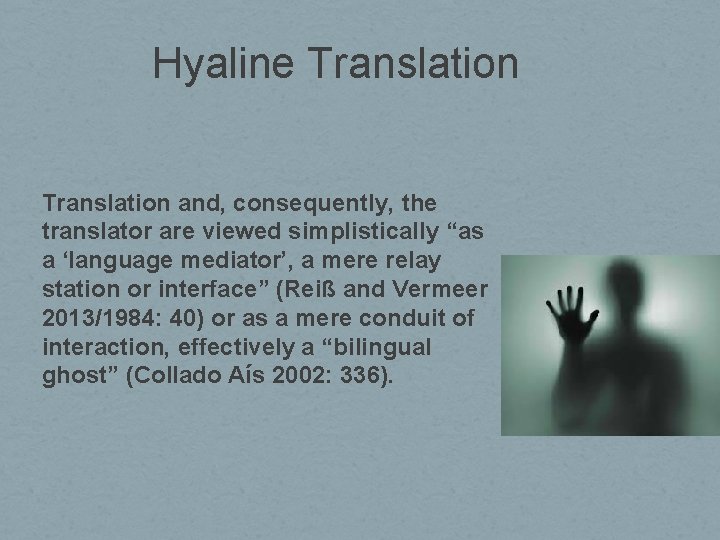
Hyaline Translation and, consequently, the translator are viewed simplistically “as a ‘language mediator’, a mere relay station or interface” (Reiß and Vermeer 2013/1984: 40) or as a mere conduit of interaction, effectively a “bilingual ghost” (Collado Aís 2002: 336).
Conclusion All types of translation (NOT ONLY INTERLINGUAL) should be studied in PS to learn new aspects of its social functioning and to systematize the known ones. To problematize PS theories by factoring in translation as an active social agent: Translation is a social activity Translators are social beings Translation is a hyaline social boundary phenomenon whose ‘density’ depends on the properties of the message mediated and on the goal(s) of the message.
Translation Broadly Conceived Sergey Tyulenev Durham University, UK sergey. tyulenev@durham. ac. uk Personal website www. tyulenev. org
- Slides: 33