
Translation and the Genetic Code A Amino Acid
- Slides: 26
Translation and the Genetic Code A. Amino Acid and Protein Structure B. Formation of Aminoacyl t. RNAs C. Ribosome structure D. Stages of Translation E. Relationship between DNA, m. RNA, and Protein Sequences
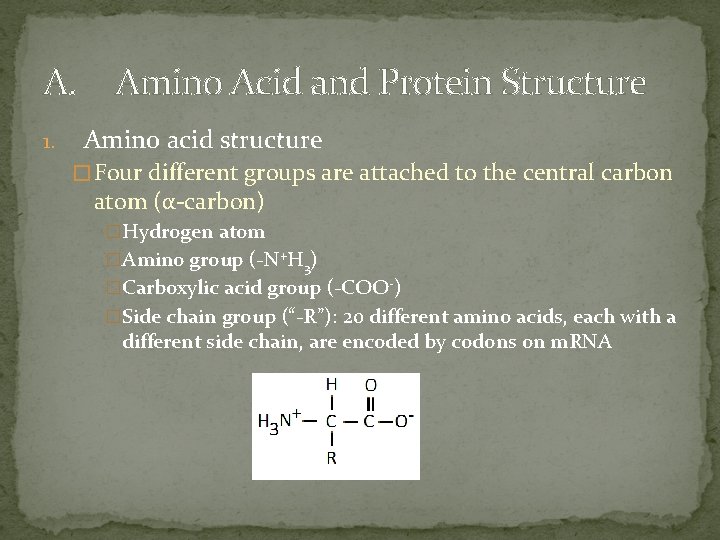
A. Amino Acid and Protein Structure 1. Amino acid structure � Four different groups are attached to the central carbon atom (α-carbon) �Hydrogen atom �Amino group (-N+H 3) �Carboxylic acid group (-COO-) �Side chain group (“-R”): 20 different amino acids, each with a different side chain, are encoded by codons on m. RNA
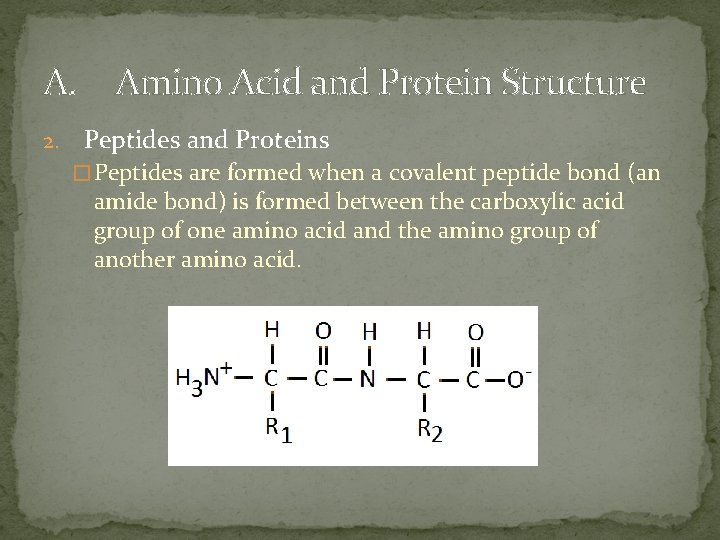
A. Amino Acid and Protein Structure 2. Peptides and Proteins � Peptides are formed when a covalent peptide bond (an amide bond) is formed between the carboxylic acid group of one amino acid and the amino group of another amino acid.
A. Amino Acid and Protein Structure 2. … � Proteins are long peptides, over 50 amino acids long and typically much longer (in the low 100 s), and typically associated with some biological function � The peptide chain of a protein folds into a specific three -dimensional shape necessary for the activity of the protein. � The folding of the protein, and the chemistry of the protein’s active site, are dependent on the amino acid sequence of the protein.
B. Formation of Aminoacyl t. RNAs Amino acids are covalently attached to the 3’ end of the appropriate t. RNAs. This is called the acceptor end. 2. The anticodon is a 3 -base sequence on the anticodon loop of the t. RNA. It is complementary to the sequence of the codon on the m. RNA. The 5’ position is referred to as the “wobble base, ” meaning that it may pair up with more that one partner. 3. The reaction is catalyzed by an aminoacyl t. RNA synthase. Each t. RNA has its own specific synthase enzyme. 1.
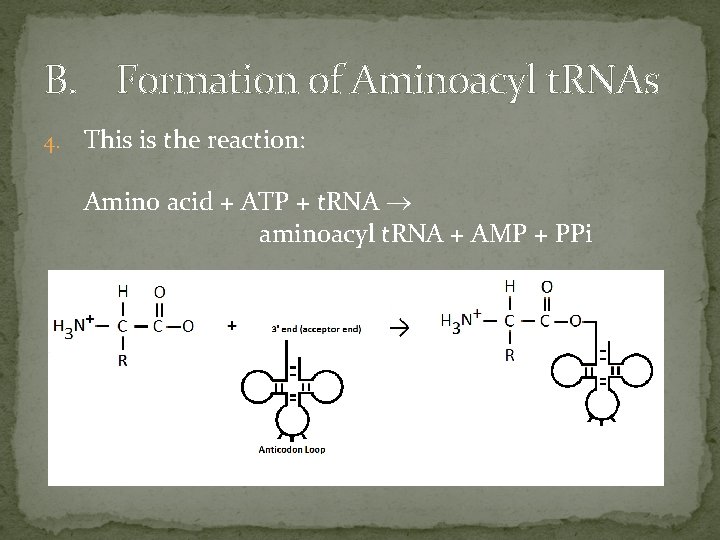
B. Formation of Aminoacyl t. RNAs 4. This is the reaction: Amino acid + ATP + t. RNA aminoacyl t. RNA + AMP + PPi
B. Formation of Aminoacyl t. RNAs 5. t. RNA has a distinctive 3 -D structure, described as a “cloverleaf, ” with hairpin loops and nonstandard bases http: //en. wikipedia. org/wiki/Transfer_RNA
C. Ribosome Structure 1. Prokaryotic ribosomes � Large subunit: 50 S � Small subunit: 30 S � Total size: 70 S 2. Eukaryotic ribosomes � Large subunit: 60 S � Small subunit: 40 S � Total size: 80 S http: //en. wikipedia. org/wiki/Ribosome
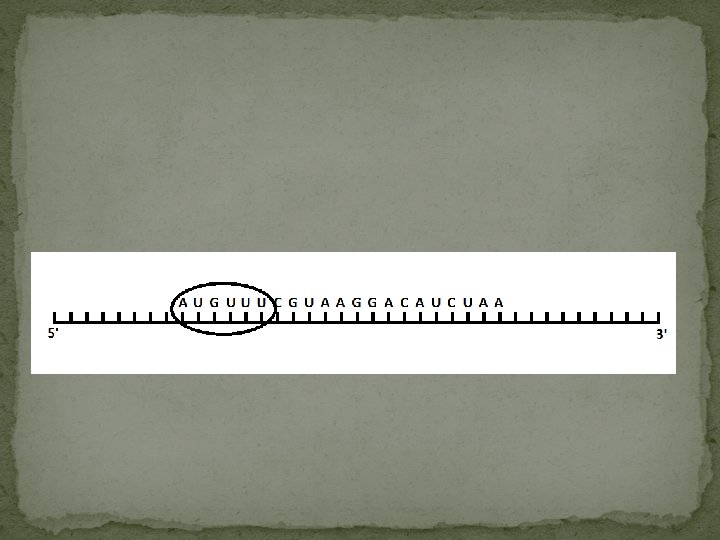
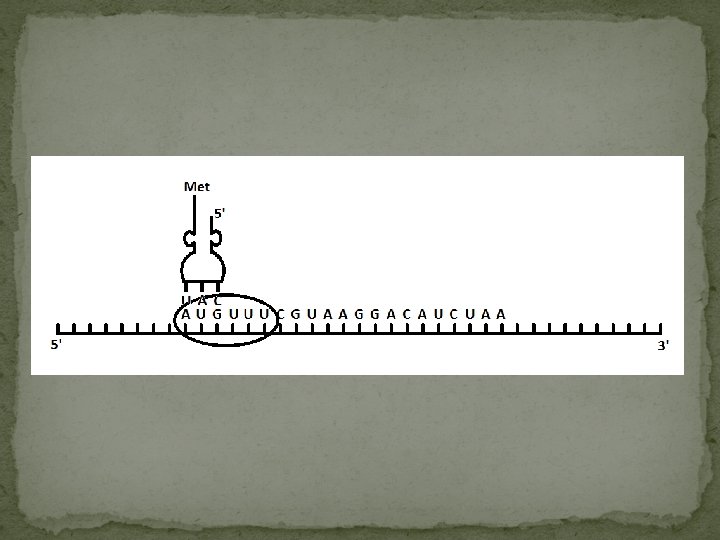
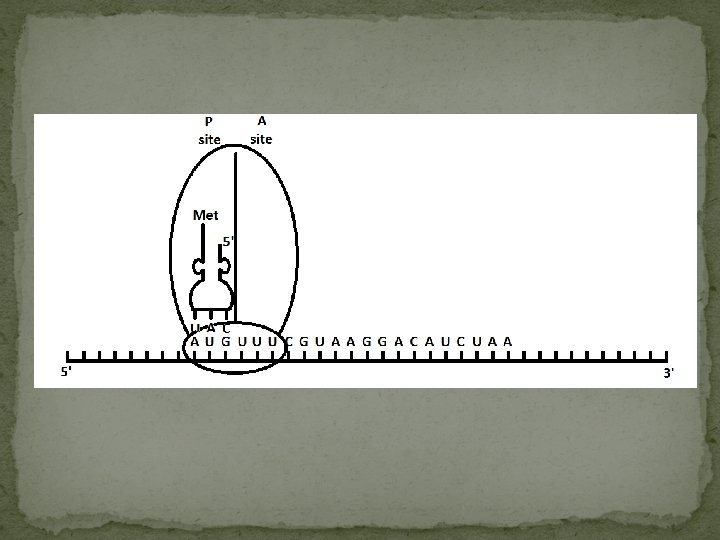
D. Stages of Translation 1. Initiation Requires the aid of initiation factor proteins b. The small ribosome subunit binds to the 5’ end of m. RNA. The proper orientation is believed to be established by a sequence in the leader region called the Shine-Dalgarno sequence (in prokaryotes) or similar sequences. c. An initiation codon (AUG) is oriented on the small ribosome subunit. AUG is the codon for the amino acid methionine. Please note: Sequences on m. RNA are listed, by convention, in the 5’ 3’ direction a.
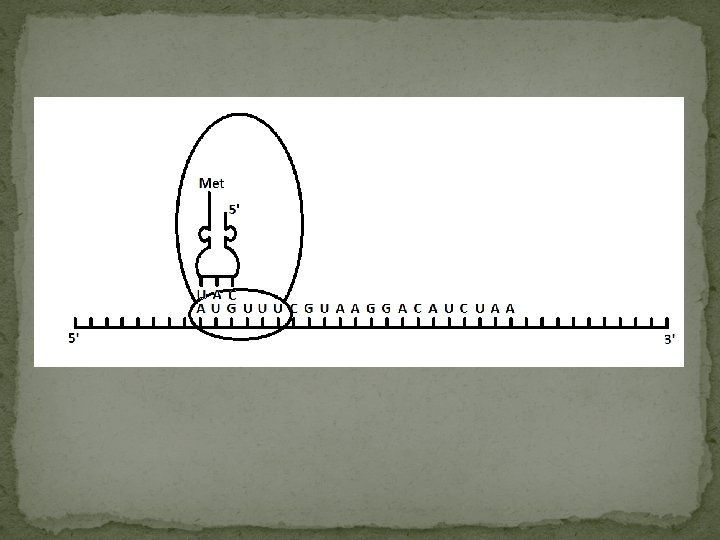
D. Stages of Translation 1. … A molecule of methionyl t. RNA (met-t. RNA) binds to the initiation codon through codon-anticodon base pairing. This step requires GTP as an energy source. e. The large subunit binds to the small subunit to complete the initiation complex. All initiation factors are released. f. Some interesting facts: d. � � � In prokaryotes, the methionine on the initiating methionyl t. RNA is formylated (f-met-t. RNA). In eukaryotes, it is not. Not every AUG codon can be an initiation codon. Sequences in the m. RNA leader seem to indicate which AUG codons are initiation codons. The initial methionine may be removed after translation (posttranslational modification), so not every protein begins with a methionine.
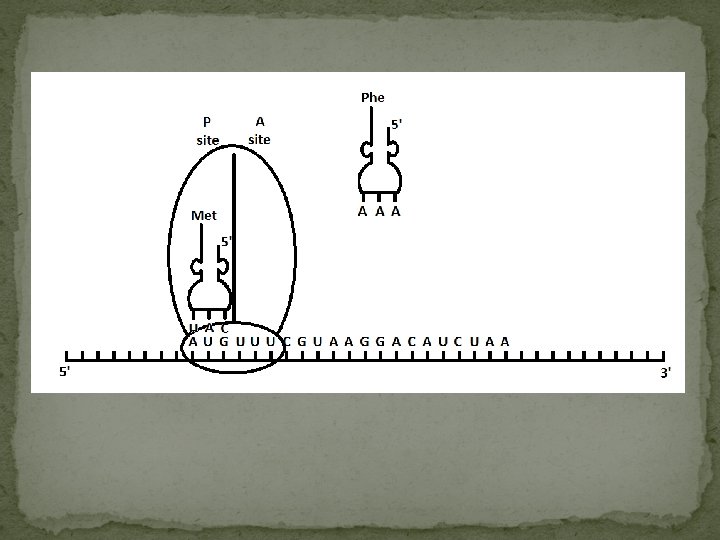
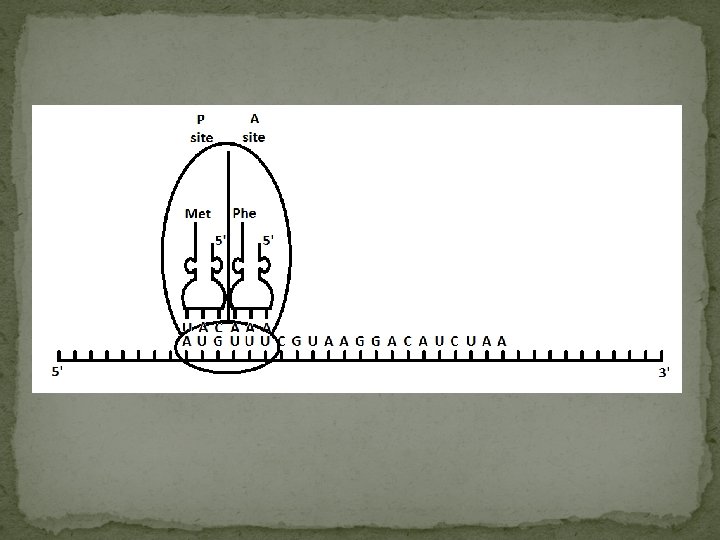
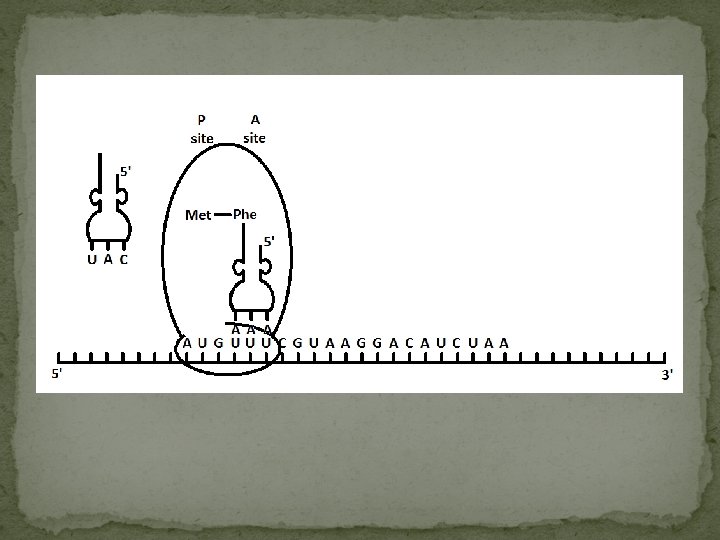
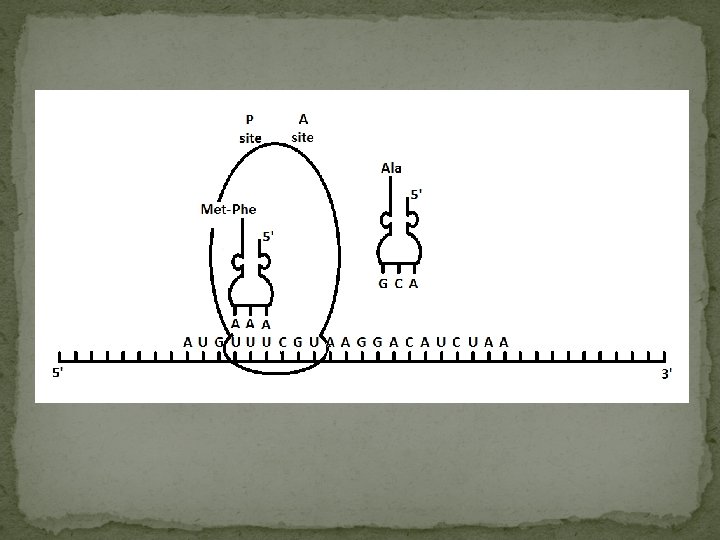
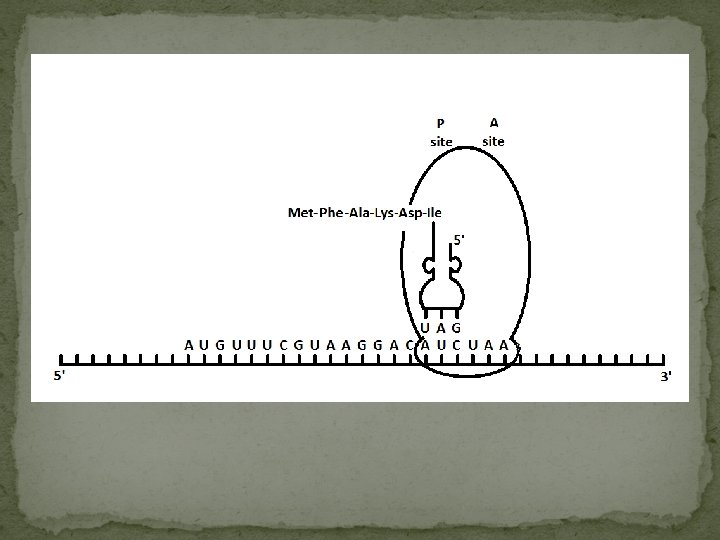
D. Stages of Translation 2. Elongation a. The ribosome/m. RNA complex has two sites: the P site (to which the growing peptide chain is attached) and the A site (where the next aminoacyl t. RNA binds). At the beginning of elongation, the met-t. RNA occupies the P site. The A site is ready to receive the next aminoacyl t. RNA. b. The next aminoacyl t. RNA binds to the ribosome/m. RNA complex at the A site. c. An enzyme activity in the ribosome, peptidyl transferase, forms a peptide bond between the carboxyl end of the growing peptide (on the P site) and the amino end of the next amino acid (on the A site).
D. Stages of Translation 2. … d. The t. RNA on the P site, no longer attached to an amino acid, is released. e. Another enzyme activity in the ribosome, called translocase, moves the ribosome so that the peptidyl t. RNA is transferred from the A site to the P site. This process requires a GTP molecule as an energy source. f. Now the A site is ready to accept the next aminoacyl t. RNA.
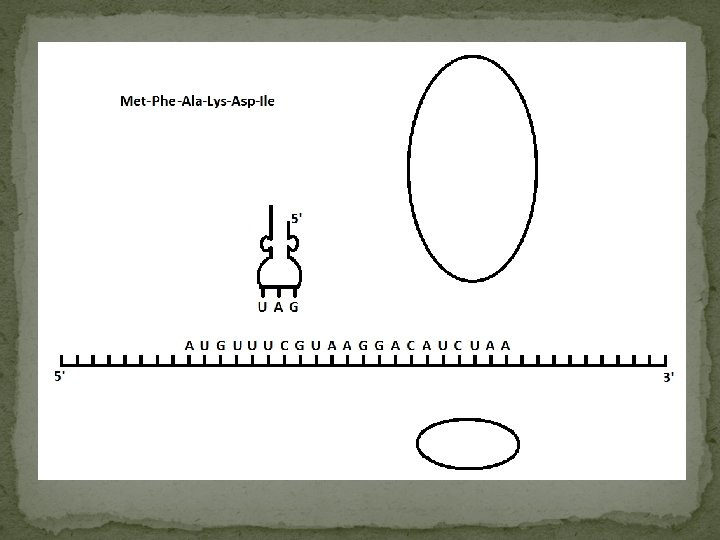
D. Stages of Translation 3. Termination a. When the ribosome encounters a termination codon on the m. RNA (UAA, UAG, or UGA), elongation ceases. b. Termination factors cause the ribosome, t. RNA, and m. RNA to dissociate from the nascent protein chain.
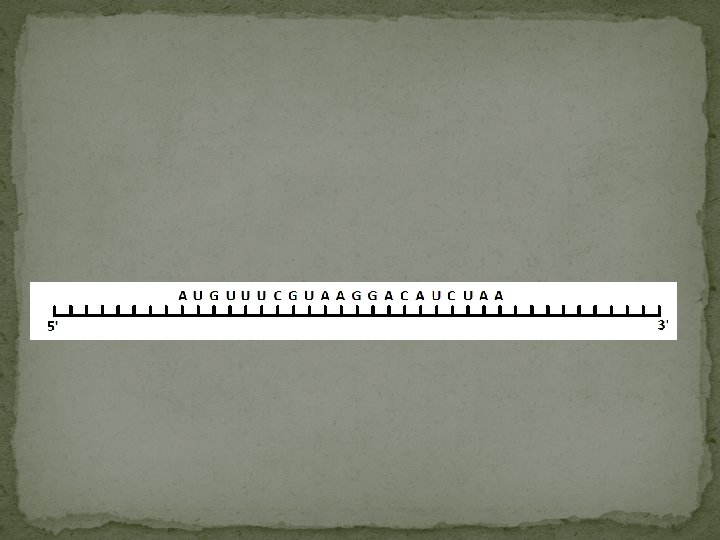
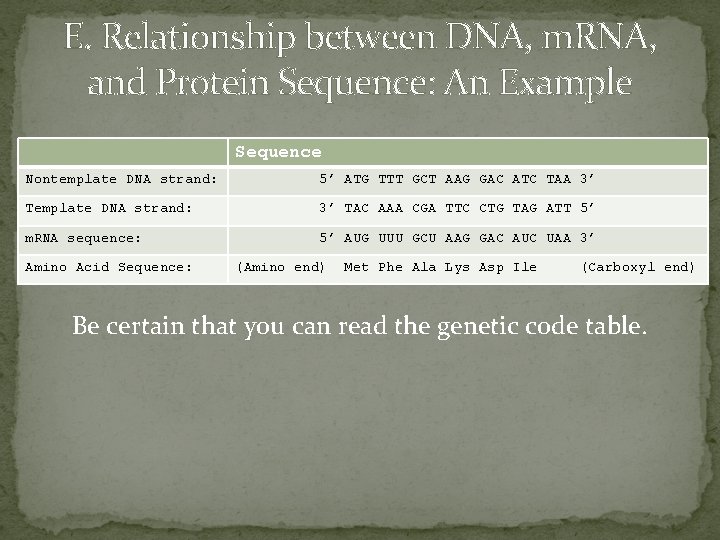
E. Relationship between DNA, m. RNA, and Protein Sequence: An Example Sequence Nontemplate DNA strand: 5’ ATG TTT GCT AAG GAC ATC TAA 3’ Template DNA strand: 3’ TAC AAA CGA TTC CTG TAG ATT 5’ m. RNA sequence: 5’ AUG UUU GCU AAG GAC AUC UAA 3’ Amino Acid Sequence: (Amino end) Met Phe Ala Lys Asp Ile (Carboxyl end) Be certain that you can read the genetic code table.
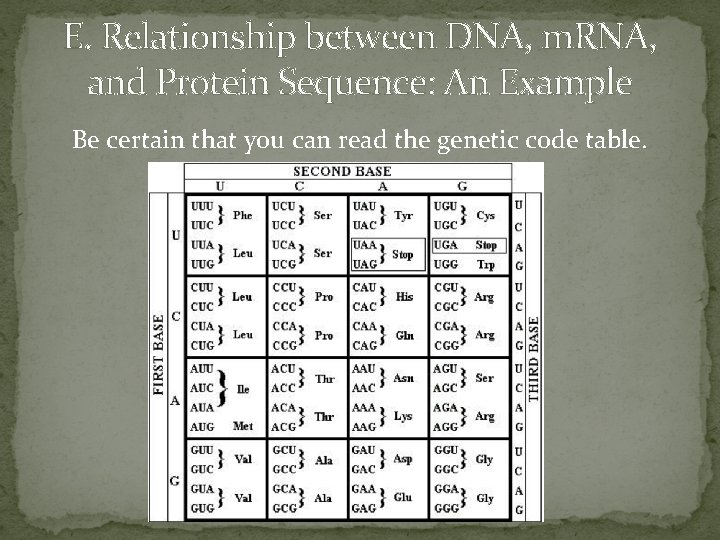
E. Relationship between DNA, m. RNA, and Protein Sequence: An Example Be certain that you can read the genetic code table.