
TRANSLATION 6 Genre and translation 2 content form
- Slides: 28
TRANSLATION 6. Genre and translation 2: content, form, context, culture Lingua Inglese 2 LM
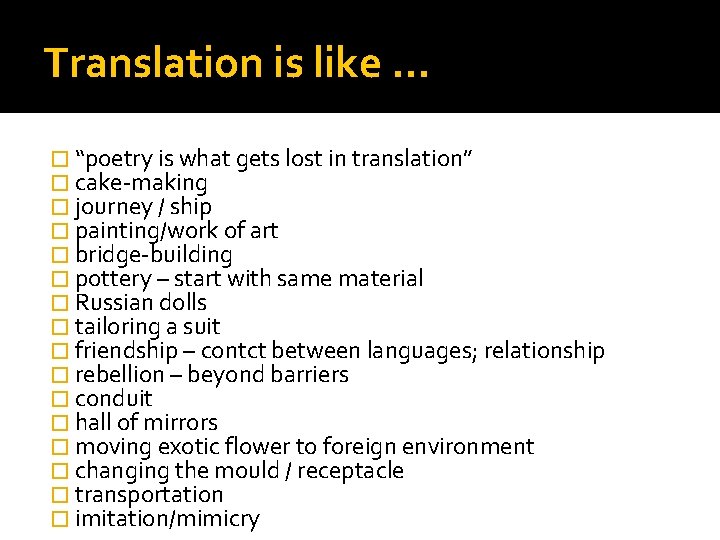
Translation is like … � “poetry is what gets lost in translation” � cake-making � journey / ship � painting/work of art � bridge-building � pottery – start with same material � Russian dolls � tailoring a suit � friendship – contct between languages; relationship � rebellion – beyond barriers � conduit � hall of mirrors � moving exotic flower to foreign environment � changing the mould / receptacle � transportation � imitation/mimicry
Translation practice lessons � 2 lessons per week x 5 weeks from November �Timetable next week �Translation resources lesson next week
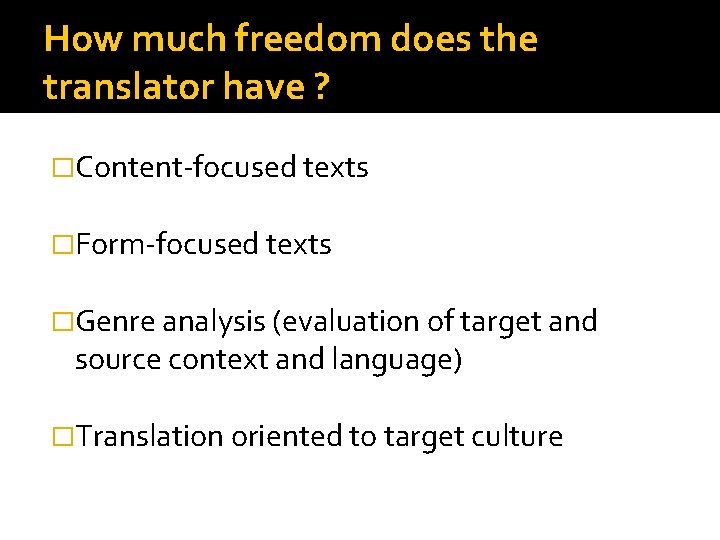
How much freedom does the translator have ? �Content-focused texts �Form-focused texts �Genre analysis (evaluation of target and source context and language) �Translation oriented to target culture
Content-focused text Examples of ‘content-focused’ text: � press-release and comments, news reports, commercial correspondence, inventories of merchandise, operating instructions, directions for use, patent specifications, treaties, official documents, educational works, non-fiction books of all sorts, essays, treatises, reports, theses, and specialized literature in the humanities, the natural sciences and other technical fields.
Translating content-focused texts �When you are translating content-focused texts, which idiom should be dominant – the idiom of the source text or the idiom of the target text?
Translation of content-focused text Content-focused texts require invariance in translation of their content. Content and information needs to be fully represented in the target language. This primary requirement demands that the linguistic form of the translation be adapted without reservation to the idiom of the target language. The target language must dominate, because in this type of text the informational content is most important and the reader of the translation needs to have it presented in a familiar linguistic form. � When you are translating content-based texts, use the modern idiom of the TL
Form-focused text Examples of ‘form-focused text: �literary prose (essays, biographies, belles- lettres), imaginative prose, (anecdotes, short stories, novellas, romances), and poetry in all its forms (from the didactic to balladry to the purely sentimental).
Translating form-focused texts �When you are translating form-focused texts, which idiom should be dominant – the idiom of the source text or the idiom of the target text?
Translating form-focused text While these forms all serve to convey some content, they lose their individual character if the original author’s external or inner forms are not preserved in translation, whether in their poetic norms, their style, or their artistic structure. . in a form-focused text the translator will not mimic the forms of the source language, but rather appreciate the form of the source language and be inspired by it to discover an analogous form in the target language, one which will elicit a similar response in the reader. For this reason we characterize form- focused texts as source language oriented.
Mixed focus - form and content �Form-focus texts based on appeal/persuasion advertising, publicity, preaching, propaganda, polemic, demagogy, satire These texts have a mixture of content-focus (information) and form-focus (appeal/persuasion)
Form-focused (source idiom dominant) or content-focused (target idiom dominant) ? Do these metaphors have an orientation towards the source text or the target text? �a conduit �hall of mirrors �gardening �transportation across a river �collaboration with writer + imitation/mimicry
Context ‘A context is a psychological construct, a subset of the hearer’s assumptions about the world, that affect the interpretation of an utterance. A context in this sense is not limited to information about the immediate physical environment or the immediately preceding utterances: expectations about the future, scientific hypotheses or religious beliefs, anecdotal memories, general cultural assumptions, beliefs about the mental state of the speaker, may all play a role in interpretation. ’ (Sperber &Wilson, 1995: 15 -16)
Be specific about context � “The more specifically we can characterize thecontext of situation, the more specifically we can predict the properties of a text in that situation. If we merely name the subject matter, or the medium, it will tell us very little; we could talk of a “register of marine biology” or a “newspaper register”, but this hardly enables us to say anything of interest about the types of text in question. ’(Halliday & Hasan, 1976: 22) � Genre analysis of medium, source, readership, communicative purpose is a good way to define context
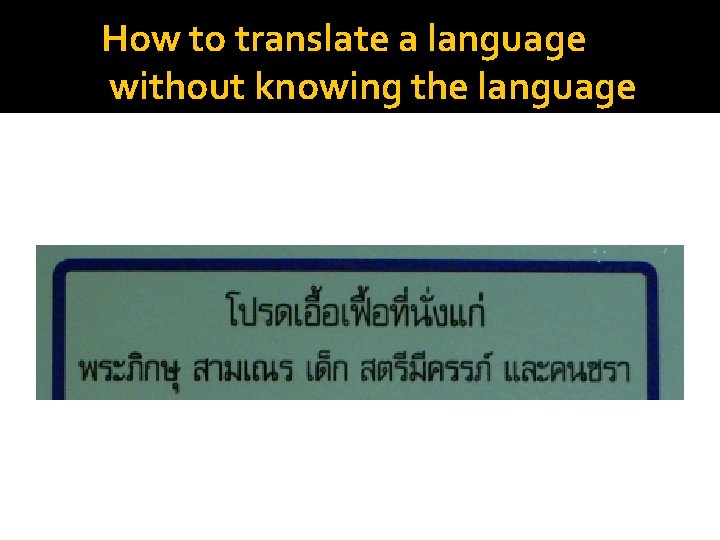
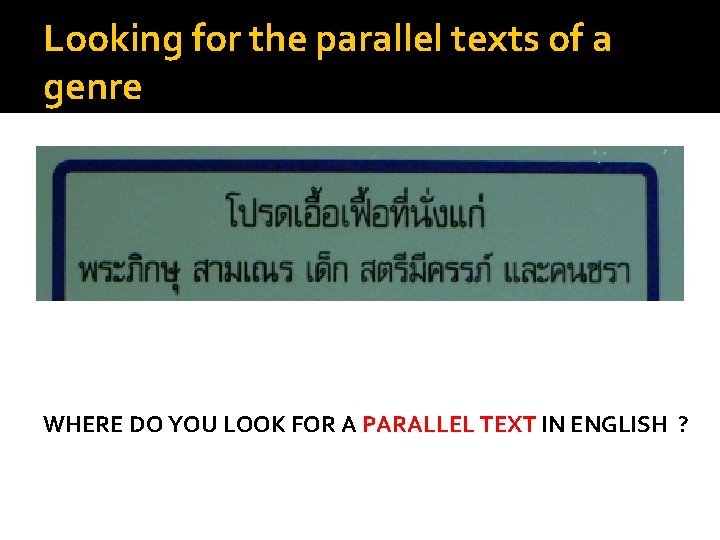
How to translate a language without knowing the language
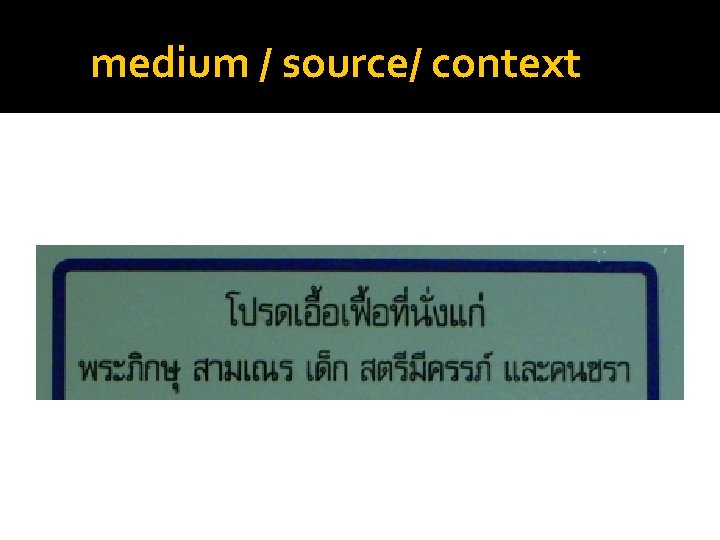
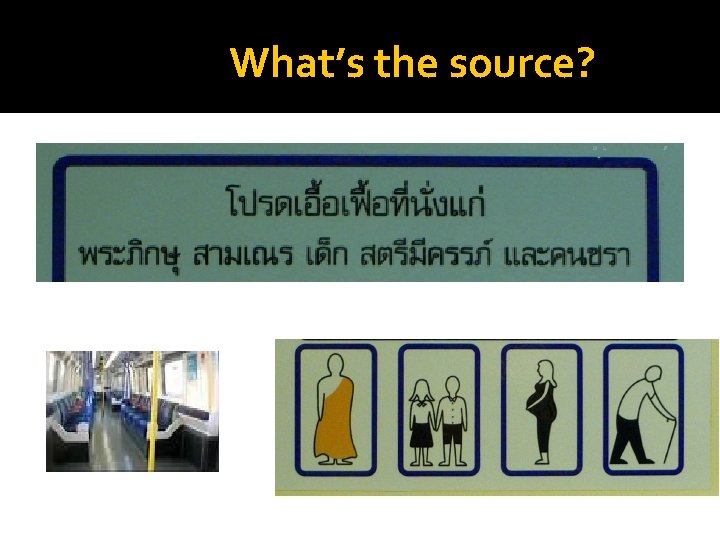
medium / source/ context
What’s the source?
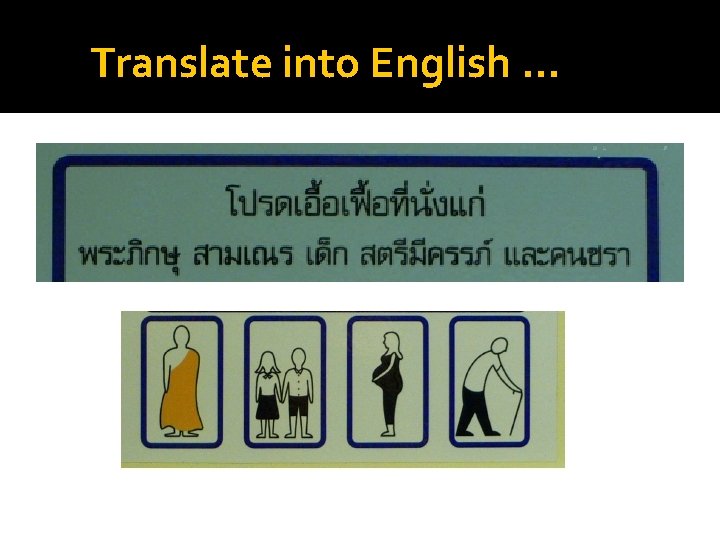
Translate into English …
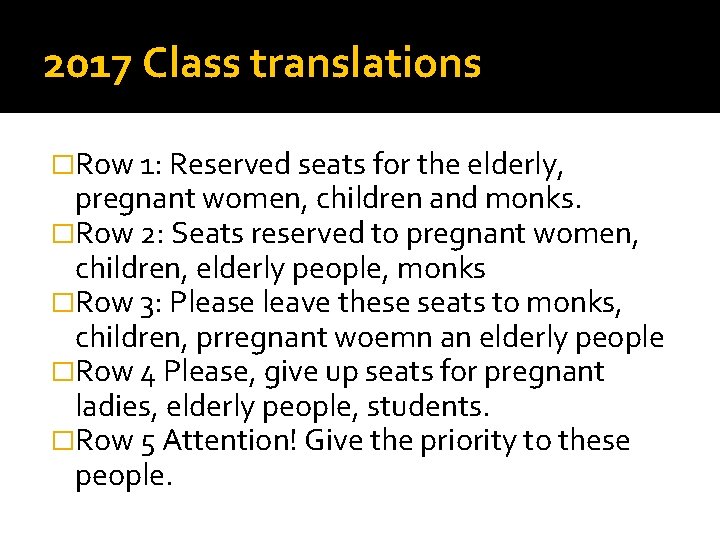
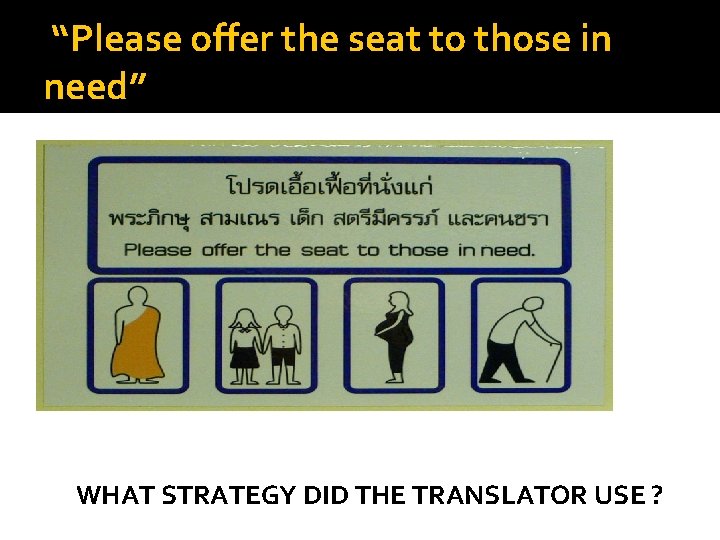
2017 Class translations �Row 1: Reserved seats for the elderly, pregnant women, children and monks. �Row 2: Seats reserved to pregnant women, children, elderly people, monks �Row 3: Please leave these seats to monks, children, prregnant woemn an elderly people �Row 4 Please, give up seats for pregnant ladies, elderly people, students. �Row 5 Attention! Give the priority to these people.
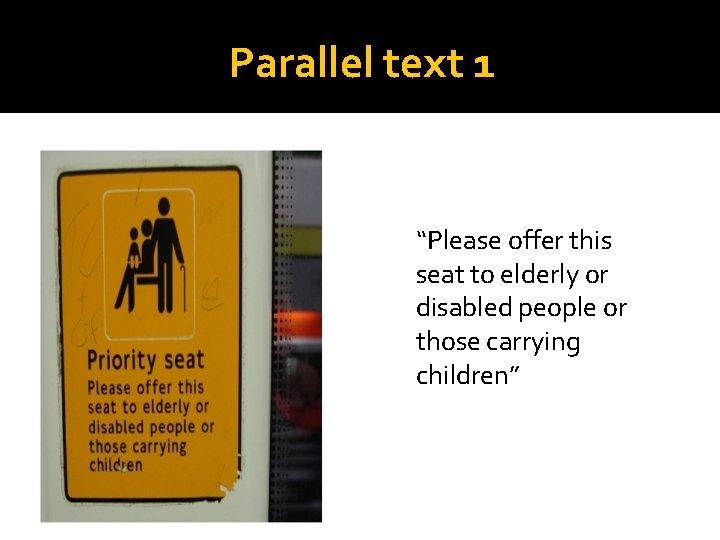
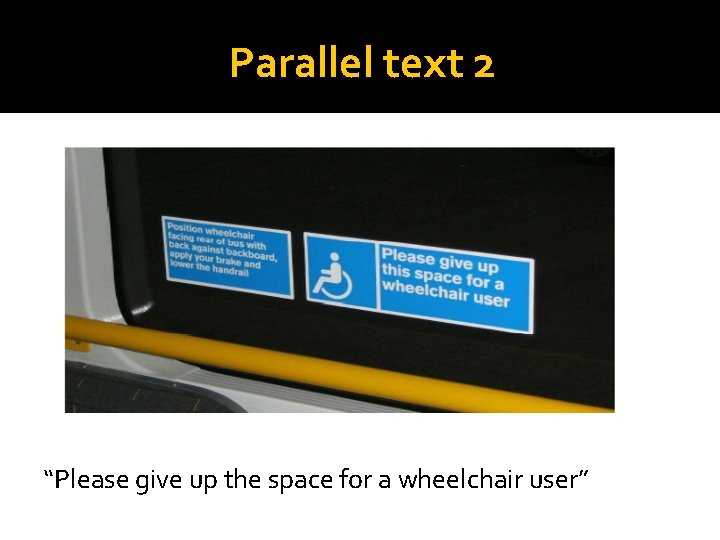
Procedure for translation �Find other exemplars of the genre in the TT �These are known as parallel texts �Do a quick genre analysis of the texts (lexis, grammar, organisation etc. ) �Decide on your translation
Looking for the parallel texts of a genre WHERE DO YOU LOOK FOR A PARALLEL TEXT IN ENGLISH ?
Parallel text 1 “Please offer this seat to elderly or disabled people or those carrying children”
Parallel text 2 “Please give up the space for a wheelchair user”
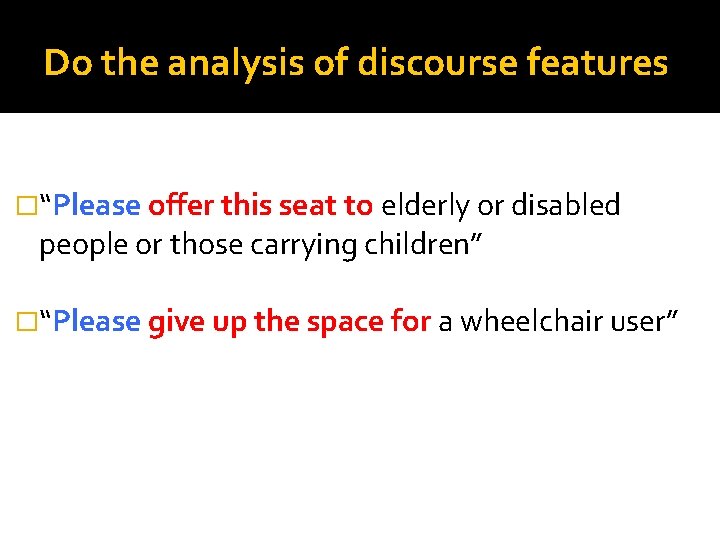
Do the analysis of discourse features �“Please offer this seat to elderly or disabled people or those carrying children” �“Please give up the space for a wheelchair user”
“Please offer the seat to those in need” WHAT STRATEGY DID THE TRANSLATOR USE ?
Translator has to evaluate what is relevant according to context ‘A “good” translation is a text which is a translation (i. e. is equivalent) in respect of those linguistic features which are most relevant in the given translation context. ’ (Halliday, 2001: 17) �The translator has to evaluate what is relevant according to context
Evaluate the target context/culture � ‘‘As its name implies, the source text is oriented towards, and is in any case bound to, the source culture. � The target text, the translatum, is oriented towards the target culture, and it is this which ultimately defines its adequacy. � It therefore follows that source and target texts may diverge from each other quite considerably, not only in the formulation and distribution of the content but also as regards the goals which are set for each, and in terms of which the arrangement of the content is in fact determined. (Vermeer, 1989, in Venuti (Ed. ), 2004)
How much freedom does the translator have ? Quite a lot � Content-focused texts – even when a translation is focused on content you can still translate by paraphrase. The important thing is the equivalent message � Form-focused texts – here the translator is free to experiment with form because content/message is less important � Genre analysis (evaluation of target and source context and language) � Translation needs to be oriented to target culture