
Translating Linear Temporal Logic into Bchi Automata Presented
Translating Linear Temporal Logic into Büchi Automata Presented by Choi, Chang-Beom
Content • Overview – Linear Temporal Logic – Büchi Automata • Translating LTL formula into Büchi Automata – Local Automaton – Eventuality Automaton – Model Automata • Further Study • Reference Translating LTL into Büchi Automata, Chang-Beom Choi, Provable Software Lab, KAIST 2/42
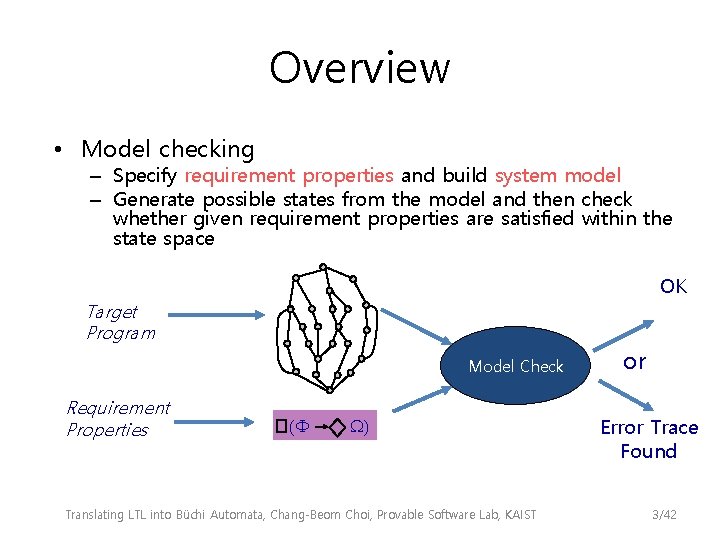
Overview • Model checking – Specify requirement properties and build system model – Generate possible states from the model and then check whether given requirement properties are satisfied within the state space OK Target Program Model Check Requirement Properties (F W) Translating LTL into Büchi Automata, Chang-Beom Choi, Provable Software Lab, KAIST or Error Trace Found 3/42
Overview • A process of Model Checking – Modeling • Build a model of program or system – Specification • Describe requirement properties – Verification • Checking that a model of the program or system satisfies a given specification Translating LTL into Büchi Automata, Chang-Beom Choi, Provable Software Lab, KAIST 4/42
Overview • How can we model check of a program or system? – Modeling • Build a Büchi automaton for a given program or system – Specification • Describe requirement properties using Temporal Logic – Verification • Automatically (semi-automatic) Translating LTL into Büchi Automata, Chang-Beom Choi, Provable Software Lab, KAIST 5/42
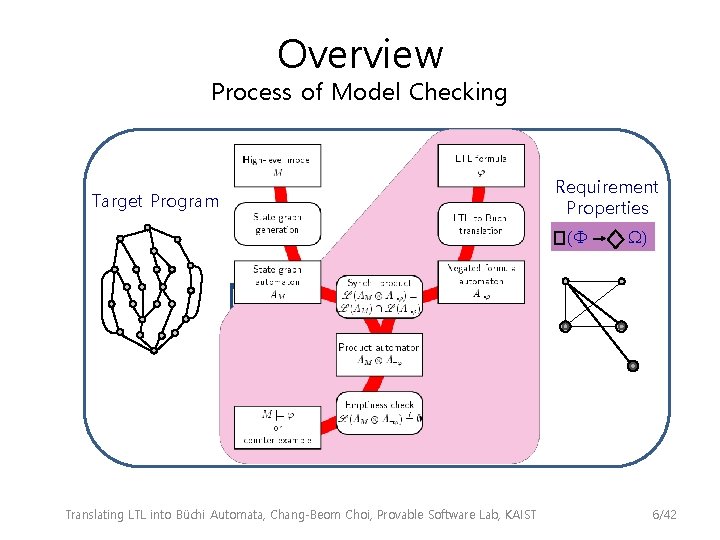
Overview Process of Model Checking Requirement Properties Target Program (F W) Model Checker Translating LTL into Büchi Automata, Chang-Beom Choi, Provable Software Lab, KAIST 6/42
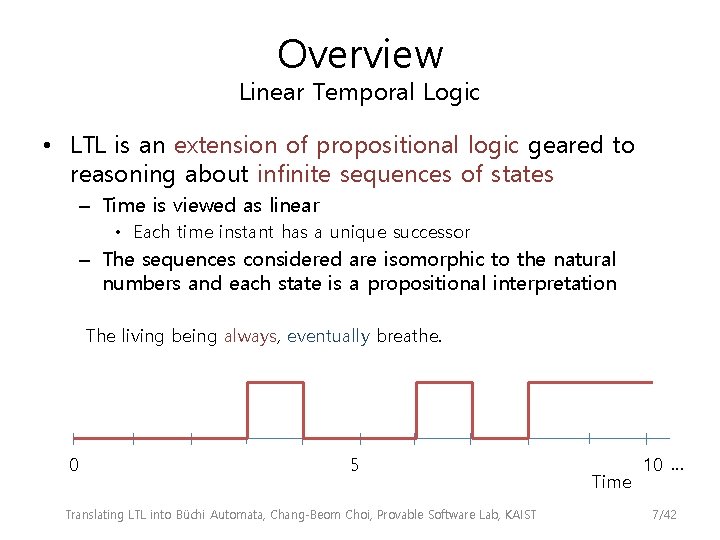
Overview Linear Temporal Logic • LTL is an extension of propositional logic geared to reasoning about infinite sequences of states – Time is viewed as linear • Each time instant has a unique successor – The sequences considered are isomorphic to the natural numbers and each state is a propositional interpretation The living being always, eventually breathe. 0 5 Translating LTL into Büchi Automata, Chang-Beom Choi, Provable Software Lab, KAIST Time 10 … 7/42
Overview Syntax of Linear Temporal Logic • The formulas of linear temporal logic built from a set of atomic propositions P are following – true, false, p, and ¬p, ∀ p ∈P; – φ1 ∧ φ2, and φ1∨ φ2 are LTL formulas; – ○ φ1, φ1 U φ2, and φ1 Ũ φ2 are LTL formulas • Sequence σ = σ[0…] = σ0σ[1…] – σ[i] = si – σ[…i] = s 0 s 1…si – σ[i…] = sisi+1… – The definition of sequence is from “Recognizing Safety and Livness, B. Alpern, F. Schneider” Translating LTL into Büchi Automata, Chang-Beom Choi, Provable Software Lab, KAIST 8/42
Overview Temporal Operators • Operator ○ – Reads : “next” – Means : at next state • Operator U – Reads : “strong until” – Means : second argument holds at the current or a future position, and first argument has to hold until that position • Operator Ũ – Reads : “weak until” – Means : first argument be true until its second argument is true (does not require that the second argument ever become true) Translating LTL into Büchi Automata, Chang-Beom Choi, Provable Software Lab, KAIST 9/42
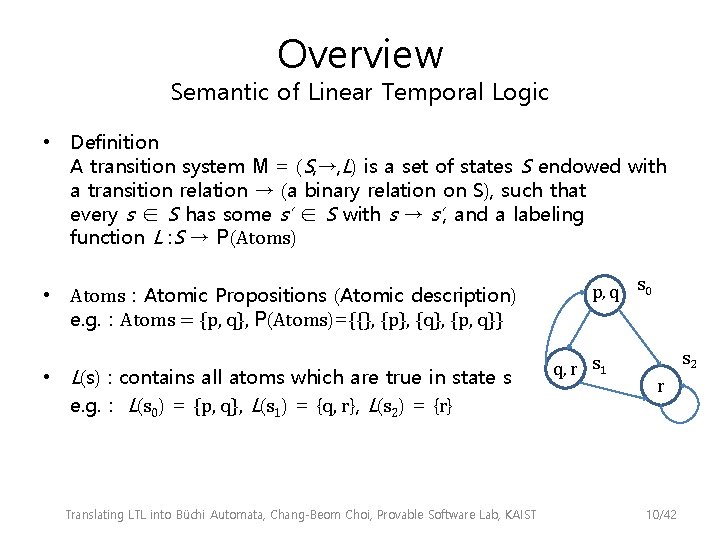
Overview Semantic of Linear Temporal Logic • Definition A transition system M = (S, →, L) is a set of states S endowed with a transition relation → (a binary relation on S), such that every s ∈ S has some s’ ∈ S with s → s’, and a labeling function L : S → P(Atoms) • Atoms : Atomic Propositions (Atomic description) e. g. : Atoms = {p, q}, P(Atoms)={{}, {p}, {q}, {p, q}} • L(s) : contains all atoms which are true in state s e. g. : L(s 0) = {p, q}, L(s 1) = {q, r}, L(s 2) = {r} Translating LTL into Büchi Automata, Chang-Beom Choi, Provable Software Lab, KAIST p, q q, r s 1 s 0 s 2 r 10/42
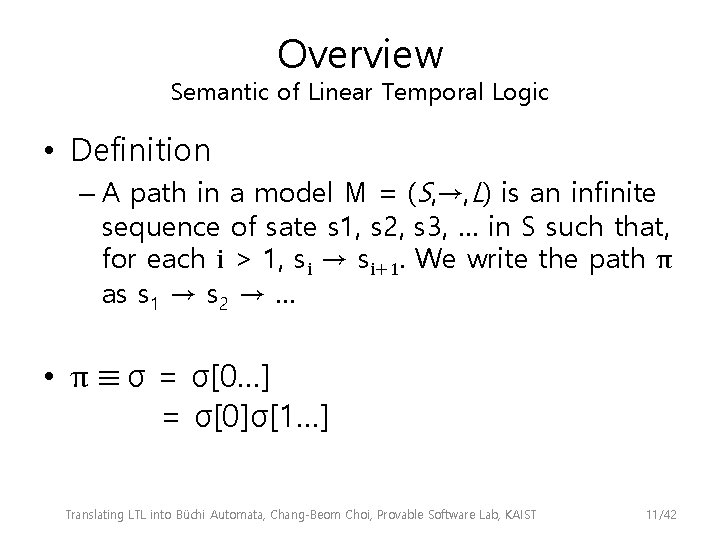
Overview Semantic of Linear Temporal Logic • Definition – A path in a model M = (S, →, L) is an infinite sequence of sate s 1, s 2, s 3, … in S such that, for each i > 1, si → si+1. We write the path π as s 1 → s 2 → … • π ≡ σ = σ[0…] = σ[0]σ[1…] Translating LTL into Büchi Automata, Chang-Beom Choi, Provable Software Lab, KAIST 11/42
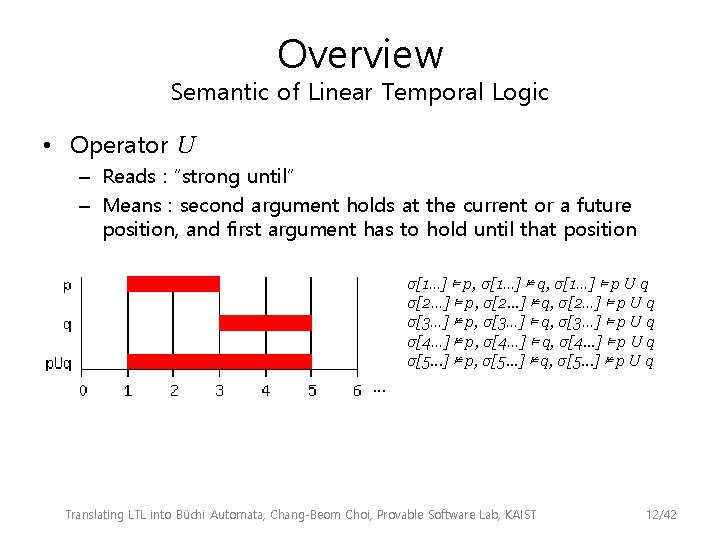
Overview Semantic of Linear Temporal Logic • Operator U – Reads : “strong until” – Means : second argument holds at the current or a future position, and first argument has to hold until that position σ[1…] ⊨ p, σ[1…] ⊭ q, σ[1…] ⊨ p U q σ[2…] ⊨ p, σ[2. . . ] ⊭ q, σ[2…] ⊨ p U q σ[3…] ⊭ p, σ[3…] ⊨ q, σ[3…] ⊨ p U q σ[4…] ⊭ p, σ[4…] ⊨ q, σ[4. . . ] ⊨ p U q σ[5. . . ] ⊭ p, σ[5. . . ] ⊭ q, σ[5. . . ] ⊭ p U q … Translating LTL into Büchi Automata, Chang-Beom Choi, Provable Software Lab, KAIST 12/42
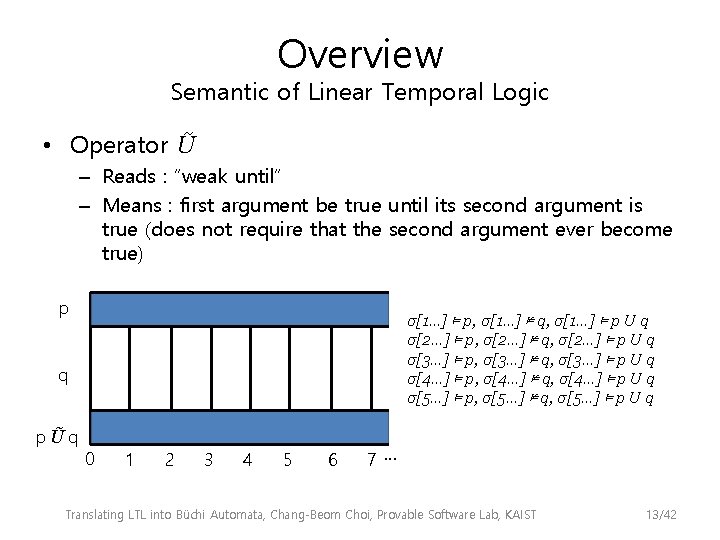
Overview Semantic of Linear Temporal Logic • Operator Ũ – Reads : “weak until” – Means : first argument be true until its second argument is true (does not require that the second argument ever become true) p σ[1…] ⊨ p, σ[1…] ⊭ q, σ[1…] ⊨ p U q σ[2…] ⊨ p, σ[2…] ⊭ q, σ[2…] ⊨ p U q σ[3…] ⊨ p, σ[3…] ⊭ q, σ[3…] ⊨ p U q σ[4…] ⊨ p, σ[4…] ⊭ q, σ[4…] ⊨ p U q σ[5…] ⊨ p, σ[5…] ⊭ q, σ[5…] ⊨ p U q q pŨq 0 1 2 3 4 5 6 7… Translating LTL into Büchi Automata, Chang-Beom Choi, Provable Software Lab, KAIST 13/42
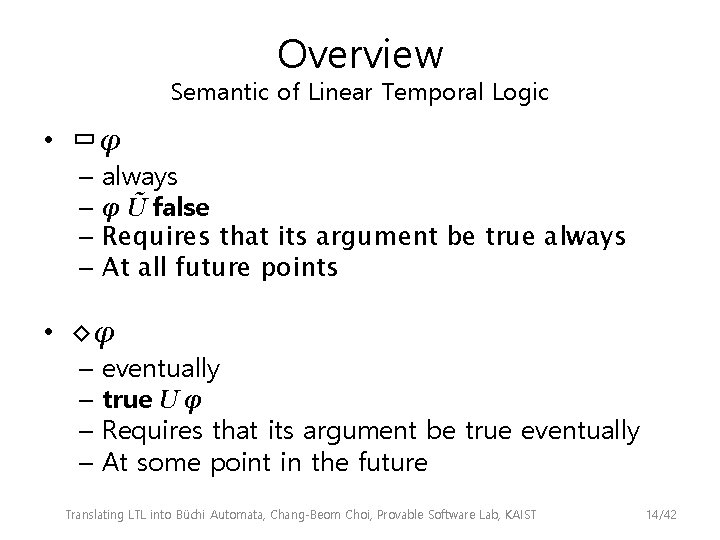
Overview Semantic of Linear Temporal Logic • ㅁφ – always – φ Ũ false – Requires that its argument be true always – At all future points • ⋄φ – eventually – true U φ – Requires that its argument be true eventually – At some point in the future Translating LTL into Büchi Automata, Chang-Beom Choi, Provable Software Lab, KAIST 14/42
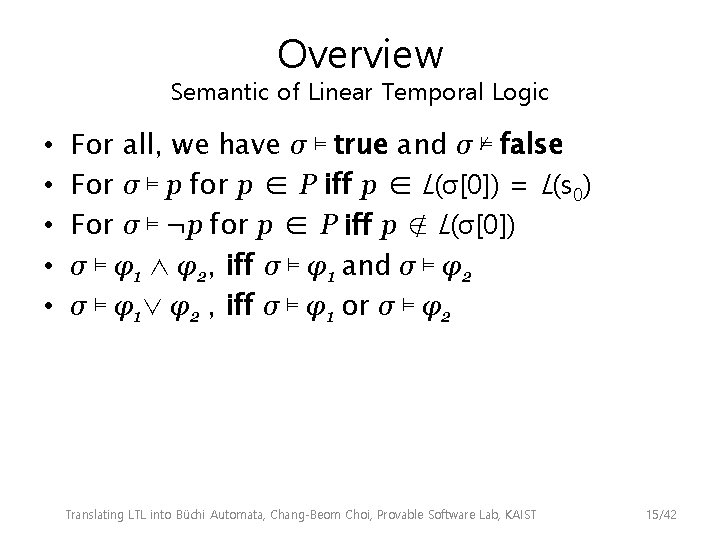
Overview Semantic of Linear Temporal Logic • • • For all, we have σ ⊨ true and σ ⊭ false For σ ⊨ p for p ∈ P iff p ∈ L(σ[0]) = L(s 0) For σ ⊨ ¬p for p ∈ P iff p ∉ L(σ[0]) σ ⊨ φ1 ∧ φ2, iff σ ⊨ φ1 and σ ⊨ φ2 σ ⊨ φ1∨ φ2 , iff σ ⊨ φ1 or σ ⊨ φ2 Translating LTL into Büchi Automata, Chang-Beom Choi, Provable Software Lab, KAIST 15/42
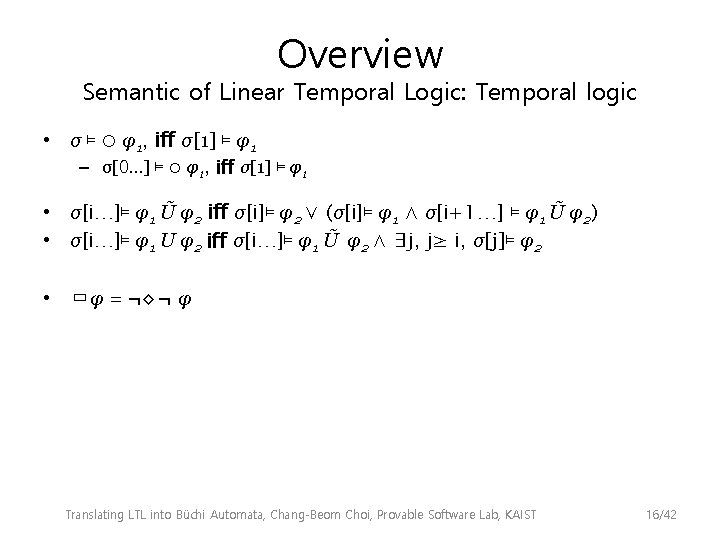
Overview Semantic of Linear Temporal Logic: Temporal logic • σ ⊨ ○ φ1, iff σ[1] ⊨ φ1 – σ[0…] ⊨ ○ φ1, iff σ[1] ⊨ φ1 • σ[i…]⊨ φ1 Ũ φ2 iff σ[i]⊨ φ2 ∨ (σ[i]⊨ φ1 ∧ σ[i+1…] ⊨ φ1 Ũ φ2) • σ[i…]⊨ φ1 U φ2 iff σ[i…]⊨ φ1 Ũ φ2 ∧ ∃j, j≥ i, σ[j]⊨ φ2 • ㅁφ = ¬⋄¬ φ Translating LTL into Büchi Automata, Chang-Beom Choi, Provable Software Lab, KAIST 16/42
Content • Overview – Linear Temporal Logic – Büchi Automata • Translating LTL formula into Büchi Automata – Local Automaton – Eventuality Automaton – Model Automata • Further Study • Reference Translating LTL into Büchi Automata, Chang-Beom Choi, Provable Software Lab, KAIST 17/42
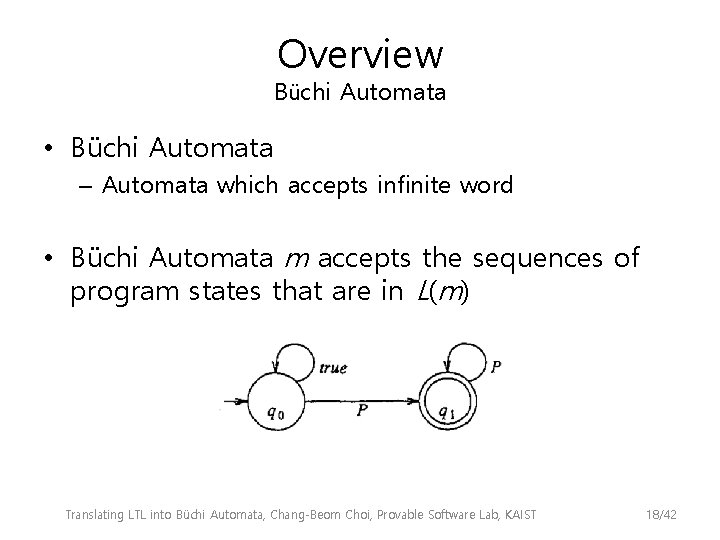
Overview Büchi Automata • Büchi Automata – Automata which accepts infinite word • Büchi Automata m accepts the sequences of program states that are in L(m) Translating LTL into Büchi Automata, Chang-Beom Choi, Provable Software Lab, KAIST 18/42
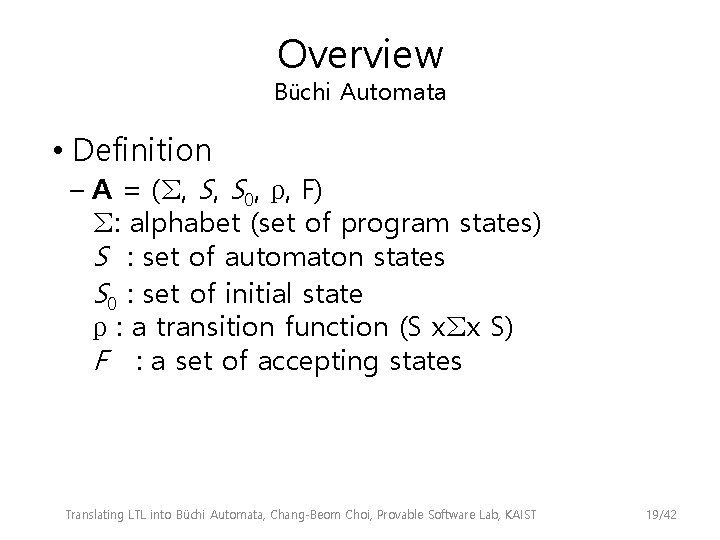
Overview Büchi Automata • Definition – A = (Σ, S, S 0, ρ, F) Σ: alphabet (set of program states) S : set of automaton states S 0 : set of initial state ρ : a transition function (S xΣx S) F : a set of accepting states Translating LTL into Büchi Automata, Chang-Beom Choi, Provable Software Lab, KAIST 19/42
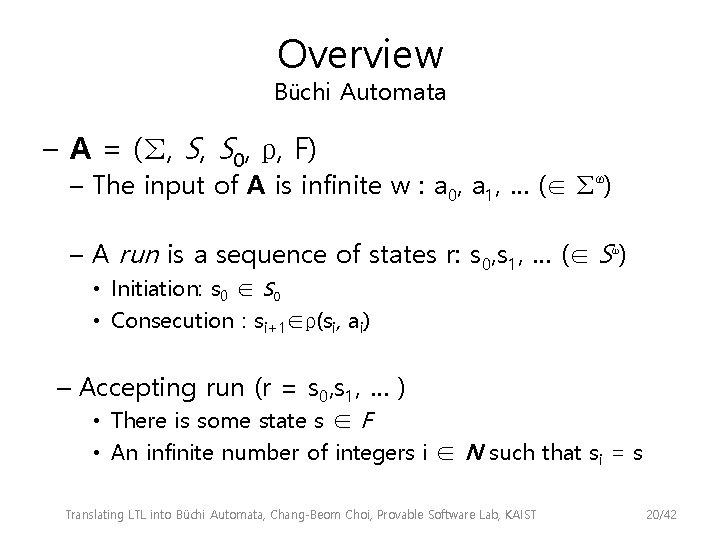
Overview Büchi Automata – A = (Σ, S, S 0, ρ, F) – The input of A is infinite w : a 0, a 1, … (∈ Σω) – A run is a sequence of states r: s 0, s 1, … (∈ Sω) • Initiation: s 0 ∈ S 0 • Consecution : si+1∈ρ(si, ai) – Accepting run (r = s 0, s 1, … ) • There is some state s ∈ F • An infinite number of integers i ∈ N such that si = s Translating LTL into Büchi Automata, Chang-Beom Choi, Provable Software Lab, KAIST 20/42
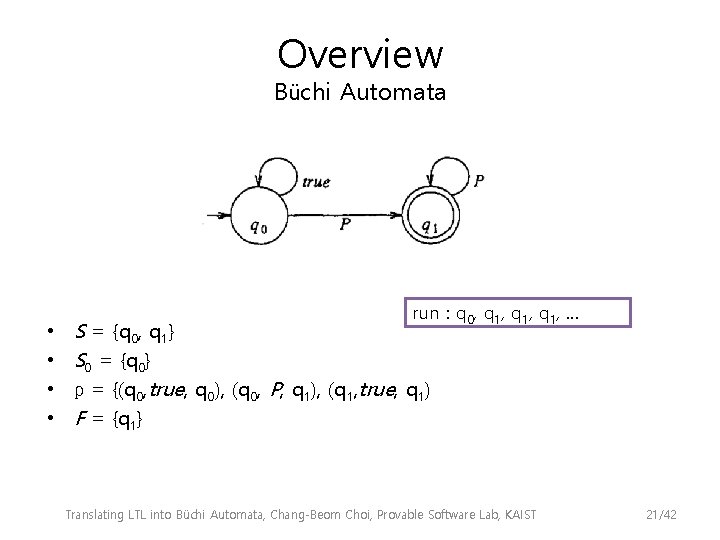
Overview Büchi Automata • • run : q 0, q 1, … S = {q 0, q 1} S 0 = {q 0} ρ = {(q 0, true, q 0), (q 0, P, q 1), (q 1, true, q 1) F = {q 1} Translating LTL into Büchi Automata, Chang-Beom Choi, Provable Software Lab, KAIST 21/42
Content • Overview – Linear Temporal Logic – Büchi Automata • Translating LTL formula into Büchi Automata – Local Automaton – Eventuality Automaton – Model Automata • Conclusion and Further Study • Reference Translating LTL into Büchi Automata, Chang-Beom Choi, Provable Software Lab, KAIST 22/42
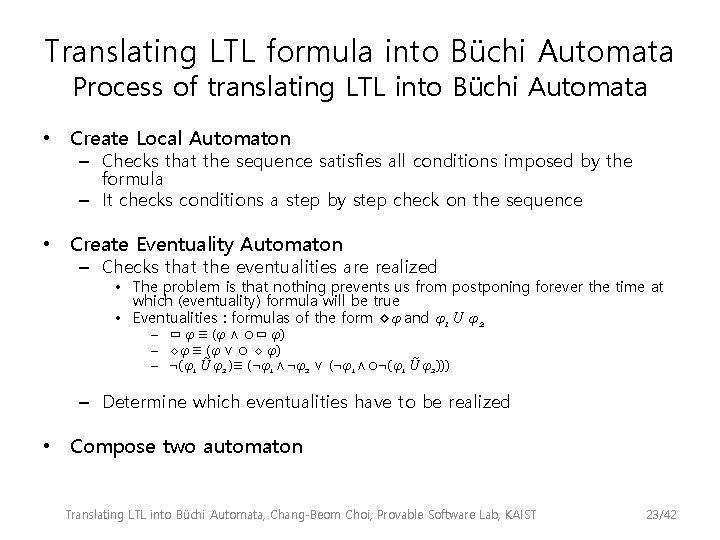
Translating LTL formula into Büchi Automata Process of translating LTL into Büchi Automata • Create Local Automaton – Checks that the sequence satisfies all conditions imposed by the formula – It checks conditions a step by step check on the sequence • Create Eventuality Automaton – Checks that the eventualities are realized • The problem is that nothing prevents us from postponing forever the time at which (eventuality) formula will be true • Eventualities : formulas of the form ⋄φ and φ1 U φ2 – ㅁ φ ≡ (φ ∧ ○ㅁ φ) – ⋄φ ≡ (φ ∨ ○ ⋄ φ) – ¬(φ1 Ũ φ2 )≡ (¬φ1 ∧¬φ2 ∨ (¬φ1 ∧○¬(φ1 Ũ φ2))) – Determine which eventualities have to be realized • Compose two automaton Translating LTL into Büchi Automata, Chang-Beom Choi, Provable Software Lab, KAIST 23/42
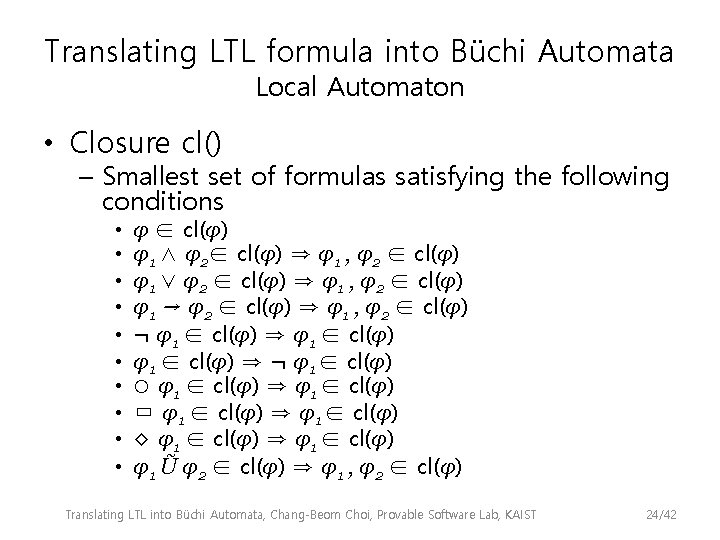
Translating LTL formula into Büchi Automata Local Automaton • Closure cl() – Smallest set of formulas satisfying the following conditions • • • φ ∈ cl(φ) φ1 ∧ φ2∈ cl(φ) ⇒ φ1 , φ2 ∈ cl(φ) φ1 ∨ φ2 ∈ cl(φ) ⇒ φ1 , φ2 ∈ cl(φ) φ1 → φ2 ∈ cl(φ) ⇒ φ1 , φ2 ∈ cl(φ) ¬ φ1 ∈ cl(φ) ⇒ ¬ φ1 ∈ cl(φ) ○ φ1 ∈ cl(φ) ⇒ φ1 ∈ cl(φ) ㅁ φ1 ∈ cl(φ) ⇒ φ1 ∈ cl(φ) ⋄ φ1 ∈ cl(φ) ⇒ φ1 ∈ cl(φ) φ1 Ũ φ2 ∈ cl(φ) ⇒ φ1 , φ2 ∈ cl(φ) Translating LTL into Büchi Automata, Chang-Beom Choi, Provable Software Lab, KAIST 24/42
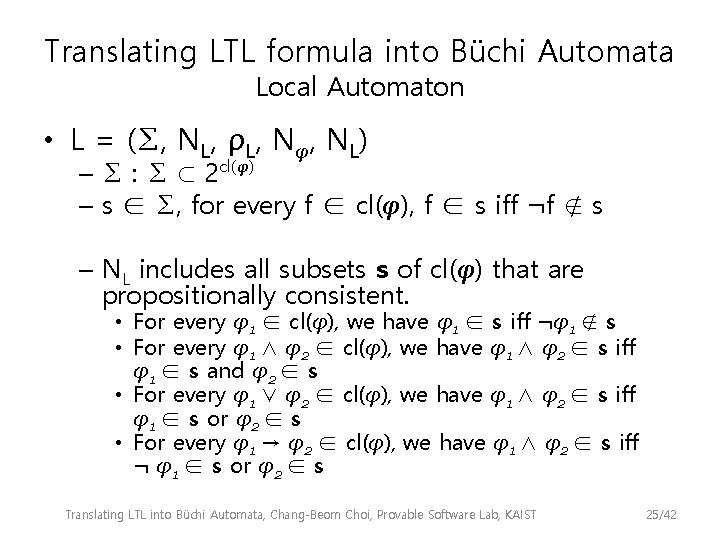
Translating LTL formula into Büchi Automata Local Automaton • L = (∑, NL, ρL, Nφ, NL) – ∑ : ∑ ⊂ 2 cl(φ) – s ∈ ∑, for every f ∈ cl(φ), f ∈ s iff ¬f ∉ s – NL includes all subsets s of cl(φ) that are propositionally consistent. • For every φ1 ∈ cl(φ), we have φ1 ∈ s iff ¬φ1 ∉ s • For every φ1 ∧ φ2 ∈ cl(φ), we have φ1 ∧ φ2 ∈ s iff φ1 ∈ s and φ2 ∈ s • For every φ1 ∨ φ2 ∈ cl(φ), we have φ1 ∧ φ2 ∈ s iff φ1 ∈ s or φ2 ∈ s • For every φ1 → φ2 ∈ cl(φ), we have φ1 ∧ φ2 ∈ s iff ¬ φ1 ∈ s or φ2 ∈ s Translating LTL into Büchi Automata, Chang-Beom Choi, Provable Software Lab, KAIST 25/42
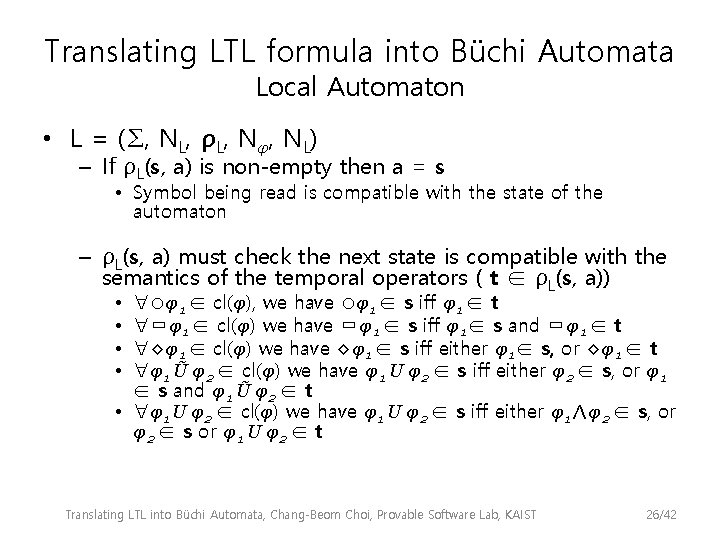
Translating LTL formula into Büchi Automata Local Automaton • L = (∑, NL, ρL, Nφ, NL) – If ρL(s, a) is non-empty then a = s • Symbol being read is compatible with the state of the automaton – ρL(s, a) must check the next state is compatible with the semantics of the temporal operators ( t ∈ ρL(s, a)) ∀○φ1 ∈ cl(φ), we have ○φ1 ∈ s iff φ1 ∈ t ∀ㅁφ1 ∈ cl(φ) we have ㅁφ1 ∈ s iff φ1 ∈ s and ㅁφ1 ∈ t ∀⋄φ1 ∈ cl(φ) we have ⋄φ1 ∈ s iff either φ1 ∈ s, or ⋄φ1 ∈ t ∀φ1 Ũ φ2 ∈ cl(φ) we have φ1 U φ2 ∈ s iff either φ2 ∈ s, or φ1 ∈ s and φ1 Ũ φ2 ∈ t • ∀φ1 U φ2 ∈ cl(φ) we have φ1 U φ2 ∈ s iff either φ1 ⋀ φ2 ∈ s, or φ2 ∈ s or φ1 U φ2 ∈ t • • Translating LTL into Büchi Automata, Chang-Beom Choi, Provable Software Lab, KAIST 26/42
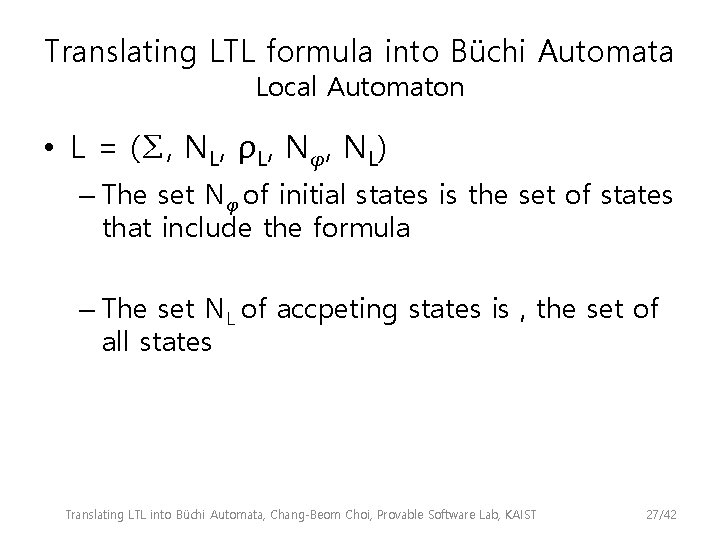
Translating LTL formula into Büchi Automata Local Automaton • L = (∑, NL, ρL, Nφ, NL) – The set Nφ of initial states is the set of states that include the formula – The set NL of accpeting states is , the set of all states Translating LTL into Büchi Automata, Chang-Beom Choi, Provable Software Lab, KAIST 27/42
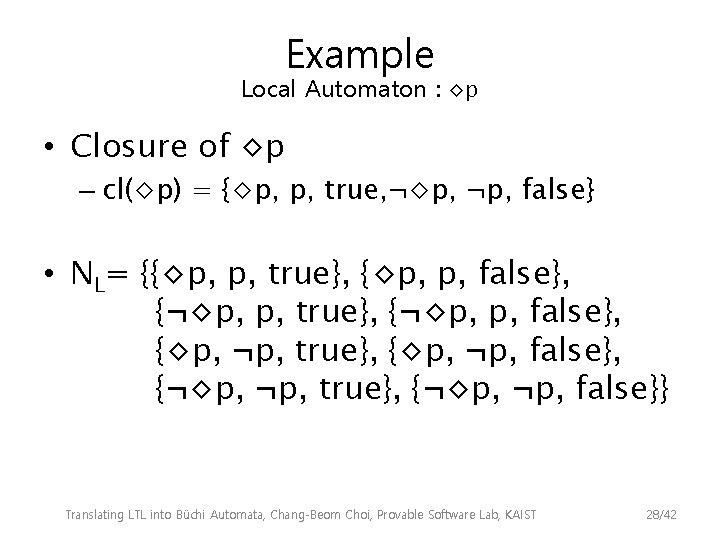
Example Local Automaton : ⋄p • Closure of ⋄p – cl(⋄p) = {⋄p, p, true, ¬⋄p, ¬p, false} • NL= {{⋄p, p, true}, {⋄p, p, false}, {¬⋄p, p, true}, {¬⋄p, p, false}, {⋄p, ¬p, true}, {⋄p, ¬p, false}, {¬⋄p, ¬p, true}, {¬⋄p, ¬p, false}} Translating LTL into Büchi Automata, Chang-Beom Choi, Provable Software Lab, KAIST 28/42
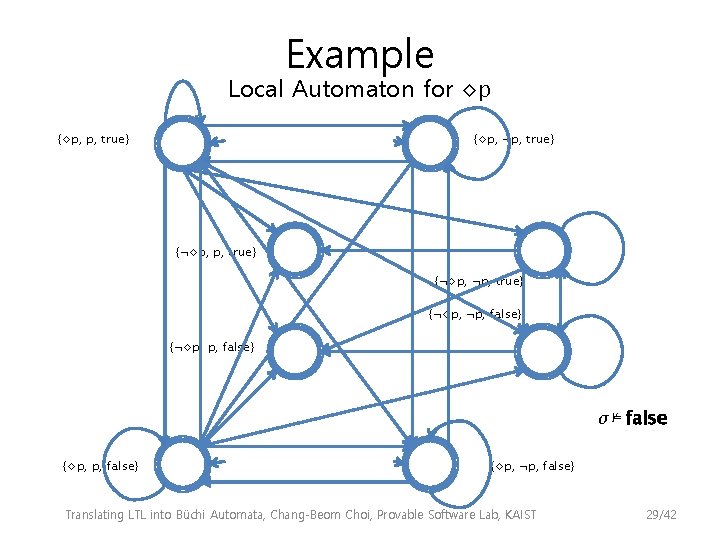
Example Local Automaton for ⋄p {⋄p, p, true} {⋄p, ¬p, true} {¬⋄p, ¬p, false} {¬⋄p, p, false} σ ⊭ false {⋄p, p, false} {⋄p, ¬p, false} Translating LTL into Büchi Automata, Chang-Beom Choi, Provable Software Lab, KAIST 29/42
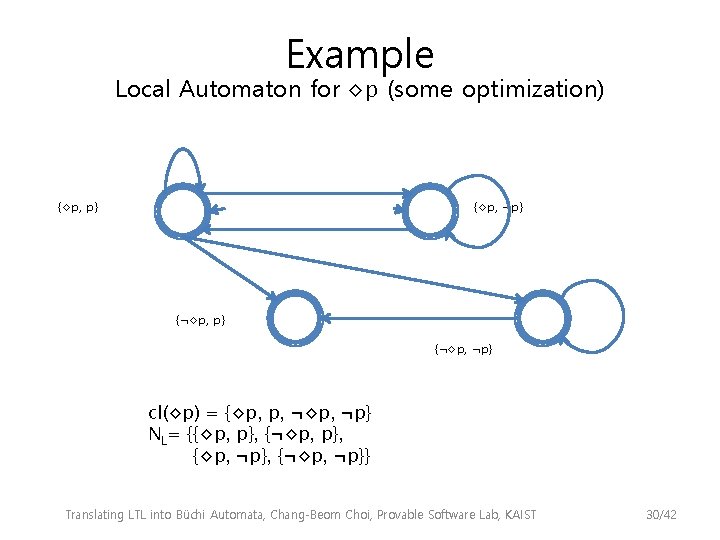
Example Local Automaton for ⋄p (some optimization) {⋄p, p} {⋄p, ¬p} {¬⋄p, ¬p} cl(⋄p) = {⋄p, p, ¬⋄p, ¬p} NL= {{⋄p, p}, {¬⋄p, p}, {⋄p, ¬p}, {¬⋄p, ¬p}} Translating LTL into Büchi Automata, Chang-Beom Choi, Provable Software Lab, KAIST 30/42
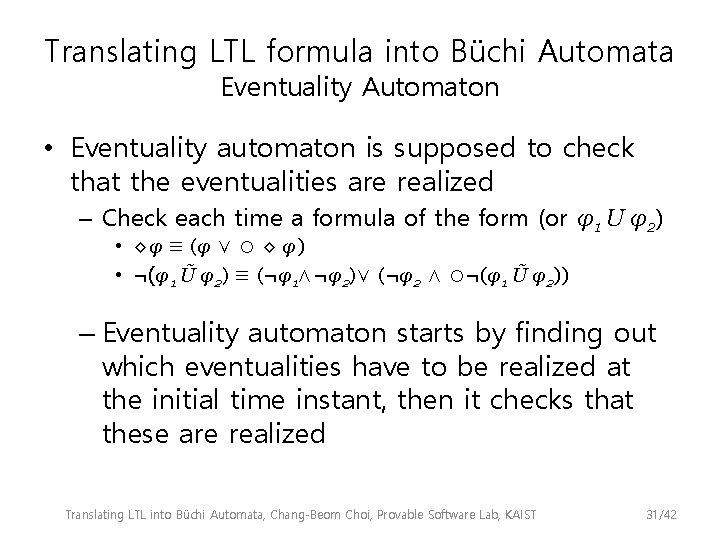
Translating LTL formula into Büchi Automata Eventuality Automaton • Eventuality automaton is supposed to check that the eventualities are realized – Check each time a formula of the form (or φ1 U φ2) • ⋄φ ≡ (φ ∨ ○ ⋄ φ) • ¬(φ1 Ũ φ2) ≡ (¬φ1∧¬φ2)∨ (¬φ2 ∧ ○¬(φ1 Ũ φ2)) – Eventuality automaton starts by finding out which eventualities have to be realized at the initial time instant, then it checks that these are realized Translating LTL into Büchi Automata, Chang-Beom Choi, Provable Software Lab, KAIST 31/42
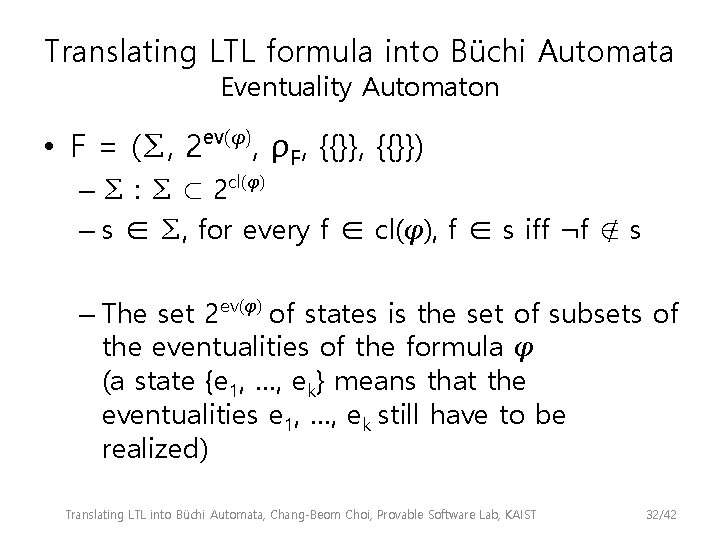
Translating LTL formula into Büchi Automata Eventuality Automaton • F = (∑, 2 ev(φ), ρF, {{}}) – ∑ : ∑ ⊂ 2 cl(φ) – s ∈ ∑, for every f ∈ cl(φ), f ∈ s iff ¬f ∉ s – The set 2 ev(φ) of states is the set of subsets of the eventualities of the formula φ (a state {e 1, …, ek} means that the eventualities e 1, …, ek still have to be realized) Translating LTL into Büchi Automata, Chang-Beom Choi, Provable Software Lab, KAIST 32/42
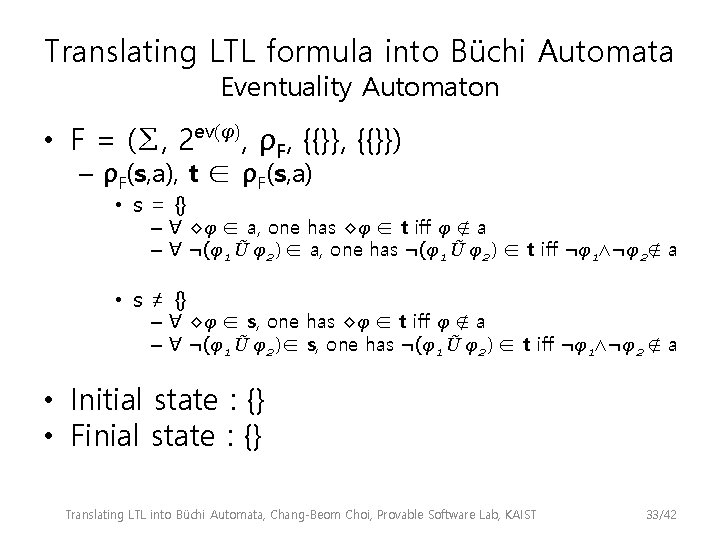
Translating LTL formula into Büchi Automata Eventuality Automaton • F = (∑, 2 ev(φ), ρF, {{}}) – ρF(s, a), t ∈ ρF(s, a) • s = {} – ∀ ⋄φ ∈ a, one has ⋄φ ∈ t iff φ ∉ a – ∀ ¬(φ1 Ũ φ2 ) ∈ a, one has ¬(φ1 Ũ φ2 ) ∈ t iff ¬φ1∧¬φ2∉ a • s ≠ {} – ∀ ⋄φ ∈ s, one has ⋄φ ∈ t iff φ ∉ a – ∀ ¬(φ1 Ũ φ2 )∈ s, one has ¬(φ1 Ũ φ2 ) ∈ t iff ¬φ1∧¬φ2 ∉ a • Initial state : {} • Finial state : {} Translating LTL into Büchi Automata, Chang-Beom Choi, Provable Software Lab, KAIST 33/42
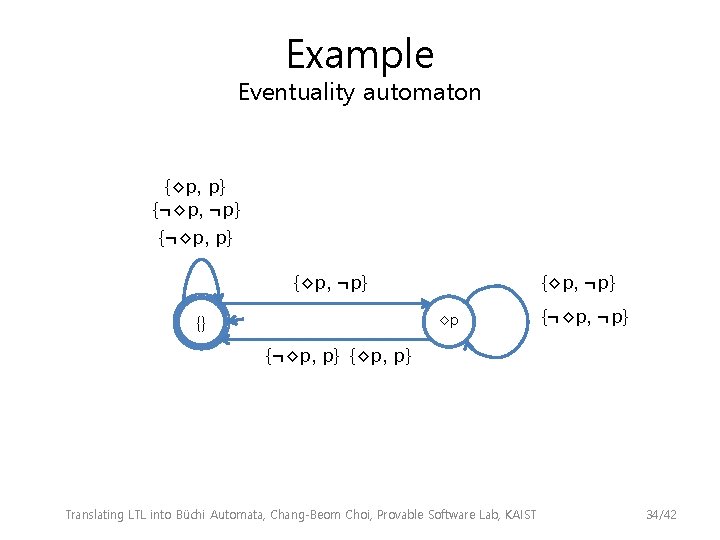
Example Eventuality automaton {⋄p, p} {¬⋄p, ¬p} {¬⋄p, p} {⋄p, ¬p} {} {⋄p, ¬p} ⋄p {¬⋄p, ¬p} {¬⋄p, p} {⋄p, p} Translating LTL into Büchi Automata, Chang-Beom Choi, Provable Software Lab, KAIST 34/42
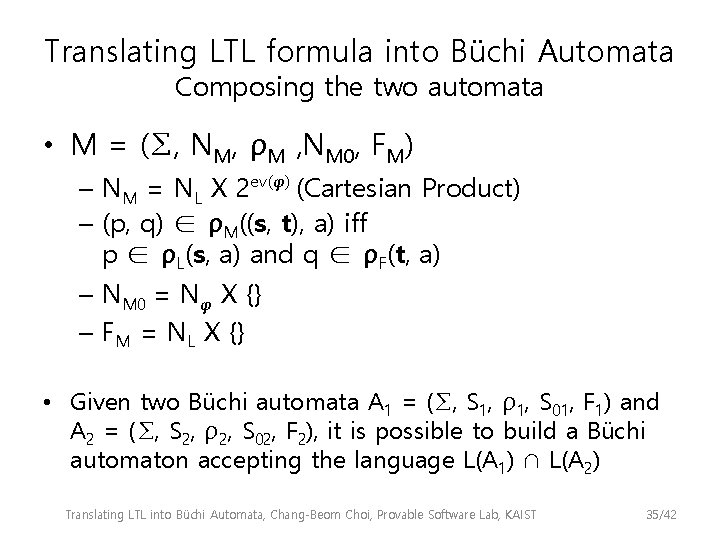
Translating LTL formula into Büchi Automata Composing the two automata • M = (∑, NM, ρM , NM 0, FM) – NM = NL X 2 ev(φ) (Cartesian Product) – (p, q) ∈ ρM((s, t), a) iff p ∈ ρL(s, a) and q ∈ ρF(t, a) – NM 0 = Nφ X {} – FM = NL X {} • Given two Büchi automata A 1 = (∑, S 1, ρ1, S 01, F 1) and A 2 = (∑, S 2, ρ2, S 02, F 2), it is possible to build a Büchi automaton accepting the language L(A 1) ∩ L(A 2) Translating LTL into Büchi Automata, Chang-Beom Choi, Provable Software Lab, KAIST 35/42
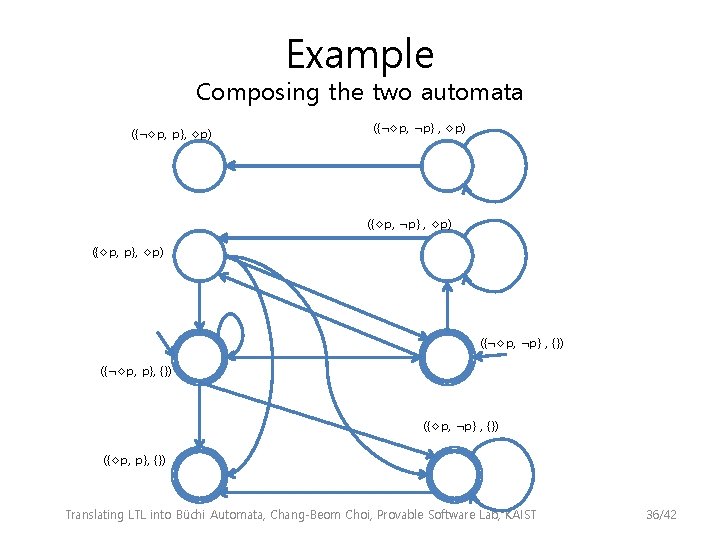
Example Composing the two automata ({¬⋄p, p}, ⋄p) ({¬⋄p, ¬p} , ⋄p) ({⋄p, p}, ⋄p) ({¬⋄p, ¬p} , {}) ({¬⋄p, p}, {}) ({⋄p, ¬p} , {}) ({⋄p, p}, {}) Translating LTL into Büchi Automata, Chang-Beom Choi, Provable Software Lab, KAIST 36/42
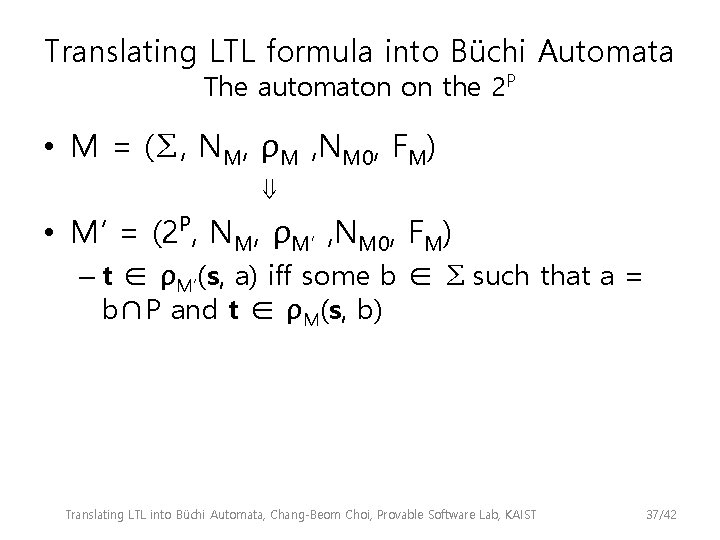
Translating LTL formula into Büchi Automata The automaton on the 2 P • M = (∑, NM, ρM , NM 0, FM) ⇓ • M’ = (2 P, NM, ρM’ , NM 0, FM) – t ∈ ρM’(s, a) iff some b ∈ ∑ such that a = b∩P and t ∈ ρM(s, b) Translating LTL into Büchi Automata, Chang-Beom Choi, Provable Software Lab, KAIST 37/42
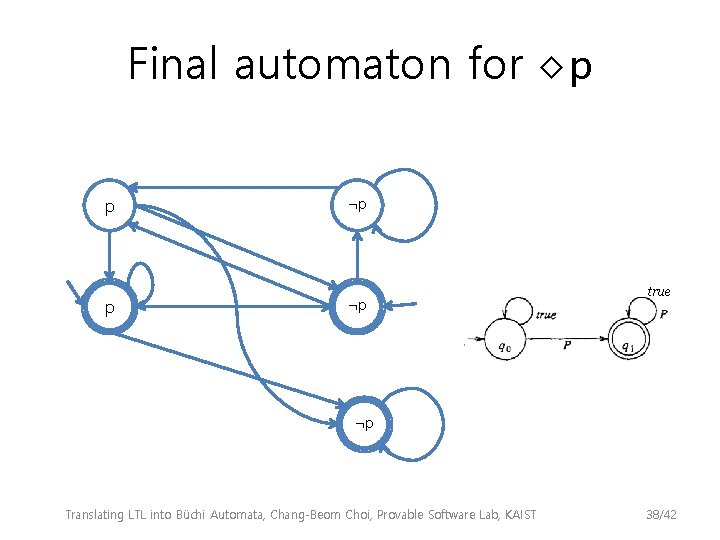
Final automaton for ⋄p p ¬p true ¬p Translating LTL into Büchi Automata, Chang-Beom Choi, Provable Software Lab, KAIST 38/42
Content • Overview – Linear Temporal Logic – Büchi Automata • Translating LTL formula into Büchi Automata – Local Automaton – Eventuality Automaton – Model Automata • Conclusion and Further Study • Reference Translating LTL into Büchi Automata, Chang-Beom Choi, Provable Software Lab, KAIST 39/42
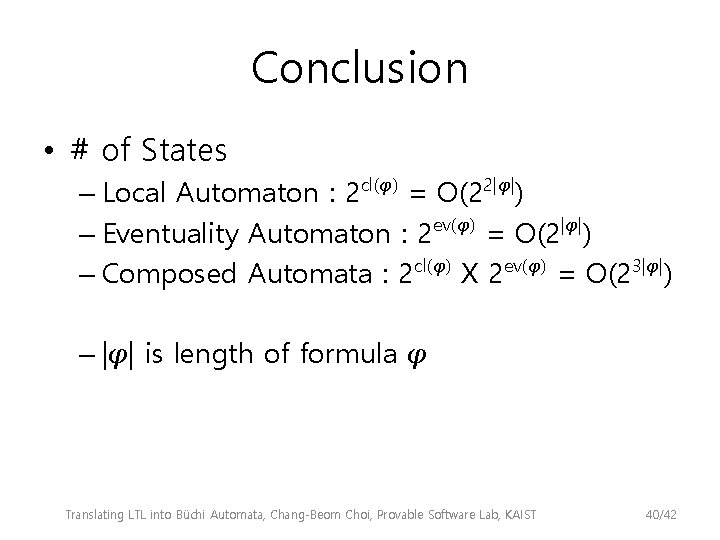
Conclusion • # of States – Local Automaton : 2 cl(φ) = O(22|φ|) – Eventuality Automaton : 2 ev(φ) = O(2|φ|) – Composed Automata : 2 cl(φ) X 2 ev(φ) = O(23|φ|) – |φ| is length of formula φ Translating LTL into Büchi Automata, Chang-Beom Choi, Provable Software Lab, KAIST 40/42
Further Study • Translate LTL to Büchi Automata – Using Alternating Büchi Automata – Tableau Method – On the fly method • Next Topic? – On-line Algorithm – More specific research on Interactive Systems – Symbolic graph representation: Ordered Binary Decision Diagram Translating LTL into Büchi Automata, Chang-Beom Choi, Provable Software Lab, KAIST 41/42
Reference • On the Relation of Programs and Computations to Models of Temporal Logic by Pierre Wolper, In Proc. Temporal Logic in Specification, vol. 398 of LNCS, pages 75 -123. Springer-Verlag, 1989. • Constructing Automata from Temporal Logic Formulas: A Tutorial by Pierre Wolper In Lectures on Formal Methods in Performance Analysis, vol. 2090 of LNCS, pages 261 -277. Springer-Verlag, July 2001. • From Modal Logic to Deductive Databases by A. Thayse et al. , Wiley, 1989 • Logic in Computer Science, second edition by M. Huth and M. Ryan, Cambridge press Translating LTL into Büchi Automata, Chang-Beom Choi, Provable Software Lab, KAIST 42/42
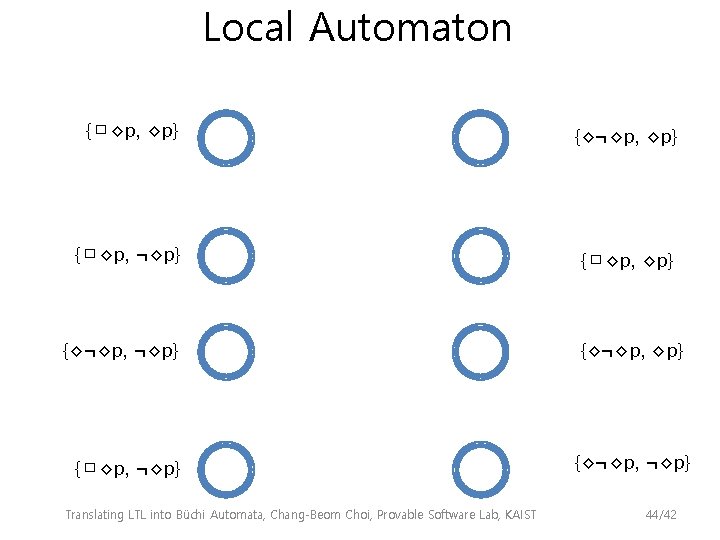
Local Automaton {ㅁ⋄p, ⋄p} {⋄¬⋄p, ⋄p} {ㅁ⋄p, ¬⋄p} {ㅁ⋄p, ⋄p} {⋄¬⋄p, ¬⋄p} {ㅁ⋄p, ¬⋄p} Translating LTL into Büchi Automata, Chang-Beom Choi, Provable Software Lab, KAIST {⋄¬⋄p, ⋄p} {⋄¬⋄p, ¬⋄p} 44/42
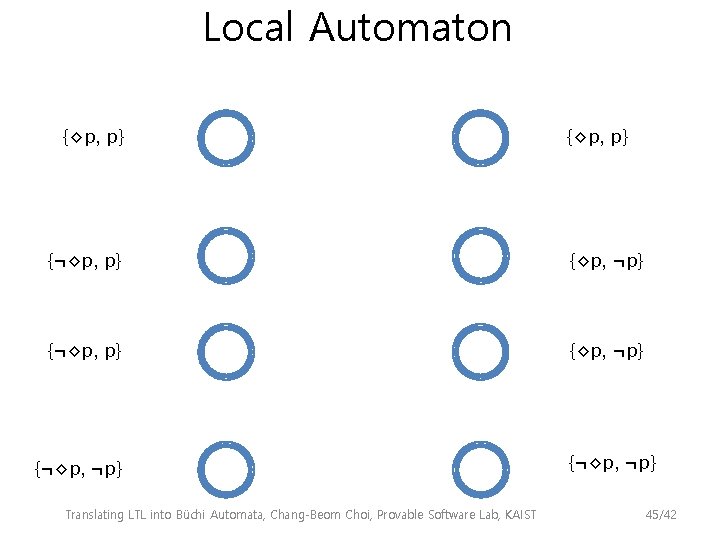
Local Automaton {⋄p, p} {¬⋄p, p} {⋄p, ¬p} {¬⋄p, ¬p} Translating LTL into Büchi Automata, Chang-Beom Choi, Provable Software Lab, KAIST {¬⋄p, ¬p} 45/42
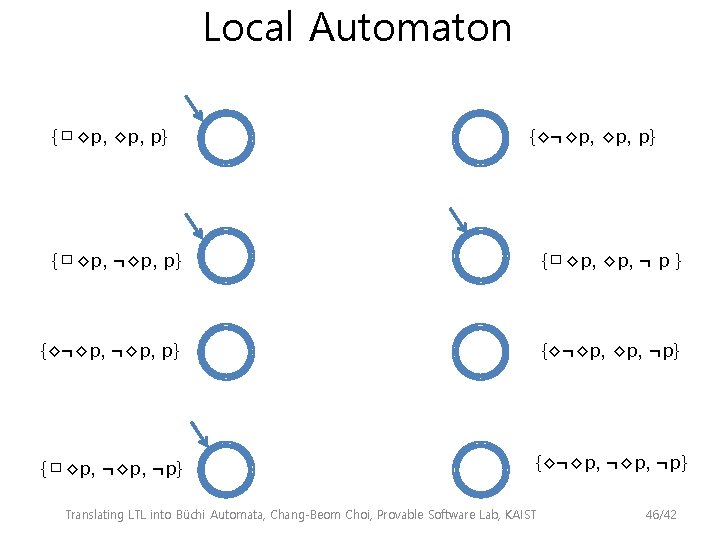
Local Automaton {ㅁ⋄p, p} {⋄¬⋄p, p} {ㅁ⋄p, ¬ p } {⋄¬⋄p, p} {⋄¬⋄p, ¬p} {ㅁ⋄p, ¬p} {⋄¬⋄p, ¬p} Translating LTL into Büchi Automata, Chang-Beom Choi, Provable Software Lab, KAIST 46/42
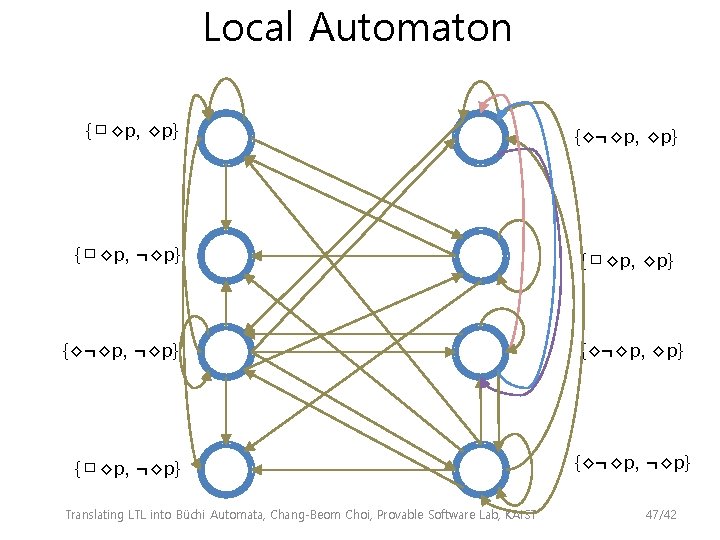
Local Automaton {ㅁ⋄p, ⋄p} {⋄¬⋄p, ⋄p} {ㅁ⋄p, ¬⋄p} {ㅁ⋄p, ⋄p} {⋄¬⋄p, ¬⋄p} {ㅁ⋄p, ¬⋄p} Translating LTL into Büchi Automata, Chang-Beom Choi, Provable Software Lab, KAIST {⋄¬⋄p, ⋄p} {⋄¬⋄p, ¬⋄p} 47/42
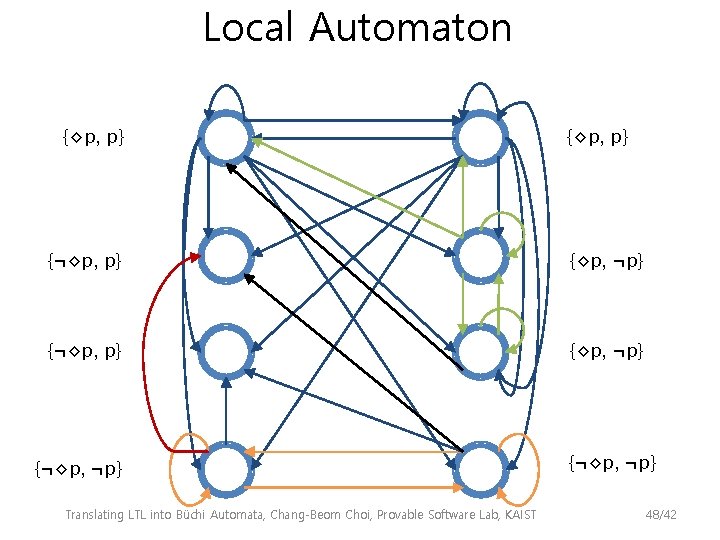
Local Automaton {⋄p, p} {¬⋄p, p} {⋄p, ¬p} {¬⋄p, ¬p} Translating LTL into Büchi Automata, Chang-Beom Choi, Provable Software Lab, KAIST {¬⋄p, ¬p} 48/42
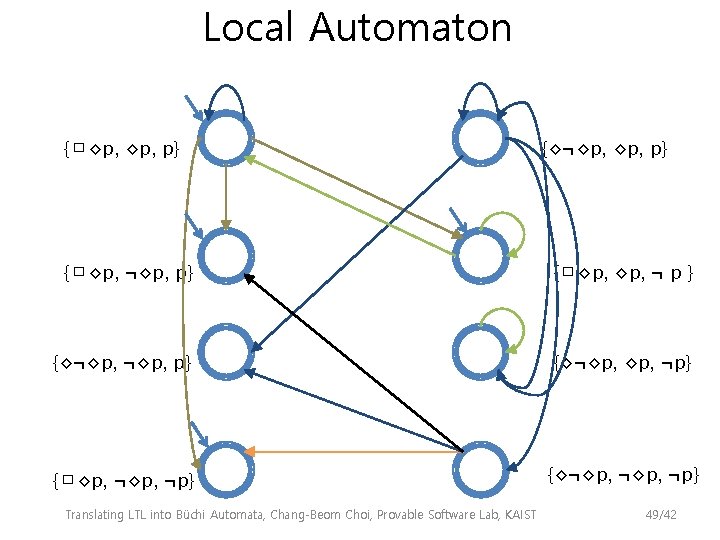
Local Automaton {ㅁ⋄p, p} {⋄¬⋄p, p} {ㅁ⋄p, ¬ p } {⋄¬⋄p, p} {⋄¬⋄p, ¬p} {ㅁ⋄p, ¬p} {⋄¬⋄p, ¬p} Translating LTL into Büchi Automata, Chang-Beom Choi, Provable Software Lab, KAIST 49/42
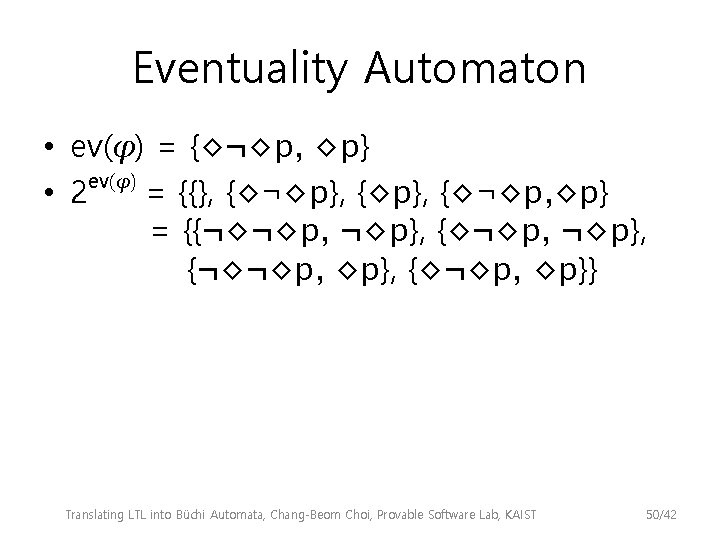
Eventuality Automaton • ev(φ) = {⋄¬⋄p, ⋄p} • 2 ev(φ) = {{}, {⋄¬⋄p}, {⋄¬⋄p, ⋄p} = {{¬⋄¬⋄p, ¬⋄p}, {¬⋄¬⋄p, ⋄p}, {⋄¬⋄p, ⋄p}} Translating LTL into Büchi Automata, Chang-Beom Choi, Provable Software Lab, KAIST 50/42
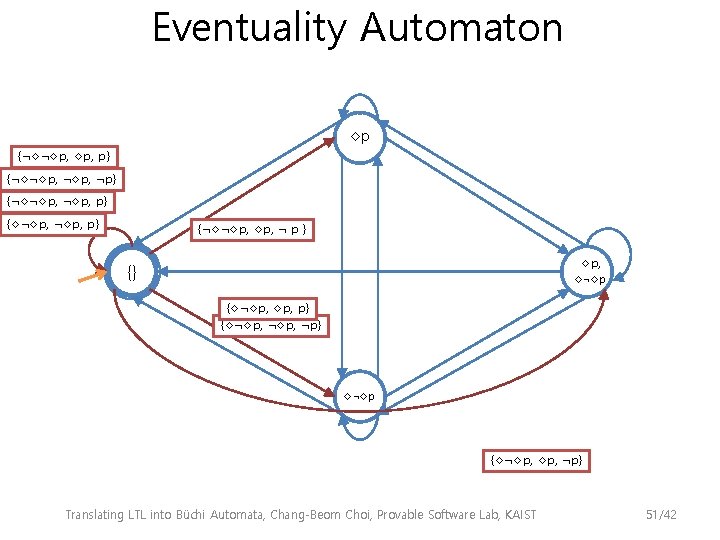
Eventuality Automaton ⋄p {¬⋄¬⋄p, p} {¬⋄¬⋄p, ¬p} {¬⋄¬⋄p, p} {¬⋄¬⋄p, ¬ p } ⋄p, {} ⋄¬⋄p {⋄¬⋄p, p} {⋄¬⋄p, ¬p} ⋄¬⋄p {⋄¬⋄p, ¬p} Translating LTL into Büchi Automata, Chang-Beom Choi, Provable Software Lab, KAIST 51/42
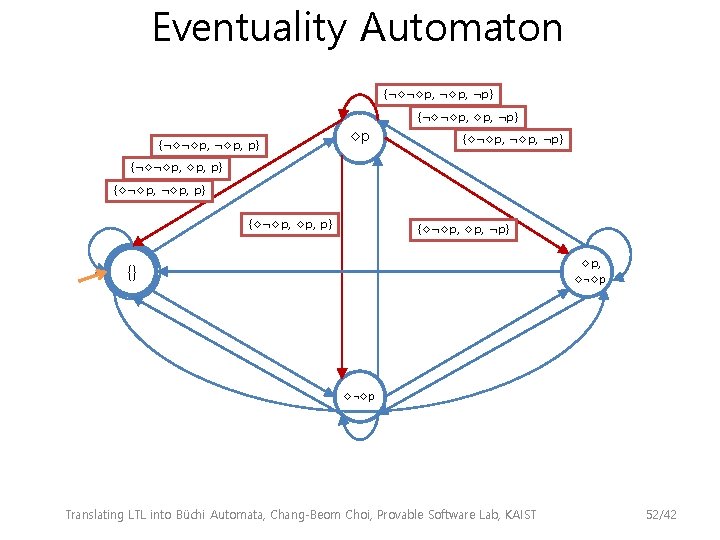
Eventuality Automaton {¬⋄¬⋄p, ¬p} {¬⋄¬⋄p, p} ⋄p {⋄¬⋄p, ¬p} {¬⋄¬⋄p, p} {⋄¬⋄p, ⋄p, ¬p} ⋄p, {} ⋄¬⋄p Translating LTL into Büchi Automata, Chang-Beom Choi, Provable Software Lab, KAIST 52/42
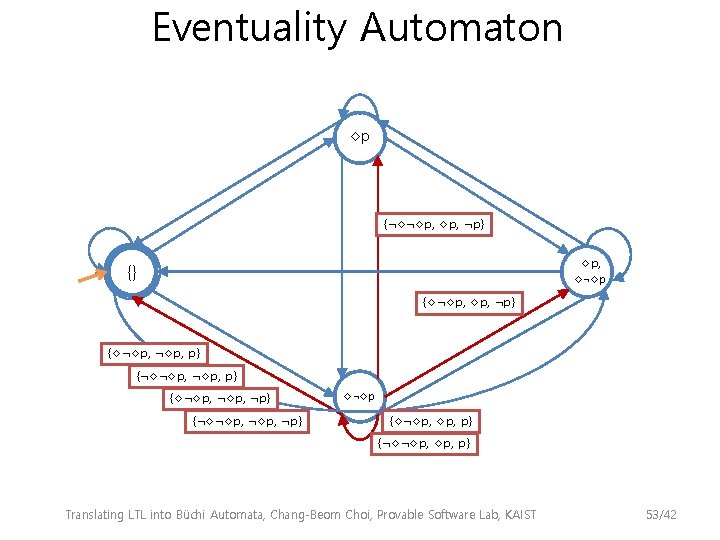
Eventuality Automaton ⋄p {¬⋄¬⋄p, ¬p} ⋄p, {} ⋄¬⋄p {⋄¬⋄p, ¬p} {⋄¬⋄p, p} {¬⋄¬⋄p, p} {⋄¬⋄p, ¬p} {¬⋄¬⋄p, ¬p} ⋄¬⋄p {⋄¬⋄p, p} {¬⋄¬⋄p, p} Translating LTL into Büchi Automata, Chang-Beom Choi, Provable Software Lab, KAIST 53/42
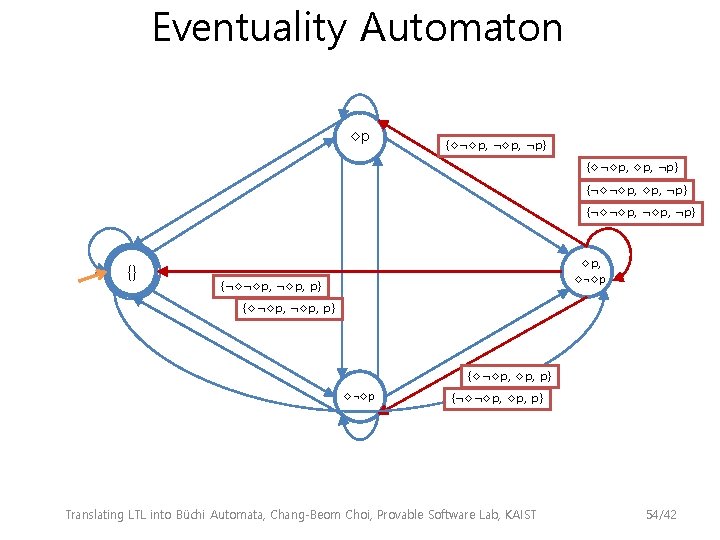
Eventuality Automaton ⋄p {⋄¬⋄p, ¬p} {⋄¬⋄p, ⋄p, ¬p} {¬⋄¬⋄p, ¬p} {} ⋄p, ⋄¬⋄p {¬⋄¬⋄p, p} {⋄¬⋄p, p} ⋄¬⋄p {¬⋄¬⋄p, p} Translating LTL into Büchi Automata, Chang-Beom Choi, Provable Software Lab, KAIST 54/42
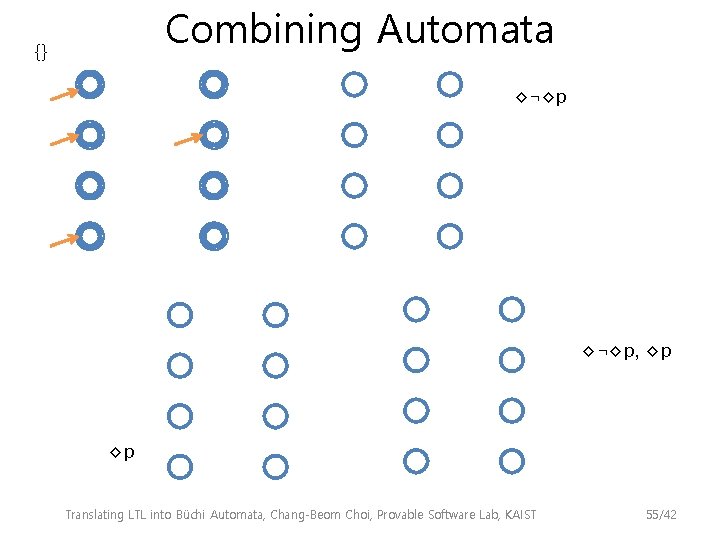
Combining Automata {} ⋄¬⋄p, ⋄p ⋄p Translating LTL into Büchi Automata, Chang-Beom Choi, Provable Software Lab, KAIST 55/42
- Slides: 55