
Translating HighThroughput Nanofiber Fabrication Techniques for Electroactive PolymerProtein
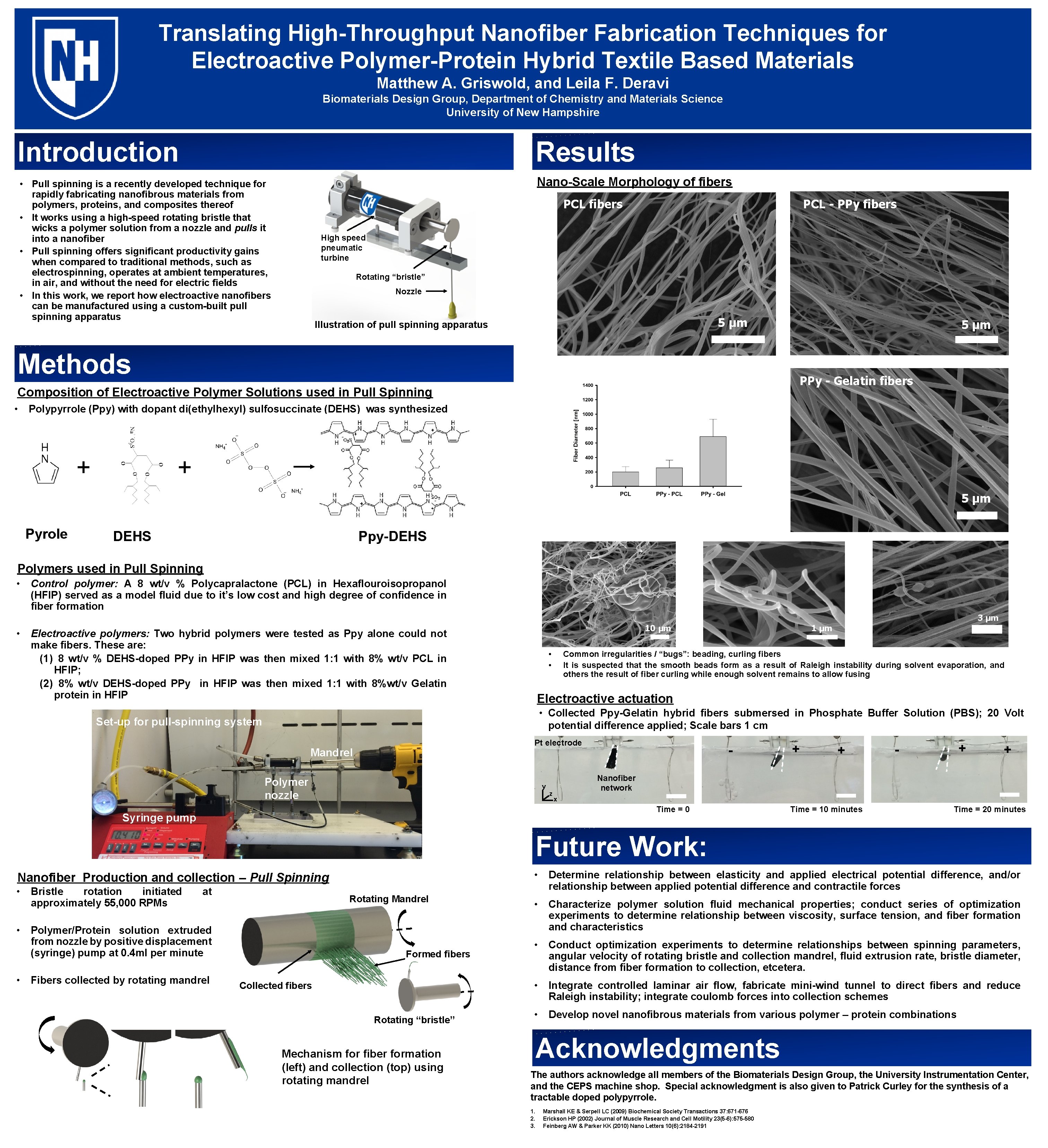
Translating High-Throughput Nanofiber Fabrication Techniques for Electroactive Polymer-Protein Hybrid Textile Based Materials Matthew A. Griswold, and Leila F. Deravi Biomaterials Design Group, Department of Chemistry and Materials Science University of New Hampshire Introduction Results • Pull spinning is a recently developed technique for rapidly fabricating nanofibrous materials from polymers, proteins, and composites thereof • It works using a high-speed rotating bristle that wicks a polymer solution from a nozzle and pulls it into a nanofiber • Pull spinning offers significant productivity gains when compared to traditional methods, such as electrospinning, operates at ambient temperatures, in air, and without the need for electric fields • In this work, we report how electroactive nanofibers can be manufactured using a custom-built pull spinning apparatus Nano-Scale Morphology of fibers PCL - PPy fibers High speed pneumatic turbine Rotating “bristle” 50 µm Nozzle 5 µm Illustration of pull spinning apparatus Methods PPy - Gelatin fibers Composition of Electroactive Polymer Solutions used in Pull Spinning • 5 µm Polypyrrole (Ppy) with dopant di(ethylhexyl) sulfosuccinate (DEHS) was synthesized + + 5 µm Pyrole DEHS Ppy-DEHS Polymers used in Pull Spinning • Control polymer: A 8 wt/v % Polycapralactone (PCL) in Hexaflouroisopropanol (HFIP) served as a model fluid due to it’s low cost and high degree of confidence in fiber formation 3 µm • 10 µm Electroactive polymers: Two hybrid polymers were tested as Ppy alone could not make fibers. These are: (1) 8 wt/v % DEHS-doped PPy in HFIP was then mixed 1: 1 with 8% wt/v PCL in HFIP; (2) 8% wt/v DEHS-doped PPy in HFIP was then mixed 1: 1 with 8%wt/v Gelatin protein in HFIP • • 1 µm Common irregularities / “bugs”: beading, curling fibers It is suspected that the smooth beads form as a result of Raleigh instability during solvent evaporation, and others the result of fiber curling while enough solvent remains to allow fusing Electroactive actuation • Collected Ppy-Gelatin hybrid fibers submersed in Phosphate Buffer Solution (PBS); 20 Volt potential difference applied; Scale bars 1 cm Set-up for pull-spinning system Pt electrode Mandrel Polymer nozzle + + - + x Time = 0 Syringe pump + Nanofiber network y z - Time = 10 minutes Time = 20 minutes Future Work: Nanofiber Production and collection – Pull Spinning • • • Bristle rotation initiated approximately 55, 000 RPMs at Rotating Mandrel Polymer/Protein solution extruded from nozzle by positive displacement (syringe) pump at 0. 4 ml per minute Fibers collected by rotating mandrel Formed fibers Collected fibers Rotating “bristle” Mechanism for fiber formation (left) and collection (top) using rotating mandrel • Determine relationship between elasticity and applied electrical potential difference, and/or relationship between applied potential difference and contractile forces • Characterize polymer solution fluid mechanical properties; conduct series of optimization experiments to determine relationship between viscosity, surface tension, and fiber formation and characteristics • Conduct optimization experiments to determine relationships between spinning parameters, angular velocity of rotating bristle and collection mandrel, fluid extrusion rate, bristle diameter, distance from fiber formation to collection, etcetera. • Integrate controlled laminar air flow, fabricate mini-wind tunnel to direct fibers and reduce Raleigh instability; integrate coulomb forces into collection schemes • Develop novel nanofibrous materials from various polymer – protein combinations Acknowledgments The authors acknowledge all members of the Biomaterials Design Group, the University Instrumentation Center, and the CEPS machine shop. Special acknowledgment is also given to Patrick Curley for the synthesis of a tractable doped polypyrrole. 1. 2. 3. Marshall KE & Serpell LC (2009) Biochemical Society Transactions 37: 671 -676 Erickson HP (2002) Journal of Muscle Research and Cell Motility 23(5 -6): 575 -580 Feinberg AW & Parker KK (2010) Nano Letters 10(6): 2184 -2191
- Slides: 1