
Translate the following sentences and tell what tense


- Slides: 32
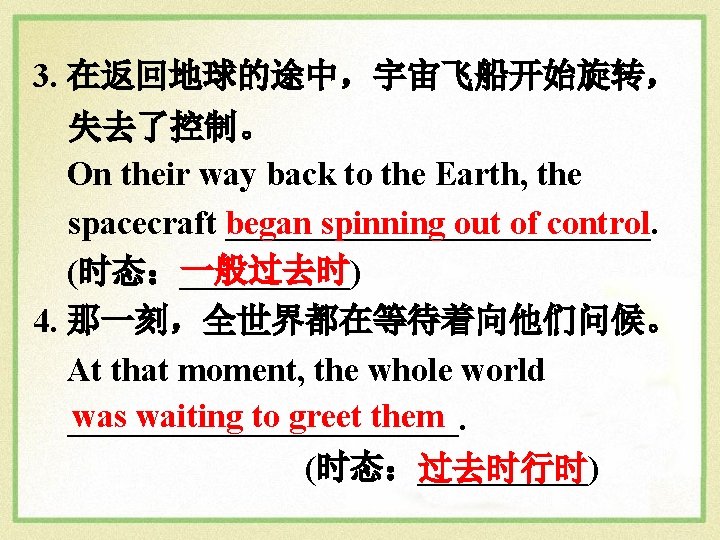
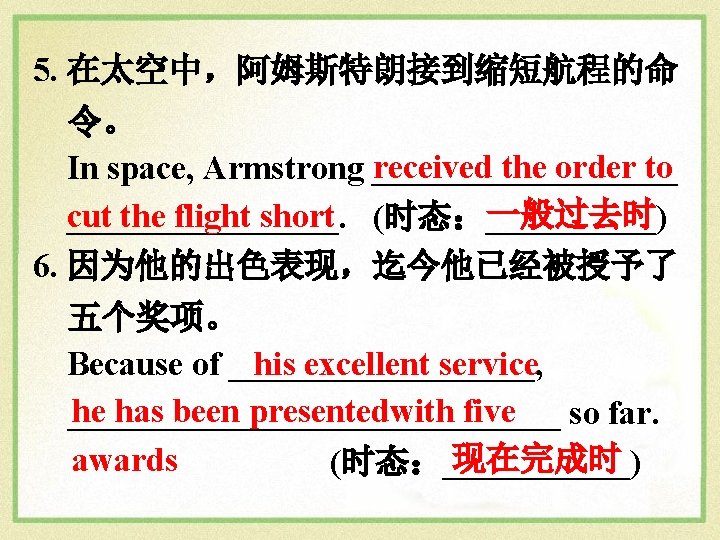
Translate the following sentences and tell what tense is used in each sentence. 1. 他总是设法独自做每一件事。 He always _____________ manages to do everything by 一般现在时 ______. (时态:_____) himself 2. 宇航员们目前为下一次飞行做准备。 are preparing for the next The astronauts ___________ flight at present. (时态:______) 现在进行时 ______
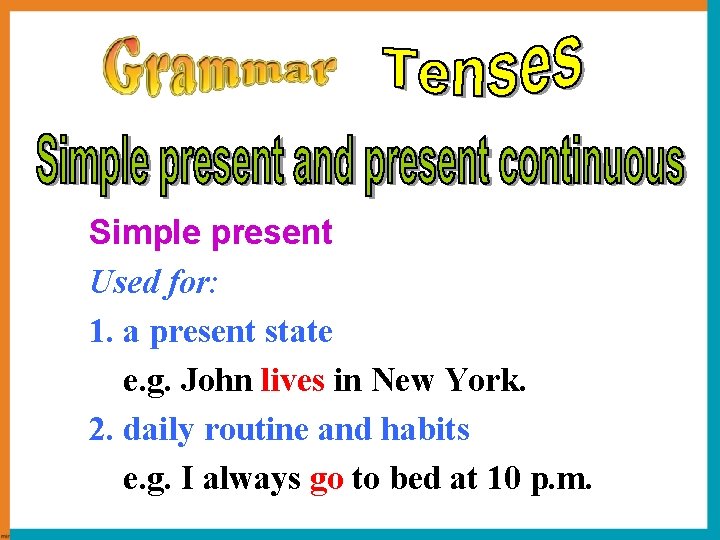
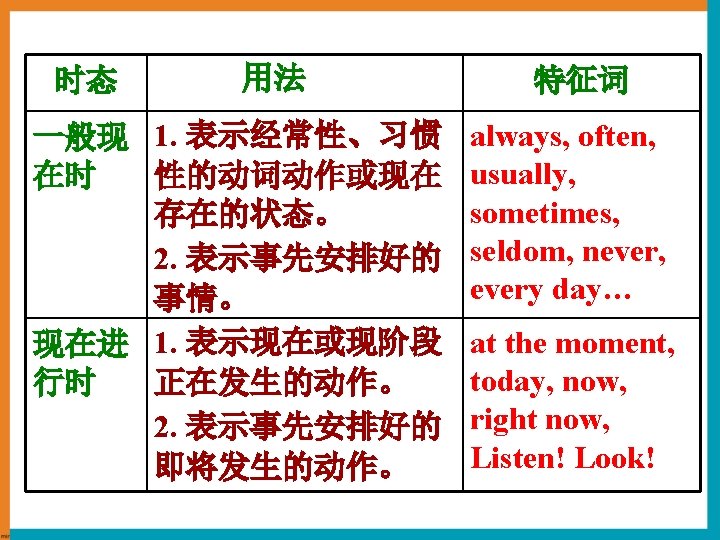
Simple present Used for: 1. a present state e. g. John lives in New York. 2. daily routine and habits e. g. I always go to bed at 10 p. m.
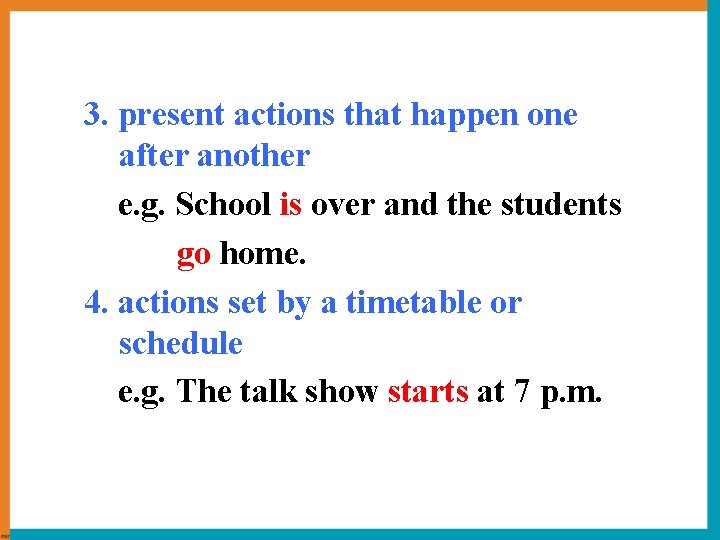
3. present actions that happen one after another e. g. School is over and the students go home. 4. actions set by a timetable or schedule e. g. The talk show starts at 7 p. m.
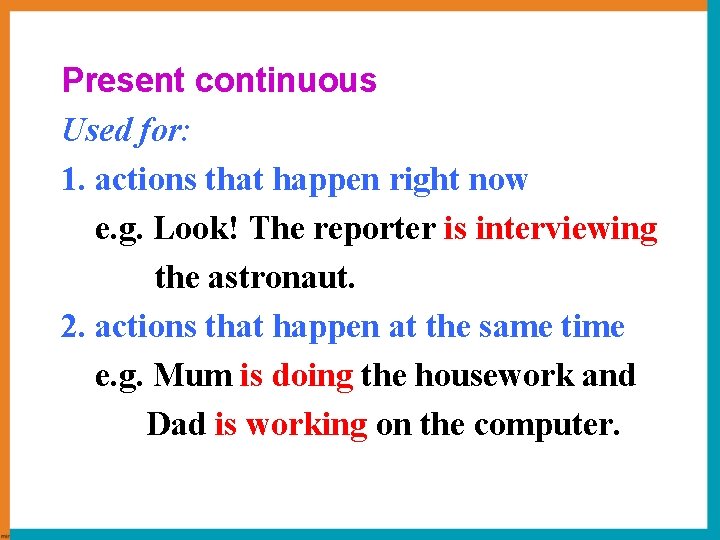
Present continuous Used for: 1. actions that happen right now e. g. Look! The reporter is interviewing the astronaut. 2. actions that happen at the same time e. g. Mum is doing the housework and Dad is working on the computer.
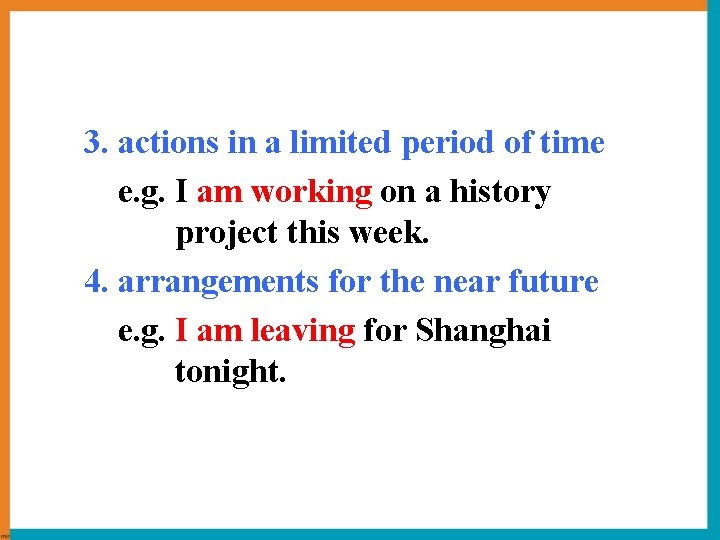
3. actions in a limited period of time e. g. I am working on a history project this week. 4. arrangements for the near future e. g. I am leaving for Shanghai tonight.
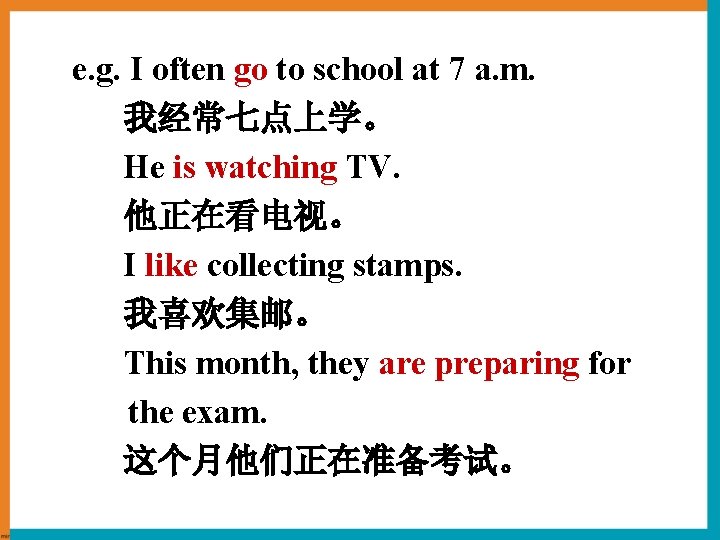
e. g. I often go to school at 7 a. m. 我经常七点上学。 He is watching TV. 他正在看电视。 I like collecting stamps. 我喜欢集邮。 This month, they are preparing for the exam. 这个月他们正在准备考试。
Millie is writing about what her family members are doing. Help her complete her article with the correct tenses of the verbs in brackets.
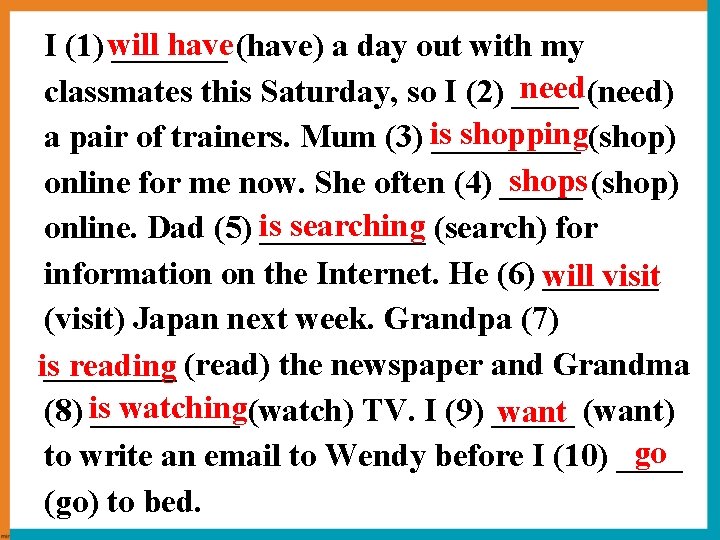
have (have) a day out with my I (1) will _______ need(need) classmates this Saturday, so I (2) ____ shopping(shop) a pair of trainers. Mum (3) is _____ shops (shop) online for me now. She often (4) _____ searching (search) for online. Dad (5) is _____ information on the Internet. He (6) will _______ visit (visit) Japan next week. Grandpa (7) is____ reading (read) the newspaper and Grandma watching(watch) TV. I (9) _____ (8) is _____ want (want) go to write an email to Wendy before I (10) ____ (go) to bed.
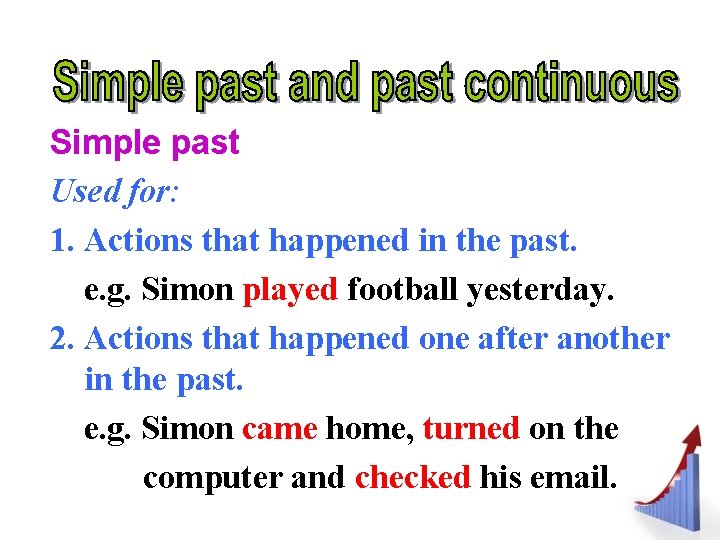
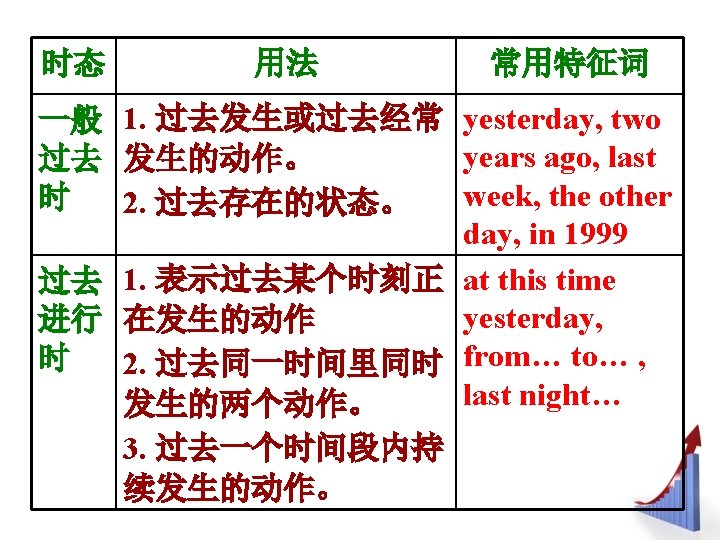
Simple past Used for: 1. Actions that happened in the past. e. g. Simon played football yesterday. 2. Actions that happened one after another in the past. e. g. Simon came home, turned on the computer and checked his email.
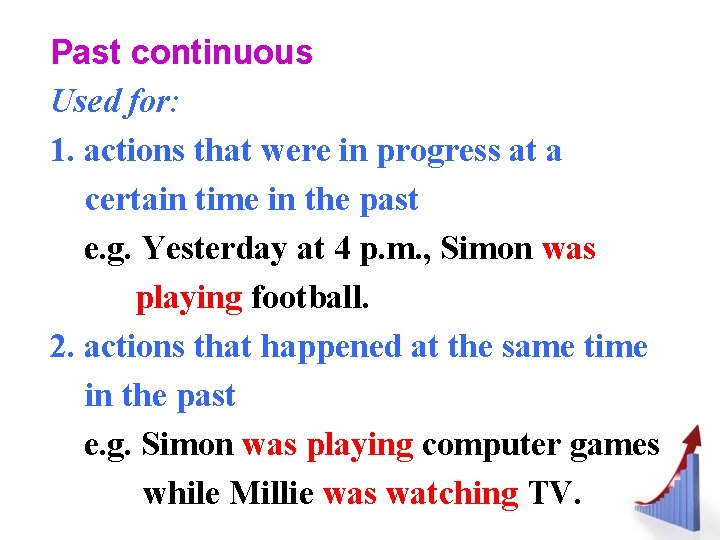
Past continuous Used for: 1. actions that were in progress at a certain time in the past e. g. Yesterday at 4 p. m. , Simon was playing football. 2. actions that happened at the same time in the past e. g. Simon was playing computer games while Millie was watching TV.
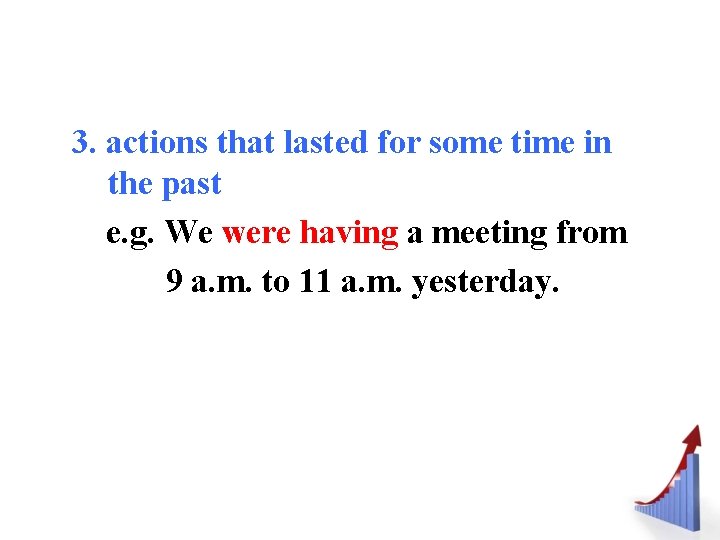
3. actions that lasted for some time in the past e. g. We were having a meeting from 9 a. m. to 11 a. m. yesterday.
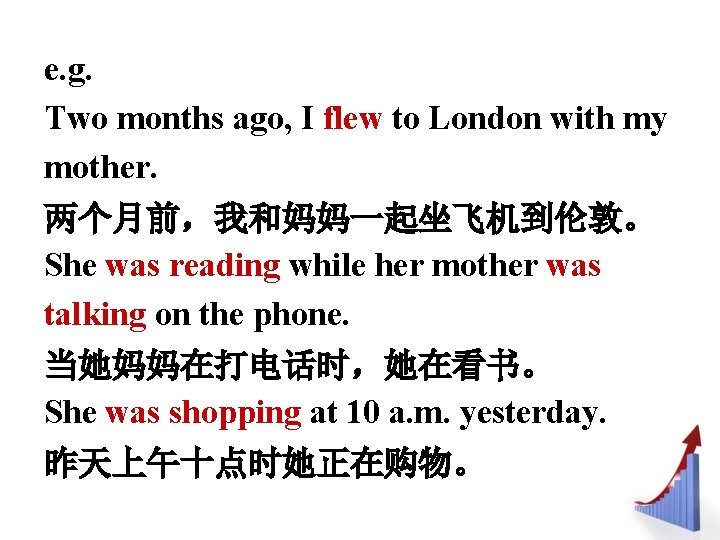
e. g. Two months ago, I flew to London with my mother. 两个月前,我和妈妈一起坐飞机到伦敦。 She was reading while her mother was talking on the phone. 当她妈妈在打电话时,她在看书。 She was shopping at 10 a. m. yesterday. 昨天上午十点时她正在购物。
Simon and his friends are talking about what they did after dinner last night. Complete their conversation with the correct tenses of the verbs in brackets.
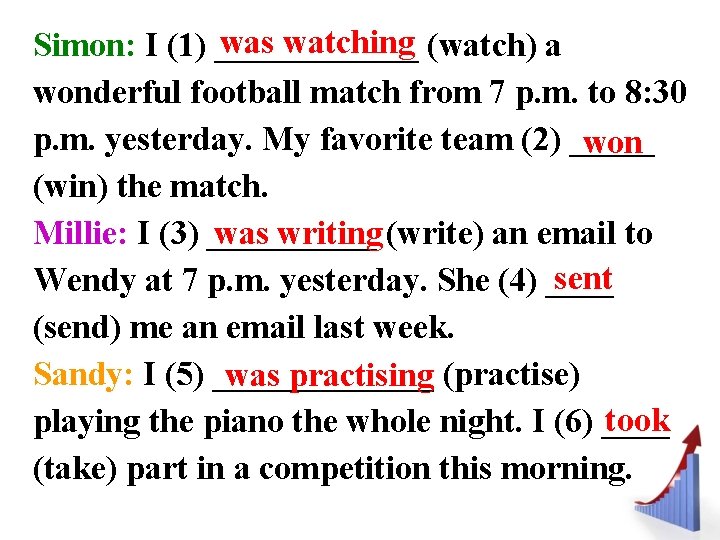
was watching (watch) a Simon: I (1) ______ wonderful football match from 7 p. m. to 8: 30 p. m. yesterday. My favorite team (2) _____ won (win) the match. Millie: I (3) _____ was writing (write) an email to sent Wendy at 7 p. m. yesterday. She (4) ____ (send) me an email last week. Sandy: I (5) _______ was practising (practise) took playing the piano the whole night. I (6) ____ (take) part in a competition this morning.
found (find) a Peter: Last night, I (7) ______ website about travelling in space. I (8) was reading (read) passages on the website ______ were playing (play) the piano, while you (9) ______ Sandy. n. 章节,乐段 was talking (talk) to Aunt Daniel: I (10) _____ Jane on the phone at 7: 30 yesterday evening. called (call) me the day before She (11) ______ was not (be not) at yesterday, but I (12) _______ home then.
Simple past Used for: 1. actions that happened in the past e. g. I bought a new bicycle yesterday. 2. actions that happened at a certain time in the past e. g. Kitty wrote an email to Linda an hour ago.
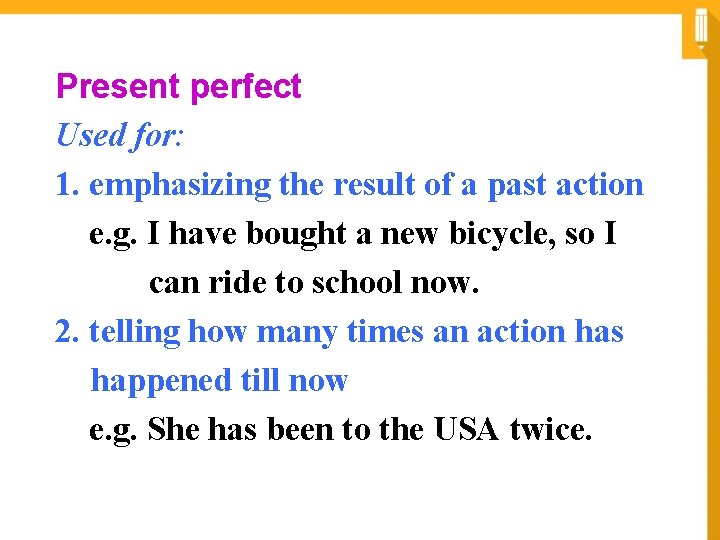
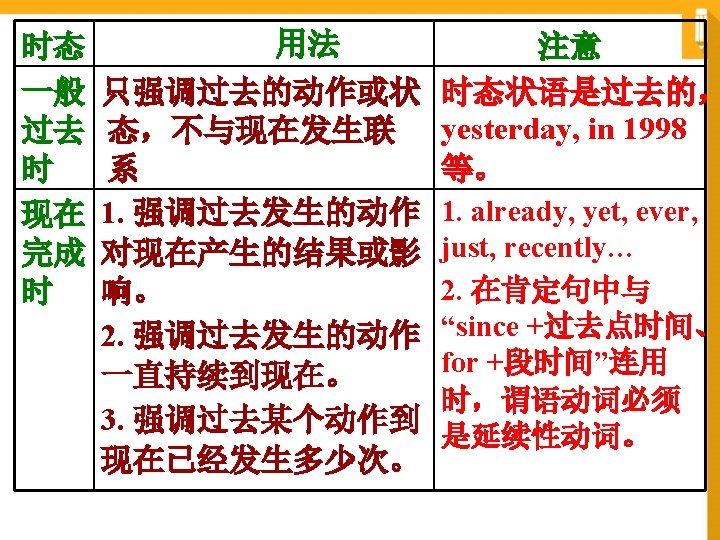
Present perfect Used for: 1. emphasizing the result of a past action e. g. I have bought a new bicycle, so I can ride to school now. 2. telling how many times an action has happened till now e. g. She has been to the USA twice.
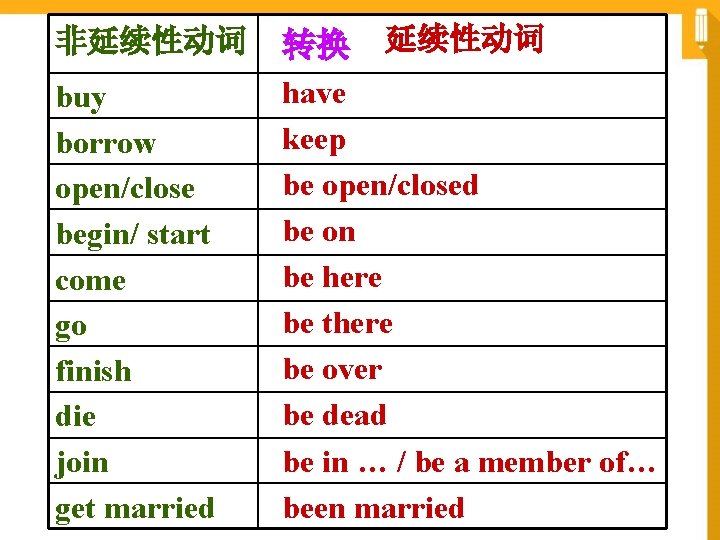
延续性动词 非延续性动词 转换 buy borrow open/close begin/ start come go finish die join get married have keep be open/closed be on be here be there be over be dead be in … / be a member of… been married
Millie is writing about some modern inventions that have changed the way we live. Help her choose the correct words in brackets to complete her article.
have made Many modern inventions (1) _____ (make/ have made) a great difference in have changed (changed/ out life. They (2) ______ have changed) the way we live. In ancient times, people (3) _____ used (used/ have used) salt to help them keep fish or meat for a longer time. Fresh food would go bad in summer in a few hours. The has solved (solved/ invention of fridge (4) _____ has solved) this problem.
washed (washed/ have In the past, people (5) _______ was 手 washed) their clothes by hand. It (6) ____ took (took/ (was/ has been) tiring, and it (7) _____ has taken) a lot of time. With the invention of have had the washing machine, people (8) _____ (had/ have had) more time to relax. travelled (travelled/ In the old days, people (9) ____ have travelled) by ship. Now planes (10) have made (made/ have made) journeys more _____ comfortable.
Remember the use of the six tenses in this lesson.