
Transitions in Narrative Writing For your Autobiographical Narrative
Transitions in Narrative Writing For your Autobiographical Narrative
Transition (noun) – a word, phrase, or passage that links one subject or idea to another in speech or writing

• Transitions = the “glue” that holds your story together. • There are six categories of transition words

Spatial Order • Words used in descriptive writing to signal spatial relationships • Examples: above, below, beside, nearby, beyond, inside, and outside
Time Order • Words used in writing narratives, and instructions to signal chronological sequence • Chronological (adj. )- presented or arranged in the order in which events occur or occurred • EXAMPLES: before, after, first, next, then, when, finally, while, as, during, earlier, later, and meanwhile
Numerical Order • Signals order of importance • EXAMPLES: first, second, also, finally, in addition, equally important, and more or less importantly
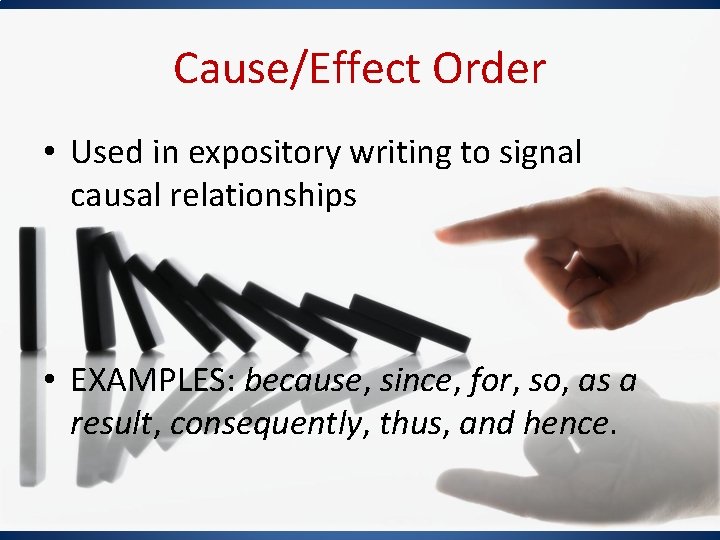
Cause/Effect Order • Used in expository writing to signal causal relationships • EXAMPLES: because, since, for, so, as a result, consequently, thus, and hence.
Compare/Contrast Order • Used to signal similarities and differences • EXAMPLES: (for similarities) also, additionally, just as, as if, as though, like, and similarly; and (for differences) but, yet, only, although, whereas, in contrast, conversely, however, on the other hand, rather, instead, in spite of, and nevertheless.
General/Specific Order • Used in descriptive reports and arguments to signal more specific elaboration on an idea • EXAMPLES: for example, such as, like, namely, for instance, that is, in fact, in other words, and indeed.
• Your autobiographical narrative should be in chronological (time) order.
Story Transitions • Narratives need transitions of time and place (a week later, sometime during the night, as we walked). • Connect all of the events in the narrative. • Help sequence the events in a clear and logical order. • Serve as a signal to readers that the character(s) will be doing something new.
Transitions often appear at the beginning of a paragraph. • When a change in the action takes place, it’s time to start a new paragraph. • When a change in the action takes place, it is also the perfect time to use a narrative transition. • However, transitions are not needed at every paragraph.
Think of narrative transitions as the frame of a story. Use them to point out the events and important action in the story.
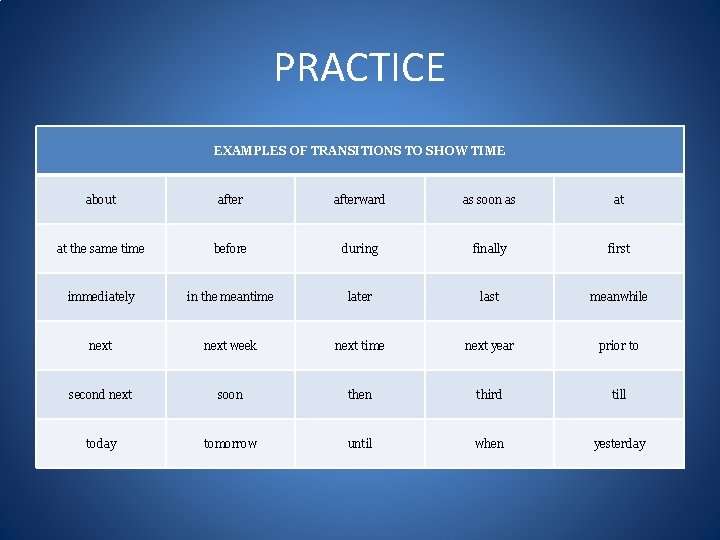
PRACTICE EXAMPLES OF TRANSITIONS TO SHOW TIME about afterward as soon as at at the same time before during finally first immediately in the meantime later last meanwhile next week next time next year prior to second next soon then third till today tomorrow until when yesterday
- Slides: 14