
Transitions and Sequencing Putting stuff in order by
Transitions and Sequencing Putting stuff in order by relationships and showing the reader the order and the relationships
Transition Words Structure 1. 2. 3. 4. Joins two complete sentences Joins two complete paragraphs Joins two parts of one sentence In the middle, but close to the beginning, of a sentence
Transition Words Always Go In Between ● ● Comma after the transition word I could write you a really good example. Instead, I’m going to write this.
1. Joins two Complete Sentences Complete Sentence. Transition word, complete sentence.
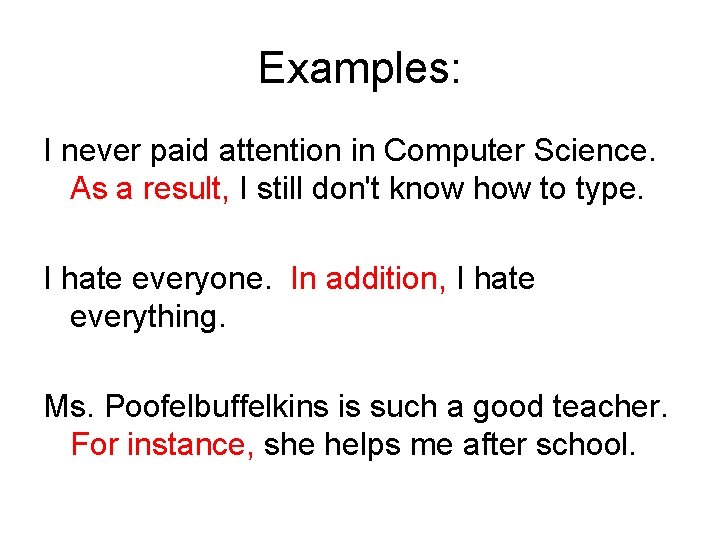
Examples: I never paid attention in Computer Science. As a result, I still don't know how to type. I hate everyone. In addition, I hate everything. Ms. Poofelbuffelkins is such a good teacher. For instance, she helps me after school.
2. Joins two complete paragraphs End of first paragraph. Transition Word, beginning of next paragraph.
Example: I’ve never liked kayaking. At the same time, I do like canoeing. It’s much more relaxing to me.
3. Joins Two Parts of One Sentence Independent Clause; Transition Word, Independent Clause. Remember the semicolon!
Example: Dogs are stupid; to illustrate, I submit my dog, Rover.
4. In the middle, but close to the beginning, of a sentence Beginning of Sentence, Transition Word, Rest of Sentence
Example: ● ● We worked hard for the Consumer Party candidates; however, we knew they didn’t stand a chance. We worked hard for the Consumer Party candidates; we knew, however, that they didn’t stand a chance.
Example: ● ● The campaign contributions we had been counting on simply didn’t materialize; in fact, the campaign was broke. The campaign contributions we had been counting on simply didn’t materialize; the campaign, in fact, was broke.
Shows Relationships ● ● ● Addition and Reinforcement Summary Result or Conclusion Contrast Concession
Addition and Reinforcement = to add more evidence to an argument This summer, I want to go swimming. I want to go to biking. Most of all, I want to go to the fair.
Example: I make sure I have time to read my novel each night; in the same way, I make time to meditate every morning.
Summary = to wrap up and condense an argument This summer, I want to go swimming. I want to go to biking. I want to go to the fair. Most of all, I just want it to be a great summer.
Example: It hasn’t rained in 100 days. The temperature is over 100 degrees. The DNR has imposed a total burning ban. In short, we are in severe drought.
Result = to make conclusions about an argument Cats are stinky. Cats poop in the house. Cats shed all over. For these reasons, I hate cats.
Example: We’ve had more over 100 degree days this summer than ever before in the 100 years climatologists have been tracking the weather. In conclusion, global warming is real.
Contrast = to show or acknowledge both sides of an issue or argument, to put them next to each other to see the similarities and differences I believe A. In contrast, you believe B. On the one hand, this is true. On the other hand, this other thing is also true.
Examples: I know you think I’m a super mean person; on the contrary, my family believes that I am helpful, polite, considerate, and kind. Twain uses satire in The Adventures of Huckleberry Finn, disguising the character of Huck as racist, thoughtless kid; however, Twain was strongly advocating against racism.
Concession ● ● Concession = to admit that the other side has some good or important points Uncle Tom’s Cabin helped inspire the country toward the abolishment of slavery and gave purpose to the Civil War. Nevertheless, Harriet Beecher Stowe displays some racist beliefs in the novel.
Example: I have always wanted to be an architect. Yet, I still struggle with the math requirements. I enjoy making model trains. Despite that, I think I’m a pretty cool kid.
- Slides: 23