
Transitioning to the New Massachusetts Curriculum Frameworks in
- Slides: 30
Transitioning to the New Massachusetts Curriculum Frameworks in ELA/Literacy and Mathematics Massachusetts Department of Elementary and Secondary Education and the Massachusetts Readiness Centers Scott R. Morrison, Manchester Essex Regional School District April 10, 2012 1
Prepared by Scott Morrison, Director of curriculum, Manchester-Essex Public Schools Adjunct faculty, Salem State University 2
Acronyms to Remember • CCSS – Common Core State Standards • CCR – College and Career Ready • PARCC – Partnership for Assessment of Readiness for College and Careers 3
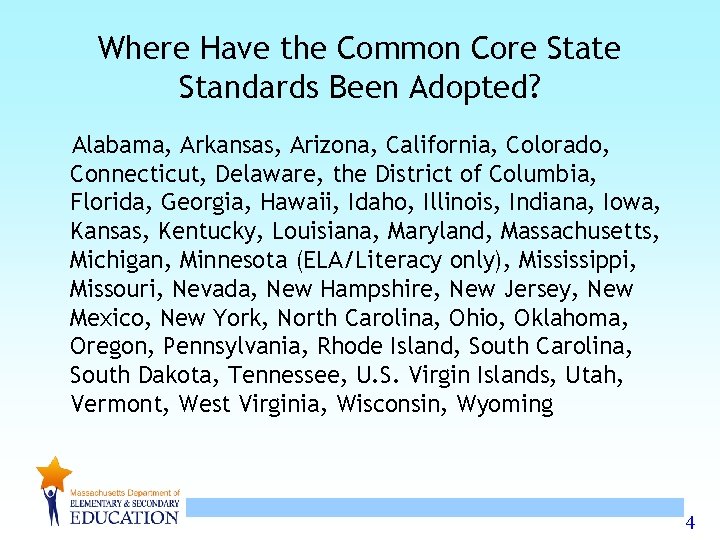
Where Have the Common Core State Standards Been Adopted? Alabama, Arkansas, Arizona, California, Colorado, Connecticut, Delaware, the District of Columbia, Florida, Georgia, Hawaii, Idaho, Illinois, Indiana, Iowa, Kansas, Kentucky, Louisiana, Maryland, Massachusetts, Michigan, Minnesota (ELA/Literacy only), Mississippi, Missouri, Nevada, New Hampshire, New Jersey, New Mexico, New York, North Carolina, Ohio, Oklahoma, Oregon, Pennsylvania, Rhode Island, South Carolina, South Dakota, Tennessee, U. S. Virgin Islands, Utah, Vermont, West Virginia, Wisconsin, Wyoming 4
Primary Intent of the New Frameworks The new ELA/Literacy and Math Curriculum Frameworks, comprised primarily of the Common Core State Standards, were written explicitly to define the knowledge and skills that students must master to be college and career ready by the end of high school. http: //www. doe. mass. edu/candi/commoncore/ 5
What is the College and Career Ready Threshold In Each of the Frameworks? ELA/Literacy Mathematics • In the ELA Framework there is a set of broad, College and Career Ready Anchor Standards for each of the areas of reading, writing, speaking/listening, and language. They anchor gradespecific standards in each of those areas. • The CCR Anchor Standards, working in tandem with the high school (9 -12) standards, define the CCR threshold (see pg 47 and on) • In the Mathematics Framework the CCR threshold is comprised of the high school standards that are not marked “+”. • Mastering those standards would prepare a student for a first-year, college creditbearing math course such as college algebra. • Mastering high school standards marked “+” would prepare a student for more advanced math courses than college algebra (see pg 73 -74) 6
ELA/Literacy 7
8
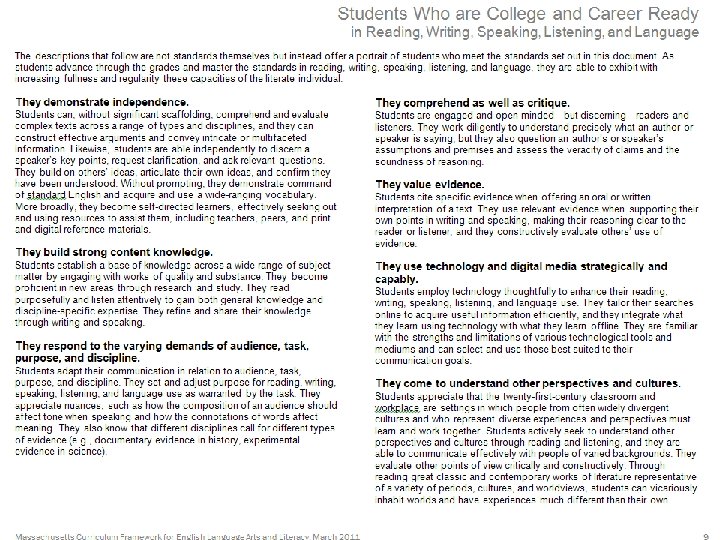
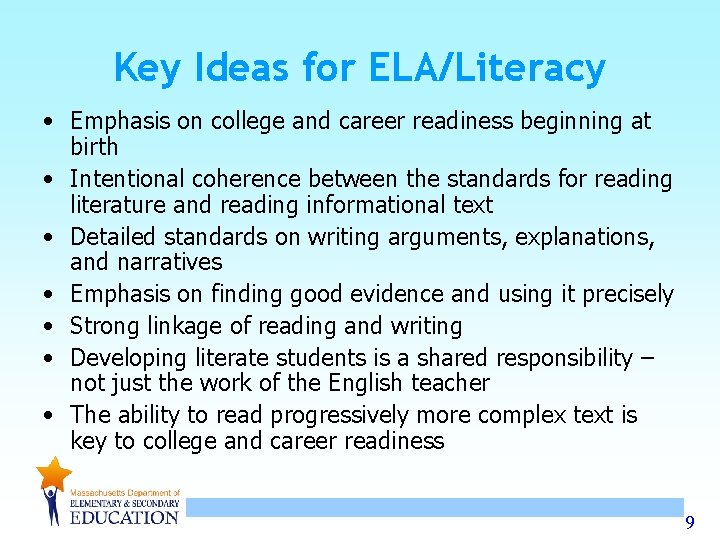
Key Ideas for ELA/Literacy • Emphasis on college and career readiness beginning at birth • Intentional coherence between the standards for reading literature and reading informational text • Detailed standards on writing arguments, explanations, and narratives • Emphasis on finding good evidence and using it precisely • Strong linkage of reading and writing • Developing literate students is a shared responsibility – not just the work of the English teacher • The ability to read progressively more complex text is key to college and career readiness 9
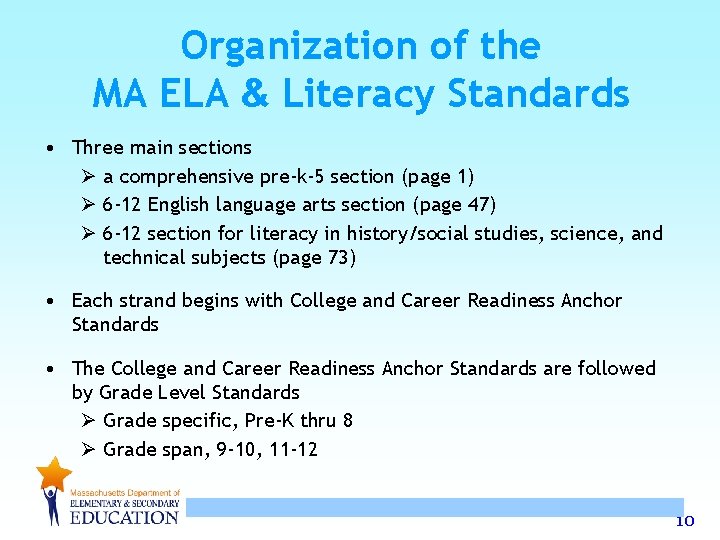
Organization of the MA ELA & Literacy Standards • Three main sections Ø a comprehensive pre-k-5 section (page 1) Ø 6 -12 English language arts section (page 47) Ø 6 -12 section for literacy in history/social studies, science, and technical subjects (page 73) • Each strand begins with College and Career Readiness Anchor Standards • The College and Career Readiness Anchor Standards are followed by Grade Level Standards Ø Grade specific, Pre-K thru 8 Ø Grade span, 9 -10, 11 -12 10
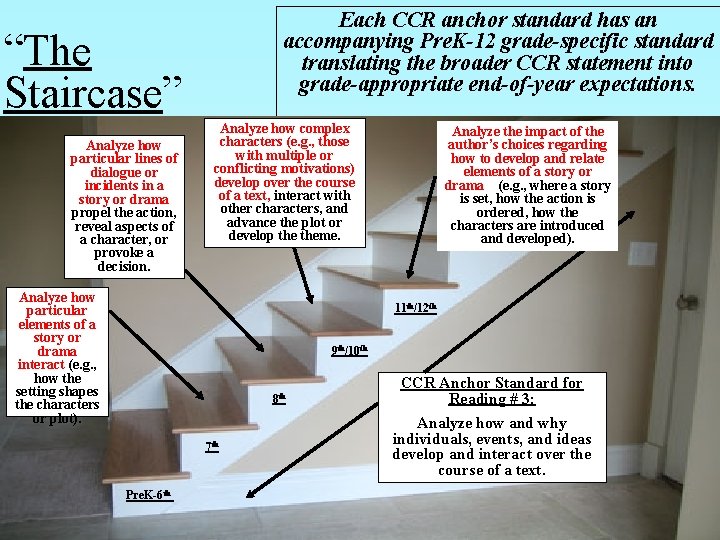
Each CCR anchor standard has an accompanying Pre. K-12 grade-specific standard translating the broader CCR statement into grade-appropriate end-of-year expectations. “The Staircase” Analyze how particular lines of dialogue or incidents in a story or drama propel the action, reveal aspects of a character, or provoke a decision. Analyze how complex characters (e. g. , those with multiple or conflicting motivations) develop over the course of a text, interact with other characters, and advance the plot or develop theme. Analyze how particular elements of a story or drama interact (e. g. , how the setting shapes the characters or plot). Analyze the impact of the author’s choices regarding how to develop and relate elements of a story or drama (e. g. , where a story is set, how the action is ordered, how the characters are introduced and developed). 11 th/12 th 9 th/10 th 8 th 7 th CCR Anchor Standard for Reading # 3: Analyze how and why individuals, events, and ideas develop and interact over the course of a text. Pre. K-6 th 11
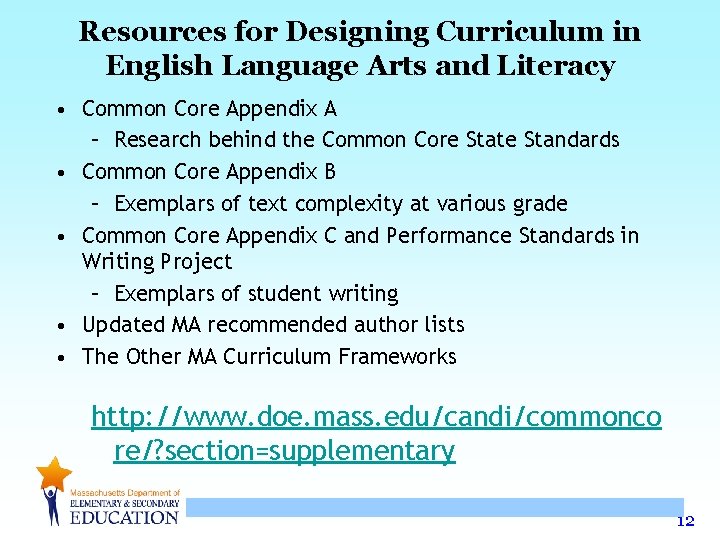
Resources for Designing Curriculum in English Language Arts and Literacy • Common Core Appendix A – Research behind the Common Core State Standards • Common Core Appendix B – Exemplars of text complexity at various grade • Common Core Appendix C and Performance Standards in Writing Project – Exemplars of student writing • Updated MA recommended author lists • The Other MA Curriculum Frameworks http: //www. doe. mass. edu/candi/commonco re/? section=supplementary 12
MATH 13
Pre-K-8 Math Standards Progression Provides a Strong Foundation for Algebra – Focus on place value, operations, and fractions in early grades – Increased attention to proportionality, probability and statistics in middle grades – In depth study of linearity and introduction of functions in Grade 8 Focus Coherence Clarity Rigor 14
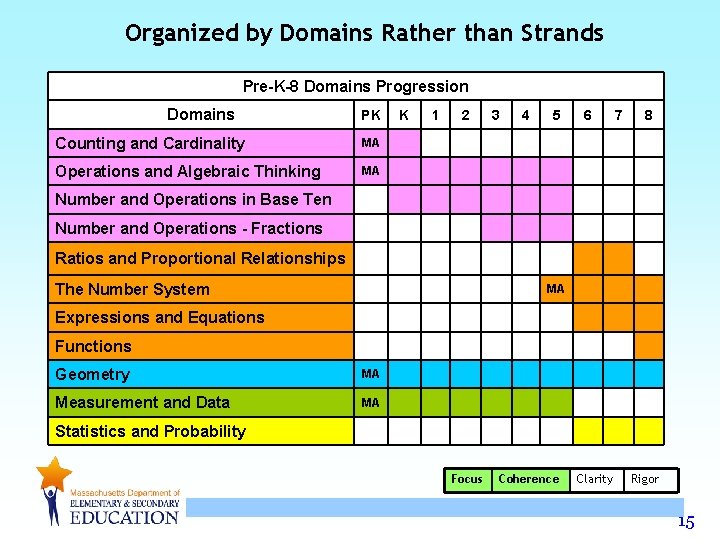
Organized by Domains Rather than Strands Pre-K-8 Domains Progression Domains PK Counting and Cardinality MA Operations and Algebraic Thinking MA K 1 2 3 4 5 6 7 8 Number and Operations in Base Ten Number and Operations - Fractions Ratios and Proportional Relationships The Number System MA Expressions and Equations Functions Geometry MA Measurement and Data MA Statistics and Probability Focus Coherence Clarity Rigor 15
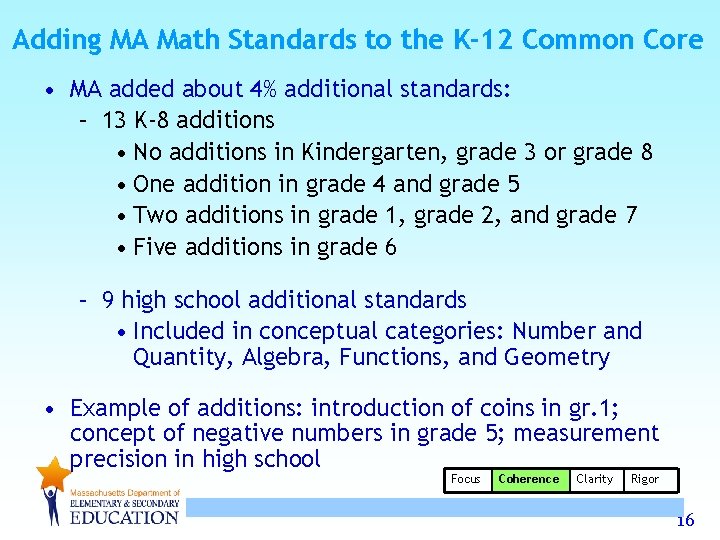
Adding MA Math Standards to the K-12 Common Core • MA added about 4% additional standards: – 13 K-8 additions • No additions in Kindergarten, grade 3 or grade 8 • One addition in grade 4 and grade 5 • Two additions in grade 1, grade 2, and grade 7 • Five additions in grade 6 – 9 high school additional standards • Included in conceptual categories: Number and Quantity, Algebra, Functions, and Geometry • Example of additions: introduction of coins in gr. 1; concept of negative numbers in grade 5; measurement precision in high school Focus Coherence Clarity Rigor 16
17
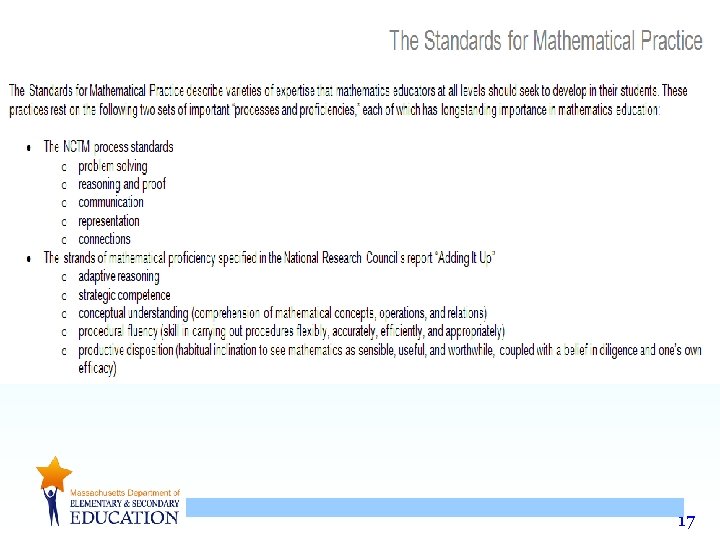
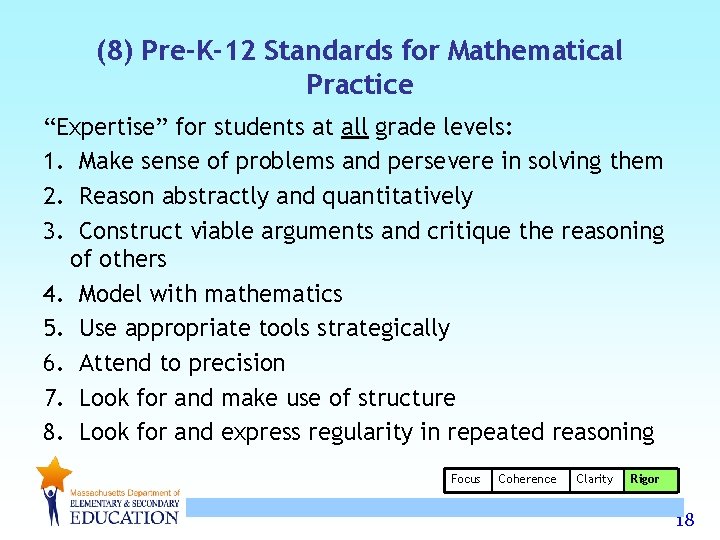
(8) Pre-K-12 Standards for Mathematical Practice “Expertise” for students at all grade levels: 1. Make sense of problems and persevere in solving them 2. Reason abstractly and quantitatively 3. Construct viable arguments and critique the reasoning of others 4. Model with mathematics 5. Use appropriate tools strategically 6. Attend to precision 7. Look for and make use of structure 8. Look for and express regularity in repeated reasoning Focus Coherence Clarity Rigor 18
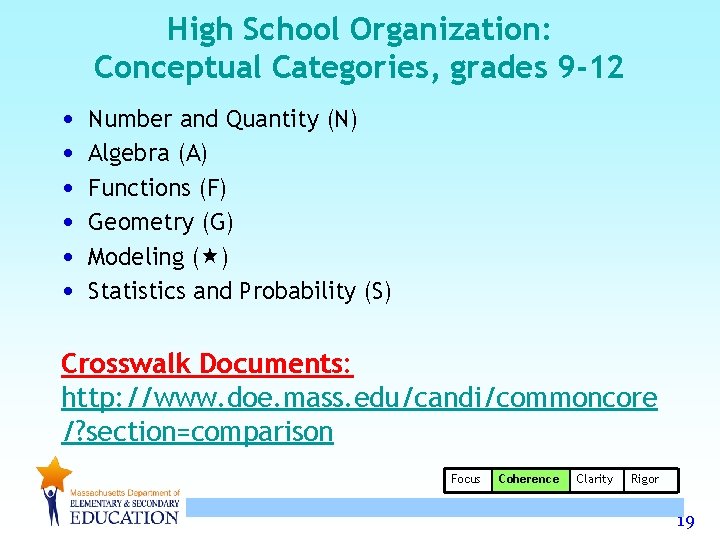
High School Organization: Conceptual Categories, grades 9 -12 • • • Number and Quantity (N) Algebra (A) Functions (F) Geometry (G) Modeling ( ) Statistics and Probability (S) Crosswalk Documents: http: //www. doe. mass. edu/candi/commoncore /? section=comparison Focus Coherence Clarity Rigor 19
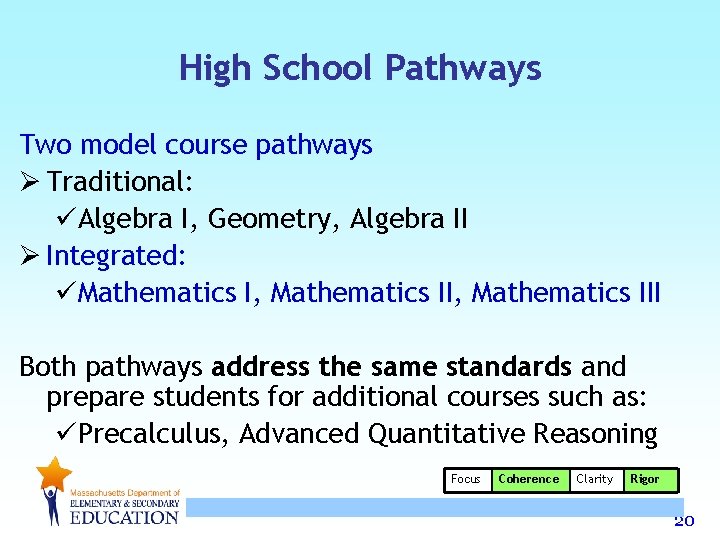
High School Pathways Two model course pathways Ø Traditional: üAlgebra I, Geometry, Algebra II Ø Integrated: üMathematics I, Mathematics III Both pathways address the same standards and prepare students for additional courses such as: üPrecalculus, Advanced Quantitative Reasoning Focus Coherence Clarity Rigor 20
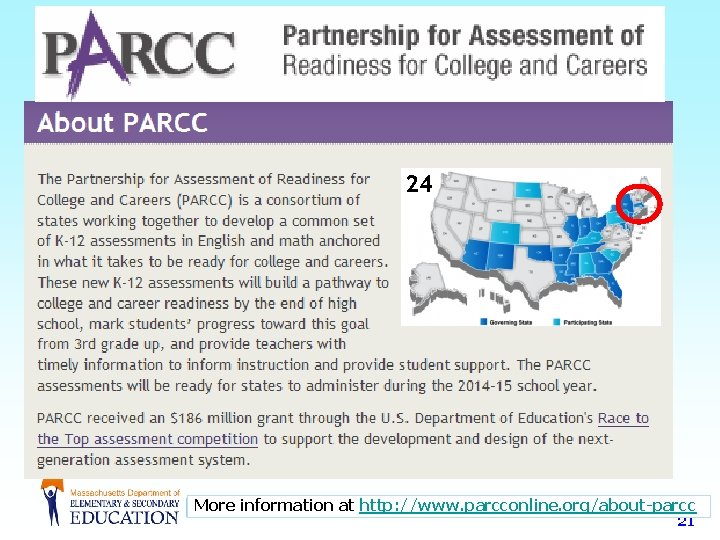
24 21 More information at http: //www. parcconline. org/about-parcc 21
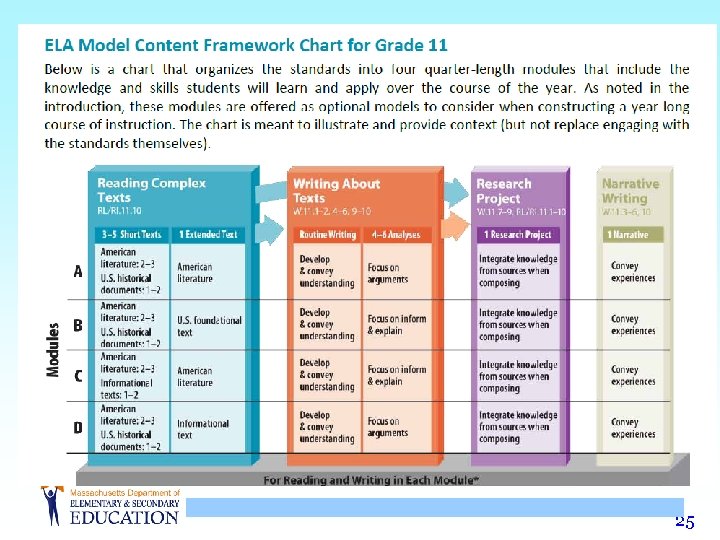
• The PARCC Model Content Frameworks were developed through a state-led process that included mathematics and ELA/literacy content experts in PARCC member states and members of the Common Core State Standards writing team. • The Model Content Frameworks are voluntary resources offered by PARCC to help curriculum developers and teachers as they work to implement the standards in their states and districts. 22
(over the next 3 years) • More than an assessment: a suite of tools to support teaching and learning—content frameworks, model instructional units, sample assessment tasks, professional development modules • Leadership training for educators in the use of PARCC materials • Focus on measuring whether students are on track for college and careers readiness • Will leverage use of technology 23
New Resources for ELA/Literacy Current • 2011 MA Curriculum Framework for English Language Arts and Literacy and PARCC Model Content Frameworks in ELA/Literacy Grade by grade standards pre-K to 12 Guidance for designing coherent curricula • Achieve Implementation Workbook Guide for creating a comprehensive transition plan for curriculum, instruction, and assessment • National PTA Guides to Student Success for Parents Coming • New Standards for English Language Learners http: //www. doe. mass. edu/candi/summit/WIDA. pdf#search=%22 WIDA%22 “WIDA” standards focus on the acquisition of academic vocabulary in ELA, math, science, social studies • Model curriculum units and performance assessments 100 pre-k to grade 12 extended instructional units with curriculum-embedded assessments in mathematics, science and technology/engineering, history/social science, and English language arts 24
25
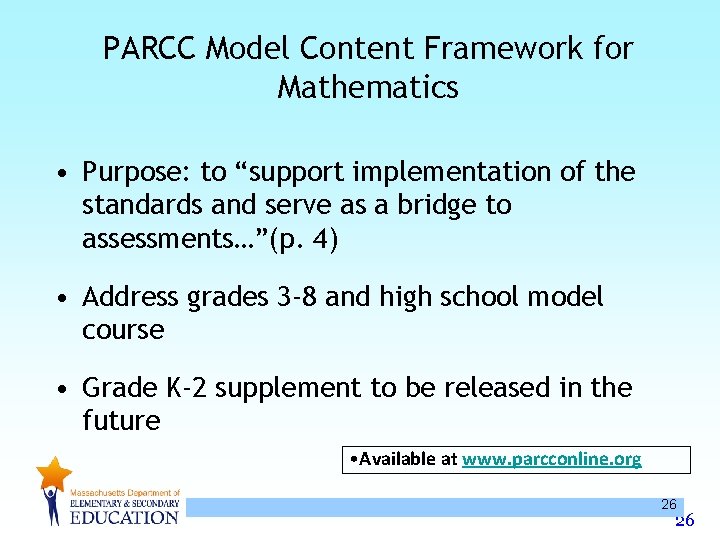
PARCC Model Content Framework for Mathematics • Purpose: to “support implementation of the standards and serve as a bridge to assessments…”(p. 4) • Address grades 3 -8 and high school model course • Grade K-2 supplement to be released in the future • Available at www. parcconline. org 26 26
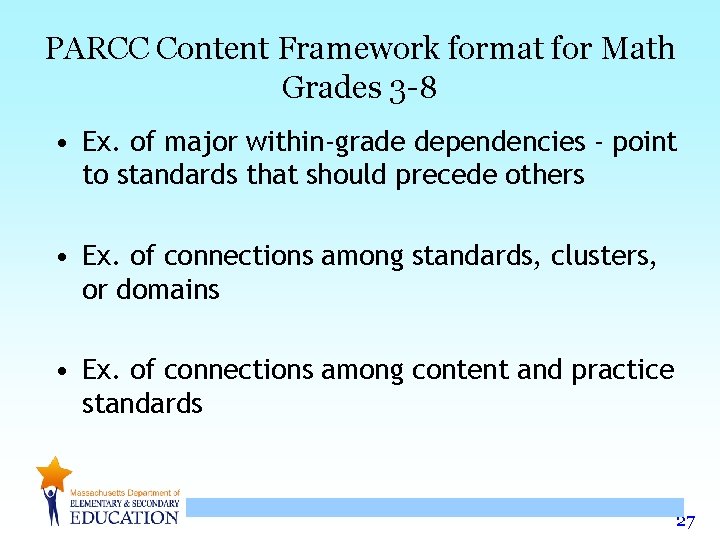
PARCC Content Framework format for Math Grades 3 -8 • Ex. of major within-grade dependencies - point to standards that should precede others • Ex. of connections among standards, clusters, or domains • Ex. of connections among content and practice standards 27
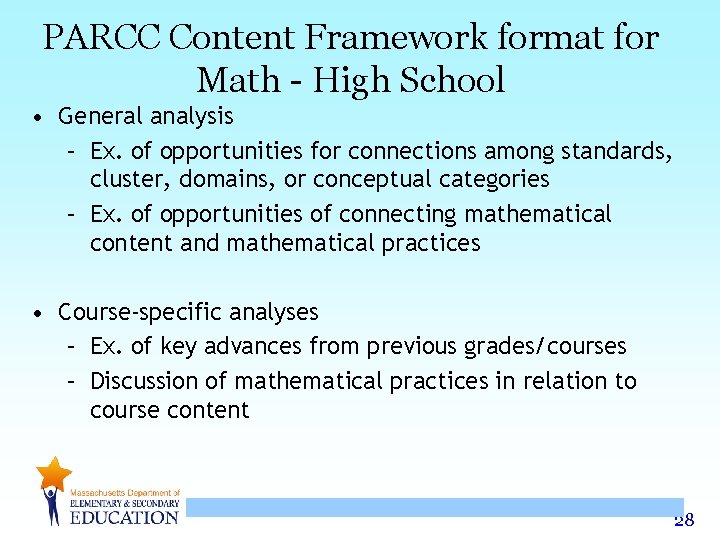
PARCC Content Framework format for Math - High School • General analysis – Ex. of opportunities for connections among standards, cluster, domains, or conceptual categories – Ex. of opportunities of connecting mathematical content and mathematical practices • Course-specific analyses – Ex. of key advances from previous grades/courses – Discussion of mathematical practices in relation to course content 28
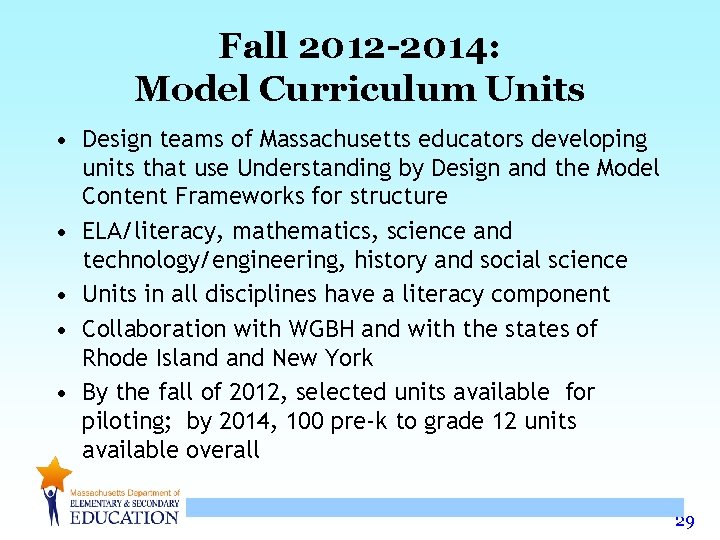
Fall 2012 -2014: Model Curriculum Units • Design teams of Massachusetts educators developing units that use Understanding by Design and the Model Content Frameworks for structure • ELA/literacy, mathematics, science and technology/engineering, history and social science • Units in all disciplines have a literacy component • Collaboration with WGBH and with the states of Rhode Island New York • By the fall of 2012, selected units available for piloting; by 2014, 100 pre-k to grade 12 units available overall 29
30